P-ISSN.2503-0817, E-ISSN.2503-0825
CrossMark
Abstract
Objective:This study aims to determine the role of gene polymorphism TGFα rs 1058213 in cases of cleft lip with or without cleft palate non-syndrome in the Riau Malay tribe.
Material and Methods: DNA extraction of venous blood and polymorphism TGFα rs 1058213 was assessed using the Restriction Fragment Length Polymorphism-PCR (RFLP-PCR) working method and followed by sequencing. Genotyping SNP rs1058213 in the TGFα gene was performed by the RFLP-PCR method in control and CLP NS
patients. The data was assessed using the test statistic premises T-test difference test.
Results:The total sample size included 68 samples consisting of 34 CLP NS samples and 34 control samples. The cases of CLP NS occurred more in men than women, 20 cases (59%) and 14 cases (14%), respectively.
Conclusion:There was no significant difference between TGFα rs 1058213 gene polymorphisms in CLP NS and controls in the Riau Malay tribe.
Masrial1*, Yanwirasti2, Sumaryati Syukur3, Endang Syamsudin4
Introduction
Cleft lip, with or without a cleft palate, is a congenital defect that is still very often encountered and is a congenital defect in the most commonly seen on facial areas. Patients with cleft lip, with or without cleft palate, have some problems with the condition, such as aesthetic problems, food intake, speech and psychosocial problems. The incidence of congenital malformations ranges from 1:700 to 1:1000 births. Asia is the highest with 1:500 births, Africa is around 1:2000 births, and in Indonesia it is estimated to be around 1:700 births. Gorlin pointed out that the prevalence of non-syndrome cleft lip occurs 1 to 2 per 1000 births and it depends on the geographic location of the incidence.1-3
Cleft lip and palate are more common in men than women, whereas cleft palates are more common in women. The male/female ratio is 1.5-1.59:1 for cleft lip, 1.98-2.07:1 for cleft lip and palate, and 0.72-0.74:1 for cleft palate.2
Etiology of deformities cleft lip with or without a non-syndrome cleft palate (CLP NS) is caused by many factors that are the interaction between genetic factors and environmental factors. Genetic factors and/or environmental factors are suspected of having a role in the pathogenesis of CLP NS. Previous research has revealed that genes and environmental factors can act independently or in combination. Nutrition imbalances, such as vita-min B deficiency, folic acid, zinc (Zn), and vitavita-min A hypervitaminosis, have been reported as risk
factors for cleft lip and cleft palate. Likewise, tera-togenic substances such as cigarettes, pesticides, and other chemicals (alcohol, drugs) are also risk factors. Infectious diseases such as syphilis, rubella virus, cytomegalovirus, herpes, toxoplasma, and HIV are also reported to play a role.4
The TGFα gene is the first identified gene to play a role in the occurrence of CLP NS abnormality. This gene is a member of the epidermal family of growth factors. This gene plays a role in coding protein growth factor and secretion of proteins expressed in the palatal tissue. Several studies have proven not to find the role of TGFα in the case of CLP NS although there are also other studies that find the role of TGFα in different races. From several studies, TGF gene polymorphisms α rs 1058213 and rs 166975 have a significant role in the case of CLP NS.5
1Department of Biomedicine, Facul-ty of Medicine, Andalas UniversiFacul-ty, Padang, Indonesia
2Department of Anatomy, Faculty of Medicine, Andalas University, Padang, Indonesia
3Department of Chemistry, Faculty of Mathematics and Natural Sci-ences, Andalas University, Padang, Indonesia
4Department of Oral and Maxillofa-cial Surgery, Faculty of Dentistry, Padjadjaran University, Bandung, Indonesia
Analysis of gene polymorphisms TGFα rs 1058213 to
cleft lip cases with or without a non-syndrome
cleft
palate
in Riau Malay Ethnic
Keywords:Cleft lip, Malay Ethnic, TGFα
Cite this Article:Masrial, Yanwirasti, Syukur S, Syamsudin E. 2018. Analysis of gene polymorphisms TGFα rs 1058213 to cleft lip cases with or without a non-syndrome cleftpalate in Riau Malay Ethnic. Journal of Dentomaxillofacial Science 3(1): 32-36. DOI: 10.15562/jdmfs.v3i1.498
Based on this background, this study will analyze whether there is a difference in polymorphism of TGFα rs 1058213 between a CLP NS sufferer and a normal person in Riau Malay.
Material and Methods
This study was conducted on humans and the material used was venous blood. Before conducting the study, ethical approval was obtained from the Research Ethics Committee of the Faculty of Medicine, University of Riau.
The study sample is part of the population that meets the inclusion and exclusion criteria. Controls were taken from people who did not suffer from cleft lip, no ethnic melayu Riau native background and had no family history from cleft lip or palate. The number of samples taken was based on a 90% confidence level and 80% test power assuming that approximately 1 in 700 Indonesians suffer from cleft lip. While the difference of the proportion of writers set by 20% of the calculation using the formula above obtained the minimum sample size is 34 samples for CLP NS cases and 34 samples for controls.
The method of sampling is done in a consecutive manner where samples are taken sequentially. Each patient diagnosed with a congenital aberration is calculated as a sample with inclusion and exclusion criteria until the amount is met. This research collects data on TGFα rs 1058213 polymorphism with geno-typing SNP rs1058213 on TGFα gene done using the restriction fragment length polymorphism PCR (RFLP-PCR) method. The PCR reaction has a total
volume of 25 μL consisting of 0.2 μM deoxynucleo-side triphosphates (dNTPs); 100 ng genomic DNA; 1.25 U HotStarTaq DNA Polymerase and its buffer solution; and 1.5 μM primary forward rs1058213-F ( 5 ’ - G G AT T C C A G G C TATATAT T T C - 3 ‘ ) and 1.5 μM reverse primer rs10582131-R (5’-GACTGGTCCCCCTTTCATGG-3’). PCR was performed under the following conditions: initial denaturation at 95°C for 5 min, followed by 35 cycles of a series of processes comprising denaturation at 94°C for 1 min, annealing at 55°C for 30 seconds, and elongation at 72°C for 30 seconds. The PCR process concludes with the final elongation stage at 72°C for 10 minutes. The PCR product is 771 base pairs (bp). Furthermore, it is conducted based on the sequence method aimed to determine the polymorphism system and the nucleotide change from the sample set of PCR result. S e qu e nc -ing a n a l y s i s r e s u l t s f r o m bioinformatics are done qualitatively with the following stages; blast, to find out the va lidity of t he resu lts of s e q u e n c i n g analysis using blast on NCBI; multiple a l i g n m e nt , a s e q u e n c i n g D NA sequences with DNA derived from GenBank data.
Genomic DNA was isolated from a blood sample of 300 μL using the GB100 Geneaid Genomic DNA mini kit (Blood/cultured cell). DNA isolation was performed in accordance with the kit procedure which consisted mainly of the sample preparation stage, cell lysis stage, DNA binding stage, leaching stage, and the elution stage of DNA. The purity of DNA isolation is checked by using NanoDrop with the results attached to the attachment. After the process of editing, coding, processing, and clean-ing, the data was computationally processed to observe the polymorphism of the TGFα gene using a frequency table and to see the difference of variables between the 2 groups using a T-test.
Results
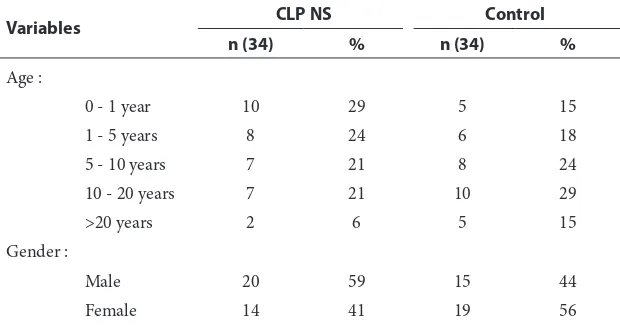
The total sample size was 68 samples consisting of 34 CLP NS samples and 34 control samples. The cases of CLP NS occur more in men than women with 20 cases (59%) and 14 cases (14%), respectively. Of the patients within the CLP NS sample, the lowest age was 4 months and the highest age was 32 years. The highest number of patients were aged 0-1 years (10 cases, 29%) and the lowest number of patients were more than 20 years old (2 cases, 6%), table 1. Table 1 Characteristics of research CLP NS cases based on age and
gender
The study population consisted of patients suffering fromor diagnosedwithcongenital abnormalities of cleft lip and palate. The participants were males and females with ethnic MalayRiau originalRiauwhocametopolyclinic oral surgery
Table 2 Primary and Restriction Enzymes for RFLP-PCR gene TGFα rs1058213
Primary
Name Primary Sequence DNA Fold
Size of Product PCR
Restriction
Enzymes Result of RFLP-PCR
TGFAHinfI-F 771 bp HinfI
(G^ANTC)
Alel CC: 771 bp
Alel CT: 771 bp + 582 bp + 189 bp
Alel TT: 582 bp + 189 bp
TGFAHinfI-R
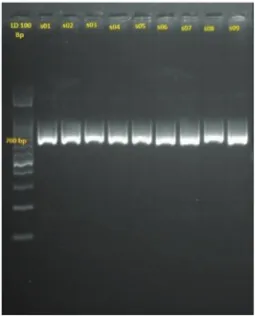
Figure 1 Electrophoregram result PCR rs1058213 gene TGFα, PCR product size 771 bp
The result of primary constructions for TGFα rs
1058213 can be seen in the table 2.
Primer didesain dengan bantuan software The PCR results were electrophoresed using a gelose of 1.5% which contained gelRed DNA colour and was visualized with GelDoc BioRad.
Figure 1shows the result of the main sequence of
TGFαHinfI-F 5’ to 3’
GGATTCCAGGCTATATATTTC and TGFαHinfI-R 5’ to 3’ GACTGGTCCCCCTTTCATGG with a product size of PCR 771 bp.
Based on the above results, both primary strands meet the criteria of a good primer. A further restriction was performed on several CLP NS and control samples using the restriction enzyme Hinf I. Restriction results were observed with electrophoresis using 2% agarose gel containing Gel DNA dye.
Figure 2 shows the electrophoregram inter-pretation of restriction results of rs1058213 with Hinf enzyme I. If only one DNA band of 771 bp
can be seen in table 3.
The RFLP-PCR results in the CLP NS group found that 19 people had TGFα rs 1058213 snp polymorphisms. There were homozygous muta-tions in 2 people (6%) and heterozygous mutamuta-tions in 17 people (50%). Polymorphism was also found in the control group consisting of homozygous visible figure 3. The sample sequencing results were analyzed bioinformatically with contig and BLAST (Basic Local Alignment Search Tool). Splitting the sequenced result data was done using the Genios Sample Alignment Process K17 (Confirmation with restriction result). Based on figure 3, it is evident There is no significant differences between patients with CLP NS and patients in the control group (p=0.166). However, in the CLP NS group, the TGFα rs 1058213 polymorphism is more prevalent than the control group (55.9%:44.1%).
Discussion
This study analyzes the relationship between allele polymorphisms of the TGFα gene that is in the allele rs 1058213 in CLB NS Malay Riau. In our data, we found that the CLB NS is more common in men than in women with 20 cases (59%) in men and 14 cases (14%) in women.
Table 3 Results RFLP-PCR gene TGFα rs 1058213
SNP
Allele
CLP NS Control
N % N %
rs1058213 TT 15 44 20 59
CC 2 6 5 15
CT 17 50 9 26
Total 34 34
Table 4 Differences in TGFα rs 1058213 polymorphism results between CLP NS and control group
Mutation Case Control p
Figure 3 Alignment of control case sequencing results with SNP motif TGFα rs 1058213
In this study, we tested the allele polymor-phism of TGFα rs 1058213. Unlike some studies conducted, the research on TGFα rs 1058213 in TGFα is a gene that plays a role in human growth factor. This gene has long been indicated to be involved in the occurrence of cleft lip cases. Lidral et al.6
from Iowa city in 2005, said TGFα is an influential gene in the formation of cleft lip.
In another study, Rajion et al.7
Conclusion
This study showed that there is not enough evidence that the TGFα rs 1058213 gene has a role in the incidence of CLP NS cases in the Riau Malay tribe. Nevertheless, further research is needed on all TGFα alleles to draw the conclusion that TGFα has an effect on the occurrence of CLP NS case in the Riau Malay tribe. In addition, it is also necessary to consider research with a larger sample of CLP NS patients in the Riau Malay tribe.
Ac
k
nowledgement
The study did not receive any financial support.
Conflict of Interest
The authors report no conflict of interest.
References
1. Verloes A. Updated diagnostic criteria for charge syndrome:
a proposal. Am J Med Genet A 2005;133: 306-308.
2. Mossey PA, Little J, Munger RG, et al. Cleft lip and palate.
Lancet 2009;374: 1773-1785.
3. Wahyuni A, Yunus M, Ruslin M. The difference uses of
panoramic photo and cbct evaluation of the gnathoplasty surgery outcome. J Dentomaxillofac Sci 2017;2: 110-113.
4. Malik NA. Textbook of oral and maxillofacial surgery.
JP Medical Ltd; 2012. p. 615-618.
5. Sull JW, Liang KY, Hetmanski JB, et al. Evidence that TGFA
influences risk to cleft lip with/without cleft palate through unconventional genetic mechanisms. Human Genetics 2009;126: 385-394.
6. Lidral AC, Moreno LM. Progress toward discerning the
genetics of cleft lip. Current Opinion Pediatrics 2005; 17: 731.
7. Rajion ZA, Alwi Z. Genetics of cleft lip and palate: a review.
Malay J Med Sci 2007;14: 4-9.
This work is licensed under a Creative Commons Attribution