of the elites in Muhammadiyah
1998-2010
Ridho Al-Hamdi
Department of Governmental Science, Universitas Muhammad iyah Yogyakarta
E-mail: ridhoalhamd [email protected]
Abstract
This study examines the roles of political elites in the Muhammadiyah in facing the dynamics Muslim politics in post New Order regime. There are three issues discussed: the emergence of Islamic political parties, the desire to implement the Jakarta charter as a state ideology, and the rise of terrorism. The result of the study demonstrated that there are four variants of the political attitudes of the elites in Muhammadiyah in post-New Order regime: 1) transformative-ideal-istic; 2) moderate-idealistic, 3) realistic-critical, and 4) accommodative-prag-matic. The variations are deeply influenced by two main factors: the sociological background and organizational factor.
3) realistis-kritis, dan 4) akomodatif-pragmatis. Variasi ini sangat dipengaruhi oleh dua faktor utama, yaitu latar belakang sosiologis dan faktor organisasi.
Keywords: Political attitudes; Muslim politics; Elites in Muhammadiyah; Terrorism
Introduction
Indonesia has reached its democratization at the end of the 1990s. It is part of what Huntington said as ‘the third wave of democratization’.1
The transition period began with the breakdown of authoritarianism on May 21st, 1998 and ended with the successful implementation of
suffi-ciently free and fair elections on October 20th, 1999. Meanwhile, the
consolidation of democracy was started after Abdurrahman Wahid (well known as Gus Dur) assumed the presidency in October 1999 notwith-standing his fragile backing in parliament.2
As the fourth most populous nation in the world – is also the world’s largest majority-Muslim country, Islam and politics in Indonesia are also of interest, because after years of sustained economic growth, this nation ranks as one of Asia’s political and economical giants.3 The
collapse of New Order regime in 1998 has had a wide political impact on the dynamics of Muslim politics. It can be seen from various phenom-ena such as the emergence of the Islam-based political parties, the demand to revive the Jakarta charter as the state principle, and also terrorism and violant actions organized by Muslim radical-extreme groups.
1 See, Samuel P. Huntington, The Third Wave: Democratization in the Late Twentieth
Cen-tury, Norman: University of Oklahoma Press, 1991.
2 Marco Bünte and Andreas Ufen, “The New Order and its Legacy: Reflections on Democra-tization in Indonesia”, in Marco Bünte and Andreas Ufen (Eds.), Democratization in Post-Soeharto Indonesia, New York: Routledge, 2009, 12-13.
These have caused heated debates and controversies among Muslim elites.
Historically speaking, the dynamics Muslim politics in Indonesia has started since the beginning of the national independence in 1945, par-ticularly in the debates between Muslim and nationalist groups on the state principle during the sessions of BPUPKI (Badan Penyelidik Usaha
Persiapan Kemerdekaan, Committee for Preparatory Work for
Indone-sian Independence) and PPKI (Panitia Persiapan Kemerdekaan Indo-nesia, Preparatory Committee for Indonesian Independence). The Muslims-nationalist group wanted to make Indonesia an Islamic state. Meanwhile, the secular-nationalists group maintained that Indonesia is a multi-religious nation, and therefore it must be a secular state which is characterized by the separation between the politics and religion.4
The debates between Muslim and nationalists groups took place for the second time after the 1955 election during the Constituent Assem-bly sessions. In fact, the members of the AssemAssem-bly failed to formulate a new constitution. It causes Soekarno issued presidential decree on June 5th 1959 to dissolve the Constituent Assembly, and reinstitution
the old 1945 Constitution. The Muslims found themselves failed to promote Islamist constitution for the second time.5
In another case, after the independence day of 1945, the Islamic communities agreed to establish an Islamist political party. Therefore, they hold a congress in Yogyakarta, 7-8 November 1945 and unani-mously agreed to establish Masyumi (Indonesian Muslims Consultation Council) as the only political party for Indonesian Muslim.6 The notion
4Endang Saifuddin Anshari, Piagam Jakarta 22 Juni 1945: Sebuah Konsensus Nasional tentang
Dasar Negara Republik Indonesia 1945-1949, Jakarta: Gema Insani Press, 1997, 27-28. 5 Ahmad Syafii Maarif, “Islam dan Konstitusionalisme: Pengalaman Indonesia”, in Prisma, No. Extra, 1984, 74-75.
was welcomed well by all of Muslim elites, including those of Muhammadiyah. Many activists of Muhammadiyah became function-aries in Masyumi such as Fakih Usman, Ki Bagus Hadikusumo, AR Sutan Mansur, Hamka, Ahmad Badawi, and Djindar Tamimy.7
In 1959, Masyumi was disbanded by Soekarno because of its al-leged involvement in a rebellion of PRRI/Permesta (Pemerintahan Revolusi Republik Indonesia/Perjuangan Semesta, Revolutionary Gov-ernment of the Republic of Indonesia/Semesta Struggle) in West Sumatera in the late 1950s. During New Order regime, former Masyumi leaders established a new Islamist party named Parmusi (Partai Muslimin Indonesia, Indonesian Muslims party). Nevertheless, it was short-lived. As a result of New Order policy, Parmusi and other Islam-based parties was fused into PPP on January 5th, 1973.
Moreover, after New Order regime, the dynamics of Muslim politics re-emerged into public spheres that were characterized, at least, by three phenomena. First is establishing a large number of Islam-based parties. To define the Islam-based party, this study divides it into two groups. On the one hand, Islam-based party is a party which adopts Islam as its ideological foundation and proposes the establishment of an Islamic state and the implementation of sharia (Islamic laws) in Indonesia, such as the Prosperous Justice Party (PKS), the United Development Party (PPP), and the Star Crescent Party (PBB). On the other hand, Islam-based party is a party which selects Pancasila8 as
their ideological base and introduces more secular platforms, such as
7 Deliar Noor, Partai Islam dalam Pentas Nasional 1945-1965, Jakarta: Grafiti, 1987: 102-111. See also, Tim Lembaga Pustaka dan Informasi PP Muhammadiyah, Profil Satu Abad Muhammadiyah. Yogyakarta: PP Muhammadiyah, 2010, 27-47.
the National Awakening Party (PKB) and the National Mandate Party (PAN).9
Second is the debate on the state principle in the parliamentary sessions. Some of Muslim communities desire to implement the Jakarta charter as the state principle of Indonesia. The charter is the source for the notion of Islamic state which contains of seven or eight words:
“…dengan kewajiban menjalankan syariat Islam bagi pemeluk-pemeluknya” (With the obligation for the professors of the Islamic faith to abide by the Islamic laws). This notion was vigorously reinforced by
Hizbut Tahrir (Freedom Party), Majelis Mujahidin (the Council of Jihad Fighters), Front Pembela Islam (Islamic Defender Front), and other local Muslim movements.
Third is terrorism deeds conducted by Muslim radicals in Indonesia, following the 9/11 terror attack in America 2001. They carried out at least four major terrorist attacks–in Bali in October 2002, and in Jakarta in August 2003, September 2004 and October 2005–which together have killed approximately 220 people and wounded several hundred more. The Bali bombings of 12 October 2002, remain the most lethal single terrorist since the September 11 attacks on the US and together with the August 5th, 2003 attack on the JW. Marriott hotel in Jakarta
had a devastating impact on Indonesia’s economy.10
These three phenomena would be scrutinized in this study through the opinions and thoughts of the elites in Muhammadiyah. Interest-ingly, these issues were controversial, and the attitudes of the elites in Muhammadiyah are not on the singular pattern. Thus, the debates
9 Mada Sukmajadi, How Islamic Parties Organize at the Local Level in Post-Suharto Indonesia:
An Empirical Study of Six Major Islamic Parties In The Tasikmalaya District, West Java Province, PhD Dissertation, University of Heidelberg, 2011, 10.
were not only between nationalists and Muslims, but also among Mus-lims particularly between essentialists group and formalist group.
Analytical framework
Islam and politics
The term of Islam cannot be separated from politics, because it is part of the way of religious propagation. On the one hand, Islam is a belief which has rapid development since seventh century. Islam became huge power of the world because of its holy teachings in al-Qur’an and al-Sunnah.11 On the other hand, politics is a practical matter which
correlates with power and state. In this sense, Islam and politics is one and a part of human activities to struggle power and territory.
Historically speaking, Islamic engagement in the political world was started when the Prophet of Muhammad saw. dominated Medina and Mecca. At the time, Muhammad was a symbol of power for Muslim society which succeeded to unite between Anshor group (Medina’s indigenous inhabitants) and Muhajirin group (immigrants). There were no hazardous conflicts among Muslim during Muhammad leadership, because all problems can refer to his utterances. Furthermore, the clash among Muslim took place after Muhammad dead. The next Muslim leadership handled by Khulafaurrasyidin (632-661 C).12 During
this period, critical clash and blood spillage were main heritage of Mus-lim politics. Three of four leaders in Islam were ended by murder. They are Umar bin Khattab, Utsman bin Affan, and Ali bin Abi Thalib.13
11 Al-Quran is the word of God revealed to the Prophet Muhammad while al-Sunnah is the Prophet Muhammad’s way of life.
12 Khulafaurrasyidin is Arabic term simply means four leaders in Islam after the Prophet of Mohammad saw. namely Abu Bakar Ash-Shiddiq, Umar bin Khattab, Utsman bin Affan, and Ali bin Abi Thalib.
The earliest form of the Islamic state was based in Medina, the next Muslim civilization moved into Damascus (Syria) under Umayyah Empire for less than one century (661-750 C). Moreover, after the failure of Umayyah Empire and the leadership was replaced by King of Abul Abbas, center of Muslim empire was shifted into Baghdad (Iraq) under Abbasiyah Empire during two centuries (750-950 C). During two these kingdoms, the main problem of Muslim society were competing to dominate the territory and power. Even during Ottoman Empire in Turkey for slightly above six centuries (1294-1924 C), the main agenda of Muslim leadership was occupying various countries through Asia, Africa as well as Europe. To sum up this section, Islamic history was taught us that the relationship between Islam and politics are the con-nection between power and occupying territory among itself Muslim.14
Theory on elites in Islam
The concept of the elite has some features. Firstly, elite is the chosen people which has small quantity. Secondly, elite has gigantic political power. Thirdly, elite can influence and direct social changes. Fourthly, elite is organized and structured group. Fifthly, elite can give directions to common people.15 Likewise, the elite can be defined as notable
people who have titanic power and significant roles in directing social changes.16 Afterward, in the context of Indonesia, employing Path
Dependence’s theory on historical institutionalism, the ruling elites can be classified into four categories.17
14 Ridho Al-Hamdi, Partai Politik Islam: Teori dan Praktek di Indonesia, Yogyakarta: Graha Ilmu, 2013, 2.
15 TB Bottomore, Elite dan Masyarakat, Jakarta: Akbar Tandjung Institute, 2006, 2. See also, Robert D. Putnam, “Studi Perbandingan Elit Politik” in Mochtar Mas’oed and Colin Mac Andrews,
Perbandingan Sistem Politik, Yogyakarta: GAMA Press, 2001, 80.
Table 1. The formation and circulation of Indonesian ruling elites
Source: Anis Baswedan (Kompas Daily, October 31st, 2006).
According to Baswedan, there are two methods in producing elites. First is recruitment of young generation. Second is the national major trend. The major trend continuously will adjust with reality. Meanwhile, young generation who took part and participated in the national trend, they are potential group to become the next ruling elites.
Meanwhile, elites in Islam can refer to the classification Javanese society into three groups namely abangan, santri, priyayi.18 Moreover,
elites in Islam can be symbolized by kyai (Muslim elders), ulama (reli-gious scholars, jurists), mubaligh (Islamic missionary, propagandist), and religious/Islamic teachers.19 After the downfall of Soeharto, ulama
are part of important elites who play vital roles in the political stage. Gus Dur from Nahdhatul Ulama and Amien Rais from Muhammadiyah are two main leaders during democratic era which became a symbol for Muslim political forces.20
More specifically, ulama should have three characteristics. First are having comprehensive knowledge, good quality in belief and attitudes,
18 Clifford Geertz, The Religion of Java, Chicago and London: University of Chicago Press, 1960, 5-6.
19 Abdul Munir Mulkhan, Perubahan Pola Perilaku dan Polarisasi Umat Islam 1965-1987, Jakarta: Rajawali Press, 1989, 17.
and useful charities. Second is having entire knowledge on Islamic studies such as aqidah (faith), moral, and Islamic laws. Third is having wide-ranging knowledge on practical and experimental sciences.21 Current
studies stated that ulama can be named as Muslim scholars which, at least, have three features. First is conducting in-depth analysis on social problems and development in order to become basic data to write articles, giving speeches in public discussions and conferences. Second is promoting critical thoughts by creating models of community development. Third is writing valuable works. Besides, this group per-petually disseminates previous Muslim scholars’ works both Western and Middle East.22
To identify elites in Muhammadiyah, the study develops Putnam’s three approaches. The first is positional approach. This method assumes that elites are who have highest position of organization. The second is reputational approach. They have no position in the structure, but they know organizational mechanisms. The third is decisional approach. This method stated that elites are who have power to influence and suc-ceeded to propose, endorse or reject any opinions and suggestions.23
Political attitudes of the elites in Islam
The term of “attitude” is way of thinking or behaving.24 In this sense,
the study concentrates on the political thoughts and opinions of the elites in Muhammadiyah in response to Muslim politics. To categorize political attitudes, it applies two extreme polar namely inclusive and exclusive. On the one hand, inclusive is emphasizing substance rather
21 PP Muhammadiyah, Berita Resmi Muhammadiyah (BRM), June 1995, 14-15.
22 M. Dawan Rahardjo, Intelektual, Intelegensia, dan Perilaku Politik Bangsa, Bandung: Mizan, 1996, 25-26, 66.
23 Robert D. Putnam, “Studi Perbandingan Elit Politik” in Mochtar Mas’oed and Colin Mac Andrews, Perbandingan Sistem Politik, Yogyakarta: GAMA Press, 2001, 91-94.
than symbol and it usually in the left position. One the other hand, exclusive is stressing symbol rather than substance and it frequently in the right position. This social cleavage represents the dynamics of Muslim politics in Indonesia.
Therefore, the study attempts to categorize the political attitudes of the elites in Islam into three models. As a matter of fact, these attitudes can experience mixture one another in order to gain a rel-evance conclusion.
Table 2. Classification of the political attitudes of the elites in Islam
Source: Compilation by the Writer.
This study will explore the definition for each attitude in order to obtain a comprehensive understanding. The totalistic, idealistic, and formalistic attitude stress that the-Quran and al-Sunnah are the only guidance for Muslim daily activities. Solution to overcome the problems in the social, economic and political fields should be based on the two Islamic fundamental sources. Meanwhile, the attitude of moderate and substantive underline their outlooks on the substance of Islamic teachings. Islam definitely has whole doctrines and principles in order to be transformed into different problems.25
25 M. Syafii Anwar, Pemikiran dan Aksi Islam Indonesia: Sebuah Kajian Politik Tentang
Cendikiawan Muslim Orde Baru, Jakarta: Paramadina, 1995, 144-183. See, Mansour Fakih,
Furthermore, the attitude of transformative stresses its attitudes on human values. Islamic teachings should be transformed into reality in order to liberate human from ignorance, injustice, and backward-ness. Besides, it should be written into scholar works to affect social changes. Afterward, the critical attitude highlights its views on problem solving by paying attention into the government system. Structural approach will help to identify injustice and misunderstanding in seeing a reality such as terrorism acts. Additionally, realistic attitude emphasizes the relationship between substantive meaning and realities. Islam should be understood into different meaning because of various cultures.26
Moreover, the accommodative attitude points up cooperation with other parties although it still gives critics toward injustice deeds. This attitude is flexible in coping with political dynamics. Last but not least, the pragmatic attitude has views that Muslim people should apply prac-tical ways in the poliprac-tical stage and leave idealistic outlooks. This atti-tude avoids personal and communal conflicts.27
Influential factors
Thereare various factors which influence political attitudes. This study focuses into two main factors. First is sociological factor. Individual background sociologically can be identified from his age, sex, educa-tion, occupaeduca-tion, citizenship, ethnics, networks, religious affiliaeduca-tion, or-ganizational experiences, family background, and life outlooks. In this sense, the study centers into four factors i.e. education, occupation, networks, and political orientation.28
26 M. Syaf’i Anwar, Pemikiran dan Aksi Islam Indonesia..., 144-183. 27 M. Syaf’i Anwar, Pemikiran dan Aksi Islam Indonesia..., 144-183.
Second is organizational factor. More specifically, this factor has three sub-factors. First is political culture in organization i.e. system of values which has close relationship with political decision. It was usually imple-mented in the organization. Second is political interest in organization. It is part of organizational target as a result of political process. Third is organizational policy. Each organization has official decrees in response to various things which have significant impacts to human life and its organization. Thus, a decision definitely passed the organizational agree-ment which has an impact that all stakeholders should obey the deci-sion.29
Research findings and arguments
This study focuses on the political attitudes of Muhammadiyah’s func-tionaries in response to Muslim politics. There are three issues being analyzed i.e. the Islam-based political party, the Jakarta charter, and
jihad and terrorism. The political attitudes are political thoughts and opin-ions of Muhammadiyah’s functionaries. Elites are minority group com-mands greater power and could be classified into three categories: posi-tional (who hold official positions in organizations), decisional (who have capability to make policies), and reputational (those who have creden-tials as leaders).30 Thus, in the case of Muhammadiyah, the elites are
cadres who officially hold leadership positions in the Central Board. They, at the same time, also have capacity to formulate policies and make decisions in the organization, as well command wide respect and creden-tials among Muhammadiyah members and supporters.
29 Miriam Budiarjo, Dasar-dasar Ilmu Politik. See, Firmanzah, Mengelola Partai Politik: Komunikasi
dan Positioning Ideologi Politik di Era Demokrasi, Jakarta: Yayasan Obor Indonesia, 2008: 52. See also, Haedar Nashir, Op.Cit: 53-54.
Who are elites in Muhammadiyah?
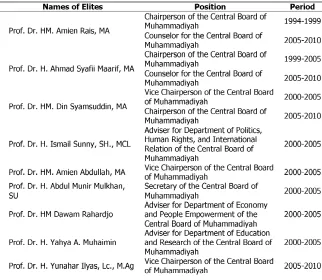
From 32 names which registered as official leaders in the Central Board of Muhammadiyah during 1998-2010, there are 12 names which are not classified as elites in this study. They are Sutrisno Muhdam, Rusydi Hamka, Ramli Thaha, Lukman Harun, Bambang Sudibyo, Anhar Burhanuddin, Rosyad Sholeh, Rahimi Sutan, Dasron Hamid, Zamroni, Husni Thoyar, and Fasich. It was caused by their position are not strategic, died, short period, and not much involved in the organization’s activities. Meanwhile, there are 20 names which classified as elites.
Source: Compilation by the Writer.
Variant of the political attitudes of the elites in Muhammadiyah31
Based on various references, interviews, and in-depth analysis on the political attitudes of the elites in Muhammadiyah in response to three main cases, the study eventually concludes that there are four
egories of the attitudes. They are transformatic-idealistic, moderate-idealistic, realistic-critical, and accommodative-pragmatic.
Transformative-idealistic
This group has a number of features. Firstly, they believed that each Islam-based party must solve social problems. Secondly, they were productive writers and active in the community empowerments. Socio-logically, they were academicians and social activists in several NGOs. Their thoughts occasionally became a controversial issue in public spaces. This study identifies some elites in Muhammadiyah: Syafii Maarif, Dawam Rahardjo, Munir Mulkhan, Amin Abdullah, Haedar Nashir, and Sudibyo Markus.
In the case of Islam-based party, they assume that all Islam-based parties should fight for people interest and civil rights such as solving poverty and backwardness, eradicating corruption, and reforming edu-cational systems. Therefore, this group underlines party’s performances for people rather than formalistic affairs.
Furthermore, in the case of Jakarta charter, this group obviously rejected the charter as a state principle. They believed that the plural-ity of Indonesian people needs a more accommodative principle. There-fore, the notion of the Islamic state should not be symbolized through the formalistic way, but it must be confined in personal domain.
Moderate-idealistic
This group has some features. Firstly, they believed that the Islam-based party is remains necessary, but it should be Islam-based on Al-Qur’an and As-Sunnah as a main Muslim doctrine. Secondly, they were not in extreme positions either right or left. Thirdly, they fundamentally re-jected any violence deeds in the name of Islam. Those in this group are Asjmuni Abdurrahman, Yunahar Ilyas, Muhammad Muqoddas, and Goodwill Zubir.
These elites sociologically work as lecturers in the college or univer-sity. They were experts in Islamic studies, and could be classified as
ulama. This group has paid the yearning of Muhammadiyah members
for the figure of ulama. They are typically engaging in the Council of
Tarjih and Tabligh –one of commissions in Muhammadiyah which is responsible to handle religious affairs and practices.
This group also believed that Islam-based parties were still needed to channel the political interests of Muslim community. In the case of Jakarta charter, this group disagreed with the notion of reviving the charter as a state principle although they do not expressive in doing so. Likewise, in the case of terrorist deeds, this group rejected any terrorist acts in the name of Islam.
Realistic-critical
Sociologically, they were lecturers as well as civil servants in the state institutes. Most of them were graduates from Western colleges. This group has close relationship with various segments in the society and helps them to solve their problems. Some of them even held governmental positions both in legislative and executive such as Amien Rais, Malik Fadjar, and Yahya Muhaimin.
In the case of Jakarta charter, they believed that the idea of Islamic state is not suitable with the plurality of Indonesian society. The verdict to create the charter as a state principle will affect conflicts which will be detrimental to the unity of the Republic of Indonesia. Political Islam should be promoted in noble and more accommodative ways. This group also rejected the violence acts conducted by terrorists. They believed that the terrorist deeds contradicted with entire values of
jihad. As a result, they prefer to disseminate prosperity oriented rather than religious symbolism. In addition, history has sounded that the political Islam is never victorious in the national politics.
Accommodative-pragmatic
This group has some features. Firstly, their attitude is cooperative and accommodative toward various interest groups. Secondly, they have inconsistent attitudes in reacting to Muslim politics. It seems that ideol-ogy is not significant for this group. It can be seen on the attitudes of Din Syamsuddin and Hajriyanto Y. Tohari.
In the various chances, Din and Tohari’s statements were inconsis-tent. On the one hand, Din stated that PAN must become the party of Muhammadiyah.32 On the other hand, when he was elected as the top
leader in Muhammadiyah, he said that Muhammadiyah has no special
relationship with any political parties including PAN.33 In addition, he
demonstrated publicly his reinforcement to the establishment of PMB (Partai Matahari Bangsa, the Nation Sun Party) as Muhammadiyah’s party. In the case of state principle, in one time, Din reinforced the implementation of the charter as the state principle.34 In the other
time, he rejected the application of the Islamic law in Indonesia.35
These evidences have illustrated their accommodative attitudes. This group wraps the issues of formalistic Islam and humanism for their pragmatic goals. Din desired to show himself as a reconciliative leader. Likewise, Latif (www.islamlib.com) also concluded that Din Syamsuddin was a politician and has interest-oriented thinking ways.
Influential factors
Inasmuch as there are some factors which influence the diversity of the political attitudes of the elites in Muhammadiyah, this study sup-posed two main factors namely sociological background and organiza-tional factor.
Sociological factor: There are four sociological factors which included here. First is educational factor. The difference of educational back-ground between those who have Islamic subject and those who have secular subject causes the different attitude among elites in Muhammadiyah. Elites who study Islamic subjects tend to show mod-erate-idealistic attitude while elites who study secular subjects tend to realistic-critical and transformative-idealistic attitude.
Second is professional factor. Most of elites in Muhammadiyah work as civil servants. It enables them to have close relation with various
33Jawa Pos, July 7th, 2005: 2.
34Republika, October 19th, 2010; www.tempointeraktif.com, November 5th, 2001.
groups in society. Consequently, they have equally open attitudes to all groups.
Third is relational factor. As an immense network, elites in Muhammadiyah enable to have wide connections with various groups. Each group definitely has different sociological background. Elites who held position in the governmental bureaucracy tend to have realistic attitudes. Furthermore, elites who held close relation with progressive groups in Islam and other religions tend to have transformatic atti-tudes. Moreover, elites who held close relation with the radical-textual communities in Islam tend to have moderate attitudes while elites who have close relation with all groups tend to exploit them for their inter-ests.
Fourth is political orientation factor. Each elite has different political orientations behind their statements. On the one hand, there are some elites purely involve in Muhammadiyah to promote religious propaga-tion to Muslim communities. On the other hand, other elites exploit Muhammadiyah as a proxy to obtain their political interests. Still others elites take advantages to enrich their personal needs through Muhammadiyah.
Organizational factor: There are three organizational factors which included here. First is organizational platform. Muhammadiyah seeks to achieve a real Islamic society (Masyarakat Islam yang Sebenar-benarnya
or MIYS). This platform has always become guidance for any
organi-zational activities. And there is a common understanding that Muhammadiyah is a civil organization which active at the societal and should not involve in any political activity and power struggle.
organiza-tion. They believed that the struggle for the public interests more important than struggle of power.
Third is historical lesson. History repeats it’s self repetitively. Elites in Muhammadiyah agree that they should continue the roles of previous leaders in Muhammadiyah in contributing to the public good. However some elites understand that elites in Muhammadiyah have to be in-volving in political activities. Meanwhile, others elites maintain that Muhammadiyah is a civil organization and it should keep a distance from political activities.
Conclusion
This study found the evidences that the charismatic leadership in Muhammadiyah does not work effectively. It can be seen by proof as explained in previous parts. Thus, the attitude in this study can be classified into four categories: Transformative-idealistic i.e. political atti-tudes which stress on Islam thoughts and humanity values in order to solve social problems; Moderate-idealistic i.e. political attitudes which believe that political Islam is the inevitably requirement. This attitude is not in extreme positions neither right nor left; Realistic-critical i.e. politi-cal attitudes which emphasize on the substantial values. They avoid formalistic ways as the tools of propaganda; Accommodative-prag-matic i.e. political attitudes which easily cooperate to everyone. It’s not in one of particular extreme attitudes. They always seek political op-portunities and attract all Islamic groups’ sympathy in order to gain popular supports.
official decrees, and historical lessons. Each factor basically has its own degree of in influencing elite’s attitude related to the political issues.
Bibliography
Books
Abuza, Zachary. Political Islam and Violence in Indonesia. New York: Routledge, 2007.
Al-Hamdi, Ridho. Partai Politik Islam: Teori dan Praktek di Indonesia. Yogyakarta: Graha Ilmu, 2013.
Anshari, Endang Saifuddin. Piagam Jakarta 22 Juni 1945: Sebuah Konsensus Nasional tentang Dasar Negara Republik Indonesia
1945-1949. Jakarta: Gema Insani Press, 1997.
Anwar, M. Syafii. Pemikiran dan Aksi Islam Indonesia: Sebuah Kajian Politik Tentang Cendikiawan Muslim Orde Baru. Jakarta: Paramadina, 1995.
Baswedan, Anis. “Siapakah Ruling Elite Indonesia?”, Kompas Daily, Oc-tober 31st, 2006.
Bottomore, TB. Elite dan Masyarakat. Jakarta: Akbar Tandjung Insti-tute, 2006.
Budiarjo, Miriam. Dasar-Dasar Ilmu Politik. Jakarta: Gramedia, 2007.
Bünte, Marco and Andreas Ufen. “The New Order and its Legacy: Reflections on Democratization in Indonesia” in Marco Bünte and Andreas Ufen (eds.), Democratization in Post-Soeharto Indone-sia. New York: Routledge, 2009.
Esposito, John L. Islam and Politics. New York: Syracuse University Press, 1984.
Feith, Herbert. The Decline of Constitutional Democracy in Indonesia.
Ithaca New York: Cornell University Press, 1962.
Firmanzah. Mengelola Partai Politik: Komunikasi dan Positioning Ideologi Politik di Era Demokrasi. Jakarta: Yayasan Obor Indonesia, 2008.
Geertz, Clifford. The Religion of Java. Chicago and London: University of Chicago Press, 1976.
Gross, Max L. A Muslim Archipelago: Islam and Politics in Southeast Asia. Washington DC: National Defense Intelligence College, 2007.
Hefner, Robert W. Civil Islam: Muslim and Democratization in Indone-sia. The United Kingdom: Princeton University Press, 2000.
Huntington, Samuel P. The Third Wave: Democratization in the Late
Twentieth Century. Norman: University of Oklahoma Press, 1991.
Jurdi, Syarifuddin. Muhammadiyah dalam Dinamika Politik Indonesia
1966-2006. Yogyakarta: Pustaka Pelajar, 2010.
Kartodirjo, Sartono. Elite dalam Perspektif Sejarah. Jakarta: LP3ES, 1981.
Maarif, Ahmad Syafii. “Islam dan Konstitusionalisme: Pengalaman In-donesia”, Prisma No. Extra, 1984 Th. XIII.
Mulkhan, Abdul Munir. Perubahan Pola Perilaku dan Polarisasi Umat Islam 1965-1987. Jakarta: Rajawali Press, 1989.
Nashir, Haedar. Perilaku Politik Elit Muhammadiyah. Yogyakarta: Tarawang, 2000.
Noor, Deliar. Partai Islam dalam Pentas Nasional 1945-1965. Jakarta: Grafiti, 1987.
Putnam, Robert D. “Studi Perbandingan Elit Politik” dalam Mohtar Mas’oed dan Colin Mac Andrews, “Perbandingan Sistem Politik”, in Mohtar Mas’oed and Colin Mac Andrews. Comparison of Political System.
Yogyakarta: GAMA Press, 2001.
Rahardjo, M. Dawan. Intelektual, Intelegensia, dan Perilaku Politik
Bangsa. Bandung: Mizan, 1996.
Sukmajadi, Mada. “How Islamic Parties Organize at the Local Level in Post-Suharto Indonesia: An Empirical Study of Six Major Islamic Parties In The Tasikmalaya District, West Java Province”, Ph. D Dissertation, University of Heidelberg, 2011.
Surbakti, Ramlan. Memahami Ilmu Politik. Jakarta: Grasindo, 1992.
Syamsuddin, M. Din, “Usaha Pencarian Konsep Negara dalam Sejarah Pemikiran Politik Islam”, Jurnal Ulumul Qur’an. No. 2 Vol. IV, Th. 1993.
Tim Lembaga Pustaka dan Informasi PP Muhammadiyah. Profil Satu
Abad Muhammadiyah. Yogyakarta: PP Muhammadiyah, 2010.
Archives, documents, and official decrees of Muhammadiyah
Badawi, Muhammad Djaldan. 95 Tahun Langkah Perjuangan
Muhammadiyah: Himpunan Keputusan Muktamar. Dokumentasi
Lembaga Pustaka dan Informasi PP Muhamamadiyah. Yogyakarta, 2005.
Panitia Pemilihan. Daftar Calon Sementara Anggota PP Muhammadiyah Periode 1995-2000.
Panitia Pemilihan. Daftar Calon Sementara Anggota PP Muhammadiyah Periode 2000-2005.
Panitia Pemilihan. Daftar Calon Tetap Anggota PP Muhammadiyah Periode 2010-2015.
PP Muhammadiyah. Laporan PP Muhammadiyah Periode 1995-2000 yang Disampaikan pada Muktamar ke-43 Muhammadiyah di Jakarta.
PP Muhammadiyah. Laporan PP Muhammadiyah Periode 2000-2005 yang Disampaikan pada Muktamar ke-44 Muhammadiyah di Malang.
PP Muhammadiyah. Berita Resmi Muhammadiyah, June 1995.
Newspapers and websites
Jawa Pos, July 7th 2005.
Jawa Pos, July 8th 2005.
Republika, October 19th 2001.
www.islamlib.com
www.tempointeraktif.com, November 5th, 2001
List of Interviewees
Abdul Malik Fadjar, interview in Yogyakarta.
Abdul Munir Mulkhan, interview in Yogyakarta.
Ahmad Dahlan Rais, interview in Surakarta.
Ahmad Rofiq, interview through Blackberry.
Asjmuni Abdurrahman, interview in Yogyakarta.
Haedar Nashir, interview in Yogyakarta.
M. Syukriyanto AR, interview in Yogyakarta.