Au st r alia
Aw ar d s
Sch o lar sh ip s
Po licy
Han d b o o k
Yo u m u st r ead t h is Sch o lar sh ip s
Po licy Han d b o o k car ef u lly an d
f u lly un d er st an d it s co n t en t s
b ef o r e sign in g t h e Co n t r act
w it h t h e Co m m o n w ealt h o f
Au st r alia.
Th e h an d b o o k is p r o vid ed t o an sw er an y q uest io n s yo u m ay
h ave ab o ut yo ur sch o lar sh ip . Please also r ead t h e o t h er in f o r m at io n
in yo ur p r e-d ep ar t ur e p ack an d f o llo w t h e in st r uct io n s car ef ully.
Fo r f ur t h er assist an ce, p lease co n t act DFAT at sch o lar sh ip s@d f at .go v.au
This work is copyright. Apart from any use as permitted under the Copyrights Act 1968, no part may be reproduced by any process without prior written permission from the Commonwealth. Requests and inquiries concerning reproduction and rights should be addressed to the Commonwealth Copyright Administration, Attorney-General’s Department, Robert Garran Offices, National Circuit, Barton ACT 2600 or posted at www.ag.gov.au
ISBN 1 920861 77 7
Co n t en t s
AUSTRALIA AWARDS SCHOLARSHIP CYCLE ... vii
GLOSSARY OF TERMS AND ACRONYMS ... 8
1. Australia Awards ... 11
1.1. Australia Awards Scholarships ... 12
1.2. How to use this scholarships policy handbook ... 12
1.3. Management responsibilities ... 14
2. Applying for an Australia Awards Scholarship ... 17
2.1. Eligibility criteria... 17
2.2. Country and regional profiles ... 18
2.3. English language requirements ... 18
2.4. Finding an appropriate course and institution ... 20
2.5. Types of courses available to applicants ... 20
2.6. Types of courses for which Australia Awards Scholarships are not available ... 22
2.7. Application process ... 23
3. Fraud ... 25
4. Selection ... 26
4.1. Selection process and criteria ... 26
4.2. Reintegration plans ... 27
4.3. Successful and reserve applicants ... 27
4.4. Advising applicants of selection outcomes ... 28
5. Placement ... 29
5.1. Request for placement and placement offers ... 29
5.2. Preparation programs ... 31
6. Accepting the scholarship and its conditions ... 33
6.1. Accepting the scholarship ... 33
6.2. Scholarship conditions ... 33
6.3. Child protection ... 37
6.4. Deferring an offer ... 37
7. Pre-departure ... 39
7.1. Pre-departure information ... 39
8. Visas ... 42
8.1. Visa requirements for awardees ... 42
8.2. Visa requirements for accompanying dependent family members ... 42
8.3. Visa requirements for awardees with disability ... 42
8.4. Visa requirements for the carer of an awardee with disability ... 43
8.5. Visa obligations ... 44
8.6. Applying for a further student visa (extension) ... 45
8.7. Two-year exclusion rule ... 45
8.8. Early completion of the scholarship ... 46
8.9. Post-scholarship externally funded program in Australia ... 46
8.10. Debt to the Commonwealth ... 47
9. Awardees with disability ... 49
9.1. Support for people with disability ... 49
9.2. Applicants with disability ... 49
9.3. Principles for providing disability support for Australia Awards Scholarship awardees ... 50
9.4. Assessing disability support needs... 50
9.5. Reasonable adjustments ... 53
10. Scholarship fees and entitlements ... 55
10.1. Summary of scholarship fees and entitlements ... 55
10.2. Establishment allowance ... 57
10.3. Contribution to living expenses ... 58
10.4. Overseas Student Health Cover ... 59
10.5. Visa costs ... 61
10.6. Conditions that apply to travel ... 61
10.7. Mobilisation travel ... 62
10.8. Reunion airfare ... 62
10.9. Completion travel ... 64
11. General support services ... 65
11.1. Standards for support services ... 65
11.2. Arrival in Australia ... 65
11.3. Accommodation ... 65
12. Academic support ... 68
12.1. Introductory Academic Program ... 68
12.2. Supplementary academic support ... 68
12.3. Fieldwork ... 69
12.5. Work attachments ... 71
12.6. Work experience ... 71
12.7. Academic progress ... 71
13. Variations to the terms of enrolment ... 74
13.1. Scholarship conditions and terms of enrolment ... 74
13.2. Withdrawals ... 75
13.3. Extensions ... 76
13.4. Suspensions ... 77
13.5. Transfers ... 79
13.6. Upgrades ... 80
13.7. Reductions ... 82
13.8. Entitlement variations ... 82
13.9. Terminations ... 83
14. Welfare Incidents ... 86
14.1. What is a Welfare Incident? ... 86
14.2. DFAT Notification and Procedure for Welfare Incidents ... 86
14.3. Principles for managing welfare incidents ... 87
14.4. Welfare Incident – General Responsibilities ... 88
14.5. Conflict, Harassment and Bullying ... 90
14.6. Health Issues and Scheduled Hospitalisations ... 91
14.7. Death of an awardee’s family member ... 92
14.8. Pregnancy ... 93
14.9. Referral to Counselling Services ... 93
14.10. Victim of Crime Overseas ... 94
14.11. Absent awardee ... 94
15. Critical incidents ... 95
15.1. What is a critical incident? ... 95
15.2. Role of Student Contact Officers ... 95
15.3. Notification of critical incidents ... 96
15.4. Principles for managing critical incidents ... 98
15.5. Critical incident response and management ... 99
15.6. Awardees who are victims of or charged with a crime in Australia ... 100
15.7. Unexpected or emergency hospitalisation of an awardee ... 101
15.8. Death of an Australia Awards Scholarship awardee ... 102
16. Natural Disasters ... 105
16.2. Natural disasters – Critical Incidents ... 105
16.3. Natural disasters – Welfare Incidents ... 105
16.4. Natural disasters in Australia ... 105
16.5. Natural disasters in an awardee’s home country ... 106
17. Return home ... 108
17.1. Finalisation of studies ... 108
17.2. Return home briefing ... 108
17.3. Final departure date ... 109
17.4. Remaining in Australia after the scholarship end date ... 109
17.5. Returning home due to illness or accident ... 110
17.6. Awardees who are unfit to travel ... 113
17.7. Finalisation and completion of a scholarship record in OASIS... 114
17.8. Requests for academic transcripts ... 114
18. Alumni ... 116
APPENDIX A: Proformas for reunion airfare travel ... 117
APPENDIX B: Scholarship fees and entitlements for Australian Leadership Awardees who commenced before 2012 ... 119
APPENDIX C: Critical incident report ... 120
AUSTRALIA AWARDS SCHOLARSHIP CYCLE
. DFAT (Scholarships and Alumni Branch & Program Areas)
Develop policy & guidelines
Establish desired program outcomes
Manage contracts with stakeholders
Develop and manage scholarship online systems
Incorporate feedback from alumni into program creation
Promotional activities
Liaise with partner governments to identify development objectives and capacity gaps and needs
Awardees
Submit application form
Short-listed applicants are interviewed
Scholarships and Alumni Branch Provide on-demand assistance to Program Areas for selection processes
DFAT Program Areas
Receive enquiries and applications
Conduct eligibility checks & shortlisting
Arrange selection processes
Check application documents
Request placements at institutions
Awardees accept offer
Notify institutions of awardees with disability/special needs
AWARDEE SELECTION PROGRAM
CREATION PROMOTION
Applicant
Applicants learn about Australia Award Scholarships through advertisement (employer, newspaper, radio, media releases etc.)
DFAT Program Areas
Conduct in-country promotion, targeting candidates in fields that
align with the country’s development
objectives
Institutions
Promote Australia Awards and relevant courses
Scholarships and Alumni Branch
Provide Program Areas with pre-departure materials
DFAT Program Areas
Notify applicants of selection outcomes
Arrange in-country language training, learning support and/or other assistance
Arrange awardees’ travel to
Australia, assist with health checks and liaison with the Departments of Immigration and Border Protection on visa
Work with institutions on requirements for awardees with disability/special needs
Provide pre-departure briefings
Institutions
Administer placement offers
PRE-DEPARTURE
Awardees
Arrive in Australia and undertake an Introductory Academic Program and commence their nominated course at host institution
Institutions
Assist awardees to become settled on arrival in Australia
Provide an Introductory Academic Program (up to 6 weeks)
Provide awardees with assistance to select appropriate subjects
ARRIVAL & ENROLEMENT
Institutions
Monitor awardee progress (including formal surveys)
Identify and address any issues that
may affect awardees’ ability to
complete their nominated course
Notify Scholarships and Alumni Branch of any awardee welfare or critical incidents that may affect an
awardee’s capacity to successfully
complete their scholarship
Administer variations to the scholarship with approval from Program Areas and Scholarships and Alumni Branch
Provide for academic and welfare support needs of awardees(including disability/special needs)
DFAT Program Areas
Authorise variations
COURSE & OUTCOMES
Awardees
Participate in further education and professional development activities
Scholarships and Alumni Branch
Provide supplementary education and professional development activities to a select group of awardees
Institutions
Provide support services as part of their international student program
SUPPLEMENTARY ACTIVITIES
Awardees
Upon completion of studies, return to home country for at least 2 years
DFAT Program Areas
Establish contact with new returnees and provide reintegration assistance
Provide access to the Australia Awards Alumni Network (AAAN)
Assist partner organisations in implementing reintegration plans where possible.
Institutions
Arrange awardees’ return travel
Notify Program Areas of awardees’
departure dates
Provide advice and assistance on reintegration in home country
GRADUATION & RETURN HOME
Awardees
Participate in alumni associations, promotional activities, selection panels and pre-departure briefings for new awardees.
Act as ambassadors to promote the Australia Awards in the wider community
DFAT Program Areas
Provide professional assistance to returned awardees through the Alumni Associations
Scholarships and Alumni Branch
Provide funding for Alumni Associations
ALUMNI
Awardees
Awardees participate in on-course and post-course surveys
DFAT Program Areas
Conduct tracer studies to measure effectiveness of scholarships, including linkage and leadership outcomes
Scholarships and Alumni Branch
Conduct reviews and evaluations as determined by DFAT policy
*Monitoring and evaluation at all stages of the cycle feed into program design, selection and appointment, and provides the basis for reporting to the Minister and Parliament
Page 8 of 122
Australia Awards Scholarships Policy Handbook, February 2014
(A) = applicant/awardee (P) = Program Area (I) = institution (S) = Scholarships and Alumni Branch
GLOSSARY OF TERMS AND ACRONYMS
Academic year Australia’s academic year is the same as the calendar year
Alumni Alumni are defined as Australia Award or Australian Centre for International Agricultural Research award recipients who have successfully completed their scholarship and returned home
Applicant A person who has applied for, but has not yet received, a DFAT funded scholarship
Arrival date The day on which an awardee arrives in Australia at the commencement of their scholarship and registers their arrival with their institution
Articulating course A course of study which progresses to another course of study at a higher qualification level. Also known as a package program e.g. Masters articulating to a PhD
DFAT Department of Foreign Affairs and Trade
Australia Awards Scholarship awardee
A person in receipt of a DFAT funded scholarship
Contribution to living expenses
A fortnightly payment to awardees during the scholarship, at a rate determined by DFAT
CRICOS The Commonwealth Register of Institutions and Courses for Overseas Students
Deferral Where an awardee delays the commencement date of their scholarship until later in the year
Dependant Spouse (a person you are married to, or a de facto partner, including same sex partner) or children under 18 years of age
Establishment allowance
A one-off allowance paid to each new awardee when they commence their scholarship, to contribute to their start-up costs
Extension Any increase in the length of an Australia Awards Scholarship
Field of study The vocational area of specialisation or principal subject matter of an Australia Awards Scholarship awardee’s course e.g. agriculture, health, etc.
Page 9 of 122
Australia Awards Scholarships Policy Handbook, February 2014
(A) = applicant/awardee (P) = Program Area (I) = institution (S) = Scholarships and Alumni Branch
Fieldwork Research undertaken in the home country or Australia as part of an awardee’s course
Foundation program
An intensive study program of up to 12 months offered to undergraduate awardees who do not meet the required standard for direct entry into their chosen course
Introductory Academic Program
A program provided by the institution to orient new awardees to the institution and its surroundings before they commence their academic program
International English Language Testing System (IELTS)
An international standardised test of English language proficiency which is accepted by Australian institutions. It is also an eligibility requirement for the DFAT (subclass 576) visa
Institution liaison officer
An officer designated by the institution in Australia to be its main point of contact with DFAT
In-country In the applicant’s home country, not in Australia
Institution Australian tertiary education institution contracted by DFAT to provide education services to awardees
Long-term award An award (scholarship) supporting studies of more than six months towards a course of studies, and which is recognised under the Australian Qualifications Framework
Australia Awards Leadership Program
A prestigious program designed to provide awardees with leadership development opportunities while they are enrolled in their masters and doctoral programs
Managing contractor
A person or organisation that is contracted by a DFAT Program Area to manage the implementation of awards
OASIS Online Australia Awards Scholarships Information System
Overseas Outside Australia
Partner government
A government that has an agreement relating to Australia Awards with Australia
Pre-course English An intensive English program provided to awardees who need additional English language skills before starting their qualification studies (in-country or in Australia)
Page 10 of 122
Australia Awards Scholarships Policy Handbook, February 2014
(A) = applicant/awardee (P) = Program Area (I) = institution (S) = Scholarships and Alumni Branch
the associated costs such as academic fees and stipend allowances
Placements (requests and offers) are processed in OASIS between the Program Area and the institution
Panel Group of people drawn together for the purposes of selecting awardees
Pearson test of English Academic (PTE Academic)
An international standardised test of English language proficiency which is accepted by Australian institutions. It is also an eligibility requirement for the DFAT (subclass 576) visa
Program Area DFAT country program, often located outside Australia and usually at an Australian diplomatic mission (Embassy or High Commission)
Post-scholarship externally funded program
Study or other activity undertaken in Australia after awardees finish their Australia Award Scholarship studies (e.g. PhD)
Preliminary program
Courses deemed necessary by the institution to enable a postgraduate awardee to successfully complete their qualification in the timeframe specified by the institution
Preparation program
One or more introductory courses that an institution can require awardees to undertake before they start their chosen course. Preparation programs include pre-course English, preliminary programs and foundation programs
Reintegration plan An awardee’s proposed strategy for using the new skills and knowledge when they return home at the end of their studies in Australia
Request for placement
A request on behalf of an awardee made through OASIS by an DFAT Program Area or managing contractor for a placement offer from an institution
Scholarship A long-term award (Australia Awards Scholarship) funded by DFAT
Sensitive information
(a) information or an opinion about an individual’s: (i) racial or ethnic origin, or
(ii) political opinions, or
(iii) membership of a political association, or (iv) religious beliefs or affiliations, or
(v) philosophical beliefs, or
(vi) membership of a professional or trade association, or (vii) membership of a trade union, or
(viii)sexual preferences or practices, or (ix) criminal record,
that is also personal information, or (b) health information about an individual, or
Page 11 of 122
Australia Awards Scholarships Policy Handbook, February 2014
(A) = applicant/awardee (P) = Program Area (I) = institution (S) = Scholarships and Alumni Branch
Student Contact Officer
The person appointed by the institution to provide support services to Australia Awards Scholarship awardees
Suspension The temporary cessation of an awardee’s study program and financial support from DFAT
Termination DFAT’s decision to end an award before the completion of study
Test of English as a Foreign Language (TOEFL)
An international standardised test of English language proficiency which is accepted by Australian institutions. It is also an eligibility requirement for the DFAT (subclass 576) visa
Variation Any change to the original placement offer made to the recipient of an award
Vocational education and training (VET)
A qualification level designed to skill workers for particular industries.
VET is part of a broader educational network in Australia that includes schools, universities, and adult and community education
Withdrawal When an awardee chooses to cease their award before completing the course of study
1. Au st r alia Aw ar d s
Australia Awards are prestigious international awards offered by the Australian Government to the next generation of global leaders for development.
Australia Awards aim to promote knowledge, education links and enduring ties between Australia, our neighbours and the global community. The Australia Awards bring the international scholarships offered by DFAT and Department of Education and the Australian Council for International Agricultural Research into a single, recognisable brand.
International scholarships have been an important component of the Australian Government’s overseas aid program since the Colombo Plan in the 1950s. They support its aim to help developing countries reduce poverty and achieve sustainable development.
DFAT’s Australia Awards include the Australia Awards Scholarships, Australia Awards Fellowships and the Australia Awards Pacific Scholarships. They provide opportunities for long and short-term study and professional development and aim to:
o develop capacity and leadership skills so that individuals can contribute to development in their home country
o build people-to-people links at the individual, institutional and country levels.
Page 12 of 122
Australia Awards Scholarships Policy Handbook, February 2014
(A) = applicant/awardee (P) = Program Area (I) = institution (S) = Scholarships and Alumni Branch
1.1.
Au st r alia Aw ar d s Sch o lar sh ip s
1.1.1. Australia Awards Scholarships aim to contribute to the long-term development needs of Australia's partner countries in line with bilateral and regional agreements. They provide opportunities for people from developing countries to undertake full-time undergraduate or postgraduate study at participating Australian universities and Technical and Further Education (TAFE) institutions.
1.1.2. The Australian Government encourages women and people with disability to apply for Australia Awards Scholarships (for more information on support for awardees with disability see Chapter 9). Australia Awards Scholarships aim to empower women to participate in the economy, leadership and education, and enhance the lives of people with disability.
1.1.3. The study and research opportunities provided by Australia Awards Scholarships develop the skills and knowledge of individuals to drive change and contribute to the development outcomes of their own country.
1.1.4. To ensure the development impact of Australia Awards Scholarships, all awardees must return home on completion of their studies so they can contribute to development in their country. Awardees are required to leave Australia for a minimum of two years after completing their scholarship. Failure to do so will result in the awardee incurring a debt to the Commonwealth of Australia for the total accrued cost of their scholarship.
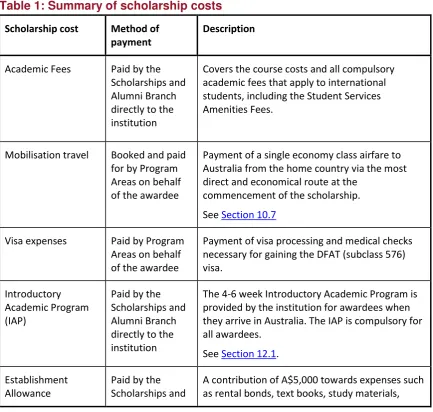
1.1.5. Australia Awards Scholarships generally cover the following fees and entitlements: (see Chapter 10 for further details.)
i. full tuition fees ii. return air travel
iii. establishment allowance iv. contribution to living expenses v. an Introductory Academic Program vi. Overseas Student Health Cover vii. visa expenses.
1.1.6. Subject to requirements and eligibility, Australia Awards Scholarships may also cover:
i. pre-course English language training fees ii. supplementary academic support iii. fieldwork (for research purposes only)
iv. reunion airfare (for unaccompanied awardees).
1.1.7. The Australian Government does not provide any financial or other support for the dependants of awardees. Awardees are responsible, including financially
responsible, for their family members who accompany them to Australia.
1.2.
Ho w t o u se t h is sch o lar sh ip s p o licy h an d b o o k
Page 13 of 122
Australia Awards Scholarships Policy Handbook, February 2014
(A) = applicant/awardee (P) = Program Area (I) = institution (S) = Scholarships and Alumni Branch
1.2.2. Institutions, applicants, awardees, DFAT officers and Program Areas (and their managing contractors and their sub-contracted Case Managers) must read and comply with this handbook. To help users identify the sections which are most relevant to them, or identify actions they need to take to comply with the policy, this handbook differentiates users by coloured boxes and icons for each group of users. The key for each user is at the bottom of each page.
1.2.3. Scholarships policy or instruction most relevant for applicants or awardees.
1.2.4. Scholarships policy or instruction most relevant for Program Areas (and their managing contractor and case managers).
1.2.5. Scholarships policy or instruction most relevant for institutions.
1.2.6. Scholarships policy or instruction most relevant for the Scholarships and Alumni Branch.
1.2.7. OASIS is DFAT’s internet-based data management system. It enables DFAT, managing contractors and institutions to access a centralised database to electronically enter and store data, process applications and manage awards. DFAT provides users with an OASIS user manual and initial training.
1.2.8. This handbook stipulates when actions need to be taken in OASIS at each stage of the process. For a detailed description of these, Program Areas and institutions can refer to the OASIS user manual.
1.2.9. This handbook underpins the contract:
i. between DFAT and institutions to provide education services, and
ii. between the awardee and the Australian Government.
1.2.10. An institution should use the guidance in this handbook, together with its knowledge and experience, to make decisions that are in the best interests of the Australian Government, the awardee and the institution.
Policy handbook review and update
1.2.11. As noted, this handbook forms part of the contractual arrangements between awardees, institutions and DFAT. It is reviewed on a regular basis to maintain its relevance and consistency with current DFAT policy.
1.2.12. DFAT reserves the right to amend this handbook and will provide timely notification of any changes. However, it is the reader’s responsibility to check the handbook regularly.
P
I
A
I
Page 14 of 122
Australia Awards Scholarships Policy Handbook, February 2014
(A) = applicant/awardee (P) = Program Area (I) = institution (S) = Scholarships and Alumni Branch
1.3.
Man ag em en t r esp o n sib ilit ies
1.3.1. The following summarises responsibilities for users of this handbook.
Scholarships and Alumni Branch
1.3.2. The Scholarships and Alumni Branch is responsible for:
i. developing and maintaining DFAT scholarship policies and conditions, and ensuring consistency in their administration
ii. assisting Program Areas with promotion, selection and mobilisation processes
iii.determining in Australia arrangements for Australia Awards Scholarships
iv. managing contracts with institutions
v. monitoring and reporting the global performance of Australia Awards Scholarships
vi.managing OASIS and training for DFAT, managing contractors and institution staff
vii.managing whole-of-government relationships in Canberra
viii. leading on DFAT’s participation in the Australia Awards.
DFAT Program Area
1.3.3. DFAT Program Areas are in-country offices or DFAT country programs in Canberra (or desks), and work collaboratively on the following policy tasks:
i. liaising with partner governments and relevant authorities on Australia Awards Scholarships matters
ii. organising the nomination process and promoting awards
iii.processing applications (hardcopy and online)
iv. managing the Australia Awards Scholarships selection process with assistance from the Scholarships and Alumni Branch as required
v. ensuring that all selection processes are equitable and transparent and that connections or relationships between applicants and staff employed in Program Areas or with managing contractors are disclosed and managed appropriately
vi.forwarding placement requests to institutions in OASIS by the deadline, and ensuring that documents accompanying the requests have been properly certified
vii.notifying all applicants of the outcome of the selection process
viii. holding functions for awardees as appropriate
ix. advising the Scholarships and Alumni Branch and institutions of awardees with disability who require additional assistance, liaising with institutions to determine the level of support they require and providing any additional support for
awardees with disability
x. arranging in-country pre-course English where relevant
xi. providing guidance to awardees around visa application process
xii.arranging travel to Australia for awardees and recording travel details in OASIS
xiii. requesting character and/or police checks from awardees and ensuring these
Page 15 of 122
Australia Awards Scholarships Policy Handbook, February 2014
(A) = applicant/awardee (P) = Program Area (I) = institution (S) = Scholarships and Alumni Branch
are received before awardees depart for Australia
xiv. providing pre-departure briefings to awardees, including DFAT alumni where possible
xv.processing and approving Australia Awards Scholarship variations in OASIS and in accordance with current policy and financial delegations
xvi. overseeing performance and contractual matters relating to the managing contractor (if applicable)
xvii. promoting and supporting Australia Awards Alumni networks.
1.3.4. A number of Program Areas have contracted in-country management of Australia Awards Scholarships to a managing contractor and sub-contracted Case Managers. For the purposes of this handbook, references to Program Areas may relate to responsibilities of either Program Areas, managing contractor, or Case Managers depending on each country program’s internal arrangements and the division of responsibilities.
1.3.5. The roles and responsibilities of managing contractors are generally set out in their agreement with DFAT. However, Program Areas are responsible for clearly defining responsibilities with the managing contractor and ensuring that they are aware of all guidance on Australia Awards, including this handbook. This responsibility extends to sub-contractors.
Institutions
1.3.6. Tertiary education institutions contracted by DFAT are responsible for in-Australia management of awardees in accordance with this handbook and their contract with DFAT. Management responsibilities include:
i. responding to Program Areas’ requests for placing an awardee
ii. meeting the academic and pastoral requirements of awardees from time of arrival until the completion of their award, including, where necessary, intervening early to ensure academic success
iii.ensuring records in OASIS are up-to-date and accurate
iv. providing information to DFAT about the awardees on request
v. managing finances in accordance with the contract
vi.managing risks in accordance with the contract
vii.providing reasonable assistance, including making reasonable adjustments, for awardees with disability.
1.3.7. Institution Contact Officer:
i. Institutions must nominate a contact officer whose role is to act as the prime contact for liaison between the institution and DFAT on matters not directly related to awardees, such as DFAT’s contract with the institution.
1.3.8. Student Contact Officers:
i. An institution’s Student Contact Officers are the points of contact for awardees in relation to Australia Awards Scholarships and anything over and above the role of the institution’s student services area. The institution decides how to manage
Page 16 of 122
Australia Awards Scholarships Policy Handbook, February 2014
(A) = applicant/awardee (P) = Program Area (I) = institution (S) = Scholarships and Alumni Branch
these arrangements, including the roles and responsibilities of the contact officers.
Applicants and awardees
1.3.9. Applicants are responsible for reading and understanding the policies underpinning Australia Awards Scholarships.
1.3.10. Awardees are responsible for providing complete, true and accurate information at all times including, but not limited to, the information provided in their award and visa applications.
1.3.11. Applicants and awardees must not give false or misleading information at any time in relation to their Australia Awards Scholarships application or while studying in Australia. Giving false or misleading information is a serious offence under the Criminal Code Act 1995.
1.3.12. Awardees are responsible for their academic and personal conduct as defined in
Chapter 6 of this handbook and for complying with their contract with the
Commonwealth of Australia, which they must sign to accept the scholarship offer.
Page 17 of 122
Australia Awards Scholarships Policy Handbook, February 2014
(A) = applicant/awardee (P) = Program Area (I) = institution (S) = Scholarships and Alumni Branch
2. Ap p lyin g f o r an Au st r alia Aw ar d s Sch o lar sh ip
2.1.
Elig ib ilit y cr it er ia
2.1.1. To be eligible to receive an Australia Awards Scholarship, applicants must:
i. be a minimum of 18 years of age at the time of commencing the scholarship
ii. be a citizen of a participating country (as listed on the Australia Awards website) and be residing in and applying for the scholarship from their country of
citizenship
iii.not be married, engaged to, or a de facto of a person who holds, or is eligible to hold, Australian or New Zealand citizenship or permanent residency, at any time during the application, selection or mobilisation phases (note: residents of Cook Islands, Niue and Tokelau with New Zealand citizenship are eligible but must apply for a DFAT (subclass 576) visa
iv. not be current serving military personnel
v. not be a citizen of Australia, hold permanent residency in Australia or be applying for a visa to live in Australia permanently
vi.not be applying for another long-term Australia Award unless they have resided outside of Australia for twice the length of the total time that they were in Australia (for example, a previous awardee who has been on an Australia Awards Scholarship in Australia for four years will not be eligible to apply for another Australia Awards Scholarship until they have been home for eight years)
vii.have satisfied any specific criteria established by the Program Area or the government of the applicant’s country of citizenship
viii. be able to satisfy the admission requirements of the institution at which the award is to be undertaken (this may mean that Program Areas will need to withdraw an award offer if the recipient cannot satisfy the institution’s admission requirements. This may not be known until Program Areas request a placement at selected institutions)
ix. be able to satisfy all requirements of the Department of Immigration and Border Protection to hold a DFAT (subclass 576) visa. This may mean that the Program Area will need to withdraw an award offer if the recipient cannot satisfy the visa requirements.
x. Applicants must inform the Program Area of any connection or relationship to staff employed at Program Areas or with managing contractors so that the application may be properly and transparently managed.
2.1.2. Program Areas may consider the following exceptions to 2.1.1(ii) in relation to applicants being required to apply from their country of citizenship:
i. applicants working for their government in a third country
ii. applicants residing in the immediate region to which they would be willing to
Page 18 of 122
Australia Awards Scholarships Policy Handbook, February 2014
(A) = applicant/awardee (P) = Program Area (I) = institution (S) = Scholarships and Alumni Branch
grant an award (e.g. Pacific Island countries considering applicants from other eligible Pacific Island countries), noting that the award will be reported as belonging to the applicant’s country of citizenship.
2.2.
Co u n t r y an d r eg io n al p r o f iles
2.2.1. Applicants must read the applicable country or regional profile for details on the application process, as opening and closing dates for applications, country specific requirements (including English language) and
documentation requirements may vary. The profiles can be found at
http://www.dfat.gov.au/australia-awards/Pages/eligiblecountries.aspx
2.3.
En g lish lan g u ag e r eq u ir em en t s
2.3.1. An applicant or awardee will meet DFAT’s English language requirements for receiving an Australia Awards Scholarship if their first language is English and if they have undertaken their education in English.
2.3.2. Note that some institutions may still require evidence of English language proficiency, and Program Areas relying on the above may need to check whether Australian institutions accept applicants from particular regions or with particular qualifications from English language institutions.
i. where an applicant or awardee does not meet DFAT’s English language
requirements (see Section 2.3.1), the awardee will need to provide an academic English language test result that meets the institution’s academic English language requirement tests before commencing the approved main course of studies. The below are accepted English language tests:
o International English Language Testing System (IELTS)
o Test of English as a Foreign Language (TOEFL)
o Pearson Test of English Academic (PTE Academic)
2.3.3. Awardees’ English language test results must be valid at 1 January of the year in which the awardee is commencing studies in Australia (IELTS, TOEFL scores, and PTE Academic are valid for two years after the test date).
2.3.4. The following scores are recommended by the Scholarships and Alumni Branch for all Australia Awards Scholarship awardees:
i. an Academic IELTS result with an overall score of at least 6.5, with no band less than 6.0, or
ii. a paper-based TOEFL overall score of at least 580, with a minimum of 4.5 in the test of written English, or
iii. an internet-based TOEFL score of at least 92, with a minimum of 21 in all subtests, or
iv. PTE Academic overall score of 58 with no communicative skill score less than 50. 2.3.5. Where an institution’s academic English language requirement is higher than DFAT’s
requirement for the main course of study, the awardee must meet the institution’s requirement.
Page 19 of 122
Australia Awards Scholarships Policy Handbook, February 2014
(A) = applicant/awardee (P) = Program Area (I) = institution (S) = Scholarships and Alumni Branch
2.3.6. If a Program Area elects not to have an English language cut off, or to have a lower cut off than recommended in Section 2.3.4 (which will be specified in country profile), the Program Area must not accept:
i. lower than the relevant institution English language entry score for direct entry into the course
ii. scores that are more than half a point lower on the International English Language Testing System (or the equivalent Test of English as a Foreign
Language or Pearson’s Test of English Academic) than the relevant institution’s English language entry requirement for awardees undertaking pre-course English in Australia.
Pre-course English training in Australia
2.3.7. Country programs may elect to provide English training to awardees in their home country or the immediate region. The following policy relates to pre-course English training in Australia.
2.3.8. An awardee who does not meet the institution’s requirements may be able to undertake pre-course English language training in Australia. This training may be provided if the awardee is:
i. within half a point of the required IELTS, or
ii. within 25 points of the paper-based Test of English as a Foreign Language, or iii. within 10 points of the internet-based Test of English as a Foreign Language or iv. within 7 points of PTE Academic.
2.3.9. Pre-course English training in Australia is for a maximum of six months. Exceptions to this six month maximum must be agreed with the Scholarships and Alumni Branch.
Pre-course English language training in-country
2.3.10. Program Areas may elect to provide pre-course English language training in country, prior to mobilisation.
i. Program Areas should assume that six months of English language training will result in advancing
o Half an IELTS point
o 25 points TOEFL paper-based
o 10 points TOEFL internet-based or
o 7 points PTE Academic
ii. It is up to Program Areas to determine on what basis they provide in-country English language training, and whether training is provided prior to or after a provisional offer of an award.
2.3.11. Program Areas will determine when applicants or awardees need to provide evidence of their English language abilities and advise applicants accordingly. Program Areas must provide the evidence in OASIS when requesting a placement for the applicant at an institution.
Page 20 of 122
Australia Awards Scholarships Policy Handbook, February 2014
(A) = applicant/awardee (P) = Program Area (I) = institution (S) = Scholarships and Alumni Branch
2.3.12. Before making a placement offer, institutions should give careful consideration to the English language training that an awardee may require. The institution may offer an in-Australia Pre-Course English
program only if the awardee is within half an IELTS point or the equivalent TOEFL score or PTE Academic score of the institution’s minimum English language requirements.
2.3.13. An institution must not accept an awardee if they are unlikely to reach the standard of English required for the main course of studies within the six months of PCE training.
2.4.
Fin d in g an ap p r o p r iat e co u r se an d in st it u t io n
2.4.1. Scholarships are available only for courses that are listed on the Commonwealth Register of Institutions and Courses for Overseas Students (CRICOS), which is the official Australian Government website that lists all Australian education providers that offer courses to people studying in Australia on student visas.
2.4.2. Scholarship applicants are not required to have an offer of place at an Australian institution when they apply. However, applicants must have researched their preferred courses, including information provided on
institution websites, and ensure that it is included on the CRICOS Register. The only exception is qualifying or preliminary courses, which do not need to be listed in the CRICOS. The Register is available at www.cricos.deewr.gov.au, though applicants are encouraged to research more broadly for information on courses.
2.4.3. Applicants are expected to undertake research on the Australian institutions that may provide the most appropriate course of study which meets their needs. The
Australian Government website www.studyinaustralia.gov.au is a good place to start. Applicants must include their course and institution preferences when submitting their application for a Scholarship.
2.4.4. Institutions may offer in-country information sessions and also have extensive information on their individual websites. An institution may recommend a qualifying or preliminary course to be taken as part of the awardee’s academic program.
2.4.5. Program Areas may also assist applicants to make an informed decision on the most appropriate course of study and location.
2.5.
Typ es o f co u r ses availab le t o ap p lican t s
2.5.1. The types of courses available for study under a Scholarship will depend on the applicant’s home country government and/or DFAT policy. Australia Awards Scholarships may be available for the following types of courses:
i. Vocational Education and Training (VET) courses ii. Bachelor degree (undergraduate) courses
I
A
I
Page 21 of 122
Australia Awards Scholarships Policy Handbook, February 2014
(A) = applicant/awardee (P) = Program Area (I) = institution (S) = Scholarships and Alumni Branch
iii. Master degree courses
iv. Doctorate degree (PhD) programs
2.5.2. Australia Awards Scholarships do not support completion of studies already commenced in Australia.
Bachelor degrees
2.5.4. The maximum duration of study permitted for a Bachelor degree is four years. Double Bachelor degrees are permitted so long as both are included in the original offer and both can be completed within four years.
2.5.5. Institutions may recommend an awardee undertaking a Bachelor degree to do an Honours year by submitting a Course Transfer variation in OASIS (refer Section 13.5.5).
2.5.6. Institutions must seek approval from Program Areas before inviting an awardee to undertake an Honours program. Institutions should provide the awardee’s subject results when seeking approval.
2.5.7. Approval must be sought by the institution no later than three months before the awardee’s scholarship completion date, to allow time for the Program Area to assess the request, including seeking partner government approval where relevant.
Master degrees
2.5.8. The maximum duration for a Master degree program is two years.
2.5.9. Master degree programs may be offered by coursework, by research or by a combination of coursework and research. Masters by research or a combination of coursework and research should be offered only to those applicants who have demonstrated the need for high-level research skills in order to undertake research or teaching or to supervise researchers upon their return home.
2.5.10. Double Master degrees are permitted only when both are included in the institution’s original offer and both courses can be completed within two years.
Doctorate (PhD) programs
2.5.12. The maximum duration for a PhD is four years.
2.5.13. Study at doctorate level (PhD) may be subject to partner government approval. Normally, approval is given only where the applicant occupies, or is expected to occupy, a senior position requiring individual research or the supervision and training 2.5.3. Applicants must read the relevant Country or Regional Profile or check
with the nearest DFAT office (or the Managing Contractor’s office) to find out what types of courses are available to them. For example, some
Program Areas do not provide scholarships for undergraduate or PhD studies.
2.5.11. Applicants wishing to undertake a Masters by research must investigate an appropriate supervisor. Australian higher education institutions’ websites identify the institution’s areas of research strength. Applicants should supply evidence of past research undertaken and highlight outcomes.
A
I
Page 22 of 122
Australia Awards Scholarships Policy Handbook, February 2014
(A) = applicant/awardee (P) = Program Area (I) = institution (S) = Scholarships and Alumni Branch
of other researchers in a research organisation (e.g. university or research centre) in the applicant’s home country.
2.6.
Typ es o f co u r ses f o r w h ich Au st r alia Aw ar d s
Sch o lar sh ip s ar e n o t availab le
2.6.1. Australia Awards Scholarships are not available for:
i. undergraduate courses that require more than four years of study (e.g. medical and veterinary science programs that take five or more years to complete) ii. undergraduate courses that are available at tertiary education institutions in the
awardee’s home country
iii. training in areas related to nuclear technology or flying aircraft iv. legal workshops
v. study by distance or external mode in Australia unless as part of CRICOS registered course where the majority of units are undertaken in the primary institution and the external component is no more than 25 per cent of the total semester study load
vi. study by distance or external mode while residing outside Australia unless as part of CRICOS registered course where the majority of units are undertaken in Australia and the external component is no more than 25 per cent of the total semester study load and with the prior approval of the Program Area
vii. military training
viii. training in counter-subversion methods, the suppression of political dissent or intelligence procurement.
2.6.2. Generally scholarships will not be available for courses of study in Australia where the applicant already has achieved that qualification and the qualification is deemed to be equivalent to the Australian qualification at the same level.
Articulated study programs
2.6.3. An articulated study program is one that combines a lower and higher level course of study, leading to award of the higher qualification. Examples include a vocational course providing a direct pathway to a university undergraduate course of study; or a Graduate Diploma leading directly to a Masters, or a Masters leading directly to a PhD.
2.6.4. Scholarships are available for articulated study programs, subject to the relevant Country or Regional Profile, but must not comprise more than two courses or have a total duration in excess of the maximum duration permitted for the higher
qualification (refer Section 5.2.9).
Preparation programs
2.6.5. Preparation programs are courses deemed necessary by the institution to enable an awardee to successfully complete their qualification in the timeframe specified in CRICOS. Such programs may be formal or informal, for example bridging courses or special intensive courses, and may not lead to a recognised qualification.
Page 23 of 122
Australia Awards Scholarships Policy Handbook, February 2014
(A) = applicant/awardee (P) = Program Area (I) = institution (S) = Scholarships and Alumni Branch
i. pre-course English (see Section 2.3)
ii. qualifying or preliminary programs for postgraduate awardees
iii. foundation programs for undergraduate and vocational education and training awardees.
2.6.7. Preparation programs can be up to a maximum of 12 months. The total program of activities (i.e. a combination of the preparatory programs and the main course of studies) must not result in the scholarship duration being more than 12 months longer than the main course.
2.7.
Ap p licat io n p r o cess
2.7.1. The Country and Regional Profiles detail the opening and closing dates for applications and which method of application is acceptable for that country or region. Not all Program Areas are able to receive applications via the online application facility in OASIS.
2.7.2. It is important that applicants read and fully understand and comply with the relevant Country or Regional Profile before submitting an application. Guidance for applicants on using the Online Application facility OASIS is at:
http://aid.dfat.gov.au/Publications/Pages/2303_50_633_9711_3818.aspx.
2.7.3. Applicants will need to supply a number of documents to support their scholarship application including, but not necessarily limited to:
i. a certified copy of original formal degree graduation certificate (i.e. testamur) and, if not in English, a certified translation of the degree
ii. a certified copy of original formal academic transcript/s and, if not in English, a certified translation copy of the transcript/s
iii.a certified copy of a citizenship document (e.g. passport or national identity card)
iv. a certified copy of original birth certificate and, if not in English, a certified translation
v. a curriculum vitae (CV) briefly detailing work history and responsibilities (and research experience, if relevant to the application)
vi.referee reports: at least one academic referee report and at least one other referee report (e.g. a work supervisor). Masters by Research or PhD applicants should provide two academic referee reports. A template for the preferred format of a referee report is available at
http://aid.dfat.gov.au/australia-awards/Pages/how-to-apply.aspx
vii.a certified copy of original English language test (IELTS OR TOEFL) results certificate valid until 1 January of the year in which the studies will commence. (For example, as results are normally valid for two years, the test date would need to have been taken after 1 January 2012 for an application for a scholarship to commence studies in 2014)
viii. PhD candidates only - evidence (e.g. letter or email communication) that the applicant has received in-principle support for their research topic from a potential supervisor.
2.7.4. See Section 2.7.7 for requirements of certification.
Page 24 of 122
Australia Awards Scholarships Policy Handbook, February 2014
(A) = applicant/awardee (P) = Program Area (I) = institution (S) = Scholarships and Alumni Branch
2.7.6. Program Areas may need to submit, on behalf of a successful applicant, an application form for the relevant institution in addition to the request for placement to meet their institution’s specific enrolment requirements.
Document certification
2.7.7. Documents accompanying a scholarship application that require certification must be certified in accordance with the requirements below.
2.7.8. The original document has been sighted and the copy has been sworn to be a true copy of the original by an authorised person at one of the following:
i. the official records department of the institution that originally issued the document/s, or
ii. an Australian overseas diplomatic mission, or iii. a Notary Public.
2.7.9. The authorised person must:
i. write ‘This is a certified true copy of the original document as sighted by me’, and
ii. sign and print his/her name, address, contact telephone number, profession or occupation or organisation and the date verified, and
iii. include the official stamp or seal of the verifier’s organisation on the copy, if the organisation has such a stamp.
2.7.10. Where an institution has specific document certification requirements, the awardee must meet the institution’s requirements.
2.7.11. Program Areas may elect at which stage of the application or selection process they require correctly certified documents, provided that certified copies are included in each request for placement at an Australian
institution.
2.7.5. PhD candidates only – if an Australia Awards Scholarship is awarded, an additional research proposal for Program Areas to submit to institutions.
2.7.12. Applicants cannot verify their own documents, even if they belong to one of the categories listed in Section 2.7.8, and documents cannot be verified by a person directly related to the applicant. If an applicant has studied under
a previous name, they must supply documentary evidence to prove their change of name, such as a marriage certificate, deed poll registration or other registration. The documentation must show their previous name/s and their current name/s.
P
Page 25 of 122
Australia Awards Scholarships Policy Handbook, February 2014
(A) = applicant/awardee (P) = Program Area (I) = institution (S) = Scholarships and Alumni Branch
3. Fr au d
3.1.1. DFAT takes all possible steps to ensure that Australian Government funds are used appropriately to deliver effective aid and development and treats all attempted, alleged, detected and suspected fraud seriously.
3.1.2. DFAT defines fraud as dishonestly obtaining a benefit, or causing a loss, by deception or other means. It cannot simply be due to a careless, accidental or an erroneous act.
3.1.3. The following could constitute fraud in the context of the Australia Awards:
i. false application supporting documents ii. false information on forms
iii. not disclosing relevant information
iv. not disclosing a conflict of interest (e.g. relationship with decision-makers) v. deliberately claiming a benefit not entitled to (e.g. reunion travel when
dependent family members are residing with the awardee in Australia). 3.1.4. DFAT has a ‘zero tolerance’ attitude towards any attempts to gain a benefit
fraudulently from the Australian Government. DFAT has the right to vary or reverse any decision regarding an Australia Award made on the basis of incorrect or
incomplete information.
3.1.5. Applicants that provide suspected fraudulent documents will be excluded from the selection process until the documents are verified. If fraud is confirmed, the applicant will be ineligible to apply for further Australia Awards.
3.1.7. Institutions must report to the Scholarships and Alumni Branch via email when it detects or suspects that an awardee has committed fraud.
3.1.8. Program Areas must report to the Scholarships and Alumni Branch via email when it detects or suspects that an awardee has committed fraud. 3.1.6. When submitting their application for an Australia Award, applicants are
required to declare that the contents of their application are true and correct; and acknowledge that DFAT has the right to vary or reverse any
decision regarding an Australia Awards Scholarship made on the basis of incorrect or incomplete information.
A
I
Page 26 of 122
Australia Awards Scholarships Policy Handbook, February 2014
(A) = applicant/awardee (P) = Program Area (I) = institution (S) = Scholarships and Alumni Branch
4. Select io n
4.1.
Select io n p r o cess an d cr it er ia
4.1.1. Program Areas manage the selection process in each country/region and the selection process is detailed in the relevant Country or Region Profile. The selection process should include an interview of short-listed candidates.
4.1.2. Selection of applicants will take into account the applicant’s professional and personal qualities, academic competence and, most importantly, their potential to impact on development challenges in their home country. Each country or region may have additional selection criteria, which can be accessed in the relevant Country or Region Profile (
http://aid.dfat.gov.au/australia-awards/Pages/eligiblecountries.aspx).
4.1.3. The table below is a guide for applicants to understand how Program Areas might score an applicant.
Outstanding: ≥90% Outstanding application with a study program that has been very well developed in relation to its contribution to building leadership in support of home country’s development; an outstanding candidate with strong academic capacity and demonstrated leadership capacities in strategic and inspirational thinking and practice, who is very likely to make a significant impact in their field of practice in home country and
internationally.
Very good: 80% ≤ 89% High quality application with a study program that has been well considered for its contributions to building leadership in support of home country’s development; a highly capable candidate who has demonstrated promising leadership capacities in strategic and
inspirational thinking and practice, who is likely to make a significant impact in their field of activity.
Good: 70% ≤ 79% Worthy application with a relevant study program; a capable candidate who has demonstrated some promising leadership characteristics and is likely to complete the study program and make a sound contribution to their field of activity.
Satisfactory: 60% ≤ 69% An adequate application with a relevant study program; a candidate that has demonstrated some initial
leadership characteristics and is reasonably likely to complete the study program and make a contribution to their field of activity.
Page 27 of 122
Australia Awards Scholarships Policy Handbook, February 2014
(A) = applicant/awardee (P) = Program Area (I) = institution (S) = Scholarships and Alumni Branch
4.1.4. Program Areas are responsible for selecting and awarding scholarships to the most suitable applicants. These are applicants who match the desired profile, who demonstrate a strong likelihood of succeeding in their studies and who will be able to contribute to development in areas being targeted by the country or regional strategy.
4.2.
Rein t eg r at io n p lan s
4.2.1. Reintegration plans (also known as Development Impact Plans or Re-Entry Action Plans) are an effective tool to assist Program Areas, applicants, awardees and alumni at the selection, return-home and post-scholarship stages, and are strongly
recommended as a best practice.
4.2.4. Program Areas may include reintegration plans as part of the application and selection process and require all applicants to complete a
reintegration plan to help selection panels identify which candidates have
well thought through approaches for using their new skills on return to their home country.
4.2.5. Program Areas may include the applicant’s/awardee’s employer as a party to the plan, particularly where the employer is holding the awardee’s position open, and where there is a strong human resource development priority for the Program Area’s Australia Awards Scholarships.
4.3.
Su ccessf u l an d r eser ve ap p lican t s
4.3.1. The Scholarship selection process in each country (or, in some cases, in the region) will result in a list of successful candidates equal to the number of scholarships available for the country or region, and in most instances a list of reserve candidates ranked in order.
4.3.2. Successful candidates become awardees once their placement at an Australian institution has been processed and the candidate has signed the Scholarship contract with the Commonwealth of Australia.
4.3.3. Program Areas should only select reserve candidates where they are high quality and should ensure that reserve candidates continue to meet all eligibility criteria and be deemed suitable for placement in the event that a
successful candidate’s institution placement is rejected, or the candidate withdraws before they depart for Australia.
4.2.2. Awardees may be required to complete a reintegration plan at any stage of their scholarship, including as part of their scholarship application.
4.2.3. The reintegration plan is a statement of intent by the applicant, setting out practical and realistic examples of tasks on which they plan to apply the skills and knowledge gained through their studies in Australia and the possible constraints they think could prevent them from achieving these tasks.
P
P
A
Page 28 of 122
Australia Awards Scholarships Policy Handbook, February 2014
(A) = applicant/awardee (P) = Program Area (I) = institution (S) = Scholarships and Alumni Branch
4.4.
Ad visin g ap p lican t s o f select io n o u t co m es
4.4.1. Program Areas will inform applicants of the outcomes of their Australia
Page 29 of 122
Australia Awards Scholarships Policy Handbook, February 2014
(A) = applicant/awardee (P) = Program Area (I) = institution (S) = Scholarships and Alumni Branch
5. Placem en t
5.1.
Req u est f o r p lacem en t an d p lacem en t o f f er s
5.1.1. After the selection of awardees is finalised, the Program Areas use OASIS to request placements for successful applicants at their first preference institution and course.
5.1.2. Requests for placement are assessed by institutions on merit. An institution will process a placement offer only where the awardee meets the institution’s admission requirements and is assessed as being capable of successfully completing the
nominated course within the specified period (as recorded on the CRICOS).
i. for placements of awardees with disability, additional considerations and requirements apply (see Chapter 9).
5.1.3. DFAT reserves the right to reject a placement offer made by an institution or to withdraw a placement request if submitted in error.
5.1.4. Successful applicants selected to undertake a PhD or Masters by Research will need to provide Program Areas with a well-developed research proposal to submit to the institution as part of the Request for Placement
process. The proposal should include a proposed methodology, timeline and a brief literature review.
5.1.5. Program Areas should initiate requests for placement in OASIS by 25 August for first semester commencement and by 15 March for second semester commencement. Program Areas are to ensure that when submitting a request for placement to an institution:
i. it is compliant with any country specific conditions set by the partner government, and
ii. the following has been uploaded or recorded in OASIS:
o properly certified supporting documentation
o the awardee’s emergency contact details o the dependants’ information, where relevant
o the awardee’s passport number and expiry date.
iii.for PhD awardees, the following has been uploaded into OASIS:
o the letter or email communication, as outlined at Section 2.7.3 viii, from the applicant’s potential supervisor giving in-principle support for the research proposal, and
o the supporting documents outlined at Section 2.7.3.
5.1.6. If the institution requests further information from Program Areas to process the request for placement, Program Areas must respond promptly to enable the
institution’s final response to the request for placement to be sent in accordance with the timeframes outlined in Section 5.1.5.
5.1.7. If an applicant’s first preference is declined by an institution, the Program Areas may decide to approach the second or other preferred institution. The Program Areas will
A
Page 30 of 122
Australia Awards Scholarships Policy Handbook, February 2014
(A) = applicant/awardee (P) = Program Area (I) = institution (S) = Scholarships and Alumni Branch
liaise with the next preferred institution on that institution’s requirements. The second preference institution will process the request for placement in OASIS in line with the process and timeframe outlined in Section 5.1.9 – 5.1.12.
5.1.8. If a successful applicant cannot be placed in any of their preferred courses, the Program Areas must advise the applicant’s nominating authority and the applicant (as appropriate) that no placement can be offered. In such circumstances, the Program Areas will withdraw the offer, and may then request a placement for a reserve applicant.
5.1.9. Institutions must respond to complete placement requests received in OASIS:
i. within 15 business days for coursework studies
ii. within 30 business days for research studies.
5.1.10. The institution may respond to a placement request in OASIS by:
i. declining to offer a place at the institution and stating the reasons why
ii. offering a place conditionally
iii.offering a place unconditionally.
5.1.11. If the institution requires further information from the Program Area to process the placement, the institution must respond to the request for placement as soon as possible so as to attempt to meet the timeframe as at Section 5.1.9.
5.1.12. If the institution does not respond to a completed request within the stipulated timeframe the Program Area may withdraw with placement from that institution at its discretion.
5.1.13. The institution should ensure placement offers include:
i. the Introductory Academic Program
ii. the awardee’s nominated course (reflecting any credit for previous study or recognition of prior learning that may reduce the length of time needed to complete the course)
iii.any preparatory programs deemed necessary by the institution
iv. any other compulsory courses or course elements (e.g. fieldwork, work attachments, first aid course, occupational health and safety course, etc.)
v. course costs and scholarship entitlements, as required (see Chapter 10)
vi.any conditions of the offer
vii.additional information about the placement offer that the successful applicant should be aware of when signing the offer and contract, such as courses that are delivered in a non-standard mode (i.e. intensive mode or at more than one institution).
Page 31 of 122
Australia Awards Scholarships Policy Handbook, February 2014
(A) = applicant/awardee (P) = Program Area (I) = institution (S) = Scholarships and Alumni Branch
5.2.
Pr ep ar at io n p r o g r am s
5.2.1. Preparation programs are courses deemed necessary by the institution to enable an awardee to successfully complete their qualification in the timeframe specified in CRICOS. Such programs may be formal or informal, for example bridging courses or special intensive courses, and may not lead to a recognised qualification.
5.2.2. Preparatory programs include:
i. pre-course English (see Section 2.3.7 – 2.3.9)
ii. qualifying or preliminary programs for postgraduate awardees
iii. foundation programs for undergraduate and vocational education and training awardees.
5.2.3. Institutions may recommend preparatory programs that run for up to a maximum of 12 months. The total program of activities (i.e. a combination of the preparatory programs and the main course of studies) must not
result in the scholarship duration being more than 12 months longer than the main course.
Foundation programs
5.2.4. A foundation program of up to 12 months may be offered by the institution to vocational education and training and undergraduate applicants if the institution assesses that the awardee does not meet the required standard for direct entry into their chosen course.
5.2.5. Awardees may also attend in-country foundation programs as part of their scholarship program.
5.2.6. Approval from the Scholarships and Alumni Branch must be sought if there is likely to be more than a two week break between completion of the preparatory program and the main course of study at any time other than normal session breaks.
5.2.7. Awardees undertaking preparatory programs in Australia should
commence their main course of study as soon as the preparatory program is completed. Awardees must achieve satisfactory results in their
preparation program to continue their award, including preparatory programs undertaken in-country. Failure to achieve satisfactory results may result in termination of the award.
5.2.8. Upon receiving a request for placement, institutions should assess whether the awardee will require a preparation program to successfully complete their qualification in the timeframe specified in CRICOS.
Preparation programs should be included in the initial placement offer. If the institution later assesses that a shorter period of preparation is adequate, the institution must reduce the overall length of the award in OASIS through a reduction variation towards the end of the award period (see Section 13.7).
I
A
Page 32 of 122
Australia Awards Scholarships Policy Handbook, February 2014
(A) = applicant/awardee (P) = Program Area (I) = institution (S) = Scholarships and Alumni Branch
Articulated study programs
5.2.9. For articulated study programs undertaken at more than one institution, the institution offering the higher course of study is deemed to be the primary
institution. The primary institution will be responsible for the contractual obligations with DFAT.
5.2.10. The primary institution needs to ensure that both courses comprising the articulated program are identified (and entered into OASIS) as part of the scholarship offer.
Reviewing a placement offer and issuing a letter of offer
5.2.11. Program Areas are responsible for reviewing an institution’s placement offer, and issuing the letter of offer, along with the scholarship contract to the successful applicant, and re