Veterinary pharmaceuticals are commonly administered to animals for disease control, and added into feeds at subtherapeutic levels to improve feeding effi ciency. As a result of these practices, a certain fraction of the pharmaceuticals are excreted into animal manures. Land application of these manures contaminates soils with the veterinary pharmaceuticals, which can subsequently lead to contamination of surface and groundwaters. Information on the occurrence and fate of pharmaceuticals in soil and water is needed to assess the potential for exposure of at-risk populations and the impacts on agricultural ecosystems. In this study, we investigated the occurrence and fate of four commonly used veterinary pharmaceuticals (amprolium, carbadox, monensin, and tylosin) in a farm in Michigan. Amprolium and monensin were frequently detected in nearby surface water, with concentrations ranging from several to hundreds of nanograms per liter, whereas tylosin or carbadox was rarely found. h ese pharmaceuticals were more frequently detected in surface runoff during nongrowing season (October to April) than during growing season (May to September). Pharmaceuticals resulting from postharvest manure application appeared to be more persistent than those from spring application. High concentrations of pharmaceuticals in soils were generally observed at the sites where the respective concentrations in surface water were also high. For monensin, the ratios of soil-sorbed to aqueous concentrations obtained from fi eld samples were within the order of the distribution coeffi cients obtained from laboratory studies. h ese results suggest that soil is a reservoir for veterinary pharmaceuticals that can be disseminated to nearby surface water via desorption from soil, surface runoff , and soil erosion.
Selected Veterinary Pharmaceuticals in Agricultural Water and Soil
from Land Application of Animal Manure
Wenlu Song and Yunjie Ding
Michigan State UniversityCary T. Chiou
National Cheng Kung UniversityHui Li*
Michigan State UniversityV
eterinary pharmaceuticals are commonly administered to animals for disease control, and added into feeds at sub-therapeutic levels to improve livestock growth via enhanced feed-ing effi ciency. Such pharmaceutical use facilitates the success of large-scale concentrated animal feeding operations (CAFOs). It was estimated that in the United States, approximately 11.2 mil-lion kg of antibiotics were used as nontherapeutic feed additives, corresponding to about 70% of the annual antibiotic production (Mellon et al., 2001). Large fractions (e.g., up to 95%) of animal feeding pharmaceuticals are excreted into manure either as parent compounds or as bioactive metabolites (Aga et al., 2005; Jacobsen et al., 2004; Kay et al., 2004). After a period of storage, the manure is usually land-applied for its fertilizer value. h is practice introduces manure-borne pharmaceuticals into agricultural eco-systems, where their fate is largely unknown (Halling-Sørensen et al., 2005; Hamscher et al., 2005; Kolpin et al., 2002; Snow et al., 2008). h ere is growing concern regarding the environmental fate and potential impacts of these veterinary pharmaceuticals on human and ecosystem health.Compared with point sources such as wastewater treatment plants, nonpoint sources of contaminant release such as those related to agricultural practice, for example, surface runoff from manure-treated fi elds, have received much less attention. Land application of animal manures can lead to veterinary pharma-ceutical contamination of surface water and groundwater via sur-face runoff and leaching (Dolliver and Gupta, 2008; Kay et al., 2004, 2005; Kuchta et al., 2009; Larsbo et al., 2009). Reliable and robust analytical methods have been developed to measure the levels and frequencies of pharmaceuticals present in water and soil. h is information is needed to assess adverse eff ects of pharmaceuticals on environmental quality and public health, and for the development of regulations to limit the release of these unregulated bioactive compounds. Solid-phase extraction (SPE) coupled with liquid chromatography/tandem mass spectrometry (LC-MS/MS) is currently the most eff ective approach to iden-tify and quaniden-tify trace levels of pharmaceuticals in environmen-tal samples. Using this capability, several classes of veterinary
Abbreviations: DOM, dissolved organic matter; LC-MS/MS, liquid chromatography/ tandem mass spectrometry; SOM, soil organic matter.
W. Song, Y. Ding, and H. Li, Dep. of Crop and Soil Sciences, Michigan State Univ., East Lansing, MI 48824; C.T. Chiou, Dep. of Environmental Engineering and Sustainable Environment Research Center, National Cheng Kung Univ., Tainan 70701, Taiwan. Assigned to Associate Editor Joel Pedersen.
Copyright © 2010 by the American Society of Agronomy, Crop Science Society of America, and Soil Science Society of America. All rights reserved. No part of this periodical may be reproduced or transmitted in any form or by any means, electronic or mechanical, including pho-tocopying, recording, or any information storage and retrieval system, without permission in writing from the publisher.
J. Environ. Qual. 39:1211–1217 (2010) doi:10.2134/jeq2009.0090 Published online 5 May 2010.
Supplementary data i les available online for this article. Received 9 Mar. 2009.
*Corresponding author ([email protected]). © ASA, CSSA, SSSA
5585 Guilford Rd., Madison, WI 53711 USA
pharmaceuticals, including tetracyclines, sulfonamides, mac-rolides, lincosamides, and ionophores, have been detected in surface water adjacent to concentrated animal feeding facilities, with the concentration ranging from low to hundreds of nano-grams per liter (Brown et al., 2006; Hao et al., 2006; Kolpin et al., 2002; Song et al., 2007; Hamscher et al., 2005). h e phar-maceuticals manifesting relatively weak sorptive interactions with soils, such as some of sulfonamides, have been shown to leach through soil profi le and into groundwater. For example, sulfonamides have been detected in groundwater at concentra-tions up to 215 ng L−1 (Batt et al., 2006).
Soil is the primary reservoir for many veterinary pharmaceu-ticals released from land-applied livestock manures (Jacobsen et al., 2004; Kim and Carlson, 2007; Stoob et al., 2007). Pharmaceuticals commonly contain several polar and/or ionic functional groups that may engage in multiple interactions with soil components, such as by ion exchange, metal–organic complexation, and hydrogen bonding. Partitioning into soil organic matter (SOM) is, by itself, insuffi cient to account for pharmaceutical retention by soils, as evidenced by the wide range (up to four orders of magnitude) of SOM-normalized sorption data (e.g., Kom values) for individual pharmaceutical among soils (Tolls, 2001). In comparison, other nonionic com-pounds with similar lipophilic properties but lacking polar/ ionic functionalities display a much narrower range of Kom
values (Chiou, 2002). h e relatively strong affi nity of certain pharmaceuticals with soil reduces their availability for biotic or abiotic transformations, leading to enhanced persistence in the environment. For example, Hamscher et al. (2002) reported up to 200 μg kg−1 tetracycline in the soils fertilized with
live-stock liquid manures. In a 2-yr fi eld study, they found that the rate of tetracycline accumulation in soils exceeded the rate of degradation, suggesting that antibiotics might persist in soils over years with continuous applications of animal manures (Hamscher et al., 2002). As a result, precipitation and irriga-tion can disseminate manure-borne veterinary pharmaceuticals and their metabolites from soil to surface and groundwaters via surface runoff or leaching.
h e objective of this study was to document the concen-trations of selected veterinary pharmaceuticals in agricultural soil and surface runoff in an agricultural farm near Lansing, MI. Four veterinary pharmaceuticals, amprolium, carbadox, monensin, and tylosin, were selected as target compounds, and their levels in soil and water were quantifi ed at various time points for a period of 1 yr. h e selected pharmaceuticals had been used as livestock feed additives at the study site (farm), and encompass a range of distinct structures and physicochemical characteristics (Supplementary Fig. S1). Amprolium is a cat-ionic compound added to livestock feeds to inhibit the growth of protozoan coccidian. Carbadox is commonly used to treat dysenteries for swine and promote their growth. Monensin is a polyether ionophore widely used in dairy cows and beef cattle to protect against certain types of gram-positive bacteria. h e macrolide tylosin is a broad-spectrum antibiotic commonly used to treat livestock infection and promote livestock growth. h e measured concentrations of these pharmaceuticals in soil and water over the period of 1 yr were used to evaluate their environmental fate in an agricultural setting.
Materials and Methods
Chemicals
Amprolium (5-[(2-methylpyridin-1-ium-1-yl)methyl]-2-pro-pyl-pyrimidin-4-amine chloride), carbadox (methyl(2E )-2-[(1,4-dioxidoquinoxalin-2-yl)methylene]hydrazinecarboxylate), monensin (4-[2-[5-ethyl-5-[5-[6-hydroxy-6-(hydroxymethyl)- 3,5-dimethyl-oxan-2-yl]-3-methyl-oxolan-2-yl]oxo-lan-2-yl]-9-hydroxy-2,8-dimethyl-1,6-dioxaspiro[4.5] dec-7-yl]-3-methoxy-2-methyl-pentanoic acid), and tylosin ([(2R,3R,4E,6E,9R,11R,12S,13S,14R )-12-{[3,6-dideoxy-4-O-(2,6-dideoxy-3-C-methyl-α-l-ribo -hexopyranosyl)-3 - ( d i m e t h y l a m i n o ) -β- d - g l u c o p y r a n o s y l ] oxy}-2-ethyl-14-hydroxy-5,9,13-trimethyl-8,16-dioxo-11-(2-oxoethyl)oxacyclohexadeca-4,6-dien-3-yl]methyl 6-deoxy-2,3-di-O-methyl-β-d-allopyranoside) were purchased from Sigma-Aldrich Chemical Company (St. Louis, MO). Formic acid, ammonium acetate, and heptafl uorobutyric acid (HFBA) were also obtained from Sigma-Aldrich Chemical Company. Methanol was of high-performance liquid chromatography (HPLC) purity purchased from J. T. Baker Chemical Company (Phillipsburg, NJ). Water was obtained from a Millipore (Billerica, MA) Mill-Q water system, then fi ltered through a 0.22-μm membrane.
Site Description
h is study was conducted in a CAFO located near Lansing, MI. h e facility consists of swine, beef cattle, horse, sheep, dairy, and poultry farms. h e farms produce approximately 1.2 × 10⁷ L of liquid and 9.5 × 10⁶ kg of solid manures each year.
h e animal manures produced are stored in the farm for a few months or composted, and then spread over 2.6 × 10⁶ m2 (650
acre) agricultural lands adjoining these farms. Surface runoff from the agricultural farm is released into the surrounding sur-face water. h e animal manures are usually applied to the lands twice (spring and fall seasons) per year. During our study period, animal manures were applied in April, May, August, October, and November 2006, and again in April and May 2007. h e more intensive application of manure to the fi elds occurred in spring season in which 4.2 × 10⁶ L of liquid and 7.5 × 10⁵ kg of
solid manures were applied in April and May 2006, and 4.1 × 10⁶ L of liquid and 1.4 × 10⁶ kg of solid manures were applied in
April and May 2007. In August 2006 a relatively small amount of liquid animal manure (1.6 × 10⁵ L) was applied to the
crop-land. h e application during postharvest season (October and November 2006) was 1.9 × 10⁶ L of liquid manure.
Water Sampling and Preparation
vacuum manifold (Fisher Scientifi c, Pittsburgh, PA) connected to a fi ltration pump was used for solid-phase extraction. A hydro-philic–lipophilic balance cartridge (Waters Oasis, Milford, MA; 30 μm, 6 mL, 200 mg) was used for sample extraction, cleanup, and preconcentration. h e cartridge was conditioned with 6 mL of methanol and 6 mL of water before use. Water sample (50 mL) was mixed with 0.2 mL of 1.0 M ammonium acetate, and passed through the preconditioned cartridge at a rate of 1.5 mL min−1. h e cartridge was washed with 5 mL of water,
vacuum-dried for 3 min, and eluted with 5.0 mL of methanol containing 0.5% (v/v) formic acid at a rate of approximately 1 mL min−1.
Pharmaceuticals in the eluate were analyzed using a LC-MS/MS (described below). For samples containing low levels of the target compounds, the volume of eluate (5.0 mL) was reduced to 1.0 mL or less using a gentle N2 fl ow to concentrate the samples. h e quantifi cation limits of this method were 5, 15, 0.6, and 20 ng L−1 for amprolium, carbadox, monensin, and tylosin,
respec-tively. h e average extraction recoveries (%) were 116 ± 20 for amprolium, 74 ± 2 for carbadox, 87 ± 12 for monensin, and 71 ± 7 for tylosin. A detailed description of the method develop-ment is presented in the suppledevelop-mentary information online.
Soil Sampling and Preparation
Soil samples were collected from the top 10 cm of soil profi le in the farm, air-dried in the dark, and manually homogenized using stainless-steel spatulas. Five to 10 g of soil samples were weighed into 25-mL Corex glass centrifuge tubes (h ermo Scientifi c, Waltham, MA), mixed with 3 g of Ottawa sand (0.6–0.8 mm), and extracted with 15 mL of 4/1 (v/v) metha-nol/0.3 M ammonium acetate solution by vigorously shaking for 2 h at 200 rpm on a platform shaker. h e tubes were then centrifuged at 4300 × g for 20 min, and the supernatants were transferred to 15-mL Pyrex graduated glass vials. h e volume of extractant was reduced to 3 mL using a nitrogen-stream evaporator apparatus. Approximately 12 mL of deionized water was added to the graduated vial to reach 15 mL, and the entire solution was then extracted via the SPE procedure described above. h e average overall recoveries (%) were 53 ± 3 for amprolium, 67 ± 2 for carbadox, 116 ± 10 for monensin, and 80 ± 3 for tylosin. h e quantifi cation limits for the soil extraction were 0.035, 0.06, 0.004, and 0.09 μg kg−1 for
amp-rolium, carbadox, monensin, and tylosin, respectively.
Liquid Chromatography/Tandem
Mass Spectrometry Analysis
h e LC-MS/MS system used in this study was a Shimadzu (Columbia, MD) HPLC consisting of two LC-20AD pumps and an autosampler (SIL-20A) coupled with an Applied Biosystems (Foster City, CA) Sciex 3200 triple quardru-pole mass spectrometer. High-purity gases
required for mass spectrometer were sup-plied by a gas generator (NM20ZA, PEAK Scientifi c, Billerica, MA). h e Turbo IonSpray (Foster City, CA) source of mass spectrometer was operated with electrospray ionization source in positive mode. h e target pharmaceuticals were quantifi ed using multiple-reaction monitoring mode. h ree
pairs of precursor/product ion transitions were simultaneously monitored to unambiguously identify the target analytes in the environmental samples (Song et al., 2007). In this study the precursor/product ion pairs (m/z) selected were 243/150, 243/122, 243/94 for amprolium; 263/231, 263/145, 263/130 for carbadox; 693/675, 693/479, 693/461 for monensin; and 916/174, 916/772, 916/145 for tylosin. h e fi rst pair of transi-tion in each set was used to quantify the analyte.
A binary gradient mobile phase for the liquid chromatogra-phy system was programmed with a fl ow rate of 300 μL min−1.
Phase A (95% water and 5% [v/v] methanol) and phase B (95% methanol and 5% water) both contained 2 mM ammonium acetate and 20 mM HFBA. Separation of the four analytes was achieved with a h ermo Hypersil Gold column (h ermo Scientifi c, Waltham, MA; 50 by 2.1 mm, 5-μm particle size) with the following mobile phase gradient program: 0 to 2.0 min, A:B = 95:5; 2.0 to 7.0 min, phase B linearly increased to 70%; 7.0 to 7.5 min, phase B ramped to 100% and held until 10.5 min; 10.5 to 11.0 min, phase B reduced to 5% and equilibrated in the fl ow system until 12.0 min. h e injection volume was 10 μL. After each sample injection, the fi rst 5-min elution volume was diverted to waste through a built-in valve, then switched to the inlet of the mass spectrometer.
Sorption Isotherm Measurement
Sorption isotherms of monensin and amprolium were mea-sured using a batch equilibration method for four soils collected from the sites nearby the farm which contained no detectable target pharmaceuticals. Selected soil properties are summa-rized in Table 1. A series of initial monensin (50–1000 μg L−1)
and amprolium (100–2000 μg L−1) solutions were prepared,
then mixed with a known weight of soil placed in glass cen-trifuge tubes. h e mixtures were equilibrated in an end-over-end shaker at 40 rpm for 24 h at room temperature (~23°C). Preliminary studies indicated that sorption approached equi-librium within 24 h. h e tubes were then centrifuged at 4000 ×
g for 30 min. An aliquot of supernatant was sampled and ana-lyzed using LC-MS/MS. Experimental controls consisted of each pharmaceutical initial solution without soil. No changes of pharmaceutical concentrations were detected in the con-trols. h erefore, sorbed concentrations were calculated from the diff erence between the initial and equilibrium concentra-tions of pharmaceuticals in the aqueous phase.
Results and Discussion
Water samples were collected monthly at six sites from drain-age tile channels (draindrain-age water) exiting the farm, and at fi ve sites from the ditches (stagnant water) in close proxim-ity to the farmland site during a 1-yr period (September 2006
Table 1. Selected properties of the soils used in measurement of sorption isotherms.
Soil pH Sand Silt Clay SOM† CEC†
— — — — — — — — — — % — — — — — —— — — cmol(+) kg−1
Capac A 7.3 55 24 21 5.5 15.8
Capac B 7.6 60 20 20 1.1 10.0
Colwood 6.9 64 21 15 6.3 15.3
Oshtemo 4.7 70 12 18 1.4 6.6
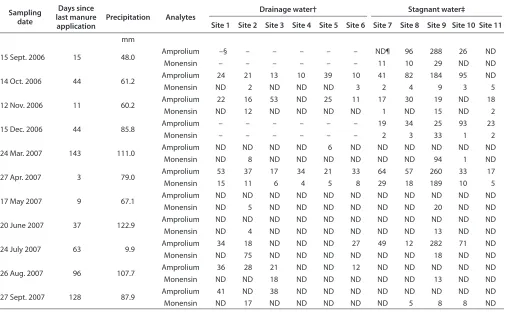
to September 2007). Because of the snow in January and February 2007, we could not collect surface-water samples. In September and December 2006 drainage-water samples were not collected because of insuffi cient fl ow in the drainage chan-nels. h e total number of samples collected was 109 includ-ing 55 stagnant-water samples and 54 drainage-water samples (Table 2). Among the four target pharmaceuticals, amprolium and monensin were most frequently detected; the concentra-tions (without correction by extraction recoveries) are reported in Table 2, along with the days since last manure application and precipitation during sampling intervals. h e concentration ranges and the detection frequencies are presented in Fig. 1. For the stagnant-water samples collected, 25 out of 55 samples contained amprolium above the detectable level, with con-centrations ranging from 12 to 288 ng L−1, and 30 samples
contained monensin at concentrations ranging from 1 to 189 ng L−1. For the 54 drainage-water samples, amprolium was
detected in 27 samples at concentrations between 6 and 53 ng L−1, and monensin was detected in 15 samples at
concen-trations ranging from 2 to 75 ng L−1. A similar concentration
range for monensin (e.g., 20–220 ng L−1) was found in
agricul-tural runoff in the Grand River watershed, Ontario, Canada (Lissemore et al., 2006).
Concentrations of both monensin and amprolium in sur-face water fell within a relatively narrow range for drainage-water samples as compared with those in stagnant drainage-water (Fig.
1). h is could plausibly be attributed to mixing during the process of surface runoff . Surface runoff from diff erent loca-tions of the farm converged and fl owed into drainage channels. It is proposed that this mixing process reduced the variation of pharmaceutical concentrations in drainage water. h e vet-erinary pharmaceuticals present in the stagnant water could result from surface runoff that bypassed the drainage channels, overfl ow from the nearby livestock waste storage lagoons, and/ or desorption from soils contaminated by the pharmaceuticals. Carbadox or tylosin was not found above detection limits in any of the drainage-water samples, but was occasionally detected in stagnant water. Carbadox was detected in three samples of stagnant water at concentrations of 20, 30, and 250 ng L−1, and tylosin was detected in two samples at 100 and 190
ng L−1, respectively. h e relatively low occurrence of tylosin
and carbadox in this study is consistent with previous labora-tory and fi eld studies (Christian et al., 2003; Kay et al., 2004; Kolpin et al., 2002). Kay et al. (2004) reported that in a farm where animal manures were applied, no detectable tylosin was found in tile drainage water, whereas sulfachloropyridazine and oxytetracycline were frequently detected. h e relatively low occurrence of tylosin in surface water at that farm is possibly due to relatively quick abiotic and/or biotic transformations in soils. Hu and Coats (2007) reported that the dissipation half-life of tylosin in soils was approximately 7 d.
Table 2. Sampling date, time since last manure application, precipitation during sampling intervals, and amprolium and monensin concentrations (ng L−1) in surface water.
Sampling date
Days since last manure application
Precipitation Analytes Drainage water† Stagnant water‡
Site 1 Site 2 Site 3 Site 4 Site 5 Site 6 Site 7 Site 8 Site 9 Site 10 Site 11
mm
15 Sept. 2006 15 48.0 Amprolium –§ – – – – – ND¶ 96 288 26 ND
Monensin – – – – – – 11 10 29 ND ND
14 Oct. 2006 44 61.2 Amprolium 24 21 13 10 39 10 41 82 184 95 ND
Monensin ND 2 ND ND ND 3 2 4 9 3 5
12 Nov. 2006 11 60.2 Amprolium 22 16 53 ND 25 11 17 30 19 ND 18
Monensin ND 12 ND ND ND ND 1 ND 15 ND 2
15 Dec. 2006 44 85.8 Amprolium – – – – – – 19 34 25 93 23
Monensin – – – – – – 2 3 33 1 2
24 Mar. 2007 143 111.0 Amprolium ND ND ND ND 6 ND ND ND ND ND ND
Monensin ND 8 ND ND ND ND ND ND 94 1 ND
27 Apr. 2007 3 79.0 Amprolium 53 37 17 34 21 33 64 57 260 33 17
Monensin 15 11 6 4 5 8 29 18 189 10 5
17 May 2007 9 67.1 Amprolium ND ND ND ND ND ND ND ND ND ND ND
Monensin ND 5 ND ND ND ND ND ND 20 ND ND
20 June 2007 37 122.9 Amprolium ND ND ND ND ND ND ND ND ND ND ND
Monensin ND 4 ND ND ND ND ND ND 13 ND ND
24 July 2007 63 9.9 Amprolium 34 18 ND ND ND 27 49 12 282 71 ND
Monensin ND 75 ND ND ND ND ND ND 18 ND ND
26 Aug. 2007 96 107.7 Amprolium 36 28 21 ND ND 12 ND ND ND ND ND
Monensin ND ND 18 ND ND ND ND ND 13 ND ND
27 Sept. 2007 128 87.9 Amprolium 41 ND 38 ND ND ND ND ND ND ND ND
Monensin ND 17 ND ND ND ND ND 5 8 8 ND
† Drainage-water samples were collected from the drainage channels exiting the farm.
‡ Stagnant surface-water samples were collected from the ditches surrounding the farmlands.
§ Not sampled due to insui cient l ow in drainage channels.
h e level and frequency of pharmaceuticals present in sur-face runoff at the farm are infl uenced by the timing of animal manure application, plant growth in manure-applied soils, and weather conditions. During our sampling period, a relatively small amount of liquid animal manure (1.6 × 10⁵ L) was applied
to the fi eld in August 2006. h e application during postharvest season (October and November 2006) was 1.9 × 10⁶ L of liquid
manure. h e more intensive application of manure to the fi elds occurred in spring in which 4.1 × 10⁶ L of liquid and 1.4 × 10⁶
kg of solid manures were applied in April and May 2007. h is application schedule resulted in the highest detection frequency, and the highest concentrations of pharmaceuticals, in water sam-ples collected in April 2007 (3 d after manure application); all these samples were found to contain monensin and amprolium. For the stagnant-water samples, concentrations ranged from 17 to 260 ng L−1 for amprolium, and 5 to 189 ng L−1 for
monen-sin. In comparison, concentrations of these pharmaceuticals in drainage-water samples were lower. Presumably, convergence of surface runoff into the drainage tile system diluted the pharma-ceutical concentrations in water, thereby narrowing the concen-trations to between 17 and 53 ng L−1 for amprolium, and 4 and
15 ng L−1 for monensin (Table 2). h e high number of detections
of veterinary pharmaceuticals in the April samples is consistent with the study by Dolliver and Gupta (2008) in which the high-est detection frequency of antibiotics (i.e., monensin and
tylo-sin) in leachates from a farm in Wisconsin was also in April. A large amount of animal manure was applied in April 2007. h e relatively cold weather in Michigan at this time of year likely inhibited pharmaceutical transformations by reducing micro-bial activity and abiotic reaction rates. Snowmelt commencing during April 2007 in Michigan increased the soil–water contact time, thereby enhancing the release of soil-sorbed pharmaceu-ticals into water. h ese results suggest that manure application after harvest (i.e., in the late-fall and early-spring seasons) in cold regions could lead to the dissemination of pharmaceuticals to the surrounding water during spring snowmelt.
Relatively cold temperatures could be responsible for the enhanced detection frequency of pharmaceuticals in the samples collected in October, November, and December 2006 (Table 2). Amprolium and monensin were frequently detected in surface runoff samples taken during October to December 2006, even though a comparatively small amount of manure was applied to the fi eld during this period. Although a much larger volume of manure was applied in April and May 2007, pharmaceuticals were only occasionally detected in surface water during the grow-ing season (i.e., from May to September 2007). h is is likely due to the enhanced biotic and abiotic pharmaceutical transforma-tions at comparatively high temperatures during the growing season, as well as more biological activities in the plant root zones. It was noted that high concentration and frequency of ampro-lium were found in the water samples collected in July 2007 due possibly to the small precipitation (9.9 mm) compared with the results in other months during that period. Dolliver and Gupta (2008) reported a signifi cant number of detections of monensin and tylosin in farm runoff and leachate in the nongrowing season vs. the growing season. Taken together, these results indicate that land application of manure shortly before the growing season (e.g., early May) could result in less dissemination of veterinary pharmaceuticals to farm runoff water as compared with the appli-cation during the nongrowing season.
Among all the sampling sites, water samples collected from Site 9 had the highest frequency of detection, and contained rela-tively high levels of amprolium and monensin (Table 2). h is site had a small ditch connecting it to a manure pool. h e overfl ow from the livestock manure pool concurrent with each rainfall event most assuredly resulted in localized high concentrations of pharmaceuticals in the stagnant surface water. In this instance, direct discharge of animal waste to surface runoff served as a signifi cant point source responsible for contamination of agri-cultural environment with veterinary pharmaceuticals.
To examine soil contamination by veterinary pharmaceuti-cals, 13 surface soil grab samples were collected from the farm in May and October 2006. Again, similar to the water samples, amprolium and monensin were the two pharmaceuticals most frequently detected in soils. Amprolium and monensin were found above quantifi cation limits in 21 and 24 of the 26 soil samples, respectively. h e concentration ranges were determined between 0.03 to 0.26 μg kg−1 for amprolium, and 0.004 to 0.50
μg kg−1 for monensin (Fig. 2). h e average concentration of
sam-ples collected in October 2006 was 0.01 μg kg−1 for monensin,
and 0.08 μg kg−1 for amprolium, which were less than the
aver-age concentrations in soils sampled in May 2006 (0.095 μg kg−1
for monensin and 0.11 μg kg−1 for amprolium). h e frequent
detection of veterinary pharmaceuticals in soil suggests that soil
could be a large reservoir for these bioactive compounds. h ese contaminants could subsequently be released into water through desorption from soil into water and/or movement of soil par-ticles containing sorbed pharmaceuticals with surface runoff . h ese processes lead to the dissemination of manure-borne phar-maceuticals in agricultural environment.
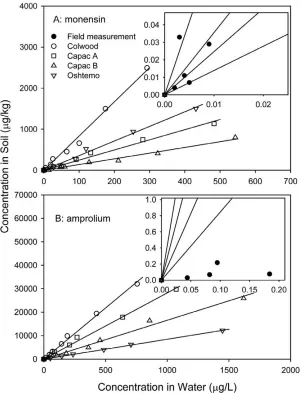
During sampling in October 2006, fi ve soil samples were col-lected beneath stagnant surface water at Sites 7 to 11 (Table 2). At Site 11, amprolium was not detected in surface water or in the soil beneath. Monensin, however, was present in both phases. In all other samples, amprolium and monensin were detected in both soil and water. h e concentrations of amprolium and monensin determined in soils were plotted against their corre-sponding aqueous concentrations (Fig. 3A and 3B), and it was observed that the concentrations in soil increased with increasing aqueous concentrations. h e distribution coeffi cients, defi ned here as the soil-sorbed concentration divided by the correspond-ing concentration in water, were approximately 1.4, 2.0, 2.8, 3.2, and 11.0 L kg−1 for monensin, and 0.4, 0.7, 0.8, and 2.3 L
kg−1 for amprolium, respectively.
Sorption isotherms of monensin and ampro-lium were measured for four soils obtained from sites nearby the farm which contained no detectable levels of the target pharmaceuticals. Sorption iso-therms were nearly linear for the relatively low aque-ous concentrations measured, that is, up to 600 μg L−1 for monensin, and 1600 μg L−1 for amprolium
(Fig. 3). h e distribution coeffi cients (taken from the slopes of the linear isotherms) were from 1.4 to 8.3 L kg−1 for monensin, and 8.4 to 43.6 L kg−1
for amprolium. Soil organic matter contents of the four soils ranged from 1.1 to 6.3%. Normalization of the distribution coeffi cients to SOM (Kom) mani-fests greater variation in the sorption coeffi cients, implying that soil components other than SOM, for example, soil minerals, also contribute to tion. Sassman and Lee (2007) measured the sorp-tion isotherms of monensin by several soils; the isotherms were linear with the distribution coeffi -cients varying from 0.9 to 33.7 L kg−1. Assuming
the sorption isotherms remain linear down to ng L−1 levels, the estimated distribution coeffi cients for
monensin from fi eld sites are within the same order of magnitude as those obtained from the laboratory measurements (inset in Fig. 3A). h is consistency in soil-water distribution of monensin among diff er-ent sites and studies suggests that monensin sorbed by soils is predictably released into the surface water during rainfall events. In contrast to monensin, the distribution coeffi cients estimated from fi eld data for amprolium are four to 100 times less than the sorption measured in laboratory (inset in Fig. 3B). h is distinction can be partially attributed to the relatively low extraction recovery of ampro-lium from soil (i.e., 53%). However, the recovery-corrected distribution coeffi cients only increase by approximately two times, which is insuffi cient to account for the discrepancy in sorption magnitude obtained from laboratory studies vs. fi eld samples.
Fig. 2. Distribution of monensin and amprolium concentrations in soils sampled in May and October 2006. The box-and-whisker plot represents the range, and the 10th, 25th, median, 75th, and 90th percentile of concentration distribution.
Unlike monensin (an organic acid with pKa = 4.2), amprolium has a permanently positive charge that can engage in strong elec-trostatic interactions with the negatively charged sites associated with dissolved organic matter (DOM). Several recent studies (Gu et al., 2007; MacKay and Canterbury, 2005; Sibley and Pedersen, 2008) have demonstrated that cationic and zwitterionic antibi-otics, such as tetracyclines and clarithromycin, can be strongly associated with dissolved humic acid in aqueous solution. Soil amended with animal manure can result in a signifi cant amount of DOM present in surface runoff (Clark et al., 1998). Hence, it is plausible to suggest that amprolium forms associations with DOM, thereby reducing its sorption by soil.
Conclusions
h is study indicates that land application of animal manures could lead to the accumulation of veterinary pharmaceuticals in agricultural lands. h e pharmaceuticals are more frequently detected in surface runoff from the farm during nongrowing season (October to April) than during growing season (May to September). Pharmaceuticals resulting from postharvest manure application appear to be more persistent than those from spring application. Soil is a reservoir for the veterinary pharmaceuti-cals that can be disseminated to nearby surface water by rain-fall events. Several factors, such as manure application timing and rates, weather conditions, soil types, landscape, and crop growth, are confl uent to aff ect the fate and transport of veteri-nary pharmaceuticals in the agricultural environment. A better understanding of the major factor(s) controlling veterinary pharmaceuticals in surface runoff is useful for guiding the land application of livestock manures while minimizing the release of veterinary pharmaceuticals to the environment from agricultural practice. More systemic evaluations of the input/output and dis-semination of veterinary pharmaceuticals, along with detailed information of agricultural practice, are needed to assess the potential risks posing to human and ecosystem health.
Acknowledgments
h is study was supported in part by Agriculture and Food Research Initiative Competitive Grant 2009-65102-05847 from the USDA National Institute of Food and Agriculture, the Center for Water Sciences of Michigan State University, and the Michigan Agricultural Experiment Station.
References
Aga, D.S., S. O’Connor, S. Ensley, J.O. Payero, D.D. Snow, and D. Tarkalson. 2005. Determination of the persistence of tetracycline antibiotics and their degradates in manure-amended soil using enzyme-linked immu-nosorbent assay and liquid chromatography-mass spectrometry. J. Agric. Food Chem. 53:7165–7171.
Batt, A.L., D.D. Snow, and D.S. Aga. 2006. Occurrence of sulfonamide an-timicrobials in private water wells in Washington County, Idaho, USA. Chemosphere 64:1963–1971.
Brown, K.D., J. Kulis, B. h omson, T.H. Chapman, and D.B. Mawhinney. 2006. Occurrence of antibiotics in hospital, residential, and dairy, ef-fl uent, municipal wastewater, and the Rio Grande in New Mexico. Sci. Total Environ. 366:772–783.
Chiou, C.T. 2002. Partition and adsorption of organic contaminants in envi-ronmental systems. John Wiley & Sons, Hoboken, NJ.
Christian, T., R.J. Schneider, H.A. Farber, D. Skutlarek, M.T. Meyer, and H.E. Goldbach. 2003. Determination of antibiotic residues in manure, soil, and surface waters. Acta Hydrochim. Hydrobiol. 31:36–44.
Clark, M.S., W.R. Horwath, C. Shennan, and K.M. Scow. 1998. Changes in soil chemical properties resulting from organic and low-input farming
practices. Agron. J. 90:662–671.
Dolliver, H., and S. Gupta. 2008. Antibiotic losses in leaching and surface runoff from manure-amended agricultural land. J. Environ. Qual. 37:1238–1244.
Gu, C., K.G. Karthikeyan, S.D. Sibley, and J.A. Pedersen. 2007. Complex-ation of the antibiotic tetracycline with humic acid. Chemosphere 66:1494–1501.
Halling-Sørensen, B., A.M. Jacobsen, J. Jensen, G. Sengelov, E. Vaclavik, and F. Ingerslev. 2005. Dissipation and eff ects of chlortetracycline and tylosin in two agricultural soils: A fi eld-scale study in southern Denmark. Envi-ron. Toxicol. Chem. 24:802–810.
Hamscher, G., H.T. Pawelzick, H. Höper, and H. Nau. 2005. Diff erent be-havior of tetracyclines and sulfonamides in sandy soils after repeated fertilization with liquid manure. Environ. Toxicol. Chem. 24:861–868. Hamscher, G., S. Sczesny, H. Höper, and H. Nau. 2002. Determination of
persistent tetracycline residues in soil fertilized with liquid manure by high-performance liquid chromatography with electrospray ionization tandem mass spectrometry. Anal. Chem. 74:1509–1518.
Hao, C., L. Lissemore, B. Nguyen, S. Kleywegt, P. Yang, and K.R. Solomon. 2006. Determination of pharmaceuticals in environmental waters by liq-uid chromatography/electrospray ionization/tandem mass spectrometry. Anal. Bioanal. Chem. 384:505–513.
Hu, D., and J.R. Coats. 2007. Aerobic degradation and photolysis of tylosin in water and soil. Environ. Toxicol. Chem. 26:884–889.
Jacobsen, A.M., B. Halling-Sørensen, F. Ingerslev, and S.H. Hansen. 2004. Simultaneous extraction of tetracycline, macrolide and sulfonamide an-tibiotics from agricultural soils using pressurized liquid extraction, fol-lowed by soil-phase extraction and liquid chromatography-tandem mass spectrometry. J. Chromatogr. A 1038:157–170.
Kay, P., P.A. Blackwell, and A.B.A. Boxall. 2004. Fate of veterinary antibi-otics in a macroporous tile drained clay soil. Environ. Toxicol. Chem. 23:1136–1144.
Kay, P., P.A. Blackwell, and A.B.A. Boxall. 2005. Transport of veterinary anti-biotics in overland fl ow following the application of slurry to arable land. Chemosphere 59:951–959.
Kim, S.-C., and K. Carlson. 2007. Temporal and spatial trends in the occur-rence of human and veterinary antibiotics in aqueous and river sediment matrices. Environ. Sci. Technol. 41:50–57.
Kolpin, D.W., E.T. Furlong, M.T. Meyer, E.M. h urman, S.D. Zaugg, L.B. Barber, and H.T. Buxton. 2002. Pharmaceuticals, hormones, and other organic wastewater contaminants in U.S. streams, 1999–2000: A nation-al reconnaissance. Environ. Sci. Technol. 36:1202–1211.
Kuchta, S.L., A.J. Cessna, J.A. Elliott, K.M. Peru, and J.V. Headley. 2009. Transport of lincomycin to surface and ground water from manure-amended cropland. J. Environ. Qual. 38:1719–1727.
Larsbo, M., D.R. Lapen, E. Topp, C. Metcalfe, K.C. Abbaspour, and K. Fenner. 2009. Simulation of pharmaceutical and personal care prod-uct transport to tile drains after biosolids application. J. Environ. Qual. 38:1274–1285.
Lissemore, L., C. Hao, P. Yang, P. Sibley, S. Mabury, and K.R. Solomon. 2006. An exposure assessment for selected pharmaceuticals within a watershed in southern Ontario. Chemosphere 64:717–729.
MacKay, A.A., and B. Canterbury. 2005. Oxytetracycline sorption to organic matter by metal-bridging. J. Environ. Qual. 34:1964–1971.
Mellon, M., C. Benbrook, and K.L. Benbrook. 2001. Hogging it: Estimates of antimicrobial abuse in livestock. Union of Concerned Scientists, Cam-bridge, MA.
Sassman, S.A., and L.S. Lee. 2007. Sorption and degradation in soils of veteri-nary ionophore antibiotics: Monensin and lasalocid. Environ. Toxicol. Chem. 26:1614–1621.
Sibley, S.D., and J.A. Pedersen. 2008. Interaction of the macrolide antimicro-bial clarithromycin with dissolved humic acid. Environ. Sci. Technol. 42:422–428.
Snow, D.D., S.L. Bartelt-Hunt, S.E. Saunders, S.L. Devivo, and D.A. Cassada. 2008. Detection, occurrence and fate of emerging contaminants in agri-cultural environments. Water Environ. Res. 10:868–897.
Song, W., M. Huang, W. Rumbeiha, and H. Li. 2007. Determination of amprolium, carbadox, monensin, and tylosin in surface water by liq-uid chromatography/tandem mass spectrometry. Rapid Commun. Mass Spectrom. 21:1944–1950.
Stoob, K., H.P. Singer, S.R. Mueller, R.P. Schwarzenbach, and C.H. Stamm. 2007. Dissipation and transport of veterinary sulfonamide antibiotics after manure application to grassland in a small catchment. Environ. Sci. Technol. 41:7349–7355.