®
The Eastern Mbum Survey:
An Assessment of the
Extendability of Current
Language Development
Projects
The Eastern Mbum Survey:
An Assessment of the Extendability of Current
Language Development Projects
Lawrence Marc Seguin
SIL International® 2012
SIL Electronic Survey Report 2012-039, September 2012 © 2012 Lawrence Marc Seguin and SIL International®
THE EASTERN MBUM SURVEY: AN ASSESSMENT OF THE EXTENDABILITY
OF CURRENT LANGUAGE DEVELOPMENT PROJECTS
The members of the Committee approve the masters thesis of Lawrence Marc Seguin
Frank Robbins ________________________________ Supervising Professor
Thomas Crowell ________________________________
Now there were staying in Jerusalem God-fearing Jews from every nation under heaven. When they heard this sound, a crowd came together in bewilderment, because each one heard them speaking in his own language. Utterly amazed, they asked: "Are not all these men who are speaking Galileans? Then how is it that each of us hears them in his own native language? Parthians, Medes and Elamites; residents of
Mesopotamia, Judea and Cappadocia, Pontus and Asia, Phrygia and Pamphylia, Egypt and the parts of Libya near Cyrene; visitors from Rome (both Jews and converts to Judaism);
Cretans and Arabs--we hear them declaring the wonders of God in our own tongues!"
THE EASTERN MBUM SURVEY: AN ASSESSMENT OF THE EXTENDABILITY
OF CURRENT LANGUAGE DEVELOPMENT PROJECTS
by
LAWRENCE MARC SEGUIN
Presented to the Faculty of the Graduate School of
The University of Texas at Arlington in Partial Fulfillment
of the Requirements
for the Degree of
MASTER OF ARTS IN LINGUISTICS
THE UNIVERSITY OF TEXAS AT ARLINGTON
iv
ACKNOWLEDGEMENTS
From July 1988 to June 1990 I had the privilege of doing
sociolinguistic survey work with the Société Internationale de
Linguistique in Cameroon. During that time I was mentally and
physically stretched as I grew not only in my awareness of the
fascinating linguistic puzzle I was daily working with, but
also in my excitement about the contribution I was helping
make to Cameroon's linguistic development. From that sprang
my decision to write my thesis on some of the work I did.
Writing this thesis has been a stretching experience as
well, and now that it is finished, I am glad that I accepted
the challenge. One of my main motivations for undertaking
this project was to provide other sociolinguistic researchers
with something solid to refer to in their own efforts to
un-ravel whatever sociolinguistic puzzles they themselves come up
against. I hope that what I have written will be useful.
Many people have supported me as I have documented the
Eastern Mbum survey. Of these I would like to especially
acknowledge the following:
First of all, my heartfelt gratitude goes to Dr. Frank
Robbins for his invaluable assistance. He stimulated me to
think through the things I was saying, to smooth out the weak
v
Dr. Tom Crowell for their input and insights.
Others who I wish to acknowledge are: the people of the
villages of Djakon, Gay Touklou, Hankao, Koutere, Ndol, Ngaram
Ngole, Ngoumi, Pandjama, Pao, and Sorombéo for their
coopera-tion in our efforts; the members of the Cameroon's Centre for
Anthropological Research and Studies, for contributing their
unique perspective to the survey task and providing that
es-sential cultural insight their non-Cameroonian SIL colleagues
lacked; the members of the SIL's sociolinguistic survey
de-partment in Cameroon, for their dedication, professionalism,
and sense of fun; and the friends and family members who
sup-ported me with their words, prayers, and financial backing.
Ultimately, however, my best thanks goes to the Lord
Jesus Christ. It is He who gave me the vision to work in
Cameroon, and so it is to Him that I dedicate this thesis.
vi ABSTRACT
THE EASTERN MBUM SURVEY: AN ASSESSMENT OF THE EXTENDABILITY
OF CURRENT LANGUAGE DEVELOPMENT PROJECTS
Publication no. ______
Lawrence Marc Seguin, M.A.
The University of Texas at Arlington, 1991
Supervising Professor: Frank Robbins
In a nation as linguistically complex as Cameroon, where
more than 200 languages are spoken, language developers must
strive to make maximum use of limited human and financial
resources by concentrating their efforts on those speech
varieties which would be usable in as many related speech
communities as possible.
This thesis documents a survey conducted in early 1990
within the Eastern Mbum group, located at the intersection of
Cameroon, Chad, and Central African Republic. Its goal was to
determine whether language development projects in Karang,
Kuo, and Nzak Mbay can be extended to five other Eastern Mbum
communities: Man, Mbere, Ngomi, Pana, and Sakpu. The tools
vii
the data collected and proposes a two-stage strategy for
viii
TABLE OF CONTENTS
ACKNOWLEDGEMENTS
ABSTRACT
LIST OF TABLES
CHAPTER I: INTRODUCTION
1.1 Research Considerations
1.2 Background Information on Cameroon
1.3 Background Information on the Eastern Mbum Group
CHAPTER II: LEXICOSTATISTIC ANALYSIS
2.1 Diachronic versus Synchronic Perspective
2.2 Lexical Similarity/Intelligibility Relationship 2.3 Lexicostatistics as a Screen for Intelligibility Testing
2.4 Analysis of Eastern Mbum Lists 2.5 WORDSURV Analysis
CHAPTER III: INTELLIGIBILITY TESTING
3.1 Historical Background 3.2 Description of the Test 3.3 Interpretation of Scores 3.4 Test Results
3.5 Conclusions
CHAPTER IV: QUESTIONNAIRE ANALYSIS--INTELLIGIBILITY AND ATTITUDES WITH RESPECT TO KARANG, KUO, AND NZAK MBAY
4.1 Methodology
ix
4.4 Attitudes towards the Use of Karang, Kuo, and Nzak Mbay
4.5 Conclusions
CHAPTER V: FULFULDE INFLUENCE IN THE UNWRITTEN-VARIETY COMMUNITIES
5.1 Background
5.2 Questions Underlying the Four Characteristics 5.3 Analysis of Data
5.4 Conclusions
CHAPTER VI: CONCLUSION--A STANDARDIZATION STRATEGY FOR EASTERN MBUM
6.1 Standardization
6.2 The Key Standardization Agency: The Language Committee
6.3 Stage #1: Development and Promotion of Shared Literature Using CADA
6.4 Stage #2: Standardization of a Single Form 6.5 Potential Problems in Implementing the Strategy
APPENDIX A: Map of Eastern Mbum Area
APPENDIX B: Individual Sociolinguistic Questionnaire
APPENDIX C: Group Intercomprehension Questionnaire
APPENDIX D: CREA 120-Item Word List (English/French)
x
LIST OF TABLES
Table 1. Lexical similarity of Eastern Mbum speech varieties (percent)
Table 2. Intelligibility of unwritten varieties among written-variety speakers (percent) Table 3. Intelligibility of written varieties
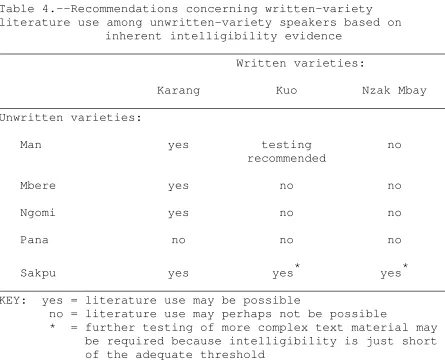
among unwritten-variety speakers (percent) Table 4. Recommendations concerning written-
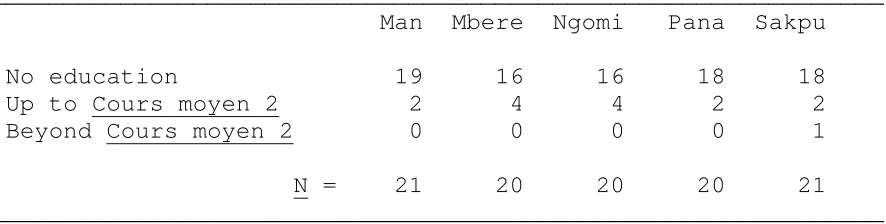
variety literature use among unwritten-variety speakers based on inherent intelligibility evidence Table 5. Education of respondents
Table 6. Mobility of respondents
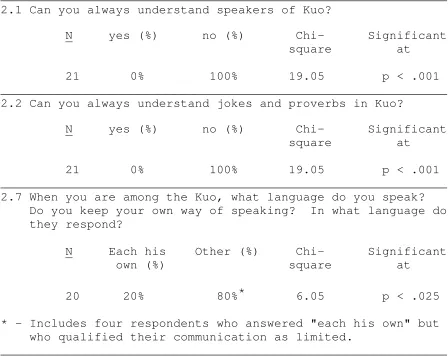
Table 7. Comprehension of Kuo by Man speakers Table 8. Comprehension of Karang by Man speakers Table 9. Comprehension of Nzak Mbay by
Man speakers
Table 10. Comprehension of Kuo by Mbere speakers Table 11. Comprehension of Karang by Mbere speakers Table 12. Comprehension of Nzak Mbay by
Mbere speakers
Table 13. Comprehension of Kuo by Ngomi speakers Table 14. Comprehension of Karang by Ngomi speakers Table 15. Comprehension of Nzak Mbay by
Ngomi speakers
Table 16. Comprehension of Kuo by Pana speakers Table 17. Comprehension of Karang by Pana speakers Table 18. Comprehension of Nzak Mbay by
Pana speakers
Table 19. Comprehension of Kuo by Sakpu speakers Table 20. Comprehension of Karang by Sakpu speakers Table 21. Comprehension of Nzak Mbay by
Sakpu speakers
Table 22. Adequacy of written-variety intelligibility among unwritten-variety speakers
Table 23. Personal literacy and children's
initial education: Attitudes of Man speakers towards the use of Karang, Kuo, and Nzak Mbay
Table 24. Personal literacy and children's
xi
initial education: Attitudes of Ngomi speakers towards the use of Karang, Kuo, and Nzak Mbay
Table 26. Personal literacy and children's
initial education: Attitudes of Pana speakers towards the use of Karang, Kuo, and Nzak Mbay
Table 27. Personal literacy and children's
initial education: Attitudes of Sakpu speakers towards the use of Karang, Kuo, and Nzak Mbay
Table 28. Intelligibility (I) and attitudes (A) of unwritten-variety speakers with respect to written varieties
Table 29. Fulfulde bilingualism among unwritten-
variety speakers
Table 30. Attitudes towards using Fulfulde in children's initial education and for
personal literacy
Table 31. Language use by children at play Table 32. Abandonment of local speech variety
in favor of another: overall Table 33. Abandonment of local speech variety
in favor of another: by community Table 34. Abandonment of local speech variety
1
CHAPTER I
INTRODUCTION
The Republic of Cameroon, a nation of some eleven
mil-lion inhabitants on the west coast of central Africa, is a
rich blend of languages, nationalities, and landscapes that
has earned it the nickname "Africa in miniature." From the
Gulf of Guinea in the south to Lake Chad in the north, its
geography offers lush equatorial forest, rolling mountains and
deep valleys, savannah reminiscent of the film Out of Africa,
and near-desert that announces the fringes of the Sahara.
Research documented in Dieu and Renaud (1983) indicates
that the people of Cameroon speak some 239 different
lan-guages, representing four of the five language families
pre-sent in Africa: Afro-Asiatic, Nilo-Saharan,
Niger-Kordofan-ian, and Indo-European (Cameroon Pidgin English). For years
these indigenous languages or mother tongues (also called
"national languages" by Cameroonian linguists, cf. Johnson
1990:11) were overlooked in favor of English and French.
First under the colonial administrators, then under
Cameroon-ians themselves, English and French became firmly entrenched
as the official languages of education and government, and to
Cameroonians are encouraged to become fluent in both these
languages.
Attitudes towards the national languages have changed,
however, and in 1985, at the congress of the Cameroon People's
Democratic Movement (CPDM) in the city of Bamenda, both the
party and President Paul Biya made statements in support of
mother-tongue development. Since then, research, though
limited in scope, has been carried out on Cameroon's mother
tongues through agencies of the primary government research
institution, the Ministry of Higher Education, Computer
Ser-vices, and Scientific Research (known officially by its French
acronym, MESIRES). These agencies are the Centre for
An-thropological Research and Studies (CREA in French), and the
Department of Linguistics and African Languages at the
Univer-sity of Yaoundé.
From July 1988 to June 1990 I was part of the
sociolin-guistic survey team of the Société Internationale de
Linguis-tique (SIL) in Cameroon. In conjunction with the sponsoring
government agencies, the team's activities were centered on
helping determine needs for language development projects
among Cameroon's mother tongues. Part of this broad effort
was a linguistic and sociolinguistic survey carried out early
in 1990 within the Eastern Mbum group of northern Cameroon,
southwestern Chad, and northwestern CAR. The goal of this
survey was to assess the feasibility of expanding SIL projects
other, presumed genetically related speech varieties. These
were Man, Mbere, Ngomi, Pana, and Sakpu. We also studied
whether Scriptures being translated by Roman Catholic priests
into a third variety, Nzak Mbay, could also be used by other
Eastern Mbum speakers.
This paper attempts to document our survey and its
results. In this first chapter I lay the groundwork for what
I plan to discuss in the remaining chapters. It is divided
into the following sections:
- (1.1) research considerations, including the research
question, motivation, purpose, description of the survey, and
definitions;
- (1.2) background information on Cameroon, including
general linguistic situation and policy towards mother-tongue
literacy;
- (1.3) background on the Eastern Mbum group, including
demographic and geographic orientation, linguistic
classifica-tion, and language development work to date.
1.1 Research Considerations
1.1.1 Research Question
The research question is: Can literature in Karang,
Kuo, or Nzak Mbay be used in any or all of the other five
Eastern Mbum communities surveyed (Man, Mbere, Ngomi, Pana,
and Sakpu)? From the answer to this question, what sort of
In answering the research question, I look at the
fol-lowing aspects:
1) inherent intelligibility relationships, including
evidences of bilingual overlay;
2) speaker attitudes towards the use of Karang, Kuo, and
Nzak Mbay for personal literacy and in children's initial
edu-cation;
3) bilingual proficiency in and speaker attitudes
towards Fulfulde, the language of wider communication in the
Eastern Mbum area. This last aspect is dealt with only
briefly.
1.1.2 Motivation
The primary motivation for this research is two-fold:
1) to answer the research question concerning the potential
usability of Karang, Kuo, or Nzak Mbay literature in other
Eastern Mbum speech communities, and 2) to propose a strategy
for providing literature to all Eastern Mbum speakers. The
answer to this will especially benefit those currently
devel-oping literature in these three speech varieties, as it will
more clearly reveal the potential value of attempting to
ex-pand their projects to the surrounding communities. It will
also benefit those who hope to see literature development in
the other five speech varieties.
Furthermore, by showing how the model is applied and the
hope to provide my peers, both in Cameroon and elsewhere, with
a concrete tool for testing the feasibility of expanding
ongo-ing language-development projects to surroundongo-ing speech
commu-nities.
1.1.3 Purpose
The purpose of this study is to document the model
(in-cluding a description of the procedures followed) that was
employed to answer the research question. The same model has
also been used, and is currently being used, for other similar
surveys in Cameroon. It encompasses three types of analysis:
lexicostatistics, intelligibility testing, and self-reports.
These are described in the following paragraphs.
Lexicostatistics is the subject of Chapter II. It
in-volves comparing vocabulary lists from two speech varieties
suspected to be genetically related, and calculating a
per-centage of lexical similarity between them. The results are
used to determine whether or not intelligibility testing
should be done between the speech varieties concerned.
Intelligibility testing is discussed in Chapter III. It
uses tape-recorded narrative texts, as described in Casad
(1974). Testing was conducted for any pair of speech
vari-eties with greater than 60% lexical similarity. The need for
an objective test presupposes that high lexical similarity in
itself is not sufficient evidence of the type of
complex reasonings and arguments in another variety. In fact,
Joseph Grimes (1988a) argues that at greater than 60% lexical
similarity, the correlation between lexical similarity and
intelligibility is weak. Low similarity, on the other hand,
does correlate with low intelligibility, and thus
intelligi-bility testing is not deemed necessary for pairs with less
than 60% lexical similarity.
The results should help us determine: (1) whether or
not inherent intelligibility (cf. definition in section 1.1.5)
is such that Karang, Kuo, or Nzak Mbay literature can be used
among speakers of Man, Mbere, Ngomi, Pana, and Sakpu; and
(2) whether there is an overlay of acquired intelligibility
(cf. definition in section 1.1.5) that can be investigated at
a later time. The interpretation of scores is based on
Joseph Grimes' (1988b) and Barbara Grimes' (1987a, 1988b)
studies.
The discussion on intelligibility assumes that oral
in-telligibility equals written inin-telligibility. This does not
always prove to be so. As Hatfield (1991:259) points out in
the case of German in Switzerland, written intelligibility can
be much broader than oral intelligibility, and extend to
groups who would hardly be understood by speakers of standard
German. I confirmed this in conversation with Peter Knapp, a
linguistics student at the University of Texas at Arlington,
who is a native speaker of a Low German dialect (personal
In this survey, however, I am dealing with preliterate
societies. Thus I have no choice but to apply a measure of
oral intelligibility, and Casad's approach provides
quantifi-able data that can be compared with other data.
Speaker self-reports form the basis for Chapters IV
and V. In Chapter IV, they are used to indicate those
speak-ers' abilities to understand Karang, Kuo, and Nzak Mbay, as
well as their attitudes towards the use of any or all of these
speech varieties both for personal literacy and for children's
initial education in local schools. In Chapter V, they help
determine the influence of Fulfulde, the language of wider
communication in northern Cameroon, within the Eastern Mbum
group. I examine this issue from two standpoints: bilingual
proficiency in Fulfulde and the areas of social interaction in
which Fulfulde appears to dominate.
Two types of questionnaire were used: an individual
questionnaire devised by SIL and CREA (Appendix B), and a
group questionnaire developed by Etienne Sadembouo of CREA
(Appendix C).
As far as intelligibility is concerned, the self-report
data were compared with the intelligibility test results to
discover areas of agreement or disagreement. This comparison
also sought to shed some light on inconclusive intelligibility
test results. I assumed that the intelligibility test results
should be considered more reliable, as they are based on an
In Chapter VI I go beyond the analytical model and
at-tempt to propose a strategy for promoting the use of Karang,
Kuo, and Nzak Mbay in those communities where their usability
appears established. I also endeavor to assess the potential
for standardizing a single written form of Eastern Mbum. This
part of the study focuses on Cameroon; since, however, the
Eastern Mbum group also spreads in Chad and CAR, I consider
the potential for standardization in those countries as well.
1.1.4 Description of the Survey
The survey took place from January 7 to February 5,
1990. The two organizations involved in this endeavor were
SIL and CREA.
Field work took place in those communities where the
eight aforementioned Eastern Mbum speech varieties are spoken.
Although all eight communities have representative populations
in Tcholliré and Touboro sub-divisions of Cameroon's North
Province, Kuo and Nzak Mbay have sizeable populations in Chad,
and Pana is primarily spoken in Central African Republic
(CAR). A map showing major towns and the villages in which
work was conducted appears as Appendix A. Man also has a
strong representation in CAR. More details on the Eastern
Mbum group are given in section 1.3.
At the time of the survey, two different SIL teams were
carrying out systematic analysis of Kuo and Karang for the
material for each of these groups, including a translation of
the Bible. In addition, the Roman Catholic missions in
Touboro (Cameroon) and Baibokoum (Chad) had produced some
portions of Scripture, a catechism, and liturgy in Nzak Mbay
for use in the local Catholic parishes. There was also a
Protestant-led language committee in Chad working on a
re-vision of the Nzak Mbay New Testament. Apparently, there are
differences between the Baibokoum and Touboro missions with
respect to the orthography, with the Touboro mission using a
long-standing modified French orthography and the Baibokoum
mission a more linguistically oriented one (Daniel Davis, SIL,
personal communication).
No other Eastern Mbum speech variety is currently being
analyzed for development as a written language.
Certain constraints and circumstances resulted in the
following limitations in the study:
Although the individual sociolinguistic questionnaire
(Appendix B) covered several other areas of interest
(multi-lingualism, ability to speak Karang, Kuo, and Nzak Mbay,
feas-ibility of using Mbum Ngaoundéré and Fulfulde), this study is
primarily limited to investigating how inherent
intelligibil-ity and attitudes may affect the feasibilintelligibil-ity of using Karang,
Kuo, and Nzak Mbay literature in the Eastern Mbum communities
surveyed. I also briefly discuss Fulfulde influence in
Intelligibility testing focused only on comparing
writ-ten speech varieties (Karang, Kuo, Nzak Mbay) to unwritwrit-ten
ones (Man, Mbere, Ngomi, Pana, Sakpu; cf. definitions in
sec-tion 1.1.5). No attempt was made to test the three written
speech varieties with one another or the five unwritten
varie-ties with one another.
Owing to time constraints (four weeks for the survey to
be conducted), the sociolinguistic study was limited to one
representative village for each of the five unwritten
speech-variety communities. In each community, only 20 people were
administered the individual questionnaire, and one group of
people was asked to take part in the group interview.
Long-term observation of language-use patterns was not possible.
None of the surveyors had any knowledge of the trade
language, Fulfulde, and knowledge of any of the Eastern Mbum
speech varieties was limited to SIL researchers Suellyn
Glidden, who could communicate relatively easily in Kuo, and
Daniel Davis, who had just begun learning Karang.
Communica-tion, therefore, was primarily in French and through
inter-preters, which to an undetermined extent may have introduced
some error into our findings.
1.1.5 Definitions
What follows specifies my usage of certain key terms.
Speech variety: For the purposes of this paper this
community and identifiable with a specific name. This
commu-nity may encompass more than one village. In this regard
re-ference will be made to written speech varieties (Karang, Kuo,
and Nzak Mbay) and unwritten speech varieties (Man, Mbere,
Ngomi, Pana, and Sakpu.)
Inherent intelligibility: Refers to "that special case
of intelligibility which is the theoretical degree of
under-standing between dialects whose speakers have had no contact"
(G. Simons 1983:3).
Acquired intelligibility or bilingual overlay: Refers
to the degree of understanding of another speech variety which
comes through contact with it over time. The other speech
variety may or may not be linguistically related. Generally
speaking, this ability, also known as bilingualism, varies
greatly from one person to another (J. Grimes 1988a:19).
Both inherent and acquired intelligibility can be
de-fined in terms of adequate, marginal, or inadequate
intelli-gibility, defined as follows:
Adequate intelligibility: Speakers of a speech variety
A are said to have adequate intelligibility of another speech
variety B when they can understand complex arguments and
reasonings in B such as those found in hortatory, expository,
and explanatory discourse (B. Grimes 1987a:19-20). They would
thus be able to use literature written in B in a manner
Marginal intelligibility: This is deemed present when
the ability of speakers of A to understand B is limited.
Simple discourse such as narrative is easy to understand, but
there are gaps in understanding more complex discourse. These
gaps may affect the ability to effectively use written
materi-als in speech variety B. Barbara Grimes (1987a:19) writes:
. . . there is a marginal area in which the mind cannot fill in sufficiently well or rapidly enough to understand the relationships between the parts it can understand, even when it can do that with most narratives, which are easier to understand.
Marginal intelligibility has been documented among some Campa
dialects of Peru as well as among some Zapotecan dialects of
Mexico. In these cases, speakers of one dialect are reported
to understand narrative discourse in another dialect, but not
hortatory, expository, or explanatory discourse in that other
dialect (cf. B. Grimes 1988b:58).
Inadequate intelligibility: Refers to the inability of
speakers of A to understand B beyond a basic level, if at all.
Thus written literature in B would not be considered usable
among speakers of A, barring a significant level of bilingual
proficiency in B (B. Grimes 1987a:19-20; J. Grimes 1988a:21).
Varieties (dialects) of the same language: Refers to
two or more speech varieties that are sufficiently similar
and the same written materials can be used for both
communi-ties.
Distinct languages: Will refer to two or more speech
varieties whose differences are such that there is inadequate
or marginal inherent intelligibility among them. Separate
literatures may therefore have to be devised for each.
Standardization: For this I will be using the
defini-tion proposed by Hatfield (1991:252-3): "The development of a
written form of a language which covers as broad a grouping of
dialects of that language as possible and which still may be
comprehensible to its speakers."
1.2 Background Information on Cameroon
1.2.1 General Linguistic Situation
The linguistic situation in Cameroon is highly complex.
Citing Dieu and Renaud (1983), Dunnigan (1990:20) reports that
of the 239 languages spoken in the country, 67 have a written
tradition, as evidenced by the existence of Bibles,
cate-chisms, poems, stories, collections of proverbs, songs, local
newspapers, or other documents. Twenty-one languages are
standardized or in a working phase of standardization, and 53
others have some standardization activity currently in
prog-ress. Twenty-one others are cited as likely to be
standard-ized. (In Dieu and Renaud, not all languages considered
stan-dardized or in the process of standardization are defined as
as having a written tradition are considered standardized or
in the process of standardization.)
1.2.2 Policy towards Mother-Tongue Literacy
According to Dunnigan (1990:16), since French Cameroun's
independence and its subsequent unification with the British
Cameroons in 1961, the Cameroonian government has been
promot-ing a policy of official French and English bilpromot-ingualism in
the formal education system. This policy's goal is to ensure
that "each student would acquire fluency in both of the
nation's two official languages" (1990:16).
As far as mother-tongue development and literacy are
concerned, however, Dunnigan (1990:24) describes the
govern-ment's policy as being "somewhat ambiguous". Statements in
support of mother-tongue development have been made by the
government, but actions in this regard have been limited. No
commitment has been made on the use of mother tongues for mass
information and literacy.
Nevertheless, as Dunnigan goes on to say (1990:26),
research is being carried out on Cameroon's mother tongues
through agencies of the primary government research
institu-tion, MESIRES. The primary project related to mother tongue
literacy is the Operational Research Project in the Teaching
of Languages in Cameroon, or PROPELCA in French. Its aim is
to "provide a workable model for the use of mother tongues in
purely bilingual system" (Dunnigan 1990:28). As of 1989
ex-perimental PROPELCA programs were under way in eleven schools
in four languages: Ewondo (spoken in Central Province), Duala
(spoken in Littoral Province), Lamnso' (spoken in Northwest
Province), and Fe'efe'e (spoken in West Province). The
PRO-PELCA project involves not only faculty from the university
but also personnel from SIL and from both Catholic and
Protes-tant institutions.
1.3 Background Information on the Eastern Mbum Group
1.3.1 Demographic and Geographic Orientation
The Eastern Mbum group spreads across a rather large
geographic area (Appendix A). Its northern border reaches
roughly from the town of Tcholliré, east across the border of
Chad, and into Baibokoum sub-division. From this line it goes
south as far as the southern road from Ngaoundéré to Touboro
in Cameroon, and southeast into southern Chad and northwestern
CAR. There are also migrant communities in and around the
major cities of Ngaoundéré and Garoua in Cameroon, and Moundou
in Chad. Population estimates are necessarily very rough,
since the figures from Cameroon's 1987 census do not include
reference to ethnic affiliation, and verifiable figures are
not available for Chad and CAR. Best estimates from Ubels
(1988) combine with figures from Barbara Grimes (1988a) to set
the total population of the group, including speakers of
ap-proximately 200,000. The estimated total for the eight speech
varieties directly surveyed is 100,000, divided as follows:
Karang 10,000; Mbum (encompassing Mbum Ngaoundéré, Mbere,
Gbete, and Nzak Mbay) 38,600; Sakpu (including Ngomi) 7,000;
and Pana (including communities in CAR) 40,000. Man is not
listed.
Access to the area is generally good; the system of dirt
roads is graded annually, and travel is difficult only during
a few months of the rainy season (July to September). A very
good paved road runs from Ngaoundéré north towards Garoua and
beyond. The exit onto the dirt road to Tcholliré intersects
this main highway at Guidjiba, about two hours' drive from
Ngaoundéré. From here to the heart of the Eastern Mbum area
is another four-hour drive under normal conditions.
The area is primarily arboreal savanna, tending to
herb-aceous savanna toward the north. The soil is very fertile in
most regions, and agriculture has become the way of life of
most of the inhabitants, although the Mbum people were
gener-ally semi-nomadic hunter-gatherers around the turn of the
cen-tury, only beginning to settle along newly-built roads in the
1930s and 1940s.
These peoples were among the many groups of northern
Cameroon who were subjugated by the southward sweeps of the
Muslim Fulani around the turn of the century. Most Mbum clan
groups adopted an informal policy of passive resistance toward
laamido (Muslim paramount chief) required of his subjects. In
this way, they have retained to a significant degree their
cultural and linguistic identities across the years since the
first conquests.
1.3.2 Linguistic Classification
Following Greenberg's (1955) classification, the Eastern
Mbum group is Niger-Congo, Adamawa-Ubangi, Adamawa, Group 6.
This classification has been further developed by several
linguists, but Boyd (1974) has developed the most thorough
subclassification of Group 6. His classification has been
further modified by Ubels and Ubels (1980) and again by Dieu
and Renaud (1983). Unfortunately, these classifications do
not agree. In addition, many of the available word lists for
the speech varieties of the group were, for one reason or
another, untrustworthy. In fact, very little detailed
lin-guistic information is available on these speech varieties,
with the exception of Karang (Ubels and Ubels 1980), Kuo
(Glidden 1984), and Mbum (Hagège 1970). Word lists and terse
grammatical statements frequently conflict, and completely
erroneous information abounds.
For the purpose of establishing a beginning point for
determining which speech varieties to test, the survey team
decided to follow the classification suggested by Ubels and
Ubels (1980:5). This decision stemmed primarily from the
that could not be matched by any of the other sources. Though
the phonological description from which the classification is
drawn was written in 1980, personal communication with the
Ubelses prior to the survey indicated that they saw no reason
to modify it based on existing information.
The suggested classification of group 6 was as follows:
I. Adamawa Group 6 A. Western
1. Pam/Mono, Mundang
2. Dama, Galke/Pormi, Kali (Kari)
B. Eastern
1. Mbum (Ngaoundéré), Man, Mbere, Kpere 2. a. Sakpu, Kuo
b. Karang, Nzak Mbay, Pana, Ngoumi, Kare
Known speech varieties left unclassified were Dek, Mbum
Mbay, Tupuri, Pondo, Gonge, and Tale. The survey team did not
work on these particular speech varieties and have no plans to
work on them in the immediate future.
1.3.3 Language Development Work to Date
Karang
According to Davis (1989), an SIL research team began
work in Karang in 1978 at the request of the Evangelical
Lutheran Church in Cameroon (or EELC in French). Research was
centered in the village of Sorombéo, the geographic center of
The following types of material have been produced in
Karang: post-primers, primers, a provisional dictionary,
health and nutrition books, prayer and song books, substantial
first-draft portions of the New Testament, an adaptation of
the Christmas and Easter stories, and the Gospel of Luke. A
comparative study of Karang and Kuo has also been produced.
Kuo
An SIL team began work in the village of Ndol, Chad, in
around 1983 following repeated requests from the Kuo-speaking
community. Their desire to see a project of their own started
was partly in response to the Karang project already under way
(Edward Ubels, personal communication).
The following types of material have been produced in
Kuo: primers, an alphabet book, an alphabet chart, calendars,
daybooks, health booklets, a hymn book, substantial
first-draft portions of the New Testaments. The Gospels of Mark and
Luke, 1 Thessalonians, and Philemon have been published.
Various linguistic descriptions have also been produced
(phonology, verbal system description, comparative study of
Kuo and Karang).
Nzak Mbay
According to Daniel Davis (personal communication), in
the 1940s and 1950s a New Testament translation was done by
people without linguistic training. In the last 20 to 30
Cameroon and Baibokoum, Chad have produced some new portions
of Scripture in Nzak Mbay, as well as a catechism and liturgy.
Suellyn Glidden also reports that Chadian Protestants have
been working on revising a past New Testament translation
(personal communication). Their committee includes some Roman
Catholic members, although not the European priests.
The Touboro and Baibokoum missions disagree on
orthogra-phy and translation style in the New Testaments they are
pre-paring. The priest in Baibokoum has received some SIL help in
his translation work, and Glidden expects his New Testament to
be produced in the near future. It will be based on the
or-thography in use in Cameroon. Davis considers it unlikely
that a harmonization of efforts between the two missions will
soon be achieved. As things now stand, it appears that Nzak
21
CHAPTER II
LEXICOSTATISTIC ANALYSIS
After identifying the Eastern Mbum speech varieties, the
survey team carried out lexicostatistic analysis of identical
vocabulary lists from each of these. The purpose of this
analysis was to calculate percentages of lexical similarity
among all the speech varieties concerned and ascertain which
ones should be candidates for intelligibility testing with
Karang, Kuo, and Nzak Mbay.
The following topics are discussed in this chapter:
- (2.1) the diachronic versus the synchronic perspective
in lexicostatistic analysis, with emphasis on the synchronic
perspective;
- (2.2) the relationship between lexical similarity and
intelligibility;
- (2.3) the use of lexicostatistics as a screen for
determining which speech-variety pairs require intelligibility
testing;
- (2.4) the analysis of the Eastern Mbum word lists,
including (i) how lexically similar items were determined;
(ii) the collection and analysis of the word lists; (iii) the
results of the analysis; and (iv) my conclusions as to which
the revision of the initial word list analysis using Wimbish's
(1989) WORDSURV program.
2.1 Diachronic versus Synchronic Perspective
Gary Simons (1977:11) writes that lexicostatistic
anal-ysis can be done from a diachronic or a synchronic
perspec-tive, and the approach used will affect how the researcher
ultimately carries out his analysis and interprets its
re-sults. This distinction was first discussed and contrasted by
Saussure (1959:81,90).
The diachronic approach is used to learn something about
the genetic classification of the speech varieties studied, or
infer something about the origins and early movements of a
group of people. In word-list analysis, it entails the
his-torical reconstruction of a parent or proto-form through the
investigation of regular sound correspondences between lists
of vocabulary items from presumed genetically related speech
varieties.
The synchronic perspective, on the other hand, views a
language as it exists in one point in time. Broadly speaking,
this is the approach used when the linguist is looking at the
effect of social factors on communication between speech
com-munities, or at the degree of communication possible between
them. In lexicostatistics, the synchronic approach can be
used in attempting to measure how well groups could be
of lexical similarity between their respective speech
varie-ties.
Since my interest in this study is to measure potential
communication among Eastern Mbum speech communities and not to
attempt any historical reconstruction of a "proto-Eastern
Mbum," I approach the lexicostatistic analysis from a
syn-chronic perspective.
2.2 Lexical Similarity/Intelligibility Relationship
Gary Simons (1983:69-99) compares the results of lexical
similarity analysis with those of intelligibility testing in
ten surveys from around the world, conducted in Ethiopia,
Uganda, Papua New Guinea, the Polynesian islands, Mexico,
Canada, and the U.S. In his study intelligibility is measured
by the mean score of all those who took an intelligibility
test in a given speech community. The score may reflect
in-herent or acquired intelligibility. He plots the results on a
graph correlating lexical similarity and intelligibility test
percentages, and draws in a line that reflects the trend
(1983:91). Upon inspection of this trend line he concludes
that "above 60% similarity, intelligibility steadily rises,
(and) below 60% the intelligibility fluctuates and shows no
steady trend" (1983:90). He thus implies that above 60%
lexical similarity, the higher the lexical similarity
Barbara Grimes (1988b:46), however, points out that for
any one point on Simons' trend line above 60% lexical
similar-ity, there is a range of intelligibility possible. She shows
that at 80% similarity, intelligibility scores range from 30%
to 79%; at 70% similarity, from 9% to 79%; and at 60%
similar-ity, from 0% to 67%. Thus no clear pattern seems to emerge
whereby one can predict intelligibility solely from a lexical
similarity percentage.
Joseph Grimes (1988a) more formally demonstrates this
apparently weak correlation between lexical similarity and
intelligibility in his study of 55 speech-variety pairs in the
Philippines. Between varieties with greater than 60% lexical
similarity, intelligibility scores range from 31% to 98%
(1988a:21). His explanation for this weak correlation is that
factors other than lexical similarity alone must be taken into
account in measuring intelligibility. These include
syntac-tic, morphological, and semantic differences between the
speech varieties being compared--differences that are not
nor-mally factored into word lists and shared vocabulary counts.
There is, however, no easy way to measure such differences.
2.3 Lexicostatistics as a Screen for Intelligibility Testing
In spite of the weak correlation between lexical
simi-larity and intelligibility, it appears that lexicostatistics
is not without merit in efforts aimed at measuring
Word list comparisons can give at least an initial indica-tion of relaindica-tionships, providing an indicaindica-tion of which languages probably do not need intelligibility testing (below 60% lexical similarity) and which ones do (above 60%).
Lexicostatistics thus has a screening function,
separat-ing those pairs of speech varieties requirseparat-ing intelligibility
testing from those that do not. Referring back to Joseph
Grimes' and Gary Simons' studies, when lexical similarity is
less than 60%, inherent intelligibility, though variable, does
not exceed 75%, the threshold level below which
intelligibil-ity is considered inadequate for using literature written in
another speech variety (cf. section 3.3.1); intelligibility
testing is unnecessary in that case because intelligibility
doubtless will be inadequate. When lexical similarity is
greater than 60%, however, inherent intelligibility can be
greater or less than 75%. Consequently, testing will be
re-quired as greater than 60% similarity still does not
distin-guish inadequate intelligibility (i.e. less than 75%) from
marginal and adequate intelligibility (i.e. greater than 75%).
The above are the criteria I applied to the analysis of
the Eastern Mbum word lists for the purpose of determining
which speech varieties should be candidates for
2.4 Analysis of Eastern Mbum Lists
2.4.1 Determination of Lexically Similar Items
In the synchronic approach, lexically similar items,
which can also be referred to as apparent cognates, are
deter-mined through the inspection method, involving the lining up
and comparison of phonetic segments in order to find
similari-ties or differences. This is in contrast to the comparative
method used in the diachronic approach. The comparative
method's aim is to find regular sound correspondences between
forms with the same meaning so as to reconstruct a proto-form.
The comparative method is described by Gudschinsky (1956).
As far as the inspection method is concerned, Sanders
(1977:34) lists several ways of determining whether two items
can be considered apparent cognates. Two of the authors he
cites, McElhanon (1967) and Z'graggen (1971), consider 50%
phonetic similarity between two lexical items as indicating
that they are cognates. Z'graggen, however, places greater
emphasis on consonant agreement than vowel agreement, as
vowels may tend to be more variable in pronunciation and are
often more difficult to hear in elicitation (1971:6).
Another researcher cited by Sanders, Dutton (1973),
con-siders two forms cognate if their sounds differ from one
an-other in no more than one of the following respects: for
consonants, point and manner of articulation; and for vowels,
"minor differences" as prenasalization and devoicing (1973:
420), and counts the absence of a sound as a difference.
Deibler and Trefry (1963) set up a scale of points and
assign a value, ranging from 0 to 4, to a given pair of items
depending on the degree of similarity. In this system, an
exact equivalence (no phonemes different) is worth 4 points;
one phoneme different, 3 points; two phonemes different,
2 points; and 3 or more phonemes different, 1 point.
Non-cognates receive zero points. The lexical similarity
per-centage is calculated by totaling the number of points and
dividing the result by the maximum number of points possible,
i.e. the number of pairs compared times 4 points per pair.
The Eastern Mbum survey team used a system similar to
Dutton's for identifying apparent cognates. To his list of
minor differences were added: fricatives versus stops;
frica-tives versus affricates; stops versus double stops; implosive
stops versus stops with egressive lung air (there were no
glottalized sounds); and semi-vowels versus vowels.
Sanders considers Dutton's method "one of the most
lib-eral" ones in use (1977:34). The approach used in the Eastern
Mbum survey appears even more liberal than Dutton's. However,
being too liberal and overestimating lexical similarity is not
a problem if the goal is to determine candidates for
intelli-gibility testing. Overestimating similarity may result in
be needed. On the other hand, by underestimating similarity
one may fail to test pairs that actually have adequate
intel-ligibility.
2.4.2 Collection and Analysis of the Word Lists
A list of Eastern Mbum speech varieties to collect word
lists for was taken from Ubels and Ubels (1980, cf. section
1.3.2). These were Kpere, Karang, Kare, Kuo, Man, Mbere, Mbum
Ngaoundéré, Ngomi, Nzak Mbay, Pana, and Sakpu. Two Western
Mbum speech varieties, Dama and Mundang, were also included.
The starting point for the lexicostatistical analysis
was CREA's 120-item list. A copy of this list, as adapted by
SIL's Survey Department, appears as Appendix D. This list
meets the government of Cameroon's need for standardizing and
harmonizing word lists collected in Cameroonian languages.
The survey team did lexicostatistic analysis prior to
its departure for northern Cameroon. First of all, various
members of the team filled out word lists for all but Kpere,
primarily from published sources available in the CREA
ar-chives in Yaoundé as well as at the SIL library (e.g. as Boyd
1974). Thus we did not include Kpere in this initial
analy-sis. No list was collected on the field either because of the
distance of the Kpere region from the survey area.
One of the surveyors was in charge of the analysis. He
began by making a chart with the speech-variety names forming
down the left side. He then filled in this chart with the
forms from the word lists.
The analyst grouped the items together into sets of
apparent cognates, as follows: Starting with the first row on
the chart, he labeled the first item in that row with the
number "1." He then examined the rest of the row and assigned
the same label to whatever items he judged to be apparent
cog-nates with that first item, based on Dutton's modified method.
If all the items were apparent cognates, then all were labeled
with the number "1." If not all the items could be assigned
to set "1," the analyst returned to the first unassigned item
in the row and labeled it "2." He assigned the same label "2"
to those items he considered to be apparent cognates with the
first item labeled "2." If after the assigning of items to
set "2" some unassigned items remained, the analyst returned
to the first unassigned item in the row and labeled it "3."
This process continued until all the items in the row were
labeled. Terms for which a form was not elicited were labeled
"0."
After processing the first row, the analyst worked on
the second row, labeling the first item in that row "1." This
same procedure was repeated for each row until all the terms
in the chart belonged to a numbered set.
Speech variety name
Sakpu Karang Pana Man Kuo Nzak Mbay etc. dog 1 1 2 1 1 3
cat 1 2 2 2 1 1 foot 1 2 1 3 3 2 etc.
The analyst then entered the final matrix into a
com-puter program called LEXISTAT, developed by Thilo Schadeberg
(date unknown). It allows for the rapid calculation of
lexi-cal similarity percentages after input of similarity
judg-ments. Owing to the nature of LEXISTAT the analyst's
deci-sions concerning the similarity of items were binary in nature
and not based on a scale of similarity, such as that suggested
by Deibler and Trefry (1963).
LEXISTAT computed the percentages of lexical similarity
from the similarity matrix entered.
2.4.3 Results of the Analysis
Table 1 shows the results of the LEXISTAT analysis. The
different speech varieties are listed in alphabetical order,
and the columns and rows showing the relationships with
Kar-ang, Kuo, and Nzak Mbay ("Nz. Mbay" in the table) are
high-lighted in bold type. "Mbum N'déré" refers to Mbum
Ngaoun-déré. From the figures given, candidates for intelligibility
testing with Karang, Kuo, and Nzak Mbay can be determined
Table 1.--Lexical similarity of Eastern Mbum speech varieties (percent)
DAM KAR KRE KUO MAN MBE MBU MUN NGO NZA PAN SAK +Dama (DAM) -
Karang (KAR) 42
-Kare (KRE) 48 90 -
Kuo (KUO) 46 70 89
-Man (MAN) * 66 84 50 - Mbere (MBE) 38 72 87 54 77 - Mbum
N'déré (MBU) 29 63 65 49 63 73 - +Mundang 44 32 58 41 * 31 28 - Ngomi (NGO) 42 90 96 69 73 88 71 35 -
Nz. Mbay (NZA) 36 76 93 61 79 78 56 28 90
-Pana (PAN) 37 72 94 59 74 80 61 31 81 86 - Sakpu (SAK) 44 82 90 83 66 74 64 38 88 80 73 -
* - figure not available
+ - classified by Ubels and Ubels (1980) as Western Mbum
Table 1 also shows that Dama and Mundang stand apart
from the others because they have considerably less than 60%
lexical similarity with all the other varieties (except for
Kare/Mundang, at 58%). This supports their classification as
distinct from Eastern Mbum and precluded further testing of
them.
2.4.4 Choice of Candidates for Intelligibility Testing
The team initially planned to undertake intelligibility
Karang and Sakpu (82% lexical similarity)
Nzak Mbay and Sakpu (80%)
Mbere (78%)
Ngomi (90%)
Pana (86%)
Man (79%)
Kare (93%)
The 50% similarity between Kuo and Man (cf. Table 1)
seemingly obviated the need for intelligibility testing. A
later refinement of the analysis brought the lexical
similar-ity percentage above the 60% threshold level (cf. section
2.5).
Even though Kuo had less than 60% lexical similarity
with both Mbere and Pana, we carried out intelligibility
test-ing anyway to follow through on an interest SIL researchers
working in the Kuo area had expressed in having
intelligibil-ity measured with these two other varieties.
By contrast, testing was not done with Kare as all
Kare-speaking villages are in CAR, and the survey team had not
obtained permission to enter that country. Testing should be
The survey team also decided not to do testing of Mbum
Ngaoundéré at this time because of the distance of the Mbum
Ngaoundéré-speaking area from the rest of the Eastern Mbum
area.
2.5 WORDSURV Analysis
LEXISTAT's design does not allow word lists to be
en-tered into a computer database. Only the similarity matrix
can be entered. Since SIL's survey department wished to have
the Eastern Mbum word lists available on a computer database,
upon the team's return from the survey the desired database
was created using Wimbish's (1989) WORDSURV program.
At this time researcher Davis, who had been studying
Karang for the past 18 months, refined the previous decisions
concerning apparent cognates by purging the database of
Eastern Mbum forms whose meanings did not match those of the
glosses they were initially associated with. This resulted in
higher lexical similarity percentages. Three pairs initially
below the 60% threshold for intelligibility testing rose above
this threshold. These were Kuo and Mbere, at 66%; Kuo and
Pana, at 70%; and Kuo and Man, at 69%.
These new figures provided not only theoretical but also
practical grounds for the original decision to test Kuo versus
Mbere and Pana. Furthermore, future intelligibility testing
34
CHAPTER III
INTELLIGIBILITY TESTING
This chapter presents the results of the intelligibility
testing for those speech varieties identified in Chapter II
for that purpose.
Although my primary focus is on inherent intelligibility
relationships, the type of testing discussed in this chapter
will also be applied to making certain hypotheses on possible
bilingualism in Karang, Kuo, and Nzak Mbay among
unwritten-variety speakers.
This chapter is divided into five sections, as follows:
- (3.1) a brief historical background to the
intelligi-bility test used;
- (3.2) a description of the test, including the
princi-ple behind it, preparation and administration of the test
tapes, composition of the test, scoring of results, the sample
tested, the criterion for testing a pair of speech varieties
in both directions, and a brief evaluation of the method;
- (3.3) the interpretation of the scores for determining
the adequacy of intelligibility and the presence of acquired
- (3.4) the test results, including a discussion of the
individual pairs tested;
- (3.5) conclusions.
3.1 Historical Background
Voegelin and Harris (1951) first proposed the use of
tape-recorded narrative texts for testing intelligibility
between presumed related speech varieties. It was one of four
methods they had suggested for determining dialect and
lan-guage affiliation, the other three being: (1) "counting
same-nesses" (counting phonetic, phonemic, morphemic, or other
linguistic similarities); (2) the "structural status method"
(comparing structures that have persisted over time, such as
noun prefixes and adjective and verb class prefixes, although
the two speech varieties may share little phonologically or
morphologically); and (3) "asking the informant" (asking
speakers for their perception of dialect differences).
During the 1950s several other researchers carried out
intelligibility testing within various American Indian
lan-guage families for the purpose of clarifying linguistic
rela-tionships. These families included Iroquois communities in
Ontario and New York (Hickerson, Turner, Hickerson 1952);
Algonquian communities in Oklahoma and Michigan (Pierce 1952);
and Yuman communities in California and Arizona (Biggs 1957).
In the early 1960s John Crawford, a linguist working in
to determine not linguistic classifications but rather how
widely a speech variety could be used in literature and
education programs among speakers of related varieties. The
methods were extensively developed by Eugene Casad in his book
Dialect Intelligibility Testing (1974). His approach is still
in widespread use within SIL worldwide and forms part of the
procedure used in the Eastern Mbum survey for determining
whether Karang, Kuo, and Nzak Mbay literature can be used in
the other Eastern Mbum communities surveyed.
3.2 Description of the Test
3.2.1 Principle of the Test
A speaker of a speech variety A listens to a story
recorded in speech variety B. According to Casad's guidelines
(1974:11), autobiographical material of unpredictable content
to the test-takers is used to construct the test tapes.
Ob-taining a story of this type is accomplished by having the
story-teller relate an amusing, exciting, or
out-of-the-ordin-ary incident from his life. Myth or ritual texts are not used
because they are generally well enough known that their
con-tent can be guessed even if only a few words are recognized
(Hickerson, Turner, Hickerson 1952:7).
The story is interspersed with ten to twelve simple
questions (who, what, where, why, or how questions) asked in
speech variety A. Each question refers back to a piece of
correct answer is awarded one point, and an incorrect one no
points. Half-points are also awarded, according to the
tester's judgment.
3.2.2 Preparation and Administration of the Eastern Mbum Test Tapes
Upon arriving in the Eastern Mbum area, the survey team
made an initial visit to a representative village in each of
the eight speech-variety communities and prepared the test
tapes.
The next step was to test intelligibility of the
unwrit-ten varieties (Man, Mbere, Ngomi, Pana, and Sakpu) among
speakers of the written varieties (Karang, Kuo, and Nzak
Mbay). For any pair where a mean intelligibility score of 60%
(allowing a few percentage points' leeway for possible error)
or greater was obtained on the unwritten-variety test, testing
was done in the other direction, i.e. written-variety
intelli-gibility was tested among unwritten-variety speakers. I
dis-cuss the basis for choosing this 60% cut-off point in section
3.2.6.
3.2.3 Composition of the Test
The intelligibility test consisted of three parts:
(1) an introductory test; (2) a hometown test; and (3) a set
of reference-point tests.
The introductory test was designed to accustom the
explana-tion in the local speech variety of who the researchers were,
what the goal of their research was, and what they expected of
the test-taker. Then followed the test itself, a 30-second
text in the local speech variety interspersed with four or
five questions in the same local speech variety. After each
question the tester stopped the tape recorder and asked the
test-taker to answer the question. The correctness of his
answer was recorded in a notebook.
The hometown test was then administered. It consisted
of a longer narrative, 3-1/2 to 5 minutes in length,
contain-ing from ten to twelve questions on its content. As with the
introductory test, everything in the hometown test was in the
local speech variety. The aim of this test was to determine
the test-taker's ability to continue with the test. If his
score was less than 80%, he was judged unsuitable to continue
with the test because of some factor affecting his
perfor-mance, such as nervousness, lack of mental agility, or
unco-operativeness (cf. Casad 1974:24).
The reference-point tests consisted of one tape for each
of the speech varieties for which intelligibility was being
measured. Each tape consisted of a narrative of 3-1/2 to 5
minutes' length, with ten to twelve questions on its content.
The questions were asked in the local speech variety. What
the narrative in the speech variety being tested and the test
questions in his own local speech variety.
3.2.4 Scoring of Results
The tester totaled the number of correct points for each
taker. Later the individual scores for all the
test-takers were added up and a mean score calculated for each
speech variety being tested in a given community. This figure
was converted into a percentage that became the mean
intelli-gibility score for that speech variety. The standard
devia-tion of the scores was also calculated and expressed in
per-centage terms. The interpretation of these figures is more
fully discussed in section 3.3.
3.2.5 Sample Tested
According to Barbara Grimes (1987a:14), ten people
comprise a sufficient sample for a test aimed at measuring
inherent intelligibility, provided they have not had prior
contact with the speech variety being tested. Therefore, to
ensure an adequate sample, each test-taker was asked before
the test what his home village was, where his parents were
from, and if he had ever lived in areas where the speech
varieties being tested were spoken.
The test sample consisted of schoolchildren enrolled in
primary school levels Cours moyen 1 and Cours moyen 2
The survey team found several advantages to testing this
group: First, they are still at an age where they are
un-likely to have had much contact with other groups as a result
of traveling outside their own language area. (Daniel Davis
(personal communication), who began work in the Karang area in
1988, felt this was a valid assumption for the Eastern Mbum
area, although this may not be so in other parts of Cameroon.)
Second, the idea of taking a test is not new to them and, as a
result, they quickly catch on to what is expected of them.
Even very nervous schoolchildren can perform sufficiently well
on their hometown test to continue with the reference-point
tests, whereas their unschooled counterparts often experience
great difficulty. Third, school children are operating under
an authority structure that compels them to take the test,
which simply makes it easier for the researchers to find the
subjects they need.
This approach would not be appropriate if the speech
variety being tested was used as the language of instruction
in the schools, as the goal is to test people with no prior
exposure.
If the children tested truly have had no prior exposure
to the speech varieties being tested, their mean
ity scores should be an indication of inherent
individuals out, however, some with previous contact may have
been tested.
In two of the communities surveyed (Sorombéo among the
Karang, and Gay Touklou among the Mbere), some children who
did not go to school were also tested. In Sorombéo, eight
Karang-speaking children who were not schoolchildren were
tested because, due to the principal's absence, the survey
team could not immediately begin work in the local primary
school. Testing moved into the school after the headmaster
returned and granted permission for the team to work there.
Among the Mbere, testing began with children who did not
go to school because there was no public school anywhere in
the Mbere-speaking area. However, after a day and a half of
work only three children had been tested, and a more amenable
setting was required. The result was the decision to move
testing outside the Mbere area, to a primary school in Ngoumi
village where Mbere-speaking children were in attendance.
Seven Mbere-speaking children were tested there. Testing
outside the language area may have introduced some skewing
into the results, depending on the extent to which the
Mbere-speaking children tested had learned Ngomi, the main language
of Ngoumi village, and the similarity of Ngomi to Karang, Kuo,
3.2.6 Criterion for Testing a Pair in Both Directions
I mentioned that if, for a given pair of speech
vari-eties, unwritten-variety intelligibility among written-variety
speakers was less than 60%, the survey team did not test in
the other direction. This figure is based on the formula 90%
minus 30%, where 90% represents the level above which
intel-ligibility is considered adequate, and 30% the possible
difference in intelligibility that may be due to linguistic
factors alone. The basis for these figures is explained in
sections 3.3.1 and 3.3.2 respectively.
Suppose, for example, that there are two speech
vari-eties, A and B. If the mean score for intelligibility of A
among speakers of B is 65%, intelligibility of B among
speak-ers of A may be as high as 95% on the basis of linguistic
dif-ferences alone, apart from intelligibility acquired through
contact. Thus, among speakers of one variety inherent
intel-ligibility may be at a level where literature use is possible,
even though among speakers of the other variety it may be
in-adequate.
On the other hand, if the score after testing in one
direction is only 50%, intelligibility in the other direction
can be no higher than 80% on the basis of linguistic
differ-ences alone. A figure of 80% reflects marginal
intelligibil-ity, and adequate intelligibilintelligibil-ity, as reflected by a mean
score of 90% or above, would be possible only as a result of
The survey team applied this formula as a time-saving
device in order to be able to focus their attention only on
those pairs in which unwritten-variety speakers might have
adequate inherent intelligibility of the written varieties.
Although it may have been worthwhile to use intelligibility
testing in the other cases as a check for possible bilingual
overlay, the team decided to look for evidences of that
through the questionnaires instead.
3.2.7 Evaluation of Intelligibility Testing
Sim (1991:160) expresses reservations as to the adequacy
of intelligibility testing for determining the extendability
of a given speech variety's literature to related varieties.
Besides questioning whether one can safely extrapolate from
the small sample tested to an entire population, he wonders if
the results gained with simple autobiographical texts can be
applied to much more complex material. Furthermore, he argues
that it is an aural/oral test, and "that is not the same as
written/read communication, which is the intended outcome of
literature programs" (1991:160). He adds: "Oral
communica-tion can quickly be adjusted for by the human ear, while
written-read forms are likely to require a specific program of
educative standardization" (1991:161).
Ultimately, Sim's objection is to a tendency he feels he
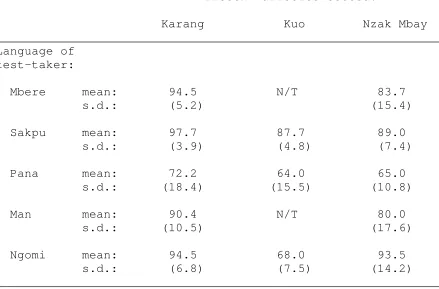
has observed to use intelligibility testing scores alone to