QUALITY DETERIORATION IN COMMERCIAL VIRGIN COCONUT OIL DUE TO
PHOTOOXIDATION AND AUTOOXIDATION
Ambar Rukmini
1, Sri Raharjo
2, Pudji Hastuti
2, Supriyadi
21Department of Food Technology and Nutrition, Faculty of Agricultural Technology, Widya Mataram University, Dalem
Mangkubumen KT III/237, Yogyakarta 55132; 2Department of Food and Agricultural Product Technology, Faculty of
Agricultural Technology, Gadjah Mada University, Bulaksumur, Yogyakarta 55281
Email: [email protected]
ABSTRACT
The objective of this study was to investigate the keeping quality of commercial virgin coconut oil (VCO) and to identify the probable cause of its quality deterioration. Fourteen brands of commercial VCO and a fresh prepared VCO were used. Sensory evaluation on odor and taste was conducted. Free fatty acid (FFA), moisture, peroxide value (PV), tocopherol, carotenoid, chlorophyll-a, total phenolics content, and fatty acid compounds of VCO were analyzed. In order to observe the effect of photooxidation on the keeping quality, a fresh prepared VCO was packed in a transparent glass bottle and exposed to fl uorescent light at 4,000 lux at room temperature for 5 h. PV of the samples were measured at 1 h interval. The results indicated that 10 out of 14 commercial VCO had PV of 1.0 meq/kg or higher and objectionable odor and taste were clearly detected by panelists. The PV of fresh prepared VCO was 0.14 meq/kg oil and only within 3 h of light exposure (4,000 lux) its PV reached 1.0 meq/kg oil. Naturally present antioxidants in the VCO were not effective for inhibiting photooxidation, while existing of 0.098 ppm chlorophyll-a effectively sensitized photooxidation reaction. This study confi rmed that once the VCO undergoes brief photooxidation, subsequent protection using light barrier packaging material will not effective to inhibit quality deterioration during trading, display, or storage.
Keywords: Quality deterioration, virgin coconut oil, photooxidation, autooxidation
INTRODUCTION
Virgin coconut oil (VCO) is widely produced and commercialized in Indonesia and currently marketed as functional oil. Since it is introduced to community, VCO has captured the attention of vast majority of publics. Thus, VCO production has shown dramatic growth in the market. Even though the Asian and Pacifi c Coconut Community (APCC) has an offi cial quality standard for VCO which was applied at VCO trading, there is variation quality of VCO in the market.
VCO is oil that is directly extracted from the fresh, mature kernel of coconut under mild temperature. This oil is specifi cally refi ned by multiple fi ltrations regarding to preserve its natural bioactive compounds. The mild temperature extraction process of VCO ensures that its pleasant and slightly delicate fl avor may be retained (Marina et al., 2010). Such process is able to avoid the loss of micro compounds such as provitamin A and vitamin E, and polyphenols (Nevin and Rajamohan, 2008). Those micro compounds which are naturally present in the VCO act as antioxidant and may signifi cantly determine its keeping quality.
In the markets, VCO are packed in transparent plastic or glass bottles and several bottles are packed using secondary packaging material such as sealed paper boxes. During storage and display at retailers, however, VCO may undergo quality deterioration leading to rejection by consumers. The most important cause of oil and fat quality deterioration is mostly oxidation, which not only decreases either shelf-life or nutritional value, moreover produces toxic compounds (Guillen and Goicoechea, 2009).
The fact that different factors such as processing technique, storage conditions, light exposure, type of packaging material, availability of oxygen, and existing of antioxidants may infl uence on the quality and characteristics of VCO. According to Rotondi et al. (2008), the presence of some natural constituents, such as phenols, tocopherols, and unsaturated fatty acid have determined the oxidative stability and shelf-life of oil.
and are in the singlet state. The triplet oxygen oxidation is initiated by the formation of radical food compounds. The radical compounds react with the diradical triplet state oxygen. Triplet oxygen oxidation, known as autooxidation, is a slow process of oxidation and requires considerable time to produce a suffi cient quantity of lipid peroxides as the main intermediate product of oxidation which could result an unpleasant fl avors in products containing lipid (Naz et al., 2004). On the other hand, singlet oxygen oxidation, known as photooxidation, is a very fast reaction (Anwar et al., 2007).
The singlet oxygen can be formed from triplet oxygen by photosensitized reactions (Min and Boff, 2002). Chlorophyll and its derivatives is a common sensitizer that acts as a promoter of photooxidation in vegetable oils (Choe and Min, 2006). After absorption of energy from light, chlorophyll can transfer that energy to triplet oxygen to form more reactive singlet oxygen, which subsequently reacts with not only unsaturated fatty acids, but also with other electron-rich food components including vitamins and amino acids, producing radical food compounds (Min and Boff, 2002). Lee et al. (1997) reported that vegetable oils that contain natural sensitizers, such as chlorophyll at 0.065-1.33 ppm, can produce singlet oxygen and initiate photooxidation reaction. These oxidation products catalyze the oxidation chain reaction (autooxidation), resulting in the oils’ quality deterioration.
The rate of the photooxidation reaction is at least 1,000-1,500 times faster than that of the autooxidation (Cuppett et al., 1997). One important factor infl uencing the rate of oxidation is the concentration of metal components in the oil, such as copper (Cu) and iron (Fe) (Andersson and Lingnert, 1998). The objective of this study was to investigate the keeping quality of commercial VCO traded in Yogyakarta region and to identify the factors that cause quality deterioration of VCO.
MATERIALS AND METHODS
Materials
A total of 14 brands of packaged VCO, 7 brands of VCO were packed in transparent plastic bottles and 7 other brands were double packed in similar plastic bottles and paper boxes, were purchased from local retailers. Five packages of each brand, having the same volume (100 ml), were selected. Each brand of VCO had a different expire date on its labels and none of them had expired. All samples were placed in styrofoam box which was covered by lid and were kept out from light and stored at room temperature prior to further analyses. A fresh prepared VCO was used as a reference. It was made from the fresh, mature kernel of coconut (12-14
months age), which was grated and made into coconut milk by adding cooled boiling water (1:1). The coconut milk was left to settle for 1 hour to separate the cream from the skim. The cream was taken, stirred, and left for 5 hours to allow the formation of a layer of oil between the dregs and water. The oil was then removed and left to settle for 24 hours, after which it was fi ltered to separate the gum from the oil called VCO. The VCO was used for experiments without any further refi ning process.
The standards of fatty acid methyl esters (FAME), chlorophyll-a, α-tocopherol, and β-carotene, and all analytical grade chemicals were purchased from Sigma Chemical Company (St. Louis, MO, USA) and Merck (Darmstadt, Germany).
Sensory Evaluation
Twelve selected and trained panelists (8 female and 4 males) aged between 25 and 40 were employed to perform sensory evaluation on odor and taste of VCO using a Multiple Comparison Difference Analysis method. The panelists were recruited on the basis of their previous experience in the difference test, interest, availability and consumption of VCO. The fi rst set of samples consisting of seven brands of VCO which was packed in transparent plastic bottles without paper box (light protection). The second set of seven samples was packed in plastic bottles and double packed with paper box (light protection) and evaluated separately. A fresh prepared VCO was used as a reference (R). The amount of each commercial VCO (15 ml) was fi lled in 20 ml transparent glass bottle with rubber caps. All samples except the reference (R) were identifi ed by three digit number randomly assigned as coded samples. Each panelist was given a series of seven coded and R samples. They were asked to determine whether each of the seven samples was individually different from R. The panelist smelled the sample by opening the cup (odor attributes), and then tasted it. They were asked to express whether the sample was exactly same or below to R, and then mark the level of difference (none, slight, moderate, much, or extreme). The ratings were given in numerical values. A score of 1 indicates no difference compared to R, while a score of 5 indicates extremely inferior to R. Between two testing different samples, the panelists cleaned the mouth with pear slices and water.
Fatty Acid Composition
by vigorous shaking of VCO samples in hexane (5 %, v/v) and then 6 ml of that solution was added with 150 μl of 2 N methanolic potassium hydroxide. That solution was mixed by vortex mixer at room temperature for 5 min. The FAMEs were identifi ed using a chromatography unit (Shimadzu CR 6A) equipped with DEGS capillary column (2 m x 3 mm) and FID. Nitrogen gas was used as carrier with a fl ow rate of 70 ml/min. The temperature of column was maintained at 150 ºC for up to 4 min and then raised to 210 ºC by increasing the temperature at 8 ºC/min, and that of the injector and the detector at 250 ºC.
Chemical Analyses
Analyses were also performed on moisture content, peroxide value (PV), free fatty acid (FFA), chlorophyll-a,
α-tocopherol, β-carotene, copper (Cu), iron (Fe), and total phenolics content of all VCO samples. FFA, moisture content, and PV were determined according to the method proposed by the IUPAC Offi cial Method 2.201, 2.601, and 2.501 respectively (Anonim, 1992). Chlorophyll contents of the samples were measured at 663.8 nm using a spectrophotometer (UV-1650 PC Shimadzu, Japan) and chlorophyll-a standard was used for the calibration curve preparation (Anonim, 2004). α-Tocopherol and β-carotene were measured according to the colorimetric method, whereas the Cu and Fe content were determined according to the AAS method as described by Anonim (2004). The total phenolics content was determined spectrophotometrically using Folin-Ciocalteau’s reagent, according to the method described by Seneviratne et al. (2009). A calibration curve of Gallic acid in methanol was performed over the concentration range 20-200
μg/ml (r = 0.99).
Photooxidative Test
In order to observe the effect of photooxidation on the keeping quality of VCO, a portion of the fresh prepared VCO sample (15 ml) was fi lled in a number of transparent glass bottles (20 ml) with rubber caps. Another portion of sample was protected from light by wrapping the glass bottles with aluminum foil. Photooxidation reaction was performed under accelerated condition using fl uorescent lights with an intensity of approximately 4,000lux for up to 5 h at room temperature and the PV of the samples were measured at 1 h interval.
Experimental Design and Statistical Analysis
A Randomized Complete Block Design was used in this study. The same type of packaging material (transparent plastic bottles or transparent plastic bottles which double packed with paper box) was grouped in a block. Five bottles from each brand of VCO were taken as sample repeatation.
Each brand of VCO was analyzed individually in triplicates. Statistical analysis of the data was performed by one-way analysis of variance (ANOVA) and continued by t-test to determine the signifi cant different effect of the factors affecting quality of VCO. P values less than 0.05 were considered signifi cant. A linear regression analysis was used to determine the correlation coeffi cients between PV and odor or taste scores.
RESULTS AND DISCUSSION
Sensory Properties
The keeping quality of VCO during storage and display at retailers can be detected through the extent of objectionable rancid odor released by the product. The odor and taste score of commercial VCO was showed in Figure 1.
Figure 1. Odor and taste score of commercial VCO without (□) and with (■) light protection. [Asterisk on top of the bar indicates signifi cant difference (P < 0.05) from the reference (R). Odor or taste score of 1 indicates no difference compared to fresh prepared VCO (R), while score of 5 indicates extror to R]
Figure 1 shows that four (4) out of seven (7) commercial VCO, packed in transparent plastic bottles without light protection, had signifi cantly different (P < 0.05) odor scores compared to the reference (R). Three (3) out of seven (7) commercial VCO packed with light protection, which was sealed in secondary paper box, had signifi cantly different (P < 0.05) odor scores compared to R. The evaluation on taste scores indicated that fi ve (5) out of seven (7) VCO packed with or without light protection, showed a signifi cant
VCO
difference (P < 0.05) as compared to R. This suggests that during prolonged storage or display for trading at retailers, these VCO underwent rapid quality deterioration, even though before its corresponding expires date was over.
Development of rancid odor and/or taste can result from either hydrolysis or oxidation reaction. Since all of the VCO products were prepared without heating, the moisture content during processing (especially settling), and microfl ora of these samples were expected to be relatively high which could facilitate hydrolytic rancidity reaction. Hydrolysis liberates the FFA from the parent oil and thus releasing the FFA that are responsible for rancid aroma (Villarino et al., 2007).
There was a signifi cant difference (P < 0.05) of FFA content in several commercial VCO samples as compared to R (Figure 2). The FFA content of R was 0.16 %. Three (3) out of seven (7) VCO packed without light protection had FFA content ranging from 1.14 to 3.11 %, whereas all of the VCO packed with light protection had FFA content of less than 1.0 %. A good quality VCO should have FFA content of less than 0.5 % (Anonim, 2003). Although some of the VCO samples packed with light protection had low FFA content (less than 0.5 %), the presence of rancid odor or taste was easily detected by the panelists. This suggests that the development of rancid odor or objectionable taste is not only due to hydrolysis reaction.
Figure 2. Free fatty acid (FFA) content of commercial VCO without (□) and with (■) light protection. [Asterisk on top of the bar indicates signifi cant difference (P < 0.05) from the reference (R)]
According to List et al. (2005), oxidation is more responsible for the deterioration of fats and oils than hydrolysis. Oxidation reactions influence the chemical, sensory, and nutritional properties of edible oils and thus play an important role in determining their use and shelf-life (Anwar et al., 2007). Ultimately, this oxidative deterioration could lead to signifi cant losses for producers, retailers, and consumers.
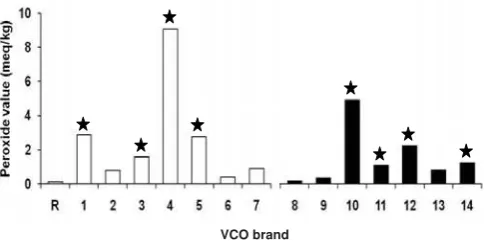
There was a signifi cant difference (P < 0.05) of PV in some of these VCO samples as compared to R (Figure 3). The R had a PV of 0.14 meq/kg oil, which was well below 3 meq/kg oil as required in the VCO standard (Anonim, 2003). Four (4) out of seven (7) commercial VCO packed without light protection were found to have PV range of 1.58 - 9.06 meq/kg oil, while four (4) out of seven (7) of those products packed with light protection have PV range of 1.08 - 4.90 meq/kg oil. It was clear that more than half of the VCO brand commercially available in Yogyakarta have suffered from quality deterioration due to oxidation. It was in a good agreement with Wongpoowarak et al. (2009) which reported that although most composition of coconut oil are saturated fatty acids, its minor unsaturated fatty acid (oleic and linoleic acids) can lead to oil rancidity because of lipid oxidation.
Figure 3. Peroxide values of commercial VCO without (□) and with (■) light protection. [Asterisk on top of the bar indicates signifi cant difference (P < 0.05) from the reference (R)]
The PV is a measure of concentration of peroxides and hydroperoxide formed as intermediate products in the initiation and propagation stages of lipid oxidation. They were unstable compounds and easily decomposed to secondary oxidation products which were responsible for rancid odor and taste. The amount of peroxides present in the oil refl ects its oxidative level and thus its tendency to become rancid (Anwar et al., 2007; Marina et al., 2009).
This study also showed a signifi cant positive correlation (rtable, 0.05 = 0.53) between the PV and the increase of sensory scores of rancid odor and/or taste (Figure 4). It can be stated that the sensory score of rancid odor and/or taste changes were accompanied by the changes of PV. Objectionable odor and taste were clearly detected by panelists on VCO samples having PV of 1.0 meq/kg oil or higher. This value agree with the previous fi nding (Labuza, 1972 in Carlsson et al., 1976) which reported that only very low concentrations of oxidation products (<0.00002% by wt) result in signifi cant off-fl avors or odors.
VCO brand
Figure 4. Correlation between peroxide value and odor (a) and taste (b) score of VCO. (Odor or taste score of 1 indicates no difference compared to fresh prepared VCO (R), while score of 5 indicates extremely inferior to R)
Fatty Acid Composition
The fatty acid composition of commercial VCO marketed by retailers in Yogyakarta is presented in Table 1. As expected, the most predominant fatty acid in VCO was lauric acid (12:0) ranged from 50.49 to 52.67 %. The Asian and Pacifi c Coconut Community (APCC) standard specifi ed that the lauric acid content of VCO is the range of 43.0 to 53.0 % (Anonim, 2003). Besides the lauric acid, there were caprilic (8:0), capric (10:0), miristic (14:0), palmitic (16:0), stearic (18:0), oleic (18:1), and linoleic acid (18:2). It was found that all of the VCO samples have met the fatty acid composition as required by the APCC standard.
Although all of the VCO samples contained more than 90 % of saturated fatty acid, it also contained a small proportion of unsaturated fatty acid, such as oleic acid (6.2 7%) and linoleic acid (1.50 %). Under the presence of oxygen and/or light, these unsaturated fatty acids could undergo lipid peroxidation and resulted in VCO quality deterioration. Further analyses on chemical characteristics are needed to determine the quality of VCO.
Chemical Characteristics
As shown in Table 2, moisture content in all of these VCO samples were well within the specifi cation limit as required
(a)
(b)
Table 1. Fatty acid (%) composition of commercial VCO*)
Fatty acid Fresh prepared VCO
Commercial VCO samples
without light protection with light protection
1 4 6 8 10 13
Caprilic acid (C8:0) 7.13 5.93 6.57 6.08 6.31 8.42 5.12
Capric acid (C10:0) 6.49 5.29 5.71 5.52 6.49 6.66 5.00
Lauric acid (C12:0) 50.49 51.26 50.37 50.76 50.42 50.35 52.99
Miristic acid (C14:0) 17.07 17.90 17.50 17.61 17.07 16.77 18.24
Palmitic acid (C16:0) 8.53 8.68 9.14 8.92 8.13 8.22 7.79
Stearic acid (C18:0) 2.50 2.59 2.60 2.59 2.50 2.32 2.53
Oleic acid (C18:1) 6.27 6.90 6.83 6.84 5.77 5.96 5.37
Linoleic acid (C18:2) 1.50 1.26 1.31 1.30 1.20 1.31 0.96
*) Selected from the brand of VCO samples having medium, highest, or lowest PV
Table 2. Chemical composition of commercial VCO
Parameters Fresh prepared VCO
Commercial VCO samples *)
1 2 3 4 5 6 7 8 9 10 11 12 13 14
Moisture (%) 0.18 0.13 0.29 0.34 0.28 0.30 0.39 0.17 0.18 0.15 0.43 0.29 0.24 0.19 0.13 Peroxide value (meq/kg) 0.14 2.89 0.08 1.58 9.06 2.77 0.43 0.93 0.19 0.37 4.92 1.08 2.23 0.85 1.24 Free fatty acid (%) 0.16 0.84 1.24 3.11 0.58 0.19 1.14 0.25 0.18 0.29 0.48 0.73 0.55 0.16 0.08 Chlorophyll (ppm) 0.098 0 0.043 0.019 0.061 0.005 0.002 0.001 0.061 0.055 0.005 0.013 0 0.051 0.016
α-Tocopherol (ppm) 4.30 4.32 4.04 4.24 4.08 4.07 4.34 4.06 4.29 4.26 4.14 4.04 4.28 4.19 4.11
β-Carotene (ppm) 0.43 0.32 - - 0.37 - 0.36 - 0.43 - 0.40 - - 0.39
-Fe (ppm) 3.11 nd nd nd nd nd nd nd 3.10 nd nd nd nd nd nd
Cu (ppm) 0.87 0.14 0.11 nd nd nd nd nd 0.87 0.32 nd nd 0.26 nd nd
Total phenolic content
(mg GAE/100 g oil) 17.47 13.75 13.36 8.94 18.68 11.42 18.29 14.33 17.47 12.66 14.23 11.54 11.48 12.85 12.15
by the VCO standard (Anonim, 2003). According to List et al. (2007), moisture promotes the splitting of triacylglycerols to form free fatty acids, mono- and diacylglycerols, which results in increased FFA content. This process requires a fat-soluble catalyst, high moisture content, high temperature (> 100 ºC), lipase, and relatively long time (several hours) of reaction. Application of mild temperature in this study, which occurred during the VCO processing, could enable the microorganism naturally present in the coconut meat released the lipases and catalyze the action of moisture to hydrolyze the oil. Therefore, samples with higher FFA content (1.14-3.11 %) than that of the fresh prepared VCO (0.16 %) indicates poor quality during processing, handling or storage.
Table 2 also shows that VCO samples packed without light protection have signifi cantly (P < 0.05) higher PV than that of samples packed with light protection, although they have similar amounts of naturally present antioxidants (α-tocopherol, β-carotene, and phenolic) and pro-oxidants (chlorophyll, Fe, and Cu). This suggests that protecting the VCO from light could effectively inhibit the quality deterioration due to photooxidation.
The undesirable oxidation reaction can be inhibited by antioxidant that acts in specifi c mechanism. Phenolic compounds can act as metal chelator (Chen and Ahn, 1998), hydrogen donating or free radical scavenger (Cheng et al., 2002). Carotenoids effectively act as singlet oxygen or excited triplet sensitizers quencher, whereas the tocopherol was singlet oxygen quencher (Lee et al., 2004). However, the singlet oxygen-quenching abilities of tocopherols are not as effective as the carotenoids (Lee et al., 1997). So,
α-tocopherol and β-carotene are expected to protect the VCO products from photooxidation, whereas the phenolic compounds were effective for inhibiting the autooxidation reaction. These differences on antioxidants and prooxidants content (Table 2) directly contribute to the differences of oxidative stability of the VCO.
Effect of Photooxidation on VCO
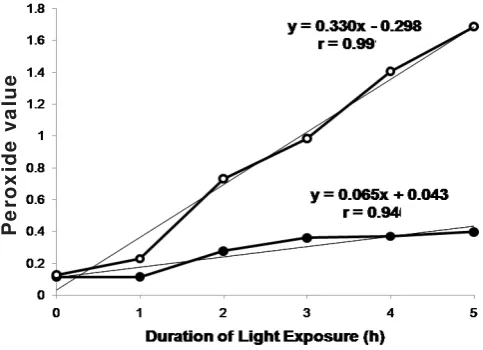
Figure 5 shows the effect of light exposure on PV of fresh prepared VCO samples. Light exposed VCO samples showed higher PV than that of the light protected samples. There was a very signifi cant difference (P < 0.01) slope of PV changes between the VCO samples packed without and with light protection. It only takes approximately 3 h of light exposure (4,000 lux) on the fresh prepared VCO to increase its PV from 0.14 to 1.0 meq/kg, while the light protected samples never reached that value. This result indicates that light exposure with relatively high intensity was very effective for initiating photooxidation.
Figure 5. Peroxide values of fresh prepared VCO in transparent glass bottle (○) and in transparent glass bottle which was wrapped with aluminum foil (●) during exposure to light at 4,000 lux for 5 hours
Oil oxidation is accelerated by light, especially in the presence of sensitizers such as chlorophylls. Choe and Min. (2006) reported that sensitizers in the singlet state absorb light energy very rapidly, in picoseconds, and become excited. Excited singlet sensitizers can return to their ground state via emission of light, internal conversion or intersystem crossing results in excited triplet state of sensitizers. The excitation energy of triplet sensitizers can be transferred onto adjacent triplet oxygen to form more active singlet oxygen. Electrophilic singlet oxygen can directly react with high-electron-density double bonds producing both conjugated and nonconjugated hydroperoxides (Min and Boff, 2002; Choe and Min, 2006). This was the reason for the increasing PV in VCO samples packed without light protection. The glass bottle, which was unprotected from light, enables the sensitizer to absorb light energy, initiate oxidation, and produce hydroperoxides. The quantity of hydroperoxides formed during photooxidation is directly proportional to the total amount of light absorbed (Anwar et al., 2007; Rahmani and Csallany, 1998).
According to Lee et al. (1997), the chlorophyll content 0.065–1.33 ppm in vegetable oils can produce singlet oxygen and initiate the photooxidation reaction. In this study, the fresh prepared VCO contained approximately 0.098 ppm chlorophyll-a. Thus, it was capable for initiating the photooxidation reaction. Kochevar and Redmond in Choe and Min (2006) reported that a sensitizer molecule may generate 103–105 molecules of singlet oxygen before becoming
inactive. The highly reactive singlet oxygen then probably attacks the double bond between the fi fth and sixth carbon of
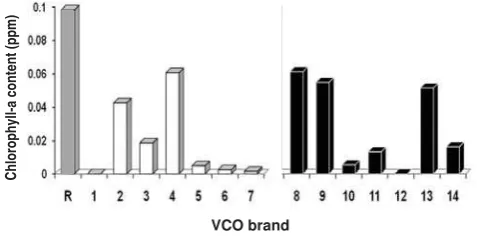
chlorophyll-a, resulting in a subsequent shift of the position of the double bond and the formation of hydroperoxides, which are then further cleaved through oxygen–oxygen linkage to form degradation products (Chen and Huang, 1998). These degradation products were no longer detected as chlorophyll-a. Therefore, there was only a minor amount of chlorophyll-a detected in the commercial VCO products which had been stored or displayed for sale at retailers for some time (Figure 6).
Figure 6. Chlorophyll-a content of fresh prepared VCO (R) and commercial VCO without (□) and with (■) light protection
During processing, it is likely that the VCO is exposed to light that illuminates the processing room. This condition could enable the naturally present chlorophyll to produce singlet oxygen and initiates the photooxidation reaction. It seemed that the naturally present antioxidants (α-tocopherol,
β-carotene, and phenolic compounds) and light protection later on was not effective once the VCO undergoes brief photooxidation reaction. It could quote the works by Psomiadou and Tsimidou (2002a, b), the condition during processing (light or darkness) might be fundamental on evolution of oil quality.
CONCLUSION
This study confi rmed that approximately 10 out of 14 commercial VCO brands marketed in Yogyakarta suffered from quality deterioration in terms of the presence of objectionable rancid odor and taste. The VCO product packed without light protection (paper box) suffered most severely from photooxidation. It is therefore suggested to minimize light exposure during VCO production, trading, display, and storage. Once the VCO undergoes brief photooxidation, subsequent protection using light barrier packaging material, such as paper box, will not effective to inhibit lipid autooxidation reaction during storage.
ACKNOWLEDGEMENT
The authors wish to thank the Ministry of Research and Technology, Republic of Indonesia for the provision of research grant in 2009 to support this work.
REFERENCES
Andersson, K. and Lingnert H. (1998). Infl uence of oxygen and copper concentration on lipid oxidation in rapeseed oil. Journal of the American Oil Chemists’ Society75: 1041-1046.
Anonim. (1992). Standard Methods for The Analysis of Oils, Fats and Derivatives. Pergamon Press, New York.
Anonim. (2003). APCC standards for virgin coconut oil. htpp://www.apccsec.org/standards.htm. [January 1, 2009].
Anonim. (2004). Offi cial methods and recommended practices of the AOCS. 5th ed. American Oil Chemists’ Society, Illinois.
Anwar, F., Chatha, S.A.S. and Hussain, A.I. (2007). Assessment of oxidative deterioration of soybean oil at ambient and sunlight storage. Grasas Y Aceites58: 390-395.
Chen, X. and Ahn, D.U. (1998). Antioxidant activities of six natural phenolics against lipid oxidation induced by Fe2+ or ultraviolet light. Journal of the American Oil
Chemists’ Society75: 1717-1721.
Chen, B.H. and Huang, J.H. (1998). Degradation and isomerization of chlorophyll-a and β-carotene as affected by various heating and illumination treatments.
Food Chemistry62: 299-307.
Cheng, Z., Ren, J., Li, Y., Chang, W. and Chen, Z. (2002). Study on the multiple mechanisms underlying the reaction between hydroxyl radical and phenolic compounds by quantitative structure and activity relationship. Bioorganic and Medicinal Chemistry10: 4067-4073.
Choe, E. and Min, D. B. (2006). Mechanisms and factors for edible oil oxidation. Comprehensive Reviews in Food Science and Food Safety5: 169-186.
Cuppett, S., Schnepf, M. and Hall, C. (1997). Natural antioxidants-Are they a reality. In: Shahidi, F. (ed.).
Natural antioxidants, chemistry, health effects and applications, pages 12-24. American Oil Chemists’ Society, Illinois.
Chlorophyll-a content (ppm)
Guillen, M.D. and Goicoechea, E. (2009). Oxidation of corn oil at room temperature: Primary and secondary oxidation products and determination of their concentration in the oil liquid matrix from 1H nuclear magnetic resonance
data. Food Chemistry116: 183-192.
Lee, J., Koo, N. and Min, D.B. (2004). Reactive oxygen species, aging, and antioxidative nutraceuticals.
Comprehensive Reviews in Food Science and Food Safety3: 21-33.
Lee, K.H., Jung, M.Y. and Kim, S.Y. (1997). Quenching mechanism and kinetics of ascorbyl palmitate for the reduction of photosensitized oxidation of oils. Journal of the American Oil Chemists’ Society74: 1053-1057. List, G.R., Wang, T. and Shukla, V.K.S. (2005). Storage,
handling and transport of oils and fats. In: Shahidi, F. (ed.). Bailey’s industrial oil and fat products, pages 191-229. John Wiley & Sons, Inc., New Jersey.
Marina, A.M., Che Man, Y.B., Nazimah, S.A.H. and Amin, I. (2009). Chemical properties of virgin coconut oil.
Journal of the American Oil Chemists’ Society86: 301-307.
Marina, A.M., Che Man, Y.B. and Amin, I. (2010). Use of the SAW sensor electronic nose for detecting the adulteration of virgin coconut oil with RBD palm kernel olein. Journal of the American Oil Chemists’ Society
87: 263-270.
Min, D.B. and Boff, J.M. (2002). Chemistry and reaction of singlet oxygen in foods. Comprehensive Reviews in Food Science and Food Safety1: 58-72.
Naz, S., Sheikh, H., Saddiqi, R. and Sayeed, S.A. (2004). Oxidative stability of olive, corn and soybean oil under different conditions. Food Chemistry88: 253-259.
Nevin, K.G. and Rajamohan, T. (2008). Infl uence of virgin coconut oil on blood coagulation factor, lipid levels and
LDL oxidation on cholesterol fed Sprague-Dawley rats.
e-SPEN, the European e-Journal of Clinical Nutrition and Metabolism3: e1-e8.
Psomiadou, E. and Tsimidou, M. (2002a). Stability of virgin olive oil. 1. Autoxidation studies. Journal of Agricultural and Food Chemistry 50: 716-721.
Psomiadou, E. and Tsimidou, M. (2002b). Stability of virgin olive oil. 2. Photo-oxidation studies. Journal of Agricultural and Food Chemistry 50: 722-727.
Rahmani, M. and Csallany, A.S. (1998). Role of minor constituents in the photo-oxidation of virgin olive oil.
Journal of the American Oil Chemists’ Society75: 837-843.
Rotondi, A., Fabbri, A. and Ganino, T. (2008). Sensory and chemical properties of extra virgin olive oils produced in two different Italian regions: Tuscany and Emilia-Romagna. Journal of Food, Agriculture and Environment6: 71-77.
Seneviratne, K.N., Hapuarachchi, C.D. and Ekanayake, S. (2009). Comparison of the phenolic-dependent antioxidant properties of coconut oil extracted under cold and hot conditions. Food Chemistry 114: 1444-1449.
Villarino, B.J., Dy, L.M. and Lizada, M.C.C. (2007). Descriptive sensory evaluation of virgin coconut oil and refi ned, bleached and deodorized coconut oil. LWT Food Science and Technology40: 193-199.