Introduction and Overview
Primary Health Care
Now
More
Than
Ever
The World Health Report
2008
Primary Health Care – Now More Than Ever
2
Director General’s
Message
hen I took ofice in 2007, I made lear my commitment to direct WHO’s attention towards primary health care. More important than my own conviction, this relects the widespread and growing demand for primary health care from Member States. This demand in tu rn displays a growing appetite among policy-makers for knowledge related to how health systems can become more equitable, inclusive and fair. o relects, more fundamentally, a owards the need for more compre-ve thinking about the performance e health system as a whole.
is year marks both the 60th birth-day of WHO and the 30th anniversary of the Declaration of Alma-Ata on Primary Health Care in 1978. While our global health context has changed remarkably over six decades, the values that lie at the core of the WHO Constitution and those that informed the Alma-Ata Declaration have been tested and remain true. Yet, despite enormous progress in health globally, our collective fail-ures to deliver in line with these values are painfully obvious and deserve our greatest attention.
We see a mother suffering complications of labour without access to qualiied support, a child missing out on essential vaccinations, an inner-city slum dweller living in squalor. We see the absence of protection for pedestrians alongside trafic-laden roads and highways, and the impoverishment arising from direct payment for care because of a lack of health insurance. These and many other everyday realities of life personify the unacceptable and avoidable shortfalls in the performance of our health systems.
Director General’s Message
lie ahead, and identify major avenues for health systems to narrow the intolerable gaps between aspiration and implementation.
These avenues are deined in the Report as four sets of reforms that relect a convergence between the values of primary health care, the expectations of citizens and the common health performance challenges that cut across all con-texts. They include:
universal coverage reforms
■ that ensure that
health systems contribute to health equity, social justice and the end of exclusion, pri-marily by moving towards universal access and social health protection;
service delivery reforms
■ that re-organize
health services around people’s needs and expectations, so as to make them more socially relevant and more responsive to the changing world, while producing better outcomes; public policy reforms
■ that secure healthier
communities, by integrating public health actions with primary care, by pursuing healthy public policies across sectors and by strength-ening national and transnational public health interventions; and
leadership reforms
■ that replace disproportion-ate reliance on command and control on one hand, and laissez-faire disengagement of the state on the other, by the inclusive, participa-tory, negotiation-based leadership indicated by the complexity of contemporary health systems.
While universally applicable, these reforms do not constitute a blueprint or a manifesto for action. The details required to give them life in each country must be driven by speciic condi-tions and contexts, drawing on the best available evidence. Nevertheless, there are no reasons why any country rich or poor should wait to begin moving forward with these reforms. As the last three decades have demonstrated, substantial progress is possible.
Doing better in the next 30 years means that we need to invest now in our ability to bring actual performance in line with our aspirations, expectations and the rapidly changing realities of our interdependent health world. United by the common challenge of primary health care, the time is ripe, now more than ever, to foster joint learning and sharing across nations to chart the most direct course towards health for all.
Dr Margaret Chan
Director-General
Introduction
and Overview
Why a renewal of primary health care (PHC), and why
now, more than ever? The immediate answer is the
palpable demand for it from Member States – not just
from health professionals, but from the
political arena as well.
Globalization is putting the social
cohesion of many countries under stress,
and health systems, as key constituents
of the architecture of contemporary
societies, are clearly not performing as
well as they could and as they should.
People are increasingly impatient with
the inability of health services to deliver levels of national
coverage that meet stated demands and changing needs,
and with their failure to provide services in ways that
correspond to their expectations. Few would disagree that
health systems need to respond better – and faster – to the
challenges of a changing world. PHC can do that.
Responding to the challenges of a changing
world
6
Growing expectations
for better performance
7
From the packages of the past to the reforms
of the future
8
Four sets of PHC reforms
10
The World Health Report
2008
Primary Health Care – Now More Than Ever
6
There is today a recognition that populations are left behind and a sense of lost opportunities that are reminiscent of what gave rise, thirty years ago, to Alma-Ata’s paradigm shift in think-ing about health. The Alma-Ata Conference mobilized a “Primary Health Care movement” of professionals and institutions, governments and civil society organizations, researchers and grassroots organizations that undertook to tackle the “politically, socially and economically unac-ceptable”1 health inequalities in all countries. The Declaration of Alma-Ata was clear about the values pursued: social justice and the right to better health for all, participation and solidarity1. There was a sense that progress towards these values required fundamental changes in the way health-care systems operated and harnessed the potential of other sectors.
The translation of these values into tangible reforms has been uneven. Nevertheless, today, health equity enjoys increased prominence in the discourse of political leaders and ministries of health2, as well as of local government struc-tures, professional organizations and civil society organizations.
The PHC values to achieve health for all require health systems that: “Put people at the centre of health care”3. What people consider desirable ways of living as individuals and what they expect for their societies – i.e. what peo-ple value – constitute important parameters for governing the health sector. PHC has remained the benchmark for most countries’ discourse on health precisely because the PHC movement tried to provide rational, evidence-based and antici-patory responses to health needs and to these social expectations4,5,6,7. Achieving this requires trade-offs that must start by taking into account citizens’ “expectations about health and health care” and ensuring “that [their] voice and choice decisively inluence the way in which health serv-ices are designed and operate”8. A recent PHC review echoes this perspective as the “right to the highest attainable level of health”, “maximiz-ing equity and solidarity” while be“maximiz-ing guided by “responsiveness to people’s needs”4. Moving towards health for all requires that health sys-tems respond to the challenges of a changing world and growing expectations for better per-formance. This involves substantial reorientation
and reform of the ways health systems operate in society today: those reforms constitute the agenda of the renewal of PHC.
Responding to the challenges of a
changing world
On the whole, people are healthier, wealthier and live longer today than 30 years ago. If children were still dying at 1978 rates, there would have been 16.2 million deaths globally in 2006. In fact, there were only 9.5 million such deaths9. This difference of 6.7 million is equivalent to 18 329 children’s lives being saved every day. The once revolutionary notion of essential drugs has become commonplace. There have been signii-cant improvements in access to water, sanitation and antenatal care.
This shows that progress is possible. It can also be accelerated. There have never been more resources available for health than now. The glo-bal health economy is growing faster than gross domestic product (GDP), having increased its share from 8% to 8.6% of the world’s GDP between 2000 and 2005. In absolute terms, adjusted for inlation, this represents a 35% growth in the world’s expenditure on health over a ive-year period. Knowledge and understanding of health are growing rapidly. The accelerated techno-logical revolution is multiplying the potential for improving health and transforming health literacy in a better-educated and modernizing global society. A global stewardship is emerging: from intensiied exchanges between countries, often in recognition of shared threats, challenges or opportunities; from growing solidarity; and from the global commitment to eliminate poverty exempliied in the Millennium Development Goals (MDGs).
Introduction and Overview
Second, the nature of health problems is chang-ing in ways that were only partially anticipated, and at a rate that was wholly unexpected. Ageing and the effects of ill-managed urbanization and globalization accelerate worldwide transmis-sion of communicable diseases, and increase the burden of chronic and noncommunicable disorders. The growing reality that many indi-viduals present with complex symptoms and multiple illnesses challenges service delivery to develop more integrated and comprehensive case management. A complex web of interrelated factors is at work, involving gradual but long-term increases in income and population, climate change, challenges to food security, and social tensions, all with deinite, but largely unpredict-able, implications for health in the years ahead.
Third, health systems are not insulated from the rapid pace of change and transformation that is an essential part of today’s globaliza-tion. Economic and political crises challenge state and institutional roles to ensure access, delivery and inancing. Unregulated commer-cialization is accompanied by a blurring of the boundaries between public and private actors, while the negotiation of entitlement and rights is increasingly politicized. The information age has transformed the relations between citizens, professionals and politicians.
In many regards, the responses of the health sector to the changing world have been inad-equate and naïve. Inadinad-equate, insofar as they not only fail to anticipate, but also to respond appropriately: too often with too little, too late or too much in the wrong place. Naïve insofar as a system’s failure requires a system’s solution – not a temporary remedy. Problems with human resources for public health and health care, inance, infrastructure or information systems invariably extend beyond the narrowly deined health sector, beyond a single level of policy pur-view and, increasingly, across borders: this raises the benchmark in terms of working effectively across government and stakeholders.
While the health sector remains massively under-resourced in far too many countries, the resource base for health has been growing consistently over the last decade. The opportu-nities this growth offers for inducing structural
changes and making health systems more effec-tive and equitable are often missed. Global and, increasingly, national policy formulation proc-esses have focused on single issues, with various constituencies competing for scarce resources, while scant attention is given to the underlying constraints that hold up health systems develop-ment in national contexts. Rather than improv-ing their response capacity and anticipatimprov-ing new challenges, health systems seem to be drifting from one short-term priority to another, increas-ingly fragmented and without a clear sense of direction.
Today, it is clear that left to their own devices, health systems do not gravitate naturally towards the goals of health for all through primary health care as articulated in the Declaration of Alma-Ata. Health systems are developing in directions that contribute little to equity and social justice and fail to get the best health outcomes for their money. Three particularly worrisome trends can be characterized as follows:
health systems that focus disproportionately on
■
a narrow offer of specialized curative care; health systems where a command and control
■
approach to disease control, focused on short-term results, is fragmenting service delivery; health systems where a hands-off or
laissez-■
faire approach to governance has allowed unregulated commercialization of health to lourish.
These trends ly in the face of a comprehensive and balanced response to health needs. In a num-ber of countries, the resulting inequitable access, impoverishing costs, and erosion of trust in health care constitute a threat to social stability.
Growing expectations for better
performance
The World Health Report
2008
Primary Health Care – Now More Than Ever
8
delivery, through different mechanisms and for different reasons, is not only less effective than it could be, but suffers from a set of ubiquitous shortcomings and contradictions that are sum-marized in Box 1.
The mismatch between expectations and performance is a cause of concern for health authorities. Given the growing economic weight and social signiicance of the health sector, it is also an increasing cause for concern among politicians: it is telling that health-care issues were, on average, mentioned more than 28 times in each of the recent primary election debates in the United States22. Business as usual for health systems is not a viable option. If these shortfalls in performance are to be redressed, the health
problems of today and tomorrow will require stronger collective management and accountabil-ity guided by a clearer sense of overall direction and purpose.
Indeed, this is what people expect to happen. As societies modernize, people demand more from their health systems, for themselves and their families, as well as for the society in which they live. Thus, there is increasingly popular support for better health equity and an end to exclusion; for health services that are centred on people’s needs and expectations; for health security for the communities in which they live; and for a say in what affects their health and that of their communities23.
These expectations resonate with the values that were at the core of the Declaration of Alma-Ata. They explain the current demand for a better alignment of health systems with these values and provide today’s PHC movement with reinvigo-rated social and political backing for its attempts to reform health systems.
From the packages of the past to
the reforms of the future
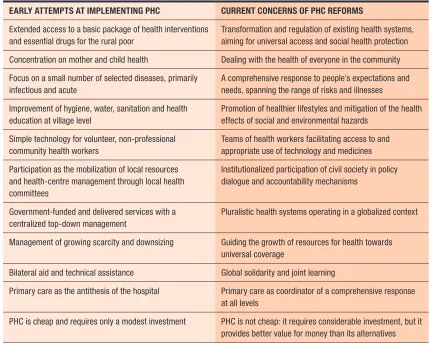
Rising expectations and broad support for the vision set forth in Alma-Ata’s values have not always easily translated into effective transfor-mation of health systems. There have been cir-cumstances and trends from beyond the health sector – structural adjustment, for example – over which the PHC movement had little inlu-ence or control. Furthermore, all too often, the PHC movement has oversimpliied its message, resulting in one-size-its-all recipes, ill-adapted to different contexts and problems24. As a result, national and global health authorities have at times seen PHC not as a set of reforms, as was intended, but as one health-care delivery pro-gramme among many, providing poor care for poor people. Table 1 looks at different dimen-sions of early attempts at implementing PHC and contrasts this with current approaches. Inherent in this evolution is recognition that providing a sense of direction to health systems requires a set of speciic and context-sensitive reforms that respond to the health challenges of today and prepare for those of tomorrow.
Box 1
Five common shortcomings of
health-care delivery
Inverse care. People with the most means – whose needs for health care are often less – consume the most care, whereas those with the least means and greatest health problems con-sume the least10. Public spending on health services most
often benefits the rich more than the poor11 in high- and
low-income countries alike12,13.
Impoverishing care. Wherever people lack social protection and payment for care is largely out-of-pocket at the point of service, they can be confronted with catastrophic expenses. Over 100 million people annually fall into poverty because they have to pay for health care14.
Fragmented and fragmenting care. The excessive specializa-tion of health-care providers and the narrow focus of many disease control programmes discourage a holistic approach to the individuals and the families they deal with and do not appreciate the need for continuity in care15. Health services
for poor and marginalized groups are often highly fragmented and severely under-resourced16, while development aid often
adds to the fragmentation17.
Unsafe care. Poor system design that is unable to ensure safety and hygiene standards leads to high rates of hospital-acquired infections, along with medication errors and other avoidable adverse effects that are an underestimated cause of death and ill-health18.
Misdirected care. Resource allocation clusters around cura-tive services at great cost, neglecting the potential of primary prevention and health promotion to prevent up to 70% of the disease burden19,20. At the same time, the health sector lacks
Introduction and Overview
The focus of these reforms goes well beyond “basic” service delivery and cuts across the established boundaries of the building blocks of national health systems25. For example, aligning health systems based on the values that drive PHC will require ambitious human resources policies. However, it would be an illusion to think that these can be developed in isolation from inancing or service delivery policies, civil service reform and arrangements dealing with the cross-border migration of health professionals.
At the same time, PHC reforms, and the PHC movement that promotes them, have to be more responsive to social change and rising expecta-tions that come with development and moderniza-tion. People all over the world are becoming more vocal about health as an integral part of how they and their families go about their everyday
lives, and about the way their society deals with health and health care. The dynamics of demand must ind a voice within the policy and decision-making processes. The necessary reorientation of health systems has to be based on sound scientiic evidence and on rational management of uncer-tainty, but it should also integrate what people expect of health and health care for themselves, their families and their society. This requires delicate trade-offs and negotiation with multiple stakeholders that imply a stark departure from the linear, top-down models of the past. Thus, PHC reforms today are neither primarily deined by the component elements they address, nor merely by the choice of disease control interven-tions to be scaled up, but by the social dynamics that deine the role of health systems in society.
Table 1
How experience has shifted the focus of the PHC movement
EARLY ATTEMPTS AT IMPLEMENTING PHC CURRENT CONCERNS OF PHC REFORMS
Extended access to a basic package of health interventions and essential drugs for the rural poor
Transformation and regulation of existing health systems, aiming for universal access and social health protection Concentration on mother and child health Dealing with the health of everyone in the community Focus on a small number of selected diseases, primarily
infectious and acute
A comprehensive response to people’s expectations and needs, spanning the range of risks and illnesses Improvement of hygiene, water, sanitation and health
education at village level
Promotion of healthier lifestyles and mitigation of the health effects of social and environmental hazards
Simple technology for volunteer, non-professional community health workers
Teams of health workers facilitating access to and appropriate use of technology and medicines Participation as the mobilization of local resources
and health-centre management through local health committees
Institutionalized participation of civil society in policy dialogue and accountability mechanisms
Government-funded and delivered services with a centralized top-down management
Pluralistic health systems operating in a globalized context Management of growing scarcity and downsizing Guiding the growth of resources for health towards
universal coverage
Bilateral aid and technical assistance Global solidarity and joint learning
Primary care as the antithesis of the hospital Primary care as coordinator of a comprehensive response at all levels
The World Health Report
2008
Primary Health Care – Now More Than Ever
10
Four sets of PHC reforms
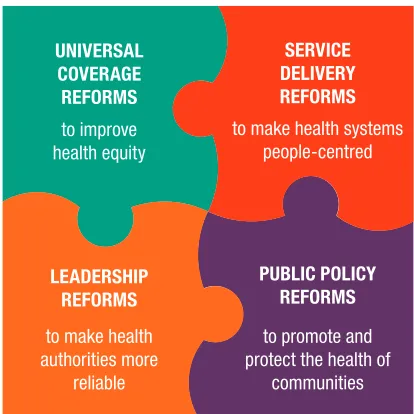
This report structures the PHC reforms in four groups that relect the convergence between the evidence on what is needed for an effective response to the health challenges of today’s world, the values of equity, solidarity and social justice that drive the PHC movement, and the growing expectations of the population in modernizing societies (Figure 1):
reforms that ensure that health systems
con-■
tribute to health equity, social justice and the end of exclusion, primarily by moving towards universal access and social health protection – universal coverage reforms;
reforms that reorganize health services as
■
primary care, i.e. around people’s needs and expectations, so as to make them more socially relevant and more responsive to the changing world while producing better outcomes – serv-ice delivery reforms;
reforms that secure healthier communities, by
■
integrating public health actions with primary care and by pursuing healthy public policies across sectors – public policy reforms; reforms that replace disproportionate
reli-■
ance on command and control on one hand, and laissez-faire disengagement of the state on the other, by the inclusive, participatory, negotiation-based leadership required by the complexity of contemporary health systems – leadership reforms.
The irst of these four sets of reforms aims at diminishing exclusion and social disparities in health. Ultimately, the determinants of health inequality require a societal response, with political and technical choices that affect many different sectors. Health inequalities are also shaped by the inequalities in availability, access and quality of services, by the inancial burden these impose on people, and even by the lin-guistic, cultural and gender-based barriers that are often embedded in the way in which clinical practice is conducted26.
If health systems are to reduce health inequi-ties, a precondition is to make services available to all, i.e. to bridge the gap in the supply of services. Service networks are much more extensive today
than they were 30 years ago, but large population groups have been left behind. In some places, war and civil strife have destroyed infrastruc-ture, in others, unregulated commercialization has made services available, but not necessarily those that are needed. Supply gaps are still a reality in many countries, making extension of their service networks a priority concern, as was the case 30 years ago.
As the overall supply of health services has improved, it has become more obvious that bar-riers to access are important factors of inequity: user fees, in particular, are important sources of exclusion from needed care. Moreover, when peo-ple have to purchase health care at a price that is beyond their means, a health problem can quickly precipitate them into poverty or bankruptcy14. That is why extension of the supply of services has to go hand-in-hand with social health protec-tion, through pooling and pre-payment instead of out-of-pocket payment of user fees. The reforms to bring about universal coverage – i.e. universal access combined with social health protection – constitute a necessary condition to improved health equity. As systems that have achieved near universal coverage show, such reforms need to be complemented with another set of proactive measures to reach the unreached: those for whom service availability and social protection
Figure 1
The PHC reforms necessary to refocus
health systems towards health for all
UNIVERSAL
to make health systems people-centred
to make health authorities more
reliable
to promote and protect the health of
Introduction and Overview
does too little to offset the health consequences of social stratiication. Many individuals in this group rely on health-care networks that assume the responsibility for the health of entire com-munities. This is where a second set of reforms, the service delivery reforms, comes in.
These service delivery reforms are meant to transform conventional health-care delivery into primary care, optimizing the contribution of health services – local health systems, health-care networks, health districts – to health and equity while responding to the growing expectations for “putting people at the centre of health care, har-monizing mind and body, people and systems”3. These service delivery reforms are but one subset of PHC reforms, but one with such a high proile that it has often masked the broader PHC agenda. The resulting confusion has been compounded by the oversimpliication of what primary care entails and of what distinguishes it from conven-tional health-care delivery (Box 2)24.
There is a substantial body of evidence on the comparative advantages, in terms of effectiveness and eficiency, of health care organized as people-centred primary care. Despite variations in the speciic terminology, its characteristic features
(person-centredness, comprehensiveness and integration, continuity of care, and participa-tion of patients, families and communities) are well identiied15,27. Care that exhibits these fea-tures requires health services that are organ-ized accordingly, with close-to-client multidisci-plinary teams that are responsible for a deined population, collaborate with social services and other sectors, and coordinate the contributions of hospitals, specialists and community organi-zations. Recent economic growth has brought additional resources to health. Combined with the growing demand for better performance, this creates major opportunities to reorient existing health services towards primary care – not only in well-resourced settings, but also where money is tight and needs are high. In the many low- and middle-income countries where the supply of services is in a phase of accelerated expansion, there is an opportunity now to chart a course that may avoid repeating some of the mistakes high-income countries have made in the past.
Primary care can do much to improve the health of communities, but it is not suficient to respond to people’s desires to live in conditions that protect their health, support health equity
Box 2
What has been considered primary care in well-resourced contexts has been
dangerously oversimplified in resource-constrained settings
Primary care has been defined, described and studied extensively in well-resourced contexts, often with reference to physicians with a specialization in family medicine or general practice. These descriptions provide a far more ambitious agenda than the unacceptably restrictive and off-putting primary-care recipes that have been touted for low-income countries27,28:
primary care provides a place to which people can bring a wide range of health problems – it is not acceptable that in low-income
■
countries primary care would only deal with a few “priority diseases”;
primary care is a hub from which patients are guided through the health system – it is not acceptable that, in low-income countries,
■
primary care would be reduced to a stand-alone health post or isolated community-health worker;
primary care facilitates ongoing relationships between patients and clinicians, within which patients participate in decision-making
■
about their health and health care; it builds bridges between personal health care and patients’ families and communities – it is not acceptable that, in low-income countries, primary care would be restricted to a one-way delivery channel for priority health interventions;
primary care opens opportunities for disease prevention and health promotion as well as early detection of disease – it is not
■
acceptable that, in low-income countries, primary care would just be about treating common ailments;
primary care requires teams of health professionals: physicians, nurse practitioners, and assistants with specific and sophisticated
■
biomedical and social skills – it is not acceptable that, in low-income countries, primary care would be synonymous with low-tech, non-professional care for the rural poor who cannot afford any better;
primary care requires adequate resources and investment, and can then provide much better value for money than its alternatives
■
The World Health Report
2008
Primary Health Care – Now More Than Ever
12
and enable them to lead the lives that they value. People also expect their governments to put into place an array of public policies to deal with health challenges, such as those posed by urbani-zation, climate change, gender discrimination or social stratiication.
These public policies encompass the technical policies and programmes dealing with priority health problems. These programmes can be designed to work through, support and give a boost to primary care, or they can neglect to do this and, however unwillingly, undermine efforts to reform service delivery. Health authorities have a major responsibility to make the right design decisions. Programmes to target priority health problems through primary care need to be complemented by public health interventions at national or international level. These may offer scale eficiencies; for some problems, they may be the only workable option. The evidence is overwhelming that action on that scale, for selected interventions, which may range from public hygiene and disease prevention to health promotion, can have a major contribution to health. Yet, they are surprisingly neglected, across all countries, regardless of income level. This is particularly visible at moments of crisis and acute threats to the public’s health, when rapid response capacity is essential not only to secure health, but also to maintain the public trust in the health system.
Public policy-making, however, is about more than classical public health. Primary care and social protection reforms critically depend on choosing health-systems policies, such as those related to essential drugs, technology, human resources and inancing, which are supportive of the reforms that promote equity and people-centred care. Furthermore, it is clear that popu-lation health can be improved through policies that are controlled by sectors other than health. School curricula, the industry’s policy towards gender equality, the safety of food and con-sumer goods, or the transport of toxic waste are all issues that can profoundly inluence or even determine the health of entire communi-ties, positively or negatively, depending on what choices are made. With deliberate efforts towards intersectoral collaboration, it is possible to give
due consideration to “health in all policies”29 to ensure that, along with the other sectors’ goals and objectives, health effects play a role in public policy decisions.
In order to bring about such reforms in the extraordinarily complex environment of the health sector, it will be necessary to reinvest in public leadership in a way that pursues collabo-rative models of policy dialogue with multiple stakeholders – because this is what people expect, and because this is what works best. Health authorities can do a much better job of formu-lating and implementing PHC reforms adapted to speciic national contexts and constraints if the mobilization around PHC is informed by the lessons of past successes and failures. The governance of health is a major challenge for ministries of health and the other institutions, governmental and nongovernmental, that pro-vide health leadership. They can no longer be content with mere administration of the system: they have to become learning organizations. This requires inclusive leadership that engages with a variety of stakeholders beyond the bounda-ries of the public sector, from clinicians to civil society, and from communities to researchers and academia. Strategic areas for investment to improve the capacity of health authorities to lead PHC reforms include making health information systems instrumental to reform; harnessing the innovations in the health sector and the related dynamics in all societies; and building capacity through exchange and exposure to the experience of others – within and across borders.
Seizing opportunities
These four sets of PHC reforms are driven by shared values that enjoy large support and chal-lenges that are common to a globalizing world. Yet, the starkly different realities faced by indi-vidual countries must inform the way they are taken forward. The operationalization of univer-sal coverage, service delivery, public policy and leadership reforms cannot be implemented as a blueprint or as a standardized package.
Introduction and Overview
environment and complement a well-established universal coverage system with targeted mea-sures to reduce exclusion. In the large number of fast-growing health economies – which is where 3 billion people live – that very growth provides opportunities to base health systems on sound primary care and universal coverage principles at a stage where it is in full expansion, avoiding the errors by omission, such as failing to invest in healthy public policies, and by commission, such as investing disproportionately in tertiary care, that have characterized health systems in high-income countries in the recent past. The challenge is, admittedly, more daunting for the 2 billion people living in the low-growth health economies of Africa and South-East Asia, as well as for the more than 500 million who live in fragile states. Yet, even here, there are signs of growth – and evidence of a potential to accelerate it through other means than through the counter-productive reliance on inequitable out-of-pocket payments at points of delivery – that offer pos-sibilities to expand health systems and services. Indeed, more than in other countries, they cannot afford not to opt for PHC and, as elsewhere, they can start doing so right away.
The current international environment is favourable to a renewal of PHC. Global health is receiving unprecedented attention, with growing interest in united action, greater calls for com-prehensive and universal care – be it from people living with HIV and those concerned with provid-ing treatment and care, ministers of health, or the Group of Eight (G8) – and a mushrooming of innovative global funding mechanisms related to global solidarity. There are clear and welcome signs of a desire to work together in building sus-tainable systems for health rather than relying on fragmented and piecemeal approaches30.
At the same time, there is a perspective of enhanced domestic investment in re-invigor-ating the health systems around PHC values. The growth in GDP – admittedly vulnerable to economic slowdown, food and energy crises and global warming – is fuelling health spending throughout the world, with the notable excep-tion of fragile states. Harnessing this economic growth would offer opportunities to effectuate necessary PHC reforms that were unavailable
during the 1980s and 1990s. Only a fraction of health spending currently goes to correcting common distortions in the way health systems function or to overcoming system bottlenecks that constrain service delivery, but the potential is there and is growing fast.
Global solidarity – and aid – will remain impor-tant to supplement and suppport countries maki-ing slow progress, but it will become less impor-tant per se than exchange, joint learning and global governance. This transition has already taken place in most of the world: most developing countries are not aid-dependent. International cooperation can accelerate the conversion of the world’s health systems, including through better channelling of aid, but real progress will come from better health governance in countries – low- and high-income alike.
The health authorities and political leaders are ill at ease with current trends in the devel-opment of health systems and with the obvious need to adapt to the changing health challenges, demands and rising expectations. This is shap-ing the current opportunity to implement PHC reforms. People’s frustration and pressure for dif-ferent, more equitable health care and for better health protection for society is building up: never before have expectations been so high about what health authorities and, speciically, ministries of health should be doing about this.
By capitalizing on this momentum, investment in PHC reforms can accelerate the transformation of health systems so as to yield better and more equitably distributed health outcomes. The world has better technology and better information to allow it to maximize the return on transforming the functioning of health systems. Growing civil society involvement in health and scale-eficient collective global thinking (for example, in essential drugs) further contributes to the chances of success.
The World Health Report
2008
Primary Health Care – Now More Than Ever
14
of close alliances beyond the health sector. Thus, intersectoral action is back on centre stage. Many among today’s health authorities no longer see their responsibility for health as being limited to survival and disease control, but as one of the key capabilities people and societies value31.
The legitimacy of health authorities increasingly depends on how well they assume responsibility to develop and reform the health sector accord-ing to what people value – in terms of health and of what is expected of health systems in society.
References
Primary health care: report of the International Conference on Primary Health
1.
Care, Alma-Ata, USSR, 6–12 September, 1978, jointly sponsored by the World Health Organization and the United Nations Children’s Fund. Geneva, World Health Organization, 1978 (Health for All Series No. 1).
Dahlgren G, Whitehead M. Levelling up (part 2): a
2. discussion paper on European strategies for tackling social inequities in health. Copenhagen, World Health Organization Regional Office for Europe, 2006 (Studies on social and economic determinants of population health No. 3).
WHO Regional Office for South-East Asia and WHO Regional Office for the Western 3.
Pacific. People at the centre of health care: harmonizing mind and body, people and systems. Geneva, World Health Organization, 2007.
Renewing primary health care in the Americas: a position paper of the Pan American
4.
Health Organization. Washington DC, Pan American Health Organization, 2007. Saltman R, Rico A, Boerma W.
5. Primary health care in the driver’s seat: organizational reform in European primary care. Maidenhead, England, Open University Press, 2006 (European Observatory on Health Systems and Policies Series).
Report on the review of primary care in the African Region
6. . Brazzaville, World Health
Organization Regional Office for Africa, 2003.
International Conference on Primary Health Care, Alma-Ata: twenty-fifth anniversary.
7.
Geneva, World Health Organization, 2003 (Fifty-sixth World Health Assembly, Geneva, 19–28 May 2003, WHA56.6, Agenda Item 14.18).
The Ljubljana Charter on Reforming Health Care, 1996
8. . Copenhagen, World Health
Organization Regional Office for Europe, 1996.
World Health Statistics 2008
9. . Geneva, World Health Organization, 2008. Hart T. The inverse care law.
10. Lancet, 1971, 1:405–412.
World development report 2004: making services work for poor people
11. . Washington
DC, The World Bank, 2003. Filmer D.
12. The incidence of public expenditures on health and education. Washington DC, The World Bank, 2003 (background note for World development report 2004 – making services work for poor people).
Hanratty B, Zhang T, Whitehead M. How close have universal health systems come 13.
to achieving equity in use of curative services? A systematic review. International Journal of Health Services, 2007, 37:89–109.
Xu K et al. Protecting households from catastrophic health expenditures. 14. Health
Affairs, 2007, 6:972–983.
Starfield B. Policy relevant determinants of health: an international perspective. 15.
Health Policy, 2002, 60:201–218.
Moore G, Showstack J. Primary care medicine in crisis: towards reconstruction and 16.
renewal. Annals of Internal Medicine, 2003, 138:244–247.
Shiffman J. Has donor prioritization of HIV/AIDS displaced aid for other health 17.
issues? Health Policy and Planning, 2008, 23:95–100. Kohn LT, Corrigan JM, Donaldson MS, eds.
18. To err is human: building a safer health system. Washington DC, National Academy Press, Committee on Quality of Care in America, Institute of Medicine, 1999.
Fries JF et al. Reducing health care costs by reducing the need and demand for 19.
medical services. New England Journal of Medicine, 1993, 329:321–325.
The World Health Report 2002 – Reducing risks, promoting healthy life.
20. Geneva,
World Health Organization, 2002.
Sindall C. Intersectoral collaboration: the best of times, the worst of times. 21. Health
Promotion International, 1997, 12(1):5–6.
Stevenson D. Planning for the future – long term care and the 2008 election.
22. New
England Journal of Medicine, 2008, 358:19.
Blendon RJ et al. Inequities in health care: a five-country survey. 23. Health Affairs,
2002, 21:182–191. Tarimo E, Webster EG.
24. Primary health care concepts and challenges in a changing world: Alma-Ata revisited. Geneva, World Health Organization, 1997 (Current concerns ARA paper No. 7).
Everybody’s business: strengthening health systems to improve health outcomes:
25.
WHO’s framework for action. Geneva, World Health Organization, 2007. Dans A et al. Assessing equity in clinical practice guidelines.
26. Journal of Clinical Epidemiology, 2007, 60:540–546.
Primary care. America’s health in a new era
27. . Washington DC, National Academy Press, Institute of Medicine 1996.
Starfield B.
28. Primary care: balancing health needs, services, and technology. New York, Oxford University Press, 1998.
Ståhl T et al, eds.
29. Health in all policies. Prospects and potentials. Oslo, Ministry of Social Affairs and Health, 2006.
The Paris declaration on aid effectiveness: ownership, harmonisation, alignment,
30.
results and mutual accountability. Paris, Organisation for Economic Co-operation and Development, 2005.
Nussbaum MC, Sen A, eds.