Jurnal Ilmiah Manajemen Vol. 6 No. 2 Mei 2007
Individualism-Collectivism (IC) as an Individual Difference
Predictor of Organizational Citizenship Behavior (OCB) in
an Accounting Environment Setting
Susanti R. Saragih and Joni1 Maranatha Christian University
Abstract
The purpose of this research is to examine whether individualism-collectivism
dimension (beliefs, values and norms) positively related with organizational
citizenship behavior dimension (interpersonal helping, individual initiative and loyal
boosterism) in an accounting environment setting. Structural Equation Model (SEM)
are used to analyze data. The sample consists of 365 accounting college students. The
results showed that individualism-collectivism’s dimension positively related with organizational citizenship behavior dimension. This result supported the previous
research conducted by Moorman and Blakely (1995).
Keywords: Individualism-Collectivism, Organizational Citizenship Behavior
1 Education: о Bachelor Degree in Accounting (Joni) and Management (Susanti) At Maranatha Christian University, graduated in 2004.
о Student of Master of Science in Accounting Major (Joni) and Management Major (Susanti)
At Gadjah Mada University.
Address: Jln. Samirono Baru No. 41, Yogyakarta (Joni)
and Jln. Kaliurang Km.5,5 gg. Gayam Sari I No.27, Yogyakarta (Susanti.) Telephone: 08122315928/ 08882129902 (Joni) and 081322222430/08882129920 (Susanti.) Email address: [email protected] (Joni) and [email protected] (Susanti.)
1.
INTRODUCTION
Researches on Organizational Citizenship Behavior (OCB) have been well
established since 1980 until now (Scholl, 1981; Weiner, 1982; Bateman and Organ, 1983; Smith, Organ and Near, 1983; Hogan, Hogan and Busch, 1984; Motowidlo, 1984; Puffer, 1987; Williams, 1988; Organ and Konovsky, 1989; Organ, 1990, 1994; Farh, Podsakoff and Organ, 1990; Podsakoff, MacKenzie, Moorman and Fetter, 1990; Williams and Anderson, 1991, 1992; Moorman, 1991, 1993; Karambayya, 1991; George, 1991; Moorman and Sayeed, 1992; Becker, 1992; Niehoff and Moorman, 1993; McNeely and Meglino, 1994; Motowidlo and Van Scotter, 1994; Organ and Lingl, 1995; Organ and Ryan, 1995; Moorman and Blakely, 1995; Konovsky and Organ, 1996; Dyne et al., 2000.) These research focus were examining the factors that act as antecedent of OCB.
In previous researches, researchers have been used job attitudes as an
antecedent of OCB, such as job satisfaction (Bateman and Organ, 1983; Smith, Organ and Near, 1983; Motowidlo, 1984; Puffer, 1987; Organ, 1990; Williams and
Anderson, 1992), organizational commitment (Scholl, 1981; Weiner, 1982; Williams and Anderson, 1991; Becker, 1992), and fairness perception (Organ and Konovsky, 1989; Moorman, 1991; Niehoff and Moorman, 1993.) Some researches also suggested task characteristic (Farh, Podsakoff and Organ, 1990; Moorman and Sayeed, 1992) and interpersonal trust (Podsakoff, MacKenzie, Moorman and Fetter, 1990.) Finally, the others have suggested that certain contextual factors such as work unit size, stability of unit membership and interpersonal relationship may also influence an
individual’s decision to perform citizenship behaviors(Karambayya, 1991.)
However, most of these researches have centered on situational causes. Then, some researchers suggested that individual difference variable, such as agreeableness, positive effect, extroversion, neuroticism, and equity sensitivity (Smith et al., 1983; Williams, 1988; Organ and Konovsky, 1989; George, 1991; Konovsky and Organ, 1996; Organ, 1994; Organ and Lingl, 1995) as a predictor of organizational
citizenship behavior.
Most of studies about individual difference (focused on dispositional) concentrate in positive affect and personality trait as predictors of OCB but they
haven’t showed the consistence’s results. That’s why research about individual
difference as a predictor of OCB still done until now.
Some researchers have suggested individualism-collectivism (cultural dimension of Hofstede, 1980) as a predictor of OCB (Moorman and Blakely, 1995; Dyne et al., 2000). Both of these statistically showed significant results of
individualism-collectivism and OCB. Research that proposed to examine the relationship of individualism-collectivism and OCB has not been adequately addressed in the literature and the results haven’t showed the strong and consistent results.
Based on the analysis about these results, so the research question emerges on this research is whether cultural dimension (individualism-collectivism) as an
Some research of OCB that took an accounting setting, such as Ryan (2001) examined moral reasoning level of employees with OCB. Then, Lih Farh, Podsakoff, Organ (1990) examined leader fairness and task scope with OCB. So, research of OCB in accounting environment setting is still rare.
The expected result from this research is the high score in Individualism-Collectivism (indicates that more oriented in collectivism) statistically related with dimension of OCB such as interpersonal aid, individual initiative, and loyal
boosterism in accounting environment. These results support previous researches of Moorman and Blakely (1995.)
This paper is organized as follows. First, we present a theoretical framework and hypotheses. Second, we explain the research method and findings. Finally, we follow with a discussion, implications and limitations of our research.
2.
THEORETICAL FRAMEWORK AND HYPOTHESES
Organizational Citizenship Behavior (OCB)
Work behavior of OCB is also called as extra-role behavior (Pearce and Gregersen, 1991) or prosocial behavior (Puffer, 1987.) But, many researchers called OCB with extra-role and define it as the attitude or employees behavior which done task out of job description or in role and not directly obtained reward from organization.
Organ (1988) in William and Anderson (1991) defined OCB as on the job behaviors which are discretionary, not formally or directly recognized by the organizational reward system, yet promote the efficiency and effectiveness of the
organization and it’s contributes to transformational resources, innovativeness and
Then, Organ (1988) in Dyne and Ang (1998) emphasized that OCB are behaviors which formed out of employees’ job description, such as helping co
worker, helping studying new tasks, as a volunteer to do something that gives benefits to group and more oriented with new employee.
Conceptually, OCB divided in two categories, (Organ, 1988 in William and Anderson, 1991), OCB-O and OCB-I. OCB-O is all of behaviors that give benefits to organization (such as attendance that exceed norm and obey the informal rules). While OCB-I is all of behaviors that gives benefits to individual directly and not directly gives benefits to organization (such as, helping other who absence and helping new employee).
Individualism-Collectivism (IC) as an individual difference
Parson and shills (1951) in Moorman and Blakely (1995) explained that IC as a way to distinguish between individuals who are oriented more towards self-interest and reaching their own goals and individuals who are oriented toward the collective and focus more on the social system rather than themselves (Earley, 1989.) Individualism would (1) consider his/her personal interests more important than interests of a group, (2) would look out for him/herself and (3) would consider the attainment of his/her personal goals of primary importance (Earley, 1989; Wagner and Moch, 1986.) On other hand, collectivist would allow the interest of the group to take precedence over those of the individual. A collectivist would greatly value membership in a group and would look out the well-being of the group even at the expense of his/her own
personal interests (Wagner, 1992; Wagner and Moch, 1986.)
A collectivist society is characterized by citizens who seek to support the goals and group welfare, while individualistic society always promote their own interests.
Some researchers suggested that distinction between individualists and collectivists within cultural dimension as a form of an individual difference. Hui and Trianfis (1986) in Moorman and Blakely (1995) suggested that cultures which are labeled with individualistic-collectivistic, commonly describe collectivistic or individualistic individual difference. Wagner (1992), in a study of social loafing among U.S. college student, labeled the variable individualism-collectivism, but it was clear he was discussing an individual difference, not a culture influence. In addition, Earley (1989, 1993) measured IC directly and did not merely on country or culture to indicate the degree the respondents were either individualistic or
collectivistic. Cox et al. (1991); Moorman and Blakely (1995); Chartman and Barsade (1995) also suggested that IC can be used as an individual difference within cultural dimension.
Individual Difference as an antecedent of OCB
Some researchers tried to measure relationship between individual difference such as agreeableness, positive effect, extroversion, neuroticism, and equity sensitivity with OCB (Smith et al., 1983; Williams, 1988; Organ and Konovsky, 1989; George, 1991; Konovsky and Organ, 1996; Organ, 1994; Organ and Lingl, 1995.) Most of these studies have focused on positive affectivity (PA) as a predictor of OCB and the results is still inconsistent. So, searching for the variable of individual difference as a
The relationship between individualism-collectivism as an individual
difference and OCB
Some researchers had examined the relationship between IC as an individual
difference with OCB (Moorman and Blakely, 1995; Dyne et al., 2000). Statistically, results of this research showed significant relationship between
individualism-collectivism with OCB. So, individualism-individualism-collectivism as an individual difference can be act as antecedent of OCB. But, this research is still rare. So, in this research, we will examine this relationship.
Graham (1989) in Moorman and Blakely (1995) suggested four dimension of OCB. They are:
Interpersonal helping: This focuses on helping co-workers in their jobs
when such help was needed.
Individual initiative: This describes communications to others in the
workplace to improve individual and group performance.
Personal industry: This describes the performance of specific tasks above
and beyond the call of duty.
Loyal boosterism: This describes the promotion of organizational image to
outsiders.
Personal industry, as one of Graham’s dimension, judged as a dimension which didn’t
Given this explanation, we offer the following hypothesis:
IC (as measured by higher IC scores indicating more of a collectivistic orientation) will be positively related to the OCB dimensions of interpersonal helping, individual initiative and loyal boosterism in accounting environment setting.
In this study, we took accounting environment setting because research of OCB in this environment setting still rare. Some researches of OCB in accounting environment setting, such as Ryan (2001), examined relationship between employee’s levels of moral reasoning with OCB. The result showed that statistically, there is a significant relationship between employee’s moral reasoning with the two dimension of OCB (interpersonal helping behaviors and sportsmanship behaviors).
Then, Lih Farh, Podsakoff, Organ (1990) examined relationship between leader fairness and task scope with OCB. The result showed a significant relationship statistically.
3.
RESEARCH METHOD
Sample Selection and Data Collection
Purposive sampling method is used as sample selection technique, which respondent criterion is accounting students (bachelor degree, master degree, professional
program.) This sample was selected because researcher would like to examine the relation between IC as individual difference with OCB in an accounting environment setting, so respondents should have an accounting background.
A survey was distributed to accounting students of several universities in Yogyakarta. They are Master of Science Program students of Gadjah Mada
University, Accountant Professional Program students of Gadjah Mada University, Bachelor program students of Gadjah Mada University, Bachelor program students of Ahmad Dahlan University, Bachelor program students of State University, and Bachelor program students of Atma Jaya University.
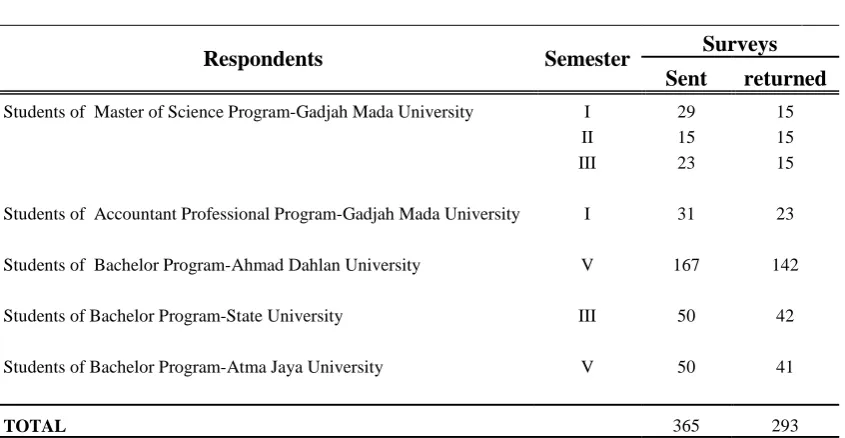
Data was collected in one month and it distributed by researcher. Table 1 provides detail distribution. A total of 365 surveys were sent and 270 useable surveys were returned, representing a 74 percent response rate.
Table 1
Surveys Distribution in an Accounting Environment
Respondents Semester Surveys
Sent returned
Students of Master of Science Program-Gadjah Mada University I 29 15
II 15 15
III 23 15
Students of Accountant Professional Program-Gadjah Mada University I 31 23
Students of Bachelor Program-Ahmad Dahlan University V 167 142
Students of Bachelor Program-State University III 50 42
Students of Bachelor Program-Atma Jaya University V 50 41
TOTAL 365 293
Variables Measurement
OCB was measured with Moorman and Blakely (1992) 19-item scale. This instrument described four OCB dimensions (interpersonal helping, individual initiative, personal
industry, and loyal boosterism). They were based on Graham’s (1989) dimensions of OCB, but contained items which referenced Organ’s (1988) dimensions. We used this
IC was measured with Wagner and Moch’s (1986) 11-item scale. Wagner and
Moch identified three structural dimensions of IC. The first was called beliefs and measured statements of truth or fact as they relate to whether the work group is perceived more productive or efficient when members are more or less collectivistic.
The second dimension was called values and measured the respondent’s general
preferences about working in a more collectivistic environment versus a more
individualistic environment. The third dimension was called norms and measured the
respondent’s specific prescriptions for the behavior of other work group members.
These prescriptions described either individualistic or collectivistic work behaviors. We used this instrument because its validity has been tested (Wagner and Moch, 1986.)
Validity and Reliability Testing
Validity refers to the extent to which a test measures what we actually wish to measure (Cooper, 2003.) We used factor analysis with SPSS for windows program version 11.5 to tested validity. Rules of thumb for loading factor are at or above 0.40 (Hair et al., 1998.)
Reliability of measure indicates the extent to which the measure is without bias (error free) and hence offers consistent measurement across time and across the various items in the instrument (Sekaran, 2000.) We used Cronbach’s Alpha
coefficient with SPSS for windows program version 11.5 to tested reliability. Rules of thumb for Cronbach’s Alpha coefficient are at or above 0.60 (Nunally, 1968 in
Gozali, 2005)
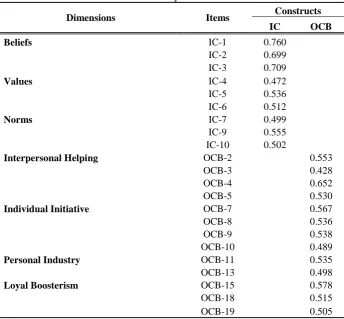
Table 2 Factor Analysis Result
Dimensions Items Constructs
IC OCB
Interpersonal Helping OCB-2 0.553
OCB-3 0.428
OCB-4 0.652
OCB-5 0.530
Individual Initiative OCB-7 0.567
OCB-8 0.536
OCB-9 0.538
OCB-10 0.489
Personal Industry OCB-11 0.535
OCB-13 0.498
Loyal Boosterism OCB-15 0.578
OCB-18 0.515
OCB-19 0.505
IC indicated Individualism-Collectivism variable;
OCB indicated Organizational Citizenship Behavior variable.
Table 2 showed that 22 items have loading factor at or above 0.40. This result indicated valid items (Hairs, et al., 1998.)
Table 3 Reliability Test Result
Constructs Items Cronbach Alpha Result
IC IC-1,2,3,4,5,6,7,9,10 0.657 Reliable
OCB OCB-2,3,4,5,7,8,9,10,11,13,15,18,19 0.752 Reliable
Then, table 3 showed that Individualism-Collectivism and Organizational Citizenship Behavior were reliable because Cronbach’s Alpha coefficient at or above 0.6
4. RESULT AND ANALYSIS
4.1 Fit Model Testing
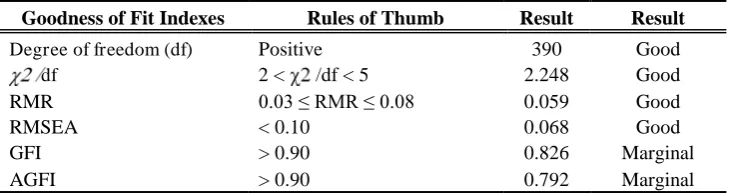
This research tested fit model with some indexes from absolute fit. They are degree of freedom (df), chi-square ( 2 statistic, the normed chi-square ( 2 df), the root mean square residual (RMR), the root mean square error of approximation (RMSEA), Goodness of fit (GFI), adjusted goodness of fit index (AGFI). This test used AMOS statistic application program version 401, the summary of the result was showed at table 4.
Table 4
Goodness of Fit Indexes
Goodness of Fit Indexes Rules of Thumb Result Result
Degree of freedom (df) Positive 390 Good
df 2 < /df < 5 2.248 Good
RMR 0.03 ≤ RMR ≤ 0.08 0.059 Good
RMSEA < 0.10 0.068 Good
GFI > 0.90 0.826 Marginal
AGFI > 0.90 0.792 Marginal
Table 4 showed that this model was accepted as research model because there are four good fit indexes. Although GFI and AGFI were accepted as marginal.
4.2 Hypothesis Testing
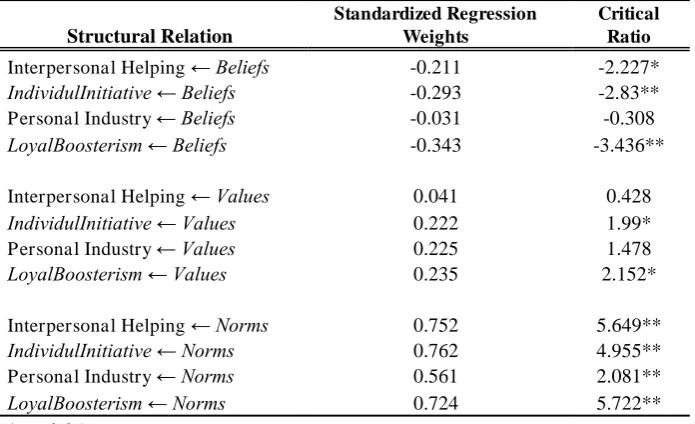
After model was accepted, then hypothesis testing will conducted. Hypothesis testing was conducted with path analysis. Table 5 showed the result, hypothesis will be supported if Critical Ratio (CR) above 1.960 (p<0.10.)
Table 5
Structural Relation, Standardized Regression Weights,
And Critical Ratio Interpersonal Helping ← Beliefs -0.211 -2.227*
IndividulInitiative ← Beliefs -0.293 -2.83**
Personal Industry ← Beliefs -0.031 -0.308
LoyalBoosterism ← Beliefs -0.343 -3.436**
Interpersonal Helping ← Values 0.041 0.428
IndividulInitiative ← Values 0.222 1.99*
Personal Industry ← Values 0.225 1.478
LoyalBoosterism ← Values 0.235 2.152*
Interpersonal Helping ← Norms 0.752 5.649**
IndividulInitiative ← Norms 0.762 4.955**
Personal Industry ← Norms 0.561 2.081**
LoyalBoosterism ← Norms 0.724 5.722**
* p< 0.05; ** p< 0.01.
This hypothesis examined IC dimensions (beliefs, values, and norms) will be positively related to the OCB dimensions (interpersonal helping, individual initiative, and loyal boosterism). This hypothesis consisted of twelve paths (see Picture 1.) Table-5 showed nine paths which statistically significant ((p<0.05 and p<0.01.)
Path from beliefs to interpersonal helping (p<0.05), individual initiative (p<0.01), and loyal boosterism (p<0.01) were significant statistically. But this path have contrary relation, it means that OCB dimensions influenced beliefs dimension. This result supported previous research which conducted by Moorman and Blakely (1995). Wagner and Moch (1986) argued that beliefs dimension has no relation with OCB dimensions because items in beliefs dimension measured statements of truth or fact as they relate to whether the work group is perceived more productive or efficient (group performances). As known, OCB oriented was individual performances.
Path from values dimension to individual initiative (p<0.05), and loyal boosterism ((p<0.05) were significant statistically. Path from norms dimension to interpersonal helping (p<0.01), individual initiative (p<0.01), personal industry (p<0.01), and loyal boosterism (p<0.01) were significant statistically. Finally, path from values dimension to interpersonal helping, and personal industry; and path from beliefs dimension to personal helping were not significant statistically.
In general, the results showed that hypothesis was supported, it means that Individualism-Collectivism as a predictor of Organizational Citizenship Behavior. This result showed that personal industry of OCB dimension has no difference between individualist and collectivist (path from beliefs and values to personal industry were not significant statistically.) Individualists could perform personal industry behaviors because they believe they will be rewarded for doing so and thus no difference between the degree individualist and collectivists perform this
5. CONCLUSION AND LIMITATION
This research proposed to examine whether Individualism-Collectivism positively related with Organizational Citizenship Behavior’s dimension (interpersonal helping, individual initiative and loyal boosterism) in accounting environment. The result showed that Individualism-Collectivism can be used as a predictor of Organizational Citizenship Behavior(hypothesis supported.) Result also showed that personal
industry dimension did not have a difference in individualist and collectivist. It can be seen in path which statistically not significant in beliefs and values dimension. The explanation for this is, neither individualist nor collectivist will done his/her job well (Moorman and Blakely, 1995).
The results also showed that all dimensions of OCB influences beliefs dimension, it means that result showed a contrary relation. This is due to all items contained in beliefs dimension are fact of group performance while dimensions of OCB are more oriented in individual performance. This research supported the previous work by Moorman and Blakely (1995.)
One of the main limitations in this research that should be noted is the sample, which in this research, accounting college students is used as a sample. This became limitation because although all of respondent have a background in accounting, but not all of them have work experience in accounting setting. So, it causes bias in filling up the questionnaire.
Future research also needed to examine the same research model but sample criterion that used should have a work experience in accounting setting. It is
REFERENCES
Appelbaum, Steven; Bartolomucci, Nicolas; Beaumier, Erika; Boulanger, Jonathan (2004). Organizational Citizenship Behavior: A Case Study of Culture,
Leadership and Trust. Management Decision, 42, ½, pg. 13.
Aquino, Karl; Bommer, William H. (2003). Preferential Mistreatment: How Victim Status Moderates The Relationship Between Organizational Citizenship Behavior and Workplace Victimization. Organization Science, Vol. 14, No.4, pp. 374-385. Barr, Steve H.; Pawar, Badrinarayan S. (1995). Organizational Citizenship Behavior:
Domain Specifications for Three Middle Range Theories. Academy of Management Journal, pg. 302.
Bienstock, Carol C.; DeMoranville, Carol W.; Smith, Rachel K. (2003). The Journal of Services Marketing, 17, 4/5, pg. 357.
Bolon, Douglas S. (1997). Organizational Citizenship Behavior among Hospital Employees: A Multidimensional Analysis Involving Job Satisfaction and Organizational Commitment. Hospital & Health Services Administration, 42, 2, pg. 221.
D. R., Cooper; P. S., Schlinder (2003). Business Research Methods, 8th es. New York: Mc Graw Hill Book Co.
Coyle-Shapiro, Jacqueline A-M.; Kessler, Ian; Purcell, John (2004). Exploring Organizationally Directed Citizenship Behavior: Reciprocity or ‘It’s My Job’. Journal of Management Studies, 41, 1, 0022-2380.
Cukur, Cem S.; De Gusman, Maria R. T.; Carlo G. (2004). Religiosity, Value, and Horizontal and Vertical Individualism-Collectivism: A Study of Turkey, the United States, and the Philippines. The Journal of Social Psychology, 144 (6), 613-634.
Deckop, R. John; Mangel Robert; Circa, Carol C. (1999). Getting More Than You Pay For: Organizational Citizenship Behavior and Pay-For-Performance Plans.
Academy of Management Journal, 42, 4, pg. 420.
Diefendorff, Michael M.; Brown, Douglas J.; Kamin, Allen M.; Lord, Robert G. (2002). Examining the Roles of Job Involvement and Work Centrality in
Predicting Organizational Citizenship Behaviors and Job Performance. Journal of Organizational Behavior, 23, 1, pg. 93.
Ehrhart, Mark G.; Naumann, Stefanie E. (2004). Organizational Citizenship Behavior in Work Groups: A Group Norms Approach. Journal of Applied Psychology, Vol. 89, No. 6, 968-974.
Feather N. T.; Rauter, Katrin A. (2004). Organizational Citizenship Behaviors in Relation to Job Status, Job Insecurity, Organizational Commitment and
Gozali, Imam (2005). Aplikasi Analisis Multivariate dengan Program SPSS, edisi 3. Baand Penerbit Universitas Diponegoro, Semarang.
Hartono, J. (2004). Metodologi Penelitian Bisnis, Salah Kaprah and Pengalaman-Pengalaman, edisi 2004/2005. BPFE, Yogyakarta.
Jones, James R.; Schaubroeck, John (2004). Mediators of the Relationship between Race and Organizational Citizenship Behavior. Journal of Managerial Issues, Vol XVI, No. 4, 505-527.
Koberg, Christine S.; Boss, R. Wayne; Goodman, Eric A. (2005). Empirical Evidence of Organizational Citizenship Behavior from the Health Care Industry. Intl
Journal of Public administration, 28, 417-436.
Lih Farh, Jiing; Earley, P. Christopher; Lin, Shu-Chi (1997). Impetus for Action: A Cultural Analysis of Justice and Organizational Citizenship Behavior in Chinese Society. Administrative Science Quarterly, 42, 3, pg. 421.
Lih Farh, Jiing; Podsakoff, Philip M.; Organ, Dennis W. (1990). Accounting for Organizational Citizenship Behavior: Leader Fairness and Task Scope versus Satisfaction. Journal of Management, Vol. 16, No. 4, 705-721.
Lovell, Sharon E.; Kahn, Arnold S; Anton, Jennifer; Davidson, Amanda; et al (1999). Does Gender Affect The Link Between Organization Citizenship Behavior and Performance Evaluation? Sex Roles, 41, 5/6, pg. 469.
Mackenzie, Scott B.; Podsakoff, Philip M.; Fetter, Richard (1993). The Impact of Organizational Citizenship Behavior on Evaluations of Salesperson Performance.
Journal of Marketing, 57, 1, pg. 70.
Morrison, Elizabeth Wolfe (1994). Role Definition and Organizational Citizenship Behavior: The Importance of Employee’s Perspective. Academy of Management Journal, 37, 6, pg. 1543.
Moideenkutty, Unnikammu; Blau, Gary; Kumar, Ravi; Nalakath, Ahamedali (2005). Relationship of Organizational Citizenship Behavior and Objective Productivity to Managerial Evaluations of Performance in India. IJCM, Vol. 15, 3&4.
Moorman, Robert H.; Blakely, Gerald L. (1995). Individualism-Collectivism as an Individual Difference Predictor of Organizational Citizenship Behavior. Journal of Organizational Behavior, 16, 2, pg. 127.
Niehoff, Brian P.; Moorman, Robert H. (1993). Justice as a Mediator of The Relationship Between Methods of Monitoring and Organizational Citizenship Behavior. Academy of Management Journal, 36, 3, pg. 527.
Organ, Dennis W. (1994). Personality and Organizational Citizenship Behavior.
Organ, Dennis W. (1995). Personality, Satisfaction, and Organizational Citizenship Behavior. The Journal of Social Psychology, 135 (3), 339-350.
Organ; Zhong; Lih Farh (2004). Organization Citizenship Behavior in the People’s Republic of China. Organization Science, Vol. 15, No. 2, pp. 241-253.
Pearce, Craig L.; Herbik, Pamela A. (2004). Citizenship Behavior at the Team Level of Analysis: The Effect of Team Leadership, Team Commitment, Perceived Team Support, and Team Size. The Journal of Social Psychology, 144 (3), 293-310. Ryan, John J. (2001). Moral Reasoning as a Determinant of Organizational
Citizenship Behaviors: A Study in the Public Accounting Profession. Journal of Business ethics, 33, 3, pg. 233.
Schnake, Mel E.; Dumler, Michael P. (2003). Levels of Measurement and Analysis Issues in Organizational Citizenship Behavior Research. Journal of Occupational and Organizational Psychology, 76, pg. 283.
Schappe, Stephen P. (1998). The Influence of Job Satisfaction, Organization
Commitment, and Fairness Perceptions on Organizational Citizenship Behavior.
Journal of Psychology, 123, 3, pg. 277.
Sekaran, Uma (2000). Research Methods for Business. John Wiley and Sons, Inc. 3rd edition.
Taylor, Edward C.; Tepper, Bennett J. (2003). Relationships among Supervisor’ and
Subordinates’ Procedural Justice Perceptions and Organizational Citizenship
Behaviors. Academy of Management Journal, Vol. 46, No. 1, 97-105.
Tepper, Bennett J.; Hoobler, Jenny; Duffy, Michelle K.; Ensley, Michael D. (2004). Moderator of the Relationships between Coworkers’ Attitudes. Journal of Applied Psychology, Vol. 89, No. 3, 455-465.
Todd, Samuel Y.; Kent, Aubrey (2006). Direct and Indirect Effects of Task
Characteristics on Organizational Citizenship Behavior. North American Journal of Psychology, Vol. 8, No. 2, 253-268.
Van Dyne; Vadewalle; Kostova; Latham; Cummings (2000). Collectivism, Propensity to Trust and Self-Esteem as Predictors of Organizational Citizenship in a Non-work Setting. Journal of Organizational Behavior, 21, 1, pg. 3.
Van Dyne, Linn; Graham, Jill W.; Dienesch, Richard M. (1994). Organizational Citizenship Behavior: Construct Redefinition, Measurement, and Validation.
Academy of Management Journal, 37, 4, pg. 765.
VanYperen, Nico W.; van den Berg, Agnes E.; Willering, Martijn C. (1999). Towards a Better Understanding of the Link between Participation in Decision-Making and Organizational Citizenship Behavior: A Multiple Analysis. Journal of
Vey, Meredith A.; Campbell, John P. (2004). In-Role or Extra-Role Organizational Citizenship Behavior: Which Are We Measuring? Human Performance, 17 (1), 119-135
Williams, Steve; Shiaw, Wong T. (1999). Mood and Organizational Behavior: The Effects of Positive Affect on Employee Organizational Citizenship Behavior Intentions. The Journal of Psychology, 133, 6, pg. 656.