http://www.scirp.org/journal/jss ISSN Online: 2327-5960
ISSN Print: 2327-5952
DOI: 10.4236/jss.2018.69005 Sep. 3, 2018 63 Open Journal of Social Sciences
Strategy of Local Government in Household
Waste Management in Jatinangor District
Sumedang Regency West Java Province
Fernandes Simangunsong
1, Amelia Fajarwati
21Institut Pemerintahan Dalam Negeri (Governmental Institute of Home Affairs), Sumedang, Indonesia 2
Jl. Raya Bandung-Sumedang, Sumedang, Indonesia
Abstract
This research focuses on determining and analyzing the strategy of Local Government in Household Waste Management, supporting and inhibiting factors of strategy of Local Government in Household Waste Management and efforts to overcome the inhibiting factors of strategy of Local Govern-ment in Household Waste ManageGovern-ment in Jatinangor District, Sumedang Regency, West Java Province. Research method used was descriptive with qu-alitative approach and by analyzing data inductively. Data collection tech-niques used were interview, observation, documentation and triangulation. Analysis technique used was SWOT analysis by determining internal strategic factors to identify strengths and weaknesses, and external strategic factors to identify opportunities and threats as basis to determine objective and formu-lation of the strategy. SWOT matrix was used to formulate strategic issues and Litmus Test was, then, used to make priority on selected strategies. Based on results of research, it can be concluded that strategy of Local Government in household waste management in Jatinangor District, Sumedang Regency, West Java Province has not been well implemented, as seen by low compe-tence of apparatus, lack of facilities and infrastructures to support the opera-tional activities, lack of promotion of regional regulation on waste manage-ment and lack of public participation in household waste managemanage-ment. De-riving from conditions above, 20 strategies were formulated, by developing the SWOT concept and Litmust Test, to be used by Local Government for waste management.
Keywords
Strategy, Local Government, Household Waste Management
How to cite this paper: Simangunsong, F. and Fajarwati, A. (2018) Strategy of Local Government in Household Waste Man-agement in Jatinangor District Sumedang Regency West Java Province. Open Journal of Social Sciences, 6, 63-87.
https://doi.org/10.4236/jss.2018.69005
Received: July 29, 2018 Accepted: August 31, 2018 Published: September 3, 2018
Copyright © 2018 by authors and Scientific Research Publishing Inc. This work is licensed under the Creative Commons Attribution International License (CC BY 4.0).
DOI: 10.4236/jss.2018.69005 64 Open Journal of Social Sciences
1. Introduction
Law No. 23 of 2014 on Local Government states that “Local Administration is implementation of administrative affairs in accordance with principles of re-gional autonomy and duty of providing assistance, and shall exercise the broad-est possible autonomy within the system and principle of Unitary State of the Republic of Indonesia as defined in the 1945 Constitution of the Republic of In-donesia”. Application of regional autonomy is aimed to facilitate the even dis-tribution of development across the country. Regional autonomy will improve basic services according to public needs of each region. In accordance with Law No. 23 of 2014 on Local Government, mandatory basic services shall include public works and spatial plannizng that also covers waste affairs [1].
Sumedang Regency Government is administrator of local governance in West Java Province which one of its duties is to deliver service in waste sector. Local Government Agency (Satuan Kerja Perangkat Daerah) authorized to control and manage waste affairs is Environmental Agency (Badan Lingkungan Hidup, or
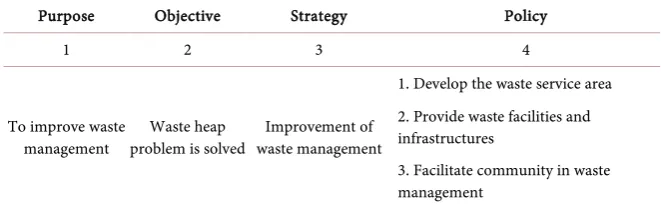
BLH) which nomenclature is changed and then incorporated with Forestry Agency as Environmental and Forestry Agency. This change of nomenclature is in accordance with Regional Regulation of Sumedang Regency No. 11 of 2016 on Formation and Structure of Local Agency of Sumedang Regency. Environmental and Forestry Agency of Sumedang Regency has strategy and policy for 2014-2018 on Waste Affairsas presented in Table 1.
In order to help enabling environmental cleanliness that is free of waste, Su-medang Regency Government has formed Work Team for Water Supply and Environmental Sanitation (Kelompok Kerja Air Minum dan Penyehatan
Ling-kungan) through Decree of Sumedang Regent No. 440/KEP.240/BAPPPPEDA/2017,
which one of its duties is to coordinate programs and activities in Sector of Wa-ter Supply and Sanitation in each Regional Bureaucracy (Organisasi Perangkat
Daerah, or OPD). Membership of the work team includes Head of
Environmen-tal and Forestry Agency of Sumedang Regency, Head of Waste and Park Affairs Division, and Head of Partnership Development for Waste Management Sec-tion.
Sumedang Regency is experiencing social and cultural and environmental is-sues, such as waste problems, due to increasing population each year. The in-creasing population contributes to increase of waste volume produced. Manik argues that, “Uncontrolled population increase causes problems in land supply for settlements and business, facilities for social and other socio-cultural servic-es” [2].
“Asian developing countries are experiencing in increasing population,
in-come and urban growth. This situation contributes to the increase of Solid Waste volume and type. Most of municipal solid waste comes from residential
areas, commerce and other source” [3].
DOI: 10.4236/jss.2018.69005 65 Open Journal of Social Sciences
Table 1. Purpose, objective, strategy and policy in waste sector.
Purpose Objective Strategy Policy
1 2 3 4
1. Develop the waste service area
2. Provide waste facilities and infrastructures
3. Facilitate community in waste management
Source: Strategic Plan of Environmental and Forestry Agency of Sumedang Regency Tahun 2014-2018.
household waste originates from daily activities of household, excluding feces and specific wastes [4].
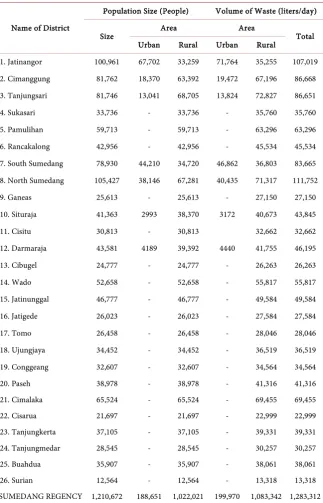
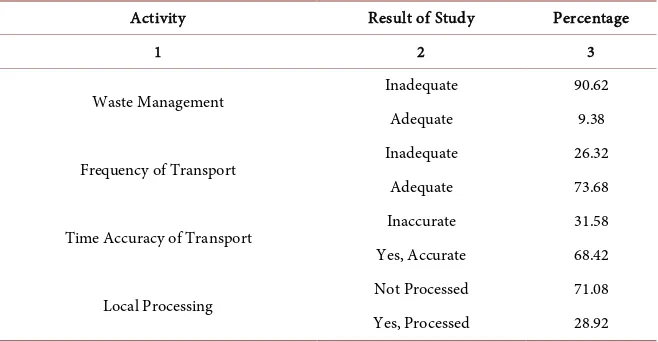
Based on data above (Table 2), highest amounts of waste heap is produced in North Sumedang District and Jatinangor District, with population size of 105,427 people in North Sumedang District producing 111,752 liters/day and 100,961 people in Jatinangor District producing 107,019 liters/day. The fact is that the more the population size contributes to the more amount of waste vo-lume produced. Based on study by Environmental Health Risk Assessment (EHRA) of Sumedang Regency on respondents in Sumedang Regency about waste management, the results are as follow (Table 3) [5].
According to results of the study, 90.62% of respondents consider that waste management in Sumedang Regency is still inadequate. 73.68% of respondents consider that frequency of waste transport is already adequate, 68.42% of them state that waste transport is time accurate, and 71% of them assert that the waste is not processed.
Waste management activities in districts are implemented by each Local Technical Implementation Unit (Unit Pelaksana Teknis Daerah or UPTD), such as Local Technical Implementation Unit (UPTD) for waste affairs in Jatinangor. Jatinangor District became an education area since one of main functions of Bandung City as an education city was relocated to Jatinangor District. As stated in Decree of West Java Governor No. 583/SK-PIL/1989 on Appointment of Jati-nangor as higher education area, Local Government of West Java Province changes the function and purpose of former farm land of Jatinangor as complex of higher education which was previously centered in Bandung City as well as conservation area and greenbelt. Furthermore, in order to have better legal basis and certainty, Decree of West Java Governor No. 583/SK-PIL/1989 was made into Regional Regulation, i.e. Regional Regulation of West Java Province No. 11 of 1992 on Designation of Former Farm Land of Jatinangor in Level II Region of Sumedang Regency [6].
DOI: 10.4236/jss.2018.69005 66 Open Journal of Social Sciences
Table 2. Volume of waste heap per district in Sumedang regency.
Name of District
Population Size (People) Volume of Waste (liters/day)
Size
Area Area
Total
Urban Rural Urban Rural
1. Jatinangor 100,961 67,702 33,259 71,764 35,255 107,019
2. Cimanggung 81,762 18,370 63,392 19,472 67,196 86,668
3. Tanjungsari 81,746 13,041 68,705 13,824 72,827 86,651
4. Sukasari 33,736 - 33,736 - 35,760 35,760
5. Pamulihan 59,713 - 59,713 - 63,296 63,296
6. Rancakalong 42,956 - 42,956 - 45,534 45,534
7. South Sumedang 78,930 44,210 34,720 46,862 36,803 83,665
8. North Sumedang 105,427 38,146 67,281 40,435 71,317 111,752
9. Ganeas 25,613 - 25,613 - 27,150 27,150
10. Situraja 41,363 2993 38,370 3172 40,673 43,845
11. Cisitu 30,813 - 30,813 32,662 32,662
12. Darmaraja 43,581 4189 39,392 4440 41,755 46,195
13. Cibugel 24,777 - 24,777 - 26,263 26,263
14. Wado 52,658 - 52,658 - 55,817 55,817
15. Jatinunggal 46,777 - 46,777 - 49,584 49,584
16. Jatigede 26,023 - 26,023 - 27,584 27,584
17. Tomo 26,458 - 26,458 - 28,046 28,046
18. Ujungjaya 34,452 - 34,452 - 36,519 36,519
19. Conggeang 32,607 - 32,607 - 34,564 34,564
20. Paseh 38,978 - 38,978 - 41,316 41,316
21. Cimalaka 65,524 - 65,524 - 69,455 69,455
22. Cisarua 21,697 - 21,697 - 22,999 22,999
23. Tanjungkerta 37,105 - 37,105 - 39,331 39,331
24. Tanjungmedar 28,545 - 28,545 - 30,257 30,257
25. Buahdua 35,907 - 35,907 - 38,061 38,061
26. Surian 12,564 - 12,564 - 13,318 13,318
SUMEDANG REGENCY 1,210,672 188,651 1,022,021 199,970 1,083,342 1,283,312
Result of analysis by Work Team of Sanitation, 2015. Note: Waste Heap: 1.05 liters/day/people.
include waste reduction and treatment. Management of household waste and other similar types of waste includes waste reduction and waste treatment.
1) Waste reduction includes activities: a) Reduce of waste heap;
b) Recycle of waste; and/or c) Reuse of waste.
DOI: 10.4236/jss.2018.69005 67 Open Journal of Social Sciences
Table 3. Waste Risk Area based on result of study of EHRA.
Activity Result of Study Percentage
1 2 3
Waste Management
Inadequate 90.62
Adequate 9.38
Frequency of Transport
Inadequate 26.32
Adequate 73.68
Time Accuracy of Transport
Inaccurate 31.58
Yes, Accurate 68.42
Local Processing
Not Processed 71.08
Yes, Processed 28.92
Source: Study Report of Environmental Health Risk Assessment (EHRA) of Sumedang Regency, 2015.
a) Sorting of waste by categorizing and separating waste according to material, volume, and/or certain characteristic;
b) Collection of waste by taking and transporting waste from the source to landfill or integrated waste treatment facility;
c) Transporting by taking waste from the source and/or landfill or integrated waste treatment facility to waste processing site;
d) Processing by changing the characteristics, composition, volume of waste; and/or final processing by returning of waste and/or residue of processed waste to environmental medium safely
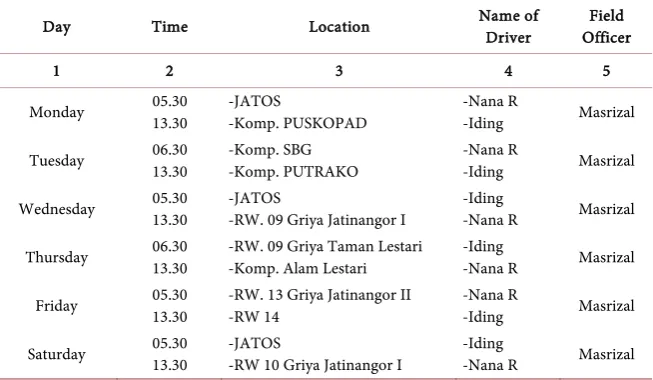
Waste management activities by Local Technical Implementation Unit for waste affairs of Jatinangor area are scheduled waste collection in Jatinangor area and transported by waste vehicle. There are 2 (two) units of waste vehicle, i.e.
one unit of dump truck and one unit of amroll. One unit of dump truck is lent by Local Technical Implementation Unit for waste affairs to Komunitas Peduli
Sampah Jatinangor (KPSJ) (literally translated to English as Jatinangor Waste
Care Community) in order to help waste collection service that can not be off-cially provided along arterial road. In waste management activities, the number of waste truck is considered insufficient for waste transport from Jatinangor to waste processing site (Tempat Pembuangan akhir, or TPA) in Sumedang. Omay Komarudin, Head of Local Technical Implementation Unit for waste affairs of Jatinagor area states that, “waste volume of Jatinangor, Tanjungsari and Ci-manggung is fairly high. On the other hand, there are only two units of waste truck” [7]. This makes waste management hindered because process of waste transfer from source to waste processing site can only be done, at most, twice a day.
DOI: 10.4236/jss.2018.69005 68 Open Journal of Social Sciences
Table 4. Schedule of waste service in Jatinangor Area.
Day Time Location Name of
-RW. 09 Griya Jatinangor I
-Iding
-Nana R Masrizal
Thursday 06.30 13.30
-RW. 09 Griya Taman Lestari -Komp. Alam Lestari
-Iding
-Nana R Masrizal
Friday 05.30
13.30
-RW. 13 Griya Jatinangor II -RW 14
-RW 10 Griya Jatinangor I
-Iding
-Nana R Masrizal
Source: Local Technical Implementation Unit for Waste Affairs of Jatinangor Area, 2017.
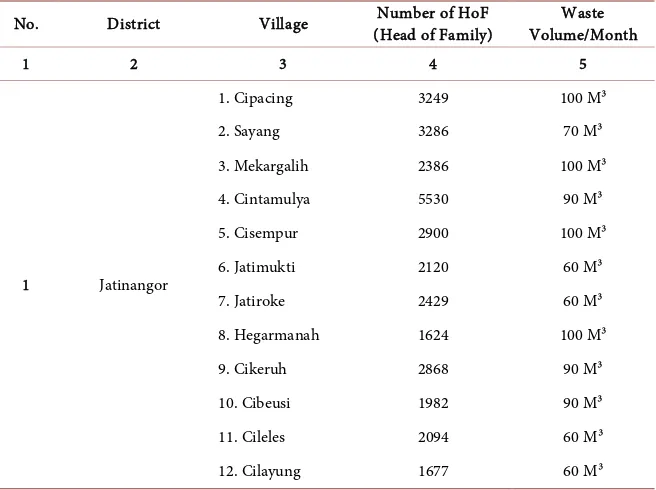
produced by community in Jatinangor, in total, reaches 980 M3 per month. In
average, waste volume produced in Jatinangor District is 32.6 M3/day.
As shown in Table 5, waste produced in Jatinangor mostly derives from local residences, apartments, and rent student rooms. Amount of waste produced is approximately 12 tons/day; however, this amount would be reduced according to student activities and academic schedule. As explained by Head of Local Technical Implementation Unit (UPTD) for waste affairs of Jatinangor area, Omay Komarudin, “Obviously, the amount of 12 tons per day might approx-imately reduced by 30% with certain conditions,” according to him, “it usually happens every once a year due to, such as, academic schedule and moment of Eid al-Fitr holiday that the waste volume decreases” [8]. Continuously increas-ing waste volume produced in Jatinangor, unfortunately, is not counterbalanced with proportional reduce of waste by community. Currently, waste bank is common thing, which is aimed to help community to reduce waste by means of waste recycle and reuse; however, waste bank in Jatinangor itself receives less response from government since there is only one waste bank built by private sector in Jatinangor, i.e.Bank Sampah Bersinar located in Sayang village.
Jatinangor District already has Integrated Waste Treatment Facility (Tempat
Pengolahan Sampah Terpadu or TPST) located in Hegarmanah village which
was inaugurated by Regent of Sumedang at beginning of January 2017. Waste management at the Integrated Waste Treatment Facility (TPST) of Hegarmanah village only receives waste from Hegarmanah village. Without Landfill (tempat
penampungan sampah or TPS) in Jatinangor area the community to dispose of
DOI: 10.4236/jss.2018.69005 69 Open Journal of Social Sciences
Table 5. Waste volume of UPTD of environmental and forestry unit of Jatinangor Area.
No. District Village Number of HoF
(Head of Family)
Waste Volume/Month
1 2 3 4 5
1 Jatinangor
1. Cipacing 3249 100 M³
2. Sayang 3286 70 M³
3. Mekargalih 2386 100 M³
4. Cintamulya 5530 90 M³
5. Cisempur 2900 100 M³
6. Jatimukti 2120 60 M³
7. Jatiroke 2429 60 M³
8. Hegarmanah 1624 100 M³
9. Cikeruh 2868 90 M³
10. Cibeusi 1982 90 M³
11. Cileles 2094 60 M³
12. Cilayung 1677 60 M³
Source: Local Technical Implementation Unit for Waste Affairs of Jatinangor, 2017.
referred to as 3Rs Landfill, is place for collection, sorting, reuse, and recycle of waste with the scale of area. Lack of waste recycle and reuse is one of factors of high volume of waste produced by community in Jatinangor District. As shown
in Figure 1.
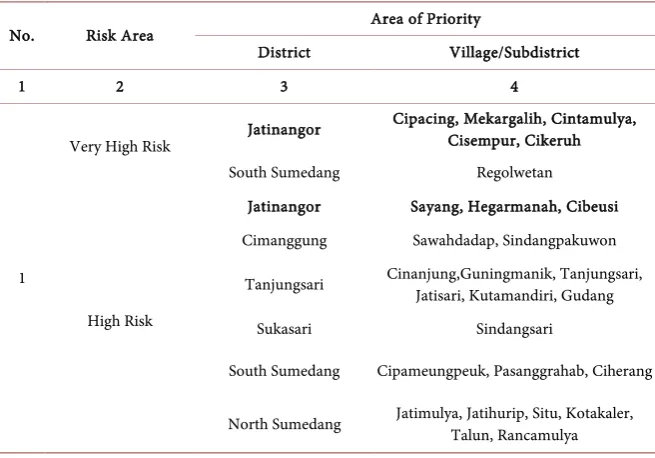
As an area that contributes to fairly high volume of waste heap, Jatinangor District becomes one of high and very high waste-risk areas. This certainly draws special attention on how to decrease waste-risk in Jatinangor area. Waste man-agement in Jatinangor District itself is administered by Local Technical Imple-mentation Unit (UPTD) for waste fair of Jatinangor area with cooperation with
Komunitas Peduli Sampah Jatinangor (KPSJ) (or literally translated to English as
Jatinangor Waste Care Community). Komunitas Peduli Sampah Jatinangor (KPSJ) was formed in order to help reduce of waste in Jatinangor area. As shown
in Figure 2.
As shown in Table 6, Waste Processing Site (Tempat Pembuangan Akhir or
TPA) in Sumedang Regency is located at the foot of Tampomas mountain in Cibereum Wetan Village, Cimalaka District. Waste management at Waste Processing Site in Sumedang Regency, since its construction in 1997 to today, uses Open Dumping system. Waste management, from the source to Waste Processing Site, still uses transport and dump system, i.e. only transport waste and dump the waste at Waste Processing Site without any further processing.
DOI: 10.4236/jss.2018.69005 70 Open Journal of Social Sciences
Figure 1. Waste in Sayang village.Source: Documentation by author.
Figure 2. Waste along Jatinangor arterial road. Source: Documentation by author.
Table 6. Village/subdistrict with risk in waste sector.
No. Risk Area
Area of Priority
District Village/Subdistrict
1 2 3 4
1
Very High Risk
Jatinangor Cipacing, Mekargalih, Cintamulya, Cisempur, Cikeruh
South Sumedang Regolwetan
High Risk
Jatinangor Sayang, Hegarmanah, Cibeusi
Cimanggung Sawahdadap, Sindangpakuwon
Tanjungsari Cinanjung,Guningmanik, Tanjungsari, Jatisari, Kutamandiri, Gudang
Sukasari Sindangsari
South Sumedang Cipameungpeuk, Pasanggrahab, Ciherang
North Sumedang Jatimulya, Jatihurip, Situ, Kotakaler, Talun, Rancamulya
Source: Update of Sanitation Strategy of Sumedang Regency, 2015.
DOI: 10.4236/jss.2018.69005 71 Open Journal of Social Sciences
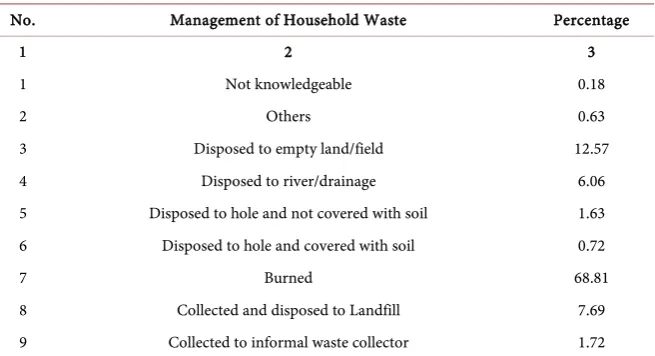
of environment, public health and economy. This regulation also regulates criminal sanction, i.e. imprisonment for a maximum of 3 (three) months or fine for a maximum of Rp50,000,000 (fifty million rupiahs) on people who dispose of waste improperly [9]. As a legal basis, Regional Regulation No. 2 of 2014 on Management of Household Waste and Other Similar Types of Waste in Sume-dang Regency should be feasibly implemented. Below is results of analysis on management of household waste in Sumedang Regency, as shown in Table 7.
In Regional Regulation No. 2 of 2014 on Management of Household Waste and Other Similar Types of Waste in Sumedang Regency, Article 44, it is stated that no one shall be allowed to: (b) dispose of waste on environmental medium or inappropriate place; and (f) burn waste on land in the open which does not meet technical requirement of waste management. This problem is resulted from regional regulation on waste management that is not promoted evenly to public. Promotion on waste management is administered by Work Team for Water Supply and Environmental Sanitation (Kelompok Kerja Air Minum dan
Penye-hatan Lingkungan or AMPL) once every 3 months or at least twice a year.
How-ever, the promotion is still limited within Sumedang City and not yet to every community in all districts in Sumedang. Promotion in the districts is still limited to representatives of community. And sanction given to people who dispose of waste improperly is still limited to warning and correctional. Sanction given is supposedly according to regional regulation enacted.
Waste problem in Jatinangor is crucial, considering that the waste produced by community will have both personally and environmentally bad effects with-out proper treatment. Effects of the waste for individual are health problems by which waste heap will become source of diseases and results in diseases such as diarrhea, respiratory problems, and skin diseases. As for environment, waste along arterial road will be aesthetically annoying, and the waste clogs drainage which eventually results in flood, such as dispose of waste on river in Jatinangor may result in flood in Rancaekek District.
Table 7. Management of household waste.
No. Management of Household Waste Percentage
1 2 3
1 Not knowledgeable 0.18
2 Others 0.63
3 Disposed to empty land/field 12.57
4 Disposed to river/drainage 6.06
5 Disposed to hole and not covered with soil 1.63
6 Disposed to hole and covered with soil 0.72
7 Burned 68.81
8 Collected and disposed to Landfill 7.69
9 Collected to informal waste collector 1.72
DOI: 10.4236/jss.2018.69005 72 Open Journal of Social Sciences
Factually, according to Strategic Plan of Environmental and Forestry Agency of Sumedang Regency on waste management, waste condition in Jatinangor area requires special attention and more advanced formulation of strategy and efforts for problems in management of waste, especially household waste. Based on elaboration above, we are interested to do research titled “Strategy of Local Gov-ernment in Household Waste Management in Jatinangor District, Sumedang Regency, West Java Province”.
2. Problem Statement
In relation with facts above, problem statements as basis for this research are: 1) What is Strategy of Local Government in Household Waste Management in Jatinangor District, Sumedang Regency, West Java Province?
2) What are supporting and inhibiting factors in the Strategy of Local Gov-ernment in Household Waste Management in Jatinangor District, Sumedang Regency, West Java Province?
3) What are efforts to overcome the inhibiting factors in Strategy of Local Government in Household Waste Management in Jatinangor District, Sume-dang Regency, West Java Province?
3. Theoretical Framework
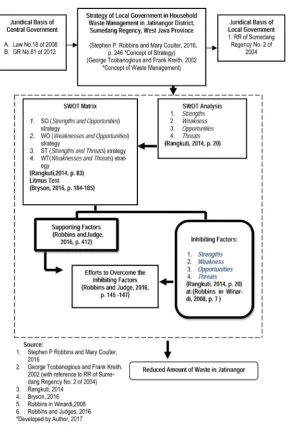
Theoretical framework explains structure of thinking used by researcher in doing research. In order to achieve good management of household waste, it re-quires certain strategy to be formulated in such a way. This research uses con-cept of strategy by Stephen P. Robbins and Mary Coulter, concon-cept of waste management by George Tcobanoglous and Frank Kreith (with reference to Re-gional Regulation of Sumedang Regency on management of household waste and other similar types of waste) and SWOT analysis technique by Rangkuti to determine strategy of Local Government in household waste management in Ja-tinangor District, Sumedang Regency, West Java Province [10].
SWOT analysis technique used consists of Strengths, Weaknesses, Opportuni-ties, and Threats with SO (Strengths and Opportunities) strategy, WO (
Weak-nesses and Opportunities) strategy, ST (Strengths and Threats) strategy, and WT
(Weaknesses and Threats) strategy [11], and then identification of supporting
and inhibiting factors using concept by Robbins. Litmus Tests is used to deter-mine the most appropriate strategy and strategic issues to be implemented. Based on explanation above, theoretical framework is formulated according to
Figure 3.
4. Work Hypothesis
DOI: 10.4236/jss.2018.69005 73 Open Journal of Social Sciences
Figure 3. Theoritical framework.
Analysis, (Strengths, Weaknesses, Opportunities, Threats) with SO (Strengths
and Opportunities) strategy, WO (Weaknesses and Opportunities) strategy, ST
(Strengths and Threats) strategi, and WT (Weaknesses and Threats) strategy.
Researcher identifies inhibiting factors using concept by Stephen Robbins (in Winardi) and supporting factors using concept by Stephen Robbins and devel-oped by researcher, and efforts to overcome the inhibiting factors using concept by Stephen Robbins. This is done to determine appropriate strategy based on strategic issues identified, and Litmus Test is administered using concept by Bryson so that the strategy is feasibly implemented.
DOI: 10.4236/jss.2018.69005 74 Open Journal of Social Sciences
is expected to amount of waste in Jatinangor can be decreased and made useful with methods of recycle and reuse.
5. Research Method
Simangunsong, in his book, says that research is included in perspective man-agement which is research, like writing scientific, semi-scientific and even non-scientific paper, is an important intellectual activity and continuing process. Furthermore it is explained that, “Research of public administration is effort to determine, develop and test indications, facts, phenomena and dynamics of pub-lic administration in order to create validity of administrative science in the context of authority and public services in coherent, corresponding and prag-matical manners that derives from systematic thinking with theoretical, legalis-tic, empirical and innovative advantages.” [12].
Based on explanation about characteristics of research and method used in research of public administration above, researcher uses qualitative method with descriptive-inductive approach to describe and analyze problems according to factual condition and relationship with existing phenomena so that conclusion can be drawn in order to find solution for the problems.
Departing from problems on the field, researcher develops theory with con-cept of strategy by Stephen P. Robbins and Marry Coulter, concon-cept of waste management by George Tchobanoglous and Frank Kreith, and then incorpo-rated into concept of SWOT analysis by Rangkuti. And concept by Robbins in Winari is used to determine supporting and also inhibiting factors, while con-cept by Robbins and Judges is used to determine efforts to overcome the inhi-biting factors.
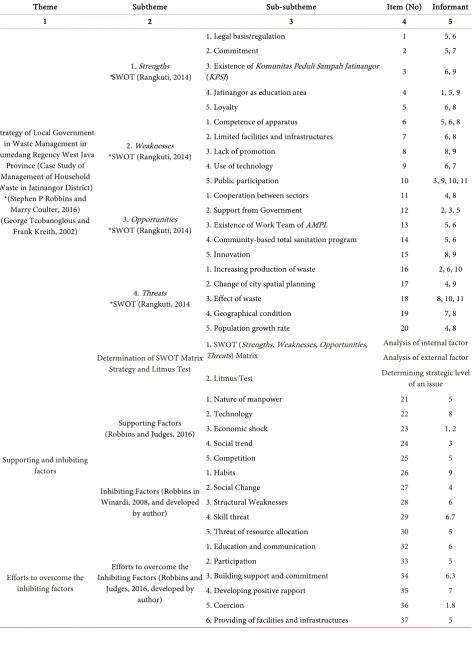
In this research (Table 8), informants were determined using purposive tech-nique. Interview was conducted to informants, i.e. local government who are able to provide information and data accurately, and villagers in Jatinangor Dis-trict where research was conducted. Informants in this research are:
1) Regent of Sumedang as informant 1;
2) Commission D of Division of Environment of Regional Legislative Council of Sumedang Regency as informant 2;
3) Regional Secretary of Sumedang Regency as informant 3;
4) Head of Regional Development Planning, Research and Development Agency of Sumedang Regency as informant 4;
5) Head of Environmental and Forestry Agency of Sumedang Regency as in-formant 5;
6) Head of Head of Waste and Park Affairs Division of Sumedang Regency as informant 6;
7) Head of Partnership Development for Waste Management Section, Envi-ronmental and Forestry Agency of Sumedang Regency as informant 7;
DOI: 10.4236/jss.2018.69005 75 Open Journal of Social Sciences
Table 8. Research theme structure.
Theme Subtheme Sub-subtheme Item (No) Informant
1 2 3 4 5
Strategy of Local Government in Waste Management in Sumedang Regency West Java
Province (Case Study of Management of Household Waste in Jatinangor District)
*(Stephen P Robbins and Marry Coulter, 2016)
3. Existence of Komunitas Peduli Sampah Jatinangor
(KPSJ) 3 6, 9
2. Limited facilities and infrastructures 7 6, 8
3. Lack of promotion 8 8, 9
4. Use of technology 9 6, 7
5. Public participation 10 3, 9, 10, 11
3. Opportunities *SWOT (Rangkuti, 2014)
1. Cooperation between sectors 11 4, 8
2. Support from Government 12 2, 3, 5
3. Existence of Work Team of AMPL 13 5, 6
4. Community-based total sanitation program 14 5, 6
5. Innovation 15 8, 9
Determination of SWOT Matrix Strategy and Litmus Test
1. SWOT (Strengths, Weaknesses, Opportunities, Threats) Matrix
Analysis of internal factor
Analysis of external factor
2. Litmus Test Determining strategic level
of an issue
Supporting and inhibiting factors
Supporting Factors (Robbins and Judges, 2016)
Inhibiting Factors (Robbins in Winardi, 2008, and developed
by author)
1. Habits 26 9
2. Social Change 27 4
3. Structural Weaknesses 28 6
4. Skill threat 29 6.7
5. Threat of resource allocation 30 5
Efforts to overcome the inhibiting factors
Efforts to overcome the Inhibiting Factors (Robbins and
Judges, 2016, developed by author)
1. Education and communication 32 6
2. Participation 33 5
3. Building support and commitment 34 6.3
4. Developing positive rapport 35 7
5. Coercion 36 1.8
DOI: 10.4236/jss.2018.69005 76 Open Journal of Social Sciences
9) Head of Jatinangor District as informant 9;
10) Head of Integrated Waste Treatment Facility (TPST) of Sauyunan as in-formant 10;
11) Villagers in Jatinangor District chosen using purposive sampling as in-formants 11.
And documents used to support analysis in this research are: 1) Documents:
a) Masterplan of Waste Affairs of Sumedang Regency (2011, projection for the next 10 years)
b) Urban Planning of Education City (Perencanaan Kawasan Perkotaan Kota
Pendidikan or PKPKP) of Jatinangor, 2016
c) RPJMD (2014-2018) of Sumedang Regency
d) White Paper of Sanitation, SSK and Study of EHRA (2015, update in once every 5 years)
e) Strategic Planning (2014-2018), LAKIP (2017) DLHK of Sumedang 2) Regulations:
a) Law No. 18 of 2008 on Waste Management
b) GR No. 81 of 2012 on Management of Household Waste and Other Similar Types of Waste
c) RR of Sumedang Regency No. 2 of 2004 on Management of Household Waste and Other Similar Types of Waste in Sumedang Regency
SWOT analysis was also used by determining internal strategic factors to identify strengths and weaknesses, and external strategic factors to identify op-portunities and threats as basis to determine objective and formulation of the strategy.
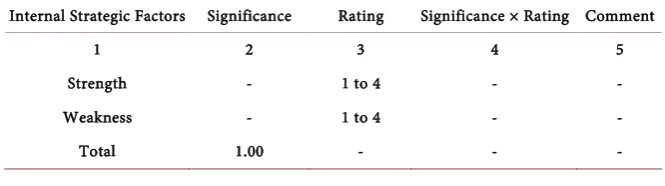
Steps to determine internal strategic factor (Internal Factor Analysis Summary or IFAS) are:
1) Determine factors in element of strengths and weaknesses to column 1: 2) Define significance of each factor by score of from 1.0 (very significant) to 0.0 (not significant) based on influence of the factor on strategic position. Keep in mind that the total significance is not more than 1.0;
3) Calculate rating (column 3) for each factor by giving score of from 4 (Out-standing) to 1 (Poor) based on influence of the factor on condition of the organ-ization. Variable with positive value, i.e. all variables included in strength, is given with score from +1 to +4 (very good) by comparing it to average score of organization’s main competitor. And variable with negative value is contrari-wise. If weakness of the organization is higher and more serious than average score of other similar organization, the score is 1. On the contrary, if weakness of the organization is lower than average score of other organization, the score is 4;
4) Multiply significance value in column 2 to score in column 3 to get signi-ficance factor in column 4. The result is signisigni-ficance score for each factor with value varying from 4.0 to 1.0.
DOI: 10.4236/jss.2018.69005 77 Open Journal of Social Sciences
and how the significance score is calculated.
6) Sum significance scores (column 4) to get total significance score for the organization. This total score shows how the organization reacts to its internal strategic factors. This score can be used to compare with other organization”.
As shown in Table 9: Steps to determine external strategic factor (External Factor Analysis Summary or IFAS) are:
1) Set column 1 with 5 to 10 main opportunities and threats faced by the insi-tution.
2) Define significance of each factor in column 2 by score of from 0.0 (not significant) to 1.0 (very significant).
3) Calculate rating (column 3) for each factor by giving scale of from 1 (very low) to 4 (very high) based on influence of the factor on condition of the organ-ization. For opportunities, value given is positive (eg. +4), and for threats, value is negative or contrariwise (e.g. −1).
4) Multiply significance value in column 2 to score in column 3 to get signi-ficance factor in column 4. The result is signisigni-ficance score for each factor with value varying from +4 (very high) to +1 (very low).
5) Use column 5 to put comment or note according to score get.
6) Sum score in column 4 to get total score for the organization. This total score shows how the organization reacts to its external strategic factors. In addi-tion, this total score can also be used to compare with other organization”. As shown in Table 10.
After rating significance acquired, next step is to formulate strategic issues by using a tool to set strategic factors, i.e. SWOT Matrix. This matrix can clearly describe how external opportunities and threats faced by organization should be matched with its strengths and weaknesses. As shown in Table 11.
1) SO Strategy
This strategy is used based on organization’s way of thinking, i.e. by using all strengths to take and use most opportunities possible.
2) ST Strategy
This is strategy to use organization’s strengths to overcome threats. 3) WO Strategy
This strategy is applied based on using available opportunities by minimizing weaknesses.
4) WT Strategy
Table 9. Internal factor analysis summary (IFAS).
Internal Strategic Factors Significance Rating Significance × Rating Comment
1 2 3 4 5
Strength - 1 to 4 - -
Weakness - 1 to 4 - -
DOI: 10.4236/jss.2018.69005 78 Open Journal of Social Sciences
Table 10. External factor analysis summary (EFAS).
External Strategic Factors Significance Rating Significance x Rating Comment
1 2 3 4 5
Define 5 - 10 internal factors of weakness
WEAKNESSES (W) Define 5 - 10 internal factors of strength
OPPORTUNITIES (O) Define 5 - 10 external factors of opportunity
SO STRATEGY
Create strategy that optimizes strengths to use opportunities
WO STRATEGY
Create strategy that minimizes weaknesses to use opportunities
THREATS (T)
Define 5 - 10 external factors of threat
ST STRATEGY
Create strategy that optimizes strengths to overcome threats
WT STRATEGY
Create strategy that minimizes weaknesses to avoid threat
Source: Rangkuti, 2014.
This strategy is based on defensive activities to minimize weaknesses and avoid threats”.
In determining a strategy as an issue, we can use Litmus Test. Litmus Test is a technique used to determine how strategic an issue is. Bryson explains that when the strategic issues are identified, they should be sorted in order of priority, log-ic, or temporal order as basis for strategy development in the next stages” [13]. Furthermore, “Litmus Test used by Hennepin Country is to filter strategic is-sues. Issues which are very strategic are the ones with highest score in all dimen-sions”. In Litmus Test, classification of scoring is set based on strategic issues provided to informants. Range of scoring for Litmus Test can be set for each item indicator to produce score of Litmus Test per strategic issue. Scoring in as-sessment by Litmus Test is as follows:
Score 1: Operational issue. Score 2: Fairly strategic issue. Score 3: Very strategic issue.
Based on highest score and lowest score acquired in scoring of strategic issues, the score ranges are as follows:
Total Score: 13 - 21 Operational issue. Total Score: 22 - 30 Fairly strategic issue. Total Score: 31 - 39 Very strategic issue.
Below is Table 12 of list of question in Litmus Test.
6. Result
DOI: 10.4236/jss.2018.69005 79 Open Journal of Social Sciences
Table 12. List of question and score of litmus test (Operational Strategy).
No. Question (1) (2) (3)
1. When does challenge or opportunity of the strategic issues
occur ahead of you? Now Next Year
Two or more years from now
2 To how much extent will the issue affect the organization? Singe division/unit Several divisions All departments
3 How much is your organization’s financial
risk/opportunity? Low Medium High
4 Will strategies for solution of the issues require:
a) development of objective and program of service? No Yes
b) Significant change in resource or amount of tax? No Yes
c) Significant change in decision or regulation? No Yes
d) Addition or modification of main facilities? No Yes
e) Significant addition of staff? No Yes
5 What is the best approach for solution of the issues? Clear and ready to implement
Wide and rather detailed
parameter Widely open
6 Which of the lowest management levels can decide how to
overcome the issues? Line staff supervisor Head of division Head of department
7 What are the possible consequences if the issues are not solved?
There will be disorder of inefficiency
Disorder in services, loss of financial resource
Long term disorder in services, and substantial
cost/declining income
8 How many other departments are affected by the issues
and involved in the solution? None One to three Four or more
9 How is sensitiveness or charge of these issues to social,
political, religious, and cultural values of the community? Soft Medium Hard
Source: John. M. Bryson, 2016.
of household waste in Jatinangor District, waste management in Jatinangor is still poorly implemented, and the strengths and opportunities owned by Sume-dang Regency can be a support to overcome threats and weaknesses in activities of household waste management. Below are conclusions that can be drawn:
Strategy of Local Government in Waste Management:
1) Strengths
a) Waste management already has legal basis/regulation, i.e. Regional Regula-tion of Sumedang Regency No. 2 of 2004 on Management of Household Waste and Other Similar Types of Waste in Sumedang Regency;
b) Work commitment is built through family relationship;
c) Komunitas Peduli Sampah Jatinangor (KPSJ) has important role in
envi-ronmental cleanliness of Jatinangor area;
d) Main asset of Jatinangor is its function as education area to prepare good quality human resources;
e) Government officials highly honor loyalty as form of compliance to work-loads given.
2) Weaknesses
DOI: 10.4236/jss.2018.69005 80 Open Journal of Social Sciences
waste management;
b) Limited facilities and infrastructures in management of household waste in operational activities of waste affairs;
c) Lack of promotion on regulation results in lack of information and under-standing on proper management of household waste;
d) Use of technology is not yet optimal in management of household waste; e) Public participation in management of household waste is still low.
3) Opportunities
a) Cooperation between both public and private sectors through coordination can synergize programs in management of household waste;
b) Support from government through providing budget for waste manage-ment, support of regional regulation, and support of control in management of household waste;
c) Existence of work team for water supply and environmental sanitation (Air
Minum dan Penyehatan Lingkungan or AMPL) to synergize activities of waste
management;
d) Program of ommunity-based total sanitation (Sanitasi Total Berbasis
Ma-syarakat or STBM) in form of waste bank;
e) Wide range of innovation in waste management.
4) Threats
a) Waste production is increasing each day;
b) Change of city spatial planning does not prepare land specified for man-agement of household waste;
c) Effect of waste becomes public threat;
d) Geographical condition of Sumedang Regency becomes constraint in the process of household waste management;
e) Population growth rate contributes to amount of waste produced. Based on analysis using SWOT matrix, the strategies are as follows: 1) S-O (Strengths-Opportunities) strategies are:
a) To establish waste bank in each village through cooperation between public and private sectors in accordance with prevailing regulations;
b) To be committed to implement management of household waste through social assistance;
c) To establish Memorandum of Understanding (MOU) with Komunitas
Pe-duli Sampah Jatinangor (KPSJ) to help the implementation of community-based
total sanitation program;
d) To support and implement program of Work Team of Water Supply and Environmental Sanitation (AMPL) in waste management;
e) To create new innovations in management of household waste through co-operation between internal sectors, private sectors, higher education institutions and community;
2) W-O (Weaknesses-Opportunities) strategies are:
DOI: 10.4236/jss.2018.69005 81 Open Journal of Social Sciences
household waste through education and training;
b) To make use of social assistance to acquire necessary supporting facilities and infrastructures for management of household waste;
c) To implement promotion of community-based total sanitation program; d) To facilitate the use of technology through development and training of household waste management;
e) To implement program of household waste management by improving fa-cilities and infrastructures and maximizing the use of technology;
3) S-TO (Strengths-Threats) strategies are:
a) To reduce waste production with the use of environmentally friendly prod-ucts and recycle of waste;
b) To be committed to continue making efforts to make change in manage-ment of household waste;
c) To support and facilitate KPSJ in waste management in order to avoid bad effects of waste;
d) Educational institutions should give idea contribution in solving the geo-graphical problem of household waste management;
e) To improve cooperation between government and educational institutions in activities of household waste management;
4) W-T (Weaknesses-Threats) strategies are:
a) To implement training that improves skills of government apparatus in household waste treatment;
b) To educate community to familiarize themselves in sorting and making use of household waste from the smallest scope i.e. own house;
c) To launch promotional program of household waste management and ef-fect of waste;
d) To use technology in coping with less supporting geographical condition for household waste management;
e) To stimulate community through activities that develop creativity and im-prove environmental awareness.
Twenty strategies based on S-O (Strengths-Opportunities) strategy, W-O
(Weaknesses-Opportunities) strategy, S-T (Strengths-Threats) strategy and W-T
(Weaknesses-Threats) strategy are tested by Litmus test to acquire strategic
is-sues in management of household waste in Jatinangor, i.e.: 1) Very strategic issues
a) To establish waste bank in each village through cooperation between public and private sectors in accordance with prevailing regulations;
b) To establish Memorandum of Understanding (MOU) with Komunitas
Pe-duli Sampah Jatinangor (KPSJ) to help the implementation of community-based
total sanitation program;
c) To improve quality of human resources to be competent in management of household waste through education and training;
DOI: 10.4236/jss.2018.69005 82 Open Journal of Social Sciences
e) To facilitate the use of technology through development and training of household waste management;
f) To implement program of household waste management by improving fa-cilities and infrastructures and maximizing the use of technology;
g) To support and facilitate KPSJ in waste management in order to avoid bad effects of waste;
h) To improve cooperation between government and educational institutions in activities of household waste management;
i) To launch promotional program of household waste management and effect of waste;
2) Fairly strategic issues:
a) To create new innovations in management of household waste through cooperation between internal sectors, private sectors, higher education institu-tions and community;
b) To make use of social assistance to acquire necessary supporting facilities and infrastructures for management of household waste;
c) To reduce waste production with the use of environmentally friendly prod-ucts and recycle of waste;
d) Educational institutions should give idea contribution in solving the geo-graphical problem of household waste management;
e) To implement training that improves skills of government apparatus in household waste treatment;
f) To educate community to familiarize themselves in sorting and making use of household waste from the smallest scope i.e. own house;
g) To use technology in coping with less supporting geographical condition for household waste management;
h) To stimulate community through activities that develop creativity and im-prove environmental awareness.
3) Operational issues:
a) To be committed to implement management of household waste through social assistance;
b) To support and implement program of Work Team of Water Supply and Environmental Sanitation (AMPL) in waste management;
c) To be committed to continue making efforts to make change in manage-ment of household waste.
Supporting and Inhibiting Factors of Strategy of Local Government in Management of Household Waste are as follows:
1) Supporting Factors
a) Diverse nature of manpower that is responsible for the duties charged; b) Technology with positive impacts in facilitating management of household waste;
DOI: 10.4236/jss.2018.69005 83 Open Journal of Social Sciences
d) Competition as strength for organization to boost improvement of services, especially of household waste management;
e) Social trend of accessible growing information; 2) Inhibiting Factors
a) Habit of the people who improperly dispose of waste;
b) Social change in a community that affects social attitudes and behaviors among groups of community;
c) Structural weaknesses in organization, including quality of human re-sources;
d) Lack of skills of the employees as a threat for organizational survivability; e) Threat on allocation of supporting resources for activities of household waste management.
Efforts to overcome the inhibiting factors in Strategy of Local Govern-ment in ManageGovern-ment of Household Waste are as follows:
1) Overcoming the inhibiting factors in waste management can be done through education and communication to improve ability and knowledge of employees;
2) Establish participation of multiple parties through promotion and provid-ing of reward in waste management activities;
3) Prepare employees and emphasizes on commitment and support on organ-ization as a whole to help them emotionally to accept changes in waste manage-ment;
4) Establish rapport between government and community to develop public trust towards government;
5) Existence of coercion emphasizes the enforcement of all rules that have been made and giving of sanction to those who fail to comply;
Providing of facilities and infrastructures in waste management will have pos-itive impacts on operational activities of organization.
7. Recommendation
Along with the conclusions, it is necessary to give input of recommendations as consideration for strategy of Local Government in management of household waste in Jatinangor District, Sumedang Regency, West Java Province, i.e.:
Based on the conclusions about strategy of Local Government in house-hold waste management in Jatinangor District, Sumedang Regency, West Java Province, below are recommendations given:
1) Strengths
a) Enactment of Regional Regulation of Sumedang Regency No. 2 of 2004 on Management of Household Waste and Other Similar Types of Waste in Sume-dang Regency;
b) Realization of commitment that has been made according to work pro-gram;
DOI: 10.4236/jss.2018.69005 84 Open Journal of Social Sciences
Peduli Sampah Jatinangor (KPSJ) and Government as basis for implementation
of waste management duty;
d) Each society of academicians should prepare human resource with envi-ronmental awareness;
e) Apparatus should deliver services and perform breakthrough movement in management of household waste;
2) Weaknesses
a) Organize job structure according to competence of each official;
b) Provide necessary supporting facilities and infrastructures for operational activities of waste management;
c) Cooperate with apparatus of each village to promote regional regulation on waste management to community;
d) Provide necessary technology of waste management and prepare necessary human resources who understand the technology as the operator;
e) Encourage community to perform waste management through environ-mental cleanliness movement.
3) Opportunities
a) Establish Memorandum of Understanding (MOU) on management of household waste between government and private sector;
b) By means of regulation on waste management, make use of budget support to implement programs of household waste management;
c) Work team for water supply and environmental sanitation (AMPL) should synergize activities of waste management to every district in Sumedang Regency;
d) Promote and implement program of community-based total sanitation program (STBM);
e) Run study together with research institutions, such as Bandung Technolo-gical Institute (Institut Teknologi Bandung or ITB).
4) Threats
a) Reduce waste production by using reuseable products; b) Review the spatial planning for Jatinangor area;
c) Minimize effect of waste by sorting and disposing of waste properly; d) Establish waste processing site (TPA) with fast road access from Jatinangor area;
e) Limit waste production in each house, and make use of waste by recycling. Based on strategy of Local Government in management of household waste through SWOT matrix analysis, recommendations that can be given are:
1) S-O (Strengths-Opportunities) strategies are:
a) Make waste bank as village program in order to improve social economy and environmental care;
b) Be committed to implement waste management programs with or with so-cial assistance;
DOI: 10.4236/jss.2018.69005 85 Open Journal of Social Sciences
(MOU) with Komunitas Peduli Sampah Jatinangor (KPSJ) to help the imple-mentation of community-based total sanitation program;
d) Programs of work team for water supply and environmental sanitation (AMPL) should be implemented in every district in Sumedang Regency;
e) Make cooperation in order to study and determine innovations in man-agement of household waste;
2) W-O (Weaknesses-Opportunities) strategies are:
a) Provide skill training and education for apparatus according to needed sec-tor;
b) Propose facility and infrastructure aid to corporates as part of their corpo-rate social responsibility toward environment;
c) Implement promotion of community-based total sanitation program to-gether with apparatus in a forum, such as at village hall;
d) Provide technology of household waste management along with its train-ing;
e) Facilitate facilities and infrastructures, technology and human resources to support management of household waste in Jatinangor;
3) S-TO (Strengths-Threats) strategies are:
a) Bring own meal box or shopping bag to reduce waste production;
b) Be courageous to start making change in management of household waste; c) Provide support of facility in operational acitivities of Komunitas Peduli
Sampah Jatinangor;
d) Run study between educational institutions in overcoming obstacles in waste management;
e) Improve the role of educational institutions in providing training and out-reach programs regarding waste management;
4) W-T (Weaknesses-Threats) strategies are:
a) Training of waste management should not only provided to apparatus but also to community;
b) Every household should have organic and non-organic waste bins to make sorting of waste easier;
c) Implement gradual and continuous promotion to community regarding management of household waste and effect of waste;
d) Establish waste processing site not far from Jatinangor area; e) Implement waste care movement by giving reward to community.
Based on supporting and inhibiting factors of strategy of Local Govern-ment in household waste manageGovern-ment in Jatinangor District, Sumedang Regency, West Java Province, below are recommendations given:
1) Supporting Factors
a) Facilitate the needs of employee in implementation of household waste management duty;
DOI: 10.4236/jss.2018.69005 86 Open Journal of Social Sciences
c) Facilitate waste recycle activities to improve social economy;
d) Make cooperation of training on waste management to improve services and work motivation;
e) Update news on waste management as motivation to seize the opportunity in waste recycle.
2) Inhibiting Factors
a) Change public mindset towards environment through continuous stimuli; b) Promote communal work as effort to regrow the spirit of togetherness and environmental care;
c) Improve quality of employees by providing skill training accordingly; d) Provide training according to job analysis in organization;
e) Make plan and proposal of internal needs of the organization.
Based on efforts to overcome the inhibiting factors of strategy of Local Government in household waste management in Jatinangor District, Su-medang Regency, West Java Province, below are recommendations given:
1) Education and communication should be customized accordingly so that capability and knowledge of employees is in line with the needs of each organi-zation;
2) Establish participation of multiple parties through promotion and provid-ing of reward in waste management activities;
3) Emphasis on support and commitment can be by familial approach, but should also be balanced with fulfillment of needs or facilitation, especially in management of household waste;
4) Establishment of rapport based on trust should be firmly held, do not let public disappointed because it will lead to the loss of public trust.
5) Coercion can be compelled as warning, coercion in waste management should still refer to prevailing regulations;
Operational activities of organization will run if supported by facilities and infrastructures according to the needs in management of household waste.
Conflicts of Interest
The authors declare no conflicts of interest regarding the publication of this pa-per.
References
[1] Misitry of Home Affairs (2014) Law No. 23 of 2014 on Local Governmet. Regula-tion, Indonesia.
[2] Manik, K.E.S. Environmental Management.Djambatan, Jakarta.
[3] Dhokhikah, Y. and Trihadiningrum, Y. Journal Solid Waste Management in Asian Developing Countries: Challenges and Opportunities.
https://www.textroad.com/pdf/JAEBS/J.%20Appl.%20Environ.%20Biol.%20Sci.,%2 02(7)329-335,%202012.pdf
DOI: 10.4236/jss.2018.69005 87 Open Journal of Social Sciences
[5] Sumedang, R. (2015) Study of EHRA (Environment Health Risk Assessment). No. Publish, Sumedang.
[6] Java, W. (2004) Province. Government Regulation No. 81 of 2004 on Management of Houshold Waste and Other Similar Types of Waste. Regulation, Bandung. [7] Kabarpriangan.
https://kabarpriangan.co.id/cecep-lukman-pemkab-tidak-fokus-kelola-sampah-di-j atinangor/
[8] http://eljabar.com/sampah-di-kawasan-jatinangor-berkurang/
[9] Sumedang, R. (2004) Regional Regulation of Sumedang Regency No. 2 of 2004 on Management of Household Waste and Other Similar Type of Waste in Sumedang Regency. Regulation, Sumedang.
[10] Stephen, R.P. and Coulter, M. (2016) Management Vol. 1 Ed. 13. Devri Barnadi Pu-tera Bob Sabran. Translate. Erlangga,Jakarta.
[11] Rangkuti, F. (2014) Technique to Investigate Business Case of SWOT Analysis.PT, Jakarta, Gramedia Pustaka Utama.
[12] Simangunsong, F. (2016) Methodology of Public Administration Research. Alfabe-ta, Bandung.