Introduction to E-commerce
Zheng Qin
Dept. of Software Engineering
Tsinghua University, Beijing 100084, China E-mail: [email protected]
_______________________________________________________________
ISBN 978-7-302-16323-7 Tsinghua University Press, Beijing
ISBN 978-3-540-49644-1 Springer Berlin Heidelberg New York
e ISBN 978-3-540-49645-8 Springer Berlin Heidelberg New York
_______________________________________________________________
Library of Congress Control Number: 2007940845
This work is subject to copyright. All rights are reserved, whether the whole or part of the material is concerned, specifically the rights of translation, reprinting, reuse of illustrations, recitation, broadcasting, reproduction on microfilm or in any other way, and storage in data banks. Duplication of this publication or parts thereof is permitted only under the provisions of the German Copyright Law of September 9, 1965, in its current version, and permission for use must always be obtained from Springer-Verlag. Violations are liable to prosecution under the German Copyright Law.
© 2009 Tsinghua University Press, Beijing and Springer-Verlag GmbH Berlin Heidelberg
Co-published by Tsinghua University Press, Beijing and Springer-Verlag GmbH Berlin Heidelberg Springer is a part of Springer Science+Business Media
springer.com
The use of general descriptive names, registered names, trademarks, etc. in this publication does not imply, even in the absence of a specific statement, that such names are exempt from the relevant protective laws and regulations and therefore free for general use.
Zheng Qinķ Li Shundongĸ Han Yiķ Dong JinchunĹ Yan Lixiangķ Qin Junĺ
ķ
School of Software, Tsinghua University, Beijing 100084, China
ĸ
School of Computer Science, Shaanxi Normal University, Xi’an 710062, China
Ĺ
Panda Electronics Group Co., Ltd. Nanjing 210002, China
ĺ
School of Information Management and Engineering, Shanghai University of Finance and Economics, Shanghai 200433, China
Abstract E-commerce is the core technology of knowledge economy.
Developing e-commerce is an inevitable choice for Chinese economy to enter into the world market, participate in and ultimately penetrate the global market, and bring about a great rejuvenation of the Chinese nation. We must grasp this business opportunity and further extend its strength by consciously studying, applying and developing e-commerce; allowing e-commerce to serve better in society’s economic development. Before we can start developing e-commerce, we have to understand the background, the basic principle and the evolution and development history of e-commerce. This enables us to have a thoughtful understanding on this new technology, hence, helping to predict the trend of e-commerce in the near future. This chapter introduces some basic knowledge regarding to e-commerce, which includes, the needs of society, development of e-commerce, basic e-commerce concepts, and couples of other information which closely related to the development of e-commerce.
Key Words e-commerce, m-commerce, electronic data interchange (EDI),
Internet, business to business (B2B), business to consumer (B2C), business to governments (B2G), consumers to consumers (C2C), governments to governments (G2G), international trade.
1.1 The Origin and Development of E-commerce
Internet has created a new world beyond the real world — a “virtual network world” or “The sixth continent” called by Lu Yongxiang, the academician of Chinese Academy of Science. E-commerce brought about by Internet is one of the most significant scientific accomplishments. In business, the prosperous e-commerce technology gives rise to a revolution in the circulation system. It breaks the boundary of time and space, alters the trade pattern, improves the circulation of merchandize, capital and information, and makes enterprises have an edge over others as well by reducing the cost of production effectively. In short, e-commerce has enabled the traditional business to achieve greater, faster, better and more economical results. The influence of the e-commerce will go beyond the business activity. It will make a profound impact on each aspect of human society, such as production and employment, government function, working talent, law systems and education etc. It permeates into every profile: industries, logistics, finance, media, governments, enterprises, research organizations and even traditional agricultures. With the development of the e-commerce, it will influence and impact to a larger extent every aspect of our society with each passing day. A new economic revolution on the basis of digitalization and Internet has set in. We can say without exaggeration that the electronic commerce is the most significant industrial revolution since Industrial Revolution, with deeper influence on mankind than the former two industrial revolutions, because it not only can raise greatly productivity, efficiency of economic operations, lower the economy operation cost, and make many originally impossible things possible, but also influence people’s life styles and every social aspect and therefore change their world outlook and methodology. In the new century, participation of the third revolution exerts the influence, to a large degree, on economy in China, especially in shortening the gap between the western developed countries and catching up with and surpassing them. Therefore, it is inevitable for us to develop e-commerce, to join the world market, participate in the globalization competition and rejuvenate China. So the book will cover the following aspects of e-commerce: its coming into being development, its composition, its nature, the guidelines for e-commerce system design, difficulties and respective solutions in e-commerce, methods of designing a good website, the relation between e-commerce and international trade, the legal problems brought by e-commerce, the methods of dealing with and analyzing how to deal with and analyze e-commerce cases. In conclusion, all the above will be touched upon in this book, relevant philosophy problems about social overall influence on mankind are beyond the scope of this book.
1.1.1 The Origin and Development of E-commerce
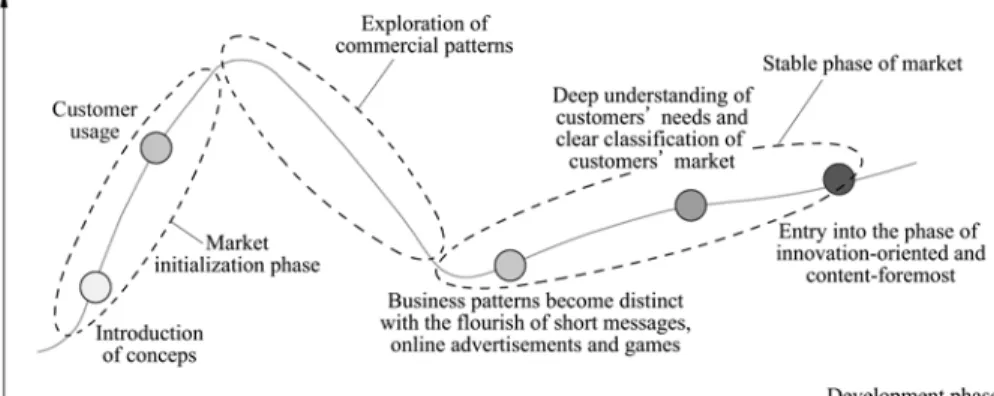
business boosts e-commerce. The development of computer science and communications sciences has laid a solid foundation for e-commerce. The development of information security makes e-commerce proceed in a secure way; the laws concerning this field also provide legal guarantees for e-commerce. The origin and development of e-commerce is illustrated in Fig. 1.1. It has been through three phases.
Figure 1.1 The development of e-commerce
Phase One: E-commerce based on EDI (Electronic Data Interchange)
EDI (Electronic Data Interchange): The EDI originated in the 60s of the 20th century. The large-scaled business enterprise in the developed countries carried out the EDI basically in the 80s. The EDI of our country began from the 80s in 20 centuries. EDI is a kind of teleportation method to transmit business documents from one computer to another. Because EDI reduces the paper note greatly, people vividly call it as “trade without paper” or “bargain without paper”. From the perspective of technology, the EDI includes both hardware (mainly the network) and software (mainly software and standard of EDI). For the sake of safety, most EDI were not transmitted by network until the 90s of 20c, but by VAN (the value-Added Network) of exclusive use. What EDI needs is a standard software to translate information in the customer databases into the EDI-standard so as to deliver. Because the business enterprise of different professions adopt different format on the basis of their own business characteristics, therefore when transmitting documents, they must be translated into the EDI standard format. Before EDI, the primary stage of e-commerce, becomes universal in China, electronic commerce has developed quickly to the second stage.
Phase Two: E-commerce based on Internet
EDI enjoys advantages and tremendous strength in decreasing enormously the intensity, mistakes and cost to make and handle documents on the one hand, and in improving efficiency to a large extent on the other hand. Therefore, it speeds up the development of international business. However, the high cost of VAN and EDI communication system hinder the expansion of e-commerce based on EDI. Moreover, EDI is only suitable for large-scaled transnational corporation rather than medium and small-sized ones, for it does not take information share into account. Since both the increasing large-scaled transnational corporations and many a medium and small-sized enterprise thirst for information sharing, the establishment of a new electronic information exchange system of low cost is on the agenda to realize the information sharing.
families, Internet functions from the information sharing to a popular mass media. After 1991, business that has always been outside of Internet came into the realm and made e-commerce a big hit in Internet, which gives impetus to the rapid development of Internet. Many enterprises made a big success by online direct marketing such as Dell Company, distinguished for direct online selling, online book store Amazon, Yahoo Internet search engine, Baidu Internet search engine, Sina, Sohu, and Ebay. Such websites are up to 424,000 in 1998, comparatively only 2,000 in 1995. By 2001, Internet has become the largest network in the world and covered up to 150 areas and countries, linking more than 25,000 networks and 520,000 mainframe computers. Vint Cerf, “Father of Intel” predicted in 1996 that there would be a hundred million Internet users by 2003. However, he was shocked by the flourisher of Internet, with 150,000,000 Internet users by the end of 1999, trice than that of 1997. According to the latest statistic reports released by CNNIC in July, 2007, there has been over 10,000,000 Internet users, 622,000 registered domain names and 677,000 websites in China. The flourishing of Internet makes flood of enterprises unable to resist the temptation to start e-commerce. The reason why e-commerce based on Internet is so attractive to enterprises is that e-commerce enjoys several evident advantages over e-commerce based on EDI: 1) low in cost. The expense of Internet is low, no more than 1/10 of VAN in general. 2) wide in overlaying. Internet spreads all over the world, by which trade partners can conveniently send commercial information and documents with common telephone wires. 3) complete in function. Internet can help different users to carry out their targets of different levels, such as issuing electronic commercial information negotiating on line and setting up virtual department stores and online banks etc. 4) flexible in use. E-commerce based on Internet is not confined to agreement of special data exchange. Any commercial document can be formed by filing the screen documents that are identical with the current paper documents. Such documents can be understood and used directly by anyone without any translation.
Internet meets the demands of medium and small-sized enterprises to exchange electronic data by overcoming the shortage of EDI. Internet, lower in cost, wider in coverage and better in service, will certainly replace VAN as the hardware carrier of EDI. Electronic information exchange system with the characteristics of being both lower in cost and able to share information makes itself popular among all enterprises. EDI based on Internet enjoys the advantages of both EDI and Internet, therefore, EDI realized by means of Internet is directly called as “Internet EDI”.
on International Trade Law on June 14, 1996, symbolized the beginning of real e-commerce. And the sonorous advertisement of IBM in 1998 Are You Ready for e-commerce set up the upsurge of e-commerce all over the world.
Phase Three: E-concept e-commerce
Since early 2000, people’s understanding has developed from e-commerce to higher e-concept e-commerce, and it is realized that e-commerce is in fact the combination of information technology and commerce applications. Apart from business, electronic information technology can be applied in many other fields, such as medical treatment, education, hygiene, military, administration and so on, to form e-concept in the fields. For instance, electronic education — remote education, the combination of electronic information technology and education; electronic treatment—remote treatment, the combination of technology and treatment; electronic administration, the combination of technology and administration; electronic command, the combination of technology and command; online banks, the combination of technology and finance; virtual enterprises, the combination of technology and business organizations and so forth. Various patterns of e-commerce such as E-B, E-C, E-G etc., have come into being by applying e-conept. With the development of electronic information technology and the increasing need of the society, more and more e-concepts will emerge and the genuine e-times will advene.
1.1.2 The Definitions of E-commerce
As the term suggests, e-commerce refers to various online commercial activities focusing on commodity exchanges by electronic means, Internet in particular, by companies, factories, enterprises, industrial undertakings and consumers. A large number of well-known organizations and corporations also have their own definitions on e-commerce. For example, ISO defines e-commerce as: it is the general term for exchange of information among enterprise and between enterprise and customers; the Global Information Infrastructure Committee defines it as the economical activities using electrical communications, with which people can purchase products, advertise goods and settle.
The following are definitions given by transnational corporations Intel, IBM and HP respectively.
Intel: E-commerce electronic marketelectronic tradeelectronic service IBM: E-commerce information technologywebbusiness
The implication of e-commerce: it refers to commercial trade activities carried out by electronic methods, the electronicization of traditional trades. The electronic means refer to electronic technologys, tools, equipments and systems, including telephone, telegram, television, facsimile, E-mail, electronic data interchange, computer, the communication network, credit card, electronic money and Internets. Commercial activities comprise inquiry, offer, negotiation, contract signing, contract fulfillment, payment. In a narrow sense, e-commerce refers to various online commercial activities focusing on commodity exchanges by electronic methods, computer network in particular, by companies, factories, enterprises, industrial undertaking and consumers. In a broad sense, electronic business (EB) refers to the electronicization of all business among all industries (including governments, enterprises, and institutional units), such as electronic government, electronic command, electronic education, electronic public business, electronic household etc.
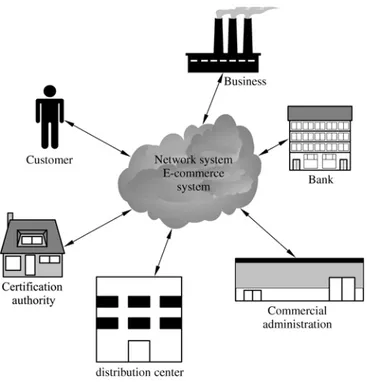
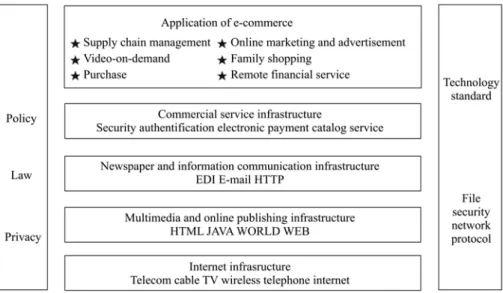
Components of e-commerce are illustrated in Fig. 1.2.
Figure 1.2 Components of e-commerce
(1) Network: It includes Internet, Intranet, and Extranet. Internet is the foundation of e-commerce and the carrier of commercial business information. As to Intranet, it means for enterprises to carry out internal affairs. With regard to Extranet, it is the link between enterprises and users to carry out commercial activities.
supply and sales by Intranet, Extranet and MIS. Personal consumer has access to information and purchases goods by connecting Internet with browsers, set-top boxes, PDA (the personal digital assistance), Visual TV etc.
(3) Authentication Authority: The authentication Authority (CA), the authority recognized by law, is responsible for issuing, managing digital certificates and facilitating parties involved in online sales to identify each other.
(4) Distribution center. It is in charge of sending goods that cannot be delivered on line to consumers and keeping track of goods flow.
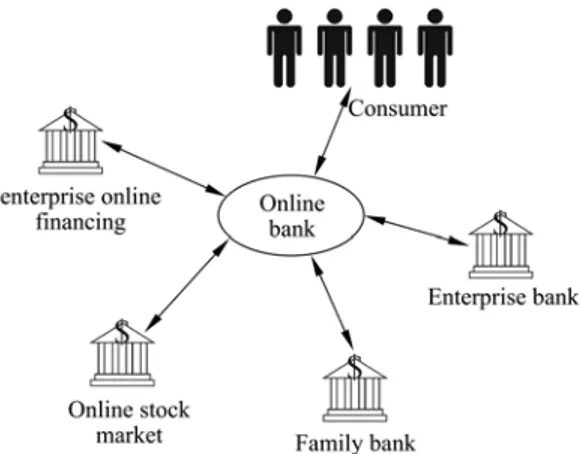
(5) Online bank. It provides the sellers and buyers the traditional bank business, such as settlement, and round-the-clock service.
(6) The administration of the commercial activity. It consists mainly of departments of industry, customs, tax and trade.
The Significance of e-concept
E-mail, called the Internet Killer User, attracts people to pay attention to the existence of the network, and sparks the rush of network gradually. E-mail transforms from receiving and sending e-mails to commercial use and becomes one of the principal tools for people to communicate on line. The e-wallet and e-cash etc. basically make it possible for people transfer fund on line and accordingly makes network and real life fuse further. The e-commerce has on a large scale began to impact the traditional pattern of trade and brought about intense changes of life style. It can be predicted that in future new concepts will spring up and the combination of electronic technologys and other ideas will give rise to new things, because electronic technology based on Internet is advancing continuously. “e-concept”, proposed in early 2000, is accepted and spreads quickly. That is to say, e-concept is a new thing taking electronic and network technology as foundation, other technologies and ideas as platform of upper level. After double integration with other technologies and ideas, e-concept will exert a great impact on social life style. In this sense, e-commerce is just a subset of e-concept.
E-commerce gives impetus to the development of society and provides broad space for future, though it is merely a subset of e-concept. The development of e-commerce may transform the whole social operation regulations, so the e-concept will exert much more influence on the society, no matter in depth or in scope.
The significance of e-concept lies in that it makes people grasp not only radical changes of new things but also the root of all changes brought by e-concept in e-times so as to promote greater social changes.
1.1.3 E-commerce in China
E-commerce in China can be divided into 4 phases:
1. E-commerce based on EDI (1990ü1993)
The application of EDI has been carried out in China since the 1990’s Since then, State Planning Commission and National Science and Technology Commission of China have put the application of EDI into the list of “the 8thFive” national science and technology promotion project. As the result, a series of EDI systems come into application, such as the import and export license EDI system of original Ministry of Foreign Trade and Economic Cooperation, PRC, Ocean/ Airway shipment management EDI system of China National Foreign Trade Transportation (Group) Corporation, the EDI system of financial affairs, petroleum, and rubber trade of China National Chemical Import and Export Corporation, the EDI system of Shandong Artex Import and Export Corporation et al. In September, 1991. The Electronic Information System Promotion and Application Office of State Council leads and coordinates original State Planning Commission, National Science and Technology Commission of China, Ministry of Foreign Trade and Economic Cooperation, PRC, Ministry of Communication of the PRC, Ministry of Post and Telecommunication of the PRC, Ministry of Electronic Industry of the PRC, The State Bureau of Quality and Technical Supervision, State Administration of Foreign Exchange, China Commodity Inspection Bureau, China Customs, Bank of China, Industrial Commercial Bank of China, People’s Insurance Company of China, State Administration of Taxation, China Council for the Promotion of International Trade etc, originating to establish the Coordination Group of EDI Application and Promotion. Meanwhile, the EDI/FACT Commission of China established in October 1991 became the member of Asia EDI/FACT Council. EDI has been widely used in sectors such as trade, communication, bank etc.
2. “Three Golden Projects” carried out by governments in 1993ü1997
establish, the foundation of e-commerce
The National Economy Informationization Joint Conference and its office coming into being in 1993 with the vice premier of the State Council as president, carried out “Three Goldens”(Golden Customs, Golden Card, and Golden Bridge) project and made great progress. “Beijing E-commerce International Forum” hosted by People’s Bank of China, Ministry of Electronics and Global Information Infrastructure Committee (GIIC) in Beijing in May. 1994 attracted up to 700 participators from the United States, Great Britain, France, Germany, Japan, Australia, Egypt, and Canada etc. The “Asian and Pacific E-commerce Seminar” in Beijing in Sep., 1994 brought about the spread of e-concept in China. In 1995, China Internet became commercialized and network companies began to rise.
to lead the construction of information. And it is in 1996 that China got Internet connected.
National Information Office organized some departments involved to draft and draw up the program of China informationization. National informationization working conference was held in Shenzhen in Apr., 1997 and soon after informationization executives of different provinces, cities and areas began to come into being and carried out informationization construction programs, including construction of e-commerce. Advertising companies began to make advertisement on line. China Goods Ordering System (CGOS) has been put into practice since Apr., 1997.
3. E-commerce based on Internet since 1998
The first Internet transaction in China succeeded in Mar., 1998. China Commodity Trading Market was declared to come into being in Jul., 1998, which was called “Never Closed China Export Commodities Fair (Guangzhou Fair)”. China Commodity Spot Transaction Market was the first spot transaction market for e-commerce with transaction volume up to 200 billion in 1999. China’s first e-commerce application system based on SET security standard was released by Bank of China and Teledata Bureau with the Bank of China in Hunan Province as its experimental unit. Committee of Economy and Trade and Ministry of Information Industry declared to start the “Golden Trade Project” centering on e-commerce, a large-scale experimental project to popularize the application of Internet and to carry out e-commerce in commercial and trade circulation domain. Beijing, Shanghai and many other cities have started to e-commerce Engineering, opened the experimental units of electronic shopping center, electronic shopping market, online shopping and transaction, built up financial and non-financial certification authority, made corresponding laws and regulations to lay a foundation for future e-commerce. Medical e-commerce network was put into operation in 1998, in which ten thousand enterprises and public institutions in medical and health industry got connected and information of over thousands of Chinese Traditional medicine and Western medicine was provided. National reconciling inventory network, national online construction and real state online promotion and many others have opened up.
The B2C websites such as 8848 formally opened in Mar., 1999, which shows that online shopping has come into application stage, such as the presence of online governments, online enterprises, online taxation, online education (online universities of Hunan University and Zhejiang University), and remote diagnosis (many large hospitals in Beijing and Shanghai).
4. The pragmatic development phase in 2000
have emerged. E-commerce software and solutions developed by domestic enterprises or domestic enterprise-oriented have dominated the market with the perfection of exterior environments such as infrastructures; the perfection of application methods of e-commerce; the maturity of market for e-commerce; and the rapid localization of e-commerce software and solutions. The e-commerce in China has taken its initial shape.
China government attaches much importance to the security related the application and development of e-commerce. For example, industry security CA has been organized with Telecom, Customs, and People’s Bank of China as initiators. CA’S have come into existence in Shanghai, Guangzhou, and many other cities. Much attention has been paid to the development of corresponding core technologies of security standard, electronic signature and password system, and investment in such fields has been intensified. Corresponding laws and regulations have driven to maturity stage and many laws are in embryo. For example, in 2005 electronic signature law was put into practice.
Current situation of e-commerce in China is as the following: (1) E-commerce in China is still in its initial stage.
(2) The application of e-commerce in China is still of its primary level. Most e-commerce is non-payable, that is, online sales and offline payment; a small part is paying, that is online sales and online payment; some even make cooperated- commerce.
(3) Minority of ten million enterprises in China has got Internet connected, carried out online marketing, to say nothing of online procurement. Majority of medium and small enterprises and a small fraction of large and medium enterprises have not carried e-commerce. In other words, enterprises are less information-based and have not become the main force of e-commerce.
(4) Most e-commerce websites in China are making electronic information research, making e-advertising, e-catalog, e-inquiry, exchanging commodity information on line; minor enterprises make such e-transaction on line (e-bargain and ordering), as making business negotiation, signing contracts, exchanging documents on line; few enterprises complete e-shopping and e-payment.
(5) Owing to the disparate development of different industries and areas, there are great differences in e-commerce between southeast coastal areas and the central and western areas. For the moment, metropolises in southeast coastal areas have carried out e-commerce while most cities and countryside in the central and western areas have not. However, it is likely that the new arrivals will surpass the old-timers.
(6) Various, multiple and multimodal strategies for e-commerce development shall be adopted for the following factors: the weakness of information foundation of national economy, the low-level business automation, the coexistence of traditional business and modern e-commerce, and the coexistence of traditional market and online market.
Open questions in the development of e-commerce in China:
(1) There are no clear development strategies and forceful technical and economic policies for e-commerce development. There is no specific programs for e-commerce development. Though policy frameworks for e-commerce have been drawn up for many years, no one has come into existence.
parts in the current administrative laws have not been revised timely. For example, there are no specific laws on electronic contract, the protection of online knowledge property and privacy, online information supervision etc. What is more, there are no enforcement regulations of network crime convictions and penalization.
(3) Because of the low level of computer application, there are not many enterprises and families connected with network. In addition, information technology has not become popular in both enterprises and families. Though netizens in China has been up to 210 million by the end of 2007, it only took up 15.6% of the total population, which is relative low comparing with 19.1% of average global popularization rate. In addition, the netizens are mainly in metropolises such as Beijing, Shanghai, Guangzhou and many other eastern cites. Only not more than 15% of enterprises in China do e-commerce, which is rather low compared with other countries. For instance, 60% of the small enterprises, 80% of medium enterprises and 90% of large enterprises in developed countries do e-commerce by means of the Internet.
(4) Economy and operation environments for the development of e-commerce are not complete. For example, social credit system has not been established; the network bandwidth cannot meet the requirement of e-commerce; e-payment methods are not mature; logistics distribution system does not match its own development.
(5) The technological level and occupancy of market of home-made products in China’s information industry are comparatively low. Hardware and software in significant applied engineering and systems of e-commerce are mainly from foreign companies. System integration and information service shall be improved. Corresponding standards and specifications of computer application are not universal and shall urgently be enforced. Standards of e-commerce lag behind the current conditions and apparently there is not adequate investment in it. Enterprise management systems, mechanisms, concepts and organization structure cannot meet the requirements of market economy. Apart from what have been mentioned, some leaders have not thoroughly realized the importance and urgency of e-commerce application. There are no internal force, labor force, financial and physical resources for an enterprise to adopt e-commerce. There are no adequate talents, especially inter-disciplinary for information technology and professional experts.
1.2 Influence of Related Basic Sciences on E-commerce
on the development of e-commerce soft environment. The development of logistics distribution, postal service, communications, electronic technology exert great influence on the development of e-commerce hard environment. The above disciplines and e-commerce are interdependent and interactive. In this chapter, the influence of computer science, communication science, and management science on e-commerce will briefly be dealt with. As for other corresponding contents, it will be expounded in the following chapters.
1.2.1 Influence of Mathematics on E-commerce
Many branches of mathematics and mathematical models are involved in e-commerce, the multidisciplinary science. Common mathematical models involved in e-commerce will briefly be introduced in relevant sections, such as probability model, queuing theory model, nonlinear dynamic model, graph theory model and many other equally important models such as Petri Net and commercial patterns.
1. Probability model
(1) Random event and probability
In given condition, the thing that is likely to happen or not is called a Random event (“event”, for short), usually represented by the capitalized letters such as A, B, C, etc. For instance, suppose tossing a coin in the homogeneous condition, heads occuring is a random event. In given condition, the thing that is sure to happen is called a certain event, represented by U. In given condition, the thing that is impossible to happen is called an impossible event, represented byI.
(2) Probability model
Probability theory is a science to study quantitative law of random phenomenon in nature. Random events in probability theory can be abstracted into three models: classical probability model, geometric probability model, and conditional probability model.
(3) Probability property
ķ The probability(P, for short) of all random events(A, for example) shall be 0İP A( )İ
ĸ The probability of a certain event is 1, and the probability of an impossible event is 0. That is to say, ( ) 1, ( )P U PI 0.
Ĺ If events A and B satisfy AģB I,then P A( ĤB) P A( )P B( ). (4) Relations between random events
To accurately work out probability, closely related to events, it is necessary to master the relations between probablility and events.
Ĺ product of events ĺ incompatible events Ļ contrary events ļ subtraction of events
(5) random events relations and probability calculation ķ addition formula of contrary events probability
If event A is incompatible with event B, that is AģB I, (P AĤB) P A( ) ( ).
P B For example, the calculation of the probability of “three-spot or five-spot” after throwing the dice falls into the category of incompatible events. Therefore, its probability shall be:
P(three-spot or five-spot) P(three-spot)P(five-spot) 1/ 6 1/ 6 1/ 3 . ĸ addition formula
The following is the formula for any random event A and B:
( ) ( ) ( ) ( )
P AĤB P A P B P AģB
Ĺ In dependence of events. If event A and event B satisfy (P AB) P A P B( ) ( ), they are independent.
If event A and event B are independent, then ( | )P B A P B P A B( ), ( | ) P A( ) To accurately calculate probability, it is necessary to have knowledge of the relationship between random events and several common probability models. After that, it is just needed to calculate.
2. Queuing theory model
The information flow in e-commerce runs in global Internet. When the information arrives at the computer’s intelligence node, it will flow to the next node, which needs processing by processors (called “service” in queuing theory). If information to be processed at the node is beyond the processing capacity of the processor, the information has to queue for processing. How long will the information has to wait for service? What is the length of the queue? How to arrange the queue to ensure the shortest queue, the lowest cost and the best service? All above problems will be studied in queuing theory.
The model of queuing theory is shown in Fig. 1.3.
Figure 1.3 Queuing Theory Model
The following factors in queuing theory influence greatly on the whole process: F (laws of event arrival), S (service regulations), and M (numbers of service windows), by which we can express the mathematical models of queuing with the F/S/M in queuing theory. If a model with poisson’s distribution as the event arrival, exponential distribution as the queuing discipline, “first come, first served” regulation as the service regulation, and the service windows being 5, its queuing model can be expressed by M/M/5.
The queuing models in common use contain the M/M/S model (arrival and treatment are all exponential distribution, and the number of service windows is S), M/M/S (the arrival distribution is the exponential distribution, treatment distribution is random distribution, the number of service windows is S) and privileged M/M/S (Data are treated on a priority basis).
3. Nonlinear dynamic model
Nonlinear science, a front-line science, is to study nonlinear phenomena in various subjects. It is a multidisciplinary science based on branches characterized by nonlinear, and is called the third revolution of natural science in the 20th century. The birth of nonlinear science reveals that people’s cognition of things always goes from the easy to the difficult and complicated, and will gradually be deepened. Achievements of sciences make people enamored of the natural harmony and perfection, and form the idea that any complicated natural phenomenon can be described by a simple law or a set of specific mathematical equations. It is almost agreed by all physical scientists that universal fundamental laws are decisive and reversible, among which Newton’s Second Law,
2
representative (mfor particle mass, x for position vector of particle motion, F for external force). Actually it is not always the case, for there are the coexistences of both reversible and irreversible evolutionary processes, both determinacy phenomenon and chance phenomenon, both future incorporated in the past and future unincorporated in the past. Prigogine’s “Dissipative Structure” theory questioned the symmetry of time, supplied new theory for the study of complicated phenomena in nature and therefore won the Nobel Prize in 1997. Presently, dissipative structurology, chaos, bifurcation, mutation theory, fractal theory, synergetics, cellular automata complement with each other. Accordingly, the nonlinear dynamics, a multidisciplinary to study complicated phenomena, comes into being.
Mathematical models studied in nonlinear dynamics contain dissipative structurological model, chaos model, bifurcation model, mutation theory model, fractal model, synergetics model, cellular automata model.
cellular automata have been used in e-commerce encryption, and fractal theory has been extensively applied in dada compression field, which meets the require- ment of high data compression ratio of (100:1)(1000:1). The mathematical formalisms of these models will not be listed here for they are so complicated that they cannot clearly be explained by general advanced mathematics. Readers who are interested in this can refer to pertinent literature. Various mathematical models shall be, without doubt, adopted to study Internet, an open and non linear system. For instance, cryptographic algorithm frequently used in e-commerce security is from the research of nonlinear dynamics.
4. Graph theory model
Graph theory model is a powerful tool to depict discrete topology. There are always diagrams composed of “node” and “edge” in computer network study and computer program flow analysis. In the computer network constituted by these “nodes” and “edges”, the intelligent node are regarded as nodes and the closed path between node as “edge”. The knowledge of graph theory will be used in the selection of the routes etc. in information transmission. A graph G is comprised of vertex set V and edge set E. The following are models in graph theory.
(1) Directed Graph Model: The connectivity of vertex is with aeolotrophy, that is, the connectivity from vertex A to vertex B does not mean the connectivity from vertex B to vertex A. Figure 1.4 is an instance of Directed graph model.
(2) Undirected graph Model: The connectivity from vertex A to vertex B means the connectivity from vertex B to vertex A. Figure 1.5 is an instance of undirected graph.
Figure 1.4 Directed Graph Figure 1.5 Undirected graph
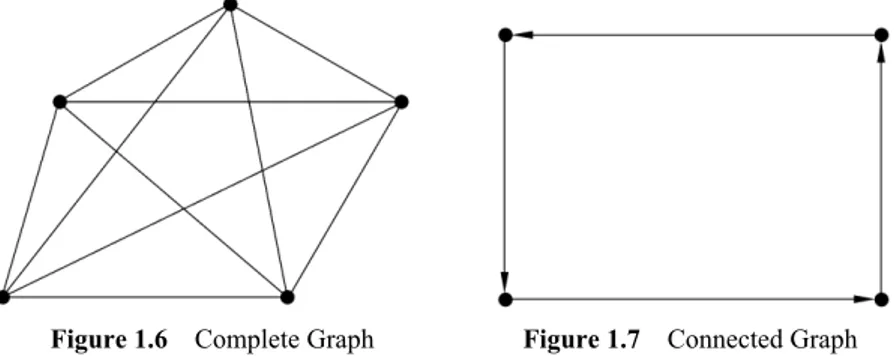
(3) Complete Graph: Graph G is called a complete graph if there is always a edge to connect any two vertexs of the vertex set G. Figure 1.6 is an instance of a complete graph.
Figure 1.6 Complete Graph Figure 1.7 Connected Graph
(5) Euler Graph Model: In graph G, Euler’s circuit refers to the circuit which passes each edge once and only once. In the Euler’s circuit, a vertex can be repeatedly passed. Figure 1.8 is an instance of Euler graph.
(6) Hamilton Graph Model: In graph G, the circuit that passes every vertex once and only once, is called the Hamilton circuit; if there is the Hamilton circuit in G, G is called the Hamiltonian graph. Figure 1.9 is an instance of Hamilton graph.
Figure 1.8 Eulerian Graph Model Figure 1.9 Hamiltonian Graph
(7) Matrix representation of graph: Though graph is intuitionistic, it is difficult to deal with by computers and brings inconvenience to the graph study. The representation of matrix, another representation of the graph, is introduced by scientists to overcome the shortcoming. Supposing the number of vertexes in graph G is m and the number of edges is n, the matrix of graph G, m nu ,can be expressed by A [aij],among which elementaij can be determined by the follows:
1 ij
a if vertex i is connected with vertex j by a edge 0
ij
a if vertex i is not connected with vertex j by a edge
1.2.2 The Impact of Computer Science Upon the E-commerce
E-commerce is based on electronic information technology, in which information storage, information exchange and information processing are all carried out by computers and Internet. Accordingly, the development of computer science and computer technology have a decisive effect on the development of e-commerce. Since the birth of the first computer with vacuum tubes, electronic devices have gone through the following steps: vacuum-tube circuit, transistor circuit, integrated circuit, large scale integrated circuit (LSI, for short) and very large scale integrated circuit (VLS1, for short). With the improvement of electronic device manufacturing technology, there emerge minicomputers, large computers and parallel computers. The computer technology, the core of information technology, has gradually become mature after the development of half a century. The computer system is developing to become intelligent, integrated and comprehensive. The birth of multimedia technology enables computers to process various information, such as graphs, texts, voice and images.
The success of specialized application software extends the application scope of computers from the single calculation to almost all application fields. The new technologys of computer network and data base a achieve the better share of software, hardware, and information resources within a shorter time, gathering and processing of information cooperatively within an extensive range. The global information revolution has been brought about by a series of breakthrough of digital technologies and the universality of computers and Internet. TCP (Transfer Control Protocol) / IP (Internet Protocol) translates the traditional network into the universal computer network. In addition, emergence and development of new technologies closely related to e-commerce, such as VPN (Virtual Private Protocol), Gigabyte Ethernet wiring system and modem, shape and urge the development of e-commerce.
Computer network system integrates the technologies of digitization, network and software, and makes telecommunication possible by computer network and computer intelligence node control technologys. It is the telecommunication that enables the rapid development of a series of long-distance applications, such as so called distance education and distance medical treatment etc. Therefore, the implementation of e-commerce is closely related to the development of computer network, and it is the development of information technology that speedups the development of e-commerce. Computer languages have developed, from machine language, to assembly language, advanced language and even to the intelligence language, and many operating system softwares (e.g. DOS, Windows, UNIX, and Linux), business softwares (Office series, Windows series, LOTUS-1-2-3 series), application softwares (Oracle, Sybase, SQL Server, DB2 data bank system software etc.), specialized application softwares (CAD / CAM, MatLab and financial software) and integrated development softwares (e.g. Power Builder, JBuilder, Delphi). All the above changes speedup software development, free people from the tiresome mental work of source code compiling to satisfy the basic need to assemble many basic software modules of excellent functions. The data base technology, the key technology of e-commerce, cannot only store all kinds of information (e.g. articles, transactions, and consumers) but also provide market information and decision-making basis by rearranging and analyzing data. The key factor to ensure the popularity of e-commerce is the security of information, for which various encryption technologys such as symmetric key encryption and public key encryption are developed to provide the basis of information privacy. In addition, technologys of firewall and intrusion detection keep information from being destroyed and stolen illegally.
If software design is compared to the construction of modern buildings, in the past it started by mixing pug, baking bricks, picking stones and burning concrete all by manual labors, while presently it is like the construction of a modern building with existing bricks, concrete, and a large number of prefabricated blocks by modern rooters, land scrapers, stirring mills and cranes. Accordingly, much energy can be concentrated on building design and construction management, which enables people to develop e-commerce software at their pleasure is the precondition for the popularity of e-commerce in all industries and work units of all sizes.
1.2.3 Impact of Communications Science upon the E-commerce
is necessary to build up wide communication channels for information transmission and exchange of e-commerce network. The rapid development of contemporary communication technologies laid the foundation of e-commerce vomitorium.
The birth of digital computerized telephone switching technology lays the foundation for modern digital communication technology. Its popularization brings about the global development of communication network and becomes the significant support network for the rapid development of Internet. The maturity of optical communication technology, especially the rapid development of the wavelength division multiplex (WDM, for short) promotes the sharp rise of bandwidth of principal networks and provides the guarantee for the extension of network and the smooth transmission of the expanding information. Moreover, the progress of wireless communication technologies such as mobile technology and satellite communication technology supplies the new way to achieve the universal overlaying and flexible application of information network and lays the foundation for the extension of e-commerce to wireless application fields.
Telecommunication network is the key to informatization. Presently, it is no longer a single tool for transmission but the integration of many technologies. It is the presence of data information network that extends communication coverage promotes communication to enter into the service stage and leads to the birth of such business based on public data network as e-mails, e-data interchange, e-numbering book, e-bulletin board system and e-commerce. Strictly speaking, all above business belong to e-commerce in a broad sense. Computers of different places and functions, terminals, and various accessory equipments are connected by computer network, a large-scale, powerful network, with communication routes so as to achieve information share in communication process, thus achieving information transmission and share of hardware, software, and data information between enormous computers.
Thanks to the combination of computer network and communication network, enormous computers can simultaneously process texts, data, images and voice etc. The above information can be available everywhere and exchanged within China or the world. Network system provides necessary methods for information exchange and transmission, the core of e-commerce. e-commerce will be groundless without the development of communication technologys and information exchange and transmission. The development of e-commerce demands for higher and higher communication. Safe, high-speed network transmission and multimedia communication have been the inevitable factors to carry out e-commerce.
Internet is the technical foundation and indispensable for e-commerce. The development of e-commerce will definitely make greater demands on the communication technology and boost the development of communication technologys; the development of communication technologys provides technical support for new applications of e-commerce. Vice versa, along with the extension of e-commerce applications, the communication infrastructure network can carry on larger-scale information flow and this requires continuous increasing of infrastructure network bandwidth.
At the same time, e-commerce requires data informatization and challenges the traditional communication mode, and data informatization will become mainstream direction for communication network development. For e-commerce clients, a high-speed route of entry is required for online shopping and online work, which proposes the request to bandwidth. E-commerce application, the mainstream application of information network in the future, will definitely exert great influence on current communication network structure and communication mode.
1.2.4 The Impact of Management Science upon E-commerce
Because management theories conforms the objective economic environment, management technologys vary in different development stages. At the classical management phase, the focus of management is to raise labor productivity by managing equipments and staff manually with strict regulations.
Because this phase falls into the category of the seller’s market, a tight market, the main task of governors is to increase labor productivity and supply. In the behavior management phase, the focus of governors is to transform the volume-produce mode into small-lot versatile production mode. The competition has changed to the service of how to meet the customer’s requirement from pure price competition. In this phase, supply has been guaranteed, customers began to push forward their claims for high-quality products. Products of low-quality are difficult to sell. Since the main task of the administrator is to sell out their commodity, commodity of high-quality, small lot and diverse types should be manufactured to satisfy various requirements of customers.
In the times of enterprise reforger, enterprises, facing the never-ending changes, improvements and fierce race, are crying for regrouping of operation flow to improve enterprise operation status and efficiency. Regrouping of operation flow is the effective path for enterprise to regain competitive power and vitality. The implementation of Business Process Reengineering (BPR, for short) needs two foundations, that is, modern information technology and high-caliber talents. The need of information processing facilitates the extension of computers in enterprises and the rapid development and popularity of management information system (MIS, for short) and decision support system (DSS, for short), thus accelerating the rapid development of computer hardware and software, computer information processing technology and message-switching technology as well as setting up the foundation for the development of e-commerce.
In the organizational management phase of globalization and knowledge economy age, the waves of informatization and globalization spread all over the world rapidly. Because of the arrival of the knowledge economy, information and knowledge become significant strategic resources. Only by organizing the global resources reasonably and winning the support of the global customers may enterprises exist and develop. To reasonably organize the global resources, apart from multinational corporations, virtual enterprises also come into being. Accordingly, an upsurge in “virtual organizations” is coming, which makes greater demands on information acquisition, information processing, and information utility than the former periods. It is this objective need that requires enterprises to connect the former systems of MIS and DSS, speedups enormous progress of Internet with the function of information communication and releasing, and perfects the infrastructure of e-commerce.
To sum up, because any technical progress is based on commercial demands, e-commerce technology, a technology to process, acquire, and make use of information, is no exception. Therefore, the demand of management pushes forward step by step the development and technological perfection of computers, information processing and information transmission to the greatest degree organic integration of e-information technology and management technology. Management promotes e-commerce development by this means.
1.3 Categories of the E-commerce
Advanced digital technologys, combined with enterprises and customers of these technologys, boost e-commerce. Similar to digital technologys, e-commerce cannot reach its goal in one move. As to enterprises and customers, e-commerce of different types and levels imply different opportunities.
business to business (B2B), business to customers (B2C), business to governments (B2G), governments to governments (G2G), and customers to customers (C2C). B2B, the mainstream in e-commerce and the principal method to improve competition ability in the competitive market, has come into existence for many years with the characteristics of carrying out commercial activities by EDI via special networks or Value-Added Networks (VAN, for short). B2C takes place between business and customers, in which online sales are carried out by Internet, such as the online bookstore Amazon. In recent years, the increase of number of netizens and new transaction platforms created by Internet for enterprises and customers speedups the rapid development of e-commerce. With regard to customers, it is unnecessary to set an unified standard for document transmission because only credit cards, e-money or e-wallet are involved in online sales and payment. In addition, searching and browsing functions and multimedia interface supplied by Internet facilitate consumers to look for and give an insight into products wanted. B2C has enormous potential and will be the main drive for the development of e-commerce. B2G, the business between enterprises and governments, is still in its experimental phase, focusing on administrative management, governmental invitated tender, and the implementation of various economic policies etc. C2C, the individual consumption behaviors, has not yet taken shape, such as the second-hand market. But along with the development of B2C and B2G, all countries will perfect the personalized services in e-commerce. In the following sections, the above five basic e-commerce categories, the common ones in e-commerce, will be analyzed in detail.
1.3.1 B2B
In the five categories, B2B plays central part and will be the mainstream in the future, for the following reasons.
1. Volume of business transaction of B2B takes up the majority of the total trading volume in e-commerce
share of B2B companies, thus enabling B2B companies to become the main force of e-commerce.
2. The B2B e-commerce companies hold an advantage in lowering operation cost
The online business of B2B companies covers production, supply, sales, or purchase, transfer and storage, which are so extensive that it can provide many ways to reduce the cost: First, reducing procurement cost by purchasing multitudinous commodities of single kind. Second, reducing production cost by shortening production period. Third, reducing operation cost by efficient inventory control. Fourth, reducing sales cost by global batch sale. The advantages of above ways are incomparable to e-commerce company of other categories.
3. B2B e-commerce companies are more suitable for modern logistics management
The logistics distribution plays a prominent role in all the commercial activities of e-commerce companies. There will be no cycle of operations without logistics. Even though there is external logistics, its expense will directly influence the achievements of e-commerce companies. Compared with other e-commerce companies, the characteristics of B2B companies logistics are fewer in times and large in quantity, while logistics of other e-commerce companies are characterized as small in quantity, more in times and high in turnover speed. According to statistics, B2B e-commerce companies are more competitive than B2C e-commerce companies in reducing logistics dispatching by 20%60%.
4. B2B e-commerce companies are competitive in guaranteeing credit and capital security during operation course
Credit and security will ever hinder the rapid development of e-commerce whether in the past, at present or in the future, which will obsess e-commerce companies for a long term as long as the complete e-commerce activities are carried out on Internet. As for the credit issue, it is a hard nut to crack, because B2C companies have thousands of clients and it is difficult to explore the credit of clients. Additionally, the frequent less in quantity and more batch online payment make clients more worried about the security of online payment, which will seriously affect the B2C companies to seize commercial opportunities.
Contrary to B2C companies, it is easy for B2B companies to inspect and identify the credit of their trade partners, because of their operation methods, fewer in batch and larger in quantity. Moreover, payment categories of special-purpose communications link of bank networks is adopted to guarantee the safety of capital flow. This will speedup the development of B2B e-commerce companies with less batch and client stability.
5. E-commerce of B2B is more mature in both theory and practice
Internet. Actually the e-commerce based on EDI at the beginning of the 70s of 20th c is typically B2B e-commerce. However the costly VAN at that time hindered the numbers of trading partnership of e-commerce based on EDI. In other words, e-commerce takes the form of B2B at the very beginning. Thanks to its history, long-term practical experience and mature theory and practice, B2B categories will lead the development of e-commerce operation, thus boosting positive shape of B2B categories.
From the above, B2B e-commerce companies will become more competitive in the fierce competition, and B2B categories will become the main categories of e-commerce in the future, to which great importance shall be attached. According to experts, global e-commerce has already entered the third stage. The first stage, attention economy presented by Yahoo. The second stage, professional network economies (B2C, C2C) with Amazon and eBay as representatives of. The third stage, integration economy, characterized by intermediary services supplied by ASP, facing the four elementary markets (e-market, e-channel, e-procurement, e-enterprise etc.) by Internet and B2B e-commerce to boost the interaction of new economy and old economy. The era of B2B e-commerce is coming.
1.3.2 B2C
In B2C (Business to Customer) e-commerce, Internet is resorted by businesses or enterprises to provide customers goods and services via websites. Presently, various types of B2C websites spread all over Internet to supply customer a variety of goods and services, varying from flowers and books, to computers and cars etc. Because of the restrictions of a variety of factors, e-commerce of this categories only takes up a small proportion whether at present or in the far future. Nevertheless, in the long run, B2C will rapidly develop and be a great part of e-commerce ultimately.
From the perspective of the business relations between enterprises and customers, B2C falls into two categories: seller (enterprises)— the personal buyers, and buyer (enterprises)— the personal sellers.
Enterprise personal sellers, is the category in which business purchases goods or service from individuals. This categories is usually used for online job application. For example, many enterprises advertise various job offers in Shenzhen Human Resources Network (http://www.szhr.com.cn). By this categories, enterprises release information on needed talents at first and then appliers negotiate with enterprises online, which is very popular in this society with big talents flow for it offers a communication platform and bridges the enterprises and individuals, thus making full use of human resources.
E-commerce of B2C can be divided into tangible and intangible goods and services, of which the latter can be completed by network, while the former cannot unless the traditional methods are resorted to.
Thanks to the information transmission and processing abilities of computer network, intangible goods and services (e.g. e-information, computer software, digital audiovisual entertaiment products, etc.) in general can be presented to customers directly via network. E-commerce categories of intangible goods and services are mainly online subscription categories, advertisement-supported pattern and online domination categories.
1. Online subscription categories
Customers subscribe intangible goods and services provided by enterprises and can consume them directly on line. This categories is mainly used by some online enterprises to sell newspapers, magazines and programs of cable TV.
The online subscription categories are shown as follows:
zOnline Publication. Publishers supply customers e-publications via Internet besides the traditional ones. Online publication merely releases e-journals, which can be downloaded by consumers by subscribing. This is not an ideal categories for information sales, because common users will give a wide berth to the charge information service in information era, though it is rather low in price, since information can be obtained from various channels. Thereby, some online publishers adopt double-track system (the combination of free reading and charge subscription) to maintain certain business return by attracting a quantity of consumers.
zOnline Entertainment. The service categories has achieved a measure of success and is greatly interested by people. Online amusement providers provide customers online games by charging certain subscription fee. At present, network games have become one of the network focuses, and Microsoft, Excite, and Infoseek etc. have made positive response to it. Actually, the network operators have already shown great foresight to obtain access frequency and loyalty of consumers by some free or cheap online amusement. 2. Advertisements-supported categories
Online service providers provide customers online information service freely and obtain income from advertisements published in the websites. This is the most successful categories, though it does not directly charge from customers. For example, many online search service websites such as Yahoo maintain operation by charge advertisements. From the standpoint of netizens, information search is the basis to locate information needed in the information sea of Internet. Therefore, businesses also are willing to release advertisements in information dragnet, which enables customers to login directly into the websites of enterprises. The success of these online service providers depend mainly on that their web pages can attract a large number of advertisements and the attention of a large number of customers.
3. Online donation categories
This categories is usually adopted by software companies to submit software to customers to improve its popularity and market share. Some software companies offer alpha-version products to Internet users freely. As for the users, they can try out the products by downloading or feedback their advice or suggestions to software companies. After a period of trial, if satisfied, the customers may purchase the formal-version software. Software companies can lower cost, expand trial community, and improve testing result and market share. The American Netscape Corporation adopted this method to popularize its browser, thus dominated the browser software market and made outstanding achievements.
In the eyes of the business administration, enterprises can adopt the following strategies to develop B2C:
(1) Appropriate strategies. Because of profound changes of relations between enterprises and customers, there came new value chain and value chance. The most important about e-commerce is to determine their goods. For example, when doing B2C e-commerce, the company is to develop new products or services or to extend the market of the current goods or services. Different strategies will bring about different performances.
(2) Coordinate market channels. The development of B2C e-commerce will undoubtedly bring about the extension of market channels and probably impact the existing channel relations, which needs the administrators’ effective coordination. The online marketing channels of B2C with originally traditional marketing ones can mutually facilitate, thus bringing more benefits to business. For instance, the retail business can facilitate the communications between business and consumers, enhance the original market channels and improve market share by releasing wide-ranging, well-illustrated goods information on line and update it timely, or provide customers technical support via Internet.
(3) Strengthen the supervision of the information. In e-commerce of B2C, the business can release the exuberant information of background, products or services, and electronic advertisements via Internet at lower cost to extensive potential market. This kind of information publication is closely related to its market competitive position. Because the information released by enterprises must be beneficial to improve corporate image, brand popularity and reputation and go beyond the original market dealing barrier, the enterprise should carry out market investigation and filter information carefully. The information management (IM) operations of the business are at the request to pay attention to the interaction with consumers on Internet, customer acquaintance by information communication and service of more valuable information, thus forming the exclusive market competitive advantage.
(4) Reinforce transaction price supervision. Business of B2C should release real time price of products. When setting the prices of online products, enterprises have to take into account whether its price is in accordance with the product price structure of the traditional market. To be simple, the business can adopt standard pricing strategy in both the traditional market and network market. But this pattern can cause the conflict with the spatial pricing policy of the business. One of the solutions is to adopt differentiation pricing policy with the list of various dispatching cost so as to prevent unfavorable market feedback.
1.3.3 B2G
the new request to the original functions of governments. Governments should administrate e-market effectively and render better service to enterprises and the public by e-government on the one hand. Governments, as the “big clients” in economy should take the lead to adopt e-commerce and offer efficient path through electronic tender invitation for government procurement on the other hand.
Following requirements to B2G are necessorry: (1) Commodity spot market
Gather, classify, and summarize the information of the wholesale article and the retail article efficiently by making use of e-commerce form for macroanalysis in many aspects. Main aspects: ķ Steer the structure of commodity production in case of “market being out of order”. ĸ Control the capacity and circulation of ineffective articles. Ĺ Crack down the production and distribution of counterfeit and shoddy products.
(2) Second-hand market
As for the second-hand market, governments should learn the overall condition timely by electronic network: what kind of second hand are of high exchange rate, what kind of second hand are of the low exchange rate, what belong to the normal commodities trading range, what article should obey the special commodities trading policy, for example: when dealing with cultural relic, governments should play an active role in leading people to trade accurately, reasonably and legally because article condition of cultural relic is more complicated than stock-in-trade.
(3) Commodity market in the Future
It is necessary for governments to monitor commodity market in the future, because it is incomprehensive to consider commodity production only from the perspective of customers, manufactures and circulation. For instance, excessive consumption of raw materials and resources and environmental pollution have to be considered from the perspective of the national collective interests. Moreover, governments are responsible for putting forward requirements of commodity favorable for the interests of people and nationality.
(4) Commodity purchasing
Government, as a big client (community), should make use of e-commerce to purchase commodity, which is of high-efficiency and low-cost on the one hand, standard, open, just and fair on the other hand, thus lead enterprises in production and circulation fields to manufacture and sell commodities efficiently and economically by adopting e-commerce.
Governments undertake large numbers of social, economic, cultural and service functions, and as “visible hands” in particular, they play a significant role in coordinating market economy and keeping markets from being out of order. At the age of e-commerce, the governmental supervision is definitely to change when enterprises apply e-commerce to produce and operate, bank realize the finance electronicization, and customers carry out online shopping.
play an important part in guiding, managing and adjusting economies. In the new age, it is required that governments adopt the modern means to manage the economies, and specify e-commerce market so as to sustain the healthy and continuous development of national economy. Governmental functions can be carried out online, that is the forming of e-government which will become an important component of e-commerce supporting environment.
1.3.4 G2G
Governmental e-commerce requirements in social production and commercial activities can be divided into the following categories: participation, statistics, service, leading of production, circulation, consumption etc. Original national information system is mostly made up of national, provincial (municipal), local (municipal) organic statistics systems or multilevel statistics bureaus. The statistics system is mainly to aim at serving state-owned economy and enterprises with urban and rural survey teams attached to statistics bureaus as organizational guarantee to set up the foundation for macro decision making by collecting, processing, disposing data of industrial and agricultural production.
But along with the advance of “two fundamental transformations” in our country, the intensifying of opening up to the outside world and reforms, the transfer of the initiative of market economy from manufacture to circulation, the original statistics system lag behind, because the methods of plan rather than actual measurement, part rather than whole, sampling rather than overall situation investigation are adopted. Therefore, data obtained are low in authenticity, high in error and hysteretic and it is difficult to obtain real time objective information and make real time adjustment, which becomes more and more prominent. Accordingly, it is necessary and extremely urgent to collect and process macro production data and help in macro pre-decision making by means of e-commerce.
E-commerce of administrations is to carry out the administration, service and internal administration etc. effectively on computer network by making use of the information and communication technology and to establish an assembly of organic service systems between administrations, society and the public. In general, the targets of the e-government mainly are embodied in the following five aspects:
(1) Computerization, network and information of each government sector are beneficial to improve governmental efficiency, service and supervision. The e-government positively boosts the streamline of government organs and business simplification with the help of information technologies.