*Corresponding author:
E-mail: [email protected]
Available online at http://medpet.journal.ipb.ac.id/
Nutrient Content, Protein Fractionation, and Utilization of Some Beans as Potential
Alternatives to Soybean for Ruminant Feeding
A. Jayanegaraa,*, S. P. Dewib, & M. Ridlaa
aDepartment of Animal Nutrition and Feed Technology, Faculty of Animal Science, Bogor Agricultural University bGraduate School of Animal Nutrition and Feed Science, Bogor Agricultural University
Jalan Agatis, Kampus IPB Darmaga, Bogor 16680, Indonesia (Received 27-06-2016; Reviewed 05-08-2016; Accepted 06-10-2016)
ABSTRACT
This experiment aimed to determine nutrient content, protein fraction, and in vitro rumen fer-mentation of some alternative beans in comparison to soybean. Samples used were napier grass, soybean, redbean, groundnut, pigeonpea, cowpea, bambarabean, and mungbean. Samples were determined for their proximate composition, Van Soest’s fiber fraction, and Cornell protein fraction. The samples were subsequently evaluated for their fermentation characteristics and digestibility by using a two-stage in vitro rumen fermentation technique, maintained at 39 oC for 2 × 48 h. The in
vitro incubation was performed in three consecutive runs by following a randomized complete block design in which each sample per run was represented by four fermentation tubes. Results revealed that all experimental beans contained high crude protein (CP), i.e. above 200 g/kg dry matter (DM), but only soybean and groundnut had CP contents higher than 300 g/kg DM. Redbean had the lowest crude fiber and acid detergent fiber contents among the beans. Soybean contained high proportion of rapidly degraded CP fraction, but low in slowly degraded and unavailable CP fractions. High propor-tion of slowly degraded CP fracpropor-tion was found in redbean and bambarabean. Redbean, pigeonpea, cowpea, and mungbean were better than soybean, groundnut, and bambarabean with regard to DM degradability and DM digestibility values (P<0.05). Concentration of total VFA was the highest in the incubation of redbean. It was concluded that groundnut, redbean, pigeonpea, cowpea, and mung-bean have the potency to be used to substitute soymung-bean for ruminant feeding.
Key words: bean, alternative feed, protein fraction, ruminant, rumen
ABSTRAK
Penelitian ini bertujuan untuk menentukan kandungan nutrien, fraksi protein, dan fermen-tasi rumen in vitro dari sejumlah kacang-kacangan alternatif kacang kedelai sebagai pakan ternak ruminansia. Bahan pakan yang digunakan dalam penelitian ini adalah rumput gajah, kacang kedelai, kacang merah, kacang tanah, kacang gude, kacang tunggak, kacang bogor, dan kacang hijau. Analisis komposisi proksimat, fraksi serat Van Soest, dan fraksi protein Cornell dilakukan pada bahan. Bahan kemudian dievaluasi secara in vitro dengan menggunakan teknik fermentasi rumen dua ta-hap pada suhu 39 oC selama 2 × 48 jam. Inkubasi in vitro dilakukan dalam tiga ulangan berdasarkan rancangan acak kelompok (masing-masing diwakili oleh empat tabung fermentasi). Hasil penelitian menunjukkan bahwa semua kacang-kacangan mengandung protein kasar (PK) yang tinggi, yakni lebih dari 200 g/kg bahan kering (BK), namun hanya kacang kedelai dan kacang tanah yang lebih tinggi dari 300 g/kg BK. Kacang merah memiliki kandungan serat kasar dan serat deterjen asam yang paling rendah di antara kacang-kacangan yang diuji. Kacang kedelai mengandung proporsi fraksi PK mudah terdegradasi yang tinggi, namun rendah fraksi yang lambat terdegradasi dan yang tidak tersedia. Fraksi PK lambat terdegradasi yang tinggi terdapat pada kacang merah dan kacang bogor. Kacang merah, kacang gude, kacang tunggak, dan kacang hijau memiliki degradasi dan kecernaan BK yang lebih tinggi dibandingkan dengan kacang kedelai, kacang tanah, dan kacang bogor (P<0,05). Konsentrasi total VFA paling tinggi terdapat pada inkubasi kacang merah. Disimpulkan bahwa kacang tanah, kacang merah, kacang gude, kacang tunggak, dan kacang hijau berpotensi untuk men-substitusi kacang kedelai sebagai pakan ternak ruminansia.
INTRODUCTION
Adequate and balance nutrients are necessary to ensure optimal livestock production and health, includ-ing energy and protein supply. Typically, in Indonesia and elsewhere, energy demand of livestock is relatively easier to meet from feed rather than protein demand, causing unbalance supply between energy and protein. The use of protein supplements is a common approach
to overcome such insufficient protein supply. Soybean, either fullfat or defatted soybean (soybean meal), has
been used as a main protein supplement for mono-gastric and ruminant animals in many regions of the
world (Campos et al., 2014; Jolazadeh et al., 2015; Liu
et al., 2016) including in Indonesia (Akhsan et al., 2015;
Faradillah et al., 2015). Among protein supplements
originated from plant sources, soybean is considered as superior with regard to its protein content and qual-ity. Protein contents of soybean and soybean meal are
around 35%-52% DM (Vollmann, 2016). Protein in soy -bean is highly digestible and rich in lysine, tryptophan, threonine, isoleucine, and valine, in which these amino
acids are generally deficient in cereal grains (Yildiz & Todorov, 2014). However, with an increasing demand
on soybean for animal feed and other purposes, and on the other hand, risks that may limit soybean production
such as soil degradation, global warming (Hao et al.,
2010), etc., there is an urgent need to search for alterna -tive protein sources other than soybean.
Beans are generally known for their high protein contents due to their symbiotic relationships with
nitro-gen fixing bacteria, i.e. Rhizobium sp. that are able to take up nitrogen from the air, thus have the capacity to
accu-mulate more nitrogenous compounds in the tissue (Goh
et al., 2016). A number of beans available in Indonesia
are redbean (Phaseolus vulgaris), groundnut (Arachis hypogaea), pigeonpea (Cajanus cajan), cowpea (Vigna unguiculata), bambarabean (Vigna subterranea), and
mungbean (Phaseolus radiatus). Although these beans
have been traditionally used for human consumption in
Indonesia (Haliza et al., 2007; 2010), they are rarely used
as animal feed. Furthermore, the informations about their nutritional contents, qualities, and utilizations
for animals are very limited. Therefore this experiment
aimed to determine nutrient content, protein fraction, and in vitro rumen fermentation of some alternative beans in comparison to soybean as a reference of com-monly used protein supplement.
MATERIALS AND METHODS
Sample Collection and Preparation
Samples used in the present experiment were napier grass (Pennisetum purpureum), soybean (Glycine max), redbean (Phaseolus vulgaris), groundnut (Arachis hypogaea), pigeonpea (Cajanus cajan), cowpea (Vigna unguiculata), bambarabean (Vigna subterranea), and
mungbean (Vigna radiata). Napier grass was collected
from experimental station of Faculty of Animal Science,
Bogor Agricultural University, and the beans were pur-chased from a traditional market in Bekasi, Indonesia.
All samples were immediately oven-dried at 60 oC for
24 h and then ground to pass a 1 mm sieve for further
chemical composition analysis and in vitro incubation.
Chemical Composition Determination
Samples were determined for their dry matter (DM), organic matter (OM), crude protein (CP), crude fiber (CF), and ether extract (EE) contents according to AOAC (2005). An oven at 105 oC and a furnace at 550
oC were employed to determine DM and OM contents
of samples, respectively. Contents of CP and EE were
determined by using micro-Kjeldahl and Soxhlet extrac -tion apparatus, respectively. Sequential diges-tion with
H2SO4 and NaOH solutions was performed to obtain CF.
Neutral detergent fiber (NDF) and acid detergent fiber (ADF) were determined by following the procedures of Van Soest et al. (1991). Analysis of NDF was performed
without using α-amylase and sodium sulfite and ex
-pressed exclusive of residual ash. Determination of ADF was similar to NDF except that the solution used was
acid detergent solution. Gross energy was determined by using a bomb calorimeter.
Determination of CP fraction followed the
pro-tocol of Licitra et al. (1996) that is based on the original
Cornell Net Carbohydrate and Protein System (CNCPS; Sniffen et al., 1992). The CP was divided into three main
fractions, i.e. fraction A (non-protein nitrogen, NPN), fraction B (true protein), and fraction C (unavailable protein). Fraction B is further divided into three frac
-tions namely B1, B2, and B3 in which they have different
degradation rates in the rumen. Fraction B1 is a rapidly degraded CP in the rumen, whereas B2 and B3 are in-termediately and slowly degraded CP, respectively. Fraction A was obtained by precipitating true protein
with trichloroacetic acid (TCA); it was calculated by the difference between CP and the precipitated true protein.
Fraction C is regarded as acid detergent insoluble crude
protein (ADICP) and was determined by measuring CP
content of ADF. Similar to ADICP, neutral detergent
insoluble crude protein (NDICP) was determined by
measuring CP content of NDF. Procedures for ADICP and NDICP measurements were adopted according to
Jayanegara et al. (2016). Determination of B1, B2, and B3
fractions require determination of soluble crude protein
(SCP). The SCP is defined as true protein soluble in buffer at rumen pH. It was measured by mixing 0.5 g sample with 50 mL borate-phosphate buffer and 1 mL of
10% sodium azide solution. Subsequently the B fractions were calculated as follow:
B1 = SCP – NPN (fraction A)
B2 = CP – SCP – NDICP
B3 = NDICP – ADICP (fraction C)
All of the chemical composition analyses were
performed in duplicate. Proximate composition and Van Soest’s fiber fractions were expressed as g/kg DM whereas fiber fractions were expressed as proportions to their corresponding CP contents (g/kg CP).
In Vitro Rumen Fermentation
fermentation characteristics and digestibility by using a
two-stage in vitro rumen fermentation technique (Tilley
& Terry, 1963). An amount of 0.5 g sample was inserted
into a fermentation glass tube and added with 40 mL
McDougall’s buffer. About 10 ml of rumen fluid was then added into the tube. Rumen fluid was obtained from two fistulated Ongole crossbred cattle, taken through the fistula before morning feeding. The cattle
were cared for according to animal welfare standard of LIPI Cibinong Bogor. All tubes were continuously
flushed with CO2 for 30 s to ensure anaerobic condition
and immediately closed with ventilated rubbers. The
in vitro incubation was performed in three
consecu-tive runs (replicates) at different weeks in which each
sample per run was represented by four fermentation tubes; two tubes were completed after 48 h incubation
with buffered-rumen fluid (first stage) and the remain -ing tubes were continued for another 48 h incubation
with pepsin-HCl solution (second stage). After the first
stage of incubation, the tubes were centrifuged at 4,000 rpm for 10 min. The supernatant was taken for
sub-sequent VFA analysis and determination of ammonia
concentration by using gas chromatography technique
and Conway micro-diffusion method, respectively. The
residue was analysed for DM, OM, and CP to obtain
DM degradability (DMDe), OM degradability (OMDe), and CP degradability (CPDe) values, respectively. In the
second stage of in vitro fermentation, the supernatants in
the remaining tubes were discarded after centrifugation. Subsequently, an amount of 50 mL pepsin-HCl 0.2% solution was added into each tube and incubation was performed for another 48 h, but without closing with the ventilated rubbers. The residue was separated with
supernatant through filtration using Whatman paper
no. 41 and analysed for DM, OM, and CP to obtain DM
digestibility (DMDi), OM digestibility (OMDi), and CP digestibility (CPDi) values.
Statistical Analysis
Chemical composition data were descriptively
tabulated. In vitro incubation data were analysed by
analysis of variance (ANOVA) following a randomized complete block design. Different batches of rumen fluid (taken at different weeks) served as the blocks. The fol
-lowing statistical model was employed:
Yij = µ + τi + βj + εij
where Yij is the observed value for i
th treatment and jth
replicate, µ is the overall mean, τi is the treatment effect, βj is the block effect (replicate) and εij is the random
residual error. The significancy was stated when the ANOVA result showed P<0.05 for a certain variable.
Comparison among treatments was performed by using
Duncan’s multiple range test. Prior to ANOVA, the data were checked for outlier values; any values ≤ –2 or ≥ 2 of
their standardized residuals were categorized as outli-ers. Pearson correlation test was applied to the data to observe relationship among chemical composition and
in vitro rumen fermentation parameters. All statistical analyses were performed by employing SPSS software version 20.
RESULTS
Chemical Composition
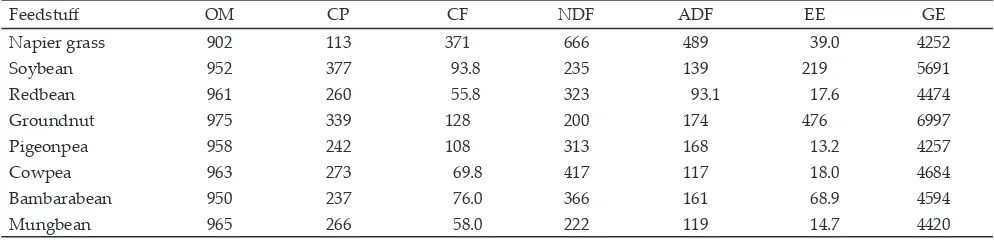
All experimental beans contained high CP, i.e.,
above 200 g/kg DM. Soybean and groundnut had CP
contents higher than 300 g/kg DM (Table 1). Napier
grass contained much higher CF, NDF, and ADF than those of the beans. Among all beans, redbean had the lowest CF and ADF contents. Other beans that had lower ADF in comparison to soybean were cowpea and mungbean. The content of EE was particularly high in groundnut and soybean. The two beans were also high in GE contents as compared to the other beans. Fraction
A was high in napier grass but low in soybean (Table 2). Soybean contained high proportion of fraction B1
and B2, but low fraction B3 and C. High proportion of fraction B3 as well as NDICP was found in napier grass, redbean, and bambarabean. Fraction C was particularly very high in napier grass. Although bambarabean and mungbean were also high in fraction C, their contents
were approximately one-third than that of napier grass.
In Vitro Rumen Fermentation
Napier grass had the lowest DMDe and DMDi in
comparison to other feeds (P<0.05; Table 3). All beans
generally had high DMDe and DMDi. Among the beans,
Table 1. Chemical composition (g/kg DM) and gross energy content of some feed materials (kcal/kg DM)
Feedstuff OM CP CF NDF ADF EE GE
Napier grass 902 113 371 666 489 39.0 4252
Soybean 952 377 93.8 235 139 219 5691
Redbean 961 260 55.8 323 93.1 17.6 4474
Groundnut 975 339 128 200 174 476 6997
Pigeonpea 958 242 108 313 168 13.2 4257
Cowpea 963 273 69.8 417 117 18.0 4684
Bambarabean 950 237 76.0 366 161 68.9 4594
Mungbean 965 266 58.0 222 119 14.7 4420
redbean, pigeonpea, cowpea, and mungbean were bet-ter than soybean, groundnut, and bambarabean with
regard to DMDe and DMDi values (P<0.05). Patterns
of OMDe and OMDi values were similar to those of
DMDe and DMDi, respectively. With regard to CPDe
and CPDi, soybean and groundnut were superior in
comparison to other beans (P<0.05). The lowest CPDe
and CPDi were found in napier grass and followed by bambarabean. Proportions of CPDe to CPDi for napier grass, soybean, redbean, groundnut, pigeonpea, cow-pea, bambarabean, and mungbean were 58%, 92%, 81%, 92%, 70%, 80%, 64%, and 82%, respectively.
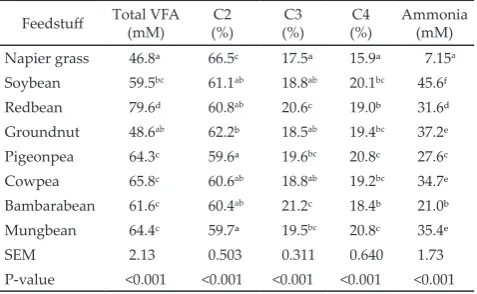
The highest concentration of total VFA was found
in the incubation of redbean and the lowest was found
in napier grass (Table 4). Groundnut produced the low
-est total VFA among all experimental beans (P<0.05).
Incubation of pigeonpea, cowpea, bambarabean, and
mungbean resulted in similar total VFA concentra
-tions. Proportion of C2 was the highest for napier grass
(P<0.05) whereas proportion of C3 was the highest for
bambarabean and redbean (P<0.05). The lowest propor
-tion of C4 was found in napier grass incubation (P<0.05).
All beans produced ammonia at concentrations above 20 mM in which soybean was superior in generating
am-monia as compared to other beans (P<0.05). The lowest
ammonia concentration among the beans was found in the incubation of bambarabean.
Correlation between Chemical Composition and iIn Vitro Rumen Fermentation Parameters
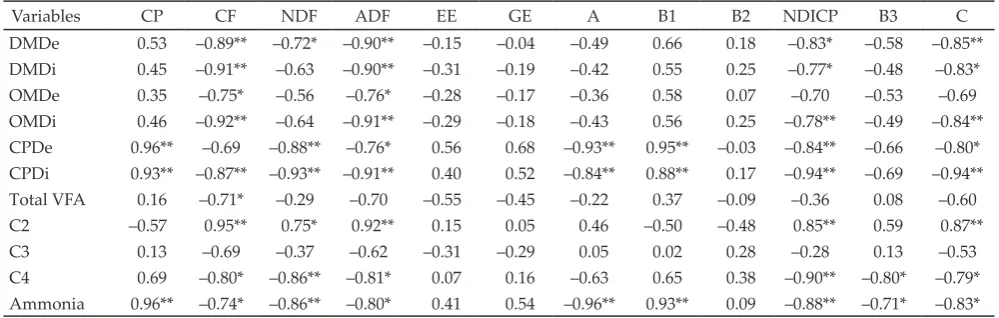
The concentration of CP was positively correlated
with CPDe, CPDi, and ammonia concentration (P<0.01; Table 5). Fiber components, especially CF and ADF
were negatively correlated with DMDe, DMDi, OMDe,
and OMDi (P<0.05) but positively correlated with C2
and C4 proportions (P<0.05). The contents of EE and GE
did not have any significant correlation with in vitro ru-men ferru-mentation parameters. Protein fraction B1 was positively correlated with CPDe, CPDi, and ammonia
concentration (P<0.01) whereas, on the contrary, NDICP
was inversely related with the in vitro rumen
fermenta-tion parameters (P<0.01). Fracfermenta-tion B3 had no significant
correlation with CPDe and CPDi but it negatively
cor-related with ammonia concentration (P<0.05). Fraction
C was negatively correlated with CPDe, CPDi, and
am-monia (P<0.05).
DISCUSSION
Although all alternative beans had relatively high CP contents, none of them had equal CP in comparison to soybean. Typical CP contents in redbean, groundnut, pigeonpea, cowpea, bambarabean, and mungbean
are (mean±sd) 248±15, 297±31, 232±90, 252±22, 198±31, and 258±28 g/kg DM, respectively (FAO, 2016), in
which data on CP contents of the beans in the present
experiment were within the range reported by FAO.
Protein in soybean is known to be easily degraded in the rumen and therefore it is high in the proportion of
Table 2. Protein fraction of some feed materials (g/kg CP)
Feedstuff A B1 B2 NDICP B3 C
Napier grass 315 49.0 142 494 168 326 Soybean 45.6 571 296 86.9 24.5 62.4 Redbean 182 543 54.6 221 161 59.8 Groundnut 146 577 169 109 28.0 80.8 Pigeonpea 220 322 352 106 24.4 81.2 Cowpea 143 515 256 86.9 27.7 59.3 Bambarabean 258 150 383 210 106 103 Mungbean 180 449 243 128 11.4 116 Note: CP= crude protein; A= non-protein nitrogen; B1= rapidly
degrad-ed protein; B2= intermdegrad-ediately degraddegrad-ed protein; NDICP= neutral detergent insoluble crude protein; B3= slowly degraded protein; C= unavailable protein.
Table 3. In vitro degradability and digestibility of some feed materials (g/kg) (n= 3 replicates)
Feedstuff DMDe DMDi OMDe OMDi CPDe CPDi
Napier grass 266ᵃ 475ᵃ 260ᵃ 429ᵃ 244ᵃ 422ᵃ Soybean 548ᵇ 755c 415bc 740c 796ᵉ 861ᵈ Redbean 672c 888ᵈ 567ᵈ 882ᵈ 636ᵈ 787c Groundnut 564ᵇ 698ᵇ 454c 683ᵇ 787ᵉ 854ᵈ Pigeonpea 698c 893ᵈ 613ᵈ 889ᵈ 531c 763c Cowpea 676c 878ᵈ 588ᵈ 874ᵈ 625ᵈ 783c Bambarabean 526ᵇ 774c 384ᵇ 758c 444ᵇ 697ᵇ Mungbean 703c 896ᵈ 619ᵈ 892ᵈ 652ᵈ 793c SEM 21.0 21.4 21.4 23.8 26.2 18.7 P-value <0.001 <0.001 <0.001 <0.001 <0.001 <0.001
Note: Means in the same column with different superscripts differ sig
-nificantly (P<0.05).
DMDe= dry matter degradability; DMDi= dry matter digestibility; OMDe= organic matter degradability; OMDi= organic matter di -gestibility; CPDe= crude protein degradability; CPDi= crude pro-tein digestibility; SEM= standard error of mean.
Note: Means in the same column with different superscripts differ sig
-nificantly (P<0.05).
C2= acetate; C3= propionate; C4= butyrate; SEM= standard error of mean.
Feedstuff Total VFA (mM) (%)C2 (%)C3 (%)C4 Ammonia(mM)
Napier grass 46.8ᵃ 66.5c 17.5ᵃ 15.9ᵃ 7.15a Soybean 59.5bc 61.1ab 18.8ab 20.1bc 45.6f Redbean 79.6ᵈ 60.8ab 20.6c 19.0ᵇ 31.6ᵈ Groundnut 48.6ab 62.2ᵇ 18.5ab 19.4bc 37.2ᵉ Pigeonpea 64.3c 59.6ᵃ 19.6bc 20.8c 27.6c Cowpea 65.8c 60.6ab 18.8ab 19.2bc 34.7ᵉ Bambarabean 61.6c 60.4ab 21.2c 18.4ᵇ 21.0ᵇ Mungbean 64.4c 59.7ᵃ 19.5bc 20.8c 35.4ᵉ SEM 2.13 0.503 0.311 0.640 1.73 P-value <0.001 <0.001 <0.001 <0.001 <0.001 Table 4. In vitro ruminal volatile fatty acid (VFA) profile and
rumen degradable protein (Maxin et al., 2013; Akbarian
et al., 2014). The present study confirmed such finding
as shown by the high proportions of protein fraction B1 and B2 in soybean as well as by the high value of CPDe
and ammonia concentration in the in vitro incubation
of soybean. To our knowledge, this is the first study in Indonesia that attempted to determine various protein fractions in feedstuffs by using CNCPS method. Sniffen
et al. (1992) stated that protein fraction B1 is rapidly
degraded in the rumen and easily converted to peptides, amino acids, and ammonia by rumen microbes, whereas some fraction B2 is fermented in the rumen and some
escapes to the next gastro-intestinal tract; this depends
on the relative rates between digestion and passage. Further, the authors reported that the digestion rate constants for B1 and B2 fractions of proteinaceous feeds
were 50-400%/h and 2-14%/h, respectively (Sniffen et al., 1992). Some beans such as groundnut, pigeonpea,
and cowpea showed high proportions of B1 and B2 like soybean, and hence, indicated high proportion of rumen degradable protein of the beans.
Such high proportion of degradable protein is not
always good. When protein is rapidly degraded in the
rumen, it may not synchron with the rate of energy and carbon provision for microbial protein synthesis,
thus decreasing its conversion efficiency (Yang et al.,
2010; Seo et al., 2013). This condition may lead to the
accumulation of ammonia concentration in the rumen and blood stream, and when ammonia concentration
in blood is above the threshold it may cause toxic
-ity response (Bartley et al., 1976; Holder et al., 2013).
Therefore a balance proportion of degradable and
undegradable (but digestible) protein is important to avoid such inefficiency of microbial protein synthesis and ammonia toxicity. Wang et al. (2008) observed that
high ratio of rumen degradable to rumen undegradable
protein resulted in high urinary N and total N excretion.
Further, a reduction of rumen degradable to rumen
undegradable protein ratio improved the efficiency of
N utilization in lactating dairy cows by decreasing N
excretion in urine and faeces. Marghazani et al. (2012)
fed different proportion of rumen undegradable protein
to early lactating Sahiwal cows, i.e., 30, 40, 50, or 60%
(iso-energetic and iso-proteic diets). It was observed
that the cows fed with 40% rumen undegradable protein
resulted in a maximum nitrogen balance and production
performance. A number of treatments may be applied to shift the highly degradable protein in soybean towards
more undegradable protein (by-pass protein) such as by using tannins (Jolazadeh et al., 2015) and formaldehyde
(De Campeneere et al., 2010). These compounds have
been known to be able to protect protein and resistant to
rumen degradation by microbes (Jayanegara et al., 2013,
2015; Mahima et al., 2015). Saponins may also poten
-tially be used for protecting protein degradation in the rumen due to their chemical interaction and inhibition on growth and activity of proteolytic microbes such as
Streptococcus bovis, Butyrivibrio fibrisolvens, and Prevotella bryantii (Jayanegara et al., 2014).
Redbean and bambarabean apparently good sources of rumen undegradable protein as shown by their high proportions of fraction B3. Protein fraction B3 is insoluble in neutral detergent solution but it is soluble
in acid detergent solution (Higgs et al., 2012). This
fraction is slowly degraded in the rumen and the high percentage of B3 fraction escapes degradation. Digestion rate constants of protein B3 for grains, proteinaceous feeds, and forages were 0.06-0.55, 0.05-0.30, and
0.08-2.0%/h, respectively (Sniffen et al., 1992). However, it
has to be noted that high proportion of undegradable protein is meaningless if it can not be digested and utilized in the lower gastro-intestinal tract. In the case of bambarabean, the high proportion of protein fraction C may limit its protein utilization. Protein fraction C is
also known as acid detergent insoluble CP (ADICP). It
represents the protein linked to lignin, tannin-protein
Table 5. Correlation coefficient between feed chemical composition and in vitro ruminal fermentation parameters (n= 8)
Variables CP CF NDF ADF EE GE A B1 B2 NDICP B3 C
DMDe 0.53 –0.89** –0.72* –0.90** –0.15 –0.04 –0.49 0.66 0.18 –0.83* –0.58 –0.85**
DMDi 0.45 –0.91** –0.63 –0.90** –0.31 –0.19 –0.42 0.55 0.25 –0.77* –0.48 –0.83*
OMDe 0.35 –0.75* –0.56 –0.76* –0.28 –0.17 –0.36 0.58 0.07 –0.70 –0.53 –0.69
OMDi 0.46 –0.92** –0.64 –0.91** –0.29 –0.18 –0.43 0.56 0.25 –0.78** –0.49 –0.84**
CPDe 0.96** –0.69 –0.88** –0.76* 0.56 0.68 –0.93** 0.95** –0.03 –0.84** –0.66 –0.80* CPDi 0.93** –0.87** –0.93** –0.91** 0.40 0.52 –0.84** 0.88** 0.17 –0.94** –0.69 –0.94** Total VFA 0.16 –0.71* –0.29 –0.70 –0.55 –0.45 –0.22 0.37 –0.09 –0.36 0.08 –0.60 C2 –0.57 0.95** 0.75* 0.92** 0.15 0.05 0.46 –0.50 –0.48 0.85** 0.59 0.87**
C3 0.13 –0.69 –0.37 –0.62 –0.31 –0.29 0.05 0.02 0.28 –0.28 0.13 –0.53
C4 0.69 –0.80* –0.86** –0.81* 0.07 0.16 –0.63 0.65 0.38 –0.90** –0.80* –0.79*
Ammonia 0.96** –0.74* –0.86** –0.80* 0.41 0.54 –0.96** 0.93** 0.09 –0.88** –0.71* –0.83*
Note: *= P<0.05; **= P<0.01.
CP= crude protein; CF= crude fiber; NDF= neutral detergent fiber; ADF= acid detergent fiber; EE= ether extract; GE= gross energy; A= non-protein ni -trogen; B1= rapidly degraded protein; B2= intermediately degraded protein; NDICP= neutral detergent insoluble crude protein; B3= slowly degraded
protein; C= unavailable protein; DMDe= dry matter degradability; DMDi= dry matter digestibility; OMDe= organic matter degradability; OMDi= or
-ganic matter digestibility; CPDe= crude protein degradability; CPDi= crude protein digestibility; VFA= volatile fatty acid; C2= acetate; C3= propionate;
complexes, heat-damaged protein, and Maillard prod
-ucts (Licitra et al., 1996). Further, it is highly resistant to
microbial enzymes, does not provide amino acids
post-ruminally (Sniffen et al., 1992), and generally considered
unavailable for ruminants (Pelletier et al., 2010). The
negative correlations between protein fraction C with CPDe, CPDi, and ammonia concentration in the
pres-ent study confirmed such concept. Our previous study
also observed a negative relationship between ADICP
proportion in feedstuffs and their protein digestibility (Jayanegara et al., 2016).
Apart from the good quality of protein found in redbean, low CF and ADF contents in the bean show
its potency as animal feed. Such low fiber content leads
to high DMDe, DMDi, OMDe, and OMDi values since lignocellulose is known to be hardly degraded and fermented by microbes under anaerobic environment
as present in the rumen (Laconi & Jayanegara, 2015;
Rouches et al., 2016). High digestibility of redbean
is confirmed by the high total VFA production as an
end product of microbial metabolism in the rumen,
particularly from carbohydrate (both structural and non-structural) fermentation (Scharen et al., 2016).
Confirming this result, a main factor determining total VFA production rate is rumen fermentable organic mat -ter intake; there is a strong linear positive relationship
between both variables (Noziere et al., 2011). In the case
of groundnut that produced low total VFA, it is appar -ently due to the high EE or fat content. Fat in the form of
triglyceride undergoes lipolysis in which fatty acids are separated from glycerol (Buccioni et al., 2012). Glycerol
is further metabolized to result VFA but fatty acids are not metabolized by rumen microbes. Rather, fatty acids
undergo saturation process of the double bonds known
as biohydrogenation (Jayanegara et al., 2012). Therefore
the contribution of fat to VFA is only from glycerol
fermentation and it is considered as small amount, tak-ing into consideration that glycerol is a three carbon
molecule whereas fatty acids are medium to long chain (>12 carbon molecule), depend on the origin of the fat.
Additionally, one molecule of triglyceride is consisted
of one molecule of glycerol and three molecules of fatty acids. The VFA is later used as energy source by the host
animals and may contribute to about 70% of their total
energy requirement (Bergman, 1990).
Each individual VFA has its own fate after absorp -tion in which acetate is a precursor of milk fat and propionate is a precursor of glucose and milk sugar
or lactose synthesis (Aluwong et al., 2010; Fievez et al.,
2012). In the present study, higher percentage of acetate is due to higher proportion of fiber, either CF, NDF or
ADF. This result is supported by a meta-analysis study
of Noziere et al. (2011) that observe an increase in molar
percentage of acetate with increasing proportion of
digested NDF in the digested organic matter, in which
the relationship is curvilinear. Further in that study, higher proportion of digested NDF in the digested
or-ganic matter results in a decrease in molar percentage of propionate. Although the correlation coefficient between fiber and propionate in this experiment was negative, it did not show any significant relationship. Bannink et al.
(2006) outlined that more cellulose (fiber) fermentation
will increase acetate production whereas more starch fermentation will increase propionate production. This
is because of different metabolic fate between fibrolytic
bacteria that produce more acetate and amylolytic
bacte-ria that produce more propionate in the rumen (Alemu
et al., 2011).
CONCLUSION
Groundnut, redbean, pigeonpea, cowpea, and mungbean have the potency as alternatives to soybean,
at least partially, for ruminant feeding. All experimental beans except redbean and bambarabean are similar
to soybean in which they are high with degradable protein proportion, whereas the other two beans con-tain substantially higher proportion of undegradable protein. Redbean in particular may strategically be used as a source of protein by-pass in ration. Although CP content of redbean is not as superior as soybean, it has a comparative advantage due to its low CF and ADF contents. In the case of bambarabean, its utilization may be limited since it contains considerable proportion of
undigested protein (fraction C).
ACKNOWLEDGEMENT
This research was funded by Indonesian Ministry of Research, Technology, and Higher Education through “Penelitian Unggulan Perguruan Tinggi – Penelitian Unggulan Divisi” research grant. All authors are grate-ful to Mr. Sofyan, Mrs. Eneh, and Mrs. Dian Anggraeni
for excellent technical helps during the experimental
period.
REFERENCES
Akbarian, A., M. Khorvash, G. R. Ghorbani, E. Ghasemi, M.
Dehghan-Banadaky, P. Shawrang, & M. H. Ghaffari.
2014. Effects of roasting and electron beam irradiating on protein characteristics, ruminal degradability and intesti-nal digestibility of soybean and the performance of dairy cows. Livest. Sci. 168:45-52. http://dx.doi.org/10.1016/j. livsci.2014.07.019
Akhsan, F., L. K. Nuswantara, & J. Achmadi. 2015. Combination of soybean meal and Hibiscus tiliaceus leaf in the goat diet: effect on some parameters of protein me-tabolism. J. Indonesian Trop. Anim. Agric. 40:100-106. http://dx.doi.org/10.14710/jitaa.40.2.100-106
Alemu, A. W., J. Dijkstra, A. Bannink, J. France, & E. Kebreab. 2011. Rumen stoichiometric models and their contri-bution and challenges in predicting enteric methane production. Anim. Feed Sci. Technol. 166-167:761-778. http://dx.doi.org/10.1016/j.anifeedsci.2011.04.054
Aluwong, T., P. I. Kobo, & A. Abdullahi. 2010. Volatile fatty acids production in ruminants and the role of monocar-boxylate transporters: a review. African J. Biotechnol. 9:6229-6232.
AOAC. 2005. Official Methods of Analysis. 18th Edition. AOAC International, Arlington, VA, USA.
Bannink, A., J. Kogut, J. Dijkstra, J. France, E. Kebreab, A. M. Van Vuuren, & S. Tamminga. 2006. Estimation of the stoichiometry of volatile fatty acid production in the rumen of lactating cows. J. Theor. Biol. 238:36-51. http://dx.doi.org/10.1016/j.jtbi.2005.05.026
D. Dayton, C. W. Deyoe, & R. M. Bechtle. 1976. Ammonia toxicity in cattle. I. Rumen and blood changes associated with toxicity and treatment methods. J. Anim. Sci. 43:835-841. http://dx.doi.org/10.2527/jas1976.434835x
Bergman, E. N. 1990. Energy contributions of volatile fatty acids from the gastrointestinal tract in various species. Physiol. Rev. 70:567-590.
Buccioni, A., M. Decandia, S. Minieri, G. Molle, & A. Cabiddu. 2012. Lipid metabolism in the rumen: new insights on li-polysis and biohydrogenation with an emphasis on the role of endogenous plant factors. Anim. Feed Sci. Technol. 174:1-25. http://dx.doi.org/10.1016/j.anifeedsci.2012.02.009 Campos, A. F., O. G. Pereira, K. G. Ribeiro, S. A. Santos, &
S. D. C. Valadares Filho. 2014. Impact of replacing soy-bean meal in beef cattle diets with inactive dry yeast, a sugarcane by-product of ethanol distilleries and sugar mills. Anim. Feed Sci. Technol. 190:38-46. http://dx.doi. org/10.1016/j.anifeedsci.2014.01.003
De Campeneere, S., J. L. De Boever, J. M. Vanacker, & D. L. De Brabander. 2010. Reducing nitrogen excretion and soybean meal use by feeding a lower rumen degrad-able protein balance and protected soybean meal to dairy cattle. Arch. Anim. Nutr. 64:85-97. http://dx.doi. org/10.1080/17450391003625011
FAO (Food and Agriculture Organization of the United Nations). 2016. Feedipedia: Animal Feed Resources Information System. http://www.feedipedia.org/ [20 June 2016].
Faradillah, F., R. Mutia, & L. Abdullah. 2015. Substitution of soybean meal with Indigofera zollingeriana top leaf meal on egg quality of Coturnix coturnix japonica. Med. Pet. 38:192-197. http://dx.doi.org/10.5398/medpet.2015.38.3.192 Fievez, V., E. Colman, J. M. Castro-Montoya, I. Stevanov, &
B. Vlaeminck. 2012. Milk odd- and branched-chain fatty acids as biomarkers of rumen function-an update. Anim. Feed Sci. Technol. 172:51-65. http://dx.doi.org/10.1016/j. anifeedsci.2011.12.008
Goh, C. H., A. B. Nicotra, & U. Mathesius. 2016. The pres-ence of nodules on legume root systems can alter pheno-typic plasticity in response to internal nitrogen indepen-dent of nitrogen fixation. Plant Cell Environ. 39:883-896. http://dx.doi.org/10.1111/pce.12672
Haliza, W., E. Y. Purwani, & R. Thahir. 2007. Pemanfaatan ka-cang-kacangan lokal sebagai substitusi bahan baku tempe dan tahu. Buletin Teknologi Pascapanen Pertanian 3:1-8. Haliza, W., E. Y. Purwani, & R. Thahir. 2010. Pemanfaatan
kacang-kacangan lokal mendukung diversifikasi pangan. Pengembangan Inovasi Pertanian 3:238-245.
Hao, X. Y., X. Han, H. Ju, & E. D. Lin. 2010. Impact of climatic change on soybean production: a review. Chinese J. Appl. Ecol. 21:2697-2706.
Higgs, R. J., L. E. Chase, & M. E. Van Amburgh. 2012. Development and evaluation of equations in the Cornell Net Carbohydrate and Protein System to predict nitrogen excretion in lactating dairy cows. J. Dairy Sci. 95:2004-2014. http://dx.doi.org/10.3168/jds.2011-4810
Holder, V. B., S. W. El-Kadi, J. M. Tricarico, E. S. Vanzant, K. R. McLeod, & D. L. Harmon. 2013. The effects of crude pro-tein concentration and slow release urea on nitrogen me-tabolism in Holstein steers. Arch. Anim. Nutr. 67:93-103. http://dx.doi.org/10.1080/1745039X.2013.773647
Jayanegara, A., M. Kreuzer, & F. Leiber. 2012. Ruminal disap-pearance of polyunsaturated fatty acids and apdisap-pearance of biohydrogenation products when incubating linseed oil with alpine forage plant species in vitro. Livest. Sci. 147:104-112. http://dx.doi.org/10.1016/j.livsci.2012.04.009 Jayanegara, A., S. Marquardt, E. Wina, M. Kreuzer, & F.
Leiber. 2013. In vitro indications for favourable non-addi-tive effects on ruminal methane mitigation between
high-phenolic and high-quality forages. Br. J. Nutr. 109:615-622. http://dx.doi.org/10.1017/S0007114512001742
Jayanegara, A., E. Wina, & J. Takahashi. 2014. Meta-analysis on methane mitigating properties of saponin-rich sourc-es in the rumen: influence of addition levels and plant sources. Asian Australas. J. Anim. Sci. 27:1426-1435. http://dx.doi.org/10.5713/ajas.2014.14086
Jayanegara, A., G. Goel, H. P. S. Makkar, & K. Becker. 2015. Divergence between purified hydrolysable and con-densed tannin effects on methane emission, rumen fer-mentation and microbial population in vitro. Anim. Feed Sci. Technol. 209:60-68. http://dx.doi.org/10.1016/j. anifeedsci.2015.08.002
Jayanegara, A., S. P. Dewi, N. Laylli, E. B. Laconi, Nahrowi, & M. Ridla. 2016. Determination of cell wall protein from selected feedstuffs and its relationship with rumi-nal protein digestibility in vitro. Med. Pet. 39:134-140. http://dx.doi.org/10.5398/medpet.2016.39.2.134
Jolazadeh, A. R., M. Dehghan-Banadaky, & K. Rezayazdi. 2015. Effects of soybean meal treated with tannins ex-tracted from pistachio hulls on performance, ruminal fer-mentation, blood metabolites and nutrient digestion of Holstein bulls. Anim. Feed Sci. Technol. 203:33-40. http:// dx.doi.org/10.1016/j.anifeedsci.2015.02.005
Laconi, E. B., & A. Jayanegara. 2015. Improving nutritional quality of cocoa pod (Theobroma cacao) through chemi-cal and biologichemi-cal treatments for ruminant feeding: in vi-tro and in vivo evaluation. Asian Australas. J. Anim. Sci. 28:343-350. http://dx.doi.org/10.5713/ajas.13.0798
Licitra, G., T. M. Hernandez, & P. J. Van Soest. 1996. Standardization of procedures for nitrogen fractionation of ruminant feeds. Anim. Feed Sci. Technol. 57:347-358. http://dx.doi.org/10.1016/0377-8401(95)00837-3
Liu, Y., N. W. Jaworski, O. J. Rojas, & H. H. Stein. 2016. Energy concentration and amino acid digestibility in high protein canola meal, conventional canola meal, and in soybean meal fed to growing pigs. Anim. Feed Sci. Technol. 212:52-62. http://dx.doi.org/10.1016/j.anifeedsci.2015.11.017
Mahima, V. Kumar, S. K. Tomar, D. Roy, & M. Kumar. 2015. Effect of varying levels of formaldehyde treatment of mus-tard oil cake on rumen fermentation, digestibility in wheat straw based total mixed diets in vitro. Vet. World 8:551-555. http://dx.doi.org/10.14202/vetworld.2015.551-555 Marghazani, I. B., M. A. Jabbar, T. N. Pasha, & M. Abdullah.
2012. Effect of supplementation with protein differ for ru-men degradability on milk production and nutrients uti-lization in early lactating Sahiwal cows. Ital. J. Anim. Sci. 11:58-62. http://dx.doi.org/10.4081/ijas.2012.e11
Maxin, G., D. R. Ouellet, & H. Lapierre. 2013. Ruminal de-gradability of dry matter, crude protein, and amino ac-ids in soybean meal, canola meal, corn, and wheat dried distillers grains. J. Dairy Sci. 96:5151-5160. http://dx.doi. org/10.3168/jds.2012-6392
Noziere, P., F. Glasser, & D. Sauvant. 2011. In vivo production and molar percentages of volatile fatty acids in the rumen: a quantitative review by an empirical approach. Animal 5:403-414. http://dx.doi.org/10.1017/S1751731110002016 Pelletier, S., G. F. Tremblay, A. Bertrand, G. Belanger, Y.
Castonguay, & R. Michaud. 2010. Drying procedures affect non-structural carbohydrates and other nutri-tive value attributes in forage samples. Anim. Feed Sci. Technol. 157:139-150. http://dx.doi.org/10.1016/j. anifeedsci.2010.02.010
Rouches, E., I. Herpoel-Gimbert, J. P. Steyer, & H. Carrere. 2016. Improvement of anaerobic degradation by white-rot fungi pretreatment of lignocellulosic biomass: a review. Renew. Sustanable Energy Rev. 59:179-198. http://dx.doi. org/10.1016/j.rser.2015.12.317
L. Huther, J. Frahm, A. Beineke, D. Van Soosten, U. Meyer, G. Breves, & S. Danicke. 2016. The effects of a ra-tion change from a total mixed rara-tion to pasture on rumen fermentation, volatile fatty acid absorption characteristics, and morphology of dairy cows. J. Dairy Sci. 99:3549-3565. http://dx.doi.org/10.3168/jds.2015-10450
Seo, J. K., M. H. Kim, J. Y. Yang, H. J. Kim, C. H. Lee, K. H. Kim, & J. K. Ha. 2013. Effects of synchronicity of car-bohydrate and protein degradation on rumen fermen-tation characteristics and microbial protein synthesis. Asian Australas. J. Anim. Sci. 26:358-365. http://dx.doi. org/10.5713/ajas.2012.12507
Sniffen, C. J., J. D. O’Connor, P. J. Van Soest, D. G. Fox, &
J. B. Russel. 1992. A net carbohydrate and protein sys-tem for evaluating cattle diets: II. Carbohydrate and pro-tein availability. J. Anim. Sci. 70:3562-3577. http://dx.doi. org/10.2527/1992.70113562x
Tilley, J. M. A., & R. A. Terry. 1963. A two-stage technique for the in vitro digestion of forage crops. Grass Forage Sci. 18:104-111. http://dx.doi.org/10.1111/j.1365-2494.1963. tb00335.x
Van Soest, P. J., J. B. Robertson, & B. A. Lewis. 1991. Methods for dietary fiber, neutral detergent fiber, and non-starch polysaccharides in relation to animal nutrition. J. Dairy Sci. 74:3583-3597. http://dx.doi.org/10.3168/jds. S0022-0302(91)78551-2
Vollmann, J. 2016. Soybean versus other food grain le-gumes: a critical appraisal of the United Nations International Year of Pulses 2016. Bodenkultur 67:17-24. http://dx.doi.org/10.1515/boku-2016-0002
Wang, C., J. X. Liu, S. W. Zhai, J. L. Lai, & Y. M. Wu. 2008. Effects of rumen degradable protein to rumen unde-gradable protein ratio on nitrogen conversion of lac-tating dairy cows. Acta Agric. Scand. A 58:100-103. http://dx.doi.org/10.1080/09064700802187210
Yang, J. Y., J. Seo, H. J. Kim, S. Seo, & J. K. Ha. 2010. Nutrient synchrony: is it a suitable strategy to improve nitrogen uti-lization and animal performance? Asian Australas. J. Anim. Sci. 23:972-979. http://dx.doi.org/10.5713/ajas.2010.r.04 Yildiz, E. & N. Todorov. 2014. The comparison of the main