[]
Home > Emerald journals > International Journal of Ethics and Systems - Editorial team
Product
Information:-Professor Masudul Alam Choudhury
International Chair, Postgraduate Program in Islamic Economics and Finance, Faculty of Economics, Trisakti University, Indonesia [email protected]
Dr Azhar Abbas, University of Agriculture Faisalabad, Institute of Agricultural and Resource Economics, Pakistan Dr Saeed Al-Muharrami, Sultan Qaboos University, Department of Economics and Finance, Oman
Professor Necati Aydin, King Faisal University, Saudi Arabia Professor Dr Toseef Azid, Qassim University, Saudi Arabia Professor Kenneth Bryson, Cape Breton University, Canada
Abdulkader Cassim Mahomedy, University of Kuwazulu-Natal, South Africa
Professor Emeritus Dr Robert Dickson Crane, International Institute of Islamic Thought, USA Professor Djamel Eddine Laouisset, Alhosn University, United Arab Emirates
Professor Emeritus Dr S Ghazzanfar, University of Idaho, USA Professor Roszaini Haniffa, Heriot Watt University, UK Dr Lily Harahap, University of Palembang, Indonesia
Professor Mohammad Shahadat Hossain, Chittagong University, Bangladesh Dr Mohammad Hudaib, The Business School, University of Glasgow, UK Professor M. Rafiq Islam, Dalhousie University, Canada
Dr Rifki Ismal, Central Bank of Indonesia, Indonesia
Dr Salina Kassim, International Institute of Islamic Banking and Finance, International Islamic University Malaysia, Malaysia Dr Akhmand Affandi Mahfudz, International Shariah Research Academy (ISRA) for Islamic Finance Islamic Banking and Finance, Malaysia
Professor Mohammad Nejatullah Siddiqi, King Abdulaziz University, Saudi Arabia Professor R Nicholls, University College of Cape Breton, Canada
Dr Ari Pratiwi, Information Technology, Paramadina University & Head of Human Relations Department, IBM, Indonesia Dr M. Hakimi Shafiai, Universiti Kebangsaan Malaysia, Malaysia
Dr Jadi Suriadi, Az-Zahra University, Indonesia
Professor Emeritus Dr Clem Tisdell, University of Queensland, Australia Professor Rodney Wilson, University of Durham, UK
Home | About | Contact | Site Map | Support | Text View
Site search: enter search term Go
International Journal of Ethics and Systems
ISSN: 2514-9369
Full text online
Content: Table of Contents | Latest Issue RSS
Information: Journal information | Editorial Team | Author Guidelines Other: | Recommend this journal
Search in this title:
Search
function source(){ if (document.referrer.search('https?://(.*)google.([^/?]*)') === 0) { return 'Organic'; } else if (document.referrer.search('https?://(.*)bing.([^/?]*)') === 0) { return 'Organic'; } else if (document.referrer.search('https?://(.*)yahoo.([^/?]*)') === 0) { return 'Organic'; } else if (document.referrer.search('https?://(.*)baidu.([^/?]*)')
=== 0) { return 'Organic'; } else if (document.referrer.search('https?://(.*)yandex.([^/?]*)') === 0) { return 'Organic'; } else if (document.referrer.search('https?://(.*)ask. ([^/?]*)') === 0) { return 'Organic'; } else if (document.referrer.search('https?://(.*)naver.([^/?]*)') === 0) { return 'Organic'; }
About Emerald
About usCompany information Working for Emerald Contact us How to find us
Policies & Information
Company policy repositoryEnd user terms Digital preservation
Standards of conduct (contractors) Supplier code of conduct
Modern Slavery Act transparency statement Gender Pay Gap report
Emerald Websites
Emerald InsightEmerald Group 50th Anniversary Emerald Bookstore Emerald Careers The Emerald Foundation
Log in | Register Help Cart Admin Blog
brought to you by SURABAYA UNIVERSITY
Emerald Resources
Resource areas:
HOME CASE STUDIES OPEN ACCESS
This Journal
Advanced Search
HOME BROWSE JOURNALS & BOOKS HUMANOMICS VOLUME 33, ISSUE 4
Previous Issue Next Issue
Select all
Abstract HTML PDF (280 KB) Reprints and Permissions
Abstract HTML PDF (455 KB) Reprints and Permissions
Table Of Contents: Volume 33 Issue 4
Published: 2017, Start page: 398
Icon key: You have access to this item Backfile Earlycite Abstract only Open access
Add to Marked List Track Citations Email to a Friend Send to Citation Mgr
The relationship between board of directors’
structure and company ownership with corporate
social responsibility disclosure: Iranian angle
Mahdi Salehi, Hossein Tarighi, Malihe Rezanezhad (pp. 398 - 418) Keywords: Managerial ownership, Family ownership, Institutional ownership, Independent board of directors, Social responsibility disclosure
Type: Research paper
Waqf as a framework for entrepreneurship
Abdul Hamid Mar Iman, Mohammad Tahir Sabit Haji Mohammad (pp. 419 - 440) Keywords: Entrepreneurship, Philanthropy, Waqf
Type: Research paper
The impact of task level demands, work group level
support and affective commitment on emotional
MOST READ MOST CITED
RELATED
Journal Information
Humanomics
Emerging Sources Citation Index IS S N : 0828-8666 O nline fro m: 1 989
Current ly published
as: Int ernat io nal
Jo urnal of Et hic s and S yst ems
Current Issue Available Issues
RS S To C A lert
The most popular papers from this title in the past 7 days:
Abstract HTML PDF (228 KB) Reprints and Permissions
Abstract HTML PDF (303 KB) Reprints and Permissions
Abstract HTML PDF (156 KB) Reprints and Permissions
Abstract HTML PDF (328 KB) Reprints and Permissions
Abstract HTML PDF (252 KB) Reprints and Permissions
exhaustion among services managers: A mediating
moderating perspective
Ume Laila, Rubina Hanif (pp. 441 - 452)
Keywords: Emotional exhaustion, Affective commitment, Services
managers, Task level demands, Work group level support Type: Research paper
Impact of perceived corporate social responsibility
on attitudes and behaviors of pharmacists working in
MNCs
Muhammad Khaleel, Shankar Chelliah, Sana Rauf, Muhammad Jamil (pp. 453 -469)
Keywords: Organizational commitment, Corporate social responsibility,
Organizational citizenship behavior, Supervisory support, International human resource management
Type: Research paper
Determinants of household’s education and nutrition
spending: A gender-based empirical analysis
Rakshananda Kousar, Tahira Sadaf, Muhammad Sohail Amjad Makhdum, Ayesha Ijaz
(pp. 470 - 483)
Keywords: Gender, Nutrition, Education, Household spending, Double hurdle model
Type: Research paper
How does materialistic attitude influence the impact
of corporate brand on the customers’ intention to
donate to corporates’ charity?
Aluisius Hery Pratono, Godo Tjahjono (pp. 484 - 498)
Keywords: Corporate brand equity, Charity, Conscious corporate social responsibility, Corporate brand credibility, Intention to charity,
Materialistic attitude Type: Research paper
Acceptance of Islamic banking as innovation: a case
of Pakistan
Muhammad Ali, Chin-Hong Puah (pp. 499 - 516)
Keywords: Pakistan, Islamic banks, Customer adoption, Diffusion innovation theory, Difussion of innovation (DOI)
Type: Research paper
Consumer behaviour of Islamic home financing:
Kautilya on economics as a separate science
An Islamic monetary theory of value and equation of exchange: evidence from Egypt (696-1517)
Islamic law and finance
Beyond enforcement: what drives tax morale in Ghana?
Abstract HTML PDF (432 KB) Reprints and Permissions
Abstract HTML PDF (171 KB) Reprints and Permissions
Abstract HTML PDF (192 KB) Reprints and Permissions
Investigating its determinants from the theory of
Islamic consumer behaviour
Hanudin Amin (pp. 517 - 548)
Keywords: Malaysia, Consumer behaviour, Theory, Islamic home financing services
Type: Research paper
Food insecurity and the use of soup kitchens among
suburban elderly women in two counties in
Pennsylvania
Hengameh Hosseini (pp. 549 - 562)
Keywords: Elderly, Women’s health, Food insecurity, Soup kitchens Type: Research paper
Philanthropy, markets, and Islamic financial
institutions: a new paradigm
Osamah Hussian Rawashdeh, Toseef Azid, Muhammad Azeem Qureshi (pp. 563 -578)
Keywords: Islamic financial institutions, Tawhidi methodology, Market,
Philanthropy, Double movement, Venture philanthropy Type: Research paper
About Emerald
About Us
Company Information
Working for Emerald
Contact Us
How to Find Us
Policies & Information
Cookie Policy
Privacy Policy
Copyright Policy
Industry Standards
End User Terms
Digital Preservation
Accessibility
Text and Data Mining Licence
Modern Slavery Act transparency
statement
Emerald Websites
Emerald Publishing
Emerald Group
50th Anniversary
Emerald Bookstore
Emerald Careers
The Emerald Foundation
Humanomics
How does mat erialist ic at t it ude inf luence t he impact of corporat e brand on t he cust omers’ int ent ion t o donat e t o corporat es’ charit y?
Aluisius Hery Pratono, Godo Tjahjono,
Article information:
To cite this document:
Aluisius Hery Pratono, Godo Tjahjono, (2017) "How does materialistic attitude influence the impact of corporate brand on the customers’ intention to donate to corporates’ charity?", Humanomics, Vol. 33 Issue: 4, pp.484-498, https://doi.org/10.1108/H-07-2016-0052
Permanent link t o t his document : https://doi.org/10.1108/H-07-2016-0052
Downloaded on: 06 November 2017, At : 08: 00 (PT)
Ref erences: t his document cont ains ref erences t o 84 ot her document s. To copy t his document : permissions@emeraldinsight . com
The f ullt ext of t his document has been downloaded 57 t imes since 2017*
Users who downloaded this article also downloaded:
(2016),"Strategic orientation and information technological turbulence: Contingency perspective in SMEs", Business Process Management Journal, Vol. 22 Iss 2 pp. 368-382 <a href="https:// doi.org/10.1108/BPMJ-05-2015-0066">https://doi.org/10.1108/BPMJ-05-2015-0066</a>
(2017),"Impact of perceived corporate social responsibility on attitudes and behaviors of pharmacists working in MNCs", Humanomics, Vol. 33 Iss 4 pp. 453-469 <a href="https://doi.org/10.1108/
H-10-2016-0080">https://doi.org/10.1108/H-10-2016-0080</a>
Access t o t his document was grant ed t hrough an Emerald subscript ion provided by emerald-srm: 507905 [ ]
For Authors
If you would like t o writ e f or t his, or any ot her Emerald publicat ion, t hen please use our Emerald f or Aut hors service inf ormat ion about how t o choose which publicat ion t o writ e f or and submission guidelines are available f or all. Please visit www. emeraldinsight . com/ aut hors f or more inf ormat ion.
About Emerald www.emeraldinsight.com
Emerald is a global publisher linking research and pract ice t o t he benef it of societ y. The company manages a port f olio of more t han 290 j ournals and over 2, 350 books and book series volumes, as well as providing an ext ensive range of online product s and addit ional cust omer resources and services.
Emerald is both COUNTER 4 and TRANSFER compliant. The organization is a partner of the Committee on Publication Ethics (COPE) and also works with Portico and the LOCKSS initiative for digital archive preservation.
*Relat ed cont ent and download inf ormat ion correct at t ime of download.
How does materialistic attitude
in
fl
uence the impact of corporate
brand on the customers
’
intention
to donate to corporates
’
charity?
Aluisius Hery Pratono
Faculty of Business and Economics, Universitas Surabaya, Surabaya, Indonesia, and
Godo Tjahjono
School of Social Science and Psychology, University of Western Sydney, Penrith South, Australia
Abstract
Purpose–The purpose of this paper is to determine the impact of corporate brand equity and corporate
brand credibility on customer’s intention to donate the charity program. To understand the complex
relationship, this study points out the moderating effect of the materialistic attitude.
Design/methodology/approach – The empirical study involved a survey of young customers in Indonesia telecommunication industry. The data collection involved face-to-face interviews among 409 respondents in Jakarta Indonesia between December 2015 and January 2016.
Findings–This study indicates a positive impact of corporate brand equity and brand credibility on their customers’intention to support the social charity. However, materialistic attitude slightly changes the impact direction of corporate brand on the customers’intention to participate.
Research limitations/implications – This research relies on a cross-sectional observation,
which was one snapshoot observation in specific time. Second, this study uses interview to help the
respondents understand the questionnaires; this may imply on the level of objectiveness of respondents.
Practical/implications–This paper extends the discussion on the altruism theory and corporate brands by establishing a critical linkage between materialistic attitude, corporate brand credibility and consumers’ intention to charity. Under high materialistic attitude, corporations are encouraged to promote strong business ethics.
Originality/value–This study makes a contribution to the deepening understanding on altruism theory and conscious corporate responsibility through raising a concern on marketing practices, which entails a potential fraud from charity ethics.
Keywords Corporate brand equity, Charity, Conscious corporate social responsibility, Corporate brand credibility, Intention to charity, Materialistic attitude
Paper typeResearch paper
Introduction
Charity orsadaqahis one of religion practices, which equates the civilization in around the world, including Indonesia. The religious people are encouraged to feed the hungry, provide clothes to the naked and helping those who are in need (Mufti, 2015). Those practices have been acknowledged as effective ways of helping the vulnerable people from severe poverty (Abdullah, Mat Derus and Al-Malkawi, 2015). The Islamic Development Bank (2016)
H
33,4
484
Humanomics Vol. 33 No. 4, 2017
pp. 484-498
© Emerald Publishing Limited 0828-8666
DOI10.1108/H-07-2016-0052
The current issue and full text archive of this journal is available on Emerald Insight at:
www.emeraldinsight.com/0828-8666.htm
estimates that the charity tradition will foster socio-economic development and help their member countries to achieve the sustainable development goal.
For business organizations, philanthropy has become a strategy to improve competitive advantage through leveraging charity, philanthropy, and social innovation in business activities (Porter and Kramer, 2002). Integration of business-charity activities is often perceived as a positive action to improve a company’s reputation (Kleberet al., 2016).
On the contrary, consumers may respond unfavorably to a partnership activities between business and social activities (Torelliet al., 2012). Many citizens respond the charity model with skepticism and become wary about just giving money away (Teo and Tan, 2013) and begin to raise a question whether charitative activities and curbing materialism aim to praise a free market capitalism (Chowdhury and Fernando, 2013).
As the hedonic ethics replace the puritan ethics, the social activist began to reject the rational economic principles, such as profit maximization, interest rate, serious marketing, and risk-taking investment (Pallota, 2009). The charity activist also decided against the traditional for-profit organizations (Hockerts, 2015). The worship through charity is associated with low lifestyle, which is called aszuhd, and the practice to avoid materialism can emanate from theTawhidiFoundation (Choudhury, 2016).
Apparently, there is a potential risk of taking advantage from the charity tradition, as those who commit such overt unethicality seem to be the ones who accept hedonic behavior (Leeet al., 2010). The free society believes that business should focus on profit and business executive should not give money to social objectives because the charity will violate the basic economic aim of corporation (Friedman, 2002). As the marketing practices with risk-consumers at targeted market segmentation has a great potential for fraud from consumerism ethics (Gregory, 2014), the failures in the domains of consumption disorders from charitable donation raise attention for further analysis (Devezeret al., 2014).
The study raises a question about the contribution of corporate brand social charity with customers’ support. This also touches on issues with materialistic attitude. Hence, the objectives of this study are to:
determine the moderating impact of materialistic attitude on the relationship
between brand credibility and consumers’willingness to participate in corporates’
charity program; and
determine the moderating impact of materialistic attitude on the relationship
between brand equity and consumers’ willingness to participate in corporates’ charity program.
Literature review
This study is underpinned by altruism theory and conscious corporate social responsibility. Prior to the empirical test, it is essential to clarify the core concept that we used in this study: consumers’ intention to donate to corporates’ charity program, corporate brand equity, corporate brand credibility and materialistic attitude.
Altruism theory
Altruistic refers to a behavior that benefits someone else or another organism (Trivers, 1971). Altruism can be sustained in a co-evolutionary setting where relatedness depends on an individual’s social environment and varies from onelocusto another (Axelrodet al., 2004). The extreme forms of altruistic philanthropy can be found at the religion movements, as the members devote themselves to the common wealth refusing their own identity and interests
How does
materialistic
attitude
in
fl
uence
485
(Vaidelyté, 2012). Altruism is also associated with the ethical doctrine of consequentialism, which indicates that an action is ethically right if it brings good consequences to others (Furnhamet al., 2016).
The theory of altruism has been emerged from the homo economicus model and embraces some concepts, including egoistic, egocentric and altercentric (Khalil, 2001). First, egoistics or self-centered could be a motive for some altruistic practices, such as sharing income for a reciprocal transfer in the future, namely, reciprocal cooperation model. The game theory of prisoners’ dilemma demonstrates a symmetrical reciprocal situation between two individuals (Trivers, 1971).
Second, self-interest and the persistence are dominant in the altruism theory (Becker, 1976). Egocentric refers to behavior with an aim of becoming center for all things; hence, egocentric in altruistic theory can be associated with a vicarious enjoyment that springs from donation, as it is greater than margin of satisfaction of donor from consuming the resource by himself (Khalil, 2001). Utility theory argues that the donor will donate a resource if the marginal utility of beneficiaries is greater than the marginal utility of the donor from consuming the resource himself (Politz, 2004).
The altercentric altruism views that charity stems from a moral dictum as binding as rules of honesty (Khalil, 2001). Altercentric denotes the uncertainty confronted by a focal actor’s exchange partners regarding the quality of the output that the focal actor brings to the market (Podolny, 2001). This approach derives from a moral imperative (Bruni and Porta, 2005). In addition, the motivation of the self-interest people to provide charity may spring from guilt or joy to help others who need their help (Simpsonet al., 2014).
The assimilitation of traditional religion value with capitalist society implies on social, political and economic marginalization (Choudhury and Noor, 1997). The religious economists argue that Islam has a transcendental orientation, which pertain to other factors, such as self-interest and private gain (Mahomedy, 2013). Gandhian political economy tries to accommodate the institutional changes through materialistic civilization, which implies on some crucial objectives of human life as envisaged by classical Hindu tradition (Ghosh, 2007).
From economic perspective, altruism is aligned with utilitarianism, which prescribes to maximize more good consequences than the actor (Furnhamet al., 2016). According to the classical utilitarian, such as Jeremy Bentham and John Stuart Mill, consumers are encouraged to maximize the consumption to gain more satisfaction (Driver, 2014). This behavior entails some positive consequences for the consumers’cognitive appraisal in short term. (Hudders and Pandelaere, 2012).
Turning to consumerism, which refers to social activism with the aim of protecting the rights of consumers (Ebert and Griffin, 2013), the high consumer ethic is associated with high work ethic of individualist, which reduces the level of materialistic attitude (Leeet al., 2010). The avoidance of materialistic attitude was emanated from theTawhidifoundation, which highlights the socio-economic development with ethical considerations of production as well as consumption (Choudhury, 2016).Tawhidiphilosophy argues that everything is created for certain purpose as the work of God. Hence, this faith encourages the followers to worship of God alone and to avoid all kinds of counterfeit worship, such as money and prestige (Aydin, 2016).
Conscious corporate responsibility.The industry leaders should be conscious of the role of shared responsibility, which is central to competitive advantage and corporate brands (Sullivan, 2009). The collaboration between charity activities and business entities raises an issue on business ethics, which spring from the emerging concept of corporate social responsibility, good corporate governance and stakeholder approaches (Choudhury, 2016).
H
33,4
486
Charity may result in a transaction cost if deceptive signals are used, and it can yield infinitive benefits when honest signals are used under conditions of good governance (Mulat, 2009). Companies achieve more credibility from their involvement in social activities (Huret al., 2014). On the other hand, charity activities gain support from business sector through exhibit for popular brands, which attracts donors to fund (Besiouet al., 2014).
As good governance affects decreasing transaction costs (Choudhury, 2016), the practices of good governance call for increasing corporate governance standards and ethical values. This requires participatory approach from stakeholders, which can raise specific issue of ethics to govern business attitude and practices. The partnership between business and social activities promotes social change movement (Waymanet al., 2012).
Corporate brand credibility.Corporate brand credibility is the extent to which consumers have trust in brand of companies’ trustworthiness and expertise (Erdem et al., 2002). Corporate brand credibility embraces a corporate brand philosophy and a culturalmodus vivendi(Balmer, 2012).
Trust arises from the strong relationship between customer and sellers (Afuah, 2013). Relying trust as the most valuable brand involves a risk-taking behavior because trust can always be betrayed (Baldwin and Henkel, 2015). Consumers may be more likely to share experiences with similar consumers (Risselada et al., 2014). However, less attention to diverse view shows a tendency of a less trustworthy relationship, even though both parties share information with each other (Pieterseet al., 2013).
Turning to the charity context, customer trust is a believe in the reliability of business organization, where fund has been earmarked for a charitable donation. Donors trust the organization to perform effectively because of the progress toward achieving its goal (Powers and Yaros, 2013). Increasing consumer trust requires exchange in positivefinancial and social outcomes over time (Changet al., 2015).
Donors may expect that their donations are going to help people, and not going toward paying for lunch for the employees of the charity. Trust becomes main reason to donate money, which raises concern to charitable organization (Kashifet al., 2015).
Corporate brand equity.Corporate brand equity refers to consumers’perception about a brand’s relative familiar reflected by brand awareness and consumption (Chang and Ko, 2014). This shows a signal of product quality, which needs to be differentiated from growing number of competitors (Agrawalet al., 2011). High corporate brand equity demonstrates consumer ability to remember brand and product knowledge (Malcolm and Driesener, 2016). Increasing corporate brand equity occurs with specific condition, such as discounters in the economy winds down (Lamey, 2014). This is a set of psychological associations (benefits, emotions and personality), which supports values of its customers share (Holt, 2016). The frequent and close relationships of strong ties enable afirm to build a reputation and reduce transaction uncertainty about partners (Afuah, 2013). Advertising strategies concern in promoting the brand equity because it increase the likelihood that consumers will remember it (Stewartet al., 2015).
Materialistic attitude. The concept of materialistic attitude refers to an obsession on anything that exists, which is also associated with the personal tendency on possessions as the main source of happiness (Belk, 1985). As a consumer value, materialism is described with three components: acquisition of centrality, acquisition as the pursuit of happiness and possession defined success (Richins and Dawson, 1992). Materialists play a pivotal economic role in society through encouraging consumers to acquire more goods (Arliet al., 2015).
Consumers with greater materialistic attitude believe that material good is an instrument for individuals to achieve their happiness, which brings them with more susceptible to materialism (Park and John, 2011). This concept demonstrates that high levels of
How does
materialistic
attitude
in
fl
uence
487
materialism view material good as signs of success and mechanisms to gain happiness (Ogle et al., 2014).
For ethical products, dealing with purchase likelihood is intuitive because a high price of a service typically decreases consumers’ willingness to buy (Luoet al., 2014). Consumer education campaign is necessary to encourage better consumption and reducing the likelihood of making important choices on impulse (Cakarnis and D’Alessandro, 2015). Hypothesis development
Gaining morefinancial support from customers for charity program allows the companies to balance their business development duties and social responsibility. As communal wellbeing is affiliated to empathy and community feelings (Chowdhury and Fernando, 2013), cultivating donors require enhancement of the organization–public relationship primarily through building corporate brand credibility (Powers and Yaros, 2013). Along with a strong relationship between corporate brand credibility and corporate social responsibility (Hur et al., 2014), high-involvement customers become more sensitive to quality, which reflected in trust and willingness to pay (Koschate-Fischeret al., 2014).
Corporate brand credibility plays a crucial role in governing consumers’ advertising responses. Trust is an essential element for customer-donor prioritization strategies (Wetzel et al., 2014). Consumers who trusted the recognized business organizations make a charitable donation (Kwon and Adler, 2014). Hence, customer brand credibility becomes main reason to donate money, which raises concern to charitable organization (Kashifet al., 2015).
Customer trust springs from a consistent quality of corporate brand experience that meets customer expectation, which could enhance the overall brand equity (Lin, 2013). The fundraising studies concern on a wider comparative context of donors in an atmosphere of trust and assume that the humanitarian activities are culturally knowable (Gray, 2015). Hence, thefirst hypothesis is drawn as follows:
H1. Corporate brand credibility has a positive impact on consumers’intention to donate to the corporates’charity program.
There is a positive relationship between corporate brand equity and social activities supported by company (Huret al., 2014). Brand equity has been acknowledged as key factor in influencing consumer decision-making (Lin, 2013). Dealing popularity can stimulate sales purchases, and consumers are more attentive to deal with popularity information in the more immediate purchase phase (Luoet al., 2014).
A positive corporate brand image for a charity is essential. Awareness of organizations’
services during crisis implies on strong donor loyalty as well as volunteer loyalty (Omura and Forster, 2014). Charity can also increase the exposure of their brand to the public and invest more in campaigns and events (Michaelidouet al., 2015). In addition, the failure to honor patents and copyrights hinders the inward investment for the introduction of brands in China (Balmer and Chen, 2015). This could happen in other developing countries. Hence, the second hypothesis is formulated as follows:
H2. Corporate brand equity has a significant and positive impact on consumers’
intention to donate to the corporates’charity program.
Being trusted is necessary but not a sufficient condition for the organization to ultimately benefit from ad personalization through retargeting (Bleier and Eisenbeiss, 2015). Materialistic attitude can change the impact of corporate brand credibility on consumers’
H
33,4
488
willingness to donor, as the nature of transaction moderates the relationship between trust and the value of a network to members and the providers (Afuah, 2013).
Firms can enhance their performance through introducing social charity (Nodari et al., 2016). However, corporate brand equity may ruin once a poor fit exists between the allied brands (Lin, 2013). Consumers with high levels of materialism tend to be less concerned for and generous toward others and materialism implies in negative impact on perceptions of“doing good”actions (Chowdhury and Fernando, 2013). Young people with high levels of materialism and low levels of trust are more likely to accept behavior that is deemed as actively benefiting from illegal activity (Arliet al., 2015).
Materialistic consumers are less concerned with ethical issues, although they might not possess lower ethical standards than less materialistic consumers (Bakaret al., 2013). In some cases, there is a lack of a significant relationship between distrust and materialism indicates that materialism was not involved in creating feelings of hesitancy, suspiciousness and doubt to make efficient purchase decisions (Durvasula and Lysonski, 2010). This implies that consumer ethical standards that encourage communal and personal wellbeing such as community-based volunteering programs need to be supported. Hence, the hypothesis for moderating effect was proposed as follows:
H3. Materialism moderates the relationship between corporate brand credibility and consumers’intention to donate to the corporates’charity program.
H3a. Higher materialism reduces the impact of corporate brand credibility on the consumers’intention to donate to the corporates’charity program.
H3b. Lower materialism increases the impact of corporate brand credibility on the consumers’intention to donate to the corporates’charity program.
Materialism can contribute to the self-identity of individuals as people identify themselves through consumption (Bakaret al., 2013). Dispositional materialism spills over to influence life satisfaction (Sirgyet al., 2012). If materialism underlies consumers’satisfaction with life, then brand messages can link this outcome with a consumption-oriented lifestyle (Segev et al., 2015).
Young consumers demonstrate low levels of both materialism and social responsibility on purchasing behaviors on popular brand (Ogle et al., 2014). Materialism influences perceived social, emotional and quality values, as materialism exerts a positive effect on perceived social value (Sunet al., 2016).
On the other hand, the materialistic attitude may bring about negative impacts on social involvement (Bauer et al., 2012). Consumers seeking possession of luxury goods tend to reinforce social isolation, which, in turn, implies on material trap (Pieters, 2013), such as depleted savings, debt accumulation, credit card abuse and unhappiness (Duh, 2015). This decreases happiness because of anxiety (Monbiot, 2013).
People with lesser obsessions of money and luxury will gain improved wellbeing and self-esteem (Kasser et al., 2014). Individualist with high work ethics tends to reduce the tendency to consume (Lee et al., 2010). The hedonistic utilitarianism highlights that pleasurable consequences is restrictive, as it ignores other morally significant consequences (More, 1903). However, the satisfaction resulting from consumption or a moral rule is dubious (Markkula Center for Applied Ethics, 2014).
H4. Materialism moderates the relationship between corporate brand equity and consumers’intention to donate to corporates’charity program.
How does
materialistic
attitude
in
fl
uence
489
H4a. Higher materialism reduces the impact of corporate brand equity on the consumers’intention to donate to the corporates’charity program.
H4b. Lower materialism increases the impact of corporate brand equity on the consumers’intention to donate to the corporates’charity program.
Research method
Given the research questions, this study uses a quantitative approach with the information required to quantify relationship among observed variables: customers’intention to donor the charity program, corporate brand credibility, materialistic attitude and corporate brand equity. Concerning behavior of young people, this research uses a random selection procedure to ensure that the sample is representative of the observed population.
The questionnaires were adapted from the literature works, and the measures were adapted from previous literature works. The measure of consumers’intention was adapted from the work ofLee and Chang (2007), while materialistic attitude was adapted fromRichin and Dawson (1992). Hence, the corporate brand credibility was measured using three items adapted fromErdemet al.(2002). To measure corporate brand equity, four items based on Hsu (2012)were used.
The data were collected by a face-to-face quantitative survey among respondents in Jakarta Indonesia between December 2015 and January 2016. A total of 409 respondents contributed to this study. They represented young customers aged between 35 and 34 years (49 per cent), while the rest belonged to the age group of 35-44 years.
To test the proposed hypotheses, the study uses regression that involves intention to donate as dependent variable and both customer trust and brand popularity as independent variable. To analyze the moderating effect of materialism, this study uses interaction–effect approach which involves multiplication between dependent variable and moderating variable (Dawson, 2014).
Result
The descriptive statistics show that the observed respondents had intention to donate at 4.57 with standard deviation at 0.66. Along with Likert scale, ranging from 1 to 6, the average value indicates a strong intention to participate in the charity program. Hence, the average is greater than the standard deviation, which indicates that the data were concentrated around the average level (Tables IandII).
The respondents admitted to be subscribers of mobile communication service in Indonesia. Around 21 per cent of them preferred Telkomsel, the largest mobile communication service provider in Indonesia. They considered that Telkomsel is the most popular brand, and they also trust the brand.
The other variables show that their average level was greater than 3, which indicates that there is strong corporate brand credibility, strong corporate brand equity and strong
Table I.
Descriptive statistics
Observed variables Average SD 1 2 3
Intention to donate 4.575 0.6623
Corporate brand credibility 4.796 0.7885 0.313**
Corporate brand equity 4.862 0.8371 0.261** 0.731**
Materialistic attitude 3.687 0.7303 0.253** 0.311** 0.382**
H
33,4
490
materialism behavior among the observed young people. In addition, there is also a significant relationship among the observed variables (Table I) (Table III).
H1. Model 1 indicates thatH1is accepted. This shows that corporate brand credibility has a significant and positive impact on consumers’ intention to donate to the charity program. Similarly, Model 3 also broadly supports the view that corporate brand credibility brings a positive impact on consumers’intention to donate to the charity program (Table II). This study confirms that fundraising activities concern a comparative context of donors in an atmosphere of trust (Gray, 2015). This result also gains support from the previous studies that customer trust becomes the main reason to donate money to the charity program (Kashifet al., 2015).
H2.There is a mixed result fromH2. Model 2 points out that corporate brand equity has a significant impact on customers’intention to donate, while Model 3 shows that corporate
brand equity has no significant impact on consumers’intention to donate. The correlation
between corporate brand equity and corporate brand credibility at 0.731 (see Table I) is much higher than theR2, which is around 0.377 (Table II). This indicates a multicollinearity problem, which implies a non-significant impact of corporate brand equity.
To overcome the problem of multicollinearity, this study proposes Models 1 and 2, which separate the two independent variables. The result shows that there is a significant impact of corporate brand equity on consumers’ intention to donate. This indicates that H2is accepted. This confirms the previous study that a strong relationship between corporate brand equity and donor loyalty (Omura and Forster, 2014) and charity can also increase the exposure of their brand to the public (Michaelidouet al., 2015).
H3: The result confirms thatH1is accepted.Table IIshows that the interaction effect between corporate brand credibility and materialism has a significant impact on the dependent variable. The interaction effect brings about a negative impact on costumers’ intention to donate, while corporate brand credibility has a positive impact on the dependent variable. This indicates that the materialism changes the direction impact of corporate brand credibility and intention to donate.
Table II.
Inner analysis
Latent variables Cronbach’s alpha KMO
Intention to donate 886 0.736
Corporate brand equity 0.831 0.791
Corporate brand credibility 0.801 0.749
Materialistic attitude 0.779 0.859
Table III.
Estimation on customers’intention to donate to corporates’charity program
Determinants Model 1 Model 2 Model 3
Determinants 1.173 (1.325) 0.880 (1.192) 1.034 (1.339)
Materialistic attitude 1.168*** (0.367) 0.744** (0.327) 1.126*** (0.370)
Corporate brand credibility 1.042*** (0.274) 1.362*** (0.451)
Brand credibility
Materialistic attitude 0.199*** (0.075) 0.293** (0.123)
Corporate brand equity 0.603* (0.244) 0.342 (0.392)
Corporate brand equityMaterialistic attitude 0.109** (0.065) 0.100 (0.105)
R2 0.374 0.319 0.377
Notes:*** = significant at alpha 1%; ** = significant at alpha 5%; * = significant at alpha 10%
How does
materialistic
attitude
in
fl
uence
491
Tofigure out the moderating effect of materialism,Figure 1shows the relationship between corporate brand credibility and intention to donate with both high and low materialisms. Under both conditions, there are positive slopes that represent a relationship between corporate brand credibility and intention to donate. However, under high materialism, there is a steeper relationship between corporate brand credibility and intention to donate.
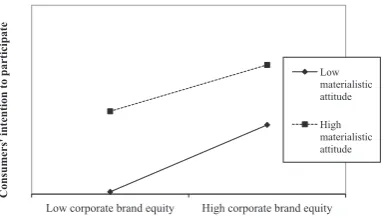
H4: The empirical result points out that interaction effect between materialism and corporate brand equity brings a negative impact on the dependent variable, while corporate brand equity has a positive impact on the dependent variable. This indicates that the moderation effect of materialism changes the direction of corporate brand equity on customers’ intention to donate. Under high materialism, there is a steeper slope that indicates the relationship between corporate brand equity and customers’ intention to donate. This indicates that materialism reduces the impact of corporate brand equity on dependent variable.
In comparison, the impact of corporate brand credibility on customers’ intention to donate is greater than the impact of corporate brand equity. Hence, the moderating impact of materialism on customer trust is nearly similar to corporate brand equity, which reduces the effectiveness of both independent variables (Figure 2).
Implication for research
First, this study confirms the pivotal role of corporate brand equity and brand credibility for the charity program. That the observed companies received donations from their costumers demonstrates an indispensable ally for charity program. The integration between corporate brand and charitative activities implies on a central aspect of both marketing strategy and charity skill. This indicates that fundraising is not a one-time-only event, as these activities make an effort to promote both corporate brand equity and brand credibility.
Figure 1.
Moderating effect of materialistic attitude on brand credibility
Low corporate brand credibility High corporate brand credibility
Consumers' intention
to participate
Low materialistic attitude
High materialistic attitude
Figure 2.
Moderating effect of materialism on brand equity
Low corporate brand equity High corporate brand equity
Consumers' intention
to participate
Low materialistic attitude
High materialistic attitude
H
33,4
492
The result highlights that marketing-by-donation needs to be managed on an ongoing basis like other forms of marketing. This does not only raise a core competency of many humanitarian organizations in which the business organizations may enhance their competitive advantage but also challenging some business ethical issue, informing to customers that the funded charity program allows them to make a better company. This is essential to the top management to gain credibility and sustainability from customers with dynamic preferences.
As the result indicates high materialistic attitude among the customers, business and charity strategies are encouraged to be streamlined more toward organic ethical compliances. Achieving a relationship with customers is necessary to build brand credibility and brand equity, but the organizations are encouraged to report back the social impact. Providing a clear mechanism to encourage customers to get involved in the social project allows them to be excited about their contribution.
Second, a conflict of interest between business orientation and social goals is often due to external forces beyond their control. This study offers supporting evidence that materialistic attitude becomes a key factor in the conflict of interest. Hence, promoting sustainable consumption without encouraging over materialistic attitude may develop trust. To gain support from customers and other donors, corporations are encouraged to make efforts to build the trust. The integration between corporate brand and charitative activities demonstrates a central aspect of both marketing strategy and charity skill. The essential element for customer-donor prioritization strategy raises concern in the marketing ethics.
To deal with the negative impact of materialistic attitude, it is essential to gain social support and acceptance to reduce the need to compensate for poor self-esteem through material goods. Marketing practices are encouraged to promote consumption message without encouraging materialism (Chowdhury and Fernando, 2013). The companies in telecommunication industry are encouraged to manage overwhelmed telemarketing practices, including limiting the number of phone call for charity and doing more to ensure that fundraisers do not take for granted from targeting children, elderly and vulnerable people.
Conscious corporate responsibility insinuates business organization to promote more responsible customer service culture and consumerism ethics. Hence, future researches are encouraged to explore the complex relationship between corporate’s brand credibility and good governments, as brand credibility is also generated through its production ethics, such as compliance of environmental laws, labor laws and tax laws.
Last but not least, this analysis needs to consider the limitation of this study. First, this research relies on a cross-sectional observation, which indicates one snapshoot observation in specific time and specific industry. Hence, future studies are encouraged to concern different contexts and industries. Second, this study uses face-to-face interview to help the respondents understand the questionnaires. Consequently, that may bring about a further bias if the respondents want to make same distinctions in their behaviors. Finally, the study used regression approach, which did not technically identify causality relationship. The future studies are encouraged to focus on an experimental research design where corporate brand equity and materialism are manipulated in various contexts.
Conclusion
This paper makes a contribution to the discussion on both altruistic theory and marketing studies by establishing a critical linkage between corporate brand credibility and consumers’ intention to donate. This study points out that corporate brand is not only relevant for business organizations but also for social activities. This empirical study
How does
materialistic
attitude
in
fl
uence
493
broadly supports the view that role of corporate brand equity and brand credibility in fundraising strategy may decrease because of increasing materialistic attitude. This calls for attention to business organizations to take into consideration the conscious corporate responsibility that business organizations need to understand stakeholder expectations and societal trends. This encourages both companies and third sector organizations to manage their activities toward a positive societal change that delivers the ultimate goal with a broader set of business metrics.
References
Abdullah, N., Mat Derus, A. and Al-Malkawi, N. (2015),“The effectiveness of zakat in alleviating poverty and inequalities: a measurement using a newly developed technique”,Humanomics, Vol. 31 No. 3, pp. 314-329.
Afuah, A. (2013),“Are network effects really all about size? The role of structure and conduct”,
Strategic Management Journal, Vol. 34 No. 3, pp. 257-273.
Agrawal, J., Grimm, P., Kamath, S. and Foscht, T. (2011),“A cross-country study of signals of brand quality”,Journal of Product & Brand Management, Vol. 20 No. 5, pp. 333-342.
Arli, D., Tjiptono, F. and Winit, W. (2015),“Consumer ethics among young consumers in developing countries: a cross national study”,Social Responsibility Journal, Vol. 11 No. 3, pp. 449-466. Axelrod, R., Hammond, R. and Grafen, A. (2004),“Altruism via kin-selection strategies that rely on
arbitrary tags with which they coevolve”,Evolution; International Journal of Organic Evolution, Vol. 58 No. 8, pp. 1833-1838.
Aydin, N. (2016),Moral Economic Axioms, Preference, Choice and Welfare in Conventional and Islamic Economics, University of California, Berkeley, Society for the Advancement of Socio-Economics, available at: https://sase.confex.com/sase/2016am/webprogram/Paper4997.html (accessed 20 October 2016).
Bakar, A., Lee, R. and Hashim, N. (2013),“Parsing religiosity, guilt, and materialism on consumer ethics”,Journal of Islamic Marketing, Vol. 4 No. 3, pp. 232-244.
Baldwin, C. and Henkel, J. (2015), “Modularity and intellectual property protection”, Strategic Management Journal, Vol. 36 No. 11, pp. 1637-1655.
Balmer, J. (2012), “Corporate brand management imperatives: custodianship, credibility, and calibration”,California Management Review, Vol. 54 No. 3, pp. 6-33.
Balmer, J.M. and Chen, W. (2015), “China’s brands, china’s brand development strategies and corporate brand communications in china”,Journal of Brand Management, Vol. 22 No. 3, pp. 175-193.
Bauer, M., Wilkie, J., Kim, J. and Bodenhausen, G. (2012),“Cuing consumerism situational materialism undermines personal and social well-being”,Psychological Science, Vol. 23 No. 5, pp. 517-523. Becker, G.S. (1976),“Altruism, egoism, and geneticfitness: economics and sociobiology”,Journal of
Economic Literature, Vol. 14 No. 3, pp. 817-826.
Belk, R. (1985),“Materialism: Trait aspects of living in the material world”,Journal of Consumer Research, Vol. 12 No. 3, pp. 265-280.
Besiou, M., Pedraza-Martinez, A. and Van Wassenhove, L. (2014), “Vehicle supply chains in humanitarian operations: decentralization, operation mix, and earmarked funding”,Production and Operations Management, Vol. 23 No. 11, pp. 1950-1965.
Bleier, A. and Eisenbeiss, M. (2015),“The importance of trust for personalized online advertising”,
Journal of Retailing, Vol. 91 No. 3, pp. 390-409.
Bruni, L. and Porta, P.L. (2005),Economics and Happiness: Framing the Analysis, Oxford University Press, Oxford.
H
33,4
494
Cakarnis, J. and D’Alessandro, S. (2015),“Does knowing overcome wanting? The impact of consumer knowledge and materialism upon credit card selection with young consumers”, Young Consumers, Vol. 16 No. 1, pp. 50-70.
Chang, H., Tsai, Y.C., Chen, S.H., Huang, G.H. and Tseng, Y. (2015),“Building long-term partnerships by certificate implementation: a social exchange theory perspective”,Journal of Business & Industrial Marketing, Vol. 30 No. 7, pp. 867-879.
Chang, Y. and Ko, Y. (2014),“The brand leadership: scale development and validation”,Journal of Brand Management, Vol. 21 No. 1, pp. 63-80.
Choudhury, M.A. (2016),God Conscious Organization and the Islamic Social Economy, Routledge, London.
Choudhury, M.A. and Noor, H.M. (1997),“A policy-theoretic analysis of sample survey of the mi’kmaq people of cape Breton in the light of knowledge-based world view”,International Journal of Social Economics, Vol. 24 No. 12, pp. 1436-1469.
Chowdhury, R. and Fernando, M. (2013), “The role of spiritual well-being and materialism in determining consumers’ ethical beliefs: an emphirical study with Australian consumers”,
Journal of Business Ethics, Vol. 113 No. 1, pp. 61-79.
Dawson, J. (2014), “Moderation in management research: what, why, when, and how”,Journal of Business and Psychology, Vol. 29 No. 1, pp. 1-19.
Devezer, B., Sprott, D., Spangenberg, E. and Czellar, S. (2014),“Consumer well-being: effect of subgoal failures and goal importance”,Journal of Marketing, Vol. 78 No. 3, pp. 118-134.
Driver, J. (2014),“The history of utilitarianism”, from Stanford Encyclopedia of Philosophy, available at:http://plato.stanford.edu/entries/utilitarianism-history/(accessed 20 October 2016).
Duh, H. (2015),“Testing three materialism life-course theories in South Africa”,International Journal of Emerging Markets, Vol. 10 No. 4, pp. 747-764.
Durvasula, S. and Lysonski, S. (2010),“Money, money, money–how do attitudes toward money impact vanity and materialism? The case of young Chinese consumers”, Journal of Consumer Marketing, Vol. 27 No. 2, pp. 169-179.
Ebert, R. and Griffin, R.W. (2013),Business Essentials, Pearson Education Limited, Essex.
Erdem, T., Swait, J. and Louviere, J. (2002),“The impact of brand credibility on consumer price sensitivity”,International Journal of Research in Marketing, Vol. 19 No. 1, pp. 1-19.
Friedman, M. (2002),Capitalism and Freedom, The University of Chicago, Chicago.
Furnham, A., Treglown, L., Hyde, G. and Trickey, G. (2016),“The bright and dark side of altruism: demographic, personality, traits, and disorder associated with atruism”,Journal of Business Ethics, Vol. 134 No. 3, pp. 359-368.
Ghosh, B.N. (2007),“Understanding gandhian dialectics”,Humanomics, Vol. 23 No. 4, pp. 197-203. Gray, P. (2015),“Russia as a recruited development donor”,The European Journal of Development
Research, Vol. 27 No. 2, pp. 273-288.
Gregory, L.D. (2014),“Fundrising and the elderly: a content analysis”,Journal of Consumer Policy, Vol. 37 No. 1, pp. 5-25.
Hockerts, K. (2015),“The social entrepreneurial antecedents scale (SEAS): a validation study”,Social Enterprise Journal, Vol. 11 No. 3, pp. 260-280.
Holt, D. (2016),“Branding in the age of social media”,Harvard Business Review, Vol. 94 No. 3.
Hsu, K. (2012),“The advertising effects of corporate social responsibility on corporate reputation and brand equity: evidence from the life insurance industry in Taiwan”,Journal of Business Ethics, Vol. 109 No. 2, pp. 189-201.
Hudders, L. and Pandelaere, M. (2012),“The silver lining of materialism: the impact of luxury consumption on subjective well-being”, Journal of Happiness Studies, Vol. 13 No. 3, pp. 411-437.
How does
materialistic
attitude
in
fl
uence
495
Hur, W.M., Kim, H. and Woo, J. (2014), “How CSR leads to corporate brand equity: mediating mechanisms of corporate brand credibility and reputation”,Journal of Business Ethics, Vol. 125 No. 1, pp. 75-86.
Islamic Development Bank (2016),Annual Report 2016, Islamic Development Bank, Jeddah.
Kashif, M., Sarifuddin, S. and Hassan, A. (2015), “Charity donation: intentions and behavior”,
Marketing Intelligence & Planning, Vol. 33 No. 1, pp. 90-102.
Kasser, T., Rosenblum, K., Sameroff, A., Deci, E., Niemiec, C., Ryan, R., Árnadóttir, O., Bond, R., Dittmar, H., Dungan, N. and Hawks, S. (2014), “Changes in materialism, changes in psychological well-being: evidence from three longitudinal studies and an intervention experiment”,Motivation and Emotion, Vol. 38 No. 1, pp. 1-22.
Khalil, E. (2001),“Adam smith and three theories of altruism”,Recherches Économiques De Louvain, Vol. 67 No. 4, pp. 421-435.
Kleber, J., Florack, A. and Chladek, A. (2016),“How to present donations: the moderating role of numeracy in cause-related marketing”, Journal of Consumer Marketing, Vol. 33 No. 3, pp. 153-161.
Koschate-Fischer, N., Cramer, J. and Hoyer, W. (2014),“Moderating effects of the relationship between private label share and store loyalty”,Journal of Marketing, Vol. 78 No. 2, pp. 69-82.
Kwon, S.W. and Adler, P. (2014), “Social capital: maturation of a field of research”,Academy of Management Review, Vol. 39 No. 4, pp. 412-422.
Lamey, L. (2014),“Hard economic times: a dream for discounters”,European Journal of Marketing, Vol. 48 Nos 3/4, pp. 641-656.
Lee, M., Pant, A. and Ali, A. (2010),“Does the individualist consume more? The interplay of ethics and beliefs that governs consumerism across culture”,Journal of Business Ethics, Vol. 93 No. 4, pp. 567-581.
Lee, Y. and Chang, C. (2007),“Who gives what charity? Characteristics affecting donation behaviour”,
Social Behavior and Personality, Vol. 35 No. 9, pp. 1173-1180.
Lin, Y.C. (2013),“Evaluation of co-branded hotels in the Taiwanese market: the role of brand familiarity and brandfit”,International Journal of Contemporary Hospitality Management, Vol. 25 No. 3, pp. 346-364.
Luo, X., Andrews, M., Song, Y. and Aspara, J. (2014),“Group-buying deal popularity”,Journal of Marketing, Vol. 78 No. 2, pp. 20-33.
Mahomedy, A.C. (2013),“Islamic economics: still in search of an identity”,International Journal of Social Economics, Vol. 40 No. 6, pp. 556-578.
Malcolm, L. and Driesener, W. (2016),“Why familiar brands are sometimes harder to remember”,
European Journal of Marketing, Vol. 50 Nos 3/4, pp. 621-638.
Markkula Center for Applied Ethics (2014),“Calculating consequences: the utilitarian approach to ethics”, (S. C. University, Producer), available at: www.scu.edu/ethics/ethics-resources/ethical-decision-making/calculating-consequences-the-utilitarian-approach/(accessed 20 October 2016). Michaelidou, N., Micevski, M. and Siamagka, N.T. (2015),“Consumers’intention to donate to two
children’s charity brands: a comparison of barnardo’s and BBC children in need”,Journal of Product & Brand Management, Vol. 24 No. 2, pp. 134-146.
Monbiot, G. (2013),“Materialism: a system that eats us from the inside out”, The Guardian, available at:
www.theguardian.com/commentisfree/2013/dec/09/materialism-system-eats-us-from-inside-out
(accessed 20 October 2016).
More, G.E. (1903),Principia Ethica, Cambridge University Press, New York, NY.
Mufti, I.K. (2015),“An introduction to the third pillar of Islam, the compulsory charity or zakat, the spiritual dimensions of zakat and charity, and how Islam views money in general”, The Religion of Islam, available at:www.islamreligion.com/articles/46/third-pillar-of-islam/(Retrieved 20 October 2016).
H
33,4
496
Mulat, T. (2009), The Economics of the Invisible Global Good-Governance and the Aid-Dependent Economy, Lulu Press, Raleigh.
Nodari, F., Oliveira, M. and Macada, A. (2016),“Organizational performance through the donation and collection of interorganizational knowledge”,VINE Journal of Information and Knowledge Management Systems, Vol. 46 No. 1, pp. 85-103.
Ogle, J., Hyllegard, K., Yan, R.N. and Littrell, M. (2014),“Segmenting the teen girl apparel market: differences in fashion involvement, materialism and social responsibility”,Young Consumers, Vol. 15 No. 2, pp. 153-166.
Omura, T. and Forster, J. (2014),“Competition for donations and the sustainability of not-for-profit organisations”,Humanomics, Vol. 30 No. 3, pp. 255-274.
Pallota, D. (2009),“Re-thinking charity”,Harvard Business Review, available at:https://hbr.org/2009/05/ rethink-charity(accessed 7 October 2017).
Park, J.K. and John, D. (2011),“More than meets the eye: the influence of implicit and explicit self-esteem on materialism”,Journal of Consumer Psychology, Vol. 21 No. 1, pp. 73-87.
Pieters, R. (2013),“Bidirectional dynamics of materialism and loneliness: not just a vicious cycle”,
Journal of Consumer Research, Vol. 40 No. 4, pp. 615-631.
Pieterse, A.N., Knippenberg, D.V. and Dierendonck, D.V. (2013), “Cultural diversity and team performance: the role of team member goal orientation”,Academy of Management Journal, Vol. 56 No. 3, pp. 782-804.
Podolny, J. (2001), “Networks as the pipes and prisms of the market”, The American Journal of Sociology, Vol. 107 No. 1, pp. 33-60.
Politz, J. (2004). “Reflective equilibrium in rule utilitarianism, (Worcester polytechnic institute)”, Humanities and Arts Course Sequnce, available at: http://cs.brown.edu/joe/docs/ JosephPolitzSufficiency.pdf(accessed 30 October 2016).
Porter, M. and Kramer, M.R. (2002),“The competitive advantage of corporate philanthropy”,Harvard Business Review, available at: https://hbr.org/2002/12/the-competitive-advantage-of-corporate-philanthropy(accessed 7 October 2017).
Powers, E. and Yaros, R. (2013), “Cultivating support for nonprofit news organizations: commitment, trust and donating audiences”,Journal of Communication Management, Vol. 17 No. 2, pp. 157-170.
Richins, M. and Dawson, S. (1992), “A consumer values orientation for materialism and its measurement: scale development and validation”,Journal of Consumer Research, Vol. 19 No. 3, pp. 303-316.
Risselada, H., Verhoef, P. and Bijmolt, T. (2014), “Dynamic effect of social influence and direct marketing on the adoption of high-technology products”,Journal of Marketing, Vol. 78 No. 3, pp. 52-68.
Segev, S., Shoham, A. and Gavish, Y. (2015),“A closer look into the materialism construct: abstract the antecedents and consequences of materialism and its three facets”, Journal of Consumer Marketing, Vol. 32 No. 2, pp. 85-95.
Simpson, A.V., Clegg, S. and Pitsis, T. (2014),“Normal compassion: a framework for compassionate decision making”,Journal of Business Ethics, Vol. 119 No. 4, pp. 473-491.
Sirgy, J., Gurel-Atay, E., Webb, D., Cicic, M., Husic, M., Ekici, A., Herrmann, A., Hegazy, I., Lee, D.J. and Johar, J.S. (2012), “Linking advertising, materialism, and life satisfaction”,Social Indicators Research, Vol. 107 No. 1, pp. 79-101.
Stewart, D., Stewart, C., Moret, T., Chaplin, A. and Gelbmann, A. (2015),“Self-reference effect and consumer brands”,North American Journal of Psychology, Vol. 17 No. 1, pp. 89-103.
Sullivan, J.D. (2009),The Moral Compass of Companies: Business Ethics and Corporate Governance as Anti-Coruption Tools, International Finance Corporation, New York, NY.
How does
materialistic
attitude
in
fl
uence
497
Sun, G., Wang, W., Cheng, Z., Li, J. and Chen, J. (2016),“The intermediate linkage between materilism and luxuxy consumption: evidence from the emerging market of China”, Social Indicators Research, Vol. 132 No. 1, pp. 475-487.
Teo, A.C.Y. and Tan, Y.Y.L. (2013),“The conceptualization of social entrepreneurship by the print media: a content analysis of print media stories published in India and Singapore”,4th EMES International Research Conference on Social Enterprise, Interuniversity Attraction Pole (IAP) on Social Enterprise (SOCENT) and EMES network,Liege.
Torelli, C., Monga, A. and Kaikati, A. (2012), “Doing poorly by doing good: corporate social responsibility and brand concepts”,Journal of Consumer Research, Vol. 88 No. 1, pp. 72-87. Trivers, R. (1971),“The evolution of reciprocal altruism”,Chicago Journals, Vol. 46 No. 1, pp. 35-57. Vaidelyté, E. (2012),“Philanthropy perception in Lithuania: attitudes of civil servants and community
leaders”,Public Policy and Administration, Vol. 11 No. 3, pp. 434-446.
Wayman, T., D’Agostino, H., Liang, A. and Perellis, C. (2012),“Social marketing at a critical turning point”,Journal of Social Marketing, Vol. 2 No. 2, pp. 103-117.
Wetzel, H., Hammerschmidt, M. and Zablah, A. (2014),“Gratitude versus entitlement: a dual process model of the profitability implication of customer prioritization”,Journal of Marketing, Vol. 78 No. 3, pp. 1-19.
Corresponding author
Aluisius Hery Pratono can be contacted at:[email protected]
For instructions on how to order reprints of this article, please visit our website:
www.emeraldgrouppublishing.com/licensing/reprints.htm
Or contact us for further details:[email protected]