The effecT of Bank’s InTernal
facTors Towards MIcro fInancIng
In IslaMIc coMMercIal Bank aT
IndonesIa
Ulfa rizki Utami
Faculty of Islamic Studies, Universitas Muhammadiyah Surakarta
email: [email protected]
aBsTracT
The main driver of Indonesian economic wheel is the small and medium-sized enterprises (SME). This SME plays significant role as well in providing employment opportunity while in the same time adding numbers of business units that support the household income from the business. One of the obstacles faced by SME is the capital and financing constraint, especially for the financing from the bank. Without financing, SME will lose its capability to grow and develop since the main support for SME is the capital and financing itself. This research aims to know the internal factors affecting the third party fund, inflation and the rate of return in the period of 2012-2014 in Islamic commercial banks at Indonesia. The research will carry out the OLS procedure since this technique allows us to know clearly the factors affecting financing in the SME. Our research shows that third party fund significantly affect SME financing with positive sign. Meanwhile, the rate of return is observed to affect negatively to the financing. Inflation also has significant and positive effect with bigger coefficient compared to others in financing for SME.
79
InTrodUcTIon
The free market environment which will be faced by
Indonesia gives impact on the society to shift their current job
towards entrepreneurship. This entrepreneurship could come in
many forms, but most of those businesses are small and
medium-sized enterprise (SME). In general, SME provides better life.
However, capital constraint is the main barrier for people to
establish their own business.
In Indonesia, one of distinguished character from SME can
be observed during the economic crisis shock on 1997-1998
which wipes out almost entire economic sector at that time. Back
at that crisis, SME was able to survive facing the shock compared to other big companies. This SME plays significant role as well in providing employment opportunity while in the same time adding
numbers of business units that support the household income from the business. SME also has flexibility compared to other big companies.
The growth and development is therefore held as important
as SME has important role in boosting economic condition
in a country, including Indonesia. As an illustration, SME
contributes to Indonesia by providing employment absorption up
to 99.74% out of total national absorption. In addition to that,
SME’s contribution for GDP counts for 547 billion Rupiah, or
equal to 56,73% of GDP. Such contribution proves that SME has
very strong ability to boost up and enhance national economic
condition (Prawirokusumo, 2001).
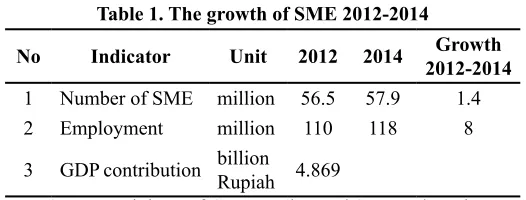
Table 1. The growth of sMe 2012-2014
no Indicator Unit 2012 2014 growth 2012-2014
1 Number of SME million 56.5 57.9 1.4 2 Employment million 110 118 8
3 GDP contribution billion
Rupiah 4.869
Source: Ministry of Co-operation and SME Indonesia
The data above shows that SME in Indonesia witnesses
continuous growing from 2012-2014. This growth is also expected to continue until next following years. This growth is also accompanied with problem faced by SME which according to Winarni (2006), the problem is the insufficient capital.
In the same time, Islamic bank also experiences significant growth from year to year, whether from the financing or deposit side. The financing channeled to SME is also linked tightly to the availability of fund collected by Islamic banks from third party.
The macro variable whether it is inflation of rate of return is the important component that has to be highlighted after the third party fund amount. The rate of return also influences SME since the higher the rate of return for financing, the more it causes reluctance from society which is the SME to use Islamic bank’s profit sharing service when the cost is not equal to profit to be gained by SME. In addition, inflation also affects bank’s decision in channeling the fund.
81 commercial bank. The study also will focus on the period of 2012 until 2014. The factors behind the decision which influence financing towards small and medium-sized enterprises from Islamic commercial bank are worth to be investigated. This is in addition whether term and condition of financing also counts as priority for the SME to undertake any other party financing on its business.
In order to make comprehensive research, this paper will start
with the literature review. Subsequent to the literature review,
some theoretical foundation will be discussed. Afterwards, we will explain the research methodology carried out in this paper for investigating the problem. The result of the research comes next along with the discussion of the result. Many statistical examinations are also arranged within it. Finally, we provide conclusion of the research by acknowledging the limitation of the
research as well as providing some suggestions on the topic.
lITeraTUre reVIew
There have been some researches which focus on the same
topic of our interest. We will sum up those previous researches in
a table model to understand its substance in a quick way. There
are 10 researches that we will show here which started from 2014
up to 2016 to make sure that we obtain the latest research as new
Table 2. compilation of literature review
no. author and
Journal Title Variables results
1 Inflation and BI
Rate on SME
financing (A case
study on Islamic Commercial Bank).
Inflation, BI rate, SME financing
The result shows that both
inflation and BI rate affects significantly towards SME financing.
Third Party Fund, Capital Adequacy Ratio (CAR), Non-Performing Financing and the Rate of return on investment of
SME financing.
Third Party Fund, Capital Adequacy
The result of t-test shows that third party fund has
significant effect on total
fund allocated towards SME. Meanwhile, the F-statistic shows that all variables which are third party fund, capital adequacy ratio (CAR),
non-performing financing, rate of return are significant. The
R-square which is close to the value of 1 shows that the
regression can explain much
of the problem observed.
3
Level of financing
repayment, type
of financing
contract, rate of return, maturity, limit ratio of
financing, type
of collateral, economic sector, type of business body, Z-score ratio
The result shows that
factors which influence the
payment collectability from the customer of Islamic commercial bank are type
of financing contract, rate
of return, economic sector, and the Z-score of that SME. The analysis on internal
and external environment
83
no. author and
Journal Title Variables results
4 Islamic Banks at Indonesia).
SME financing
at Islamic Banks, rate of return,
financing to
deposit ratio,
inflation, GDP.
The result shows based on the statistical evidence, some variables such as rate of
return, inflation as well as GDP does not affect SME financing done by Islamic
banks. Meanwhile, only
financing to deposit ratio which has significant effect on the financing allocation
to the SME by the Islamic Financing on the Development and
The results of this study indicate that the development
of Islamic banking financing in an effort to develop
SMEs in Makassar during
2010-2011 experienced a fluctuating increase. This reflects that the role of Islamic banking financing in
no. author and
Journal Title Variables results
6 Factors in Islamic Banks
The results of regression
analysis finds independent variables for external,
internal and religiosity such
as inflation, Bank Indonesia Islamic Certificate (SBIS), non-perfoming financing
and third party funds have simultaneous and partial
effect on SME financing in
Islamic Banking in Indonesia. The most dominant
regression variable in
influencing SME financing in
Syariah Banking is the
non-performing financing (NPF)
variable.
Volume 5 Issue 9 (2016)
The Impact of Internal and
External Factors
on Financing of Sharia Bank in Indonesia
Bank Indonesia
Islamic Certificate (SBIS), inflation,
third party fund, non-performing
financing, FDR,
ROA.
Based on the result of this research all the variables observed can simultaneously
affect SMEs and non SMEs
conducted by sharia banks.
SME financing is influenced by inflation, deposits, NPF financing, FDR, and non
SMEs. As a result, sharia banking should consider these variables in conducting
SME financing. Non-SME financing is influenced by Inflation, DPK, FDR, and SME financing. Thus, sharia
banking should consider these variables in providing
85
no. author and
Journal Title Variables results
8 small and medium enterperises
financing mode
based on supply
chain finance.
Supply chain
finance, financial crisis, financing
on SME.
Supply chain finance has
advantages in solving SME
financing difficulties. First, it has more flexibility. with
the aid of supply chain strength, upstream and downstream enterprises
can use the flexibility of financing strategy to obtain various forms of financial
support. Second, it helps
direct financing where in
the mode of supply chain
financing, the core enterprise, SME, financial institution
and the third party logistics are a whole. Third, It is easy
to carry out folk financing
since supply chain provides an information sharing platform for bank and SME,
which effectively solves
no. author and
Journal Title Variables results
9
SME in Tanzania play a
significant role in income
generation, job creation and poverty reduction. However,
the sector is facing significant
credit rationing from e formal
financial institutions. As a
result, the sector is highly credit-constrained. The credit
rationing by formal financial institutions is explained
mainly by the mismatch between the requirements of
formal financial institutions’
lending process and structural problems in SME’s business
processes. The existing
mismatch leads to credit market failure in the SME market.
credit crunch : Current financing
Developments during the crisis have shown that banks
significantly reduced their foreign exposures and as ’financial fragmentation’ has
taken hold the countercyclical
effects of internal capital
markets has been working
less efficiently.
daTa and MeThodologY
This study is quantitative research with descriptive
approach. Descriptive statistics in research is basically a process
87 independent variables are the rate of return, third party funds and the rate of inflation. The type of data used in this study is secondary data obtained indirectly from third parties through intermediaries
and various sources available which include, Bank Indonesia, SME
Department and Islamic banking statistics of OJK.
This research will use multiple linear regression analysis
tool which increases the number of free variable into two or more
independent variables. In this study, multiple linear regression analysis is used to determine the relationship and influence level of internal factors towards SME financing in Islamic commercial banks. Before performing multiple regression analysis, this method
requires to test classical assumption to get good result (Ghozali,
2006). The equation of regression is as per following:
PKMt = α+β1DPKt+ β2INFt+ β3TMt+ ut
Where :
PKM : SME financing (billion rupiah) α : Constant variable
β : Coefficient parameter
DPK : Third party fund (billion rupiah) INF : Inflation (%)
TM : Rate of return (%)
u : Error term
resUlT and dIscUssIon
descriptive analysisindividual or legal body. Financing data for SME collected by OJK
as compiled at Islamic Banking Statistics in 2012-2014 can be
shown by the following graph:
graph 1. growth of financing on sMe 2012-2014
Source: Islamic Banking Statistics (processed data)
From the graph above, we can see that at the beginning of 2013 the financing reaches Rp. 92,672 billion up to July 2013 when it reaches Rp. 108,932 billion. Here, the financing for SME gains an increase. It then decreased slightly on August 2013 to
Rp. 104,727 billion rupiahs before it increased again until the end
of 2013 which amounts to Rp. 110,086 billion. Such increase did
not last long since it dropped sharply until the end of 2014 when
it touched merely Rp 60,000 billion.
2. The growth of third party fund
89 compiled the data for this third party fund. The following graph
shows the third party fund statistics from 2012-2014.
graph 2. growth of Third Party fund 2012-2014
Source: Islamic Banking Statistics (processed data)
From the graphic above, we can see that Rp. 147,512 billion financing is recorded until the end of 2012. In the beginning of 2013 the total financing was Rp. 148,731 billion rupiah and keep increasing until the end of 2013. There was only slight decrease
in the early 2014 which touched Rp. 177,930 billion, but then increased again in the next month until the end of year observed amounting to Rp. 217,858 billion rupiah. The decline in the
development of third party funds is not evident in the graph above because the decrease is not significant.
3. Inflation rate
Graph 3. Inflation Rate 2012-2014
Source: Centre Body for Statistics
By observing the year end data from the graphic above, we can see that the lowest inflation rate happened at December 2012 that is 4.30%. In December 2013, the inflation peaked into its higher level at 8.38%. The inflation decreases only slightly in the end of 2014 by 0.02%. From the above table, it is evident that the inflation in 2012 is generally lower compared to other years.
4. Rate of return
Islamic Banking Statistics also has compiled the data for the
change of any rate of return through out the year. The graphic
91
graph 4. rate of return 2012-2014
Source: Islamic Banking Statistics (processed data)
At the of 2012, the rate of return recorded at 8.92%. Coming
into January 2013, it increased by 0.3% into 9.22% while it
decreased into 8.79% at the end of the same year. However,
it recorded the highest increase at the end of 2014 which was 10.86%. The rate of return actually fluctuates in each of the months. However, it seems not to be evident in the graphic since the increase or decrease is insignificant.
estimation result
1. statistical interpretation
As it has mentioned above, we use multiple linear regression
in order to know the relation between the variables. The result of
Table 3. regression result
PKMt= 269081.2 + 0.251143DPKt + 3146.138INFt - 25783.53TMt
(0.0067)* (0.0104)** (0.0000)*
R2 = 0.844232; DW-Stat= 1.307656; F-Stat= 57.81141; Sig.F-Stat= 0.000000
Diagnosis testing
1. Multicollinearity (VIF test)
DPK=4.434988INF=2.478560 TM=2.963089
2. Autocorrelation (Breusch Godfrey test)
x2 (3) = 0.614252 sig(x2) = 0.8932
3. Linearity (Ramsey Reset test)
F( 2, 28) = 1.245321 sig(F) = 0.3033
4. Normality (Jarque Bera test)
x2 = 4.338550 sig(x2) = 0.114260
5. Heteroscadasticity (White test)
x2 (9) = 12.03249 sig(x2) = 0.2115
keterangan : *Signifikan pada α = 0.01; **Signifikan pada α = 0.05; ***Signifikan pada α = 0.10; Angka dalam kurung adalaah probabilitas nilai
t-statistik.
Before explaining the result, we would like to first discuss the diagnosis testing. This is because when regression falls to fulfill the entire classical assumptions, the regression result could be bias or inefficient. First, we find no multicollinearity after conducting VIF test since none of the value exceeds the limit which is 10. The Breush Godfrey test for the autocorrelation
also shows that our regression does not encounter problem of
autocorrelation since the sig(x2) = 0.8932. We also test for the
93 that the regression does not suffer from any heteroscadasticity problem as the value sig(x2) = 0.2115
We also conducted the model examination to know whether the variables as a whole are significant or not by using F-test. Here, the F-stat probability has the value of 0.000000 which means the model is significant or in other word it does exist. Apart from the F-test, we also interested in the result of R2. The R2 value which is
0.844232 shows that almost 85% of the change in the dependent variable (PKM) can be explained by three independent variables we investigate here. Meanwhile, the rest variation is explained by variables outside the model.
Since we are done with all the tests, we can now proceed to the estimation interpretation part. The third party fund affects significantly and positively on the SME financing. The coefficient shows the value of 0.251143 which means any one billion rupiah
increase in third party fund would be associated with the increase of SME financing by 0.251143 billion rupiah while one billion rupiah decrease in third party fund would by associated with the decrease of SME financing by 0.251143 billion rupiah assuming the other variables hold constant.
2. economic interpretation
First, the significant and positive effect of third party fund on the SME financing means that more third party fund is needed. Thus, bank must attract more people to save their money under their custody so that the amount for financing channeled to the SME could increase. Even though the third party fund is not
necessarily meant to be channeled to SME, it at least adds the possibility of such financing. The results of this study conforms what has been done by Nurhidayah and Any Isvandiari (2016) with their publication titled “Internal Factors and External Factors Affecting Allocation of Small and Medium Business Financing (Study on Indonesia Islamic Banks)”. The results showed that third party fund affects SME financing.
Second, inflation has a positive and significant effect on the financing of SME. This means that the relationship between Inflation towards financing of SME is very influential. The increasing rate of inflation in Indonesia will lead to an increase in the amount of funds channeled for the financing of SME. The result here also conform previous study which is done by Sri Delasmi and Deky Anwar (2016) entitled “The Effect of Inflation, BI Rate on Micro and Small Business Financing (Case Study at Sharia Commercial Bank)” that there is a significant influence between the independent variable of inflation on the dependent variable of UMKM financing.
95 This is because from the rate of return determination, the Bank will get advantage when doing financing to customers. However, the result of this study is in the contrast with the research of
Nurhidayah and Any Isvandiari (2016). The t test on margin level variables shows that t value has negative and insignificant value to the allocation of SME financing of Indonesian sharia bank, this indicates that the increase and decrease in the level of financing margin does not affect the allocation of financing to SME.
conclUsIon and sUggesTIon
The regression model in this study has past all the tests to fulfill the classical assumptions on regression. The test includes normality, multicollinearity, autocorrelation, heteroscadasticity and model specification. According to t-test, all variables in the study are significant with both positive and negative signs and various magnitudes. The third party fund affects significantly with positive sign and having the coefficient of 0.251143. In the same time, inflation impacts significantly and positively towards SME financing with the magnitude 3146.138. At the last, rate of return is significant but having negative sign with the coefficient -25783.53. However, we acknowledge that the study here has
limitation in which we only observe from year 2012 until 2014.
Based on these results, some suggestions can be proposed.
First of all, it is important for the government to maintain monetary stability to boost up SME financing. This monetary stability which includes inflation has the effect on SME financing as we have seen above. Secondly, Islamic commercial banks should pay
based on the result of this paper.
reference
Arieffandi, R. Y., Firdaus, M., & Sasongko, H. (2016). Faktor-faktor Yang Mempengaruhi Tingkat Kolektibilitas
Pembiayaan Sektor UMKM (Studi Kasus: Bank Syariah
XYZ Kantor Cabang Jakarta Barat). Jurnal Aplikasi Bisnis
dan Manajemen, Vol. 2 No 3.
Astarini, R. P., Hartoyo, S., & Maulana, T. N. (2015). The Impact of Internal and External Factors on Financing of Sharia Banks in Indonesia. International Journal of Science and
Research, Volume 5 Issue 9.
Aziz, R. M. (2017). Development Of Small Medium Entreprise With External, Internal, And Religiosty Factors In Islamic Banks. KINERJA, 17-34.
Data Inflasi. (2012). Diambil kembali dari Bank Sentral Republik
Indonesia: http://www.bi.go.id/id/moneter/inflasi/data
Data Inflasi. (2013). Diambil kembali dari Bank Sentral Republik
Indonesia: http://www.bi.go.id/id/moneter/inflasi/data
Data Inflasi . (2014). Diambil kembali dari Bank Sentral Republik
Indonesia: http://www.bi.go.id/id/moneter/inflasi/data
Ghozali, I. (2006). Aplikasi Analisis Multivariate Dengan
Program SPSS. Semarang: Badan Penerbit Universitas
Diponegoro.
Irawan, O., Khalil, J., & Amin, A. R. (2016). Dana Pihak Ketiga, Rasio Kecukupan Modal, Pembiayaan Bermasalah, dan
97 Jayanti, S. D., & Anwar, D. (2016). Pengaruh Inflasi dan BI Rate
Terhadap Pembiayaan Usaha Mikro Kecil dan Menengah
(Studi Pada Bank Umum Syariah). I-Economic, vol.2, no 2.
Kara, M. (2013). Konstribusi Pembiayaan Perbankan Syariah
Terhadap Pengembangan Usaha Mikro, Kecil dan
Menengah. Ahkam, Vol XIII, No 2.
Marwa, N. (2014). Micro, Small and Medium Enterprises’ External Financing Challenges : The Role of Formal Financial Institusi and Development Finance Intervention
in Tanzania. International Journal of Trade Economic and
Finance, Vol 5 No 3.
Nurhidayah, & Isvandiari, A. (2016). Faktor Internal dan Eksternal Yang Mempengaruhi Alokasi Pembiayaan Usaha
Kecil Menengah (Studi Pada Bank Syari’ah Indonesia).
Jurnal JIBEKA, 42-48.
Prawirokusumo, S. (2001). Ekonomi Rakyat : Konsep, Kebijakan,
dan Strategi . Yogyakarta: BPFE.
Qi Zhang, H. L., & QI, X. (2014). Research on Small and Medium Enterprise Financing Mode Based on Supply Chain Finance.
Journal of Chemical and Pharmaceutical Research, 6(5) :
1818-1824.
Statistika Perbakan Syariah. (2012). Diambil kembali dari
Otoritas Jasa Keuangan:http://www.ojk.go.id/id/kanal/
syariah/data-dan-statistik/statistik-perbankan-syariah/ default.aspx
Statistika Perbankan Syariah. (2013). Diambil kembali dari
Otoritas Jasa Keuangan:http://www.ojk.go.id/id/kanal/
default.aspx
Statistika Perbakan Syariah. (2014). Diambil kembali dari
Otoritas Jasa Keuangan:http://www.ojk.go.id/id/kanal/
syariah/data-dan-statistik/statistik-perbankan-syariah/ default.aspx
Wehinger, G. (2014). SMEs and the credit crunch : Current Financing difficulties, policy measures and a review of literature. Journal : Financial Market Trends, VOL 2.
Winarni, S. (2006). Strategi Pengembangan Usaha Kecil Melalui
Peningkatan Aksesibilitas Kredit Perbankan. Infokop