INCORPORATING ENTERPRENEURSHIP IN A
PRODUCTION FUNCTION
Sujarwo
1*, Nuhfil Hanani
1 1Lecturer of Agribusiness Study Program, Faculty of Agriculture, Universitas of Brawijaya, Malang
*corresponding author: [email protected]
ABSTRACT: Entrepreneurship is an important factor which influences farmers’ production through the way how the rational farmers decide in allocating their inputs and make effective and efficient decisions facing risk and uncertainty in their production. Regarding this study, the first objective is to determine what is the essential factors can be applied to determine the level of entrepreneurship for the small scale farming production. The second objective is to utilize a fit production function incorporating entrepreneurship in the production function specified. The frontier production function is not fit with the data set; therefore, mean production function is selected for further analysis. Furthermore, the entrepreneurship that affects intercept in the model specified is the fit model with the variation of small-scale shallot production. It means that managerial skill is the most dominance factor in increasing production rather than entrepreneurship, which affects marginal productivity of inputs.
Keywords: entrepreneurship, farmer, production function, technical inefficiency
INTRODUCTION
Production function is observed intensively among the researchers to reveal the producer behavior. It has been developed several approaches starting from mean production function, which neglects the efficiency level among the producers, frontier production function that considers error term decomposition into technical inefficiency and random error (Jondrow et al, 1982), and also risk production function developed extensively by Kumbhakar, 2002. However, rarely do the researchers consider entrepreneurship in production function specification.
Entrepreneur is the most intriguing factor that the existence in real life is trivial but there is not enough convergence definition and boarder among economists related to it. Mainstream microeconomic theory has ignored the existence of entrepreneurship for long time (Baumol 1968).
Economic theory considers that production function and production efficiency measure are based on rationality, competitive market, and profit maximization assumptions. Based on those conditions, there is no space for entrepreneur in neoclassical economic theory (Hughes 1986; Casson 2003; Amanor-Boadu 2006; Grebel, Pyka, Hanusch 2003; Rocha 2012). Those assumptions led to homogenous production processes and
homogenous products in the market as implication of the same decision making process in allocating resources among producers because the perfect information available could be accessed. No one will have incentive to exploit opportunity and static equilibrium in the market will occur. Furthermore, assuming that there is a competitive market; then, global optimum decision making for inputs allocation and production can be obtained. In this way, explicit optimum solution mathematically can be found in the convex set and concave function of economic modeling.
In fact, many problems in the markets hamper fulfilling the assumption of perfect information and competitive market in the theoretical view. This implies that there is opportunity available to be exploited due to imperfect information that influences the decision-making among agents in the market. The agents who have the quality in exploiting such market opportunity are called entrepreneurs. From this point, entrepreneurship becomes an essential concept that influences not only the way how the producers decide to allocate their inputs and the level of production expected but also how the market works.
Sujarwo dan Nuhfil Hanani
Agricultural Socio-Economics Journal Volume XVI, Number 02 (2016): 79-86
80
introduced entrepreneurship which is known today. He addressed entrepreneur as risk taker that play important role in equilibrating supply and demand in the market. It means that production which generates supply in the market in the uncertain
condition and the Walras’ system of equilibrium of the markets cannot be reached instantly by the market.
Cantillon (1755) defined entrepreneur as arbitrageur and Schultz (1975) characterized entrepreneur as ability to deal with disequilibrium situation and acts according to it to get higher satisfaction. Kirzner (1997) and Schumpeter (1989) identified entrepreneur from the opposite direction. Kirzner views that entrepreneur is ability to exploit opportunities in the markets. It happens due to disequilibrium in the markets. On the contrary, Schumpeter points out the role of innovation as a creative destruction, which is destruction of equilibrium markets.
According to Bula (2012), the Schultz approach of entrepreneurship deals more in the ability to handle such disequilibrium in the markets. Schultz (1975) argued that entrepreneurship exists in every economic agent with different degrees of entrepreneurial ability in utilizing opportunities for gaining higher satisfaction; however, the responses to the opportunities are not instant in nature. Those take producer with traditional setting tends to obtain optimum level when there is enough time to adjust the changing and also responses the price changing in the market appropriately.
Kirzner and Schumpeter concern in neoclassical assumption regarding Walras general equilibrium theory that markets in the circular flow are always in the equilibrium and input production is paid exactly as what its marginal productivity is. According to Kirzner, equilibrium theory did not consider market process in how such equilibrium exists in the market. Kirzner argued that there is a dynamic market that causes disequilibrium. In the disequilibrium market exists opportunity as an incentive and alert for entrepreneur to obtain the gain from disequilibrium in the market. Each agent attempts to conjecture iteratively the changing regarding the opportunity available.
Entrepreneurs play important role in the market process starting from disequilibrium toward
equilibrium market economy. The equilibrium can be achieved since there are flow of information and the possibility for new entrant to come to the market exploiting together the market opportunity. Of course, it is the nature of the game in the market that extra profit in the market can attract new entrant to come and reducing the extra profit limit to zero. In that senses the economic activities in the market will converge to equilibrium.
Schumpeter and Kirzner view of entrepreneurship are in the opposite direction. Schumpeter introduced entrepreneurship as a critical factor that destructs market equilibrium through innovation (equilibrium destruction theory). Entrepreneurs constantly get out from ordinary way of production or thinking and try to entrepreneurship are totally in opposite direction but those really complete the phenomena in the real world. Equilibrium can be destructed by entrepreneur and the disequilibrium is also highly possible moving toward equilibrium due to the same reason which is entrepreneurship.
In the theoretical point of view, neoclassical theory does not give any space for entrepreneurship because there are extreme assumptions deployed related to perfect competition and perfect information available in the market. These assumptions imply that there is a static equilibrium in the market and no chance for an agent exploiting market opportunity (Baumol 1968; Montanye 2006).
In this paper, we utilize the Kirzner’s view
be specified incorporating entrepreneurship in order to count the magnitude and the statistically significance of entrepreneurship coefficients.
David Kahan (2013) in his paper of farm management extension guide promoted the explanation related to entrepreneur in farming. It has broadly portrayed that farmer as an entrepreneur is a farmer that has passion in farm businesses and willing to calculate the risk in order to get the best possible result of his/her businesses. He also noted that a farmer as an entrepreneur acquires ability to operate his/her business in the complex and dynamic environment. The capacity to switch challenges into opportunities and weaknesses into strengths are some of the quality required to survive in the market and those are part of the qualities owned by entrepreneur.
Agriculture sector is risky business and has some weaknesses in their production process and also weaknesses that embodied in the agricultural products and also agricultural market performance (Kohls and Uhl, 2002). We can picture that production of agricultural product are seasonal and annual variability in production, very much depending on weather and biological processes, and farmer cannot control over the product of their production as the non-agricultural production. Moreover, the characteristics of bulky and perishable, a raw material, and the quality variation are among the weaknesses of agricultural products. The weaknesses of market performance of agricultural products are inability to adjust quickly the market changing, asymmetric information, and imbalance bargaining position of producer and buyer in the market.
In the risk and uncertainty of agricultural businesses, entrepreneurship has a strategic role to not only survive in such environment but also change those challenges into opportunity. As defined by Wolf and Schoorlemmer (2007) that an entrepreneurial farmer is a person who has capacity to create and develop their farm business into profitable business and to change the business environment. Therefore, profit can be one of the ultimate goals of entrepreneurs.
The main objectives of this paper are to contribute identifying entrepreneurship measure and to construct econometric modeling in production economic incorporating entrepreneurship.
RESEARCH METHODS
According to Coelli (2005), production functions which are widely used in production economic theory are developed based on four properties which are negativity, weak essentiality, non-decreasing in input, and concave in input. Furthermore, monotonicity of production function property is possible to be relaxed in case of input congestion.
Suppose we have production function of one output and N inputs as follows
( ) ( )
Satisfying those properties in the production function will fulfill assumption of rationality. It means we will find production function in where producer works in the economically feasible region of production. Furthermore, satisfying the fourth property will assure concavity, which implies all marginal input productivities are non-increasing. In turn, we fulfill the law of diminishing marginal productivity.
The development of production function is started from estimating mean production function
which assumes that the residuals ε ~ N(0,σ^2).
Residual of the estimation is the factor that cannot be explained by input considered. Furthermore, the residuals constitute the factor of uncertainty and the failure in production management due to interaction between production activities and the state of nature of the production at the given time.
Further development of production function, which has been developed and widely used in production research is stochastic frontier production function. Jondrow et al. (1982) successfully developed this approach by decomposing residual into systematic error (u) and random error(v). The systematic error is called technical inefficiency and the random error is considered as unexplained factors that affect production.
Framework of Entreprenuer Measure
Sujarwo dan Nuhfil Hanani
Agricultural Socio-Economics Journal Volume XVI, Number 02 (2016): 79-86
82
entrepreneurship concept in economic research. They emphasize different angle of entrepreneurship but the most common characteristics proposed are the capacity of person to create added value regarding economic resources use. This in turn generates extra profit for the entrepreneurs, pushes competitiveness and the dynamic of economic capacity and activities along the time.
Miller (1983) has developed a measurement of entrepreneurship score, which was called entrepreneurial orientation (EO) score. He considered specific characteristics such as propensity to take risks, attitude on innovation, and pro-activeness in their business activities. The further development of this measurement also has been conducted by Covin and Slevin (1988). They enriched the factor considered by adding some qualities of growth orientation and competitive aggressiveness (Hortovanyi, 2009).
Kahan (2013) identified that successful farmer entrepreneurs can be viewed through several competencies such as technical competencies, managerial competencies, and entrepreneurial competencies. Those are required in order to handle their businesses moving forward toward enterprise development. Furthermore, the entrepreneurial characteristics are depicted as having confidence in risk taking, self-confidence, flexibility (flexible, adaptive, opportunity seeker), core values (trustworthy and honest), problem solver (creative, innovative, and be able to learn from failure), inspiring (highly motivated, high energy, determined, persevering), and competitive (goal driven). As farmer entrepreneurs, they personally
can be seen from their knowledge, skill, and behavior in handling their farm businesses. Singh (2013) attempted to depict farmer entrepreneur using 12 indicators. There are market oriented, high need for achievement, self-criticism, creativity, leadership, perseverance, flexibility, empathy, initiative, inspired, passiveness, and laziness.
The basic idea of this paper regarding entrepreneurship measure is that combining the entrepreneurship characteristics based on the theoretical point of view and the empirical view from previous researcher. Kahan (2013) was classify clearly how the entrepreneurship should be viewed which is from the knowledge, the skill, and the behavior of the farmer. Final destination of all those measurement is profitability of the farm business. It is because all of the qualities have to be observed as entrepreneur will end up into profit of the farm business that that has been running for long time.
Production Function Incorporating Entrepreneurship
Assuming that all inputs are important and satisfying the law of diminishing marginal productivity; then the functional form can be specified as following:
( ) ∏
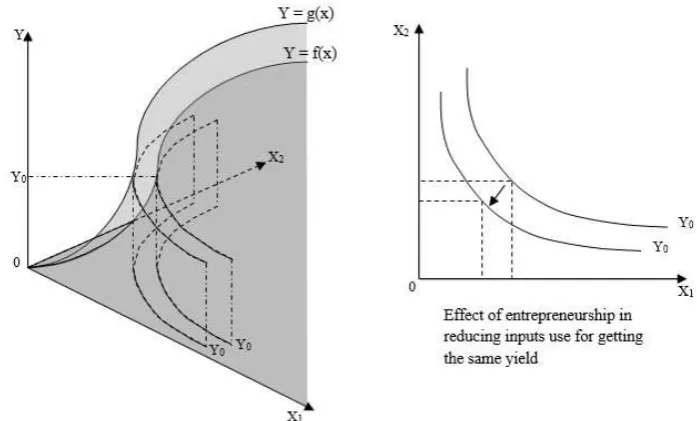
This specification above can be represented as graph below.
It is also possible to consider model specification of production function incorporating entrepreneurship by the following form Model specification:
( ) ∑
∑
( )
( ) ∏
In this form, equation (4), the entrepreneurship measures affect input productivity and the graph for explaining this specification as follows:
Figure 2. The effect of entrepreneurship to the input productivity
Data Used
This paper uses the data from survey of small scale shallot farming in Nganjuk Regency, East Java Province, Indonesia. The data has been collected in 2005. The data are obtained from 36 shallot
farmers. The data are relatively out of date, but this paper emphasizes on the application of econometric production function specification incorporating entrepreneurship on it.
Entrepreneur measure is derived from the outcome of the knowledge, skill, and behavior of the farmers in generating income for their shallot production. The higher entrepreneurship score is represented by the higher profit can be obtained by the farmers. This approach is relatively fit for the small scale shallot farming since the shallot production has been run by the farmers for more than 15 years. Based on this fact, we argue that farmers have a certain level of knowledge, technical and managerial skill in shallot production, and have a relatively formed behavior for decision making in their allocation of inputs and selling their shallot commodity. Those integrated entrepreneur qualities in turn determine how much the profit will be earned by each farmer. Therefore, profit measure can be used to approximate the level of entrepreneurship for this case.
We use actual profit obtained by farmers as the basic measurement and those will be transformed to the entrepreneurship level by this formula:
( )
Where is the actual profit of farmer-i, is the minimum profit obtained by the farmer in the data set, and is the maximum profit obtained by the farmer in the data set.
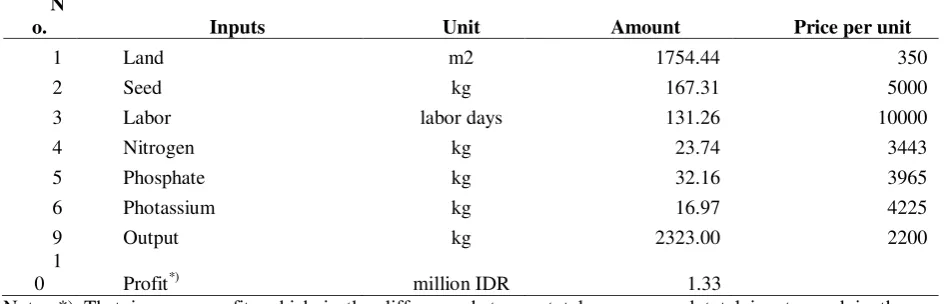
The descriptive data of the shallot farmers can be shown in Table 1 as below.
Table 1. Descriptive statistics of small scale shallot production in Nganjuk Regency, East-Java, Indonesia N
o. Inputs Unit Amount Price per unit
1 Land m2 1754.44 350
2 Seed kg 167.31 5000
3 Labor labor days 131.26 10000
4 Nitrogen kg 23.74 3443
5 Phosphate kg 32.16 3965
6 Photassium kg 16.97 4225
9 Output kg 2323.00 2200
1
0 Profit*) million IDR 1.33
Agricultural Socio-Economics Journal P-ISSN: 1412-1425 | E-ISSN: 2252-6757 Volume XVI, Number 02 (2016): 79-86
RESULTS AND DISCUSSION
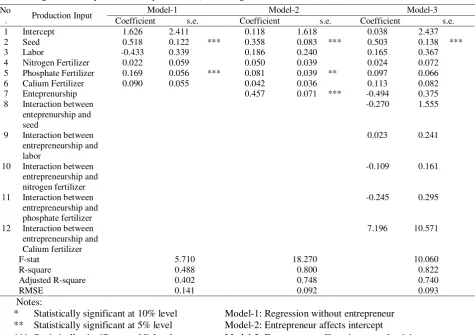
Considering entrepreneurship as defined in the methodology, the double-log production function incorporating entrepreneurship in model-2 (affecting intercept) could define the variation of small scale shallot production quite well. Assuming that entrepreneurship as exogenous variable derived from profit obtained by shallot farmer, the model-2 is the fit model explaining the behavior of the data set collected. Technical inefficiency cannot be found in this data set; therefore, only mean production function is estimated (Table 2).
Several reasons of model-2 as selected model among others are (1) the model satisfies the law of diminishing marginal productivity of input as required in the production function. This implies that rationality assumption of producer is also fulfilled; (2) the model can explain about 75% variation of the shallot production. It means that there is about 25% of other factors affecting the variation of shallot production; (3) the model has the lowest root of mean square error (RMSE) which indicate better accuracy in prediction among others.
Table 2. Regression analysis of shallot production (double-log functional form) No
. Production Input
Model-1 Model-2 Model-3
Coefficient s.e. Coefficient s.e. Coefficient s.e.
1 Intercept 1.626 2.411 0.118 1.618 0.038 2.437
2 Seed 0.518 0.122 *** 0.358 0.083 *** 0.503 0.138 ***
3 Labor -0.433 0.339 0.186 0.240 0.165 0.367
4 Nitrogen Fertilizer 0.022 0.059 0.050 0.039 0.024 0.072
5 Phosphate Fertilizer 0.169 0.056 *** 0.081 0.039 ** 0.097 0.066
6 Calium Fertilizer 0.090 0.055 0.042 0.036 0.113 0.082
7 Enteprenurship 0.457 0.071 *** -0.494 0.375
8 Interaction between enteprenurship and seed
-0.270 1.555
9 Interaction between entrepreneurship and labor
0.023 0.241
10 Interaction between entrepreneurship and nitrogen fertilizer
-0.109 0.161
11 Interaction between entrepreneurship and phosphate fertilizer
-0.245 0.295
12 Interaction between entrepreneurship and Calium fertilizer
7.196 10.571
F-stat 5.710 18.270 10.060
R-square 0.488 0.800 0.822
Adjusted R-square 0.402 0.748 0.740
RMSE 0.141 0.092 0.093
Notes:
* Statistically significant at 10% level Model-1: Regression without entrepreneur ** Statistically significant at 5% level Model-2: Entrepreneur affects intercept
*** Statistically significant at 1% level Model-3: Entrepreneur affects input productivity
Model-2 represents the effect of entrepreneurship level in how an entrepreneur that has a better managerial skill is capable to increase output of production using the same amount and quality of inputs. 2 is preferred over Model-1 and Model-3 since those have lower determination coefficient and lower number of significant inputs.
The Model-3 specifically is specified making an allowance for interaction between
Considering Model-2, coefficient of entrepreneur is not only higher in term of magnitude but also statistically very significant. The inputs considered significant at 5% significant level are seed and phosphate.
Phosphate and seed are essensial for shallot production. Seed is the input, which has the higher effect on production of shallot comparing with other physical inputs. The coefficient of seed is 0.358, which means that increasing 1% of seed will increase 0.358% of shallot production. On the other hand, increasing 1% of entrepreneur capability in the shallot farmers will raise higher, comparing to the effect of seed, which is 0.457%.
Labor does not have significant effect on shallot production. The plausible reasons to support this finding is that labor productivity in each farmer is so differently regarding the ability of the hired
Entrepreneurship is essential aspect in farming
system. That deeply influences the farmer’s capacity in organizing and managing farmers’
resources in order to survive and develop their farm businesses.
Entrepreneurship also assures the sustainability of long term production in agriculture because through the entrepreneurship characteristics such as innovation, creativity, eagerness to develop their business, ability to adapt such uncertainty and risky environments and making any decisions accordingly will really support the farmers moving forward and find new opportunities and exploit them. As a result, the farmer entrepreneur will generate better profit in their production.
REFERENCES
Amanor-Boadu, V. (2006). Putting Entrepreneurship into Agricultural Economics: Research and Teaching Perspectives-Discussion. Journal of Agricultural and Applied Economics, 38(2), 441.
Baumol, W. J. (1968). Entrepreneurship in economic theory. The American economic review, 64-71.
Cantillon, Richard. (1755). Essai Sur La Nature Du Commerce en General. London: Gyles.
Casson, Mark. (2003). The Entrepreneur: An Economic Theory. 2d ed. Cheltenham, UK: Edward Elgar.
Coelli, T. J., Rao, D. S. P., O'Donnell, C. J., & Battese, G. E. (2005). An Introduction to Efficiency and Productivity Analysis. Springer.
Covin, J. G., & Slevin, D. P. (1988). The influence of organization structure on the utility of an entrepreneurial top management style. Journal of management studies, 25(3), 217-234.
Grebel, T., Pyka, A., & Hanusch, H. (2003). An evolutionary approach to the theory of entrepreneurship. Industry and innovation, 10(4), 493-514.
Hannah Orwah Bula. (2012). Evolution and Theories of Entrepreneurship: a critical review on the Kenyan Perspective. International Journal of Business and Commerce. Vol. 1, No. 11. Asian Society of Business and Commerce Research
Hortovanyi, L. (2009). entrepreneurial management in Hungarian SMEs. Unpublished doctoral Thesis, Corvinus university of Budapest.
Hughes, J. (1986). The vital few: The entrepreneur and American economic progress. Oxford University Press.
Jondrow, J., L. Knox, I. Materov, and P. Schmidt, (1982). On the Estimation of Technical Inefficiency in the Stochastic Frontier Production Function Model. Journal of Econometrics, 19(2): 233-238.
Kahan, D. (2013). The role of the farm management specialist in extension. Food and Agriculture Organization of the United Nations.
Kirzner, Israel M. (1997). “Entrepreneurial Discovery and the Competitive Market
Process: An Austrian Approach,” Journal
of Economic Literature 35: 60-85.
Montanye, J. A. (2006). Entrepreneurship. The Independent Review, 10 (4), 547-569. Retrieved April, 13, 2006.
Sujarwo dan Nuhfil Hanani
Agricultural Socio-Economics Journal Volume XVI, Number 02 (2016): 79-86
86
Agriculture, 2007 (eds) (www.esofarmers.org)
Rocha, V. C. (2012). The entrepreneur in economic theory: from an invisible man toward a new research field (No. 459). Universidade do Porto, Faculdade de Economia do Porto.
Schultz, T. W. (1975). The value of the ability to deal with disequilibria. Journal of economic literature, 827-846.
Schumpeter, Joseph. (1989). “Economic Theory
and Entrepreneurial History.” Reprinted
from Change and the Entrepreneur. Cambridge: Harvard University Press, 1949. In Essays On Entrepreneurs, Innovations, Business Cycles, and the Evolution of Capitalism, edited by Richard Clemence. New Brunswick: Transaction Publishers.