This series brings together titles dealing with a variety of aspects of language acquisition and processing in situations where a language or languages other than the native language is involved. Second language is thus interpreted in its broadest possible sense. The volumes included in the series all offer in their different ways, on the one hand, exposition and discussion of empirical fi ndings and, on the other, some degree of theoretical refl ection. In this latter connection, no particular theoretical stance is privileged in the series; nor is any relevant perspective – sociolinguistic, psycholinguistic, neurolinguistic, etc. – deemed out of place. The intended readership of the series includes fi nal-year undergraduates working on second language acquisition projects, postgraduate students involved in second language acquisition research, and researchers and teachers in general whose interests include a second language acquisition component.
Series Editor:
David Singleton
Writing in Foreign Language
Contexts
Learning, Teaching, and Research
Edited by
Rosa M. Manchón
Library of Congress Cataloging in Publication Data
A catalog record for this book is available from the Library of Congress.
Writing in Foreign Language Contexts: Learning, Teaching, and Research/Edited by Rosa Manchon.
Second Language Acquisition: 43
Includes bibliographical references and index.
1. Language and languages–Study and teaching. 2. Rhetoric–Study and teaching. 3. Second language acquisition. I. Manchón, Rosa.
P53.27.W75 2009
808’.0071–dc22 2009017380
British Library Cataloguing in Publication Data
A catalogue entry for this book is available from the British Library.
ISBN-13: 978-1-84769-184-2 (hbk) ISBN-13: 978-1-84769-183-5 (pbk)
Multilingual Matters
UK: St Nicholas House, 31–34 High Street, Bristol BS1 2AW. USA: UTP, 2250 Military Road, Tonawanda, NY 14150, USA.
Canada: UTP, 5201 Dufferin Street, North York, Ontario M3H 5T8, Canada. Copyright © 2009 Rosa M. Manchón and the authors of individual chapters.
All rights reserved. No part of this work may be reproduced in any form or by any means without permission in writing from the publisher.
The policy of Multilingual Matters/Channel View Publications is to use papers that are natural, renewable and recyclable products, made from wood grown in sustainable forests. In the manufacturing process of our books, and to further support our policy, preference is given to printers that have FSC and PEFC Chain of Custody certifi cation. The FSC and/or PEFC logos will appear on those books where full certifi cation has been granted to the printer concerned.
Typeset by Datapage International Ltd.
Contributors . . . .vii Acknowledgements . . . xi Preface . . . xiii
Introduction: Broadening the Perspective of L2 Writing Scholarship: The Contribution of Research on Foreign Language Writing
Rosa M. Mancho´n. . . 1
Part 1: Looking Back. Research Insights
1 Situated Writing Practices in Foreign Language Settings: The Role of Previous Experience and Instruction
Carol Rinnert and Hiroe Kobayashi. . . 23 2 Changes in English as a Foreign Language Students’
Writing Over 3.5 years: A Sociocognitive Account
Miyuki Sasaki. . . 49 3 Towards a Blueprint of the Foreign Language Writer:
The Linguistic and Cognitive Demands of Foreign Language Writing
Rob Schoonen, Patrick Snellings, Marie Stevenson
and Amos van Gelderen. . . 77 4 The Temporal Dimension and Problem-solving
Nature of Foreign Language Composing Processes. Implications for Theory
Rosa M. Mancho´n, Julio Roca De Larios and Liz Murphy. . . 102 5 Age-related Differences and Associated Factors in
Foreign Language Writing. Implications for L2 Writing Theory and School Curricula
M. Luz Celaya and Teresa Nave´s. . . 130 6 The Globalization of Scholarship: Studying Chinese
Scholars Writing for International Publication
John Flowerdew and Yongyan Li. . . 156
7 A Critical Evaluation of Writing Teaching Programmes in Different Foreign Language Settings
Melinda Reichelt. . . 183
Part 2: Looking Ahead. Issues in Theory, Research and Pedagogy
8 The Contribution of Studies of Foreign Language Writing to Research, Theories and Policies
Alister Cumming. . . 209 9 Studying Writing Across EFL Contexts:
Looking Back and Moving Forward
Lourdes Ortega. . . 232 10 Training for Writing or Training for Reality? Challenges
Facing EFL Writing Teachers and Students in Language Teacher Education Programs
Christine Pearson Casanave . . . 256
Part 3: Coda
11 Bibliography of Sources on Foreign Language Writing
Melinda Reichelt. . . 281
Christine Pearson Casanave taught full time at a Japanese university from 1990 to 2003 and part time most of those years at Teachers College, Columbia University’s Japan campus in their MATESOL program. Between 2004 and 2007 she was affiliated with Temple University’s Japan Campus, where she taught masters and doctoral students during fall semesters. She continues advising Temple doctoral students online from her home in California. Her speciality is issues in academic literacy.
M. Luz Celaya is Associate Professor in Applied Linguistics in the
English and German Department at the University of Barcelona. Her main interests are the development of written production in EFL and the age factor, cross-linguistic influence and syntactic development in multilingual learners. She is the coordinator of the Masters ‘Applied Linguistics and Language Acquisition in Multilingual Contexts’ at her university and a member of the GRAL team that carried out the BAF project.
Alister Cummingis Professor and Head of the Modern Language Center
at the Ontario Institute for Studies in Education, University of Toronto. He conducts research and teaches graduate courses on writing in second and foreign languages, language assessment, language policies and research methods. He is Executive Director of the journal Language Learning, as well as being on the editorial boards of numerous journals in applied linguistics and education.
John Flowerdew is a Professor in the Centre for Language Education
Research, School of Education, University of Leeds, UK. As well as writing and editing a number of books, including four edited collections on academic discourse, he has published widely in the leading Applied Linguistics, Language Teaching and Discourse Analysis journals, focus-ing on academic and political discourse, His most recent edited book (with Vijay Bhatia and Rodney Jones) is Advances in Discourse Studies (Routledge, 2008).
Hiroe Kobayashi, Professor of English at Hiroshima University, earned her doctorate in TESOL at Teachers College, Colombia University. She teaches EFL, writing and pragmatics, and has taught ESL in the United States and the Philippines. Her primary interest is in development of L2 writing ability, including analysis of L1/L2 textual features and bidirectionality of transfer. She has published articles in Language Learning and the Journal of Second Language Writing, co-authored with Carol Rinnert.
Yongyan Liis currently a researcher at the City University of Hong Kong
and a visiting scholar at the Centre of Asian Studies of the University of Hong Kong. She has published widely on the problems of Chinese scholars writing for publication in English and her work has appeared in journals such as TESOL Quarterly, Journal of Second Language Writing, English for Specific PurposesandAsian Journal of English Language Teaching.
Rosa M. Mancho´n is Associate Professor of Applied Linguistics,
University of Murcia. Her research interests include the sociocognitive dimension of second language acquisition, particularly second language writing processes and research methods. Her work has appeared in leading Applied Linguistics and Second Language Writing journals such as IRAL,Journal of Second Language Writing,Language Learning, Learning and Instructionand theModern Language Journal. Together with Ilona Leki, she edits theJournal of Second Language Writing.
Liz Murphyis Assistant Professor in the English Department, University
of Murcia (Spain), where she teaches Academic Writing. Together with Julio Roca and Rosa Mancho´n she has published articles on foreign language writing processes in international journals includingLanguage Learning, the Modern Language Journal, Learning and Instruction and the Journal of Second Language Writing. Her own particular research interest centres on the uses of the mother tongue in foreign language writing.
Teresa Nave´s is Assistant Professor in Applied Linguistics at the
Lourdes Ortegais Associate Professor of Second Language Studies at the University of Hawai’i at Manoa. Her research interests include instructed SLA, tasks and interlanguage development, L2 writing, foreign language education, and research methods. Recent books areSynthesizing Research on Language Learning and Teaching(co-edited with John Norris; Benjamins, 2006), The Longitudinal Study of Advanced L2 Capacities (co-edited with Heidi Byrnes; Routledge, 2008) and Understanding Second Language Acquisition (Hodder Arnold, 2009).
Melinda Reichelt is Professor of English at the University of Toledo,
where she coordinates the ESL writing program and teaches courses in TESOL and linguistics. Her research and publications focus on second language writing, including the role of English and English language teaching in Europe. Her work has appeared in journals such as the Journal of Second Language Writing,Composition Studies,Issues in Writing, theModern Language JournalandForeign Language Annals.
Carol Rinnert, Professor of International Studies, Hiroshima City
University, earned her doctorate in linguistics at SUNY/Buffalo. She teaches sociolinguistics and English debate and writing, and has taught ESL/EFL in the USA and Yemen. Her research interests include comparative analysis of Japanese/English written and spoken discourse and development of L2 academic writing and pragmatic competence. She has published articles in the Journal of Pragmatics and the Modern Language Journal, co-authored with Hiroe Kobayashi.
Julio Roca de Larios is Associate Professor at the University of Murcia,
Spain, where he works in initial EFL teacher education. His research interests include the analysis of writing processes, classroom interaction processes and the development of appropriate tools and strategies to foster reflective practice among student teachers. His work on foreign language writing has appeared inLanguage Learning,the Modern Language Journal, Learning and Instruction and the Journal of Second Language Writing.
Miyuki Sasakiis Professor in the Faculty of Foreign Studies at Nagoya
Applied Linguistics from the University of California, Los Angeles. She is currently interested in the longitudinal development of L2 writing ability and motivation, as well as method factors in L2 testing.
Rob Schoonen is Associate Professor at the Amsterdam Center for
Language and Communication, Faculty of Humanities of the University of Amsterdam. His main research interests are second and foreign language acquisition, psycholinguistics, research methodology and language testing, especially in relation to vocabulary knowledge and writing proficiency.
Patrick Snellings is Assistant Professor in the School of Psychology,
Department of Psychology at the University of Amsterdam. His research interests include learning disabilities such as developmental dyslexia, (second) language acquisition, cognitive development, skill acquisition and school-based interventions.
Marie Stevensonlectures in applied linguistics and language education
at the University of Sydney. Her main areas of research are second language reading and writing processes, and she has published in these areas in various international journals. She is a member of the TESOL Research Network.
Amos van Gelderen is Senior Researcher at the SCO-Kohnstamm
All edited books are the result of a collective enterprise. This one has been so in very special ways and I would like to express my sincere gratitude to all the contributors for helping me shape the vision I had for our joint endeavour and for making the book a reality. I would also like to thank them for their diligence in writing and repeatedly rewriting their chapters, for always keeping to deadlines and for their generosity in reviewing each other’s chapters. My sincere gratitude also goes to Ilona Leki for having accepted to write the Preface.
I am also grateful to the anonymous reviewer who read an earlier version of the manuscript and who helped us all to improve our chapters and the book as a whole. I wish to express my appreciation of the help and support by Multilingual Matters: the series editor David Singleton, Marjukka Grover, Tommi Grover, Anna Roderick, Sarah Williams and Elinor Robertson have all helped in different ways in the completion of this publishing project.
Lastly, my heartfelt thanks to my family, Chris, Laura, Beatriz and Helena, for their sustained, sincere and loving support and encourage-ment in all the projects I decide to undertake.
As language scholars, teachers and learners around the world increas-ingly focus their attention on issues related to writing in a second language (SL), the publication of Writing in Foreign Language Contexts: Learning, Teaching, and Researchis a much needed and welcome bracer for L2 writing research. It firmly reminds us that L2 writing does not take place only in SL contexts, that is, where the target language is widely used outside the classroom. Far greater numbers of L2 writers reside, learn and write in foreign language (FL) environments. Ignoring the research contributions that come out of these contexts and failing to consider writing practices in FL settings badly distorts our under-standing of L2 writing.
Writing in Foreign Language Contexts: Learning, Teaching, and Researchis unique in its focus on FL writing, and that focus alone would make the collection an important contribution to the field of L2 writing research. But this volume is not the average edited collection with disparate and uneven contributions, some aimed too narrowly, some too broadly. Instead Writing in Foreign Language Contexts: Learning, Teaching, and Researchis an unusually coherent, thorough and rigorous examination of research on FL writing. Rosa Mancho´n’s fine editorial guidance is evident in the careful organization of the chapters of the text. Each chapter of the two main sections follows similar, though by no means monotonous or lockstep, patterns. In each chapter of the first section, the authors begin by retrospectively re-examining their own repertoire of research studies on FL writing (covering a variety of FL settings and learner proficiencies, ages and uses for L2 writing), then trace the methodological choices that guided that body of work, and, finally, use that contextualization to foreground their more recent studies or reflections. Readers will find the flexible regularity of this ‘looking back, moving forward’ approach innovative and helpful in drawing attention to the important trends and main findings of the high quality research on FL writing clearly and yet succinctly highlighted here.
A particularly innovative feature of Writing in Foreign Language Contexts: Learning, Teaching, and Research is the unique window it
provides into the thinking processes of the researchers. Because the individual pieces of research discussed were often a part of long-term research projects (whether initiated that way or not), we are afforded insights not only into the kinds of methods that the researchers used, but also into their decision-making as each segment of the project yielded information that led the researchers toward the next methodologically appropriate step.
The chapters of the second part ofWriting in Foreign Language Contexts: Learning, Teaching, and Researchare broader reflections on and analyses of the findings of the first part, critically and imaginatively reshuffling them to bring out further perspectives made possible by this juxtapositioning. The authors’ frequent references to the other chapters throughout the book contribute to a sense of unity without the artificiality that some-times plagues this rhetorical move in other texts. The annotated and unannotated bibliography of the last section contributes a final piece that L2 writing scholars and students alike will find themselves turning to repeatedly.
Although language professionals and applied linguists have long noted the distinction between SL and FL learning contexts, it is a distinction that has been insufficiently heeded in L2 writing studies, which have instead been perhaps more concerned with marking the similarities and differences between L2 and L1 writing and writing instruction. Yet, many features of specifically FL writing contexts distinguish them from SL settings and vary across the FL contexts. These features are forcefully foregrounded inWriting in Foreign Language Contexts: Learning, Teaching, and Research. As the authors of the chapters of this book emphasize, among other features, in FL settings:
. It is likely that the linguistic, social, cultural and particularly educational backgrounds of the FL students are fairly uniform. This leveling may benefit research by reducing the linguistic and literacy variability among research participants.
proficiency is one of the many factors that correlate with L2 writing proficiency.
. The social value a particular society places on writing and on the role writing or learning to write is hoped to play in a given society differs. If, for instance, in North American SL settings, learning to write in L1 is conceived in school-sponsored writing mainly as taking and defending a position, then writers will develop certain approaches and attitudes toward writing that differ from the ones developed in cultures or societies where the ability to write or facility in writing is constructed primarily as, for instance, a general sign of a well-rounded education, the ability to self-reflect, personal originality or creativity, moral virtue, patriotic enthusiasm or any number of other orientations. Why a particular society wants its young people to learn to write in L1, if it does, influences the valuing of, approach to and interest in L2 writing that these learners absorb and reflect.
. As L2 writing is less likely to be a survival tool in FL than in SL contexts, motivation to write may be entirely extrinsic and explicit, never more than an obedient response to teacher-set assignments and perceived by the student writers as having no further role whatsoever in their lives.
. Contrary to dogma in SL writing, with its now-traditional de-emphasis of language learning, using writing to develop language proficiency may be a central aim of L2 writing in FL settings.
writing that require approaches to research and pedagogy that cannot simply be imported in from SL writing domains.
In addition to challenging tenets of SL writing research and pedagogy, Writing in Foreign Language Contexts: Learning, Teaching, and Research responds to increased calls for an extension of second language acquisition (SLA) research beyond oral data to data from written sources. Such written sources arguably are especially well-suited to studying SLA because of their stability and their capacity for capturing the writer’s hypotheses about and compensations for gaps in L2. Furthermore, they yield findings that are particular not only to FL versus SL settings, but also to written versus oral language forms. The findings touch on such issues as what might be the optimal age of exposure to L2 literacy (e.g. that late starting learners may outperform early starters not only initially, but also ultimately) or whether in producing the L2, overloaded cognitive capacities and linguistic capacities compete with or comple-ment each other. These kinds of findings present a challenge to current assumptions about SLA that have been built from primarily oral data.
Like many calls to broaden research perspectives (from L1 writing to L2 writing, or from SLA in monolingual societies to SLA in multilingual societies), Writing in Foreign Language Contexts: Learning, Teaching, and Research invites us to step back and rethink what we believe we know about L2 writing. I feel I can say with confidence that even readers who have followed developments in FL writing closely, including those readers who are familiar with the published works the authors critically examine here, will be astonished at how much more they learn from this collection and how compelling the organization and presentation is. Each chapter reaches the highest standards of excellence. Given the high quality of the research discussed, the excellent writing and the carefully considered positions taken in this volume, accepting the book’s invita-tion to thoroughly examine FL contexts brings not only enlightenment, but also true pleasure and even inspiration.
Broadening the Perspective of L2
Writing Scholarship: The
Contribution of Research on
Foreign Language Writing
ROSA M. MANCHO´ N
In 1997, Tony Silva, Ilona Leki and Joan Carson published a committed paper entitled ‘Broadening the perspective of mainstream composition studies’, in which they denounced the narrow and limited scope of the disciplinary inquiry in this area. Their main argument was that composition studies had neglected second language (SL) writing theory and research, a limitation that, in their view, had important theoretical and pedagogical implications. They reasoned that ‘a theory of composi-tion that looks only at English writers, readers, texts, and contexts is an extremely narrow one’ (Silva et al., 1997: 424), hence the need to overcome the monolingual and monocultural bias of composition studies by opening the field up to research that concerned itself with ‘how different writers learn to deal with variable demands in various situations’. In their view, this research agenda entailed going beyond the ‘political borders of North America’ (Silvaet al., 1997: 424).
At this juncture in the history of the discipline, it might be appropriate to continue the disciplinary dialogue initiated by Silva, Leki and Carson over 10 years ago, this time exposing a similar limited perspective on writers, writing contexts and writing practices in mainstream SL writing research: just as composition research had neglected SL writing scholar-ship, so has the latter partly ignored foreign language (FL) writing theory and research. This is why voices have been raised to denounce a collegially tolerated SL-bias of official L21writing discourse (cf. Mancho´n & DeHaan, 2008a; Ortega, 2004). In support of this contention, until recently, overviews of the field hardly accounted for the potential
contribution of insights gained in FL writing studies to SL writing scholarship (for exceptions, see Cumming, 2001; Leki et al., 2006, 2008; Silva & Brice, 2004). Similarly, mainstream pedagogical discussions have rarely debated whether or not instructional recommendations for SL contexts apply to FL settings, or acknowledged (much less endorsed) the right of those in charge of writing policies and practices in FL contexts to question, or resist (should this be the case), pedagogies developed for SL writing (see Casanave, this volume; Leki [2001] for educationally committed positions on this issue).
that writing can play in the acquisition of a second language in educational settings’.
The situated and varied nature of writing practices in FL contexts also has important practical implications, especially in areas such as teacher education (as discussed by Casanave), as well as important ideological and ethical dimensions. In this respect, Leki (2001) recently drew our attention to the various institutional consequences of introducing writing into school programs in English non-dominant countries, such as ‘the need to justify the large investment required on the part of institutions and individuals in order to teach L2 writing, the right to resist center imposed materials and methods, the need for a dialogue with students about the role of writing in their lives, and the need to make L2 writing enhance learner options rather than limit them’ (Leki, 2001: 197).
In the article mentioned in the opening paragraph, Silvaet al. (1997) suggested that the aim of our disciplinary inquiry is to search for answers to questions regarding how various student populations learn to deal with the demands of writing in a variety of contexts and situations. Therefore, it seems appropriate to ‘cross the border’ (to use their own words) of university-level and adult (professional) SL writers (the focal population in mainstream SL writing research), texts, contexts, writing practices and writing instruction in an attempt to open the field to critical discussions of a whole range of theoretical, applied and ethical dimen-sions of learning, teaching and researching writing in FL contexts. Various recent initiatives in this direction point to a shift in the field. For instance, the presence of FL studies in the Journal of Second Language Writinghas substantially increased from the turn of the century onwards (see Ortega, this volume) and the Journal featured a special guest-edited issue on FL writing in 2008 (Mancho´n & DeHaan, 2008a). Similarly, the theme of the 2008 Symposium on Second Language Writing was ‘Foreign Language Writing Instruction: Principles and Practices’, a choice on the part of the organizers based on the recognition that SL research ‘has overshadowed work on L2 writing done in the foreign language (FL) context’, a situation that the Symposium attempted to remedy (http:// www.sslw2008.org/).
empirical investigations undertaken by scholars with a continuous involvement in various research programs on learning and teaching writing in diverse geographical, educational and professional FL settings. These colleagues (whose contributions make up Part 1) kindly accepted the challenge to re-examine critically their own research, the ultimate aim of this collective critical reflection being to arrive at a situated understanding of writing practices in FL instructional settings. The book is also intended as an attempt to move forward, i.e. as a critical reflection onwhat lies ahead in terms of theory, research and pedagogy, a task that three colleagues with ample experience in the field also kindly agreed to undertake. Their contributions make up Part 2. In addition, the book features a comprehensive bibliography of empirical studies on FL writing in which Melinda Reichelt offers a panorama of the disciplinary inquiry in the area over the last 10 years, including works from geographical areas and educational levels that have not achieved sufficient visibility in mainstream discussions of L2 writing research.
In the overview that follows, I first summarize the orientation and content of the different chapters in the book, and then I highlight the main problems addressed by the contributors regarding the past and the future in the three areas that make up the title of the book.
An Overview of the Book
The chapters in Part 1 offer accounts of both the inquiry process followed and the main insights gained in various long-term programs of research. I asked each author or research team to focus on specific themes running across their studies, and they all follow a common pattern in the analysis of their research efforts over the years: they contextualize their research in L2 writing scholarship, present the rationale for their disciplinary inquiry, explain the methodology of their programs of research, fully discuss their main findings, and draw implications for theory, research and/or pedagogy. The result is that, as noted by Cumming in Chapter 8, these contributions ‘tell us as much about foreign language writing as they do about the efforts, achievements, and challenges of doing research on this topic’ (p. 222).
leads them to several observations in three main areas. First, their research reveals the significant influence that the writers’ prior L1 and L2 writing experience and instruction exerts on both the development of writing ability and the shaping of the L2 writer’s attitudes towards writing. Second, they explore their empirical data with respect to the transfer of skills across languages, which they found to take place in both directions and to depend on various individual and social factors. Third, they delve into the dynamic nature of writing practices in FL contexts, which they claim to be related to changing social conditions and the individual writer’s perceptions of FL writing. Rinnert and Kobayasi also suggest a number of far-reaching theoretical and pedagogical implica-tions of these findings. At the level of theory, they claim that past writing experience should be included as a major factor in a theoretical model of developing writing competence, whereas at the level of pedagogy, they emphasize the centrality of writing students’ prior training in pedago-gical decision making. In addition, an important contribution of Rinnert and Kobayashi’s chapter is represented by the testable hypotheses they put forward regarding the manner in which multicompetent L2 users resort to their various languages and knowledge sources in L2 compos-ing, an issue that runs through several other chapters (Celaya & Nave´s, Cumming, Mancho´net al., Ortega, Schoonenet al.).
common educational experience in FL contexts that, surprisingly, has received only marginal attention in L2 writing scholarship. It should also be noted that equal scant attention has been paid to the study of writing in study-abroad research. Second, we gain insights into the influence of situational variables on the dynamics of motivation in FL contexts, a much-needed approach to understanding motivation in second language acquisition (SLA) (Do¨rnyei, 2005). Finally, Sasaki’s research continues a recent line of inquiry into goals in L2 writing initiated by Cumming (2006), in her case shedding light on the same issue in a FL context.
Chapters 3 and 4 account for two programs of research that have investigated the processing dimension of composing, and both are representative of what Ortega and Carson (2009) term ‘SLA-oriented writing research’. Another common characteristic is that these two groups of researchers approached the study of writing by comparing their EFL writers’ composing processes in their L1 and L2.
In Chapter 3, Rob Schoonen, Patrick Snellings, Marie Stevenson and Amos van Gelderen contextualize and synthesize their research (the Nelson Project) into L1 and L2 writing by Dutch secondary school students. They describe a variety of complementary studies within the Project, including a large-scale longitudinal study, an in-depth think-aloud and keystroke study, and an intervention study intended to enhance lexical retrieval. When accounting for these various studies, they focus on the interplay between cognitive and linguistic resources in writing and relate their findings in this area to models of L1 and FL writing processes. One of the main outcomes of their research is the discovery that FL writing is more local and language-oriented than L1 composing. Based on their findings in this domain, they put forward the ‘Inhibition Hypothesis’, according to which the resource-demanding nature of linguistic processing in FL composing will limit the possibility of attending to other aspects of text production, such as content concerns or general textual features. In line with Rinnert and Kobayashi, and Sasaki, they also found that more general metacognitive knowledge about writing and text characteristics is also associated with proficient writing, both in L1 and FL; hence the strong correlation they obtained between L1 and FL writing proficiency. This finding is additional evidence in support of Rinnert and Kobayashi’s claims regarding the interplay of L1 and L2 knowledge sources and skills in FL writing, this time with data from a younger population than the participants in Rinnert and Kobayashi’s research and from a different FL context.
the long-term programme of research on Spanish EFL learners at various proficiency and educational levels reported by Rosa Mancho´n, Julio Roca de Larios and Liz Murphy in Chapter 4. The main aim of this research was to investigate cognitive activity in L1 and L2 writing as a function of writer-related and task-related factors. The discussion revolves around two main themes: the problem-solving nature of composing activity, on the one hand, and the temporal dimension of writing processes, on the other. In accounting for their findings in these two areas, Mancho´n, Roca de Larios and Murphy delve into important issues in cognitively oriented accounts of writing, such as the internal structure of the process of converting ideas into language (which appears to be more time- and attention-consuming in the L2 condition), the purported recursive nature of composing (which was found to be proficiency-dependent), or the strategic behavior engaged in while writing (which in FL writing involves conspicuous recourse to the various resources in the L2 writer’s linguistic repertoire). The researchers discuss their findings from various perspectives, one of them being the consideration of L2 writers as multicompetent language users (a perspective also adopted by Rinnert and Kobayashi) and conclude that FL writing is a truly bilingual event. They also stress the close interaction between the FL writer’s composing and linguistic competence, an issue that in the FL context can be more fully explored, they maintain, when learner-internal and learner-external factors are jointly combined in the analysis.
to both SLA and writing research. Thus, their findings add further support to (i) the empirical evidence in favor of ‘the older, the better’ in FL acquisitional contexts (since they found that those students who started their FL education at a later age systematically appeared to write better texts in their L2 than those who started at an earlier age); and (ii) what other chapters in the volume (and elsewhere) have discovered regarding multilingual L2 writers’ recourse to their various languages while composing.
Chapter 6 includes the contribution by John Flowerdew and Yongyan Li, in which they take us into another geographical and sociocultural setting and another line of inquiry with their focus on the efforts of academics in mainland China and Hong Kong to publish in English as a necessary requisite for their professional advancement. Flowerdew and Li first explore in detail their inquiry process (which is characterized by multidimensional triangulations in terms of theoretical frameworks, issues and methods, a position related to the notion of ‘glocalization’) through a series of naturalistic case studies featuring academics writing for international publication. They then summarize the main findings of their research by noting that scholars in EFL contexts face particular challenges, not only because of a language barrier, but also from other sociopolitical and economic forces created in the processes of globaliza-tion. Flowerdew and Li discuss the theoretical, methodological and pedagogical implications of their findings, noting how their research contributes to opening the field of L2 writing to more grounded descriptions of new populations and contexts. In this respect, their chapter links up with other chapters in the book by highlighting the theme of the situatedness of writing (in this case, the sociopolitical nature of scholarly writing and publication) in EFL contexts, as well as the diversity inherent in FL writing, an issue further explored in Reichelt’s chapter as well as in Cumming’s and Ortega’s contributions in Part 2.
factors; and the availability of EFL writing materials, technology and qualified teachers. This analysis sheds light on the range of sociocultural factors that shape the purposes and values of FL writing instruction around the world, and, as argued by several contributors, is further evidence of the diversity that characterizes FL writing. Reichelt con-cludes that, in view of the accumulated evidence regarding the manner in which local factors shape FL instruction, ‘FL specialists, curriculum developers and language planners should consider the specifics of their particular context in making decisions about FL writing instruction’ (p. 202), a position also endorsed in the three chapters in Part 2.
As mentioned earlier, the chapters in Part 2 were conceived as a move forward in FL theory, research and pedagogy. Once the chapters in Part 1 were completed, they were passed on to the contributors of Part 2, who then incorporated their insights into their own chapters. Common to these three contributions is a retrospective look at the available empirical research (particularly the research reported in Part 1) and at professional experiences as a springboard to move forward in theory, research and pedagogy.
approach so that a stronger link is established between assessment practices and pedagogical choices.
In Chapter 9, Lourdes Ortega looks back at both the body of available research on FL writing (including the publication patterns of flagship journals during the last 16 years, as well as the research programs synthesized in Part 1), and she offers a personal analysis of some threads that run through cognitive, textual-linguistic, social and educational dimensions of EFL writing. She then looks ahead and offers a critical reflection on the kinds of research that will be needed in the future in order to keep our knowledge of FL writing advancing at the levels of theory, research and pedagogy. Issues for further research include (i) researching the values and purposes of FL writing pedagogies (an area in which she discusses issues related to feedback, motivation, and the writing-to-learn and learning-to-write perspectives mentioned above); (ii) ascertaining the nature of FL writing instruction (along the explicit-implicit continuum) in view of the diversity inherent in FL contexts; and (iii) exploring the individual and social forces that shape the way FL writers make use of their knowledge sources and skills. She further argues that, in order for research on FL writing to advance theories and practices in L2 writing, work in the area must continue to employ the methods used up to now and also expand research methodologies, as well as to investigate a wider range of acquisitional contexts.
(iii) the need to decenter L2 research from its traditional English-dominant university settings, and to open it to new contexts and peoples. The idea, as Casanave puts it, would be for ‘EFL writing educators and teachers to observe closely the local needs and realities of their particular settings rather than prescribing fixed teacher education curricula for future EFL writing teachers’.
Learning, teaching and researching writing in FL contexts: Looking back and looking ahead
Different messages emerge from the book regarding where we are now and where we need to go next in our search for answers in the realms of learning, teaching and researching FL writing.
Learning FL writing: Looking back
The accumulated empirical evidence allows us to reach some conclusions in three main domains. First, we must acknowledge the diversity that characterizes FL writing in terms of writing processes, textual outputs and pedagogical approaches: FL writing is learned for multiple purposes, in various sociocultural contexts, each one shaped by its own sociohistorical factors and educational purposes and values, and by different writers who must learn to deal with variable demands in various educational and professional situations. This is why Ortega (this volume) rightly warns us that ‘we should take great care to avoid the pitfall of treating teachers, writers, and writing contexts across studies as belonging to an undifferentiated, homogeneous contextual class of ‘‘FL’’ or ‘‘EFL’’’ (p. 250).
sociocultural contexts in which they write and learn to write, as opposed to viewing ‘what our students know as a static knowledge base deterministically stemming [. . .] from their cultural affiliation’ (Ortega,
this volume).
As for the interplay of linguistic and cognitive factors in the development of writing ability, the empirical evidence shows that FL writing is a true problem-solving task. This labor-intensive nature of L2 composing entails the solution of numerous linguistic problems (thus making FL writing much more language-oriented than L1 writing) and, at least at some levels of L2 proficiency, creates a tension in attentional demands. Understanding this problem-solving activity has certainly contributed to theorizing in the field (as noted in various contributions), but the issue also has an important ethical dimension (as noted, for instance, in the discussion of academics’ publishing efforts), as well as crucial implications for pedagogy, particularly regarding the content of FL writing instruction and the preparation of FL writing teachers and EAP specialists.
Third, another main conclusion to be drawn from the research reported in the book relates to the multilingual nature of FL writing. We learn in various contributions that transfer is an ever-present phenom-enon in FL writing, that transfer is bidirectional, and that it includes transfer of knowledge, skills and, very importantly, the use of the writer’s total linguistic repertoire at product and process levels. This general conclusion has important implications for a theory of L2 writing (which cannot obviate the multicompetent nature of FL writers and the multilingual nature of FL writing) and also for the long-standing study of transfer in language production within SLA research, an area of inquiry in which claims about transfer derive in great part from research on oral communication.
Learning FL writing: Moving forward
grounded investigation of advanced academic literacy experiences in various parts of the world may have for theory building. Finally, Casanave argues in favor of opening up L2 writing research to new populations and contexts.
Another area of future research relates to the instrumental role that writing can play in the language learning experience of FL writers. From a theoretical perspective, investigating the language learning potential of writing in FL contexts is not only relevant in L2 writing research, but also in SLA research, particularly in relation to the theory and research on the role of output practice in the acquisition of an additional language (as discussed recently in Mancho´n [forthcoming], Mancho´n & Roca de Larios [2007] and Muranoi [2007]. See also Ortega, this volume).
In addition to these new research avenues, future research must also delve further into some of the issues investigated up to now. For instance, Schoonen et al. contend that the Inhibition Hypothesis must be put to empirical test with more proficient writers and more cognitively demanding tasks. The explicit or implicit nature and content of the metaknowledge acquired by FL writers in their learning experiences (see Ortega) also merits further exploration. Various contributors (particu-larly Rinnert and Kobayashi, and Mancho´net al.) suggest some empirical questions worth investigating in relation to the manner in which FL writers (at various levels of L2 proficiency and writing expertise) resort to their various languages and the purposes for which they do so. Finally, the research program initiated by Flowerdew and Li on the scholarly publication experiences of academics has opened up various avenues worth exploring in the future regarding the ethical, linguistic, cultural and sociopolitical dimensions of the discursive activities of these EFL writers. As noted by Flowerdew and Li, and Ortega, an important area of future research would be the study of academics’ attempts ‘to contribute their voice in international academia, despite potential discursive and non-discursive obstacles’ (Flowerdew & Li: 170).
Teaching FL writing: Looking back
contributors point out (Casanave, Cumming, Ortega, Reichelt), that theoretical and pedagogical discussions in the area need to acknowledge the diversity and variability that characterizes the range of contexts in which a variety of student and teacher populations learn and teach FL writing.
Various contributors have also shed light on the question of writing teacher preparation, an area that has attracted very little attention in official pedagogical discourse. Reichelt documents the variability ob-served in the professional training for FL writing that teachers in various settings receive and the influence that such instruction may have on these teachers’ pedagogical decision making. To this, Casanave adds an analysis (perhaps the first ever) of the challenges faced by those writing teachers who do receive such professional training, when they try to accommodate what they have learned in their teacher education programs to the local realities of the FL contexts in which they teach. As she explains, the result is more often than not a mismatch between the teachers’ pedagogical ideas and the pedagogical and political realities of local EFL contexts.
Teaching FL writing: Moving forward
Awhole research program for the future emerges from the book. This includes questions in three main areas: the joint work between teachers and learners, the nature and purposes of writing instruction and questions of writing teacher education.
Regarding the first dimension, areas worthy of further exploration are the development of FL students’ motivation to write, feedback issues, and the purposes and functions of assessment. As for motivational issues, Sasaki’s findings call for a search for ways to induce long-lasting motivation in FL instructional contexts. In addition, given the beneficial effects of study-abroad experiences on the development of motivation to improve FL writing, and given also that not all FL writers can enjoy these overseas experiences, an ethical commitment would be to look for ways to create similar potentially motivating learning environments in the home contexts where FL writers live and write. Regarding the question of motivation, Ortega also points out that future research must disclose the possible dilemmas between attempts to increase the learners’ motivation to write, and similar attempts to foster L2 development via writing practice.
under-researched area in FL writing. Future studies therefore need to explore feedback issues specifically in relation to sociocultural contexts other than those within the borders of university-level writing centers and writing courses in English-dominant countries. What is more, the question of ‘focus on form’ (cf. Doughty, 2001; Doughty & Williams, 1998) of which the issue of feedback is an important part acquires special significance in the FL context, a setting in which the L2 input made available to the L2 learner is limited in quality and quantity, and a context in which attempts to speed up language learning via intentional (versus incidental) learning makes much pedagogical sense.
Closely related to the learner’s motivation and the forms and functions of feedback is the new orientation of the purposes and values of assessment suggested by Cumming, an issue that also bears upon another macroarea for further exploration: that of teacher education. Casanave deals with the issue in depth and she offers a number of proposals that, in essence, advocate informing professional development by ecological approaches to language teaching. This approach would entail reorienting the content of teacher education programs so that prospective writing teachers become fully aware of the realities of the varied teaching contexts subsumed under the umbrella term of FL classrooms, develop abilities to cope with these varied realities, acting flexibly as reflective practitioners and, ultimately, engage in pedagogical decision making aimed at enhancing learner’s options. In this respect, Flowerdew and Li add a further suggestion, this time regarding academics’ publishing efforts with the help of English for academic purposes (EAP) professionals acting as ‘mediators of literacy’.
Closely linked to the issue of teacher professional development are the various areas for future study suggested in relation to the nature and purposes of writing instruction. The general message is a plea for locally appropriate practices. When deciding on these, questions to be con-sidered include the dual option of writing-to-learn and learning-to-write instructional approaches (Casanave, Ortega); the question of the explicit-implicit nature of instruction (Ortega); and various issues related to the functions of feedback and assessment practices mentioned above. Cumming adds the investigation of the political dimensions of indivi-dual writing and mass education as further items on the research agenda.
Researching FL writing: Looking back
how FL writing is learned (by FL learners with Eastern and Western native languages, including different age groups, as well as various L2 proficiency levels and degrees of writing expertise) and practised in different geographical (in Asia, America and Europe) and instructional contexts (covering the whole spectrum of primary, secondary and university education). The programs of research reported also vary in the research designs and methods employed, as well as in the theoretical perspectives adopted. Reflecting on this diversity, Cumming and Ortega make two important observations. First, they argue that varied research approaches are needed in the exploration of diverse aspects of FL writing, which include psycholinguistic, textual-linguistic, sociolinguistic and educational dimensions. Second, they contend that some approaches are more suited to the exploration of these various dimensions of EFL writing; hence, the relevance of continuing to use all the methodologies employed in research to date, as documented in the studies reported in Part 1.
One important merit of the available research resides in the fact that, as the authors in Part 2 note, we are concerned with sustained, long-term programmes of research that have involved successive and deeper investigations into various facets of FL writing through a series of empirical studies. This must have certainly contributed to the credibility and robustness of the knowledge accumulated so far about FL writers, contexts and texts.
Researching FL writing: Moving forward
Despite the merits and achievements of available research on FL writing, a message we can begin to draw from the book is that future advancement in theory, research and pedagogy is dependent upon the investigation of new themes, the adoption of new theoretical frameworks and the employment of new methodologies.
claims of official discourse have not been sufficiently tested across diverse contexts (much less across widely varying EFL contexts).
Regarding theoretical approaches, an overwhelming message from the book is that FL writing is certainly a sociocognitive endeavor, hence the need to combine cognitive and social perspectives in future research. The insights reported in Part 1 make it clear that FL writing is certainly a mental process that individual writers engage in. However, this activity takes place in a given sociocultural context and, therefore, FL writers develop their metaknowledge about writing, attitudes, motivation, confidence and writing abilities as a function of their previous learning experiences within specific cultures of practice. Accordingly, both cognitive and social perspectives are needed in the analysis, although, as noted by Cumming, this is not an easy task. Yet, as he suggests, sociocultural and goal theories can be appropriate frameworks to reconcile the two perspectives.
Hinted at in various contributions is the need to adopt what Ortega (this volume and elsewhere) calls the ‘multicompetence lens’ in the investigation of L2 writers (both SL and FL writers) and their texts. FL writers are not deficient users of an L2, but rather possessors of a distinct form of multicompetence that allows them to resort to their various linguistic and cognitive resources in their attempts to express themselves in writing in one of the languages that form their linguistic repertoire. What future research must uncover are the ‘hows’ and ‘whys’ of their behavior.
requires both descriptive online studies of writing processes and further experimental studies.
I mentioned earlier that this book attempts to make visible the insights gained in research conducted on L2 writing in FL contexts. In addition to putting FL writing on the scene, it is hoped that the book also achieves its aim of revealing the situated nature of FL writing practices. I would also like to think that this collective effort can make a valuable general contribution to L2 writing scholarship in terms of writing theories, research and pedagogies. Finally, it is hoped that the book is also a contribution in terms of the understanding of writers, texts and contexts that it may bring to the general field of language learning studies, a field in which research on L2 writing has much to add to the insights obtained so far in input-based and oral-based empirical research.
The book is therefore intended for a wide readership in different areas of applied linguistics. First, it may appeal to academics in L2 writing studies in search of an updated and critical account of the past, present and future of FL writing research. The book may also be of value to researchers in SLA and composition studies, regardless of their interest in FL writing issues. Second, doctoral students pursuing a principled engagement with the field of FL writing may find it useful. Third, the book should be of interest to language teaching professionals, curriculum developers and policymakerswishing to have an informed opinion on the findings and implications of writing research conducted in different FL settings.
I would like to invite the reader to initiate a journey through the book to discover how the ideas presented in this opening chapter are fully explored in the various contributions that make up this collective reflection on the output and value of past and future FL writing research.
Note
1. L2 is used to refer to both second and foreign languages.
References
Cumming, A. (2001) Learning to write in a second language: Two decades of research. In R.M. Mancho´n (ed.)Writing in the L2 Classroom. Issues in Research and Pedagogy.Special issue ofInternational Journal of English Studies1 (2), 123.
Cumming, A. (ed.) (2006) Goals for Academic Writing: ESL Students and Their Instructors. Amsterdam: John Benjamins.
Doughty, C. (2001) Cognitive underpinnings of focus on form. In P. Robinson (ed.) Cognition and Second Language Instruction (pp. 206257). New York:
Cambridge University Press.
Doughty, C. and Williams, J. (eds) (1998) Focus on Form in Classroom Second Language Acquisition. New York: Cambridge University Press.
Harklau, L. (2002) The role of writing in classroom second language acquisition.
Journal of Second Language Writing11, 329350.
Leki, I. (2001) Material, educational, and ideological challenges of teaching EFL writing at the turn of the century. In R.M. Mancho´n (ed.) Writing in the L2 Classroom: Issues in Research and Pedagogy. The International Journal of English Studies1 (2), 197209.
Leki, I., Cumming, A. and Silva, T. (2006) Second-language composition teaching and learning. In P. Smagorinski (ed.) Research on Composition. Multiple Perspectives on Two Decades of Research (pp. 141169). New York: Teachers
College Press, Columbia University.
Leki, I., Cumming, A. and Silva, T. (2008) A Synthesis of Research on Second Language Writing in English. London: Routledge.
Mancho´n, R.M. (forthcoming) The language learning potential of writing in foreign language contexts. Lessons from research. In M. Reichelt and T. Chimasko (eds)Foreign Language Writing. West Lafayette, IN: Parlor Press. Mancho´n, R.M. and DeHaan, P. (2008a) Writing in foreign language contexts:
Research insights.Journal of Second Language Writing17 (1), 16.
Mancho´n, R.M. and DeHaan, P. (2008b) Writing in foreign language contexts: An introduction.Journal of Second Language Writing17 (1).
Mancho´n, R.M. and Roca de Larios, J. (2007) Writing-to-learn in instructed language contexts. In E. Alco´n and P. Safont (eds) The Intercultural Speaker. Using and Acquiring English in Instructed Language Contexts (pp. 101121).
Dordrecht: Springer-Verlag.
Muranoi, H. (2007) Output practice in the L2 classroom. In R. DeKeyser (ed.)
Practice in a Second Language. Perspectives from Applied Linguistics and Cognitive Psychology(pp. 5184). Cambridge: Cambridge University Press.
Ortega, L. (2004) L2 writing research in EFL contexts. Some challenges and opportunities for EFL researchers.ALAK Newsletter, Spring.
Ortega, L. and Carson, J. (2009) Multicompetence, social context, and L2 writing research praxis. In T. Silva and P.K. Matsuda (eds)Practicing Theory in Second Language Writing. West Lafayette, IN: Parlor Press.
Silva, T. and Brice, C. (2004) Research in teaching writing. Annual Review of Applied Linguistics24, 70106.
Situated Writing Practices in
Foreign Language Settings: The
Role of Previous Experience and
Instruction
CAROL RINNERT and HIROE KOBAYASHI
Introduction
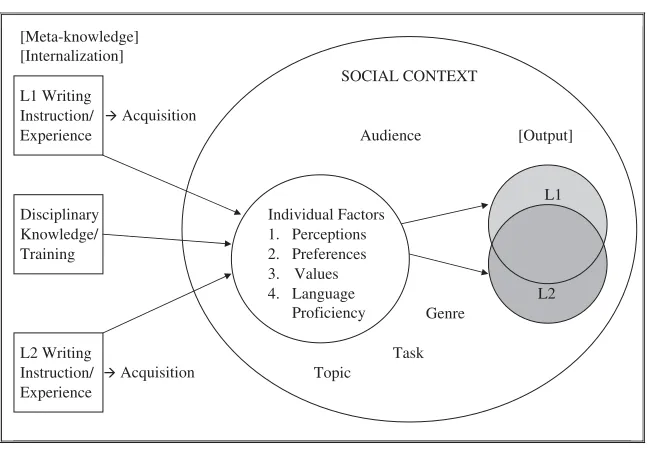
An English as a foreign language (EFL) setting epitomizes the situated nature of writing. The writing of EFL students is affected not only by their first language (L1), but also by the educational context where they learn to write. This socially and culturally characterized context provides metaknowledge about writing (i.e. view of audience and goals of writing) as well as linguistic and textual knowledge, affecting the ways in which students process and produce writing.
Recognizing that L1 writing instruction/experience plays an impor-tant role in the development of students’ writing in an EFL situation, for the last decade we have conducted a number of studies to examine possible effects of such experience. These studies have evolved under the influence of major writing theories in the field of second language (L2) writing, including contrastive rhetoric, cognitive-process approaches, genre theory and sociocognitive theory. Along with this evolution, the methods adopted have changed from large-scale experimental and questionnaire survey studies to a case-study approach based on a variety of data sources, including in-depth interviews.
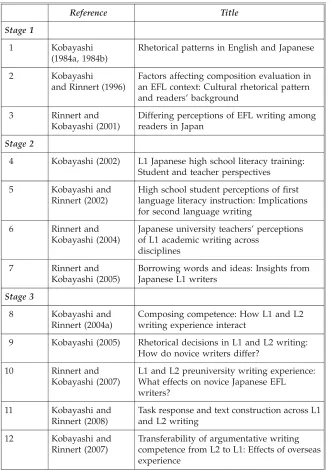
In order to elucidate this evolution, we have selected the 12 studies shown in Table 1.1. These studies focus primarily on two of the three dimensions of L2 writing that characterize the knowledge that students are expected to acquire: the features of texts they produce, and the sociocultural context where writing takes place (Cumming, 2001). The studies highlight a relationship between these two dimensions; that is, the students’ perceptions and use of L1 and L2 rhetorical patterns tend to
Table 1.1 Main studies for analysis
Reference Title
Stage 1
1 Kobayashi
(1984a, 1984b)
Rhetorical patterns in English and Japanese
2 Kobayashi
and Rinnert (1996)
Factors affecting composition evaluation in an EFL context: Cultural rhetorical pattern and readers’ background
3 Rinnert and Kobayashi (2001)
Differing perceptions of EFL writing among readers in Japan
Stage 2
4 Kobayashi (2002) L1 Japanese high school literacy training: Student and teacher perspectives
5 Kobayashi and Rinnert (2002)
High school student perceptions of first language literacy instruction: Implications for second language writing
6 Rinnert and Kobayashi (2004)
Japanese university teachers’ perceptions of L1 academic writing across
disciplines
7 Rinnert and Kobayashi (2005)
Borrowing words and ideas: Insights from Japanese L1 writers
Stage 3
8 Kobayashi and Rinnert (2004a)
Composing competence: How L1 and L2 writing experience interact
9 Kobayashi (2005) Rhetorical decisions in L1 and L2 writing: How do novice writers differ?
10 Rinnert and Kobayashi (2007)
L1 and L2 preuniversity writing experience: What effects on novice Japanese EFL writers?
11 Kobayashi and Rinnert (2008)
Task response and text construction across L1 and L2 writing
12 Kobayashi and Rinnert (2007)
change through writing training and experience, as well as with changing social-cultural contexts. While the chosen studies do not deal directly with composing processes such as planning and revising (a third dimension in Cumming’s [2001] terms; see contributions by Mancho´n et al. and Schonnenet al., this volume), those conducted at the latest stage show how EFL students in Japan respond to given writing tasks and construct texts in Japanese and English. The conceptual, linguistic and rhetorical choices individual writers make when writing essays consti-tute part of the composing process, which reflects ‘ideational, inter-personal and textual positions arising from the writer’s experience in participating in genres and discourses’ (Roca et al., 2002: 47). From a sociocognitive approach, the studies have looked at both macro- and micro-level discourse/rhetorical choices that students have made in constructing L1 and L2 texts.
In relation to the acquisition of EFL students’ academic writing ability, we are greatly concerned with the issue of transfer of writing skills across languages, not only from L1 to L2, but also the reverse direction, from L2 to L1. A number of studies have investigated the transfer of writing ability from L1 to L2 (Cumming, 1989; Kobayashi, 2005; Sasaki & Hirose, 1996), and also from L2 to L1 (Berman, 1994; Shi & Beckett, 2002). However, few studies have approached the issue to clarify how previous writing instruction and experience affect the occurrence of transfer and even fewer have taken a close look into the direction of such influence.
In this chapter, we categorize our studies into three stages, which constitute a logical continuum, and attempt a critical examination of the research conducted in each stage. In the sections below, we summarize, evaluate and reinterpret the major findings of the studies shown in Table 1.1, while drawing logical connections among them. In the conclusion, we synthesize the findings and discuss their significance in relation to L2 writing theory, research and pedagogy.
Stage 1
students (American college students, advanced Japanese ESL students in America and two groups of Japanese college students in Japan) in their use of rhetorical patterns. The study found a consistent tendency among the four groups: Whereas American students writing in English often used a general-to-specific (‘deductive’) pattern, Japanese students writing in Japanese frequently employed a specific-to-general (‘induc-tive’) pattern, and the two Japanese groups writing in English differed from each other, the group in Japan being substantially close to the group writing in Japanese and the group in the USA, relatively close to the American group. These findings confirmed what contrastive rhetoric had argued, but they also clearly suggested that the writing instruction and experience the Japanese advanced ESL students in the USA received influenced their frequent use of the general-to-specific pattern. In terms of research design, the study has strongly affected our subsequent research, in that we have continued to assume that a multiple group comparison can provide more insight than a single or two-group comparison in the investigation of the effects of such factors as writing experience on EFL students’ writing.
Method
Whereas Kobayashi’s (1984a, 1984b) study investigated the use of culturally preferred rhetorical patterns in the L1 and L2 writing of Japanese EFL students, the two evaluation studies examined the perceptions of L2 writing containing such patterns in a Japanese EFL context. More specifically, these large-scale experimental studies inves-tigated how readers’ background (differing L1, academic status and amounts of writing instruction) influenced the evaluative judgments of essays with contrasting rhetorical patterns. We assumed that the findings of the studies would benefit both sides (students and teachers) instructionally, in that students might learn about reader’s expectations, and teachers could find out what features need to be taught in class on the basis of students’ perceptions.
rhetorical differences, the two other features of coherence breaks and language use errors were also included as text characteristics, and four groups of readers with different backgrounds (n465) were asked to evaluate two essays, one with a Japanese rhetorical pattern and one with an American pattern.
Findings
The analyses of the readers’ evaluative judgments in the two studies yielded the same overall tendencies among the four groups. The 1996 study found that on one of the expository topics (TV’s effects on family life), Japanese EFL students who had not received English writing instruction (‘inexperienced students’) preferred the Japanese rhetorical pattern; native English teachers favored the American rhetorical pattern; Japanese teachers and Japanese EFL students who had received English writing instruction (‘experienced students’) valued features of both patterns. The 2001 study went further to analyze both evaluative criteria and comments by the same readers and showed clear parallel tendencies between the two sets of data: while inexperienced students attended predominantly to content in judging and commenting on essays, experienced students and Japanese teachers focused on clarity, logical connection and organization. The experienced groups’ perceptions tended to be more similar to the perceptions of the native English-speaking teachers, which may suggest that with more L2 writing experience, EFL readers’ perceptions of English essays change gradually from preferring L1 writing features to preferring many of those of L2 writing.
Although the findings suggest that the writing instruction/experience students receive affects their changing rhetorical perceptions, the studies did not provide any insight into the effects of specific amounts and kinds of previous writing instruction/experience on L2 writing. Thus, we felt it necessary to find out more about Japanese EFL students’ writing training before entering universities. This turned our attention particularly to the current status of L1 literacy being practiced in higher education in Japan, including high schools and universities.
Stage 2
We conducted four large-scale questionnaire surveys to clarify the nature of Japanese students’ L1 writing experience and instruction in both high school and university (studies 47 in Table 1.1). In addition to our own research interest, these studies responded to social needs for investigating students’ previous educational training in two academic contexts, Japan and North America. In Japan, many educators have been concerned with how to articulate high school education to the university level in order to deal with the recent problem of declining academic ability among university students (Arai, 2000). Similarly, those in North America have become increasingly concerned with obtaining informa-tion about the L1 educainforma-tional background of their non-native students to assist them with academic difficulties they are likely to face at the university level (e.g. Leki & Carson, 1994).
These questionnaire studies were theoretically grounded in the view of writing as a situated act, which emphasizes the actual performance of writing in a particular context, focusing attention on ‘the experiences of writers and. . . their understandings of the local features of context they
deal with as they write’ (Hyland, 2002: 30). Through the use of a variety of data sources such as questionnaires, observation and in-depth inter-views, this approach allows researchers to attain a detailed description of the context that characterizes local writing.
Method
the survey for high school teachers employed stratified random sampling to obtain responses nationwide, the other three used convenience sampling, in which questionnaires were distributed through personal contacts around the country, and hence may be less representative. Along with the questionnaire surveys, in-depth interviews were also conducted with university students to take a close look at their writing instruction/ experience in high school and university.
Findings
The quantitative and qualitative analysis of the high school responses indicated parallels between the students’ and teachers’ perceptions, particularly that the most important goal ofkokugo(Japanese) instruction is to develop an ability to read and understand ‘bunshou’ (texts), and much more time is spent on reading than writing instruction. The overwhelming emphasis on reading over writing appears to be related in part to educational policies stressing historical and cultural heritage through reading classics and modern prose, and also to many teachers’ belief that reading trains the basic human abilities to think and judge. However, the findings also revealed that many high schools (85% of the 79 schools that responded) provide special writing training, often as individual tutoring outside regular kokugo classes, to help students prepare to write short essays for university entrance exams. According to the students interviewed (n21), the training was given on a short-term basis consisting of 14 months of intensive, individualized instruction, and the common task was to write opinion-stating essays in which they were instructed to take a clear position, for example, for or against the author’s assertion or on a social issue presented in a text, and to provide support from such sources as personal experience, observation or factual knowledge. In short, the present L1 literacy instruction in high school offers two kinds of writing training, one for all the students in regular kokugoclasses and another for a selected group of students.
admission), the findings suggest that the kind of writing that students are trained to produce in such special training sessions attaches importance to logical argumentation, which seems to echo the typical characteristics of English academic writing (e.g. Langan, 2000; Reid, 1988), as well as the emphasis on opinion writing in recent writing textbooks in Japan (Kubota & Shi, 2005).
Like the high school surveys, the university questionnaire responses showed that students and teachers shared similar perceptions of L1 academic writing. One of the most significant findings was that both groups perceived a strong need for more instruction in appropriate citation conventions (Rinnert & Kobayashi, 2005). Japanese students were found to have little knowledge of citation of sources and also to perceive the borrowing of words or ideas without citing the source to be not entirely negative. Another related finding was that academic discipline was a more influential factor than academic level (under-graduate versus (under-graduate) in affecting student knowledge and attitudes toward the borrowing, with more concern shown in humanities/social sciences than in physical/information sciences.
While the evaluation studies in Stage 1 suggested that L2 writing instruction/experience and exposure to English rhetorical features contributed to Japanese EFL readers’ changing perceptions of culturally influenced patterns in English writing, the high school questionnaires and interviews showed that L1 writing instruction promotes rhetorical conventions similar to those of English opinion-writing. These rhetorical similarities may reflect common characteristics of opinion-writing across languages or changes occurring in Japanese L1 writing instruction to help students express ideas clearly and logically in order to cope with the rapidly changing world. Whatever the source, rhetorical perceptions continue to evolve in a dynamic way, being influenced by social and educational changes. However, it is not certain whether changes in L1 writing instruction affects actual writing in both L1 and L2, as claimed in the interviews by some of the students. This became a new inquiry for our research at the next stage.
Stage 3
university setting and varying kinds of L2 writing experience overseas. The studies in this stage were undertaken from a sociocognitive perspective (Flower, 1994; Riazi, 1997; Roca & Murphy, 2001; Villamail & de Guerrero, 1996), which sees writing as a primarily mental activity by an individual writer