CYTOTOXICITY OF METHANOL LEAF EXTRACT OF
ARTOCARPUS ALTILIS
,
ARTOCARPUS HETEROPHYLLUS,
AND
ARTOCARPUS CAMANSI
AGAINST
MCF-7 BREAST CANCER CELLS
Haryoto and Pratiwi Widowati
Faculty of Pharmacy, Universitas Muhammadiyah Surakarta
Jl. Achmad Yani, Tromol Pos 1, Pabelan Kartasura, Surakarta 57102, Central Java, Indonesia Corresponding email: [email protected]
ABSTRACT
Artocarpus had been used as traditional medicine for cancer, cirrhosis, malaria, hypertension, and diabetes. This research aimed to evaluate the cytotoxic activity of methanol leaf extract of Artocarpus altilis, Artocarpus heterophyllus, and Artocarpus camansi against MCF-7 breast cancer cell. The leaf extracts of Artocarpus altilis, Artocarpus heterophyllus, and Artocarpus camansi were obtained by the method of maceration with methanol. Phytochemical screening was performed by Thin Layer Chromatography with the use of silica GF-254 for stationary phase and ethyl acetate: n-hexane (2:8) for mobile phase. The cytotoxic test was conducted by MTT with diverse concentrations of extract, namely 500, 250, 125, 62.5, and 31.25 µg/mL. The results of cytotoxic test were measured by ELISA reader. Based on phytochemical screening, tannin, and alkaloids were found in three extracts. Cytotoxic test demonstrated that those extracts had low cytotoxic activity against MCF-7 breast cancer cells, with IC50 of 120.85; 339.46 and 530.88 µg/mL, respectively, for Artocarpus altilis, Artocarpus heterophyllus, and Artocarpus camansi.
Keywords: Extract, TLC, MCF-7, IC50, cytotoxic, MTT assay
INTRODUCTION
Cancer is the second leading cause of death globally with a percentage of 13% following cardiovascular disease (MoH, 2014). In 2012, the International Agency for Research on Cancer (IARC) reported breast cancer as the cancer with the highest percentage of new cases, which amounted to 43.3% with the percentage of death of 12.9% (Ministry of Health, 2015). Breast cancer treatment with chemotherapy is an option that has been chosen by the cancer patients in Indonesia. However, the treatment of cancer using chemotherapeutic agents may result in failure that causes drug resistance cancer cells (Stærk et al., 2002). Exploration of herbal ingredients is an effort to find anticancer chemotherapeutic agents that have high cytotoxic power and low side effects at the same time.
17
Cytotoxicity of Methanol Leaf Extract ...(Haryoto and Pratiwi Widowati)
ethanol leaf extract of Artocarpus camansi showed cytotoxic activity in colon cancer HCT116 cells with IC50 of 38.18 µg/mL (Tantengco & Jacinto, 2015). According to Saravanan et al., (2014) suggested several compounds of herbal ingredients, e.g. flavonoids, have been proven potential to be developed as anticancer chemotherapeutic agents, particularly in breast cancer.
Referring to previous studies, this research was conducted to determine the anticancer activity of the methanol leaf extract of breadfruit (Artocarpus altilis), jackfruit (Artocarpus heterophyllus) and breadnut (Artocarpuscamansi) on MCF-7 breast cancer cells. It is expected the results of this study will provide a basis for the development of anticancer chemotherapeutic agents.
MATERIALS AND METHOD
Materials
Leaves of breadfruit, jackfruit, and breadnut, MCF-7 cells, the Dulbecco’s modified eagle medium (DMEM), 10% FBS (Fetal Bovine Serum), 1% penicillin-streptomycin, 10% SDS (Sodium Dodecyl Sulfate), trypsin-EDTA (0.25%), DMSO (dimethyl sulfoxide), 0.5% Fungizone, a solution of MTT (3-(4,5-dimethylthiazol-2-yl)-2,5-diphenyltetrazolium bromide), PBS (Phosphate Buffered Saline), distilled water, methanol, 70% alcohol, spray reagent (FeCl3, sitroborat, and Dragendorff), GF-254 silica, n-hexane and ethyl acetate, liquid nitrogen tank, CO2 incubator (Binder), inverted microscope (Olympus Japan), cell counters, vortex (Genie), a micropipette (Soccorex), blue tip and yellow tip (Greiner), a test tube, microtube, scales electrical, LAF (Nuaire ), ELISA reader (ELX 800 Bio Tech), 96 well-plate (Iwaki), tissue culture flasks (Nunclon), tube conical sterile (Nunclon), hemocytometer (Marienfield Germany), sonicator, appliance glass (Pyrex), vacuum rotary evaporator (Heidolp), aluminum foil, a spatula, and a vacuum Buchner funnel and a digital camera (Sony).
Sample preparation
Samples of leaves of breadfruit, jackfruit, and breadnut were obtained from Sukoharjo, Central Java. Leaves were washed and aerated until the they were air dry and dried under the sun for 4-5 days to dry (bulbs). The simplicia was extracted and the yield was weighed.
Extraction
An amount of 200 grams of crude drug powder was soaked (macerated) using 750 mL of methanol for 24 hours, then filtered with a Buchner vacuum. The generated solution was evaporated into a thick extract. The dregs were re-macerated for 4 times with the same treatment. The evaporated yield was moved into a porcelain cup and placed on a water bath to evaporate the residual solvent and to obtain a thick extract.
Phytochemical screening
Cytotoxic test
The cell suspension as much as 100 mL was put into the plate 96 and incubated for 24-48 hours in a 5% CO2 incubator. At the end of incubation, the media in each of the wells was removed, then added by 100 mL of sample in each of wells with variation of concentrations of 500, 250, 125, 62.5 and 31.25 mg/mL. Furthermore, the plate 96 was incubated in a 5% CO2 incubator for 48 hours at a temperature of 37ºC. At the end of incubation, the media in each of the wells disposed MTT was then added 100 mL of 5 mg/mL in PBS. Subsequently, Plate 96 was incubated for 2-4 hours in a 5% CO2 incubator at a temperature of 37ºC. Living cells would react with MTT (3-(4,5-dimethylthiazol-2-yl)-2,5-diphenyltetrazolium bromide) to form purple formazan. Formation of formazan reactions was stopped by the addition of 100 mL solution of 10% SDS (Sodium Dodecyl Sulphate) in 0.01N HCl into the respective wells, and then wrapped in paper and stored overnight at room temperature in a dark place. At the end of the incubation, absorbance was read with ELISA reader at a wavelength of 594 nm. The percentage of live cells was calculated by the absorbance of data cells, which was then made into curve of log concentration of living cells and % of values based on IC50. Absorbance obtained from the ELISA reader was used to calculate the percentage of live cells with the formula:
% 100%
. .
−
= ×
−
Absorbance treatment Absorbance of media control Living cell
Absorb of solvent control Absorb of media control
Subsequently, equation was made, which is y= Bx + A, with y=% live cells and x= log concentration (figure of log concentration versus the percentage of living cells and the calculated linear regression). The IC50 values were obtained by including y= 50 on the linear regression equation and the x was antilog, which was then calculated from these concentrations (CCRC, 2013). The IC50 value indicates the concentration which can lead to the death of 50% of the population.
RESULT AND DISCUSSION
Extraction
Results of bulbs with methanol extraction yielded 10.39% for jackfruit leaves, 11.85% for breadfruit leaves and 10.60% for breadnut leaves.
Phytochemical screening
The preliminary test of mobile phase indicated the optimal result of the ratio of ethyl acetate: n-hexane (2: 8). The stationary phase used for the analysis was silica GF-254, which is able to fluoresce at a wavelength of 254 nm. Phytochemical screening was performed to flavonoids, tannins and alkaloids.
19
Cytotoxicity of Methanol Leaf Extract ...(Haryoto and Pratiwi Widowati)
which the alkaloid compounds were produced by the methanol extract of leaves of jackfruit. Similarly, research conducted by Tehubijuluw and Southeast (2013) stated that the methanol extract of leaves of breadfruit contains alkaloids. Detection with the reagent sitroborat spray showed negative flavonoid in the methanol leaf extracts of breadfruit, jackfruit, and breadnut. A positive result is marked with yellow-green spots on the UV 366 nm (Markham, 1988). Apsari (2007) reported the presence of flavonoids in the methanol extract of bark of breadnut, thus the result opposes this study. It is due to the different parts of plant as the object of observation. Visualization of spots on TLC test (Table 1). Research conducted by Mohan etal., (2012) stated that the alkaloid compounds have activity as anticancer agents by inhibiting topoisomerase enzymes involved in DNA replication, induces apoptosis and p53 gene expression.
Cytotoxic test of leaf extract
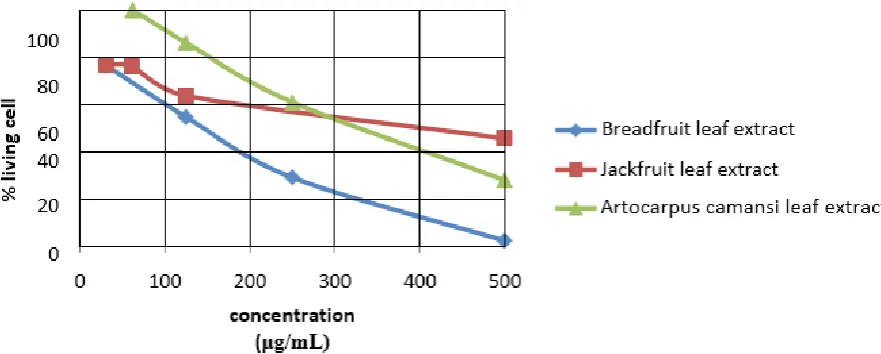
Cytotoxic test conducted by dissolving the extract in DMSO. The DMSO level used in this test was 0.01% v/v. Theoretically, the use of high concentrations DMSO can cause the cell death. However, research by Jamalzadeh etal. (2016) suggested the use of 0.5% v/v DMSO does not affect the viability of MCF-7 cells. Observations of cell morphology showed insignificant difference between the control of MCF-7 cells and the control of DMSO treatments. The result of the methanol leaf extracts of breadfruit, jackfruit and breadnut generated the IC50 value of 120.85; 530.88 and 339.46 mg/mL, respectively (Table 2).
In theory, the relationship between the percentage of living cells and the concentration of the extract is an inversely proportional relationship. The lower the extract concentration, the higher the percentage of living cells (a dose-dependent phenomenon) (Khademvatan et al., 2016; Shiezadeh etal., 2013). The results of this study showed a dose-dependent phenomenon (Fig. 1) (Table 2).
20
Journal of Nutraceuticals and Herbal Medicine
Volume 1, Number 1, February 2018
Table 1 Visualization of spots on TLC test
Leaf extract
The color appearance of patches
Result
Before spraying After spraying
Sitroborat FeCl3 Dragendorff Visible light UV 254nm UV 366nm UV 366nm Visible light Visible light
21
Cytotoxicity of Methanol Leaf Extract ...(Haryoto and Pratiwi Widowati)
Table 2 Cytotoxic test data on the extracts of breadfruit, jackfruit, and breadnut
Leaf extract
equation IC50 (µg/mL)
Breadfruit
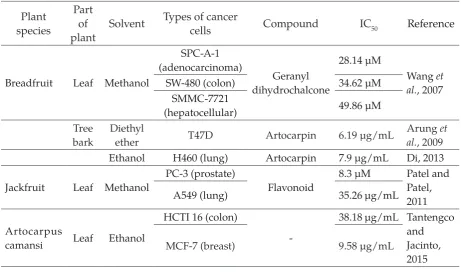
The calculations show that the methanol leaf extract of breadfruit has the highest cytotoxic activity in compared with those of jackfruit and breadnut. Based on the criteria of the United States National Cancer Institute, a substance is classified as having the potential cytotoxic effect if the IC50 value is ≤ 20 mg/mL. The results of the acquisition of IC50 values in this study indicate that the three extracts of species in the genus Artocarpus have relatively low cytotoxic activity against MCF-7 breast cancer cells in which the potential of the extract is breadfruit > breadnut > jackfruit. The results show dissimilarities with previous studies (Table 3).
Table 3 Cytotoxic test data on previous research
Plant species
Part of plant
Solvent Types of cancer
cells Compound IC50 Reference
Breadfruit Leaf Methanol
ether T47D Artocarpin 6.19 µg/mL
Arung et al., 2009
Ethanol H460 (lung) Artocarpin 7.9 µg/mL Di, 2013
Based on the data, the obtained IC50 values are significantly different from previous studies. It might be due to the different types of cancer cell used in cytotoxic test, in addition to the different parts of the plant and the different solvent extraction. The compounds observed in relation with their potential cytotoxic activity in previous studies were flavonoids and their derivatives. The compounds were not involved in this study, thus the results of the acquisition of IC50 were different.
CONCLUSION
Research on MCF-7 breast cancer cells was done in pertaining with the effects of cytotoxic using the methanol leaf extract of breadfruit (Artocarpusaltilis), jackfruit (Artocarpus heterophyllus), and breadnut (Artocarpus camansi). It can be concluded that the methanol leaf extracts of breadfruit, jackfruit and breadnut have anticancer activity against MCF-7 breast cancer cells t with IC50 values are 120.85; 530.88 and 339.46 mg/mL, respectively, which can be classified as low potential. The compounds contained in the methanol leaf extracts of breadfruit, jackfruit and breadnut are alkaloids and tannins. To complement this research, the cytotoxic test of other species in the genus Artocarpus and the cytotoxic test on different types of cancer cells using other plant parts of the breadfruit, jackfruit, and breadnut, are required.
REFERENCES
Apsari K., 2007, Isolasi dan Karakterisasi Senyawa Kimia dari Ekstrak n-Heksan Kulit Batang Kluwih (Artocarpusaltilis Park) serta Efek Sitotoksiknya terhadap Sel HeLa, Phytochemistry, 7 (2), 45–51.
Arung E.T., Yoshikawa K., Shimizu K. and Kondo R., 2010, Isoprenoid-substituted Flavonoids from Wood of Artocarpus heterophylluson B16 Melanoma Cells: Cytotoxicity and Structural Criteria, Fitoterapia, 81 (2), 120–123.
CCRC, 2013, Uji Sitotoksik Metode MTT, Accessed on: http://ccrc.farmasi.ugm.ac.id/ [at 15 May 2016].
Haidara K., Zamir L., Shi Q. and Batist G., 2005, The Flavonoid Casticin Has Multiple Mechanisms of Tumor Cytotoxicity Action, Cancer Letters, 1–11.
Jamalzadeh L., Ghafoori H., Sariri R., Rabuti H., Nasirzade J., Hasani H and Aghamaali M.R., 2016, Cytotoxic Effects of Some Common Organic Solvents on MCF-7, RAW-264.7 and Human Umbilical Vein Endothelial Cells, Avicenna Journal of Medical Biochemistry, In press.
Kemenkes, 2014, Hilangkan Mitos tentang Kanker, Accessed on: http://www.depkes.go.id/ article/print/201407070001/hilangkan-mitos-tentang-kanker.html [at 15 May 2016].
Kemenkes, 2015, Stop Kanker: Situasi Penyakit Kanker, infodatin-Kanker, p.3.
Khademvatan S., Eskandari A., Saki J., Foroutan-Rad M., Khademvatan S., Eskandari A., Saki J. and Foroutan-Rad M., 2016, Cytotoxic Activity of Holothuria leucospilota Extract against Leishmania infantum In Vitro, Advancesin Pharmacological Sciences, 2016, 1-6.
23
Cytotoxicity of Methanol Leaf Extract ...(Haryoto and Pratiwi Widowati)
Markham, K.R., 1988, Cara Mengidentifikasi Flavonoid, (Trans. Kosasih Padmawinata), Bandung: Penerbit ITB.Mohan K., Jeyachandran R., and Mohan Assistant Professor K., 2012, Alkaloids as Anticancer Agents, Annals of Phytomedicine, 1 (1), 46–53.
Dalarmi L., Maria Warumby Zanin S., Gomes Miguel O., de Fátima Gaspari Dias J. and Dallarmi Miguel M., 2015, Determination of Antioxidant, Radical Scavenging Activity and Total Phenolic Compounds of Artocarpus heterophyllus (Jackfruit) Seeds Extracts, Journal of Medicinal Plants Research,8(40),1013–1020.
Pradhan C., Mohanty M. and Rout A., 2012, Phytochemical Screening and Comparative Bioefficacy Assessment of Artocarpus altilis Leaf Extracts for Antimicrobial Activity, Frontiers in Life Science, 6 (3–4), 71–76.
Saifudin A., 2014, Senyawa Alam Metabolit Sekunder (Teori, Konsep, dan Teknik Pemurnian), Yogyakarta: Deepublish.Saravanan R., Brindha P. and Ramalingam S., 2014, A Review on the Role of Phytoconstituents in Breast Cancer Cells, International Journal of Pharm Tech Research, 6 (2), 799–808.
Shiezadeh F., Mousavi S.H., Amiri M.S., Iranshahi M., Tayarani-Najaran Z. and Karimi G., 2013, Cytotoxic and Apoptotic Potential of Rheum turkestanicum Janisch Root Extract on Human Cancer and Normal Cells., Iranian journal of pharmaceutical research :IJPR, 12 (4), 811–9. Stærk D., Lykkeberg A.K., Christensen J., Budnik B.A. and AbeF., 2002, InVitro Cytotoxic Activity
of Phenanthroindolizidine Alkaloids from Cynanchum vincetoxicum and Tylophoratanakae against Drug-Sensitive and Multidrug-Resistant Cancer Cells, Journal of Natural Products, 65 (3), 1299–1302.
Tantengco O.A.G. and Jacinto S.D., 2015, Cytotoxic Activity of Crude Extracts and Fractions from Premnaodorata (Blanco), Artocarpus camansi (Blanco) and Gliricidiasepium (Jacq.) Against Selected Human Cancer Cell Lines, Asian Pacific Journal of Tropical Biomedicine, 5 (12), 1037–1041.
Tehubijuluw H. and Tenggara A., 2013, Screening of Phytochemicals and Bioactivity Test of The Leaves Breadfruit (Artocarpus altilis), Ind. J. Chem. Res., 1, 28–32.