Institutional Role in Gunung Walat Educational Forest Policy:
Discourse and Historical Approaches
1* 2 3 3
Yulius Hero , Rudy C Tarumingkeng , Dudung Darusman , and Hariadi Kartodihardjo 1Graduate School of Bogor Agricultural University,
2Department of Forest Product, Faculty of Forestry, Bogor Agricultural University, Academic Ring Road, Campus IPB Dramaga PO Box 168, Bogor 16680, Indonesia 3Department of Forest Management, Faculty of Forestry, Bogor Agricultural University,
Academic Ring Road, Campus IPB Dramaga PO Box 168, Bogor 16680, Indonesia
Received November 22, 2011/Accepted May 20, 201
Abstract
Institutional science with various approaches have been used in analysing forest policy at international level and in Indonesia. This research used institutional science with discourse and historical approach for the policy of Forest Territory with Special Purpose (Kawasan Hutan dengan Tujuan Khusus, KHDTK). This research study the KHDTK case of Gunung Walat Educational Forest (Hutan Pendidikan Gunung Walat, HPGW). The goal of this research is to understand discourse/narration of policy and describe the policy space for HPGW and KHDTK. Institutional analysis in this research used discourse and historical approach. Discourse analysis used IDS model supported with Wittmer-Birner model and Eden-Ackermann diagram. On the other hand, historical approach used the historical relationship. The research outcome showed that the process of creating HPGW policy is not linear, but being affected by policy discourse/narration in the process of creating HPGW policy. Faculty of Forestry IPB has been successfully managing HPGW because of the success to build policy discourse/narration which is supported by the knowledge of HPGW managers, cooperation network, and interest and power. Meanwhile, external party perceived and believed the importance of HPGW management for forestry education. The success key of HPGW policy is in structuring the institution that control the behavior of HPGW managers, so the managers obtained trust from third parties to create interest alliances which can boost HPGW management performance. HPGW policy can be used to fulfill KHDTK policy space according to Article 8, Forestry Law Number 41 Year 1999.
Keywords: discourse, history, institution, Gunung Walat Educational Forest (HPGW), forest territory with special purpose (KHDTK)
*Correspondence author, email: [email protected], telp. +62-251-8621244, fax.+62-251-8621244
Dramaga Main Road, Campus IPB Dramaga, Bogor 16680, Indonesia
2
Introductio
The approach of institutional role began to be used in analysing forestry policy in Indonesia in the end of 1990's (Kartodihardjo 1998). The spectrum of institutional theorem is very wide and always develops fast (Yustika 2006). Several researches on institutional forestry at international level, were among other things: collective action theorem in Nepal (Varugese & Ostrom 2001; Gautam & Shivakoti 2005), institutional economy theorem in China (Zhang et al. 2000), agency theory (Gibbons 20005), choice of policy instrument theory at global scale (Bowers 2005), and rule of law and forest management theory in Finland and Brazil (Hirakuri 2005). Meanwhile in Indonesia, examples of such researches were: transaction cost theory for natural forest management (Kartodihardjo 1998) and industrial plantation forests (Kartodihardjo 2003), agency theory in natural forest management (Nugroho 2003), and transaction cost theory in the institution of watershed management (Kartodihardjo et al. 2004).
n In early 1980's, analysis of forestry policy at international
level used institutional discourse approach. Institutional discourse approach has been used in the global forest policy since early 1980's and also in forest policy negotiations at European Parliament in the late 1990s (Arts & Buizer 2009). Such discourse analysis has been applied in the analyzing of forestry policies (Elands & Wiersum 2001; Bengston et al. 2005; Selby et al. 2007). Meanwhile for Indonesia, institutional research using discourse approach began to be used in year 2010 (Khan et al. 2010; Ekawati 2011). Khan et al. (2010) did an institutional research for the case of production forest area, whereas Ekawati (2011) for the case of protected forest area. On the other hand, this research was done on forest territory with special purpose (KHDTK) for education and training with Gunung Walat educational forest (HPGW) case.
bare lands. In 1969, through the Decree of the Head of West Java Forestry Service No. 7041/IV/69 it was declared as an educational forest belonging to the Faculty of Forestry of Bogor Agricultural University (IPB) (HPGW 2009). At the time of this decree issuance, HPGW was a forest surrounded by villages and people's gardens, where the forest conditions "appeared dead" and was not categorized as enterprise-class, was abandoned, and underwent many land encroachment by the surrounding communities. Since early 1969, tree planting has been carried out in HPGW involving forestry students of Faculty of Forestry IPB. In 1980, the entire region of HPGW was successfully planted with various tree species (HPGW 2009). Data processing of HPGW in 2011 showed that the gross revenue from the utilization of copal gum and resin as well as visits to HPGW in 2011 accumulated to more than 3.6 billions rupiah (HPGW 2011).
The objectives of the research were: (1) analyzing the concept of discourse/narrative toward management HPGW policies, (2) analyzing the interests, actors, and networks of HPGW management, and (3) describing the policy space and recommendation for the improvement of HPGW and KHDTK policy.
M
The research paradigm was the critical view of the social practice of HPGW policies as a post-territory research object. Research procedures were subjective, with no distance (intimate) between researchers and research objects. The results were unique, inductive, and applicative (problem solving) for HPGW policy. This type of research is categorized as applied research/applicative (Damin 2004) or problem solving research (Johnson 1986). This type of knowledge is tacit knowledge (Nonaka & Takeuchi 1995).
This research used institutional theorem with discourse and historical approach. Institution is related to the study of individual or organizational behavior in social practices in the form of rules, norms, prohibition, and contract, that control and rule individual or organizational behavior in social practices (North 1990) of HPGW management policy. Institutional research approaches which have been widely used, such as: materialist, positivist, interest-based, and resource-oriented have been criticized by many parties. As the alternative of an approach for the study of human behavior, discourse approach has been used (Art & Buizer 2009). Discourse evolves from linguistics (text), which is later used in the science of Communication, Social, Politics, Psychology, and Institution; study of discourse is growing in line with advances in communication media (printed and electronic); in Indonesia the study of discourse (text) evolved since 1980's (Eriyanto 2005).
This research method is a case study of social practice in the form of ideas or concepts (regarding discourse) of HPGW policy by using institutional role approach through discourse and historical approach. Discourse institutionalism approach that is used in this research is IDS model discourse institutionalism (2006) which is completed with Wittmer-Birner model (2005) and Eden-Ackermann diagram (1998). This research used the approach of analytical history (descriptive analysis) which is focusing on the problem (Kartodirdjo 1992) and discourse approach used critical
ethods
point of view (Eriyanto 2005) which criticized the hidden purpose and meaning (frame) in the social relation. Historical institutionalism approach is to analyze historical relation of HPGW by using historical-relation analysis (path dependency) from Peters et al. (2005), where the policy which is created now, really depends on the policy which has been created in the past. This research methodology is a deep (serious) interview with source respondent who understand and master HPGW management policy the most. The technique that is used for this research is using question list or questionaire.
Results and Discussion
The reconstruction outcome of HPGW management history according to research needs (Kartodirdjo 1992) shows that HPGW management periods could be grouped into 6 periods, namely: period of year 1969-1972, period of year 1972-1989, period of year 1989-2001, the period of year 2001-2003, period of year 2003-2009, and period of year 2009-2013. The period division of HPGW management is in conformity with period of new policy creation, the change of Dean in Faculty of Forestry IPB, and the change of Field Managers of HPGW.
failed. It happened because of inability of Faculty of Forestry to create policy which can give solution to the problems of forest management for LGC purpose and unable to maintain the existence of IPB to manage ex HPH PT. IFA in Batanghari, Jambi Province (LMGC IPB 2002). Diamond (2005) says that the policy failure is the result of poor decision making in understanding complex social condition which really affect the success of a policy. Kartodihardjo (2006) says that there is a big gap between the decision making to decide forest management and the forest managers in the field.
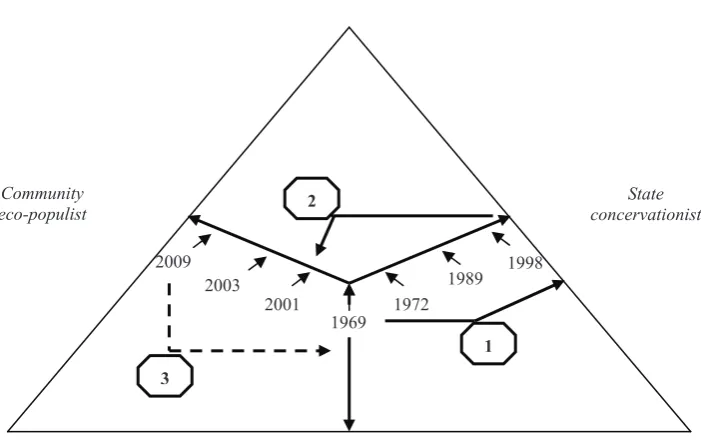
Interest-alliances in the policy of HPGW management show that in the period of year 1972 until year 2001, Faculty of Forestry tended to be more active in creating interest-alliances with external party which was government or state institution. It was shown from the success of Faculty of Forestry to get financial support (DIP/APBN) in the year 1972-1998. Afterwards, in the year 2001-2011 Faculty of Forestry was more active to create interest-alliances with external party in the form of community. In the year 2001, it was difficult to rely on government support because of economic and monetary crisis impact in Indonesia in the mid of year 1998. Therefore, the interest-alliances were created with the community. It was shown from the effort of HPGW manager to include community who have eco-populist view in achieving independency of HPGW manager. Those being included in the community were: farmers, seedlings buyer, and cooperation with researcher and developer. Interest-alliances of HPGW manager with the market will need certainty of government policy for the use of HPGW outcomes. In the long run, HPGW is hoped to be able to serve as educational forest which is not only financially independent, but also able to get profit (Figure 1).
Figure 1 Alliances of HPGW policy with external parties.
The space for updating the policy of HPGW management is relatively easy to be obtained, implying that policy inovation is relatively easy implemented in HPGW management. In the period of year 1989-2001 there was an institutional obstacle because the policy of discourse/narration which was invented by Faculty of Forestry IPB in the form of “full power HPGW management” had not been accepted and had not been trusted by Forestry Department. HPGW leadership dualism between Faculty of Forestry and interest union Faculty of Forestry IPB and Forestry Training Bureau, (Balai Latihan Kehutanan-BLK) made the HPGW manager became hard to manage and control the actors who were involved in HPGW management in this period, so that the effort of HPGW management in the period of year 1989-2001 or in 10 years was not optimum. It proved that institutional arrangement (rules, norms, prohibitions, and contract that control and rule actor’s behavior) really affect the success to achieve power of HPGW management. Institutional role really affects to the success in getting various instruments and incentives to be implemented in the policy of HPGW management.
The analysis result of actors shows that the external actors that have a big role in the policy of HPGW management are: Ministry of Forestry, local government of Sukabumi, and Perhutani in West Java. The development of external actors who have a big role is needed to be observed. The external actors who have big role and the external actors who have not had important role now (community around HPGW and mining factory) can create interest alliance that can support (supporter) and can disturb (Wittmer & Birner 2005; Hermans & Thissen 2008) the power of HPGW management.
Figure 3 Total number of annual visits to HPGW.
To
ta
lr
es
ea
rc
h
(ti
tle
ye
ar
-1 )
2 4 6 8 12
10
0
1982
-2000 20012003- 20042008- 20092011 -Figure 2 The average number of annual researches
in HPGW.
2007 2008 2009 2010 2011 2,000
14,000
4,000 6,000 8,000 12,000
10,000
0
M
on
th
ly
pr
od
uc
tio
n
(k
g)
Figure 5 Total quantity of resin sap monthly production in HPGW.
To
ta
lv
isi
to
rs
(p
er
so
n)
1,000 7,000
2,000 3,000 4,000 6,000
5,000
0
2003 2004 2005 2006 2007 2008 2009 2010
Figure 4 Total quantity of damar sap monthly production in HPGW.
M
on
th
ly
pr
od
uc
tio
n
(k
g)
1,000 7,000
2,000 3,000 4,000 6,000
5,000
0 8,000
management policy at this time is affected and depend on the HPGW management policy in the past (Peters et al. 2005), and those are: (1) decision of HPGW Head, (2) concept of sustainable forest management, and (3) pattern of HPGW outcome usage. The power of HPGW management today, in terms of finance and productivity of HPGW outcomes usage is not excluded from the foundation of HPGW management which has been formed in the past. The analysis of relational history (path dependency) of HPGW policy shows that in the period of year 1969-2001, the choice base in deciding HPGW manager is normative (Steinmo 2008) with normative institutional pillar (Dacin et al. 2002). Whereas the choice base in deciding HPGW manager in the period of year 2001-2011 is normative (Steinmo 2008) with normative institutional pillar and cognitive culture (Dacin et al. 2002).
The usage of HPGW outcomes shows that in the beginning of 2001, there was an innovation of HPGW usage which is always increasing from the previous period to the next management period. Besides, the power of HPGW outcomes usage in terms of productivity for research, visit, and resin production is always increasing. The increase of HPGW management power which started from year 2009 was because of institutional arrangement that became the key of success HPGW management policy. The arrangement of HPGW institution through policy of controlling the behavior of HPGW managers (the actors), made the managers were able to get trust from many parties, so they are ready to create interest-alliance with Faculty of Forestry IPB which can increase the HPGW management performance.
The total number of HPGW research shows that before year 2001, the number of HPGW research on average was
-1 -1
1.33 titles year , year 2001-2003 was 3.11 titles year , year -1
2003-2009 was 8 titles year , and year 2009-2013 was 10.5 -1
titles year . After the HPGW policy of “financially independent” in the mid of year 2001, there was increasing number of research, significantly from year to year (Figure 2). The number of visits in HPGW shows that there was -1 fluctuation in year 2003-2009 from 500-3,000 visits year . Moreover there was a significant increase of visits in HPGW
-1
to be more than 6,000 visits year (Figure 3). The total production of damar resin increased significantly from 0.35
-1 -1
was a significant increase as large as 4 ton month , and in the -1 year 2011 the production was more than 13 ton month (Figure 5).
Conclusion
HPGW policy discourse/narration is that forest area of
Gunung Walat (HPGW) is for educational purpose of Faculty
of Forestry IPB. Faculty of Forestry IPB has been successfully maintaining the existence of HPGW from 1969-2011 because Faculty of Forestry IPB has succeeded in building policy discourse and narration of HPGW HPGW managers (the actors), so they can get trust from the third party to create interest-alliances that can increase the power of HPGW management. Despite that, at macro level, the government regulation on HPGW is still poor, still orienting to the object, not to the control of payment system and invest to respond to challenge and promise a certainty of HPGW outcomes usage in the future. Law certainty is really needed if HPGW will be managed to get profit with market orientation. In the process of policy making for educational forest (KHDTK), it is suggested to pay attention on the discourse/narration, actors, cooperation network, interests, and power factor. These phenomena are due to the creation of HPGW policy which is not linier, but is really affected by those factors mentioned above. KHDTK HPGW management policy in terms of HPGW's policy period of 2009-2020 (SK Dean of Faculty of Forestry IPB No. 35/13.5/kp/2008) can be used as reference for creating government regulation for HPGW policy in particular and in KHDTK in general for complying with Article 8, Law Number 41 Year 1999 concerning Forestry.
References
Arts B, Buizer M. 2009. Forests, discourses, institutions adiscursive-institutional analysis of global forest governance. Forest Policy and Economics 11:340-347.
. Bengston D, Potts R, Fan D, Goetz E. 2005. An analysis of
the public discourse about sprawl in the United States: monitoring concern about a major threat to forests.
Forest Policy and Economics 7:745-756.
.
Bowers J. 2005. Instrument choice for sustainable development: an application to forestry sector. Forest
Policy and Economic 7:97-107.
.
Dacin, MT, Goodstein T, Scott WR. 2002. Institutional theory and institutional change: introduction to the special research forum. The Academy of Management
Journal 45(1):43-56.
.
Damin S. 2004. Metode Penelitian untuk Ilmu-Ilmu
Perilaku. Jakarta: Bumi Aksara.
Diamond J. 2005. Collapse: How Societies Choose to Fail or
Servive. London: Penguin Books.
Eden C, Ackermann F. 1998. Making Strategy: the Journey of
Strategic Management. London: Sage Publications.
Ekawati S. 2011. Proses pembuatan kebijakan pembagian kewenangan antar tingkat pemerintahan dalam pengelolaan hutan lindung dan implementasinya di tingkat kabupaten [dissertation]. Bogor: Graduate
School of Bogor Agricultural University.
Elands BHM, Wiersum KF. 2001. Forestry and rural development in Europe: an exploration of socio-political discourse. Forest Policy and Economics 3:5-16.
. Eriyanto. 2005. Analisis Wacana: Pengantar Analisis Teks
Media. Yogyakarta: LkiS Pelangi Aksara.
Gautam AP, Shivakoti GP. 2005. Conditions for successfull local collective action in forestry: some effidence from the hills of Nepal. Society and Natural Resources 18:153-171.
.
Gibbons R. 2005. Incentives between firms (and within).
Management Science 51(1):2-17.
.
Hirakuri S. 2003. Can Law Safe the Forest Lessons from
Finland and Brazil. Jakarta: Grafika Desa Putera
Indonesia.
[HPGW] Gunung Walat Educatinal Forest. 2009. Rencana
Pengembangan Hutan Pendidikan Gunung Walat.
Bogor: Faculty of Forestry IPB.
[HPGW] Gunung Walat Educatinal Forest. 2011. Laporan Kemajuan Semester 1/2011 dan Rencana Semester 2/2011. Bogor: Faculty of Forestry IPB.
[IDS] Institute of Development Studies. 2006. Understanding Policy Processes: A Review of IDS research on the Environment. Knowledge, Technology
and Society Team. Brighton: Institute of Development
Studies at the University of Sussex.
Jhonson GL. 1986. Research Methodology for Economists:
Philosophy and Practice. New York: Macmillan.
[LMGC] Land Management Grant College IPB. 2002. Menggagas Arah Kebijakan Pengelolaan Hutan dan
Pendidikan Kehutanan. Bogor: Bogor Agricultural
University.
Kartodirdjo S. 1992. Pendekatan Ilmu Sosial dalam
Metodologi Sejarah. Jakarta: PT Gramedia Pustaka
Utama.
Kartodihardjo H. 1998. Peningkatan kinerja pengusahaan hutan alam produksi melalui kebijaksanaan penataan institusi [dissertation]. Bogor: Graduate School of Bogor Agricultural University.
Kartodihardjo H. 2003. Telaah Kebijakan Pembangunan HTI. Bogor: Faculty of Forestry IPB.
Kartodihardjo H. 2006. Ekonomi dan Institusi Pengelolaan Hutan: Telaah Lanjut Analisis Kebijakan Usaha
Kehutanan. Bogor: Institute for Development
Economics of Agriculture and Rural Areas (IDEALS).
http://dx.doi.org/10.1016/S1389-9341(00)00027-7
http://dx.doi.org/10.1080/0894192 0590894534
http://dx.doi.org/10. 1287/mnsc.1040.0229
Kartodihardjo H, Murtilaksono K, Sudadi U. 2004. Institusi Pengelolaan Daerah Aliran Sungai: Konsep dan
Pengantar Analisis Kebijakan. Bogor: IPB Press.
Khan A, Kartodihardjo H, Soedomo S, Darusman D. 2010. Kebijakan usaha kehutanan: sebuah analisis diskursus.
Jurnal Manajemen Hutan Tropika 16(2):101-111.
Nonaka I, Takeuchi H. 1995. The Knowledge-Creating Company: How Jappanese Company Create the
Dynamics of Innovation. New York: Oxfort University
Press Inc.
North DC. 1990. Institutions, Institutional Change, and
Economic Performance. United Kingdom: Cambridge
University Press. .
Nugroho B. 2003. Kajian institusi pelibatan usaha kecil-menengah industri pemanenan hutan untuk mendukung pengelolaan hutan lestari [dissertation]. Bogor: Graduate School of Bogor Agricultural University. Peters GB, Piere J, King D. 2005. The politics of path
dependency: political conflict in historical institutionalism. The Journal of Politics 67(4): 1275
-1300. .
Selby A, Koskela T, Petajisto L. 2007. Evidence of lay and professional forest-based development discourses in three contrasting regions of Finland. Forest Policy and
Economics 9:633-646.
.
Steinmo S. 2008. What is Historical Institutionalism? United Kingdom: Cambridge University Press.
Sutton R. 1999. Policy Process: An Interview. Working Paper 118. Overseas Development Institute. London: Chameleon Press Ltd.
Varugese G, Ostrom E. 2001. The contested role of heterogeneity in collective action: some evidence from community forestry in Nepal. World Development 29(5):747-765.
.
Wittmer H, Birner R. 2005. Between Conservationism, Eco-Populism and Developmentalism-Discourses in Biodiversity Policy in Thailand and Indonesia year of 2002. Washington: International Food Policy Research Institute.
Yustika AE. 2006. Ekonomi Kelembagaan: Definisi, Teori dan Strategi. Malang: Bayumedia Publishing.
Zhang Y, Uusivuori J, Kuulainen. 2000. Impacts of economic reforms on social forestry. Forest Policy and Economics 1(1):27-40.
.
http://dx.doi.org/10.1017/CBO9 780511808678
http://dx.doi.org/10.1111/j.1468-2508.2005. 00360.x
http://dx.doi.org/10.1016/ j.forpol.2006.05.003
http://dx.doi.org/10.1016/S0305-750X (01)00012-2