CHAPTER I
INTRODUCTION
1.1 Background
Eye is the most important of human sensory organ that play a critical
role in human-environmental interaction. In 1996 and 1997, WHO Programme
and the Task Force to the Partnership Committee of collaborating
Non-Governmental Organizations launched The Global Initiative for the Elimination
of Avoidable Blindness. The mission of this program is to eliminate the main
cause of all preventable and treatable blindness by the year 2020. One of eye
disease causing visual impairment that most occur is refractive error.1
There are 4 types of refractive anomaly: hyperopia, myopia,
presbyopia, and astigmatism. Myopia (or nearsightedness) is a condition where
the object shadow is fall in front of retina. Clinical manifestation that makes
patient really disturbed is blurred vision, and maybe worsened by headache.2
Myopia is a complex disease, caused by genetic and or environment factor, or a
Mendelian trait with different pattern of inheritance (autosomal dominant,
autosomal recessive, X-linked).3,4Myopia can be classified based on the age of
onset: early-onset myopia (occur under the age of 20), early adult-onset myopia
(between the ages of 20-40), and late adult-onset myopia (occur over the age of
eyeball axial length, lens thickness, anterior chamber depth and corneal
curvature.3,4,5
The prevalence of children with myopia in Pondok Ranji, Jakarta, is 51
out of 89 respondent (57.3%).7The highest rate of myopia in Denpasar, Bali, is
in the age group 11-20 years old (25.1%).8 In a high school in Palembang,
South Sumatera, 46.7% students were having myopia in their 15 years old age.9
The prevalence of myopia in Malay people who lives in Singapore were
24.6%.10
Scientists from many countries already studied many genes that
assumed to play a role in myopia. A Genome Wide Association Study (GWAS)
was conducted to find genes that have a strong relation to corneal curvature in
Singapore citizen. This study found positive association between corneal
curvature and FK506 binding protein 12-rapamycin associated protein 1
(FRAP1) gene on chromosome 1p36.2 and platelet-derived growth factor
receptor alpha (PDGFRA) gene on chromosome 4q12.11 This study is partly
replicated by in Australian and White European populations which only found
positive association with PDGFRA gene.12,13
FRAP1 is a gene that code the FK506 binding protein 12-rapamycin
associated protein 1.14This protein regulate cell growth and proliferation. Since
this protein is a family of phosphatidylinositol 3-kinase-related (PI3 kinase), it
will affects the corneal tissue because corneal stroma is sensitive to growth
also regulate the cell growth.15 This protein expressed mainly in the
mesenchymal tissue.16
Based on database in Gene Expression Profiling In Silico (GEPIS),
PDGFRA protein is expressed more in normal eye tissue (113.50 Digital
Expression Unit) compare to FRAP1 protein (18.92 Digital Expression Unit).17So,
this study is focusing on PDGFRA gene polymorphism because its protein is
expressed dominantly in eye tissue. Because of the replication studies in
Australian and white Europeans found diversities in different ethnics, it may
interesting to find PDGFRA gene polymorphism among Indonesian people.
1.2 Research Question
1.2.1 General Research Question
What kind of distribution of PDGFRA gene polymorphism in
Indonesian people with early-onset myopia?
1.2.2 Specific Research Question
1. What kind of distribution of PDGFRA gene polymorphism in South
Sumatera ethnic group with early-onset myopia?
2. What is the correlation between PDGFRA gene polymorphism and risk
factors i.e parental history, near work, reading in dim light, outdoor
activity, sex, and corneal curvature in early-onset myopia?
To identify risk factor and PDGFRAgene polymorphism in Indonesian
people with early-onset myopia.
1.3.2 Specific Aims
1. To identify PDGFRA gene polymorphism in South Sumatera tribes with
early-onset myopia.
2. To find the association between sex and early-onset myopia in South
Sumatera tribes.
3. To find the association between family history of myopia and
early-onset myopia in South Sumatera tribes.
4. To find the association between outdoor activity and early-onset
myopia in South Sumatera tribes.
5. To find the association between near work activities and early-onset
myopia in South Sumatera tribes.
6. To find the association between lighting while doing near work and
early-onset myopia in South Sumatera tribes.
7. To find the association between corneal curvature and early-onset
myopia in South Sumatera tribes.
8. To find the association between PDGFRA gene polymorphism and
corneal curvature in South Sumatera tribes.
9. To find the association between PDGFRA gene polymorphism and
1.4 Research Benefits
1. To provide information about PDGFRA gene polymorphism in South
Sumatera ethnic group which may different with other ethnics.
2. To provide the information about correlation between genetic
susceptibility and risk factors i.e parental history, near work, reading in
dim light, outdoor activity, sex, and corneal curvature in the
development of early-onset myopia in South Sumatera ethnic group.
1.5 Research Originality
This is the first study to identify PDGFRAgene polymorphism in South
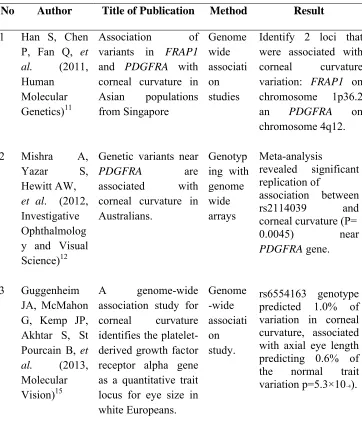
Sumatera ethnic group from Indonesia with early-onset myopia. Table 1 shows
previous studies about association ofPDGFRAgene polymorphism and corneal
Table 1. List of previous studies about PDGFRAgene polymorphism
No Author Title of Publication Method Result
1 Han S, Chen
variants in FRAP1
and PDGFRA with corneal curvature in Asian populations were associated with
corneal curvature
variation: FRAP1 on
chromosome 1p36.2
Genetic variants near
PDGFRA are
associated with
corneal curvature in Australians.
A genome-wide