Development of Foot Massage Program on Nausea and Vomiting for Cancer Patients: A Literature Review
Ni Ketut Guru Prapti*, BSc, RN, Wongchan Petpichetchian**, PhD. RN, Wimonrat Chongcharoen***, MSc, RN
This study aims to develop a foot massage program to support care activity in reducing nausea and vomiting for cancer patients undergoing chemotherapy. Two phases, a literature review and the development of a foot massage program were conducted. The literature review was to analyze state of the art massage techniques by reviewing problems, related theories and supporting evidence. Eight published studies in the English language were reviewed. A massage can be performed for different durations, from 10 minutes up to 60 minutes for three to six weeks and can be applied on various body areas. We found that the soft stroke/effleurage seems to be the best method and is most suitable for patients with cancer. It is also evident that foot massaging can be applied as a modality to reduce nausea and vomiting for cancer patients undergoing chemotherapy. We developed a foot massage program specifically for patients with cancer. The foot massage program comprised of three sessions, including 1) education session, 2) preparation session, and 3) foot massage session. In the education session, patients obtain brief information about the definition of a foot massage, the benefits and contraindication of foot massaging. During the preparation phase, foot soaking and warming up are performed. Subsequently, the foot massage is applied and should last for 30 minutes. Further research is recommended to test the effectiveness of the proposed foot massage program for nausea and vomiting in cancer patients across countries including Indonesia.
Key Words: Foot massage program, chemotherapy, nausea and vomiting
*
Master Student, Master of Nursing Science (International Program), Faculty of Nursing, Prince of Songkla University, Thailand and Nursing Lecturer of Nursing School, Faculty of Medicine and Health Science, Udayana University of Denpasar - Bali, Indonesia (Corresponding author: [email protected])
**
Assistant Professor, Department of Surgical Nursing, Faculty of Nursing, Prince of Songkla University, Thailand
***
Introduction
Cancer is a global health problem and is a leading cause of death worldwide. In 2002, there were 10.9 million new cases, 6.7 million deaths, and 24.6 million people living with cancer (Parkin, Bray, Ferlay & Pisani, 2005). In Indonesia, cases of cancer reached 153,000 annually (World Health Organization [WHO], 2007). The prevalence of cancer in Indonesia is 4.3 per 1000 people, and has become the second leading cause of death after cardiovascular disease (Indonesia Health Profile, 2010). It is estimated that there would be at least 170-190 new cancer cases annually for each 100,000 people (Tjindarbumi & Mangunkusumo, 2002).
Chemotherapy is one of cancer treatments that can destroy cancerous cells and prevent metastasis. Nausea and vomiting are distressing symptoms for patients with cancer, especially those who are receiving chemotherapy (Bender et al., 2002; Rhodes & McDaniel, 2001). Despite the development of anti-emetic therapy, nausea and vomiting are commonly seen in clinical practice. Since the anti-emetic drugs can not totally relieve the symptoms of chemotherapy-induced nausea and vomiting, several techniques have been used in combination with medications to reduce the symptoms (Rose et al., 1999). Nurses can play a significant role to help the patients to cope with these symptoms through non-pharmacological therapy such as massage, aromatherapy, reflexology, guided imagery, etc.
massage in the cancer population (Jane, Wilkie, Gallucci & Beaton, 2008). In this systematic review study, 15 studies published during 1966 to 2006 were included. These studies incorporated a wide range of outcome measures, including pain, fatigue, anxiety, depression, and nausea. Among 15 studies, only three of them included nausea as the outcome of massage intervention. These three studies (Ahles et al., 1999; Cassileth & Vickers, 2004; Grealish, Lomasney & Whiteman, 2000), therefore, were included in this present review for further examination together with the more recent evidence.
Massage can be applied on any part of the body. However, some parts of the body may not be easily accessible or relevant to apply in some cultures. For example, Muslim women may feel reluctant to have others to touch their body. Thus, a foot massage may be an alternative type of massage for them.
Considering the nurses’ role, massaging is a complementary therapy that nurses can deliver independently to their clients. However, it is necessary to examine which type of massage should be applied, and whether there is adequate evidence to support its effectiveness before nurses can apply this method to guide their evidence-based nursing practice. Moreover, concerning the body area that is easily accessible in most clients, the development of a foot massage program for cancer patients should be developed based on the current stage of knowledge in massage literature.
Purpose
Method of the study
A relevant literature search was conducted by using the CINAHL, PubMed, Science Direct, ProQuest, Nursing and Allied Health Source, and Cochrane Library databases over the last ten years (1999-2009). The universal case entry websites such as Google-web and Google scholar were also used. Keywords used to obtain relevant articles included massage, non-pharmacology, nausea and vomiting, cancer and chemotherapy-induced nausea and vomiting. Only articles in English and Indonesian language were reviewed. The authors critically analyzed each article and extracted key information needed to guide the development of the foot massage program specific for reducing nausea and vomiting in cancer patients.
Foot massage as an intervention for nausea and vomiting reduction
Out of eight published studies, three studies were randomized control trials (RCTs) (Ahles et al., 1999; Billhult et al., 2007; Mehling et al., 2007), three studies were quasi experimental studies (Grealish et al., 2000; Post-White et al., 2008; Sturgeon et al., 2009) and two were observational, exploratory studies (Andersen et al., 2006; Cassileth & Vickers, 2004). A study by Post-White et al. was a pilot study examining the feasibility to apply massage to both children with cancer and their parents. Massaging was conducted on both outpatients and hospitalized patients.
(2004) used massage as a single intervention and they reported a significant reduction of nausea with persisting benefits across a total of 48 hours for the outpatients. A review by Wilkinson, Barnes and Storey (2008) evaluated the evidence for the effectiveness of massage combining aromatherapy for people with cancer on quality of life, psychological or physical problems and unwanted side effects. They suggested that massaging may reduce anxiety on a short term, and it may reduce physical symptoms in cancer patients including nausea.
When a massage should be given to reduce nausea and vomiting and how it works are still unclear. Only a study conducted by Billhult et al. (2007) mentioned about the cycle of chemotherapy. Massaging was conducted at the third to the seventh cycle of chemotherapy in this study without clear rationale. The 20-minute massage was given at each cycle with a pre and post intervention measured by using a Visual Analog Scale for nausea. Only one study elaborated using acts of touch and muscle relaxation as their theoretical framework (Grealish et al., 2000). The other studies did not address a specific theory to explain how massaging works in reducing nausea.
Massaging was performed by expert therapists or trainers in most studies. Only a study conducted by Sturgeon et al. (2009) did not mention clearly about the therapist. Massage techniques being used included effleurage, petrissage, friction, vibration and tapotement. Based on voluntary testing, Billhult et al. (2007) suggested using effleurage as the best method and most suitable method for cancer patients. Massaging can be done on any part of the body including the feet (Grealish et al., 2000), foot/lower leg or hand/lower arm (Bilhult et al., 2007), shoulders, neck and head (Ahles et al., 1999) and full body massage (Sturgeon et al., 2009).
Table 1.
Massage therapy to relieve nausea and vomiting in cancer patients Author (year) Sample & setting Study design Experimental treatment Control treatment
Type, length, and site of massage
Therapist Instrument Conceptu al frame work
Main results
1.Ahles et al., (1999) Thirty-four patients scheduled for autologous bone marrow transplantation
RCT Massage therapy (n=16) Standard treatment (n=18) Swedish’ massage (effleurage and
petrissage) 20 minutes to upper body: shoulder, neck, head, and face, approximately 3 massages/ weekly for 3 weeks One trained, healing-arts specialist who has over 10 years experience in providing massage to medically ill, hospitalized patients. Numerical Scale (0–10) for Nausea (representing symptoms of distress) Not explicitly specified but “reduction of muscle tension and relaxation” were addressed
The massage group demonstrated immediate effect (pre to post massage) with significantly larger reduction in nausea than that of the control group (p = .01), particularly in the first seven days of treatment. 2.Andersen et al., (2006) 54 patients undergoing chemotherapy Prospective exploratory, non-experimen tal Multidimen-sional exercises
- A 6-week intervention with structured physical activity. Two levels of physical training were classified without clear instruction how each subject was instructed to perform which one. High intensity physical training (in group-1.5 hr X 3 times/wk). Low intensity physical training included: progressive muscle relaxation (in group-0.5 hr X 4 times/wk),
Trained physiotherap ists and a specially trained nurse
Common Toxicity Criteria, scale from 0 to 4 and 0 to 3, including “vomiting” and “nausea”, respectively Not specified and not specific to massage
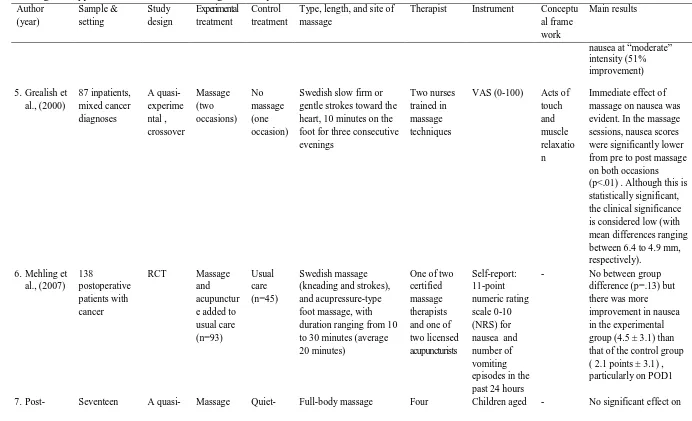
Table 1.
Massage therapy to relieve nausea and vomiting in cancer patients Author (year) Sample & setting Study design Experimental treatment Control treatment
Type, length, and site of massage
Therapist Instrument Conceptu al frame work
Main results
massage (individual-0.5 hr twice/wk), and body-awareness training (in group-1.5 hr/ wk) 3.Billhult et
al., (2007) 39 women with breast cancer undergoing chemotherapy
RCT Five 20-minute massage sessions (n=19) 20-minute visit by hospital staff (n=20) Swedish (effleurage strokes massage) 20 minutes, to either hand/lower arm or foot/lower leg Five staff nurses or nurse aids VAS (0-100). Change of scores on the VAS between pre and post treatment was computed as percent of improvement out of the five sessions
Not specified
Nausea score was significantly lower in the massage group than that of the control group (p =.025) with
approximately 1.5 fold in number of subjects indicating an
improvement between massage group (73.5%) and the control group (49.5%)
4.Cassileth and Vickers, (2004)
1,290 cancer patients at Memorial Sloan-Kettering Cancer Center, with 3,609 episodes of massage Observati onal study
Massage - Standard (Swedish) massage, light touch, and foot massage,
20 min for inpatients (n=961) and 60 min for outpatients (n=329)
12 licensed massage therapists
Numerical rating scale (0-10)
Not specified
Swedish and light touch massage had superior outcomes to foot massage.
Table 1.
Massage therapy to relieve nausea and vomiting in cancer patients Author (year) Sample & setting Study design Experimental treatment Control treatment
Type, length, and site of massage
Therapist Instrument Conceptu al frame work
Main results
nausea at “moderate” intensity (51% improvement)
5.Grealish et al., (2000) 87 inpatients, mixed cancer diagnoses A quasi-experime ntal , crossover Massage (two occasions) No massage (one occasion)
Swedish slow firm or gentle strokes toward the heart, 10 minutes on the foot for three consecutive evenings
Two nurses trained in massage techniques
VAS (0-100) Acts of touch and muscle relaxatio n
Immediate effect of massage on nausea was evident. In the massage sessions, nausea scores were significantly lower from pre to post massage on both occasions (p<.01) . Although this is statistically significant, the clinical significance is considered low (with mean differences ranging between 6.4 to 4.9 mm, respectively).
6.Mehling et al., (2007)
138
postoperative patients with cancer
RCT Massage and acupunctur e added to usual care (n=93) Usual care (n=45) Swedish massage (kneading and strokes), and acupressure-type foot massage, with duration ranging from 10 to 30 minutes (average 20 minutes)
One of two certified massage therapists and one of two licensed acupuncturists Self-report: 11-point numeric rating scale 0-10 (NRS) for nausea and number of vomiting episodes in the past 24 hours
- No between group difference (p=.13) but there was more improvement in nausea in the experimental group (4.5 ± 3.1) than that of the control group ( 2.1 points ± 3.1) , particularly on POD1
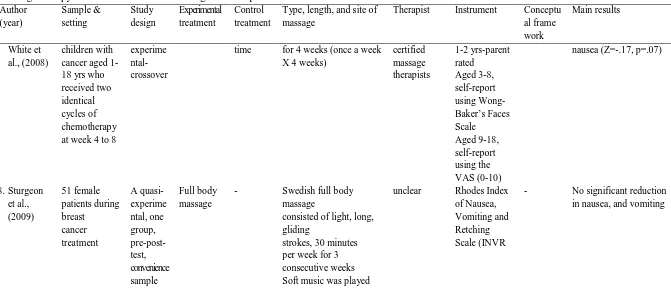
Table 1.
Massage therapy to relieve nausea and vomiting in cancer patients Author (year) Sample & setting Study design Experimental treatment Control treatment
Type, length, and site of massage
Therapist Instrument Conceptu al frame work Main results White et al., (2008) children with cancer aged 1-18 yrs who received two identical cycles of chemotherapy at week 4 to 8
experime ntal-crossover
time for 4 weeks (once a week X 4 weeks)
certified massage therapists 1-2 yrs-parent rated Aged 3-8, self-report using Wong-Baker’s Faces Scale Aged 9-18, self-report using the VAS (0-10)
nausea (Z=-.17, p=.07)
8.Sturgeon et al., (2009) 51 female patients during breast cancer treatment A quasi-experime ntal, one group, pre-post-test, convenience sample Full body massage
- Swedish full body massage
consisted of light, long, gliding
strokes, 30 minutes per week for 3 consecutive weeks Soft music was played
unclear Rhodes Index of Nausea, Vomiting and Retching Scale (INVR
The quality of reviewed studies
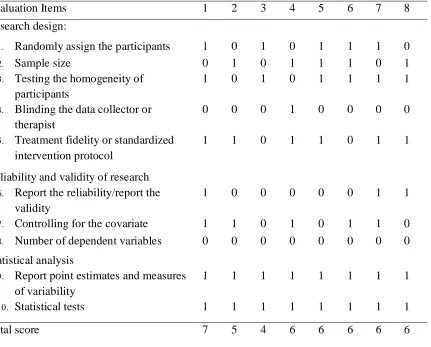
The quality of the reviewed studies was evaluated by a 10-item assessment tool modified from Detsky et al. and van Tukder et al. (as cited in Jane et al., 2008) including the research design, validity of the research, and statistical analyses. Among the eight studies, seven studies (88%) were of medium quality and one study (12%) was of high quality. The results are detailed in Table 2 and the operationalizations of the criteria for quality assessment of the research studies are presented in Table 3.
Table 2.
The quality of reviewed studies
Evaluation Items 1 2 3 4 5 6 7 8
Research design:
1. Randomly assign the participants 1 0 1 0 1 1 1 0
2. Sample size 0 1 0 1 1 1 0 1
3. Testing the homogeneity of participants
1 0 1 0 1 1 1 1
4. Blinding the data collector or therapist
0 0 0 1 0 0 0 0
5. Treatment fidelity or standardized intervention protocol
1 1 0 1 1 0 1 1
Reliability and validity of research
6. Report the reliability/report the validity
1 0 0 0 0 0 1 1
7. Controlling for the covariate 1 1 0 1 0 1 1 0
8. Number of dependent variables 0 0 0 0 0 0 0 0
Statistical analysis
9. Report point estimates and measures
of variability
1 1 1 1 1 1 1 1
10. Statistical tests 1 1 1 1 1 1 1 1
Total score 7 5 4 6 6 6 6 6
Note: Quality of study was determined by the total score of evaluation items and classified as
Table 3
Operationalization of criteria for quality assessment of research Research design:
1. Randomly assign the participants: adequate description of sampling and randomization and
having a control group
2. Sample size: having at least 20 participants in each group or 30 in a one-group design
3. Testing the homogeneity of participants: adequate description of similarity on some demographic data (age, gender, or duration of disease, baseline of primary outcome) or description of how to minimize differences in participants in terms of inclusion criteria (types of disease, age, or previous experience)
4. Blinding the data collector or therapist: given information on blinding data collectors or
therapists
5. Treatment fidelity or standardized intervention protocol: adequate description of standardized intervention protocol, duration, intensity, and frequency of treatment session or manipulation checking applied
Reliability and validity of research
6. Report the reliability/report the validity: given information about the reliability or validity of instrumentation
7. Controlling for the covariate: adequate description of confounder and strategies for adjustment or further examination
8. Number of dependent variables: inclusion of at least 3 outcome measures to reflect multidimensional nature of nausea
Statistical analysis
9. Report point estimates and measures of variability: provision of means and SD or confidence
interval for primary outcome measure
10. Statistical tests: report statistical tests used and results
Note: Adopted from Detsky et al. and van Tukder et al. in “Systematic review of massage
intervention for adult patients with cancer: A methodological perspective” by Jane, S. W., Wilkie, J. D., Gallucci, B. B., and Beaton, R. D. (2008) Cancer Nursing, 31, E25-E35.
Safety and contraindications of massage therapy
common forms of massage, tailored appropriately, are considered very low risk (Ezzo et al., 2007; Lafferty, Downey, McCarty, Standish & Patrick, 2006). A systematic review of the safety of massage therapy concluded that although massage is not entirely free of risk, serious adverse events are rare (Corbin, 2005; Ernst, 2003). The majority of adverse effects were associated with exotic types of manual massages or massages delivered by a layperson. Therefore, providing the information related to the safety and contraindications of massaging are important.
Massaging is often associated with reflexology. Although both involve the use of hands to apply their techniques, these modalities are different. Hodgson and Andersen (2008) state that the major differences of these modalities are that reflexology uses small muscle movements that are applied to specific areas of the body (feet and hands), while massaging uses large muscle movements and is often applied to the entire body.
Foot Reflexology
Reflexology has been offered to patients with cancer in an attempt to improve the adverse physical and psychological symptoms associated with the illness or its treatments (Hodgson, 2000; Quattrin et al., 2006; Ross et al., 2002; Stephenson et al., 2000; Wright et al., 2002,). Studies evaluating the effect of reflexology in a variety of health conditions have shown that it is a promising treatment in promoting well-being with little risk of side-effects (Richardson as cited in Hodgson & Anderson, 2008) and does not interfere with patients' privacy (Stephenson et al., 2000). In addition, the human touch accompanied by reflexology offers care and attention for patients, and this psychological comforting has been reported as a primary benefit of reflexology (Gambles et al. as cited in Wang, 2008). Integrating reflexology points with foot massaging would improve the result, as well as involving some physical and social contact for the patients. Thus, we developed a foot massage program specifically for cancer patients and integrated reflex points of reflexology to determine the area of massage.
Development of Foot Massage Program
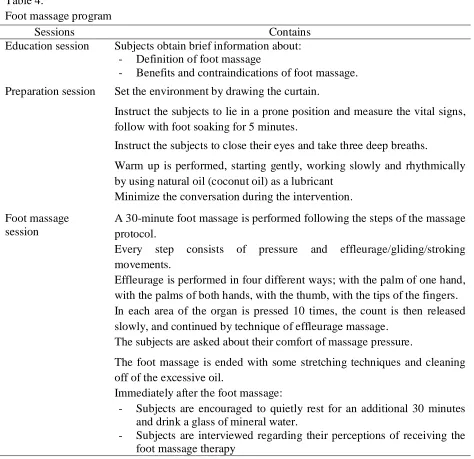
Table 4.
Foot massage program
Sessions Contains
Education session Subjects obtain brief information about: - Definition of foot massage
- Benefits and contraindications of foot massage. Preparation session Set the environment by drawing the curtain.
Instruct the subjects to lie in a prone position and measure the vital signs, follow with foot soaking for 5 minutes.
Instruct the subjects to close their eyes and take three deep breaths.
Warm up is performed, starting gently, working slowly and rhythmically by using natural oil (coconut oil) as a lubricant
Minimize the conversation during the intervention. Foot massage
session
A 30-minute foot massage is performed following the steps of the massage protocol.
Every step consists of pressure and effleurage/gliding/stroking movements.
Effleurage is performed in four different ways; with the palm of one hand, with the palms of both hands, with the thumb, with the tips of the fingers. In each area of the organ is pressed 10 times, the count is then released slowly, and continued by technique of effleurage massage.
The subjects are asked about their comfort of massage pressure.
The foot massage is ended with some stretching techniques and cleaning off of the excessive oil.
Immediately after the foot massage:
- Subjects are encouraged to quietly rest for an additional 30 minutes and drink a glass of mineral water.
- Subjects are interviewed regarding their perceptions of receiving the foot massage therapy
Conclusion and Recommendation
References
Ahles, T., Tope, D., Pinkson, B., Walch, S., Hann, D., Whedon, M., Dain, B., Weiss , J., Mills, L. & Silberfarb, P. (1999), Massage therapy for patients undergoing autologous bone marrow transplant. Journal of Pain and Symptom Management, 18, 157-163.
Andersen, C., Adamsen, L., Moeller, T., Midtgaard, J. Quist, M., Tveteraas, A. et al. (2006). The effect of a multidimensional exercise programme on symptoms and side-effects in cancer patients undergoing chemotherapy: The use of semi-structured diaries. European Journal
of Oncology Nursing, 10, 247–262.
Batavia, M. (2004). Contraindications for therapeutic massage: do sources agree? Journal of
Bodywork and Movement Therapies 8, 48-57.
Bender, C. M., McDaniel, R. W., Murphy-Ende, K., Pickett, M., Rittenberg, C. N., Rogers, M. P., et al. (2002). Chemotherapy-induced nausea and vomiting. Clinical Journal of
Oncology Nursing, 6, (2), 94-102.
Billhult, A., Bergbom, I., & Stener-Victorin, E. (2007). Massage relieves nausea in women with breast cancer who are undergoing chemotherapy. The Journal of Alternative and
Complementary Medicine, 13 (1), 53-57.
Cassileth, B. R. & Vickers, A. J. (2004). Massage therapy for symptom control: Outcome study at a major cancer center. Journal of Pain and Symptom Management, 28, 244-249.
Corbin, L. (2005). Safety and efficacy of massage therapy for patients with cancer. Cancer
control, 12, 158-164.
Ernst, E. (2003). The safety of massage therapy. Rheumatology, 42, 1101–1106.
Ezzo, J. (2007). What can be learned from Cochrane systematic reviews of massage that can guide future research? Journal of Alternative and Complementary Medicine. 13, 291-295. Grealish, L., Lomasney, A., & Whiteman, B. (2000). Foot massage: A nursing intervention to
modify the distressing symptoms of pain and nausea in patients hospitalized with cancer.
Cancer Nursing, 23, 237-243.
Hodgson, N. A., & Andersen, S. (2008). The clinical efficacy of reflexology in nursing home residents with dementia. The Journal of Alternative and Complementary Medicine, 14, 269–275.
Indonesia Health Profile (2010). Retrieved on July 31, 2010 from http://www.depkes.go.id Jane, S. W., Wilkie, J. D., Gallucci, B. B., & Beaton, R. D. (2008). Systematic review of
massage intervention for adult patients with cancer: A methodological perspective. Cancer
Nursing, 31, E24-E35.
Lafferty, W. E., Downey, L., McCarty, R. L., Standish, L. J., Patrick, D. L. (2006). Evaluating CAM treatment at the end of life: A review of clinical trials for massage and meditation.
Complementary Therapies in Medicine, 14, 100—112.
Lakasing, E., & Lawrence, D. (2010). When to use reflexology. Alternative Medicine, 20, (1). 16-19.
Mehling, W. E., Jacobs, B., Acree, M., Wilson, L., Bostrom, A., West, J., et al. (2007).Symptom management with massage and acupuncture in postoperative cancer patients: A randomized controlled trial. Journal of Pain and Symptom Management, 33, 258-266. Parkin, D. M., Bray, F., Ferlay, J., Pisani, P., (2005). Global cancer statistics 2002. CA: A
Cancer Journal for Clinicians, 55(2), 74–108.
Post-White, J., Fitzgerald, M., Savik, K., Hooke, M. C., Sencer, S. F. (2008). Massage therapy for children with cancer. Journal of Pediatric Oncology Nursing, 26, 16-28.
Quattrin, R., Zanini, A., Buchini, S., Turello, D., Annunziata, M. A., Vidotti, C et al. (2006). Use of reflexology foot massage to reduce anxiety in hospitalized cancer patients in chemotherapy treatment: methodology and outcomes. Journal of Nursing Management 14, 96–105.
Rhodes, V. A., & McDaniel, R. W. (2001). Nausea, vomiting, and retching: Complex problems in palliative care. CA: A Cancer Journal for Clinicians, 51, 232-248.
Rose, P. G., Bundy, B. N., Watkins, E. B., Thingpen, J. T., Deppe, G., Maiman, M. A., et al. (1999). Concurrent cisplatin-based radiotherapy and chemotherapy for locally advanced cervical cancer. The New England Journal of Medicine, 340, 1144-1153.
Sherman, K. J., Cherkin, D. C., Kahn, J., Erro, J., Hrbek, A., Deyo, R. A et al (2005). A survey of training and practice patterns of massage therapists in two US states. BMC
Stephenson, N. L. N., Weinrich, S. P., & Tavakoli, A. S. (2000). The effect of foot reflexology on anxiety and pain in patients with breast cancer and lung cancer. Oncology Nursing
Forum, 27 (1), 1-12.
Sturgeon, M., Wetta-Hall, R., Hart, T., Good, M., & Dakhil, S. (2009). Effects of therapeutic massage on the quality of life among patients with breast cancer during treatment. Journal
of Alternative and Complementary Medicine, 15, 373-80.
Tjindarbumi, D. & Mangunkusumo, R. (2002). Cancer in Indonesia, present and future.
Japanese Journal of Clinical Oncology, 32, S17-S21.
Wang, M.-Y., Tsai, P.-S., Lee, P.-H., Chang, W.-Y., & Yang, C.-M (2008). The efficacy of reflexology: Systematic review. Journal of Advanced Nursing 62, 512–520.
Wilkinson, S., Barnes, K. & Storey, L. (2008). Massage for symptom relief in patients with cancer: Systematic review. Journal of Advanced Nursing 63, 430–439.
World Health Organization [WHO] (2007). Fight against cancer: Strategies that prevent, cure and care. Retrieved from
www.who.int/cancer/publicat/WHOCancerBrochure2007.FINALweb.pdf