
UNIVERSITI SAINS MALAYSIA Second Semester Examination
2010/2011 Academic Session April/May 2011
EMC322/3 – Automatic Control [Kawalan Automatik]
Duration :3 hours [Masa : 3 jam]
INSTRUCTIONS TO CANDIDATE:
ARAHAN KEPADA CALON:
Please check that this paper contains SEVEN (7) printed pages and SIX (6) questions before you begin the examination.
Sila pastikan bahawa kertas soalan ini mengandungi TUJUH(7) mukasurat bercetak dan ENAM (6) soalan sebelum anda memulakan peperiksaan.
Answer all questions 1 to 4 and answer either question 5 or 6.
Jawab semua soalan 1 hingga 4 dan jawab salah satu soalan 5 atau 6.
You may answer all questions in English OR Bahasa Malaysia OR a combination of both.
Calon boleh menjawab semua soalan dalam Bahasa Malaysia ATAU Bahasa Inggeris ATAU kombinasi kedua-duanya.
Answer to each question must begin from a new page. Show the working clearly for answers involving calculations.
Setiap soalan mestilah dimulakan pada mukasurat yang baru.Tunjukkan jalan kerja dengan jelas bagi jawapan yang melibatkan kiraan.
In the event of any discrepancies, the English version shall be used.
Sekiranya terdapat sebarang percanggahan pada soalan peperiksaan, versi Bahasa Inggeris hendaklah digunapakai.
[EMC 322/3]
-2-
Q1. [a] A spring used in an automobile shock absorber develops a force f represented by the relation , where x is the displacement of the spring. Determine a linear model for the spring when .
Sebuah pegas yang diguna dalam sebuah penyerap kejutan kereta menghasilkan satu daya f yang diwakili oleh hubungan , di mana x adalah anjakan pegas. Tentukan satu model lelurus bagi pegas tersebut apabila .
(20 marks/markah) [b] A high precision positioning slide is shown in Figure Q1[b]. The governing differential equation for spring is , for mass is , and for friction is . Determine the transfer function when the drive shaft friction is , the drive shaft spring constant is , carriage mass is , and the sliding friction is .
Sebuah peluncur kedudukan persis ditunjukkan dalam Rajah S1[b].
Persamaan pembezaan taklukan bagi pegas adalah , bagi jisim adalah , dan bagi geseran adalah . Tentukan rangkap pindah apabila geseran aci pacu adalah , pemalar pegas aci pacu adalah , jisim pengangkut adalah , dan geseran meluncur adalah .
Figure Q1[b]
Rajah S1[b]
(30 marks/markah) [c] Determine the partial fraction expansion and find the inverse Laplace
transform of a system response which is represented by the equation Tentukan pengembangan pecahan separa dan dapatkan penjelmaan Laplace songsang bagi satu sambutan sistem yang diwakili oleh persamaan
(30 marks/markah) xin
xp
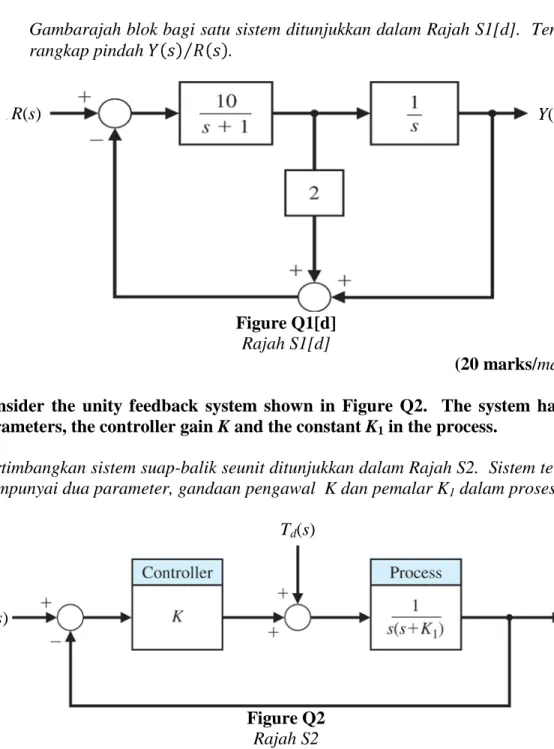
[d] The block diagram of a system is shown in Figure Q1[d]. Determine the transfer function .
Gambarajah blok bagi satu sistem ditunjukkan dalam Rajah S1[d]. Tentukan rangkap pindah .
Figure Q1[d]
Rajah S1[d]
(20 marks/markah) Q2. Consider the unity feedback system shown in Figure Q2. The system has two
parameters, the controller gain K and the constant K1 in the process.
Pertimbangkan sistem suap-balik seunit ditunjukkan dalam Rajah S2. Sistem tersebut mempunyai dua parameter, gandaan pengawal K dan pemalar K1 dalam prosesnya.
Figure Q2 Rajah S2
[a] Find the sensitivity of the close loop transfer function to changes in K1. Dapatkan kepekaan rangkap pindah gelung tertutup terhadap perubahan dalam K1.
(30 marks/markah)
R(s) Y(s)
Y(s) R(s)
Td(s)
[EMC 322/3]
-4-
[b] How would you select a value for K to reduce the sensitivity to change in K1?
Bagaimana anda akan memilih satu nilai bagi K untuk mengurangkan kepekaan terhadap perubahan K1?
(10 marks/markah) [c] Calculate the steady state error of the closed loop system due to a unit step input R(s) = 1/s when K = 120 and . Assume there is no disturbance.
Kira ralat keadaan mantap sistem gelung tertutup akibat satu masukan pelangkah unit R(s) = 1/s apabila K = 120 dan K1 = 10. Anggap tiada gangguan.
(35 marks/markah) [d] Calculate the steady state response of the closed loop system due to a unit step disturbance Td(s) = 1/s when K = 120 and K1 = 120. Assume the input is R(s) = 0.
Kira sambutan keadaan mantap sistem gelung tertutup akibat satu gangguan pelangkah unit Td(s) = 1/s apabila K = 120 dan K1 = 10. Anggap masukan adalah R(s) = 0.
(25 marks/markah) Q3. A third-order closed loop control system with unity feedback is to be designed for an undamped response to a step input. The specifications for the system are percent overshoot P.O ≤ 5%, settling time Ts ≤ 4 seconds, and peak time Tp ≤ 1 second.
Satu sistem kawalan gelung tertutup darjah ketiga dengan suap-balik seunit akan direkabentuk bagi satu sambutan tak-teredam terhadap satu masukan pelangkah.
Spesifikasi-spesifikasi sistem adalah peratus lajakan P.O ≤ 5%, masa enapan Ts ≤ 4 saat, dan masa memuncak Tp≤ 1 saat.
[a] Identify the desired area in the s-plane for the dominant roots of the system.
Kenalpasti kawasan dikehendaki dalam satah-s bagi punca-punca perusa sistem tersebut.
(45 marks/markah) [b] Determine the smallest value of a third pole if the complex conjugate
poles are to represent the dominant response.
Tentukan nilai terkecil bagi satu kutub ketiga jika kutub-kutub jodoh kompleks adalah mewakili sambutan dominan.
(30 marks/markah)
[c] Determine the closed-loop transfer function of the third-order system.
Tentukan rangkap pindah gelung tertutup bagi sistem darjah ketiga tersebut.
(25 marks/markah) Q4. [a] Using Routh-Hurwitz criterion, determine whether a system is stable.
The system has the following characteristic equation
Menggunakan kriteria Routh-Hurwitz, tentukan samada satu sistem adalah stabil. Sistem tersebut mempunyai persamaan ciri berikut
(40 marks/markah) [b] Determine the roots of the characteristic equation of a system. The system
has the following characteristic equation
Tentukan punca-punca persamaan ciri satu sistem. Sistem tersebut mempunyai persamaan ciri berikut
(25 marks/markah) [c] A closed loop system is shown in Figure Q4[c]. For what range of values
of parameters K and p is the system stable?
Satu sistem gelung tertutup ditunjukkan dalam Rajah S4[c]. Apakah julat bagi nilai-nilai parameter K dan p menjadikan sistem stabil?
Figure Q4[c]
Rajah S4[c]
(35 marks/markah) Q5. A unity feedback system has a loop transfer function
Satu sistem suap-balik seunit mempunyai satu rangkap pindah gelung
[a] Determine the angle of departure of the root locus at the complex poles.
Tentukan sudut pelepasan londar punca pada kutub-kutub kompleksnya.
(30 marks/markah)
R(s) Y(s)
[EMC 322/3]
-6- [b] Sketch the root locus.
Lakarkan londar puncanya.
(45 marks/markah) [c] Determine the gain K when the roots are on the jω-axis and determine the
location of the roots.
Tentukan gandaan K apabila punca-puncanya berada di atas paksi-jω dan tentukan kedudukan punca-punca tersebut.
(25 marks/markah) Q6. [a] An adaptive suspension vehicle uses a legged locomotion principle. Design a suitable phase-lag compensator by using root locus method that can achieve a steady-state error for a ramp input of 10% and a damping ratio of the dominant roots of 0.707. The control of the leg can be represented by a unity feedback system with
Sebuah kenderaan gantungan suai menggunakan satu prinsip penggerak berkaki. Reka satu pemampas susulan fasa dengan menggunakan kaedah londar punca yang boleh mencapai satu ralat keadaan mantap bagi satu masukan tanjakan 10% dan satu nisbah peredam punca-punca dominan 0.707. Kawalan kaki boleh diwakili oleh satu sistem suap-balik seunit dengan
(60 marks/markah)
[b] A control system with a controller is shown in Figure Q6[b]. Add a pre- filter and select Kp and KI so that the step response is deadbeat and the settling time (with a 2% criterion) is less than 2 seconds. Use the coefficient and response measure of a deadbeat system from Table Q6[b].
Satu sistem kawalan dengan satu pengawal ditunjukkan dalam Rajah S6[b].
Tambahkan satu pra-penapis dan pilih Kp dan KI supaya sambutan pelangkahnya adalah pecundang dan masa enapannya (dengan kriteria 2%) kurang dari 2 saat. Gunakan pekali dan ukuran sambutan satu sistem pecundang dari Jadual S6[b].
Figure Q6[b]
Rajah S6[b]
Table Q6[b]
Jadual S6[b]
(40 marks/markah)
-oooOOooo-
Y(s) R(s)
[EME 422/3]
-1-
UNIVERSITI SAINS MALAYSIA Second Semester Examination
Academic Session 2010/2011 April /May 2011
EME 422/3 – Energy Conversion System Sistem Penukaran Tenaga
Duration : 3 hours Masa : 3 jam
INSTRUCTIONS TO CANDIDATE:
ARAHAN KEPADA CALON:
Please check that this paper contains FIVE (5) printed pages and FIVE (5) questions before you begin the examination.
Sila pastikan bahawa kertas soalan ini mengandungi LIMA (5) mukasurat bercetak dan LIMA (5) soalan sebelum anda memulakan peperiksaan.
Answer ALL questions.
Jawab SEMUA soalan.
You may answer all questions in English OR Bahasa Malaysia OR a combination of both.
Calon boleh menjawab semua soalan dalam Bahasa Malaysia ATAU Bahasa Inggeris ATAU kombinasi kedua-duanya.
Answer to each question must begin from a new page.
Jawapan untuk setiap soalan mestilah dimulakan pada mukasurat yang baru.
In the event of any discrepancies, the English version shall be used.
Sekiranya terdapat sebarang percanggahan pada soalan peperiksaan, versi Bahasa Inggeris hendaklah diguna pakai.
Thermodynamic property table and Carta Mollier are provided.
Jadual Sifat Bendalir Termodinamik adalah dibekalkan.
Q1. [a] Describe briefly one of the following renewable energy resources.
(i) Solar (ii) Wind (iii) Geothermal (iv) Mini hydro (v) Wave
Terangkan salah satu daripada sumber tenaga boleh diperbaharui berikut.
(i) Suria (ii) Angin (iii) Geotermal (iv) Hidro mini (v) Ombak
(40 marks/markah) [b] A 50 kWe small power plant consist of a gasifier and a diesel engine.
The followings are the assumptions made:
• Diesel displacement 60%
• Efficiency of the gasifier 70%
• Efficiency of the engine 25%
• Biomass heating value 15 MJ/kg
• Heating value of diesel fuel 30 MJ/kg
• Engine speed 1500 rev/min Determine
(i) The amount of biomass required per hour (ii) The volumetric flow rate of air
(iii) Overall efficiency of the system (iv) The specific biomass consumption
Sebuah lojikuasa kecil 50 kWe mengandungi sebuah penggas dan enjin diesel. Berikut adalah andaian yang dibuat:
• Anjakan minyak diesel 60%
• Kecekapan penggas 70%
• Kecekapan enjin 25%
• Nilai haba biomass 15 MJ/kg
• Nilai haba minyak diesel 30 MJ/kg
• Laju putaran enjin adalah 1500 rev/min Tentukan
(i) Amaun biomass yang diperlukan setiap jam (ii) Kadar alir isipadu udara
(iii) Kecekapan keseluruhan sistem (iv) Penggunaan spesifik biomass
(60 marks/markah) Q2. [a] Describe briefly the procedure for proximate analysis
Terangkan dengan ringkas prosedur bagi analisis hampiran
(40 marks/markah)
[EME 422/3]
-3-
[b] Ultimate analysis of coal is shown below:
C = 80%, H = 10%, O = 6%, S = 0.5%, ash = 3.5%
Determine
(i) A/F ratio for excess air of 20%
(ii) Amount of carbon dioxide emission annualy Analisis arang batu adalah ditunjukan di bawah:
C=80%, H=10%, O=6%, S=0.5%, ash abu=3.5%
Tentukan
(i) Nisbah A/F bagi kelebihan udara 20%
(ii) Amaun pencemaran karbon dioksida setahun.
(60 marks/markah) Q3. Combine cycle power plant produces 250 MW. The following are the details
(i) Pressure ratio of gas turbine 7:1
(ii) Inlet temp to the gas turbine plant is 30oC
(iii) Maximum temperature in the gas turbine plant is 1000oC (iv) Steam pressure is 60 bar
(v) Steam temp 600oC
(vi) Calorific value of fuel 40 MJ/kg
(vii) Condenser pressure of the steam plant is 0.05 bar (viii) Gas temp at HRSG exit 200oC
(ix) Gas temp inside HRSG 800oC
Use the Mollier chart provide. Sketch the combine cycle plant and determine its thermal efficiency.
Loji kuasa gabungan menjana 250 MW kuasa. Berikut adalah perincian loji.
(i) Nisbah tekanan turbin gas 7:1
(ii) Suhu masukan kedalam loji gas turbin adalah 30oC (iii) Suhu maksimum dalam loji gas turbin adalah 1000oC (iv) Tekanan stim adalah 60 bar
(v) Suhu stim 600oC
(vi) Nilai haba bahan api 40 MJ/kg
(vii) Tekanan pemeluwap loji stim adalah 0.05 bar (viii) Suhu gas pada keluaran HRSG 200oC
(ix) Suhu gas pada masukan HRSG 800oC
Gunakan carta Mollier yang dibekalkan. Lakarkan loji kuasa gabungan dan tentukan kecekapan keseluruhan loji.
(100 marks/markah)
Q4. [a] The following is the data for a 20 MW biomass power plant:
(i) Nominal RM 5000/ kW (ii) Interest rate 7%
(iii) Period of loan 25 years (iv) Period of operation 25 years (v) Number of workers 20
(vi) Average salary per month RM 4000 (vii) Fuel cost RM 20 per ton
(viii) Type of fuel is oil palm waste (ix) Heating value 15 MJ/kg (x) Thermal efficiency 20%
(xi) Maintenance cost = Labour cost (xii) Capacity factor 80%
(xiii) Power sales by TNB 17sen/kWh Calculate the unit production cost.
Berikut adalah maklumat bagi sebuah loji kuasa biojisim 20 MW.
(i) Kos nominal RM 5000/ kW (ii) Kadar pinjaman 7%
(iii) Masa pinjman 25 years (iv) Masa operasi 25 years (v) Bilangan pekerja 20
(vi) Purata gaji sebulan RM 4000 (vii) Kos bahanapi RM 20 per ton
(viii) Jenis bahanapi adalah sisa kelapa sawit (ix) Nilai haba 15 MJ/kg
(x) Kecekapan haba 20%
(xi) Kos penyelenggaraan = Kos pekerja (xii) Faktor kapasiti 80%
(xiii) Pembelian kuasa oleh TNB 17sen/kWh Tentukan unit kos penjanaan.
(60 marks/markah) [b] Explain whether you would invest in such power plant and compare feasibility of a plant using oil at a price of RM200 per ton with heating value of oil 30 MJ/kg.
Terangkan samada anda ingin melabur dalam loji kuasa tersebut dan bandingkan kesesuaian loji kuasa menggunakan minyak pada harga RM200 per ton dimana nilai haba minyak 30 MJ/kg
(40 marks/markah)
[EME 422/3]
-5-
Q5. [a] Describe briefly 3 main pollutants from coal power plant including the production, hazards and ways of reducing them.
Terangkan dengan ringkas 3 pencemar daripada loji kuasa arang batu termasuk penghasilannnya, bahaya dan cara mengurangkannya.
(40 marks/markah) [b] Describe briefly the following systems and also explain why the
following energy systems are not implemented at present:
(i) Fusion energy
(ii) Thermoelectric generator (iii) Fuel cell
Terangkan dengan ringkas sistem berikut dan terangkan juga kenapa sistem tenaga berikut tidak digunakan pada masa sekarang.
(i) Tenaga fusion
(ii) Penjana termoelektrik (iii) Sel bahanapi
(60 marks/markah
-oooOOooo-
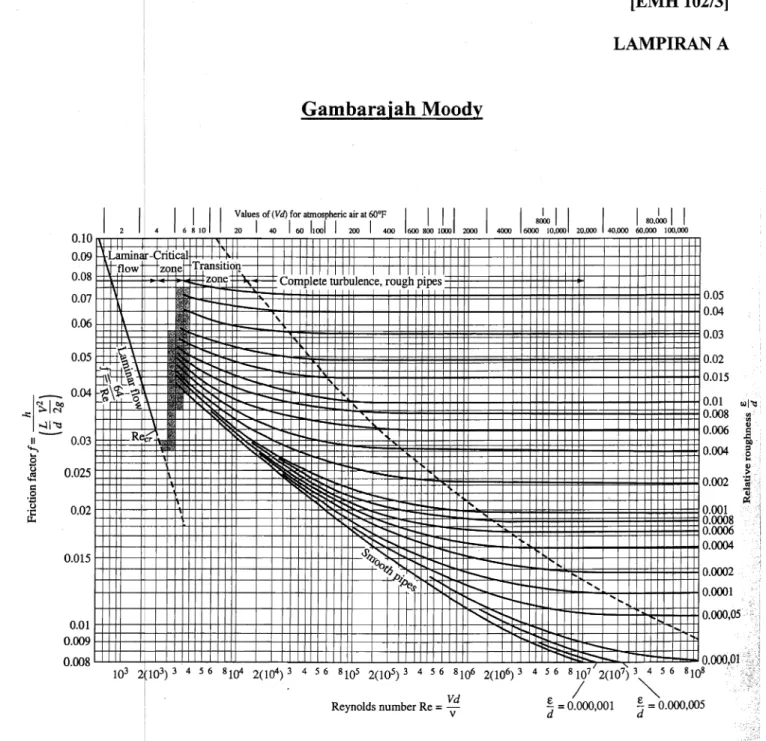
LAMPIRAN A
Gambarajah Moody
I I I I I I
Values of (Vd) for atmospheric air at 6O'FI I I I I I
1I I I I I I
12 4 6 8 10 20 I 40 I60 11001 I 200 I 400 600 800 1000 2000 4000 ~oo;o,ooo 20,000 40,000 60,:;00:00,000
0.05 0.04 0.03 0.02 0.D15 0,01 "'1'1;
0.008
.a
'" " '"0.006
b/)
0.004
"
g;. "
0,002 .."
..
0.001 ~
0,()()()8 0.()()()6 0.0004 0.()()()2 O.()()()l 0.000,05
0.000,01
8 Reynolds number Re =v Vd
Fig. 6.13 The Moody chart for pipe From tests with commercial pipes Moody gave the values for average pipe roughnes~
friction with smooth and rough walls. listed in Table 6.1.
This chart is identical to Eq. (6.64)
for turbulent flow. (From Ref 8, by Table 6.1 Average Roughness of Commercial Pipes permission of the ASME.)
Material (new) ft mm
Riveted steel 0.003-0.03 0.9-9.0
Concrete 0.001-0.01 0.3-3.0
Wood stave 0.0006-0.003 0.18-0.9
Cast iron 0.00085 0.26
Galvanized iron 0.0005 0.15
Asphalted cast iron 0.0004 0.12
Commercial steel or wrought iron 0.00015 0.046
Drawn tubing 0.000005 0.0015
Glass "Smooth" "Smooth"
[EMH 102/3]
LAMPIRAN B
Pemalar Kehilangan pada Pelbagai Sambungan
UNIVERSITI SAINS MALAYSIA Second Semester Examination
Academic Session 2010/2011 April/May 2011
EMH 102/3 – Fluid Mechanics Mekanik Bendalir
Duration : 3 hours Masa : 3 jam
INSTRUCTIONS TO CANDIDATE:
ARAHAN KEPADA CALON:
Please check that this paper contains SEVEN (7) printed pages, TWO (2) pages appendix and SIX (6) questions before you begin the examination.
Sila pastikan bahawa kertas soalan ini mengandungi TUJUH (7) mukasurat bercetak, DUA (2) mukasurat lampiran dan ENAM (6) soalan sebelum anda memulakan peperiksaan.
Answer FIVE (5) questions.
Jawab LIMA (5) soalan.
Appendix/Lampiran :
1. Gambarajah Moody [1 page/mukasurat]
2. Pemalar Kehilangan pada Pelbagai Sambungan [1 page/mukasurat]
You may answer all questions in English OR Bahasa Malaysia OR a combination of both.
Calon boleh menjawab semua soalan dalam Bahasa Malaysia ATAU Bahasa Inggeris ATAU kombinasi kedua-duanya.
Answer to each question must begin from a new page.
Jawapan untuk setiap soalan mestilah dimulakan pada mukasurat yang baru.
In the event of any discrepancies, the English version shall be used.
Sekiranya terdapat sebarang percanggahan pada soalan peperiksaan, versi Bahasa Inggeris hendaklah diguna pakai.
[EMH 102/3]
-2-
Q1. [a] Explain the capillary effect and how it is caused by?
Terangkan kesan rerambut dan apakah yang menyebabkan kesan ini terjadi?
(30 marks/markah) [b] If the gauge pressure at the bottom surface is 73kN/m2, determine the specific gravity of the gasoline. Calculate also the pressure at the gasoline-water interface as in Figure Q1[b]. Express the gauge pressure in units of N/m2, N/mm2, and as a pressure head in meter of water.
Jika tekanan tolok di permukaan dasar adalah 73kN/m2, tentukan graviti tentu bagi gasolin. Kirakan juga tekanan antara-muka gasolin-air, dan di dasar tangki seperti dalam Rajah S1[b]. Ungkapkan tekanan tolok dalam unit N/m2, N/mm2, dan sebagai turus tekanan dalam meter air.
Gasoline
Water Compressed Air, Pg= 30kPa
5m
1m
Figure Q1[b]
Rajah S1[b]
(30 marks/markah) [c] Given v = 10y1/6, where v is the velocity of water in m/s and y is the distance from the boundary in mm, plot the velocity profile and determine the ratio of shear stress at y= 2mm to the shear stress at y= 5mm.
Diberi v = 10 y1/6, di sini v adalah halaju air dalam m/s dan y adalah jarak daripada sempadan dalam mm, lukis susuk hahaju dan tentukan nisbah tegasan ricih pada y= 2mm kepada tegasan ricih pada y= 5mm.
(40 marks/markah)
S2. [a] Calculate the vacuum necessary to cause cavitation in a water flow at temperature of 80oC at the mount of Kinabalu where the elevation is 2500m above sea level.
Kirakan hampagas diperlukan yang boleh menyebabkan keronggaan di dalam aliran air pada suhu 80oC di gunung Kinabalu pada paras ketinggian 2500m di atas paras laut.
(30 marks/markah) [b] Determine the location of the resultant force F of the water on the
triangular gate and the force P needed to hold the gate in the position as shown in Figure Q2[b] (Take for triangular gate)
Tentukan lokasi daya hasilan F bagi air pada pintu segitiga dan daya P yang diperlukan bagi menahan pintu pada posisi seperti dalam Rajah S2[b] (Ambil bagi pintu segitiga)
water
50
3m 2m
P
Hinge
Gate
5m
Figure Q2[b]
Rajah S2[b]
(30 marks/markah)
[EMH 102/3]
-4-
[c] The barge is loaded such that the center of gravity of the barge and load is at the waterline. Determine the stability of barge if the barge length is 10m.
Baj dimuatkan dengan muatan supaya pusat graviti baj dan muatan adalah pada paras garis air. Tentukan kestabilan baj tersebut jika panjang baj adalah 10m.
Barge
Water
8m
3m
Figure Q2[c]
Rajah S2[c]
(40 marks/markah) Q3. [a] Differentiate between the Eulerian and Langragian flow concepts.
Bezakan di antara konsep aliran Euler dan Langrange.
(30 marks/markah) [b] A liquid with a specific gravity of 1.26 flows in a pipe at a rate of
700liter/s. At a point where the pipe diameter is 60cm, the pressure is 300kPa. Find the pressure at a second point where the pipe diameter is 30cm if the second point is 1.0m lower than first point. Neglect head loss.
Cecair mempunyai graviti tentu 1.26 mengalir di dalam sebuah paip pada kadar 700liter/s. Pada suatu titik di mana garis pusat paip 60cm, tekanan adalah 300kPa. Tentukan tekanan pada titik kedua di mana garis pusat paip adalah 30cm jika titik kedua adalah 1.0m rendah daripada titik pertama. Abaikan kehilangan turus.
(30 marks/markah)
[c] An inviscid, incompressible fluid flows between wedge-shaped walls into small opening as shown in Figure Q3[c]. The potential velocity (in m2/s), which approximately describes this flow is
r ln
−2 φ =
Determine the volume flow rate (per unit length) into the opening.
Bendalir tak likat, tak boleh mampat mengalir di antara dinding berbentuk baji yang mempunyai bukaan kecil seperti yang ditunjukkan dalam Rajah S3[c]. Halaju upaya (dalam m2/s), yang diramal aliran ini dengan
r ln
−2 φ =
Tentukan kadar aliran isipadu (per unit panjang) ke dalam bukaan.
V 0
r
Figure Q3[c]
Rajah S3[c]
(40 marks/markah) Q4. [a] Draw the orifice meter and explain how the flow rate can be measured.
Lukis meter orifis dan terangkan bagaimana kadar aliran boleh diukur.
(30 marks/markah) [b] An oil with a kinematic viscosity of 0.000135m2/s flows through a pipe of diameter 15cm. What is the minimum velocity will the flow is laminar?
Minyak dengan kelikatan kinematik 0.000135m2/s mengalir melalui sebuah paip bergaris pusat 15cm. Apakah nilai minimum halaju yang akan menghasilkan aliran laminar?
(30 marks/markah) [c] The flow rate in a 30cm diameter pipe is 0.255m3/s. The flow is known to be turbulent, and the centerline velocity is 3.7m/s. Plot the velocity profile, and determine the head loss per meter of pipe.
Kadar aliran dalam sebuah paip bergaris pusat 30cm ialah 0.255m3/s.
Aliran diketahui sebagai gelora, dan halaju di garis pusat ialah 3.7m/s.
Lukis susuk halaju, dan tentukan kehilangan turus per unit meter bagi paip.
(40 marks/markah)
[EMH 102/3]
-6-
Q5. [a] Explain briefly the terms of pathline, streakline and streamline by the help of diagrams.
Terangkan secara ringkas sebutan garis laluan, garis jalur dan garis arus berbantukan gambarajah.
(30 marks/markah) [b] Sketch the pitot-static probe and piezometer arrangement on the pipe.
Using the Bernoulli equation show that the fluid velocity, V in the pipe can be obtained by using the equation:
Lakarkan susunan peralatan pitot-statik dan piezometer pada paip.
Dengan menggunakan persamaan Bernoulli tunjukkan halaju bendali, V di dalam paip boleh ditentukan dengan menggunakan persamaan:
(30 marks/markah) [c] The piping system as shown in Figure Q5[a] is used to transport the
liquid (s = 0.85, ν = 1x10⁻⁵m2/s) from tank A to tank B. Determine the flow rate of the system.
Line 1: L= 10m, D= 0.2m, pipe material= wrought iron Line 2: L= 500m, D= 0.25m, pipe material= wrought iron
Sistem paip seperti dalam Rajah S5[a] digunakan bagi menghantar cecair (s= 0.85, ν= 1x10⁻⁵m2/s) daripada tangki A ke tangki B. Tentukan kadar aliran bagi sistem.
Laluan 1: L= 10m, D= 0.2m, bahan paip= besi waja Laluan 2: L= 500m, D= 0.25m, bahan paip= besi waja
Sharp edge elbow
Gate Valve Full Opening Elevation 10m
Elevation 20m
Line 2
Line 2 Line 1
20kPa
Figure Q5[a]
Rajah S5[a]
(40 marks/markah) Tank B
Tank A
Q6. [a] List and describe the three necessary conditions for complete similarity between a model and a prototype.
Senarai dan terangkan tiga keadaan penting bagi keserupaan lengkap di antara sebuah model dan sebuah prototaip.
(30 marks/markah) [b] The pressure drop ΔP in the pipe depends on the average velocity V, pipe diameter D, kinematic viscosity ν, wall roughness height e, and the fluid density ρ. Find the dimesionless group for the expression of ΔP.
Kejatuhan tekanan ΔP di dalam paip bergantung kepada halaju purata V, garis pusat paip D, kelikatan kinematik ν, ketinggian kekasaran dinding e, dan ketumpatan bendalir ρ. Tentukan kumpulan tanpa dimensi bagi ΔP.
(30 marks/markah) [c] A test model is to be performed on a proposed design for a large pump that is to deliver 1.5m3/s of water from a 40cm diameter impeller with a pressure rise of 400 kPa. A model with an 8 cm diameter impeller is to be used. Calculate the flow rate should be used and the pressure rise that to be expected. The model fluid is water at the same temperature as the water in the prototype.
Sebuah model ujian untuk dijalankan ke atas sebuah reka bentuk cadangan bagi sebuah pam besar mengalirkan air pada 1.5 m3/s daripada pendesak garis pusat dengan 40cm dengan peningkatan tekanan 400kPa. Sebuah model dengan sebuah pendesak bergaris pusat 8cm yang akan digunakan.
Kirakan kadar aliran yang sepatutnya digunakan dan peningkatan tekanan yang dijangkakan. Bendalir model adalah air pada suhu yang sama dengan air bagi prototaip.
(40 marks/markah)
-oooOOooo-
[EMH 222/3]
-1-
UNIVERSITI SAINS MALAYSIA Second Semester Examination
Academic Session 2010/2011 April/May 2011
EMH 222/3 – Fluid Dynamics Dinamik Bendalir
Duration : 3 hours Masa : 3 jam
INSTRUCTIONS TO CANDIDATE:
ARAHAN KEPADA CALON:
Please check that this paper contains NINE (9) printed pages and SIX (6) Sila pastikan bahawa kertas soalan ini mengandungi
questions before you begin the examination.
SEMBILAN (9) mukasurat bercetak dan ENAM (6) soalan sebelum anda memulakan peperiksaan.
Answer FIVE Jawab
questions.
LIMA soalan.
You may answer all questions in English OR Bahasa Malaysia Calon boleh menjawab semua soalan dalam
OR a combination of both.
Bahasa Malaysia ATAU Bahasa Inggeris ATAU kombinasi kedua-duanya.
Answer to each question must begin from a new page.
Jawapan untuk setiap soalan mestilah dimulakan pada mukasurat yang baru.
Gas Table for Compressible Flow Calculation is provided.
Jadual untuk Pengiraan Aliran Bolehmampat adalah dibekalkan.
In the event of any discrepancies, the English version shall be used.
Sekiranya terdapat sebarang percanggahan pada soalan peperiksaan, versi Bahasa Inggeris hendaklah diguna pakai.
Q1. [a] Explain why the stream function is useful in fluid mechanics? What restrictions or conditions are imposed on stream function ψ so that it exactly satisfies the two-dimensional incompressible continuity equation by definition?
Terangkan mengapa rangkap arus penting dalam mekanik bendalir?
Apakah had-had atau keadaan yang dikenakan pada rangkap arus, ψ supaya rangkap tersebut memenuhi kehendak persamaan keselanjaran dua dimensi?
(50 marks/markah) [b] A uniform stream of speed V is inclined at angle α from the x-axis
(as in Figure Q1[b]). The flow is steady, two-dimensional and incompressible. The Cartesian velocity components are
and . Generate an expression for the stream function for this flow.
Satu aliran arus yang mempunyai kelajuan V dicondongkan pada sudut α daripada paksi-x (seperti dalam Rajah S1[b]). Aliran tersebut adalah aliran mantap, dua dimensi dan tak boleh mampat. Komponen halaju Cartesian adalah dan . Janakan satu ungkapan untuk rangkap arus aliran tersebut.
Figure Q1[b]
Rajah S1[b]
(50 marks/markah)
[EMH 222/3]
-3-
Q2. [a] In the nondimensionalized incompressible Navier-Stokes equation has four nondimensional parameters. Name each one, explain its physical significance (e.g. the ratio of pressure forces to viscous forces), and discuss what it means physically when the parameter is very small or very large.
Dalam persamaan Navier-Stokes tanpa dimensi tak boleh mampat, terdapat empat parameter tanpa dimensi. Namakan setiap satu parameter tersebut, terangkan kepentingan fizikal (contoh: nisbah daya tekanan dan daya kelikatan) dan bincangkan apakah yang dimaksudkan secara fizikal parameter-parameter tersebut sekiranya nilai parameter tersebut terlalu kecil atau terlalu besar.
(50 marks/markah)
[b] Air at 20°C flows at parallel to a flat plate (Figure Q2[b]). The front of the plate is well rounded, and the plate is
40 cm long. The plate thickness is . Calculate the apparent thickness of the plate (includes both sides) at downstream distance . Assume the boundary layer starts growing at x=0 cm and the plat is smooth.
Udara mengalir pada halaju dan suhu 20°C selari dengan plat rata (Rajah S2[b]). Permukaan hadapan plat rata tersebut berbentuk bulat dan panjang plat tersebut ialah 40 cm. Ketebalan plat tersebut adalah 0.75 cm. Kirakan ketebalan ketara plat rata tersebut (untuk kedua- dua belah) pada jarak hilir x=25 cm. Anggapkan lapisan sempadan mula meningkat pada jarak x=0cm dan plat adalah licin.
Figure Q2[b]
Rajah S2[b]
(50marks/markah)
Q3. [a] The drag coefficient of a vehicle increases when its windows are rolled down or its sunroof is opened. A sport car as in Figure Q3[a] has a frontal area of 1.7 m2 and a drag coefficient of 0.22 when the windows and sunroof are closed. The drag coefficient increases to 0.41 when the sunroof is open. Determine the additional power of consumption of the car when the sunroof is opened at:
Pekali heret sebuah kenderaan meningkat apabila tingkap-tingkap dan bumbung suria dibuka. Sebuah kereta sukan seperti dalam Rajah S3[a]
mempunyai luas permukaan depan 1.7 m2
(i) 55 km/h
dan pekali heret 0.22 apabila tingkap dan bumbung suria ditutup. Pekali heret akan meningkat kepada 0.41 apabila bumbung suria tersebut dibuka. Kirakan kuasa tambahan yang diperlukan apabila bumbung suria dibuka pada kelajuan kenderaan:
55 km/jam (ii) 110 km/h
110 km/jam
Take the density of air to be 1.2 kg/m3. Comment your answer of the differences found with respect to the power consumption to overcome the drag.
Ketumpatan udara yang digunakan 1.2 kg/m3
Figure Q3[a]
Rajah S3[a]
(50 marks/markah) . Komen jawapan anda berkenaan perbezaan yang diperolehi dalam penggunaan kuasa yang diperlukan untuk mengurangkan daya heretan.
[EMH 222/3]
-5-
[b] Consider a light aeroplane that has a total weight of 15000 N and a wing area of 46 m2 and whose wings resemble the NACA 23012 airfoil with no flaps. Using data from Figure Q3[b], determine the takeoff speed at an angle of attack of 5° at sea level. Also determine the stall speed.
Sebuah pesawat ringan mempunyai jumlah berat 15000 N dan luas sayap 46 m2
Figure Q3[b]
Rajah S3[b]
(50 marks/markah) yang mana sayap tersebut serupa seperti kerajang udara tanpa kepak NACA 23012. Menggunakan data dalam Rajah S3[b], kirakan halaju berlepas pada sudut tujahan 5° pada paras laut. Kirakan juga halaju pegun.
Q4. [a] Air flows steadily from a large reservoir through a convergent- divergent nozzle into a 0.3 m diameter pipe with a length of 3.5m, as illustrated in Figure Q4[a]. The conditions in the reservoir are such that the Mach number, M, and the pressure, P, at the inlet to the pipe are 2 and 0.13kPa respectively. The average friction factor, f, for the flow in the pipe is estimated to be 0.005.
(i) If no shocks occur, find M and P at the exit of the pipe.
(ii) If there is a normal shock at the exit of the pipe, find the back pressure in the chamber into which the pipe is discharging.
Find the back pressure in the chamber into which the pipe is discharging when there is a shock halfway down the pipe.
Udara mengalir secara mantap daripada takungan besar melalui muncung tumpu-capah ke paip berdiamater 0.3 m dan panjang paip 3.5 m seperti dalam Rajah S4[a]. Keadaan dalam takungan tersebut ialah nombor Mach, M = 2 dan tekanan, P, pada salur masuk paip ialah 0.13 kPa.
Purata faktor geseran, f, untuk aliran di dalam paip dianggarkan 0.005.
(i) Sekiranya tiada kejutan berlaku, kirakan M dan P di salur keluar paip tersebut.
(ii) Sekiranya ada kejutan biasa pada salur keluar paip, kirakan tekanan balik di dalam kebuk di mana paip aliran dalam paip tersebut dialirkan keluar.
Figure Q4[a]
Rajah S4 [a]
(50 marks/markah)
[EMH 222/3]
-7-
[b] Natural gas flows through a 0.075m diameter pipeline which has a length of 750 m, as in Figure Q4[b]. The flow can be assumed to be isothermal with a temperature of 15˚C. The Mach number and pressure at the inlet are 0.09 and 900 kPa. If the mean friction factor for the flow is 0.002, find the Mach number and the pressure at the exit to the pipe. Also find the maximum possible length of the pipe and the exit pressure with this length of pipe. Assume that the flow is steady and that the natural gas has a specific heat ratio at 1.3.
Gas asli mengalir melalui talian paip berdiamater 0.075m sepanjang 750m seperti dalam Rajah S5[b]. aliran tersebut boleh dianggapkan sebagai isoterma dangan suhu 15˚C. Nombor Mach dan tekanan pada salur masuk ialah 0.09 dan 900 kPa. Sekiranya purata faktor geseran untuk aliran tersebut ialah 0.002, kirakan nombor Mach dan tekanan pada salur keluar paip. Kirakan juga panjang maksimum yang mungkin untuk paip tersebut dan tekanan pada salur keluar dengan panjang maksimum yang dikirakan.
Anggapkan aliran adalah mantap dan gas asli tersebut mempunyai nisbah haba tentu 1.3.
Figure Q4[b]
Rajah S4[b]
(50 marks/markah) Q5. [a] Explain with the aid of diagram the elementary theory of radial flow pumps showing the impeller control volume and the velocity diagram at control surfaces.
Terangkan dengan bantuan rajah berkenaan teori asas pam aliran jejari dengan menunjukkan rajah pendesak isipadu kawalan dan gambarajah halaju pada permukaan kawalan.
(50 marks/markah)
[b] An axial flow pump is designed with a fixed guide vane or stator blade, located upstream of the impeller. The stator imparts an angle of
to the fluid as it enters the impeller region. The impeller has a rotational speed of 500 rpm with a blade exit angle of . The control volume has an outer diameter of and an inner diameter of . Determine the theoretical head rise and power required if of liquid ( is to be pumped.
Sebuah pam aliran paksi direkabentuk dengan ram pandu tetap atau bilah pemegun di hulu pendesak. Pemegun tersebut menyesahkan aliran pada sudut apabila masuk ke dalam ruang pendesak. Halaju putaran pendesak ialah 500 rpm dan sudut keluar bilah . Isipadu kawalan
mempunyai diameter luar dan diameter dalam . Kirakan turus kepala dan kuasa diperlukan untuk
cecair yang akan dipamkan.
(50 marks/markah) Q6. [a] Briefly discuss the main differences in the way that dynamics pumps and reaction turbines are classified as centrifugal (radial), mixed flow or axial.
Bincangkan secara ringkas perbezaan ketara bagaimana pam dinamik dan turbin tindak balas yang diklasifikasikan sebagai empar (jejarian), aliran campuran atau paksi.
(40 marks/markah) [b] A Francis radial-flow hydro turbine is being designed with the
following dimensions: r2 = 2.0 m, r1 = 1.42 m, b2 = 0.7361 m and b1 = 2.20 m. The runner rotates at . The wicket gates
turn the flow by angle from radial at the runner inlet, and the flow at the runner outlet is at angle from radial (as in Figure Q6[a]). The volume flow rate at design conditions is 340 m3/s, and the gross head provided by the dam is . For the preliminary design, irreversible losses are neglected. Calculate the inlet and outlet runner blade angles and , respectively, and predict the power output (MW) and the required net head (m).
Is the design feasible? Explain.
[EMH 222/3]
-9-
Sebuah hidroturbin Francis aliran jejarian direkabentuk dengan dimensi seperti berikut: r2 = 2.0m, r1 = 1.42m, b2 = 0.7361 m dan b1 = 2.20 m.
‘Pelari’ tersebut berputar pada . ‘Pintu Wicket’
memusingkan aliran tersebut pada sudut daripada jejari ‘pelari’
dalaman dan aliran pada alur keluar ‘pelari’ adalah pada sudut
dari jejari (seperti dalam Rajah S6[b]). Kadar aliran isipadu pada keadaan rekabentuk ialah 340 m3
Figure Q6[b]
Rajah S6[b]
(60 marks/markah) /s dan nilai turus kasar oleh empangan adalah . Untuk rekabentuk permulaan, kehilangan tak boleh balik boleh diabaikan. Kirakan alur masuk dan alur keluar sudut bilah ‘pelari’ dan , juga ramalkan kuasa keluaran (MW) dan nilai turus bersih (m) yang diperlukan. Adakah rekabentuk tersebut boleh dilaksanakan? Terangkan.
-oooOOooo-
UNIVERSITI SAINS MALAYSIA Second Semester Examination
Academic Session 2010/2011 April/May 2011
EMM 102/3 – Statics Statik
Duration : 3 hours Masa : 3 jam
INSTRUCTIONS TO CANDIDATE:
ARAHAN KEPADA CALON:
Please check that this paper contains NINE (9) printed pages and FIVE (5) questions before you begin the examination.
Sila pastikan bahawa kertas soalan ini mengandungi SEMBILAN (9) mukasurat bercetak dan LIMA (5) soalan sebelum anda memulakan peperiksaan.
Answer ALL questions.
Jawab SEMUA soalan.
You may answer all questions in English OR Bahasa Malaysia OR a combination of both.
Calon boleh menjawab semua soalan dalam Bahasa Malaysia ATAU Bahasa Inggeris ATAU kombinasi kedua-duanya.
Answer to each question must begin from a new page.
Jawapan untuk setiap soalan mestilah dimulakan pada mukasurat yang baru.
In the event of any discrepancies, the English version shall be used.
Sekiranya terdapat sebarang percanggahan pada soalan peperiksaan, versi Bahasa Inggeris hendaklah diguna pakai.
[EMM 102/3]
-2-
Q1. [a] The vector “r” extends from point A to the midpoint between points B and C, as shown in Figure Q1[a]. Prove that 1
( )
2 AB AC r= r +r
Vektor “r” memanjang dari titik A ke titik tengah antara B and C, seperti yang ditunjukkan dalam Rajah S1[a]. Buktikan bahawa 1
( )
2 AB AC r= r +r
Figure Q1[a]
Rajah S1[a]
(15 marks/markah) [b] An engineer determines that an attachment point will be subjected to a force F = 20i + Fyj – 45k (kN). If the attachment point will safely support a force of 80-kN magnitude in any direction, what is the acceptable range of values of Fy?
Seorang jurutera menentukan bahawa satu sendi sambungan akan dikenakan daya F = 20i + Fyj – 45k (kN). Sekiranya sendi sambungan tersebut selamat untuk menampung magnitud daya sebanyak 80-kN pada sebarang arah, tentukan julat daya Fy yang selamat dikenakan?
(15 marks/markah)
[c] The magnitude of FB is 400-N and |FA + FB| = 900 N, as shown in Figure Q1[c]. Determine the components of FA.
Magnitud FB ialah 400-N dan |FA + FB| = 900 N, seperti yang ditunjukkan dalam Rajah S1[c]. Tentukan komponen FA.
Figure Q1[c]
Rajah S1[c]
(30 marks/markah) [d] Determine the magnitude of couple forces F1 and F2, as shown in
Figure Q1[d] so that the resultant couple moment acting on the block is zero.
Tentukan magnitud daya ganding F1 dan F2, seperti yang ditunjukkan dalam Rajah S1[d] supaya momen ganding paduan yang bertindak ke atas blok ialah sifar.
Figure Q1[d]
Rajah S1[d]
(40 marks/markah)
[EMM 102/3]
-4-
Q2. [a] Figure Q2[a] shows the mass of each pulley of the system is “m” and the mass of the suspended object A is “mA”. Determine the force T necessary for the system to be in equilibrium.
Rajah S2[a] menunjukkan jisim setiap kapi bagi sistem ini ialah “m” dan jisim objek A yang tergantung ialah “mA”. Tentukan daya T yang perlu dikenakan supaya sistem ini kekal pada keseimbangan.
Figure Q2[a]
Rajah S2[a]
(50 marks/markah) [b] The L-shaped bar as shown in Figure Q2[b] is supported by a bearing at A and rests on a smooth horizontal surface at B. The vertical force F = 4 kN and the distance b = 0.15 m. Determine the reactions at A and B.
Bar berbentuk-L seperti yang ditunjukkan dalam Rajah S2[b] disokong oleh galas di A dan permukaan mendatar yang licin di B. Daya menegak F = 4 kN dan jarak b = 0.15 m. Tentukan daya tindak-balas di A dan B.
Figure Q2[b]
Rajah S2[b]
(50 marks/markah)
Q3. [a] Determine the force in members ED, EH and GH of the truss as shown in Figure Q3[a] and state if the members are in tension or compression. Determine also the zero force members of this truss.
Tentukan daya dalam anggota ED, EH dan GH bagi kekuda seperti yang ditunjukkan dalam Rajah S3[a] dan nyatakan samada anggota ini dalam keadaan tegangan atau mampatan. Tentukan juga anggota daya sifar yang terdapat pada kekuda ini.
Figure Q3[a]
Rajah S3[a]
(50 marks/markah) [b] Refer to Figure Q3[b], the coefficient of static friction between the 20 kg bar and the floor is µs = 0.3. Neglect friction between the bar and the wall.
(i) If α = 20o, what is the magnitude of the friction force exerted on the bar by the floor?
(ii) What is the maximum value of α for which the bar will not slip?
Merujuk kepada Rajah S3[b], pekali geseran statik antara bar seberat 20 kg dengan lantai ialah µs = 0.3. Abaikan geseran antara bar dengan dinding.
(i) Sekiranya α = 20o, tentukan magnitud daya geseran yang dikenakan ke atas bar oleh lantai tersebut?
(ii) Apakah nilai maksimum α yang boleh digunakan agar bar tersebut tidak tergelincir?
[EMM 102/3]
-6-
Figure Q3[b]
Rajah S3[b]
(50 marks/markah) Q4. [a] Locate the centroid (x, y ) of the composite area as shown in
Figure Q4[a], then determine the moment of inertia of the area about the centroidal
y’
axis.Tentukan kedudukan sentroid (x, y ) bagi luas rencam seperti yang ditunjukkan dalam Rajah S4[a], kemudian tentukan momen inersia luas merujuk kepada paksi sentroid y’.
Figure Q4[a]
Rajah S4[a]
(50 marks/markah)
[b] Determine the smallest dimensions of the circular shaft (d3) and circular end cap (d1 and t), as shown in Figure Q4[b] if the load it is required to support is P = 150 kN. The allowable tensile stress, bearing stress and shear stress are = 180 MPa, 280 MPa and 120 MPa, respectively.
Tentukan dimensi terkecil untuk aci bulat (d3) dan tukup penghujung bulat (d1 dan t), seperti yang ditunjukkan dalam Rajah S4[b] sekiranya daya yang perlu disokong ialah P = 150 kN. Magnitud yang dibenarkan bagi tegasan tegangan, tegasan galas dan tegasan ricih ialah masing-masingnya 180 MPa, 280 MPa dan 120 MPa.
Figure Q4[b]
Rajah S4[b]
(50 marks/markah)
[EMM 102/3]
-8-
Q5. [a] The rigid beam AC as shown in Figure Q5[a] is supported at its end by two steel tie rods, AB and CD. The rods have diameters of dAB = 13mm and dCD = 8mm. If the allowable stress for the steel is
σ
all = 110MPa, determine the intensity of the distributed load w and its length x on the beam AC so that the beam remains in the horizontal position when it is loaded.Sebatang rasuk tegar AC seperti yang ditunjukkan dalam Rajah S5[a]
disokong di hujungnya dengan dua batang rod besi AB dan CD. Rod tersebut memiliki garispusat dAB = 13mm and dCD = 8mm. Sekiranya tegasan yang dibenarkan untuk rod besi ialah
σ
all = 110MPa, tentukan keamatan daya agihan w dan panjang x yang dikenakan ke atas rasuk AC supaya rasuk tersebut kekal pada posisi mendatar apabila daya tersebut dikenakan.
Figure Q5[a]
Rajah S5[a]
(50 marks/markah)
[b] Refer to Figure Q5[b], each bar has a 25-cm2 cross-sectional area, modulus of elasticity E = 100GPa and coefficient of thermal expansion α = 12 x 10-6/oC. If their temperature is decreased by 50oC from their initial temperature T, what force would need to be applied at A so that the total displacement of point A caused by the temperature change and the force is zero?
Merujuk kepada Rajah S5[b], setiap batang bar memiliki luas keratan rentas 25-cm2, modulus elastik Young E = 100GPa dan pekali pengembangan haba α = 12 x 10-6/oC. Sekiranya suhu diturunkan sebanyak 50oC berbanding suhu asal T, berapakah daya yang perlu dikenakan di A supaya jumlah anjakan titik A yang disebabkan oleh perubahan suhu dan daya tersebut ialah sifar?
Figure Q5[b]
Rajah S5[b]
(50 marks/markah)
-oooOOooo-
[EMM 222/4]
-1-
UNIVERSITI SAINS MALAYSIA Second Semester Examination
Academic Session 2010/2011 April/May 2011
EMM 222/4 – Dynamics & Mechanisms Dinamik & Mekanisma
Duration : 3 hours Masa : 3 jam
INSTRUCTIONS TO CANDIDATE:
ARAHAN KEPADA CALON :
Please check that this paper contains TEN (10) printed pages, ONE (1) page appendix and FIVE (5) questions before you begin the examination.
Sila pastikan bahawa kertas soalan ini mengandungi SEPULUH (10) mukasurat bercetak, SATU (1) mukasurat lampiran dan LIMA (5) soalan sebelum anda memulakan peperiksaan.
Answer ALL questions.
Jawab SEMUA soalan.
Appendix/Lampiran :
1. Fundamental Equations of Dynamics [1 page/mukasurat]
Answer all questions in English OR Bahasa Malaysia OR a combination of both.
Calon boleh menjawab semua soalan dalam Bahasa Malaysia ATAU Bahasa Inggeris ATAU kombinasi kedua-duanya.
Answer to each question must begin from a new page.
Jawapan untuk setiap soalan mestilah dimulakan pada mukasurat yang baru.
In the event of any discrepancies, the English version shall be used.
Sekiranya terdapat sebarang percanggahan pada soalan peperiksaan, versi Bahasa Inggeris hendaklah diguna pakai.
Q1. [a] Starting from rest, a particle moving in a straight line has an acceleration of a=(2t−6)m/s2, where t is in seconds. Determine:
(i) The particle’s velocity when t = 6 s, (ii) The particle’s position when t = 11 s.
Bermula dari rehat, satu zarah yang bergerak lurus mempunyai pecutan / 2
) 6 2
( t m s
a= − , dimana t dalam saat. Tentukan:
(i) Halaju zarah apabila t = 6 s, (ii) Kedudukan zarah apabila t = 11 s.
(20 marks/markah) [b] The test car in Figure Q1[b] starts from rest and travels along a
straight track such that it accelerates at a constant rate for 15 s and then decelerates at a constant rate.
(i) Draw the v-t graph (ii) Draw the s-t graph
(iii) Determine the time t’ needed to stop the car (iv) How far has the car traveled?
Kereta ujian dalam Rajah S1[b] bermula dari rehat dan bergerak atas jalanraya lurus di mana ianya memecut pada kadar tetap untuk 15 s dan menyahpecutan pada kadar tetap.
(i) Lukiskan geraf v-t (ii) Lukiskan geraf s-t
(iii) Tentukan masa t’ yang diperlukan untuk kereta itu berhenti (iv) Berapa jauh kereta itu sudah berjalan?
Figure Q1[b]
Rajah S1[b]
(40 marks/markah) 15
5
15
[EMM 222/4]
-3-
[c] A projectile is fired with an initial velocity of 300 m/s at a target B located 600 m above the gun A and at a horizontal distance of 3600 m as shown in Figure Q1[c]. Neglecting air resistance, determine the value of the firing angle angle α. Hint:
Satu peluru dilepaskan dengan hadlaju permulaan 300 m/s pada sasaran B dilokasi 600 m di atas penembak A dan pada jarak mendatar 3600 m seperti yang ditunjukkan dalam Rajah S1[c]. Dengan mengabaikan halangan udara, tentukan nilai sudut lepasan α. Petua:
Figure Q1[c]
Rajah S1[c]
(40 marks/markah) Q2. [a] A spring is used to stop a 60-kg package which is sliding on a
horizontal surface as shown in Figure Q2[a]. The spring has a constant k= 20 kN/m and is held by cables so that it is initially compressed 120 mm. Knowing that the package has a velocity of a 2.5 m/s in the position shown and that the maximum additional compression of the spring is 40 mm when the package hit the spring, determine:
(i) The coefficient of kinetic friction between the package and the surface
(ii) The velocity of the package as it bounces back from hitting the spring
Satu pegas digunakan untuk memberhentikan bungkusan 60 kg yang meluncur di atas permukaan mendatar seperti yang ditunjukkan dalam Rajah S2[a]. Pegas tersebut mempunyai pemalar k = 20 kN/m dan dipegang oleh kabel yang pada mulanya dimampatkan 120 mm. Dengan mengetahui bungkusan mempunyai hadlaju 2.5 m/s pada kedudukan yang ditunjukkan dan mampatan tambahan maksima pegas sebanyak 40 mm selepas bungkusan tersebut mengenai pegas, tentukan
(i) Nilai pekali kinetik geseran di antara bungkusan dan permukaan (ii) Hadlaju bungkusan selepas ia berpatah balik daripada berlanggar
pegas
Figure Q2[a]
Rajah S2[a]
(40 marks/markah) [b] At an intersection car B was traveling south and car A was traveling 30° north of east when they slammed into each other as shown in Figure Q2[b]. Upon investigation it was found that after the crash the two cars got stuck and skidded off at an angle of 10° north of east. Each driver claimed that he was going at the speed limit of 50 km/h and that he tried to slow down but could not avoid the crash because the other driver was going a lot faster. Knowing that the mass of cars A and B were 1600 kg and 1200 kg respectively, determine:
(i) which car was going faster before the crash
(ii) the speed of the faster of the two cars if the slower car was traveling at the speed limit
Pada satu persimpangan, kereta B bergerak kearah selatan dan kereta A bergerak 30° dari utara timur bila mereka berlanggar sesama sendiri seperti yang ditunjukkan dalam Rajah S2[b]. Selepas disiasat, didapati selepas perlanggaran kedua-dua kereta bergabung dan meluncur pada arah 10° utara timur. Setiap pemandu mengatakan yang mereka memandu pada had kelajuan dan cuba untuk memperlahankan kereta untuk tidak terlibat daripada perlanggaran tetapi tidak dapat mengelak perlanggaran kerana pemandu yang lain memandu agak laju. Dengan mengetahui jisim kereta A dan kereta B ialah 1600 kg dan 1200 kg, tentukan:
(i) Kereta yang mana satu dipandu lebih laju sebelum perlanggaran (ii) Halaju kereta yang lebih laju jika kereta yang lebih perlahan bergerak
pada had hadalaju yang ditetapkan
[EMM 222/4]
-5-
Figure Q2[b]
Rajah S[b]
(30 marks/markah) [c] A gear train is shown in Figure Q2[c]. The gears have the following
properties : N2 = 18 teeth; N3 = 72 teeth and Pd = 10; N4 = 16 teeth and Pd = 8; and N5 = 48 teeth where N is number of teeth and Pd is the diametral pitch. Determine :
(i) the velocity of gear 5 as gear 2 drives at 1200 rpm clockwise.
(ii) the center distance between gears 2 and 5.
Satu pacuan gear ditunjukkan dalam Rajah S2[c]. Gear-gear tersebut berparameter seperti berikut: N2 = 18 gigi; N3 = 72 gigi dan Pd = 10;
N4 = 16 gigi dan Pd = 8; dan N5 = 48 gigi di mana N adalah jumlah gigi dan Pd ialah pic garis pusat. Tentukan:
(i) halaju gear 5 jika gear 2 dipacu pada 1200 rpm ikut arah jam.
(ii) jarak pusat di antara gear 2 dan 5.
Figure Q2[c]
Rajah S2[c]
(30 marks/markah)
Q3 [a] The sliding door has a weight of 1 kN and a center of gravity at G as shown in Figure Q3[a]. Determine the constant force F that must be applied to the door to push it open 3.6 m to the right in 5 s, starting from rest. Also, find the vertical reactions at the rollers A and B.
Pintu gelongsor memiliki berat 1 kN dan pusat graviti di G seperti yang ditunjukkan pada Rajah S3[a]. Tentukan gaya F malar yang harus diterapkan ke pintu untuk menolaknya membuka 3.6 m ke kanan dalam 5 s, mulai dari rehat. Juga, cari daya tindakbalas menegak pada geguling A dan B.
Figure Q3[a]
Rajah S3[a]
(40 marks/markah) [b] Figure Q3[b] shows the internal gearing of a spinner used for drilling wells. With constant angular acceleration, the motor M rotates the shaft S to 100 rev/min in t = 2 s starting from rest. Determine the angular acceleration of the drill-pipe connection D and the number of revolutions it makes during the 2-s start up.
Rajah S3[b] menunjukkan gear dalaman pemusing yang digunakan untuk telaga gerudi. Dengan pecutan sudut malar, motor M memutarkan aci S kepada 100 pusingan/ minit pada t = 2 s bermula daripada rehat. Tentukan pecutan sudut sambungan D paip dril dan jumlah pusingan paip dril memusing semasa 2 s tersebut.
![Table Q5 [b2]: Cost information on machines](https://thumb-ap.123doks.com/thumbv2/123dok/3759838.3930915/86.893.155.797.536.811/table-q-b-cost-information-on-machines.webp)