Characteristic and Knowledge among Treatment Supporter of Children
Patients with Tuberculosis at Lung Clinic Bandung October–November
2012
Kamelia Utami Suhada,1 Sri Yusnita Irda Sari,2 Diah Asri Wulandari,3 Elsa Pudji Setiawati4
1Faculty of Medicine Universitas Padjadjaran, 2Department of Public Health Faculty of
Medicine Universitas Padjadjaran, 3Department of Child Health Faculty of Medicine Universitas
Padjadjaran/Dr. Hasan Sadikin General Hospital Bandung, 4Department of Public Health Faculty
of Medicine Universitas Padjadjaran
Abstract
Background: Children are the most vulnerable to get TB infection and infected by adult patients. One of the components of Directly Observed Treatment Short Course (DOTS) is direct observation by treatment supporter who has important role in the success of TB’s treatment. The aim of this study was to identify the characteristics and knowledge among treatment supporter of children patients with TB at Lung Clinic Bandung.
Methods: A descriptive study was conducted in October-November 2012 to 96 treatment supporters of child patients who were diagnosed with TB, either new or old cases. They were selected by consecutive sampling at Lung Clinic Bandung. Validated questionnaire with 14 questions was administered. The percentage of the correct answers was categorized as good, moderate, and poor. The Characteristic variables included age, sex, education, occupation, relation with the patients, living at the same house, presence of other TB patients, and counseling given by providers. Data was analyzed using frequency distribution.
Result: Most of the respondents were 21-30 years old (42.7%), female (84.4%), elementary school graduate (33.3%), unemployed (69.8 %), mother of the child, living in the same house, had other TB patients, and had received counseling by providers at Lung Clinic. The knowledge about TB among the respondents was moderate (56.3%). The respondents who had good knowledge had underwent the counseling session.
Conclusions: The knowledge of the respondents was moderate. Further study on the relationship between the level of knowledge of treatment supporter and the adherence of TB treatment should be conducted.
[AMJ.2015;2(1):167–71]
Keywords: Knowledge, treatment supporter, tuberculosis in children
Correspondence: Kamelia Utami Suhada, Faculty of Medicine, Universitas Padjadjaran, Jalan Raya Bandung-Sumedang Km.21, Jatinangor, Sumedang, Indonesia, Phone: +628562191992 Email: [email protected]
Introduction
Tuberculosis (TB) is a bacterially infectious disease caused by Mycobacterium tuberculosis (MTB), which is transmitted from person to person through the droplet from the throat and lungs of the people with active TB disease.1
At present time, TB remains a primary health problem which occurs in many parts of the world.2
According to the World Health Organization (WHO) in 2011, Indonesia is the fourth largest contributor of TB in the world.3 As reported
by the Sub-Directorate of TB of Indonesian Ministry of Health, the province of West Java has the highest prevalence compared to other regions.4
Children are the most vulnerable age to get TB infection. Most children are infected by TB
from adult patients. Difficult confirmation of
TB diagnosis among children has resulted in
difficult treatment of TB, hence TB in children
was excluded from the priority of public health in many countries, including Indonesia. However, in the last several years, along with recent studies conducted in the developing countries, control of TB in children had been provided with proper attention.5
Table 1 The Characteristics of treatment supporter
Characteristics Frequency (n=96) Percentage (%)
Age (years old)
21–30 41 42.7
31–40 40 41.7
>40 15 15.6
Sex
Female 81 84.4
Male 15 15.6
Education
No school 1 1.0
Not completed elementary school 5 5.2 Completed elementary school 32 33.3
Junior high school 17 17.7
Senior high school 29 30.2
University/college 12 12.5
Occupation
Student 3 3.1
Unemployed 67 69.8
Civil Servant 8 8.3
Entrepreneur 8 8.3
Farmer/Fisherman 7 7.3
Others 3 3.1
Relation of treatment supporter and Patients
Father 15 15.6
Mother 77 30.2
Grandmother 3 3.1
Aunty 1 1.0
Living in the same house with Patient
Yes 93 96.9
No 3 3.1
Other TB patients at home
Yes 59 61.5
No 37 38.5
respondent Counseling
Yes 68 70.8
Lung Clinic 50 52.1
Primary Health Care 14 14.6
Dr. Hasan Sadikin Hospital 4 4.2
and the World Bank.4 The DOTS is the most
effective strategy to control the epidemic of TB throughout the world.7 One component of
DOTS is the combination of short-term of TB’s drug and direct observation, that requires a person responsible for the observation of the patients in medicine-taking, which is called treatment supporter (Pengawas Menelan Obat/PMO)8. The knowledge of the treatment
supporter plays an important role in the success of TB’s treatment. Poor knowledge of the treatment supporter might result in treatment failure.
Based on the explanation above, this study was conducted to identify the characteristics and knowledge among treatment supporters of children patients with TB at Lung Clinic Bandung
Methods
A Descriptive study was conducted in October– November 2012 to 96 treatment supporters that were selected by consecutive sampling at Lung Clinic Bandung. Those respondents were treatment supporters of children patients who were diagnosed with TB, either new or old cases. The data were collected using validated questionnaire comprising 14 questions about TB and treatment supporter’s role. Informed consent was given to respondents before the interview. The correct answer was scored as 1 and the wrong answer/not know was scored 0. The percentage of correct answers was calculated and interpreted as follows: Good: 75–100%, moderate: 56–75%, and poor: < 56%.9
Other variables collected were: age, sex, education, occupation, relation with the patients, living at the same house, presence of other TB patients, and counseling given by providers. Data were analyzed using frequency distribution.
Results
Table 1 showed that nearly half of the respondents were at the age of 21-30 years
(42.7%) and that 81 respondents (84.4%) were female. With regard to the education level, the majority of patients attending elementary school were (33.3%). Most of the treatment supporters were unemployed (69.8 %).
Additionally, most of the respondents were the mother of the children, living in the same house with the patients and had other TB patients who lived at the same house. Most of the respondents had already been given counselling by the providers at Lung Clinic. Meanwhile there was 28 respondents(29.2%) who never received counselling.
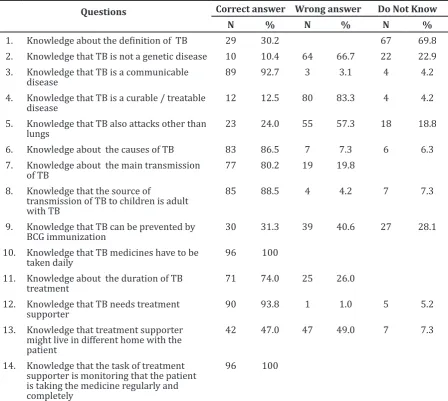
Mostly the knowledge concerning TB among the respondents was moderate, followed by good and poor (Table 2).
Most respondents (69.8%) did not know
the definition of TB. They had ever heard about TB but did not know exactly the definition
of TB. Nearly all respondents (92.7%) knew that TB was a communicable disease. Most of respondents (83%) made mistake when answering the questionwhether TB is a curable/treatable disease, they still assumed that TB was not a curable/treatable disease. All respondents (100%) were informed that the medicines had to be taken daily and they also knew about their task as treatment supporter (Table 3). Most of the respondents who had good knowledge had underwent the counselling session.
Discussions
From all respondents, the youngest respondent was 23 years while the oldest was 59 years. There is no age limit to be treatment supporter. Most importantly, treatment supporter can ensure that TB patients take the medicines, regardless to the age.10
Most of the treatment supporters were mother of the patients, the distribution of treatment supporter in the study was all from family groups, including father, mother, grandmother, and aunt.10 The recruitment
of treatment supporter in Semarang was prioritized from the patients’ family since the family has the closest relation that enables
Table 2 Knowledge of Treatment Supporter
Knowledge of treatment supporter Frequency Percentage
Good 21 21.9
Moderate 54 56.3
Table 3 The Percentage of Knowledge on TB among Treatment Supporters
Questions Correct answer Wrong answer Do Not Know
N % N % N %
1. Knowledge about the definition of TB 29 30.2 67 69.8
2. Knowledge that TB is not a genetic disease 10 10.4 64 66.7 22 22.9 3. Knowledge that TB is a communicable
disease
89 92.7 3 3.1 4 4.2
4. Knowledge that TB is a curable / treatable disease
12 12.5 80 83.3 4 4.2
5. Knowledge that TB also attacks other than lungs
23 24.0 55 57.3 18 18.8
6. Knowledge about the causes of TB 83 86.5 7 7.3 6 6.3 7. Knowledge about the main transmission
of TB
77 80.2 19 19.8
8. Knowledge that the source of
transmission of TB to children is adult with TB
85 88.5 4 4.2 7 7.3
9. Knowledge that TB can be prevented by BCG immunization
30 31.3 39 40.6 27 28.1
10. Knowledge that TB medicines have to be taken daily
96 100
11. Knowledge about the duration of TB treatment
71 74.0 25 26.0
12. Knowledge that TB needs treatment supporter
90 93.8 1 1.0 5 5.2
13. Knowledge that treatment supporter might live in different home with the patient
42 47.0 47 49.0 7 7.3
14. Knowledge that the task of treatment supporter is monitoring that the patient is taking the medicine regularly and completely
96 100
them to ensure that the patients take the medicine without any transportation cost.10 In
addition, since there is an emotional relation between the patient and treatment supporter from the family, it is expected that the rate of treatment supporter’s practice will increase.10
The study showed that, most of the respondent already got the counseling about TB. The Counseling is one of the obligatory programs in Lung Clinic Bandung. Each treatment supporter was obliged to attend the counseling about TB. The knowledge level among the respondents who had attended the counseling was higher compared to those who had not attended, as represented in the higher percentage of good and moderate knowledge among the respondents who had attended the counseling, and higher percentage of poor knowledge among those who had not attended
the counseling. Hoa et al.11 reported that there
was significant relation between education
level and the extent of information received by respondents.
All respondents were informed that TB medicines had to be taken every day, but only some knew the length of TB treatment of 6 months. Hermayanti12 stated all patients knew
about the duration of the treatment (6 months), but only 50% of them knew the impact of incomplete adherence to the treatment.12 This
is closely related to the information provided by the health staff.12 All patients stated that
they already received the information from health workers, however, it was likely that the information about the impact of incomplete treatment was missed.12
treatment supporter. This implied that they did not know their role as the treatment supporter. The importance of treatment supporter should be disseminated to the community, especially to those who served as treatment supporters in order to increase their awareness.
Good level of knowledge among treatment supporters may improve one practice as the treatment supporter. Widjanarko et al.10 said that there were strong correlation
between the knowledge and practice of treatment supporter. Ancok in Widjanarko et al.10 suggested that one’s good knowledge
of activities will result in positive attitude
reflected in their activeness in taking part in
the activities.
The limitation of this study might be in the respondents who only rely on common sense in answering a questionnaire so that the results do not actually describe the knowledge of the respondents. In conclusion, mostly, the knowledge about TB among the respondents was moderate.
Based on the results of this study, it is suggested that Lung Clinic Bandung should ensure that each treatment supporter has to get counseling session. Such counseling should be provided periodically to treatment supporter. Further study about the relationship between the level of knowledge of treatment supporter and the adherence of TB treatment had to be performed.
References
1. WHO. Tuberculosis. 2012 [cited 2012 April 11]; Available from: http://www. who.int/topics/tuberculosis/en/.
2. Andrus JK, Quadros CA, Bureau PAS. Recent advances in immunization. 2nd ed. Washington, D.C: Pan American Health Org; 2006.
3. WHO. Tuberculosis Fact Sheets. 2012 [cited 2012 April 11]; Available from: http:// www.who.int/mediacentre/factsheets/ fs104/en/index.html
4. Departemen Kesehatan Republik Indonesia. Situasi Epidemiologi TB Indonesia. Jakarta: Departemen Kesehatan Republik Indonesia; 2011.
5. Kartasasmita CB. Epidemiologi tuberkulosis. Sari Pediatri; 2009;11(2): 124–9.
6. Elzouki AY, Stapleton FB, Whitley RJ,
William, Harfi HA, Nazer H. Textbook
of Clinical Pediatrics. 2nd ed. New York:Springer; 2011.
7. TB Alert. DOTS. 2005 [cited 2012 April 12]; Available from: http://www.tbalert. org/worldwide/DOTS.php.
8. Rahajoe NN, Basir D, MS M, Kartasasmita CB, editors. Pedoman nasional tuberkulosis anak. 2nd ed. Jakarta: UKK Respirologi PP IDAI; 2008.
9. Arikunto, Suharsimi. Prosedur penelitian: suatu pendekatan praktek. Jakarta: Rineka Cipta; 2002.
10. Widjanarko B, Prabamurti PN, Widyaningsih N. Analisis faktor-faktor yang mempengaruhi praktik pengawas menelan obat (PMO) dalam pengawasan penderita tuberkulosis paru di Kota Semarang. Jurnal Promosi Kesehatan Indonesia; 2006;1(1):15–24
11. Hoa NP, Diwan VK, Co NV, Thorson AE. Knowledge about tuberculosis and its treatment among new pulmonary TB patients in the north and central regions of Vietnam. Int J Tuberc Lung Dis. 2004;8(5):603–8.
12. Hermayanti D. Studi kasus drop out pengobatan TB di Puskesmas Kodya Malang. Jurnal Saintika Medika. 2010;6(13)
Table 4 The Knowledge on TB and Subject Participation in Counseling
Counseling Level of knowledge
Good (%) Moderate (%) Poor (%)
Yes 19 (27.9%) 39 (57.4%) 10 (14.7%)