Jaya Hardi et al.
* Corresponding author. Tel/Fax : +62-251-8624567 Email address : [email protected]
DISSOLUTION BEHAVIOR, STABILITY AND ANTI-INFLAMMATORY ACTIVITY OF
KETOPROFEN COATED TRIPOLYPHOSPHATE MODIFIED CHITOSAN NANOPARTICLE
Jaya Hardi1, Purwantiningsih Sugita2,*, and Laksmi Ambarsari3 1
Chemistry Department, Science and Mathematic Faculty of Tadulako University, Bumi Tadulako Tondo Campus, Palu Sulawesi Tengah 94111, Indonesia
2
Chemistry Department, Science and Mathematic Faculty, Bogor Agricultural University, Fapet Building W2 Lt 4-5, Jl Agatis Kampus IPB Darmaga Bogor 16680, Indonesia
3
Biochemistry Department, Science and Mathematic Faculty, Bogor Agricultural University, Fapet Building W5 Lt 5 Jl Agatis Kampus IPB Darmaga Bogor 16680, Indonesia
Received December 17, 2012; Accepted June 24, 2013
ABSTRACT
Ketoprofen coated tripolyphosphate modified chitosan nanoparticle was resulted from ionic gelation process by ultrasonication, centrifugation, and spray dry methods. Particle was analyzed by particle Size Analyzer. Dissolution and stability of them have conducted by Row Hansen methods at 37±0.5 °C and 150 rpm and using climatic chamber at 40±2 °C and relative humidity 75±5% for 3 months, respectively. Anti-inflammatory activities have conducted by Plate Reader methods. The result showed that B formulae have particles diameter of 563.1±157.5 nm and entrapment efficiency of 89.663%, respectively. Dissolution behavior showed that ketoprofen restrained released within acid medium and maximum released within base medium of 11.35-15.87% and 45.73-99.25%, respectively. Kinetically, dissolution of ketoprofen within intestinal and gastric pH condition was Korsmeyers-Peppas kinetic models. While, stability behavior showed that B formula has ketoprofen percentage left in nanocapsule after 3 months greater than 90% with water content and shelf life of 19.68%, and 14.19 week, respectively, and degradation kinetic model followed Avrami-Eroveef equation. Anti-inflammation test showed that B formula had the COX-2 inhibitory activity of 90.86% is higher than free ketoprofen.
Keywords: nanoparticles; ketoprofen; dissolution; stabilities; anti-inflammatory
ABSTRAK
Ketoprofen tersalut nanopartikel kitosan termodifikasi natrium tripoliposfat (STPP) telah dihasilkan melalui proses gelasi ionic dengan metode ultrasonikasi, sentrifugasi dan dikeringkan dengan metode spray dry. Ukuran partikel dianalisis dengan alat Particle Size Analizer (PSA), sedangkan perilaku disolusi dan stabilitas sediaan dilakukan berturut-turut dengan metode Row Hansen pada suhu (37±0.5)ºC dengan kecepatan pengadukan 150 rpm dan metode climatic chamber pada suhu 40±2 °C dengan kelembaban relative 75±5% selama 3 bulan. Aktivitas anti-inflamasi sediaan dilakukan dengan metode Plate Reader. Hasil penelitian menunjukkan bahwa formula B mempunyai ukuran diameter partikel dan efisiensi enkapsulasi berturut-turut 563,1±157,5 nm dan 89,663%. Perilaku disolusi menunjukkan bahwa ketoprofen lepas terkendali di medium asam dan lepas maksimum di medium basa dengan persentase pelepasan berturut-turut 11,35-15,87% dan 45,73-99,25% dan mekanisme kinetikanya di kedua medium tersebut mengikuti model kinetika Korsmeyers-Peppas. Perilaku stabilitas menunjukkan bahwa formula B adalah formula yang mampu mempertahankan kadar ketoprofen lebih dari 90% dengan kadar air dan usia guna berturut-turut 19,68%, dan 14,19 minggu dan model kinetika degradasinya mengikuti model Avrami-Eroveef. Hasil analisis anti-inflamasi menunjukkan bahwa formula B menghambat aktivitas COX-2 lebih tinggi (90,86%) dibandingkan ketoprofen tanpa salut.
Kata Kunci: nanopartikel; ketoprofen; disolusi; stabilitas; anti-inflamasi
INTRODUCTION
The use of ultrasonic waves in the nanoparticles formation is one of the effective methods. Ultrasonic frequency of 20 kHz - 1MHz is widely used in chemistry.
Jaya Hardi et al.
the liquid medium has the ability to generate a bubble or cavity in a liquid medium. When the ultrasonic wave propagates in a liquid medium strain and density cycle occurred. The decrease of pressure resulted in a strain that form a bubble will absorb energy from ultrasonic waves, so the bubble can expand to a maximum size and eventually rupture [2]. According to Schroeder et al. [1] bubble burst resulted extreme conditions which include temperature rising, reaches 5000 K and pressures increasing up to 1000 atm with heating to cooling speed reached >1010 K/s. These extreme conditions cause the termination of the chemical bond, called as the Hot Spot Theory.
Nakorn [3] produce chitosan nanoparticles with a size of 39-300 nm using ultrasonication method at a frequency of 20 kHz for 5 min, followed by centrifugation for 15 min at 6000G. Saha et al. [4] produce chitosan nanoparticles with a size of 200-500 nm using ultrasonication method at a frequency of 20 kHz for 20 min, followed by centrifugation at a speed of 15000 rpm for 10 min. Sugita et al. [5] have conducted optimization of chitosan nanoparticle loaded ketoprofen. At ultrasonication conditions with a frequency of 20 kHz ultrasonication every 25 mL for 60 min at 20% amplitude that followed with centrifugation at 19000 rpm for 2 h at 4 °C produced chitosan-TPP nanoparticles loaded ketoprofen having average-sized of 222-366 nm with polydispersity index close to 100%. Similarly, the efficiency of ketoprofen adsorption also increased to 87.36%. Adsorption of ketoprofen coated chitosan-STPP nanoparticle has been evidenced by FTIR spectra. Specific peaks at 1410 cm-1 and 1637 cm-1 are from ketoprofen groups. Peaks at 1410 cm-1 was showed electrostatic interaction between carboxylic groups of ketoprofen with amino groups of chitosan. Specific peak also appear at 1153 cm-1 that showed P=O group of TPP [6-7]. However, the effectiveness of the preparation of ketoprofen coated chitosan-STPP nanoparticle have not been investigated for its dissolution, stability and activity as an anti-inflammatory property. Study related those properties of ketoprofen loaded chitosan nanoparticles have not been reported previously.
Dissolution test intended to see the drug release kinetics that can describe the release mechanism of that drug. Nanocapsule dissolution test was carried out by using the Hansen paddle method. Sugita et al. [6-7] was conducted dissolution test of chitosan-alginate micro-particles with glutaraldehyde as crosslinker loaded with ketoprofen and the result shows that the chitosan microparticles are capable of withstanding the release rate of ketoprofen in acidic medium up to 10.69% and in alkaline medium up to 99%. The kinetic study followed diffusion mechanism of Hixson-Crowell kinetic models. Stability is defined as the ability of a product to survive within the time limit set during the period of storage and
use. The function of a drug is to provide treatment effect, so that the most important thing from a drug is the availability of the active compound thet required until its expired date. Latifah et al. [8] did a stability test based on water and ketoprofen content that were still coated with chitosan nanoparticles using accelerated test period for 3 months at ambient temperature 40±5 °C and relative humidity (RH) 70±5%. The test results showed that the availability of chitosan-alginate microcapsules had higher remaining water and ketoprofen content in the microcapsules, respectively, 27-40% and ketoprofen content more than 90% of the initial level by 14 weeks. Meanwhile, in vitro anti-inflammatory test of ketoprofen coated chitosan nanoparticles intended to illustrate the ability of the active ingredient in inhibiting prostaglandin synthesis. Prostaglandins are inflammatory that being synthesized by the help of cyclooxygenase-2 (COX-2). Ketoprofen works by blocking the cyclooxygenase-2 [9]. Lu et al. [9] conducted inflammatory activity test of ketoprofen that were adsorbed in β-cyclodextrin complex with anti-inflammatory activity of 62.79%, greater than conventional ketoprofen (40.38%).
Tripolyphosphate modified chitosan nanoparticles offers a hope for improving the performance of activities of anti-inflammatory of ketoprofen. The negative effects of the ketoprofen in the conventional form can be addressed immediately. Therefore, the study of the dissolution behavior, stability, and in vitro anti-inflammatory activity of ketoprofen loaded chitosan nanoparticles is necessary and very important. This research aims to determine its kinetic through in vitro dissolution behavior in acidic medium pH 1.2 (pH resembles to the stomach environment) and alkaline medium pH 7.4 (pH resembled to the intestines environment), the stability of the stocks based on the water content and the levels of ketoprofen that still coated with chitosan nanoparticles through the accelerated test period time for 3 months and its in vitro anti-inflammatory activity. The research had conducted either on ketoprofen coated nanoparticles tripolyphosphate modified chitosan or in the form of conventional.
EXPERIMENTAL SECTION
Materials
Jaya Hardi et al.
buffer pH 1.2, silica gel, tris-HCl buffer, heme, arachidonic acid, the enzyme cyclooxygenase-2 (COX-2), tetramethyl-p-phenylenediamine (TMPD), dimethylsulfoxide (DMSO), filter paper, and deionized water.
Instrumentation
The instruments used in this study are include analytical balance, magnetic stirrer, IKA Werke T8 homogenizer Probe, oven Memmert, Turbidimeter type 2100P, Ultraviolet-Visible spectrophotometer type UV-1700 type Pharma Spec, high intensity ultrasonic processor Cole Palmer 130 watts 20 kHz probe type CV18, Particle Size Analizer (PSA) Delsa Nano C, high speed refrigerated centrifuge Himag CR 21G, Buchi spray drier 190, dissolution tester Logan UDT-804, SP-climatic chamber Firlabo BPEHF, shaking bath Grant, plate reader and pH meter Beckman 34.
Procedure
Chitosan nanoparticle synthesis [5]
Ketoprofen loaded chitosan nanoparticles was prepared by mixing STPP, chitosan, and oleic acid. The formula used was the three formulas used by Sugita et al. [5], the formula B with concentrations of chitosan and oleic acid respectively 2.5% (w/v) and 0.8 mg/mL), the formula A with chitosan 2.5% (w/v) and oleic acid 0.1 mg/mL, and the formula P with chitosan 3% (w/v) oleic acid and 1.5 mg/mL. Each formula was mixed with 0.8 mg/mL STPP and 0.2 mg /mL ketoprofen.
A total of 100 mL of chitosan solution was added to 40 mL of STPP solution, the mixture was stirred until homogeneous. Furthermore, to the mixture was added 40 mL ketoprofen and 20 mL of oleic acid solution with stirring at room temperature. Then, every 25 mL of the mixture flowed ultrasonic waves at a frequency of 20 kHz and amplitude of 20% for 60 minutes. Furthermore, the solution centrifuged at 19,000 rpm for 2 hours. Supernatant obtained in the form of nanoparticles suspensions. Changing the form of a powder suspension done by using hair spray. Size of chitosan nanoparticles was analyzed by PSA, while the efficiency was determined by adsorption UV spectrophotometer.
In vitro dissolution test of ketoprofen coated with chitosan nanoparticle [10]
Nanocapsule dissolution test was carried out by using second type tool (Hansen paddle method). A total of 500 mg nanocapsule were weighed and put into a chamber containing 500 mL of dissolution medium solution. Dissolution test was carried out in the medium of pH 1.2 (artificial gastric fluid) for three hours and the
medium pH 7.4 (artificial intestinal fluid) for six hours at a temperature 37±0.5 °C with a stirring speed of 150 rpm. Aliquot on acid or alkaline dissolution was taken every 15 min with a volume of 15 mL for each sampling. Each time taking aliquots, drawn medium volume was replaced with fresh medium solution with the same volume and temperature. The concentration of ketoprofen in solution aliquot was measured using UV-Vis spectrophotometer. The data obtained were examined by the model kinetics order with 0 order, the first order, Higuchi, Hixson-Crowell, and Korsmeyer-Peppas. The curve with the coefficient of determination (R2) indicates the highest model of the exact release mechanism and release rate constants of the line equation (k) of the drug was determined.
Drug Release Kinetics [12-13]
Generally, drug release kinetic is controlled with oreder 0 and 1. Order 0 reaction can be described as:
or
t o
A A kt Qkt
(1)
with [A]t is trace drug concentration in drug dosage after
t, [A]o is initial drug concentration, Q is the release percentage, and k is rate efficient. While order 1 reaction is describe as:
ln ln
t o
A A kt
(2)
Drug release from initial dosage can take place with erosion or diffusion mechanism. On the mechanism of erosion, eroded so that the drug dosage apart when in contact with the liquid medium. The mechanism of drug release by erosion following the Fick’s first law derived from the order one of this reaction:
s
dt is dissolution mass rate, Sis the barrier surface area, D is diffusion coefficient, Cs is drug
concentration in saturation state, C is drug concentration in the medium. H is the membrane thickness, and t is the time. The diffusion process is commonly seen in drug dosage using coating and expressed by Higuchi equation, which was developed from Fick’s law:
1 2
Qkt (4)
Besides Higuchi model, the diffusion release can be described also by kinetic modeling approach proposed by Korsmeyer-Peppas through this equation (5):
n
Qkt (5)
Q is the fraction of drug released at t time, k is the rate coefficient, and n is the release exponent. The release of the drug can be described through erosion kinetics model approach by Hixson through the equation below:
1 3 1 3
0 t
Jaya Hardi et al.
Table 1. Amount of nanoparticle, polydispersity index (IP), and adsorption efficiency (EP) based on material concentration and final turbidity (Tb)
Concentration*
*C (chitosan), AO (oleic acid), [ketoprofen] = 0.2 mg/mL, [STPP] = 0.84 mg/mL, each formula was sonicated for 60 min at 20% amplitude. NP=nanoparticle, IP=polydispersity index, EP= entrapment efficiency
Qt is the amount of drug released at t time, Q0 is the
initial amount of drug in the dosage, and k is the rate coefficient.
Stability test of ketoprofen coated with chitosan nanoparticle [13]
Each nanocapsule formula packed into capsules, 1 capsule contains as much as 100 mg. Each nanocapsule formula that has been incorporated into 12 packed brown bottle size 100 mL and observed for 12 weeks. Each bottle is filled with the capsule from each formula. Then the bottle is stored in a climatic chamber at a temperature 40±2 °C and RH 75±5% for 3 months. Microcapsules stability test conducted chemically and physically. Chemical testing is done by measuring the levels of ketoprofen using spectrophotometry, while the physical stability test is done by measuring the gravimetric water content. Using the second test will be obtained water content and concentration of ketoprofen data in nanocapsule each week over a period of 3 months, which is then used to determine the kinetics of chemical stability and age of the nanocapsule. The kinetics are determined by the stability equation approach followed the general equation model of the reaction kinetics on a solid phase condition (Prout–Tompkins and Avrami-Erofeev) resulting by using differential equation (7) with l=0, m=1 and n value was varied
In vitro anti inflammatory activity test of ketoprofen coated with chitosan nanoparticle [16]
A total of 160 mL tris-HCl buffer and 10 mL heme put into three well as the background well. Tris-HCl buffer 150 mL, heme 10 mL, 10 mL and an enzyme entered in three Initial well as 100% activity well. Tris-HCl buffer 150 mL, 10 mL heme, enzyme 10 mL, and 10 mL of the test sample, put in inhibitor well. Solvent (DMSO) 10 mL was added to 100% initial activity wells and background wells. Plate shuffled a few seconds and incubated for five min at 25 °C. Colorimetric substrate solution (TMPD) 20 mL incorporated into all well used. 20 mL arachidonic acid incorporated in all well used. Plate again shaken for a
few sec and then incubated again for five min at 25 °C. The same treatment is also done for ketoprofen without coating. Absorbance readings made at 590 nm using a plate reader. Background well absorbance values as 100% of the initial activity of each sample wells and the inhibitors well are averaged, and then do the following calculation:
% inhibition =
"A 100% initial wells corrected - A inhibitor wells corrected" x 100% "A 100% initial wells corrected"
RESULT AND DISCUSSION
A, B and P Formula Properties
Ultrasonication principles closely linked to the acoustic cavitation phenomenon, the formation, growth, and rupture of bubbles formed in the liquid medium [1]. When the ultrasonic wave propagates in a liquid medium strain and density cycles occur, bubbles formed will absorb energy and ultrasonic waved, so the bubble will expand to its maximum size and eventually rupture [2]. The outbreak of the bubble causes the particle size becomes smaller, and also followed by the falling value of the turbidity. Turbidity is the cloudiness of a fluid medium level with Nephelometric Turbidity Units (NTU). Turbidity of initial formulas A, B and P measured at 58.7-176.8 NTU, after ultrasonication turbidity measured at 52.5-144.8 NTU. This is supported by the physical appearance of the color of the solution changes to be clearer than the initial color. Treatment continued to produce the supernatant by centrifugation at 31.33-115.25 NTU turbidity value. Decreasing in turbidity values indicate that the ultrasonication and centrifugation can reduce the particle size of a solution.
Jaya Hardi et al.
formulas A and P is more uniform in size compare to the formula B, but based on particle size formulas A and B are in the category of nano-sized particles, 10-1000 nm [17] and the second formula has a percentage of nanoparticles size over 95% compared to formula P. Uniformity of size and the high number seen in the role of nano particles adsorb ketoprofen were analyzed through the measurement of the adsorption efficiency (EP). Formula B has a higher EP than formula A and P. EP formula B is also higher than the results of Sugita et al. [5] research by using the same method. The EP is also higher than EP rivastigmin coated with chitosan nanoparticles modified with STPP [18]. This study shows consistent results from Sugita et al. [5] studies, formula B is a formula with physical properties better than formula A and P, but all of three formulas can be developed further as a candidate for ketoprofen drug coating.
Dissolution Behavior of A, B and P Formula
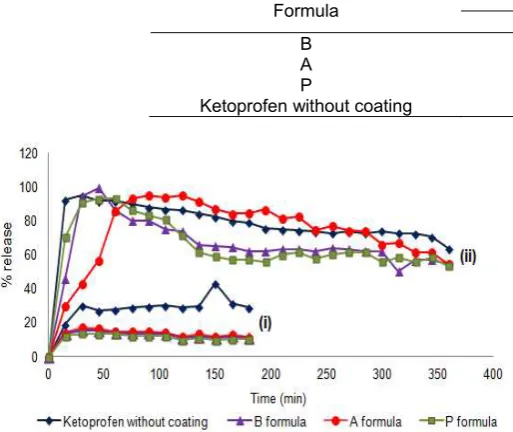
Dissolution test is useful to describe the relevant mechanisms of drug release kinetics from a matrix. The test is performed in vitro using two media as a representative medium resembling human gastric (pH 1.2) and intestinal medium (pH 7.4). Drug release mechanism very influenced by pH factor. Ionic crosslinking of chitosan-STPP could be through swelling on acid and base medium. The bond density of chitosan-STPP will be decrease on acid and base medium until the drugs released [14]. The release process of ketoprofen coated chitosan modified with STPP from time to time are presented in Fig. 1 and the total concentration of ketoprofen is released after treatment in both acidic and alkaline medium that are presented in Table 2.
Fig. 1 shows the curve of time effect on the average release of ketoprofen on artificial medium for the stomach and intestines. In the first 15 to 30 min in the acid medium, a formula that is able to with stand the rate of release of ketoprofen from the matrix is the P formula, then followed with B and A formula. Furthermore, the release rate of ketoprofen after 30 min apart slowly and under control. This is shown by the large concentrations of ketoprofen that were released up to that time of 180 min, the P formula is lower than the A and B formula (Table 2). However, the ability of the third formulas in controlling the release of ketoprofen in acid medium less favorable than that of ketoprofen microparticles coated chitosan-alginate crosslinked with glutaraldehyde [6-7], but still better than the chitosan-CMC and chitosan-guar gum that were also crosslinked with glutaraldehyde [19] and Li et al.[20] who observed nifedipine drug release coated chitosan-alginate
nanoparticles, even better than ketoprofen without a salute.
Meanwhile, the first 15 to 45 min in alkaline medium, the formula that can liberate ketoprofen close to 100% is a formula B, then followed with formula P around 92%, the formula A is only 50%, and the release rate of ketoprofen over 90% for a new formula achieved in the 90 min. Formula A, B and P along with the results of Sugita et al. [6-7] that coated ketoprofen with chitosan-alginate microparticles crosslinked with glutaraldehyde. Modified chitosan matrix formulations were not a barrier to the release of ketoprofen in alkaline medium, because the medium is destroyed and ketoprofen released similarly with ketoprofen without coating. Performance of modified chitosan in alkaline medium as coating is better than hydroxymethyl propyl cellulose in coated the same drug, which is ketoprofen [21].
Release behavior of ketoprofen gel matrix modified chitosan crosslinked with STPP controlled by diffusion processes, as it was ever done to the matrix of chitosan-CMC [19], and chitosan alginate [6-7] with glutaraldehyde as crosslinker. Sutriyo et al. [22] reveals that if a hydrated matrix can last a long time in a certain time, then the rate of drug release is controlled by diffusion and linear release pattern with the root of time. Conversely, if a hydrated matrix can not survive long in a certain time, then the rate of drug release is controlled by erosion events and patterns of linear release with time. Sugita et al. [12] reported that the test results of the membrane diffusion of ketoprofen coated by chitosan-guar crosslinked with glutaraldehyde through a mechanism that begins with the swelling of the membrane when the membrane in contact with the fluid, then the formation and opening of the pore membrane so that the drugs can pass through the matrix .The thicker the layer of gel that must be passed by ketoprofen, the greater the barrier that must be ketoprofen overcome for migration [23]. Chitosan-alginate membrane with a thickness of 10-34 μm successfully passed ketoprofen dose of 50 and 75 mg/L both at 37 and 42 °C. Concentration of ketoprofen in the recipient cell at equilibrium (Cs) at therapeutic concentrations approaching those conditions, 15-25 mg/L. The time needed to reach the value associated with the Cs parameter which are concentrations of ketoprofen (A), the diffusion temperature (T), and the membrane thickness (h) ranged between 3.33 and 12.5 h. This suggests that the chitosan-alginate coating potential for ketoprofen sustained release dosage so that the frequency of administration of ketoprofen can be minimized and may reduce the side effects from the use of ketoprofen [23].
Jaya Hardi et al.
Table 2. Ketoprofen percentage that being measured from in vitro dissolution test after 3 h in acid medium and after 6 h in basic medium
Ketoprofen release in the medium (%) Formula
Acid Basic B
A P
Ketoprofen without coating
15.87 17.38 13.76 43.28
99.25 94.96 92.80 94.77
Fig 1. Effect of time against ketoprofen release rate in acid medium (i) and basic medium (ii)
Fig 2. Water content of ketoprofen coated chitosan-STPP nanoparticle each week
Fig 3. Total ketoprofen remaining in chitosan-STPP nanoparticle each week
reaction, the value of k and t1/2 of ketoprofen.
Determination of the reaction order is done using graphical methods, namely by looking at the value of the
coefficient of determination, R2 curves derived from the relationship between the concentration of ketoprofen and time [12-13]. The three formulas show the release kinetics of ketoprofen in both acidic and alkaline medium, all formulas followed Korsmeyer-Peppas kinetics model. The coefficient of determination (R2), the highest in both acidic and alkaline medium is achieved by the formula B with a rate constant of release (k) respectively 2.113 mol2L-2min-1 and 1.499 mol2L-2min-1. Likewise with ketoprofen without coating, its kinetic also follows Korsmeyer-Peppas models. Mechanism of Korsmeyer-Peppas kinetic models indicate that the drug regard less of the matrix is dominated by the diffusion process. The study is in line with research conducted by Sugita et al.[6-7], Shoaib et al.[11], Kim et al.[24], and Sarvanan et al.[12], but different from chitosan-alginate crosslinked with glutaraldehyde a mechanism in acid medium is dominated by the first order, whereas in alkaline medium it follow order-0 and Hixson-Crowell. Release mechanism shown by the first and zero order equation support through the mechanism of drug release process of erosion, while the Hixson-Crowell equation signifies apart by drug diffusion mechanism accompanied by erosion events [6].
Stability and Shelf Life of A, B and P Formula
The stability of nanoparticle filled with ketoprofen evaluated from two aspects, which are the physical and chemical stability for three months of testing. Physical stability was determined by measuring the dosage of water content. The recommended water content for pharmaceutical products is less than 10% [25]. The stability of the chemical dosage is determined by determining the levels of drugs that are still coated in the matrix after three months of testing. The nature of the coating is categorized either when it is still able to maintain drug levels over 90% [13].
Jaya Hardi et al.
Table 3. Ketoprofen degradation in stability test for three months
Formula Kinetic reaction model Rate equation R2 [A]o
a The order of the pseudo-1
y=0.0079x + 0.015
Description: a ketoprofen initial content, b ketoprofen content within two 12 weeks, c ketoprofen content that still coated
after 12 weeks
Table 4. Best formula order based on shelf life and water content
Formula Shelf life
(week)
Weight value based on shelf life
Water
water content of formula A, B, and P, respectively 8.3, 10.6 and 8.3%, and after 12 weeks of storage moisture third consecutive formula is 19:22, 19.68 and 18.65%. The water content is still better when compared with that of ketoprofen microparticles coated with chitosan-alginate [8] and chitosan-guar gum [13] that both crosslinked with glutaraldehyde under the same conditions. Although the water content of the formula B showed highest moisture after a 12-week storage period, but the change range is lower than the formula A and P. This shows that the formula B matrix formulation that can with stand interaction with water vapor that is expected to prevent the hydrolysis reaction in the active compound. The difference in water levels rise in the third formula is suspected because of the thickness, density matrix and IP.
Fig. 3 shows the relationship between the levels of ketoprofen that were still coated in the matrix after the storage time for 12 weeks. In general, the levels of the active compound in the preparation of the third formula was decrease with increasing storage time. Loss of ketoprofen on coated stocks less than ketoprofen without coating. Ketoprofen levels without coating on the first week fell to 15%, higher than the coated ketoprofen, that only decrease about 0.11-2.47% levels initially. Initial concentrations of ketoprofen (% w/w) were over laid on the formula A, B and F, respectively, 83.048, 89.663 and 76.556%, and after storage for 12 weeks, ketoprofen concentration (% w/w) remaining in the third matrix formula is 75.14, 81.00 and 69.38%, respectively. All three formulas have a similar range of reduction, and the levels of coated ketoprofen during the storage period of 12 weeks is still over 90% from the initial level (Table 3). This indicates that the chemical stability of the three formulas are eligible [13]. In this study, the stability matrix of chitosan-STPP in protecting ketoprofen is less favorable than the complex (hydroxymethyl propyl cellulose) -(sodium carboxymethyl cellulose) that coated ranitidine hydrochloride[26], but it's better than the solid form tetrahydrokannabinol (THC) [27] both measured by the same method with this study.
Data content of ketoprofen per week may be used for the determination of the decomposition reaction kinetics model of drug dosage. By knowing its kinetic model, then the value of drug degradation rate constant (k) can be used to determine age for the expired time. Reaction kinetics model for the third formula is based on the regression curve between concentration and time with the highest R2 value. The approach relies drug decomposition kinetics model of the expired time, solution or solid form. Based on the highest R2 value, a formula B, A, and P each following drug degradation reaction kinetics model Erofeev (n=1), Avrami-Erofeev (n=4), and the order of the pseudo-1 (Table 3), and formula B R2 value is more than 90%. Avrami-Erofeev kinetics model (n=1) was known as the first-order kinetics in the degradation mechanisms of solid dosage forms. Avrami-Erofeev kinetic model equations describing the chemical drug degradation reactions in the solid conditions allegedly caused by autocatalytic reaction controlled by the formation and growth of reactions nuclei with various modifications [15]. The kinetics of the solid reaction conditions have a more complex model than the kinetic model of reaction in solution conditions, because the reaction occurs in heterogeneous systems. Many theories have been developed, but not as improved as model theory of reaction kinetics in solution conditions, so the study is limited to the estimation of the selected corresponding kinetics model.
Jaya Hardi et al.
longest to the shortest. In contrast, the water content is done by weighting formula to sort lowest to highest water content. The total value of the smallest weight is the best nanoparticle formula. If there are two or more values of the same weight, the more dominant factor for age. Weights between the three formulas are the same, but the age order of formula B is longer than A and P. Range of change in the amount of (∆) formula B water content (9.08%) is also smaller than the formula A (10.92%) and P(10.35%). Therefore, the best formula represented by the formula B followed by formula A and P. Based on the dissolution behavior and stability of nanoparticle-STPP coated ketoprofen, then the formula B is the composition of nanoparticles that consistently gives the best results.
Anti Inflammatory Activity of B Formula
The aim of this test is to see if the ketoprofen coating using ultrasonication where the preparation was exposed to high temperature was capable to act as an anti inflammatory agent. Formula B anti inflammatory activity was analyzed based on its ability to inhibit the enzyme cyclooxygenase-2 (COX-2) that plays a role in synthesizing prostaglandins as the cause of inflammation. The ability ofCOX-2 inhibition is shown by the lower absorbance of the sample solution compared to the blank solution using the plate reader measurement. Colors are formed in solution due oxidation of tetramethyl-p-phenylenediamine (TMPD) to release one electron that form a colored compound that absorbat 590 nm wavelength. TMPD oxidized simultaneously with changes prostaglandin G2 (PGG2) to
prostaglandin H2 (PGH2) by the peroxidase activity of
COX. When COX (especially COX-2) inhibited by inhibitor the conversion of PGG2 to PGH2 did not happen
and therefore oxidation TMPD to form colored compounds will not happen too.
Ketoprofen concentration being used for anti inflammatory activity assay was 5.95 mg/L to 500 mg of nanoparticles. At that concentration, formula B is able to inhibit the enzyme COX-2 by 91%, slightly higher than conventional ketoprofen that approaches 88% at the same dosage of ketoprofen. This value is consistent with Saha et al. [4] research that tested the antimicrobial activity of ampicillin trihydrate drug coated chitosan-STPP nanoparticles. Ampicillin trihydrate nanoparticle formula gave 14 mm inhibition zone higher than the conventional form which is only about 12 mm after 48 h. The results of this study indicate that the ultrasonication process does not damage the compounds, it even still able to produce high activity. Excellence form chitosan-STPP nanoparticles loaded with ketoprofen will reduce the COX-2 enzyme much longer than conventional forms. As reported by Lu et al. [9] through an in vivo
animal model with rats. Research results report that the anti-inflammatory activity of ketoprofen that were absorbed in β-cyclodextrin complex is higher (63%) than conventional ketoprofen that were only 40%.
CONCLUSION
Formula B with composition of chitosan nanoparticles was 2.5% (w/v), ketoprofen 0.2 mg/mL, sodium tripolyphosphate 0.84 mg/mL, and oleic acid 0.8 mg/mL yielded an average particle diameter of 563.1±157.5 nm. Dissolution behavior in acidic medium able to control the release of ketoprofen up to 180 min only 15.87% loss, followed Korsmeyer-Peppas kinetics model, while its stability behavior showed ketoprofen percentage left in nanocapsule after 3 months, water content and shelf life of 90.34%, 19.68%, and 14.19 weeks, respectively, with degradation kinetic model followed Avrami-Eroveef. Formula B has the ability of COX-2 inhibition 91%, slightly higher than conventional ketoprofen that giving 88% of the inhibition at the same dosage of ketoprofen.
REFERENCES
1. Schroeder, A., Kost, J., and Barenholz, Y., 2009,
Chem. Phys. Lipids,162, 1-2, 1–16.
2. Hielscher, T., 2005, Ultrasonic production of nano-size dispersions and emulsions, in: Proceedings of
European Nanosystems Conference ENS’05 Paris,
France, 14-16 December 2005.
3. Nakorn, P.N., 2008, J. Met. Mater. Miner., 18 2, 73–77.
4. Saha, P., Goyal, A.K., and Rath, G., 2010, Trop. J.
Pharm. Res., 9, 5, 483–488.
5. Sugita, P., Ambarsari, L., and Farichah, F., 2013,
Int. J. Res. Rev. Appl. Sci.,14, 3, 612–618.
6. Sugita P., Ambarsari L., Sari Y.A., and Nugraha Y. 2013. Int. J. Res. Rev. Appl. Sci.,14, 1, 141–149. 7. Sugita, P., Napthaleni, Kurniati, M., and Wukirsari
T., 2010, Makara Sci. Ser.,14, 1, 107–112.
8. Latifah, S., Sugita, P., and Srijanto, B., 2010,
Stabilitas mikrokapsul ketoprofen tersalut
kitosan-alginat, in Prosiding Seminar Nasional Sains III;
Fakultas MIPA Institut Pertanian Bogor, 13 November 2010, 248–259.
9. Lu, W-L., Zhang, Q., Zheng, L., Wang, H., Li, R-Y., Zhang, L-F., Shen, W-B., and Tu, X-D., 2004, Biol.
Pharm. Bull., 27, 10, 1515–1520.
10. Departemen Kesehatan RI, 1995, Farmakope
Indonesia, Ed. Ke-4, Jakarta.
11. Shoaib, M.H., Tazeen, J., Merchant, H.A., and Yousuf, R.I., 2006, J. Pharm. Sci.,19, 2, 119–124. 12. Sarvanan, M., Nataraj, K.S., and Ganesh, K.S.,
Jaya Hardi et al.
13. Sugita, P., Srijanto, B., Arifin, B., and Setyowati, E.V., 2009, Indo. J. Chem., 9, 3, 391–397.
14. Berger, J., Reist, M., Mayera, J.M., Felt, O., and Gurny, R., 2004, Eur. J. Pharm. Biopharm., 57, 1, 35–52.
15. Levenspiel, O., 1999, Chemical Reaction Engineering, 3rd ed., John Wiley & Sons, New York. 16. Cayman Chemical Company, 2002, Colorimetric
COX ovine inhibitor screening assay, kit no. 760111.
USA.
17. Patel, J.K., and Jivani N.P., 2009, Int. J. Pharm. Sci.
Nanotechnol.,2, 2, 517–522.
18. Kaur, S.P., Rao, R., Hussain, A., and Khatkar, S., 2011, J. Pharm. Sci. Res., 3, 5, 1227–1232.
19. Sugita, P., Achmadi, S.S., and Yundhana, Y., 2010,
J. Nat. Indonesia,13, 1, 21–26.
20. Li, P., Dai, Y-N, Zhang, J-P, Wang, A-Q., and Wei, Q., 2008, Int. J. Biomed. Sci., 4, 3, 221–228.
21. Najmuddin, M., Ahmed, A., Shelar, S., Patel, V., and Khan, T., 2010, Int. J. Pharm. Pharm. Sci., 2, 2, 164-168.
22. Sutriyo, Joshita, D., and Rosari, I., 2005, Majalah
Ilmu Kefarmasian, 2, 3,145–153.
23. Sugita, P., Asnel, R.S., Arifin, B., and Wukirsari, T., 2010, Indo. J. Chem., 10, 3, 269–275.
24. Kim, M-S., Kim, J-S., and Hwang, S-J., 2007,
Chem. Pharm. Bull.,55, 11, 1631–1634.
25. Menteri Kesehatan, 1994, Keputusan Menteri Kesehatan Republik Indonesia Nomor: 661/MENKES/SK/VII/1994 Tentang persyaratan obat tradisional, Jakarta.
26. Janardhan, D., Llingam, M., Mohan, C.K., and Venkateswarlu, V., 2008, Int. J. Pharm. Sci.
Nanotechnol., 1, 3, 227–232.