
STUDY ON THE ADSORPTION PROPERTIES OF NOVEL CALIX[6]ARENE POLYMERS
FOR HEAVY METAL CATIONS
Susy Yunita Prabawati
1,2,*, Jumina
2, Sri Juari Santosa
2, Mustofa
3, and Keisuke Ohto
4 1Department of Chemistry, Faculty of Science and Technology, UIN Sunan Kalijaga of Yogyakarta, Indonesia
2
Department of Chemistry, Faculty of Mathematics and Natural Sciences, Universitas Gadjah Mada, Indonesia
3
Department of Pharmacology and Toxicology, Faculty of Medicine, Universitas Gadjah Mada, Indonesia
4
Department of Applied Chemistry, Faculty of Science and Engineering, Saga University, 1-Honjo, Saga, 840-8502, Japan
Received November 1, 2011; Accepted December 26, 2011
ABSTRACT
A research has been conducted to investigate the capability of a series of novel calix[6]arenes-based polymers: poly-monoallyloxycalix[6]arene (2a), poly-monoallyloxypenta-estercalix[6]arene (2b) and poly-monoallyloxypenta-acidcalix[6]arene (2c) for trapping of heavy metal cations such as Cd(II), Cu(II) and Cr(III). The existence of active hydroxy group (-OH) and with a tunnel-like structure of the polymers, caused the polymers can be used as adsorbents for heavy metals. The adsorption process was carried out in batch method in the variation of acidity (pH), contact time and initial concentration of metal ions. The results showed that the amount of adsorbed metal increased with the increasing of the pH of metal solution. For these three polymers, the amount of metal ions Cd(II), Cu(II) and Cr(III) adsorbed was optimum at pH 7, 6 and 5 respectively. The optimum contact time for Cd(II) and Cu(II) was 120 min, while that for Cr(III) was 60 min. Study of the adsorption kinetics showed that the adsorption of Cd(II), Cu(II) and Cr(III) using polymer2afollowed kinetics model of Ho. For adsorbent2band2c, the adsorption kinetics of Cd(II) and Cr(III) also followed kinetics model of Ho while for the Cu(II) followed Lagergren kinetic models. Isothermal studies showed that the adsorption of metal ions on all adsorbents tend to follow the Langmuir isotherm. The adsorption energies of the three adsorbents were higher than 23 kJ/mole and polymer2chas the largest adsorption capacity for Cr(III).
Keywords:Calix[6]arene-based polymers; Cd(II); Cu(II); Cr(III); adsorption kinetic; isotherm adsorption
ABSTRAK
Telah dilakukan penelitian untuk mengkaji kemampuan adsorpsi senyawa turunan polikaliks[6]arena yaitu poli-monoalilkaliks[6]arena (2a), poli-monoalilesterkaliks[6]arena (2b) dan poli-monoalilasamkaliks[6]arena (2c) terhadap kation logam berat seperti Cd(II), Cu(II) dan Cr(III). Adanya gugus aktif hidroksi (-OH) dan struktur senyawa yang menyerupai terowongan sangat memungkinkan pemanfaatan senyawa-senyawa tersebut sebagai adsorben logam berat. Proses adsorpsi dilakukan dengan metode batch pada variasi keasaman (pH), waktu kontak dan konsentrasi awal ion logam. Hasil penelitian menunjukkan bahwa jumlah ion logam teradsorpsi semakin bertambah dengan bertambahnya pH larutan logam. Untuk ketiga polimer, jumlah ion logam Cd(II), Cu(II) dan Cr(III) masing-masing teradsorpsi optimum pada pH 7, 6 dan 5. Waktu kontak optimum untuk Cd(II) dan Cu(II) adalah 120 menit, sedangkan untuk Cr(III) adalah 60 menit. Kajian kinetika adsorpsi logam menunjukkan bahwa adsorpsi ion logam Cd(II), Cu(II) dan Cr(III) menggunakan polimer 2amengikuti model kinetika Ho. Sementara itu untuk adsorben 2b dan 2c, kinetika adsorpsi Cd(II) dan Cr(III) juga mengikuti model kinetika Ho sedangkan untuk Cu(II) mengikuti model kinetika Lagergren. Studi isotermal adsorpsi menunjukkan bahwa pola adsorpsi ion logam pada ketiga adsorben cenderung mengikuti pola isotermal Langmuir. Energi adsorpsi ketiga adsorben adalah lebih dari 23 kJ/mol dan polimer2cmemiliki kapasitas adsorpsi terbesar untuk Cr(III).
Kata Kunci:poli-kaliks[6]arena; Cd(II); Cr(III); Cu(II); kinetika adsorpsi; isotermal adsorpsi
INTRODUCTION
Heavy metals are major pollutants in various surface water or ground water in treated wastewater. It is
The most commonly methods have been used to remove heavy metal ions from various aqueous solutions such as chemical precipitation, ion exchange, filtration and adsorption, etc. [7-8]. Among these methods, adsorption has increasingly received more attention in recent years because the method is simple, relatively low-cost and effective in removing heavy metal ions, especially at medium to low metal ion concentrations.
One of the potential compound to develop is calixarene. Calixarenes are such of macrocyclic compounds which have a fairly unique molecular geometry with almost unlimited derivate possibilities [9]. The peculiarity of the structure gives great potential for further development.
Calix[6]arene with six phenol ring arrange the molecules are relatively more easily made than calix[4]arene. It has provided important avenue to be used for various utilization. Several studies have shown that the calix[6]arenes and their derivatives widely used as an electrode to detect uranium (VI) in aqueous solution [10]. Furthermore its have been applied as catalysts in synthetic reactions [11] and in a number of instances, they were also used as a potential adsorbent for heavy metals, dye or organic wastewater [12-13].
To enhance the affinity of calixarenes toward metal ions, there are two general strategies have been adopted: either there have been incorporated different ionophoric groups including carbonyl, amide, nitrile and other suitable functionalities onto the calix-platform, or the calixarene units were fixed in a polymeric matrix. Various studies have been carried out in this regard, for instance, calix[6]-based polymers showed remarkable abilities to trap alkali metal ions and UO2 [14]. The adsorption properties of calix[6]-amide polymers has been also reported toward soft cations (Ag+, Hg2+) and hard cations (Na+, K+) [15] and in our previous work, we have also synthesized poly-diallylcalix[6]arene and it has been investigated to trap Cr(III) cation [16].
Adsorption process is generally based on the interaction between metal and active groups existed on the surface of adsorbent through complex formation [17]. The hydroxy group on poly-calix[6]arene plays an important role as an active groups for cation binding. That phenolic OH groups can be substituted by other functional groups to produce derivatives that having different shapes and may act as effective and selective adsorbent.
Thus, continuation to our studies, herein we report the application of poly-monoallyloxy-calix[6]arene and their ester and acid derivatives as adsorbent for heavy metals. To research the adsorption capacity and
of middle-class while the Cr metal ion represent the hard acid. Besides that the three metal ions are also the main pollutant in Indonesian waters.
EXPERIMENTAL SECTION
Materials
Poly-monoallyloxycalix[6]arene, poly-monoallyl oxypenta-estercalix[6]arene and poly-monoallyloxy penta-acidcalix[6]arene used in this study were prepared from p-tert-butylphenol according to the procedures reported previously [18], obtained according to synthetic method given in Fig. 1. The aqueous solution of Cd, Cu and Cr 1000 mg/L was prepared by using the analytical grade Merck product.
Instrumentation
Magnetic stirrer, concentration of the samples was analyzed by using Atomic Absorption Spectrophotometer (AAS, GBC Australia at Analytical Laboratory, UGM).
Procedure
The procedure of this research was carried out in the following stages, i.e. (1) adsorption studies for trapping of heavy metals, (2) adsorption kinetics, and (3) adsorption isotherm.
Adsorption Studies of Calix[6]arene Polymers for Trapping of Cd(II), Cu(II), and Cr(III)
Effect of pH.A series of 10 mL of each metal solution (Cd(II), Cu(II), and Cr(III)) 10 mg/L was prepared and the pH adjustments were performed with 0.1 M HCl or 0.1 M NaOH. Into every metal solution, 0.008 g of each polymer was poured and then stirred for 2 h. After filtering, the concentration of metal in the supernatant was analyzed by using atomic adsorption spectrometry (AAS).
Adsorption Kinetics. The kinetics experiments were investigated to determine the adsorption rate constant. Batch adsorption experiments were carried out by shaking 0.008 g of each polymer in 10 mL of the metal solution 10 mg/L at the optimum of pH for different reaction times (15–240 min). After filtering, the concentration of metal in the supernatant was analyzed by using AAS. The data was analyzed using three different adsorption kinetic models.
O H
Fig 1.The synthetic route of preparation of poly-calix[6]arenes
the adsorption equilibrium of Cd(II), Cu(II), and Cr(III) by the polymers. As much as 0.008 g of each polymer was interacted with and stirred in 10 mL of solution containing the various concentrations of 4, 8, 12, 16, and 20 mg/L of each metal at the optimum of pH and contact time. After separating the supernatants, the concentration of metal in the supernatant was analyzed by AAS.
RESULT AND DISCUSSION
The synthesis of poly-calix[6]arene derived were prepared fromp-tert-butylphenol which polymerized with concentrated sulfuric acid according to the procedures reported previously [18]. The scheme of the synthetic route of polymers was showed in Fig. 1.
The application of these polymers as adsorbent for Cd(II), Cu(II), and Cr(III) was investigated in batch systems. The adsorption parameters included the variation of pH, adsorption kinetic and adsorption isotherm.
Effect of pH
pH is one of the most important factors affecting the adsorption process. Adsorption ability of metal ions
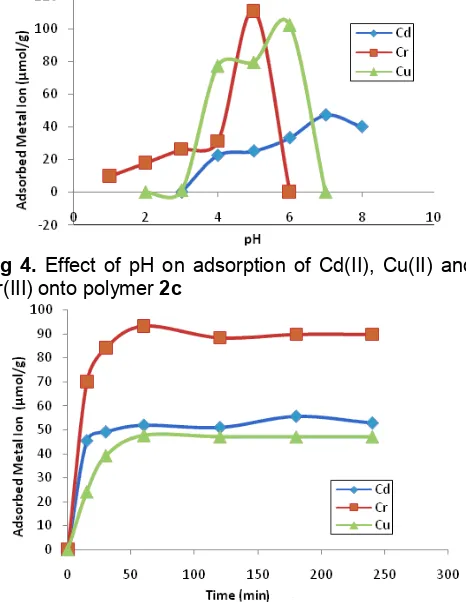
can depend on pH because of protonation of the anionic of Cd, Cu and Cr are in the form of Cd2+, Cu2+, and Cr3+. Fig. 2-4 depicts the effect of pH on the adsorption of Cd(II), Cu(II), and Cr(III) ions on polycalix[6]arene.
It showed that the concentration of adsorbed metal increased with the increasing of the pH of metal solution. The increase of sorption from pH 2 to 5 must be caused by the decrease of the amount of H+in the medium, and therefore, the competition between metal ions and H+ in occupying the active sites of the sorbents also decreased. For these three polymers, the concentration of metal ions Cd(II), Cr(III) and Cu(II) group [19]. Similarly, in poly-calix[6]arenes, the protonation of the phenolic-OH group is expected to play a role in the adsorption process.
Fig 2. Effect of pH on adsorption of Cd(II), Cu(II) and Cr(III) onto polymer2a
Fig 3. Effect of pH on adsorption of Cd(II), Cu(II) and Cr(III) onto polymer2b
Fig 4. Effect of pH on adsorption of Cd(II), Cu(II) and Cr(III) onto polymer2c
Fig 5.Effect of contact time on adsorption of metal ion onto polymer2a
Adsorption Kinetic Models
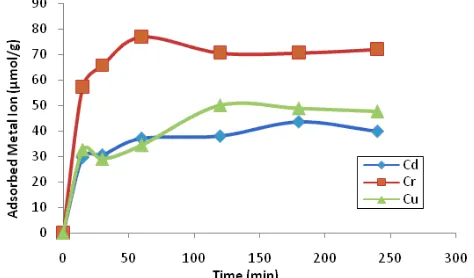
Adsorption metal process by calix[6]arene polymers conducted at constant temperature 25 °C. Fig. 5-7 presents the time dependence of the adsorption of metal ions. It was found that the adsorption of metal ions increased with increasing contact time and then having an equilibrium. For these three polymers, the optimum contact time for Cd(II) and Cu(II) is 120 min, while for Cr(III) is 60 min.
Parameter commonly used to study the rate of adsorption is the adsorption rate constant, k. From the data obtained, it can be analyzed to study the adsorption kinetics based on several models of the adsorption kinetics, i.e. a single ion of Santosa-Muzakky [20], pseudo first order (Lagergren), and the second order of the Ho [21].
Based on the data showed in Table 1, it shows that the kinetics model of Ho has a curve with a linearity higher than the kinetic model Santosa-Muzaky and Lagergren kinetic model for the third adsorption of metal ions using polymer2a. It can be concluded that all three metals adsorption using adsorbents2atend to follow the pseudo second order. On the other hand, for adsorbent
2b and 2c, the adsorption kinetics of Cd(II) and Cr(III)
followed kinetics model of Ho while for the Cu(II) followed Lagergren kinetic models. These results are similar by previous researchers [22] showed that adsorption of Cr(III) onto polypropylcalix[4]arenes followed the kinetics model of Ho. By using the three adsorbents, shows that the adsorption rate constant for Cr(III) is greatest when compared to the adsorption of Cd(II) and Cu(II). This means that within the same time, calix[6]arene polymers can adsorb Cr(III) more than Cd(II) and Cu(II).
Adsorption Isotherm
Several models have been published in the literature to describe experimental data of adsorption isotherms. The Langmuir and Freundlich models are the most frequently employed models. In this study, both models were used to describe the relationship between the adsorbed amount of Cd(II), Cu(II), and Cr(III) and its equilibrium concentration in solution. Langmuir isotherm model: C/Xm= 1/bK + C/b
Freundlich isotherm model: log Xm= log B + 1/n (log C) where:
Fig 6. Effect of contact time on adsorption of metal ion onto polymer2b
Fig 7.Effect of contact time on adsorption of metal ion onto polymer2c
Table 1.The Adsorption Kinetic Models
Adsorption Kinetic Models Santosa-Muzakky
1
Co ln
t Ca
= K + k
Co Ca
Pseudo Orde 1 (Lagergren)
ln qe - qt = log qe - kt
Pseudo Orde 2 (Ho)
2
t 1 1
= +
qt 2kqe qe
Equation
R2 k (min-1) R2 k (min-1) R2 k (min-1)
Cd 0,6366 1.2 x 10⁻³ 0,6658 2 x 10⁻⁵ 0,9098 4.5 x 10⁻⁷
Cu 0,4432 5 x 10⁻⁴ 0,7889 7.1 x 10⁻³ 0,8051 6.3 x 10⁻²
Cr 0,3151 5 x 10⁻⁴ 0,7926 3.2 x 10⁻³ 0,9203 1.03 x 10⁻²
Adsorbent 2a
Cd 0.4500 9 x 10⁻⁴ 0.8001 2 x 10⁻³ 0.915 1.3 x 10⁻³
Cu 0.2418 4 x 10⁻⁵ 0.8671 1.1 x 10⁻³ 0.6798 10-2
Cr 0.4153 3 x 10⁻⁴ 0.8837 3.7 x 10⁻³ 0.9295 1.88 x 10⁻²
Adsorbent 2b
Cd 0.7429 1.2 x 10⁻³ 0.8329 2.5 x 10⁻³ 0.9394 3.8 x 10⁻³
Cu 0.7000 6 x 10⁻⁴ 0.9511 3.5 x 10⁻³ 0.8761 1.15 x 10⁻²
Adsorbent 2c
Cr 0.2358 3 x 10⁻⁴ 0.8307 2.3 x 10⁻³ 0.9184 5.8 x 10⁻³
Table 2.Langmuir and Freundlich Isotherm Models
Adsorbent 2a Adsorbent 2b Adsorbent 2c
Isotherm Parameters
Cd Cu Cr Cd Cu Cr Cd Cu Cr
Langmuir Xm (µmol/g) 29.38 41.08 55.65 24.41 9.03 25.27 26.91 50.44 73.23
K x 104
(L/mol) 22.28 52.46 1.29 5.62 1.55 5.48 74.33 15.72 3.19
ΔG(KJ/mol) 30.42 32.54 23.39 27.02 23.84 26.96 33.39 29.56 25.62
R2 0.9765 0.9583 0.8145 0.9767 0.8016 0.8840 0.9227 0.9117 0.8590
Freundlich K (mol/g) 31.460 1.701 0.913 1.156 0.119 1.728 24.176 2.159 2.460
R2 0.1785 0.4876 0.8090 0.8754 0.6725 0.0129 0.2166 0.4845 0.2208
b, Langmuir’s sorption capacity K, sorption affinity
B, Freundlich’s sorption capacity
The application of the two models are resulted the adsorption parameters as shown in Table 2. Table 2 showed that the linearity of the Langmuir isotherm model is higher than Freundlich isotherm model for all three metal ions. Thus the pattern of adsorption of Cd(II), Cr(III) and Cu(II) on the polymer 2a-ctend to follow the Langmuir isotherm model. This means that the adsorption process occurs on the monolayer instead of
multilayer. Therefore, it can be assumed that the maximum adsorption occurs when all of the active sites of adsorbents filled by the adsorbate forming the monolayer.
(column methods)
Poly-diallylcalix[6]arene Cr(III) 14.7 [16]
(Batch methods)
p-t-b-calix[4]arene Cu((II) 11.75 [24]
(Batch methods) Cr(III) 6.47
Poly-5-allyltetrahydroxy[4]arene Cr(III) 50.58 [25]
(Batch methods)
Baggase fly ash Cu(II) 35.57 [26]
Grape stalks wastes Cu(II) 47.21 [27]
poly-monoallyloxy-pentaacidcalix[6]arene Cu(II) 50.44 [current work]
(Batch methods) Cr(III) 73.23
The minimum energy of chemical adsorption is 5 kcal mole-1or 20 kJ mole-1[23]. Based on the data, the adsorption energies of the three adsorbents more than 23 kJ/mol. It means that the interactions between metal ions with the polymer2a-ccan be viewed as a chemical adsorption process. This can be explained because the poly-calix[6]arenes have active sites such as hydroxy group (-OH), ester (-COOR) and carboxyl acid (-COOH) groups which can interact with Cu(II), Cd(II) and Cr(III). These active sites possess capability of capturing soft and hard metal ions. It can be understood that poly-calix[6]arene and their derivatives have electron donating of the OH groups or the O-containing carbonyl groups at their lower rim which can donate pair of electrons to the metal ion, forming coordination.
The results indicate that the maximum adsorption capacity of Cr(III) > Cu(II) > Cd(II). These phenomenon can be explained using the HSAB concept. Cu(II) is an acidic medium and Cd(II) is a soft acid because it has a large radius, while Cr(III) is a strong acid because it has a small radius and large charge. In the HSAB concept, soft acid will bind with soft bases, whereas hard acids will bind with hard bases. Active site on the adsorbent which is a strong base, so that it will be more stable binding to Cr(III) which is a strong acid as well. From these adsorption experimental results, it can be deduced that the adsorption capabilities were also influenced by the functional groups of calixarene polymers.
In general, the adsorption capacity of calix[6]-polymers i.e. polymers 2c for Cu(II) and Cr(III) determined to be around 50.44 and 73.23μmol/g respectively, is higher than other materials. The value adsorption capacities in different adsorbents are summarized in Table 3.
The data show that the adsorption capacity of calix[6]arene polymers are relatively high when compared with other sorbent materials. Therefore, it can be said that calix[6]arene polymers can be regarded as a potential adsorbent for trapping of heavy metals.
CONCLUSION
The adsorption experiment towards series of cations showed that third polymers: poly-monoallyloxycalix[6]arene, poly-monoallyloxypenta-estercalix[6]arene and poly-monoallyloxypenta-acidcalix[6]arene can be selectively adsorbed for Cd(II), Cu(II), and Cr(III) cations. It has been observed that the amount of metal ions Cd(II), Cu(II)) and Cr(III) adsorbed was optimum at pH 7, 6 and 5 respectively. The adsorption of polymer 2a fit the pseudo second order kinetic model. For adsorbent 2b and 2c, the adsorption kinetics of Cd(II) and Cr(III) also followed the pseudo second order kinetic model while for the Cu(II) followed the pseudo first order kinetic model. The adsorption behavior of Cd(II), Cu(II), and Cr(III) onto polymers 2a-c obeys Langmuir’s model. The adsorption energies of polymers 2a-c more than 23 kJ/mol. It means that the interactions between metal ions with adsorbents can be viewed as a chemical adsorption process. It has been observed that polymer
REFERENCES
1. Benhammou, A., Yaacoubi, A., Nibou, L., and Tanouti, B., 2005, J. Colloid Interface Sci., 282, 2, 320–326.
2. Flora, S.J.S., Saxena, G., Gautama, P., Kaur, P., and Gill, K.D., 2007, Chem. Biol. Interact., 170, 3, 209–220.
3. Massó, E.L., Corredor, L., and Antonio, M.T.J., 2007,Trace Elem. Med. Biol., 21, 3, 210–216. 4. Tabakci, M., and Yilmaz, M., 2008, J. Hazard.
Mater., 151, 2-3, 331–338.
5. Solangi, I.B., Memon, S., and Bhanger, M.I., 2009, Anal. Chim. Acta, 638, 2, 146–153.
6. Ahmad, F., 2009,Makara Sains, 13, 2, 117–124. 7. Liu, C.C., Wang, M.K., and Li, Y.S., 2005,Ind. Eng.
Chem. Res., 44, 5, 1438–1445.
8. Mellah, A., Chegrouche, S., and Barkat, M., 2006,J. Colloid Interface Sci., 296, 2, 434–441.
9. Gutsche, C.D., 1998, Calixarenes Revisited, The Royal Society of Chemistry, Cambridge.
10. Becker, A., Tobias, H., Porat, Z., and Mandler D., 2008,J. Electroanal. Chem., 621, 214–221.
11. Lang, J., Dybal, J., Makrlik, E., Vanura, P., Vasickova, S., and Malon, P., 2007, J. Mol. Struct., 846, 1-3, 157–160.
12. Kunsagi-Mate, S., Szabo, K., Lemli, B., Bitter, I., Nagy, G., and Kollar, L., 2005, Thermochim. Acta, 425, 1-2, 121–126.
13. Chen, M., Shang, T., Fang, W., and Diao, G., 2011, J. Hazard. Mater., 185, 2-3, 914–921.
14. Brindle, R., Albert, K., Harris, S.J., Tröltzsch, C., Horne, E., and Glennon, J.D., 1996,J. Chromatogr. A, 731, 1-2, 41–46.
15. Yang, F.F., Guo, H.Y., Lin, J.R., and Yuan Yin Chen, Y.Y., 2003,Chin. Chem. Lett., 14, 5, 453–455.
16. Prabawati, S.Y., Jumina, Santosa, S.J., and Mustofa, 2011,Indo. J. Chem., 11, 1, 37–42. 17. Handayani, D.S., Jumina, Santosa, S.J., and
Mustofa, 2011,Indo. J. Chem, 11, 2, 191–195. 18. Prabawati, S.Y., Jumina, Santosa, S.J., and
Mustofa, 2011, Synthesis of a Series of Calix[6]-arene Polymers from p-ter-butylphenol,Proceeding of the International Conference on Bioscience and Biotechnology, State Islamic University of Yogyakarta, 11-12 October 2011.
19. Santosa, S.J., Siswanta, D., Kurniawan, A., and Rahmanto, W.H., 2007, Surf. Sci., 601, 5155– 5161.
20. Santosa, S.J., Narsito, and Lesbani, A., 2003, J. Ion Exch., 14, 89–91.
21. Ho, Y.S., 2004,Scientometrics, 59, 1, 171–177. 22. Utomo, S.B., Jumina, and Wahyuningsih, T.D.,
2009,Indo. J. Chem., 9, 3, 437–444.
23. Adamson, A.W., 1990, Physical Chemistry of Surface, 5th ed., John Wiley & Sons, New York, 381–382.
24. Pramuwati, E., 2005, Study on The Adsorption of Pb(II), Cu(II) and Cr(III) using p-tert-buthylcalix[4]arene, Under Graduate Thesis, FMIPA-UGM, Yogyakarta.
25. Anitasari, F., 2009, Study on The Adsorption of Pb(II) and Cr(III) using Poly-5-allyl-25,26,27,28-tetrahydroxycalix[4]arene as The Adsorbent, Under Graduate Thesis, FMIPA-UGM, Yogyakarta. 26. Gupta, V.K., and Ali, I., 2000,Purif. Technol., 18, 2,
131–140.
![Fig 1. The synthetic route of preparation of poly-calix[6]arenes 2](https://thumb-ap.123doks.com/thumbv2/123dok/872406.820914/3.595.131.471.109.425/fig-synthetic-route-preparation-poly-calix-arenes.webp)
![Table 3. Comparison of Metal Ion Adsorption on Calix[6]-Polymers and Other AdsorbentsAdsorbentMetalXm (μmol/g)Reference](https://thumb-ap.123doks.com/thumbv2/123dok/872406.820914/6.595.88.530.122.328/table-comparison-metal-adsorption-calix-polymers-adsorbentsadsorbentmetalxm-reference.webp)
![SYNTHESIS OF POLYPROPYLCALIX[6]ARENE FROM p- t -BUTYLPHENOL AS ADSORBENT FOR Cr(III) METAL ION | Prabawati | Indonesian Journal of Chemistry 21417 40503 1 PB](data:image/gif;base64,R0lGODlhAQABAIAAAP///wAAACH5BAEAAAAALAAAAAABAAEAAAICRAEAOw==)