A Thesis
Presented as a Partial Fulfillment of the Requirements for the Attainment of a Sarjana Pendidikan Degree in English Education
Written by: Eny Daliana Ismiyati
07202249002
DEPARTMENT OF ENGLISH EDUCATION FACULTY OF LANGUAGES AND ARTS
(QS. An Najm: 39)
“Verily, along every hardship is relief.” (QS. Ash-Sharh: 5)
Three guidance to educate the children: the first seven years treat them as kings and queens, the second seven years treat them
as prisoners, and the third seven years treat them as friends (Ali bin Abi Tholib)
One does not feel the bitterness of studying, does not feel the sweetness of knowledge.
(Imam Syafi’i)
If you want to be successful, it's just this simple: Know what you're doing. Love what you're doing. And believe in what you're doing.
(O.A. Battista)
1. My Beloved Family: father, mother, brothers and sister.
Thanks for the love, supports, prayers, and patience.
2. My husband
3. My daughter
4. The Head master and all members of SKB Dinas Pendidikan Kulon Progo
5. All teachers and my collegues in TPA Pelangi Nusa
6. All children of D3 in TPA Pelangi Nusa
7. All my teachers
8. All of my friends from L class PBI 2007
blessings and miracle I would never have finished the thesis. In accomplishing the study, I
grateful to a lot of people for supports, guidance, and assistance without which this thesis
would never have been completed.
I would like to express my sincerest gratitude to my supervisor, Nury Supriyanti, M.A.,
for the guidance, advice, support, and correction given to me in the accomplishment of this
thesis. Special appreciation also goes to the head of English Education Department Dr. Agus
Widyantoro, M.Pd for the support and also for all lecturers in the English Department of
Yogyakarta State University for sharing valuable knowledge especially in the teaching of
English.
I would like to express my sincerest gratitude to my parents, Bp. Suryaman Daly and Ibu
Istiningsih. My appreciation also goes to my brothers Ismu Prabowo Adhy Gusno, SIP,
Adhytia Setya Ariwibawa, A.Md, Indra Surya Wibawa, S.Pd, and my sister Melina Dewi
Suryaningsih, S.E. Moreover, my deepest thank goes to my husband and my daughter, R.
Astoro Herry and Sreshi Dissa Almita, for their endless supports and prayers. I am so sorry for
making you wait so long for my graduation.
. Furthermore, I would like to express my sincerest gratitude to the Ministry of Education
and Culture of Indonesia, Directorate General of Early Childhood Education, Informal and
Non-formal, for the scholarship without which, i could not finish this degree.
My biggest appreciation goes to all children of TPA Pelangi Nusa, Wates, Kulon Progo,
especially the D3 class children for being nice and cheerful, during the implementation of the
APPROVAL ii
RATIFICATION iii
PERNYATAAN iv
MOTTOS v
DEDICATION vi
ACKNOWLEDGEMENT vii
LIST OF CONTENTS ix
LIST OF FIGURES xvi
LIST OF TABLES xvii
ABSTRACT xvi
CHAPTER 1 INTRODUCTION 1
A. Background of the Study 1
B. Identification of the Problems 4
C. Limitation of the Problems 6
D. Formulation of the Problems 7
E. Objectives of the Study 7
F. Product Specification 7
G. Significances of the Study 9
1. English Teaching and Learning for Children 12
a. Children Characteristics 12
1) Children Love to Play 13
2) Having Sense of Fun 13
3) Attention Span 13
4) Curiosity 14
5) Fantasy, Imagination and Movement 14
b. The Principles of English Teaching to Children 15
1) Intellectual Development 16
2) Attention Span 16
3) Sensory Input 17
4) Affective Factors 18
5) Authentic and Meaningful Language 18
c. Teaching the Four Skills to Children 19
1) Teaching Listening to Children 20
2) Teaching Speaking to Children 20
3) Teaching Reading to Children 21
4) Teaching Writing to Children 22
b. Types of Activities 25
1) Game 26
2) Song 31
c. Developing Appropriate Activities for Children 33
1. The Principles and Stages in Developing Activities for Children 33
2. Material 35
3. Activity Design 36
4. The steps in Developing Appropriate Activities 39
B. Conceptual Framework 41
C. Research Questions 42
CHAPTER III RESEARCH METHOD 42
A. Type of the Study 45
B. Research Procedure 45
1. Conducting Needs Analysis 46
2. Selecting Some Activities and Themes 46
3. Writing the Course Grid 46
4. Developing the Activities 46
5. Having Expert (Participants) Judgment for the First Draft 47
C. Activities Design 48
1. Product of the Study 48
2. Participants of the Study 49
3. Data Collection Technique and Research Study 49
a. Data Collection 49
1) Questionnaire 50
2) Observation 50
3) Interview 50
b. Research Instruments 51
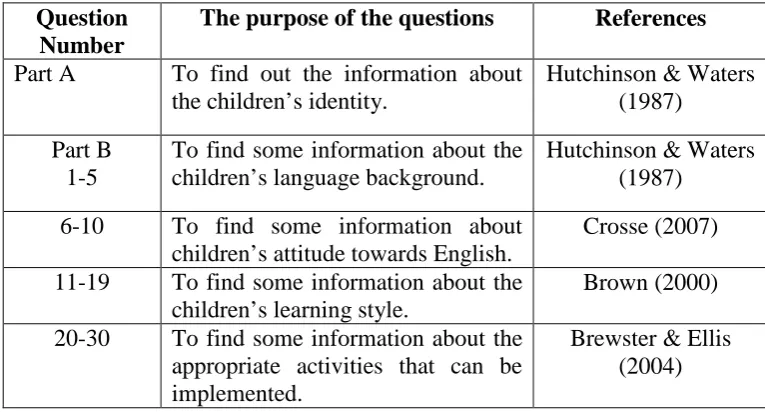
1) Questionnaire 51
2) Observation Guide 53
3) Interview Guide 54
4. Data Analysis Technique 55
a. Data Analysis of the Children’s Needs 55
b. Data Analysis of the developed Product Evaluation 56
CHAPTER IV RESEARCH FINDINGS 57
A. Needs Analysis 57
1. Description of the Children’s Characteristics 57
2. Description of the Second Grid 73
3. Description of the Third Grid 74
C. Developed Activities 75
1. The Format of the Developed Activities 75
2. The Description of the First Developed Activities 77
3. The Description of the Second Developed Activities 78
4. The Description of the Third Developed Activities 79
D. Product Revision 80
1. Evaluation and Revision from the Consultant 80
2. Evaluation and Revision from the Participants 81
E. The Final Draft of the Developed Activities 88
The Tryout, Analyzing, Evaluation and Revising 88
1) The Second Draft of the First Developed Activities 89
a. The Tryout of the Second Draft of the First Developed Activities 90
b. The Evaluation of the Second Draft of the First Developed Activities 98
c. The Revision of the Second Draft of the First Developed Activities 102
2) The Second Draft of the Second Developed Activities 103
a. The Tryout of the Second Draft of the Second Developed Activities 104
a. The Tryout of the Second Draft of the Third Developed Activities 115
b. The Evaluation of the Second Draft of the
Third Developed Activities 120
c. The Revision of the Second Draft of the
Third Developed Activities 123
F. Final Product 124
G. Limitation of the Product Development 125
H. Summary 125
CHAPTER V CONCLUSION AND SUGGESTIONS 128
A. Conclusion 128
1. The Product Study 128
2. The Characteristics of the Product Study 130
B. Suggestions 131
REFERENCES 134
APPENDIX 136
APPENDIX A: THE DATA OF THE D3 CLASS CHILDREN OF TPA PELANGI NUSA
AND THE PARTICIPANTS 137
APPENDIX B: INSTRUMENTS 140
APPENDIX F: FIRST DRAFT 193
APPENDIX G: SECOND DRAFT 237
APPENDIX H: DOCUMENTATIONS 267
APPENDIX I: RESEARCH LICENCES 272
Figure 2: The Cameron’s Principles 34
Figure 3: The Stages of the Developed Activities 34
Figure 4: The Plan-Do Review Model 37
Figure 5: Instructional Activities Design 39
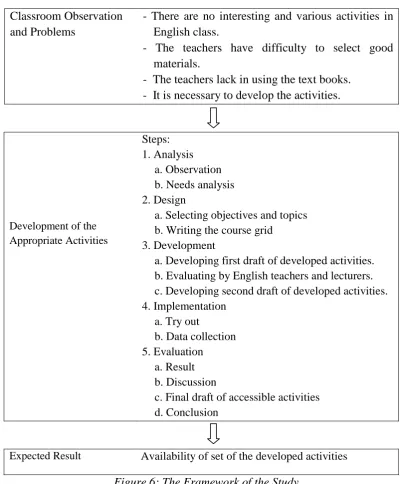
Figure 6: The Framework of the Study 42
Figure 7: Flash Cards of Numbers 70
Figure 8: Realia-Plant 70
Figure 9: Picture of Fish 71
Figure 10: The Model of the Developed Activities Format 75
Figure 11: The First Developed Activities 97
Figure 12: The Second Developed Activities 110
Figure 13: The Third Developed Activities 120
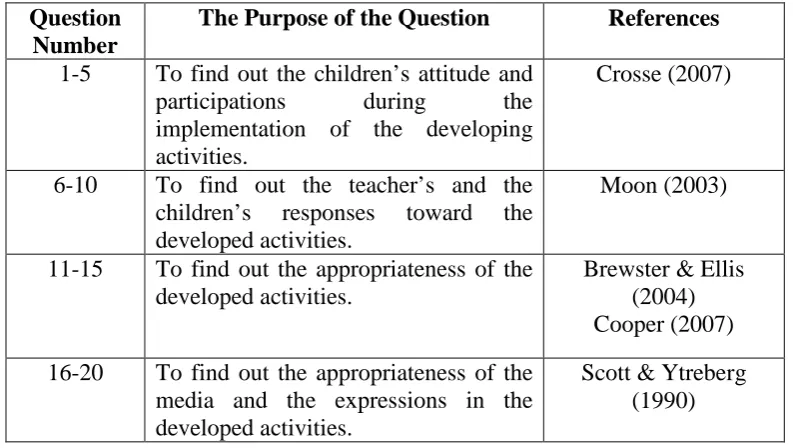
Table 2: The Organization of the Second Questionnaire 53
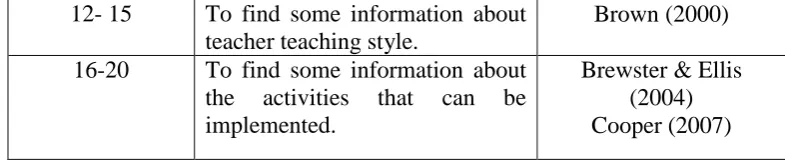
Table 3: The Organization of the observation Guide 54
Table 4: The Organization of the Interview Guide 54
Table 5: Quantitative Data Conversion 55
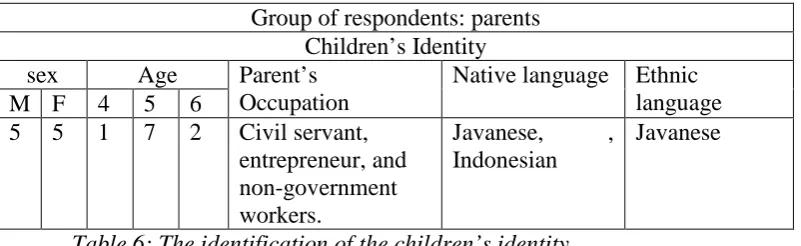
Table 6: The Identification of the Children’s Identity 58
Table 7: Needs Analysis of the Children’s Characteristics 58
Table 8: The Needs Analysis of the Children’s Characteristics and Needs 63
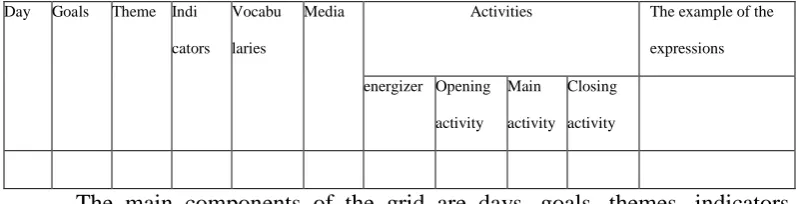
Table 9: The Format of the Course Grid 67
Table 10: The Evaluations and Revisions of the First Draft 80
Table 11: The Data of the Participants 81
Table 12: The Mean Score of the Goal Aspect 82
Table 13: The Mean Score of the Activity Aspect 83
Table 14: The Mean Score of the Language Aspect 85
Table 15: The Mean Score of the Media Aspect 86
Table 16: The Mean Score of the Layout of the Guide Book 87
Table 17: The Revision of the Second Draft of the First Developed Activities 102
Table 18: The Revision of the Second Draft of the Second Developed Activities 114
Table 19: The Revision of the Second Draft of the Third Developed Activities 124
07202249002
ABSTRACT
This research was aimed at developing appropriate activities for children. These developed activities are easy to use and to understand because they are completed with teacher’s manuals. The next objective was to find out the characteristics of the appropriate activities for children at TPA Pelangi Nusa, Wates, Kulon Progo.
This research is a Research and Development (R and D). The subjects of the research were the children and the English teacher of TPA Pelangi Nusa Wates Kulon Progo. There were three instruments used in this research. They were questionnaires, an interview guide, and an observation guide. The data were analyzed quantitatively for the questionnaires and qualitatively for the interviews and the observations. Eight steps were done to do this research, namely conducting needs analysis, selecting some activities, writing the course grid, developing the activities, having the expert judgment, evaluating and revising the first draft, trying out the second draft, and finally analyzing, evaluating, and revising the second draft to produce the final draft.
The results of the study show that the developed activities were relevant to the children’ and the teacher’s needs and characteristics. The developed activities were also in accordance with the school curriculum and the generic learning manual from the Ministry of Education about the very young learners’ competencies. The course grid which had eight aspects was developed based on the obtained data of the needs analysis, the school curriculum, and the government generic learning manual and was used as the guideline in developing the activities. The activities were playing with number, planting, drawing and coloring. Each developed activities consisted of energizing, opening, main, and closing activities with several steps inside. The developed activities were evaluated and approved statistically using a questionnaire. The result showed that the draft was ready to be tried out which was shown by the mean scores range of 3.42 to 3.50 which included in the good categories. After the try-out, the observations and interviews were used to evaluate the implemented draft. The data showed that the activities, the goal, the media, and the language were appropriate to the children, while the layout of the draft suited the teacher.
A. Background of the Study
The teaching of English to children In Indonesia has become especially
important in recent years. English as foreign language is an essential means of
communication. The language is used in interactions with parents, teachers and
others as vehicle through which understanding and learning take place.
Using language remind children what they already know, solving
problems, and general support for their learning. Learning is an active process.
Children can actively involve when they are interested. For that reason, there are
many pre-schools and kindergartens begin to introduce this subject to the
children. Children in pre-school have different characteristic in thinking and
learning from other.
Teaching English in pre-school is really different from the teaching
English in higher level. Pre-school children, as the young learner or children, have
certain characteristics in thinking and learning from other. It is obvious that
teaching English to children is quite different from teaching English to adults
since children have their own world and unique characteristics. In those schools
children are often more enthusiastic and lively as learners; they want to please the
teacher than their peer group. The learning process is needs a certain treatment.
Some children develop early, some later. Children have a great curiosity about
new things such as English. They will try to search information about something
that they want to know.
Consequently, it is necessary to the teacher to know about the children’s
characteristics as young learners. The teacher must try to find ways to improve the
learners to master not only such kind of a new word but also the follow up
activities as much as possible and notice their needs in order to make the learning
and teaching process effectively done. According to Crosse (2007: 26) young
children learn through being active in both a physical and intellectual sense. They
need to be involved and responsible for their learning so that all their energy and
enthusiasm is harnessed and channeled into the activity.
In other word, a good teacher should ensure that his or her teaching
methods are suited to the level of the development stages reached by the children
at their ages and thus avoid many behavior problems that occur when children
become bored and unable to follow what is being taught. One of the causes of
failure in teaching English in the pre- school is that the teacher still teaches with
the routine activities.
Some pre- school teacher just introducing new kind of words based on the
magazine published as guidance to deliver the materials without an interesting
following activities that might develop the children’s knowledge and also without
considering that it will make the children bored and lost their attention span to the
learning and teaching process, unless activities are extremely engaging, they can
easily get bored, losing interest after ten minutes or so (Harmer, 2001: 38). As a
their interest. Brown (2001:88) stated “Short attention spans do come into play
when children have to deal with material that to them is boring, useless, or too
difficult”. As a result, the children’s motivation and participation in learning will
decrease. Here, interesting and appropriate activities become a crucial factor in
deciding in teaching children on classroom practice. Children have a great
capacity to enjoy themselves. When children are enjoying themselves, they are
usually absorbed by the activity and want to continue with it. Children are not
always aware that they are learning English.
Therefore, the teacher should apply appropriate activities and create an
interesting atmosphere so that children will be enthusiastic to the learning and
teaching process. In the light of the unique characteristics, it can be concluded that
good teachers must make every effort to can give a good learning achievement for
their students.
Based on the preliminary observation at TPA Pelangi Nusa, one of the pre-
schools at Wates Sub District of Kulon Progo regency, it is very important for the
English teacher to try to develop activities because there are limited guidance to
make follow up activities to support the materials given for the children.
Moreover, the children will get the impacts. In this case, the children are young
learners who like interesting materials and various activities that should also be
suitable with their needs. However, children just learn English in simple and fun
ways since they learn for the first time. The activities focus on introducing new
things toward the theme based on PAUD (Pendidikan Anak Usia Dini)
making the children interested in English much. There are many activities
supporting the idea of creating conducive atmosphere for children to develop their
language ability. Therefore, conducting this research about “Developing
Appropriate Activities for Children at TPA Pelangi Nusa, Wates, Kulon Progo”
can support children in the process of their learning. It hoped that the outcome of
this study will be beneficial for the school.
B. Identifications of the Problems
Teaching English in earlier years need to take into account. Introducing
children to a new language offers opportunities to widen their horizons and
awaken their early enthusiasm and curiosity about language (Pinter, 2006: 32). A
successful teaching and learning process for children needs consider some factors
seen from children’s understanding toward the material. The problems of this
present study are related to the teacher, children as students, and learning
activities.
In the teaching and learning process, there are two factors that directly
related to each other. They are the teacher and children. The teacher is as the
educator and children as the learners. Teachers are better able to provide
appropriate learning experiences for children. Therefore, the direct interaction
between the teacher and children as the students in the teaching-learning process
determine children’s understanding toward the material. According to Tomlinson
the learning of a language. To deliver the material, teacher can use media as the
learning kit and appropriate activities to support children understanding.
Good material and appropriate activities should be given to children in
order to help children in studying English. Unfortunately, there are no suitable
materials for Pendidikan Anak Usia Dini (PAUD). Based on the observation at
TPA Pelangi Nusa, it is very important for the teacher to develop the suitable
material for children because she only uses student magazine published as
guidance for PAUD’s teacher as the main source. The teacher get difficulties in
using it because it is only introduce new vocabularies with simple pictures. The
teacher needs the manual to develop the material to be more interesting with
various activities that appropriate for the children.
However, children are not adult in the miniature. The aim of teaching pre-
school children is to produce happy, confident, enquiring children, interested in
life and enthusiastic about the challenges they encounter. That’s why the material
for teaching language to children should be different from the materials for
teaching adult. A set of material with appropriate activities is needed which
involve children and give them many chance to learn English in a fun atmosphere.
The children’s experiences in learning English ought to be enjoyable and not put
an extra burden on them.
In other word, if children enjoy their learning, they will be more involved
and this may increase their desire to continue. This is very positive for language
learning, because if children want to continue with an activity for some time, it
the language. Moreover, the Ministry of Education in Indonesia has the objective
to motivate children to learn English in interesting and fun way.
In general, pre-school children are in the age from zero to six years old.
This period is the transition period between the early childhood periods to late
period. In their age, children are innately physically active. They will learn faster
though playing. It is what they do naturally. Playing is an important part of
children life and education. Through playing, children develop their social,
emotional, and cognitive skill with fun. Children are more interested in learning
through fun activities such as game, songs and actions. Moreover, certain kinds of
play demonstrate the ways in which children are able to become fully engaged in
their activity and sustain their interest for some time. Therefore, this present study
will tries to develop appropriate activities for pre-school children. In order they
will involve in the teaching and learning process and they will have many chances
to explore and to be familiar with English.
C. Limitation of the Problems
There are many factors that are potential to influence the children’s
successes in learning English. It is believed that the factors discussed above give
contribution to English achievement. Considering that the TPA Pelangi Nusa uses
the theme designed by the Pendidikan Anak Usia Dini (PAUD) curriculum to
teach children in pre-school, this study will only focus in developing activities
researcher to improve children understanding in learning English are games and
songs at TPA Pelangi Nusa Wates, Kulon Progo.
D. Formulation of the Problems
Based on what is stated in the background of the study, identification of
the problems, and the limitation of the problem presented previously, the
problems of this study are formulated as follows:
1. What activities are appropriate for children to learn English at TPA Pelangi
Nusa Wates, Kulon Progo?
2. What are the characteristics of the appropriate activities for children at TPA
Pelangi Nusa, Wates, kulon Progo?
E. Objectives of the Study
From the formulation of the problem, the objective of the problems are :
a. To develop appropriate activities for Children that accessible for teacher at TPA
Pelangi Nusa, Kulon Progo.
b. To find out whether these characteristics of the activities are appropriate for
children at TPA Pelangi Nusa, Kulon Progo.
F. Product Specification
The product of this study is developing appropriate activities for D3 class
of TPA Pelangi Nusa, Wates, Kulon Progo and completed with the teacher’s
plant, and animal with the sub theme let’s play with number for the number
theme, planting time for the theme plant, and beautiful fish for the theme animal.
The activities develop the children’s sense, physical coordination in both
gross motor skill and fine motor skill, and cognitive skill. It also stimulates
children to practice the four skills such as listening, reading, writing and speaking
skill that suitable for them.
Further, the activities were described the teaching and learning steps. The
teacher can read the guidance book in order to deliver the material. The steps can
make the learning process be more organized. The steps are energizer, opening
activity, main activity, and closing activity. For energizer, children are asked to
join the circle time. Here, the activities are sing and move session. In this session,
the songs that can be used to deliver the material also can be introduced. The
energizer held in the outdoor such as play ground or yard.
Next step is the opening session. Before the opening session, the children
are asked to have a snack time. After that, all the children entered the class and
join the opening activity. The activities in this session are greeting, praying,
registration, and introducing the theme. In this step, some media are used to
introduce the material to the children.
The following activity is main activity. The main activity can be done in
the classroom or outside the classroom. Here, children are asked to do some
exercise related to the material they have learnt in the previous lesson. The
guidance. In this step, the teacher asked the children and check whether they have
been able mastering the material or not.
In addition, the media are used to support the material. For the theme
number, the media used are ball, basket, and flash card of number with smooth
surface and rough surface. The second theme is plant with the activity of planting.
The media used are realia like flower and the tool for planting such as soil, seeds,
shovel, and watering can. The last theme is animal that specified into beautiful
fish. The media used for this theme are realia with the real fish, and also the white
board, board marker, paper and crayon to draw a beautiful fish.
The developed activity also comprises a teacher’s guidance book for those
three themes. The teacher’s guide is used for assisting the teacher to deliver the
material. It is contain of teaching guidance of how to present the material, how to
play the game, the song lyric, and how to use the daily expression.
G. Significances of the Study
The results of the study are expected to be able to give the following
benefit and contribution to the pre school English teacher, children as the
students, pre-school intuitions and other researchers. The significances of this
study are:
1. Theoretically
The findings of this study may verify the validity of the activities based on
2. Practically
The findings of the research are useful for:
a. For Pre- School English Teacher
This research can motivate the English teachers of pre- school at Wates sub
district of Kulon Progo regency to develop activities that supported the
materials that accessible and suitable for the children.
b. Pre- School Children
It is hoped that this study sill gives the children new experiences in
learning English.
c. For Other Researcher
This study will give other researchers ideas to conduct research studies of a
similar kind to enlarge the readers’ knowledge in using activities as the
media of teaching and learning process for very young learners.
3. Methodologically
It is expected that the procedure and also the outcome of this study can
inspire other researchers to do research concerning similar themes.
H. Assumption and Limitation of the Study
The development of this study is based on some assumptions:
1. The developed activities product can be accessible for teacher at TPA Pelangi
2. The developed activities product can make the English teaching and learning
process in class D3 children of TPA Pelangi Nusa more effective and
interesting.
3. The developed activities product can increase children’s interest in learning
English.
4. The developed activities product can help the teacher in presenting the material
to the children.
5. The development activities product has characteristics that suitable with the
children’s development stages.
The development of this study also has limitations. They are:
1. The developed activities product of this study only for the higher class that is
D3 class children at TPA Pelangi Nusa, Wates, Kulon Progo proposed by the
English teacher and the headmaster. Therefore, the characteristic of the product
only suitable with the children needs and characters of D3 class children.
2. The development of the product only gained three themes. However, the
development of others themes also necessary developed in order to comprise
CHAPTER II
LITERATURE REVIEW AND CONCEPTUAL FRAMEWORK
A. Theoretical Review
1. English Teaching and Learning for Children
In this study, the discussion of the English teaching and learning for
children consist of three aspects that related to the topic of the study. These are
the characteristic of the children in learning the principles in English teaching the
children and teaching the four skills for children. These aspects are described
below:
a. Children’s Characteristics
The adult world and the child’s world are not the same. Children tend to
be self-oriented and preoccupied with their own world. Children are unique and
natural. They have different characteristics from adult. According to Pinter,
(2006:16) children within the same age groups may show similar characteristics
but at the same time they are also very different as individuals with their strengths
and preferences as learners. The characteristics of children depend on their ages
and it plays an important role on how they acquire the language. The subjects of
the study are the children of D3 class in TPA Pelangi Nusa are in the range of four
to six years old. Therefore, it is necessary to discuss some theories of children
characteristics proposed by experts. There are six characteristics of children
1) Children Love to Play
Children love to play. They can play the whole time as they want. It is
appropriate to their nature that they love to play. Scott and Ytreberg (1990:4)
states that children love to play, and learn best when they are enjoying
themselves. But they also take themselves seriously and like to think that what
they are doing is ‘real ‘work. Moreover, in learning process children have a great
capacity to enjoy themselves. When they are enjoying themselves, they are
usually absorbed by the activity and want to continue with it. They are not always
aware that they are learning language.
2) Having Sense of Fun
Children have sense of fun. They like games, puzzles, and songs (Harmer,
2007: 82). At this point, the children find them as interesting and fun activities.
They take great pleasure in finding and creating fun in what they do. Children can
enjoy the activities when they can create something new. Moreover, by engaging
children in the fun activities, the teacher will keep the children’s motivation and
enthusiasm. It can provide the real world context in the classroom. These fun
activities will give a chance for children to participate in the teaching and learning
process.
3) Attention Span
An attention span is extends to how long a person is able to hold full
attention in a teaching and learning process. In general, children especially young
learners usually need to move and cannot concentrate for long periods. In other
concentrate on something long. Brown, (2000:88), states that children are
focussed on the immediate here and now, activities should be designed to capture
their immediate interest. Some language lesson can at times be difficult for
children. For that reason, learning and teaching process should be interesting,
lively and fun. Varieties of activities keep interest and attention alive. A child
attention span normally related to his/her age. By knowing children attention
span, it will be enable the teacher to schedule the steps in the process of language
teaching appropriately.
4) Curiosity
Children have big curiosity about everything around them. Brown, (2001:
89) state that children have a lot of natural curiosity. Children are full of questions
and will search for the answer in their mind. Children curiosity about the world
engages them to make sense of whatever they can see, hear, smell, taste, and
touch. When children are curious about something, they try to find lacks of the
information. Furthermore, children enjoy fantasy, imagination, and movement
(Pinter, 2006:2). Children need to have all five sense stimulated. Therefore, the
activities should strive to go well beyond the visual and auditory. Without an
understanding of the child’s perception and characters, the effective learning
environment will not occur.
5) Fantasy, Imagination and Movement
Children enjoy fantasy, imagination and movement (Pinter, 2006:2).
Fantasy is a situation imagined by an individual or group that has no basis in
An imagination is the activity of forming mental images, sensations, and
concepts in a moment when they are not perceived through sight, hearing, or other
senses. It helps provide meaning to experience an understanding the knowledge.
A movement is moving the body or parts of the body. Children are
naturally active. They eagerly explore the environment through physical activity
and experiencing things at first hand. They also love to touch, to watch, to taste, to
listen to and to smell anything directly by themselves. They need to have all the
sense stimulated.
Based on those characteristics of the children, this can be concluded that
children are really different with adults. Children like fun and cheerful
atmosphere, so that the activities should be appropriate, various, and interesting
for them. The teacher should create a friendly atmosphere in which they can enjoy
their learning then the goal of the teaching and learning process can be achieved.
b. The Principles of English Teaching to Children
The process of teaching English to pre-school children is different from
the process of teaching in higher level. Teaching English to children has many
aspects. According to Brewster and Ellis (2002:29), children in the age of three to
six years old are capable of symbolic thought, where a picture can be substituted
for the real thing. Children need opportunities to choose and decide on actions; to
investigate, explore and be curious; be encouraged to question, to work things out;
activities which help them to focus and pay attention in order to develop memory
developing and develop oral skills. Teacher needs to find appropriate activities
that can lead children to obtain the goal of the language learning.
Brown (2007: 8), states that teaching cannot be defined apart from
learning. Teaching is guiding and facilitating learning, enable the learner to learn,
setting the condition for learning. Children need to be settled in the language
lesson in order to make them get better output. Moreover, pre-school emphasize
creative play, social interaction, and natural expression. It implies that a happy
and fun atmosphere can help children to get the language competence. The
approaches to teach children are described below:
`1) Intellectual Development
Technique and activities used in English teaching should appropriate with
the children intellectual development. According to Brown (2001:87), in learning
a new language, children depend on the world around them as they are cantered
on the here and now, in the functional purposes of language. In teaching children,
explaining grammar and starting rules in abstract concept should be avoided.
Certain difficult patterns require repetition but the activities should not burden and
bore them.
2) Attention Span
Children have short attention span. Short attention spans do come into
play when children have to deal with material that to them is boring, useless or
too difficult. For that reason, the teacher has to make them interesting, lively, and
1. Because children are focused on the immediate here and now, activities
should be designed to capture their immediate interest.
2. A lesson needs a variety of activities to keep interest and attention alive.
3. A teacher needs to be animated, lively, and enthusiastic about the subject
matter.
4. A sense of humor will go along way to keep children laughing and learning.
5. Children have a lot of natural curiosity, than teacher should make tap into
that curiosity whenever possible to maintain attention and focus.
Therefore, a teacher needs to direct children’s attention of immediate
situation to focus on the language lesson by providing enjoyable activities in the
classroom.
3) Sensory Input
Children need to have all five sense stimulated. According to Brewster and
Ellis (2002: 35), the younger the learners, the more physical activity they tend to
need and the more they need to make use of all their sense. Children are still
developing their motor skills, such as holding a pencil, hopping, skipping,
balancing and the hand-eye coordination. They are also more physically active.
Physical activities such as songs, games and actions provide excellent context for
language learning. The language is closely related to what is happening in the
situation, and so children can get clues about the meaning about the activity which
accompanies the language. Moreover, children learn through doing, so that
`4) Affective Factors
Children are often innovative in language forms but still have a great
many inhibitions. Children are in many ways much more fragile than adult. Their
egos are still being shaped, and therefore the slightest nuances of communication
can be negatively interpreted. Therefore, the teacher needs to help children to
overcome such potential barriers to learning by conducting fun atmosphere, build
their self esteem, and elicit as much oral participation of the children especially
quieter ones to give them plenty of opportunities for trying things out.
5) Authentic and Meaningful Language
Children are focused on what this new language can actually be used for
here and now. The class is forbidden to have an overload of language that is
neither authentic nor meaningful. The understanding of pre-school children comes
through the hands, eyes and ears, so the physical world is dominant all the times.
Brewster and Ellis (2002: 35) states that a language teaching method that works
well with the beginners and young learners is Total Physical Response (TPR).
Invented by Asher, it involves learners in listening to something and then showing
their understanding by their actions and responses. This draws on learning by the
ear and eye and is good for those with bodily – kinaesthetic intelligence.
Crosse (2007:5) state that a good foundation for learning English as an
additional language is embedded in quality early years practice. Good early years
practice is based on the following principles:
1. Equality of opportunity which enables all children to reach their full potential.
3. Emphasising and building on what children can do rather than what they cannot
do.
4. An understanding of child development leading to appropriate activities for
children.
5. Giving priority to personal, social and emotional development.
6. Encouraging children to become independent, autonomous learners.
7. Learning based on first –hand experiences which is then evaluated.
8. Effective record-keeping and assessment identifying what children learn and
how they learn.
As what has been mentioned before, the understanding of child
development leads to appropriate activities for children. Furthermore, the
government develop a guideline of teaching young children or pre-schooler. It is
built upon five aspects of child development as well as child growth. These
aspects are moral and religious, cognitive, language, physical and motor, and
socio-emotional development. The developmental skills are quite similar to what
most countries have set up for their childhood education. The difference is that
Indonesian has included religion comprehension into list of developmental skill to
be achieved by young children.
c. Teaching the Four Skills to Children
English is a foreign language. Learning a foreign language is an integrated
process that children study the four basic skills: listening, speaking, reading, and
receiving information from an outside source. Speaking and writing, on the other
hand, are productive skills because they focus is on producing information.
However, teaching that four skills for children at the beginning levels differ from
adult.
1) Teaching listening to children
According to Scott and Ytreberg (1990:21), listening is the skill that
children acquire first, especially when they have not yet learnt to read. When
children start to learn foreign language, it is going in mainly through their ears
and what children hear is the main source of the language. Listening can be seen
as primarily the active use of language to access other people’s meaning
(Cameron, 2001:40).
In the other words, listening is the receptive use of language, and since
the goal is to make the sense of speech, the focus is on meaning rather than in
language. Listening is the ability to identify and understand what others are
saying. Linse (2005:25) also considers that teaching of listening skills as
foundational to the development of other language skill. However, it is important
to provide specific activities which give children listening practice. Pinter
(2006:51) states that a great deal of listening practice in the early years can grow
out of TPR such as listen and respond games.
2) Teaching Speaking to Children
Speaking is equally important in children overall language development.
Children are immensely creative with language and enjoy playing with words. In
producing language. Cook, cited in Linse (2005:46), states that there are many
different ways that children play with words and language beginning with the
tickling rhymes that they hear as babies and continuing with other sorts of play
which involve both the form of meaning of language. As they grow, children
integrate these words and structures into their real and imaginary play.
According to Pinter (2006:56), after children have been exposed to
English though listening, they soon want and able to participate in interactions
with the teacher and other. Many children will want to start copying simple
phrases, join in with rhymes and songs, answer simple questions, introduce
themselves, and memorize short dialogue.
3) Teaching Reading to Children
Teaching reading to children is a bit different than the way adult are taught
to read. According to Linse (2005:69), reading is a set of skills that involves
making sense and deriving meaning from printed word. Furthermore, Scott and
Ytreberg (1990:70) states that five to ten years olds are likely to take longer to
learn to read in a foreign language then eight to ten years old. Some children
starting school are not familiar with book or what they use for. They have to go
through the process of doing reading activities first – ‘reading’ from left to right,
turning the pages t the right place, going back and reading the same pages again,
etc. According to Pinter (2006:69-70), reading activity for children is to connect
spoken words and written words deliberately by using word cards, picture cards,
4) Teaching Writing to Children
Sokolik cited in Linse (2005:98) states that writing is a combination of
process and product. The process refers to the act of gathering ideas and working
with them until they are presented in manner that is polished and comprehensible
to readers. In line with Sokolic, Dorn and Sofofos cited in Linse (2005:98) states
that when teaching writing to young children, teacher must recognize the
complexity of the process. According to Linse (2005:99), when teaching writing
to children who are four to seven years old, the teacher must consider to fine
motor skills like how to hold pencil firmly and cognitive skills to formulate ideas.
Therefore, children enjoy experimenting with writing and putting their ideas down
on paper. Children may need more or less practice with the mechanical basic of
writing. It is useful to start with tracing and copying (Pinter, 2006:74).
d. Teachers of Children
Children as young learners have certain characteristics and need certain
treatment. Consequently, it is necessary to the teacher to know about children
characteristics and notice their needs in order to make the teaching-learning
process effectively done. A good teacher should ensure that his or her teaching
methods are suited to the level of cognitive development reached by the children
at their schooling stage, and thus avoid many behavior problems that occur when
children become bored and unable to follow what is being taught.
Moreover, establishing and enforcing the National Standard of the
Education, teacher's competencies consist of four categories: personal,
professional, pedagogic, and social competencies. Personal competencies include
the ability to perform positive behavior according to child developmental needs,
religious and cultural values, and noble characters. Professional competencies
include comprehension of child developmental stages and principals, how to
provide educational and developmental stimulus and care, and how to protect and
empower children. Pedagogic competencies include skills to plan, implement, and
evaluate the learning process and assess the developmental progress of children.
Lastly, social competencies include adaptive and communication skills.
2. Activities
According to Nunan (1989:59), activities specify what learners will
actually do with the input which forms the point of departure for the learning task.
For pre-school children, these activities are intended to effect developmental
changes in children. Furthermore, Brewster and Ellis (2002:49) states that
activities like traditional exercises, focus on the guided teaching and learning of
specific items of language, skills or knowledge.
a. Characteristics of Good Activities for Children
Most children do not have very long attention span. Also, not every child
is going to enjoy or learn from the same type of activities. Children need physical
movement and activity as much as stimulation for their thinking. Moreover, Scott
include movement and involve the sense. Therefore, the activities should consider
with developmental stages of the individual needs.
Furthermore, Brewster and Ellis (2002:49), proposes seven characteristics
of activities. Figure 1 bellows illustrates the characteristics of activities:
Figure 1: The Characteristics of the activities
There are seven characteristics of activities according to Brewster and
Ellis. They are (1) the activities have language practice as their main aim and
include such things as becoming more familiar with new vocabulary, grammar
and language functions or practicing skills as listening for detail using charts; (2)
activities focus on form and meaning to some extend but are not in themselves
purposeful of meaningful; (3) they rehearse a particular set of sub-skills, language
items or task procedures; (4) they usually consist of a cognitively simple set of
operations and have reduced learner control; (5) activities are used as a means of
preparing pupils for more independent work or task. (6) activities are often done
in pairs or individually and might include: listening for specific sounds and words
Activities
Are not a meaningful end in themselves Provide a small degree of
pupil freedom and choice Provide controlled,
guided practice Rehearse specific language items skills or strategies
to notice new sounds and words; pronunciation practice e.g. matching the word
stress by using large and small cards; practicing new vocabulary using flashcards;
sequencing letters, words, sentences to practice spelling, vocabulary (7) the
activities often form the main part of course books and accompanying workbook.
b. Types of Activities
A good pre-school lets children learn by doing. It stimulates their senses
through art, music, and tactile materials-clay, water, and wood. It encourages
children to observe, talk, create, and solve problems. Through storytelling,
dramatic play, conversation, and written activities, it helps children develop
pre-literacy skills (Papalia and Olds, 2001).
Furthermore, Pattisin (1987) cited in Nunan (1989:68) proposed seven
activity types. These are as follows:
1) Question and Answer
These activities are based on the notion of creating an information gap by
letting learners make a personal and secret choice from a list of language items
which all fit into given frame (e.g. the location of a person or object). The aim is
for learners to discover their classmate secret choice. This activity can be used to
practice almost any structure, function or notion.
2) Dialogues and Role-Play
These can be wholly scripted or wholly improvised, however, ‘if learners
are given some choice of what to say, and if there is a clear aim to be achieved by
more thoroughly than when they are told to simply repeat a given dialogue in
pairs”.
3) Matching activities
Here, the task for the learners is to recognize matching items, or to
complete pairs of sets.
4) Communication strategies
These are activities designed to encourage learners to practice
communication strategies such as paraphrasing, borrowing or inventing words,
using gesture, asking for feedback, simplifying.
5) Pictures and Picture stories
Many communication activities can be stimulated through the set of
pictures (e.g. spot the difference, memory test, and sequencing picture to tell a
story).
6) Puzzles and problems
There are many different types of puzzles and problems. These require
learners to ‘make guesses, draw on their general knowledge and personal
experience, use their imagination and test their powers of logical reasoning’.
7) Discussion and decisions
These require the learner to collect and share information to reach a
decision.
Most activities for children should include movement and involve the
language trough play and other activities which they find enjoyable such as
games and song.
1) Game
According to Lewis with Bedson (1999:5), games are fun and children like
to play them. Playing games is a vital and natural part of growing up and learning.
Trough games children experiment, discover, and interact with their environment.
Games add variation to a lesson and increase motivation by providing a plausible
incentive to use the target language.
Moreover Brewster at all (2002:172) states that children enjoy play and
games. They are not only motivating and fun but can also provide excellent
practice for improving pronunciation, vocabulary, grammar and the four language
skills. For very young children games also provide `an important link between
home and school which help to make them feel more secure and confident. Games
help to make learning more memorable and accessible by using as many
approaches as possible, such as mime and movement, use of color and patterns, or
personalization.
Furthermore, Martin (1995:1) cited in Brewster at all (2002:172) said that
game is any fun activities which gives young learners the opportunity to practice
the foreign language in relaxed and enjoyable way. Brewster at all (2002: 175)
proposed two types of games. They are:
1) Accuracy – focused games
In these games the aim is usually to score more points than others and is
(listening/reading) as well as production (speaking/writing). In this case, the child
may not necessarily say anything but gets used to hearing or reading words or
sentence pattern over and over again. Some of these games are also very good at
training their memories.
2) Fluency – focused games
This referred to moves from language control to communication. This type
of game tends to focus on developing fluency and collaboration with others.
Games for very young learners should be easy to explain, set up and play.
Furthermore, Brewster at all (2002:178) said that games can be classified by the
resources required to play them. The list below shows the eight types:
1. No resources e.g. guessing games, listening games, (listen and do, hide and
find, repeat if its true, stand up when you hear…)
2. Simple pencil and paper/ blackboard games (spelling, games, consequences)
3. Picture games (describe and colour/ label/ draw/ arrange/ sequence, picture
dictation, mime)
4. Word cards (dominoes, read and classify, pelmanism). These practice
vocabulary and may focus on the meaning and pronunciation of words,
collocation or word association such as fighting fit, meaning relation
between words, such as opposites and word families.
5. Games using sentence cards (matching parts of a sentences, matching
question with answers, problems with solutions, cause and effect)
6. Dice games (dice have words or pictures on them instead of numbers which
words or actions which correspond to the number on the dice e.g. follow
instructions: 1: jump, 2: say your name, and so on.
7. Board games (five senses: a board with pictures of different items and
‘chance’ card with instructions such as “ if you can smell this, move on two
spaces and so on.
8. Games using chart or matrices (draw and arrange type game using
information gap, where each child in a pair secretly marks the position of
things on a chart.
On the whole, game needs to be short, easy to carry out and easy to
explain. Moreover, Lewis with Bedson (1999: 16) proposes ten types of game for
children. They are:
1) Movement games
In these games, children are physically active. Movement games are
generally ‘rousers’ and need to be closely monitored.
2) Card games
Children collect, give away, exchange, sot, and count cards. The cards can
have meaning or value in a game, o simply serve as symbols for object o
actions.
3) Board games
Board games are any games which mainly involve moving markers along a
4) Dice games
Dice games are incredibly versatile. The dice can have numbers, colours, and
letters of the alphabet.
5) Drawing games
Drawing games are special because they span a gap between key functions of
the brain. On the one hand, drawing requires creativity and sensitivity
towards the world.
6) Guessing games
The aim of this game is to guess the answer to a question of some kind.
7) Role Play games
Role play games can be seen as simple, guided drama activities. The
language input can be quite rigidly prescribed or vey open depending on the
language level, curiosity, and confidence of the class. Role plays stimulate a
child’s imagination and are tests of true communication
8) Singing and Chanting games
Singing and chanting games often involve movement, but teacher decided to
list them separately since music plays such an important role in early
childhood learning.
9) Team games
Team games can belong to the other categories, but also require cooperative
team work.
These games utilize children’s enjoyment of playing with words. They are
mostly for older children as they involve spelling and writing.
2) Song
Children love songs, rhyme and chant and their repetitive nature and
rhythm make them an ideal vehicle for language learning (Brewster at all, 2002).
A song is a group of words which have rhythm and intonation. The benefit of the
use of songs, rhymes, and chant for language learning has been grouped together
for language teaching process. Below is the list of those benefits.
1. A Linguistic Resource
a) They allow new language to be introduced and structures and vocabulary to
be reinforce and recycled.
b) They present familiar language in new and exciting forms and in a rich,
imaginative context.
c) They provide for lots of natural and enjoyable repetition.
d) They can be used to develop all skills in an integrated way.
e) They help improve all aspects of pronunciation.
2. A Psychological/ Affective Resource
a) They are motivating and fun and help develop positive attitudes towards the
target language.
b) They are non-threatening and the more inhibited child will feel secure when
c) They can encourage a feeling of achievement and build children’s
confidence by allowing children to learn chunk of language which they can
“show off” or teach to friends or to members of the family.
3. A Cognitive Resource
a) They help to develop concentration, memory and coordination
b) They sensitize children to rhyming clues as aids to meaning.
c) Repetition enables children to predict what comes next and to consolidate
language items.
d) Accompanying actions or gestures help to reinforce meaning, while
channeling high levels of energy in a positive way.
e) The variety they provide changes the pace and atmosphere of a lesson and
caters for different learning styles.
f) They can be complied into song/rhyme books to help children develop good
study habits.
4. A Cultural Resource
They are from authentic sources and can contribute to the cultural
component of a language program. Children can be encouraged to compare
with those in their own language.
5. A Social Resources
a) Singing and chanting together is a shared social experience and helps to
develop a class and group identity.
Finally they offer a flexible resource to the teacher. There are plenty to
choose form, can be used with a variety of age groups at different stages in their
language learning; can act as a starting point for devising a program of work, can
integrate with cross-curricular work, topic and stories and can complement and
supplement other resources (Brewster at all, 2002)
Furthermore, Brewster, Ellis, and Girard (2003: 164) add that by using
songs, rhymes, and chants, children can learn and practice the pronunciation
aspects; such as the individual sounds and sounds in connected speech, stress and
rhythm, and intonation. Songs can be used in many different ways and activities:
as warmers, as a transition from one activity to the next, closers, to introduce a
new language, to practice language, to revise language, to change the mood, to get
someone’s attention, to channel high levels of energy. Considering all those
advantages, the researcher uses some songs in some activities of the developed
activities. She uses songs to motivate children, to attract their attention, to ask the
children to do something, and to revise and repeat new words.
c. Developing Appropriate Activities for Children
1. The Principles and Stages in Developing Activities for Children
Cameron (2001) suggests several principles of classroom activities for
children in learning a foreign language. The activities should:
1) Have coherence and unity.
2) Having meaning and a purpose.
3) Have a clear language.
5) Involve the children actively.
The activities should also be congruent with the children’s lives. The idea
of the meaningful input will make the activities always have meaning, purposes,
and clear the language goal. The routines which are designed for the children will
allow them to have the same beginning and end. Below is the figure of the
Cameron principles
Figure 2 The Cameron’s Principles
There are three stages that must be considered in a classroom activity. The
first stage is preparation. Here, the preparation activities prepare children to be
able to do the next activity, which is the core activity. The second stage is core
activity. It is set up through its language goals. The third stage is follow up. It
builds on a successful completion of the core.
Therefore, this study adapted those three stages in developing the activity.
In the preparation stage, it divided into two separated activity that is energizer and
opening activity proposed by the school curriculum. In hence, there are four
developed activities in this study. They are energizer deals with physical activity
in a circle time, opening activity, main activity, and the closing activity. The
stages of the developed activities can be seen in the figure 3.
Figure 3: The Stages of the Developed Activity
Preparation Core activity Follow up
The energizer is an activity in a circle time. The activity can build children
motivation and interest before they entered the next session in their learning
process by sing and do activity. The opening activity deals with the warming up
and the explanation to deliver the main activity. The main activity is the input
which is set based on the objectives. The closing activity is done after the main
activity which reviews the previous lesson.
Moreover, teaching children is concerned with their all round general
education; there are other aspects to take into consideration when planning a
lesson.
2. Material
Material plays a role as the input of teaching and learning activity. It refers
to anything which is in the form of media, which is provided by book writers and
used by the teacher and students as the input in the language learning (Tomlinson,
1998:2). Good materials should achieve impact, namely, materials have a
noticeable effect on learners that is when the learners’ curiosity, interest, and
attention are attracted. Material should help learners’ self-investment (Tomlinson,
1998:7).
Moreover, material is a vital part of learning source of task and activities.
The material should be interesting and can be developed based on some topics.
The appropriate materials will make children easy to understand the material and
encourage them to participated activity in teaching and learning process. In this
A manual is a book which gives its readers practical instructions on how
to use something. Hornby, (1995:715), states that a manual lexically is a book
containing information or practical instructions or a given subject. Then, in this
study, the manual is consists of teacher’s guidelines. Guidelines are independent
tool that can assist the teacher in successful planning and implementing the
project. It designed to help the teacher in teaching process. In this study, teacher’s
guidelines are defined as steps on how the teacher teaches the material.
Therefore, the use of media in the teaching and learning process also has
important part to improve the quality of the process and build children to
comprehend the lesson more easily. Moreover, media help the teacher to motivate
children by bringing a slice of real life into the classroom and by presenting
language in its more communicative context (Brinton, 2001). In addition, media
are needed to reach the objectives of the teaching and learning process. Harmer
(2001:134) states that as a language teacher, the use a variety of teaching aids to
explain language meaning and construction, engage student in a topic or as a basis
of a whole activity. In this study, flash card and realia as the teaching media.
3. Activity Design
Teaching of children is concerned with their all round general education;
there are other aspects to take into consideration when planning a lesson. This
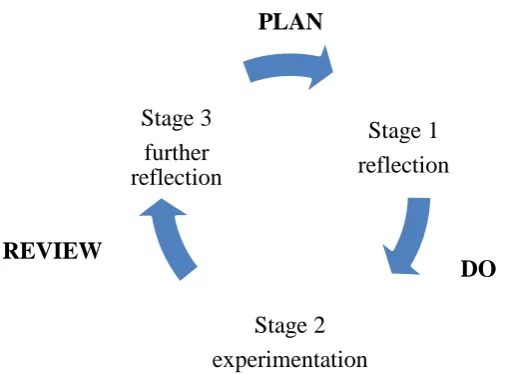
figure applies the plan-do-review model to the overall lesson structure and
Figure 4: The Plan-Do-Review Model
This model consist of three stages provide a framework in which teacher
can incorporate opportunities for children to plan, do and review through
reflection, experimentation, and further reflection and representing the ongoing
cyclical nature of learning as follows (1) children think about they already know
and what the need to do to plan and prepare for an activity: (2) children
experiment, that is, they do the activity or task; (3) children engage in further
reflection to review and assess what has been done.
a. Plan: Beginning the lesson
1) Warm –up
This could take the form of an informal chat, ritual activities like taking a
register, writing the date on the whiteboard, etc. It may include singing a song or
chanting a rhyme of the children own choice which provides a good transition for
the children if they have come directly to English class from a main subject class
in their own language. This helps them move into English and to get in the mood. Stage 1
reflection
Stage 2 experimentation Stage 3
further reflection
PLAN
REVIEW
2) Review of work covered in previous lesson
This is to consolidate language learned in the previous lesson and may
provide lesson and may provide a base for input of new language.
3) Informing the lesson aims
Prepare for language that would use to explain the aims of the lesson.
b. Do: Activity cycle
An activity cycle involves children in a learning a task which incorporates
the plan-Do-review sequences. A lesson will include one or more activity cycle
that have some kind of connection and purpose between them.
1) Plan: Activity cycle
This stage allows to sets the content of the lesson so children see its
relevance, to draw upon and activate their prior knowledge, arouse their curiosity
and motivate them and to set up an activity like use variety of technique using
elicitation, showing picture, playing a guessing game, playing a flash card game.
2) Do: Activity cycle
This stage will involve children in an activity or task which enables them
to experiment and use the language practiced in stage one.
3) Review: Activity cycle
This stage is likely to include an activity or activities which enable the
children to consolidate, extend and personalize language introduced and practiced
c. Review: Ending the lesson
Give a rounding up, overall review and summary of the lesson, a
confirmation of the aims of the lesson and review of children performance.
4. The Steps in Developing Appropriate Activities
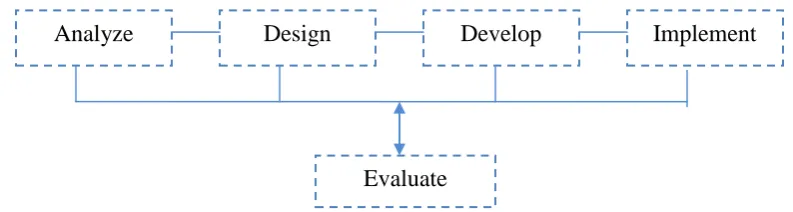
In developing activities for children, the researcher uses some steps. There
are five steps in developing the activities. They are analyze, design, develop,
implement, and evaluate. Those phases can be seen in the following figure.
Figure 5: Instructional Activities Design
a) Analysis
There are some activities that must be done in the analysis phase. First, the
instructional problem should be clarified. Second, the instructional goals and
objectives are established. Finally, the learning environment and learner's existing
knowledge and skills are identified.
b) Design
The design phase deals with the learning objectives, assessment instruments,
exercises, content, subject matter analysis, lesson planning and media selection. This
phase should be systematic and specific in order to show a brief view of the goal.
Analyze Design
Evaluate