A new hydrothermal scenario for the 2006 Lusi eruption, Indonesia. Insights from
gas geochemistry
Adriano Mazzini
a,⁎
, Giuseppe Etiope
b, Henrik Svensen
a aPhysics of Geological Processes, University of Oslo, Sem Sælandsvei 24, Box 1048, 0316 Oslo, Norway
bIstituto Nazionale di Geofisica e Vulcanologia, Sezione Roma 2, Italy and Faculty of Environmental Science and Engineering, Babes-Bolyai University Cluj-Napoca, Romania
a b s t r a c t
a r t i c l e
i n f o
Article history:
Received 5 July 2011
Received in revised form 17 November 2011 Accepted 18 November 2011
Available online xxxx
Editor: R.W. Carlson
Keywords:
Lusi eruption
sediment-hosted hydrothermal system mud volcanoes
gas origin CO2and CH4 mantle
The 29th of May 2006 gas and mud eruptions suddenly appeared along the Watukosek fault in the north east of Java, Indonesia. Within a few weeks several villages were submerged by boiling mud. The most prominent eruption site was named Lusi. To date (November 2011) Lusi is still active and a ~7 km2area is covered by the burst mud breccia.
The mechanisms responsible for this devastating eruption remain elusive. While there is consensus about the origin of the erupted mud, the source of water is uncertain, the origin of the gas is unknown and the trigger of the eruption is still debated. In order to shed light on these unknowns, we acquired a wide set of data of molecular and isotopic composition of gas sampled in several Lusi vents, in the surrounding mud volcanoes, in the closest natural gasfield (Wunut), and in the hydrothermal vents at the neighbouring volcanic complex in the period 2006–2011.
The boilingfluids erupted in the crater zone are apparently CO2-dominated, while colder CH4-dominated and C2–C3bearingfluids are identified at several sites around the crater zone. Gas genetic diagrams, maturity plots and gas generation modelling suggest that the hydrocarbons are thermogenic (δ13C1up to−35‰; δ13C2up to−20‰), deriving from marine kerogen with maturity of at least 1.5%Ro, for instance in the ~4400 m deep Ngimbang source rocks. CO2 released from the crater and surrounding seeps is also thermogenic (δ13C from−15 to−24‰) related to kerogen decarboxylation or thermal CH4oxidation in deep rocks, although three vents just outside the crater showed an apparent inorganic signature (−7.5‰bδ13C =−0.5‰) associated to mantle helium (R/Ra up to 6.5). High CO2–CH4equilibrium temper-atures (200–400 °C) are typical of thermally altered hydrocarbons or organic matter. The data suggest mainly thermally altered organic sources for the erupted gases, deeper sourced than the mud and water (Upper Kalibeng shales). These results are consistent with a scenario of deep seated (>4000 m) magmatic intrusions and hydrothermalfluids responsible for the enhanced heat that altered source rocks and/or gas reservoirs. The neighbouring magmatic Arjuno complex and itsfluid–pressure system combined with high seismic activity could have played a key role in the Lusi genesis and evolution. Within this new model framework, Lusi is better understood as a sediment-hosted hydrothermal system rather than a mud volcano.
© 2011 Elsevier B.V. All rights reserved.
1. Introduction
The 29th of May 2006 the Sidoarjo district in East Java, Indonesia witnessed the sudden birth of numerous gas and mud vents on the ground. These eruption sites extended over a distance of more than a kilometre forming a NE–SW alignment. Within a few days a prominent crater formed and the initial vents were quickly covered by the large volumes of erupted boiling mud. Theflow-rates from the main crater reached 180.000 m3/day (Mazzini et al., 2007). The
largest crater was named Lusi [acronym from LUmpur (mud) and
SIdoarjo (the district name)]. To date (November 2011) Lusi is still active and has since 2006 gained the constant attention of the
media due to the spectacular nature of the eruption that devastated and submerged villages, displaced more than 50,000 people and covered a region of more than 7 km2by hot mud (Fig. 1).
The trigger of the Lusi eruption remains debated. One hypothesis links Lusi to a blowout from a neighbouring well (Davies et al., 2007; Tingay et al., 2008), whereas others have confuted the“man-made” sce-nario (e.g.Sawolo et al., 2009, 2010). An alternative hypothesis links the eruption events to the reactivation of a fault following a 6.3 M earth-quake that struck the Java Island the 27th of May 2006 (Mazzini et al., 2007, 2009; Tanikawa et al., 2010). More thanfive years after the birth of Lusi, we stress that the geological knowledge of the Lusi region and the neighbouring areas shows that: 1) The presence of a NE–SW oriented fault (Watukosek fault,Fig. 1) that originates from the neigh-bouring Arjuno–Welirang volcanic complex, crosses Lusi and extends towards the NE of Java. Field observations showed that lateral shearing
⁎Corresponding author.
E-mail address:[email protected](A. Mazzini).
0012-821X/$–see front matter © 2011 Elsevier B.V. All rights reserved. doi:10.1016/j.epsl.2011.11.016
Contents lists available atSciVerse ScienceDirect
Earth and Planetary Science Letters
20 km
Lusi Penanggungan V
Indian Ocean
Madura Strait
Java
MaduraLUSI
300 km
112°
06°
08°
108°
Indian Ocean Java Sea
Semeru V Bromo V Wilis V
Kelud V
Kawi V Gunung Butak V
Arjuno V Welirang V
Fault Volcano/
volcanic vent Mud volcano
Escarpment/ Lahar
A
500 m
B
was reactivated after the 27th of May 2006 6.3 M earthquake. 2) The fault escarpment is composed of volcanic rocks and is located only 4.6 km from Lusi. 3) The nearest volcano is the Holocene Penanggungan (~10 km from Lusi) and the active Arjuno–Welirang volcano is 25 km further to the SW. 4) Volcanic vents and mud volcanoes (Fig. 1A) in this part of Java are aligned towards Lusi with the same strike of the Watukosek fault (Carn, 2000; Mazzini et al., 2007).
Regardless what the trigger for the Lusi eruption is (man-made or natural), it remains crucial to further investigate the origin of the eruptedfluids, the eruption mechanisms, and the possible interac-tions between volcanism, tectonics, and seismicity. New data is need-ed in order to answer the following key questions: Is Lusi a mud volcano? What is the origin of the gas, and is its source shallow or deep? Do mud and gas have the same origin? How long will the erup-tion last? And what are the triggers that feed the eruperup-tion and the episodic pulsations? Are more eruptions like Lusi likely to occur in other parts of Java? Andfinally, is there a connection between Lusi and the neighbouring volcanic complex?
In order to address some of the above questions and to investigate the possible involvement of deep volcanicfluids in Lusi, we present a new set of gas geochemical data collected from 2006 (i.e. during the initial phase of the eruption) to 2011. The gas samples were taken from the Lusi crater, from other mud volcanoes located nearby and from the closest exploited natural gasfield, Wunut. We claim that un-derstanding the gas origin (microbial, thermogenic or abiotic) and source (shallow or deep hydrocarbon reservoirs or geothermalfluids) are essential to move ahead towards a better understanding of Lusi.
2. Geological setting
The island of Java is a prospective province for hydrocarbon explo-ration and is an exceptional area where volcanism, piercement struc-ture formation and tectonism interact. A detailed and broad overview of the Indonesian basins, their geology and petroleum systems, are provided by Doust and Noble (2008) and references therein. The Lusi area is particularly interesting as sedimentary and volcanic phenomena are intimately connected and can be studied in detail. Moreover the Lusi eruption provides a unique opportunity to study an erupting system from its birth.
Lusi is located in a Tertiary-aged back-arc basin of NE Java, in the East Java Basin (Kusumastuti et al., 2000), where the sedimentary se-quences are characterised by high sedimentation rates of organic-rich deposits (e.g. rates of about 2.5 km/Ma since the Pleistocene) often capped by sealing units of tuffaceous or volcaniclastic sands. The presence of numerous mud volcanoes in the NE Java highlights that sedimentary volcanism is a wide-spread phenomena in this part of the island (Mazzini et al., 2007; Satyana and Purwaningsih, 2003). The formation of mud volcanoes is likely to be triggered by frequent seismic activity, leading to the release of overpressuredfluids that formed by hydrocarbon generation and illitization of clays at depth.
The setting of the Lusi eruption is peculiar when compared with the other mud volcanoes in Java as it is situated at the southernmost tip of the back-arc region neighbouring the large Arjuno–Welirang volcanic complex. Arjuno–Welirang is part of the volcanic arc con-touring the southern part of Java (Figs. 1, 2). The complex comprises two older volcanoes named Mount Ringgit (to the east), and Mount Linting (to the south). Arjuno–Welirang is a stratovolcano and volca-nic cones and craters are located in a 6 km line between Arjuno and Welirang. The northernmost volcano of this complex is Penanggun-gan which crater is located 10 km to the SW of Lusi.
3. Lusi phenomena: open questions
What is Lusi? Is it really a mud volcano (i.e. sedimentary volcanism driven by gravitational sediment imbalance and fluid overpressures (e.g.Kopf, 2002)) as commonly wisdomed?
Geochemistry of thefluids and petrography of the solids erupted by Lusi werefirst reported byMazzini et al. (2007). The early sam-plings showed the presence of mud breccia and significant amounts of methane, typical of mud volcanoes worldwide. Preliminary ana-lyses of the erupted material indicated that the main source of clay and water is the overpressured units located at ~1500–1800 m that were rapidly buried and under-compacted. This type of deposits is typical at many mud volcano settings. Moreover, water compositional analyses indicated a strong signature of illitized clay minerals; this is common for many mud volcanoes, however a possible deeper water component could not be excluded. Thefirst gas analyses from Lusi, showed the presence of methane of mixed microbial–thermogenic origin, but the actual source/reservoir rocks (shallow or deep shales and limestones) remained elusive.
Despite the research carried out so far, many aspects of this phenomenon remain without explanation.
The longevity of the Lusi eruption (still active after more than 5 years) is atypical when compared to other mud volcanoes that usu-ally extinguish the largest amount of overpressure after few hours or days and become dormant (Aliyev et al., 2002; Deville and Guerlais, 2009; Shnyukov et al., 1986). Is this surprising activity related to the Lusi infancy, or are mud volcanoes not relevant analogues for un-derstanding Lusi? Several lines of evidence suggest that Lusi is similar to a hydrothermal system rather than a mud volcano. For instance, Lusi is characterised by high temperature and pulsations with sudden increase inflow rates that, so far, have not been clearly explained (Mazzini et al., 2009). Is the frequent seismicity in Indonesia altering Lusi plumbing system? Or thefluctuatingflow rate is merely related to volumetric contractions of the conduit? The generally high geo-thermal gradient at Lusi locality (42 °C/km) is likely due to the prox-imity to the adjacent volcano (Mazzini et al., 2007), which may explain the clay mineral and geochemical transformations occurring at relatively shallow depths. For example the illitization of clays is oc-curring at 1100 m (and possibly shallower) while in most of the other basins it takes place at greater depths (e.g.Kholodov, 2002and refer-ences therein). Finally, unlike the commonly CH4-dominated gases
erupted from mud volcanoes worldwide, the main gas erupted at Lusi is CO2. This questions the applicability of standard mud volcano
models (e.g.Kopf, 2002) to Lusi.
4. Methodology
4.1. Field work sampling and measurements
Five fieldwork campaigns (2006, 2007, 2008, 2010 and 2011) included sampling of the seepingfluids at Lusi site, from the neigh-bouring Wunut gas field, from other nearby mud volcanoes, and from some of the hydrothermal seeps at the Arjuno–Welirang volcanic system. A total of 43 gas samples were collected and grouped according to their geological setting: Group 1: Fluids emitted from the main vent that today coincides with the Lusi crater; Group 2: Gas sampled from the satellite cold seeps surrounding the crater; Group 3: Gas from the Wunut gasfield; Group 4: Gas from seven mud volcanoes in the NE of Java region (Gunung Anyar, Kalang Anyar, Pulungan, Gunung Sening, Gunung Bulag, Pangangson, Bledug Kuwu), Group 5: Gas from four hydrothermal seeps at or close to the Arjuno volcano. All gas samples were stored into brine-filled glass bottles that were subsequently hermetically sealed (see Mazzini et al., 2011for details).
the dikes framing the crater were already submerged by the boiling mud) when an excavator on afloat drifting to the crater zone allowed sampling. Thus it was impossible to collect gas samples directly from the central part of the crater zone. Gas samples from the other local-ities (Groups 2–4) were collected with more traditional techniques, as funnelling the gas and storing it into brine-filled glass bottles.
Group 2 includes satellite seeps that are either aligned along the direction of the Watukosek fault or distributed around the crater where the main caldera collapse occur (i.e.Istadi et al., 2009). Sam-ples were collected during the campaigns in 2006, 2007 and 2011.
Group 3 refers to the Wunut gas field in shallow sandstones (350–700 m). The main wells are located about 4 km to the west of Lusi and the reservoir extends laterally towards Lusi. Samples were collected in 2010 directly from two production pipes accessing two
reservoir zones respectively between 341–379 and 670–680 m depth. Samples for helium analyses were collected from a pipeline merging the production units mentioned above.
Seven additional mud volcanoes (Group 4 samples) are located in the NE Java Basin and Madura Island, and one of them further to the west of central Java (see Fig. 1 inMazzini et al., 2009for location). These gas samples were collected during the campaigns in 2006 and 2008.
Gases from Group 5 were collected in 2011 at natural hydrother-mal seeps around the Arjuno–Welirang volcanoes (Songgoriti, Cangar, Pacet localities) and from a hydrothermal seep connected to a deep water well close to Penanggungan volcano (Kepulungan locality).
At all seepage sites, the exit temperature was measured with a TFX 392 SK-5 thermometer with a precision of 0.1 °C.
B
C
A
D
E
Fig. 2.(A) Helicopter view of Lusi (19 May 2011), on the background the Watukosek escarpment and the Penanggungan volcano. Note: the broken containment dam that was destroyed 5 h after the 26-04-2011 earthquake is aligned along the Watukosek fault system connecting Lusi and the volcanic complex; (B) View of the close volcanic complex from Lusi site. From left to right: Arjuno, Welirang (erupting white smoke), and Penanggungan; (C) View of erupting Lusi crater approached walking on dry erupted mud; (D) One hour after the 26-04-2011 earthquake two distinct craters formed at Lusi site clearly indicating a correlation between the two events; (E) Helicopter view with detail of the damaged dam after the earthquake suggesting reactivation of the strike-slip fault.
A, B, D, E courtesy of S. Hadi.
4.2. Laboratory analyses
The 2006, 2007, 2008 gases (N2, O2, CO2, C1–C2 +hydrocarbons)
were analysed at the Institute for Energy Technology (IFE), Norway, using a Hewlett Packard 5890 Series II GC equipped with Porabond Q column, aflame ionisation detector (FID), a thermal conductivity detector (TCD) and a methylization unit. The accuracy of the gas composition is better than 3% (1 sigma) for all compounds. The stable carbon isotopic composition of methane and carbon dioxide was determined by a GC-C-IRMS system at IFE. Repeated analyses of standards indicate that the reproducibility ofδ13C values is better than 1‰VPDB (2 sigma).
The gas samples collected in 2010 were analysed at the Isotech Labs Inc. (Illinois, USA) for C1–C6hydrocarbons, He, H2, Ar, O2, CO2,
N2, (Carle AGC 100–400 TCD-FID GC); precision 2% (1σ), and isotopic
compositions δ13C1, δD1, δ13CCO2 (Finnigan Delta Plus XL mass
spectrometer, precision ± 0.1‰(1σ) for13C and ± 4‰(1σ) for2H).
Results are reported inδnotation, as per mil (‰) deviation relative
to the VPDB (for carbon) and VSMOW (for hydrogen) standards. As a result of the difficult sampling logistics, several of the crater samples have high air contamination. We applied air-free correction to verify the order of magnitude of non-atmospheric CH4and CO2
concentration and compare with less contaminated samples outside the crater. The corrected compositional values must be considered as“apparent”, since they could be affected by the relative analytical error at low concentrations.
At the sites with vigorous gas seepage, samples for He analyses were collected in annealed copper tubes sealed in thefield using a cold welding clamp. At localities were gas was seeping as small bubbles, water samples were collected for further gas extraction. The samples were analysed at the Istituto Nazionale di Geofisica e Vulcanologia (Italy). The isotopic analyses were performed on a
puri-fied helium fraction (Sano and Wakita, 1988) by a static vacuum mass spectrometer (GVI5400TFT) that allows simultaneous detection of
3He and 4He-ion beams, thereby keeping the 3He/4He error of
measurement to very low values. Typical uncertainties in the range of low-3He samples are within ±5%. The results are given in the
R/Ra notation, where R is the sample 3He/4He ratio and Ra is the
atmospheric3He/4He ratio, 1.39 × 10⁻⁶.
During the 2011 fieldwork seven samples were collected for helium analyses. Four of these samples revealed significant air contamination (i.e. 0.5bHe/Neb0.8). Although these contaminated
values cannot be considered quantitatively, we have included them inTables 1A, 1B(see details in the caption).
5. Results
5.1. Molecular and isotopic composition of gas
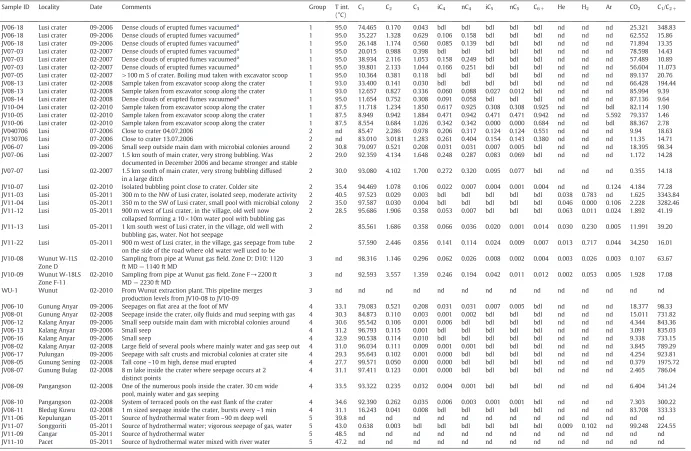
Tables 1A, 1Bsummarise the molecular and isotopic composition of the sampled gas. The interpretation of gas origin is exclusively based on isotopic data and the relative composition of methane, alkane and propane. Five samples (Lusi crater JV10-07; west of Lusi crater JV11-12, JV11-13; Songgoriti JV11-07; and Wunut WU-1) provided reliable helium isotopic data without significant air contam-ination (He/Ne >1).
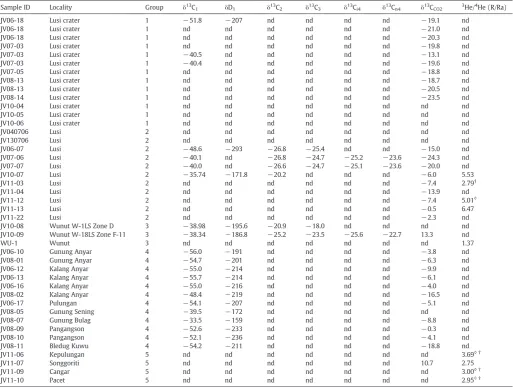
Gas from Group 1 (Lusi crater with boiling mud) is apparently CO2-dominated (up to 89%). The δ13CCO2 measured during
2006–2010 varies between−13.1 and−23.5‰. A smaller portion
of the emitted gas is represented by hydrocarbon gases from C1to
C4. Theδ13CCH4varies from−51.8 to−35.7‰.
Group 2 gas (satellite seeps) is methane-dominated (up to 97%) and the isotopic values are in the same range of those measured from the crater zone (Group 1). Ethane, propane and heavier alkanes in Groups 1 and 2 occur in concentrations typical of thermogenic gas, with C1/C2+ C3 ratios from 3 to 349. Only two exceptions show
significantly higher values (i.e. JV11-03, JV11-04) where molecular fractionation is likely to be present. The helium from the closest seep to the Lusi crater (92 ppmv) has a R/Ra isotopic ratio = 5.53. Two more seeps (JV11-12 and JV11-13) located to the west of the Lusi crater revealed consistent high R/Ra isotopic ratio (5.01 and 6.47 respectively). Station JV11-03 (~300 m NW from the crater) showed significant air contamination (i.e. He/Ne = 0.86) but still gave a high R/Ra = 2.79. Group 3 gas (Wunut gasfield) is methane-dominated (up to 98%). The deepermost units of thefield reveal a larger amount of C2 + hydrocarbons (5.4%) compared with the
shallower units (1.5%). Theδ13CCH4ranges from−38.9 to−38.3‰,
whileδ13CCO2shows positive values (+13.2‰). Helium (53 ppmv)
shows a slight mantle component with R/Ra ~ 1.4.
Group 4 (NE Java Basin mud volcanoes) samples are all CH4
-dominated (79%bCH4b99%) withδ13CCH4signatures from−33.5 to −55.7‰andδ13CCO2ranging from−0.3 to−18.8‰. A remarkable
exception is Bledug Kuwu that has a similar morphology and eruption mode to Lusi, and, like Lusi, releases CO2dominated gas (CO2= 84%).
Group 5 gas (hydrothermal vents for the neighbouring volcanic arc) is represented by the Songgoriti locality that has a CO2
-dominated gas (99%) with highδ13CCO2(10.7‰) and relatively high
R/Ra isotopic ratio (2.75). Similarly to station JV11-03, the helium sampling for the other hydrothermal localities (Kepulungan, Cangar, Pacet) was affected by air contamination. Still relatively high values were measured with R/Ra up to 3.69.
5.2. Temperature data
Since 29-05-2006, Lusi has been constantly erupting mud (including clasts), gas and water. A constant plume of aqueous vapour has been observed rising from the centre indicating that the temper-ature of at least 100 °C has been present since the beginning. This is consistent with the reported measurements (Tables 1A, 1B). So far it has not been demonstrated if there is a direct correlation between temperature rise and the sudden bursts with increasedflow rates. The recorded temperature data (Tables 1A, 1B) from the crater zone (Group 1) have temperatures close to 100 °C. This contrasts the much lower (~30 °C) temperatures at satellite seeps (Group 2). It is interesting to notice that in all the samples but one, the CO2
-dominated samples have consistently higher temperatures, while the colder satellite seeps (Group 2) are CH4dominated.
Measurements from a seep of Bledug Kuwu gave a temperature of 31.1 °C. It was impossible to collect temperature measurements from the crater. However, judging from the significant clouds of steam released after each burst, temperatures close to 100 °C are expected. All the other mud volcanoes showed relatively low temperatures with values ranging between 27.7 °C and 34.6 °C. These values are consistent with those typically found in other mud volcanoes during dormant periods (e.g.Etiope et al., 2002; Nakada et al., 2011) and are likely to be affected by air temperature.
6. Discussion
6.1. Methane and heavier alkanes
Classic gas genetic zonation diagrams (Schoell and Bernard plots,
Fig. 3A–B) suggest that the Lusi samples collected in 2006 contain thermogenic hydrocarbons mixed with a minor microbial CH4
com-ponent, as preliminary reported byMazzini et al. (2007). However the samples collected after 2006 show that the gas composition evolved, the microbial component disappeared (Tables 1A, 1B). The emitted gas shows a complete thermogenic signature, similar to the gas sampled from the Wunut gasfield, Gunung Senig and Gunung Bulag MVs. In the Bernard diagram (Fig. 3B), the gas of these MVs appear to be molecularly fractionated, with higher C1/(C2+ C3) ratios.
Table 1A
Molecular composition of sampled gas in vol.%. N2for samples JV06-07 and JV06-10 is respectively 1.703 and 1.736.
Sample ID Locality Date Comments Group T int.
(°C)
C1 C2 C3 iC4 nC4 iC5 nC5 C6 + He H2 Ar CO2 C1/C2 +
JV06-18 Lusi crater 09-2006 Dense clouds of erupted fumes vacuumeda 1 95.0 74.465 0.170 0.043 bdl bdl bdl bdl bdl nd nd nd 25.321 348.83
JV06-18 Lusi crater 09-2006 Dense clouds of erupted fumes vacuumeda 1 95.0 35.227 1.328 0.629 0.106 0.158 bdl bdl bdl nd nd nd 62.552 15.86
JV06-18 Lusi crater 09-2006 Dense clouds of erupted fumes vacuumeda 1 95.0 26.148 1.174 0.560 0.085 0.139 bdl bdl bdl nd nd nd 71.894 13.35
JV07-03 Lusi crater 02-2007 Dense clouds of erupted fumes vacuumeda 1 95.0 20.015 0.988 0.398 bdl bdl bdl bdl bdl nd nd nd 78.598 14.43
JV07-03 Lusi crater 02-2007 Dense clouds of erupted fumes vacuumeda 1 95.0 38.934 2.116 1.053 0.158 0.249 bdl bdl bdl nd nd nd 57.489 10.89
JV07-03 Lusi crater 02-2007 Dense clouds of erupted fumes vacuumeda 1 95.0 39.801 2.133 1.044 0.166 0.251 bdl bdl bdl nd nd nd 56.604 11.073
JV07-05 Lusi crater 02-2007 >100 m S of crater. Boiling mud taken with excavator scoop 1 95.0 10.364 0.381 0.118 bdl bdl bdl bdl bdl nd nd nd 89.137 20.76 JV08-13 Lusi crater 02-2008 Sample taken from excavator scoop along the crater 1 93.0 33.400 0.141 0.030 bdl bdl bdl bdl bdl nd nd nd 66.428 194.44 JV08-13 Lusi crater 02-2008 Sample taken from excavator scoop along the crater 1 93.0 12.657 0.827 0.336 0.060 0.088 0.027 0.012 bdl nd nd nd 85.994 9.39 JV08-14 Lusi crater 02-2008 Dense clouds of erupted fumes vacuumeda 1 95.0 11.654 0.752 0.308 0.091 0.058 bdl bdl bdl nd nd nd 87.136 9.64
JV10-04 Lusi crater 02-2010 Sample taken from excavator scoop along the crater 1 87.5 11.718 1.234 1.850 0.617 0.925 0.308 0.308 0.925 nd nd bdl 82.114 1.90 JV10-05 Lusi crater 02-2010 Sample taken from excavator scoop along the crater 1 87.5 8.949 0.942 1.884 0.471 0.942 0.471 0.471 0.942 nd nd 5.592 79.337 1.46 JV10-06 Lusi crater 02-2010 Sample taken from excavator scoop along the crater 1 87.5 8.554 0.684 1.026 0.342 0.342 0.000 0.000 0.684 nd nd bdl 88.367 2.78 JV040706 Lusi 07-2006 Close to crater 04.07.2006 2 nd 85.47 2.286 0.978 0.206 0.317 0.124 0.124 0.551 nd nd nd 9.94 18.63 JV130706 Lusi 07-2006 Close to crater 13.07.2006 2 nd 83.010 3.0181 1.283 0.261 0.404 0.154 0.143 0.380 nd nd nd 11.35 14.71 JV06-07 Lusi 09-2006 Small seep outside main dam with microbial colonies around 2 30.8 79.097 0.521 0.208 0.031 0.031 0.007 0.005 bdl nd nd nd 18.395 98.34 JV07-06 Lusi 02-2007 1.5 km south of main crater, very strong bubbling. Was
documented in December 2006 and became stronger and stable
2 29.0 92.359 4.134 1.648 0.248 0.287 0.083 0.069 bdl nd nd nd 1.172 14.28
JV07-07 Lusi 02-2007 1.5 km south of main crater, very strong bubbling diffused in a large ditch
2 30.0 93.080 4.102 1.700 0.272 0.320 0.095 0.077 bdl nd nd nd 0.355 14.18
JV10-07 Lusi 02-2010 Isolated bubbling point close to crater. Colder site 2 35.4 94.469 1.078 0.106 0.022 0.007 0.004 0.001 0.004 nd nd 0.124 4.184 77.28 JV11-03 Lusi 05-2011 300 m to the NW of Lusi crater, isolated seep, moderate activity 2 40.5 97.523 0.029 0.003 bdl bdl bdl bdl bdl 0.038 0.783 nd 1.625 3343.84 JV11-04 Lusi 05-2011 350 m to the SW of Lusi crater, small pool with microbial colony 2 35.0 97.587 0.030 0.004 bdl bdl bdl bdl bdl 0.046 0.000 0.106 2.228 3282.46 JV11-12 Lusi 05-2011 900 m west of Lusi crater, in the village, old well now
collapsed forming a 10 × 10m water pool with bubbling gas
2 28.5 95.686 1.906 0.358 0.053 0.007 bdl bdl bdl 0.063 0.011 0.024 1.892 41.19
JV11-13 Lusi 05-2011 1 km south west of Lusi crater, in the village, old well with bubbling gas, water. Not hot seepage
2 85.561 1.686 0.358 0.066 0.036 0.020 0.001 0.014 0.030 0.230 0.005 11.991 39.20
JV11-22 Lusi 05-2011 900 m west of Lusi crater, in the village, gas seepage from tube on the side of the road where old water well used to be
2 57.590 2.446 0.856 0.141 0.114 0.024 0.009 0.007 0.013 0.717 0.044 34.250 16.01
JV10-08 Wunut W-1LS Zone D
02-2010 Sampling from pipe at Wunut gasfield. Zone D: D10: 1120 ft MD—1140 ft MD
3 nd 98.316 1.146 0.296 0.062 0.026 0.008 0.002 0.004 0.003 0.026 0.003 0.107 63.67
JV10-09 Wunut W-18LS Zone F-11
02-2010 Sampling from pipe at Wunut gasfield. Zone F→2200 ft MD—2230 ft MD
3 nd 92.593 3.557 1.359 0.246 0.194 0.042 0.011 0.012 0.002 0.053 0.005 1.928 17.08
WU-1 Wunut 02-2010 From Wunut extraction plant. This pipeline merges production levels from JV10-08 to JV10-09
3 nd nd nd nd nd nd nd nd nd nd nd nd nd nd
JV06-10 Gunung Anyar 09-2006 Seepages onflat area at the foot of MV 4 33.1 79.083 0.521 0.208 0.031 0.031 0.007 0.005 bdl nd nd nd 18.377 98.33 JV08-01 Gunung Anyar 02-2008 Seepage inside the crater, oilyfluids and mud seeping with gas 4 30.3 84.873 0.110 0.003 0.001 0.002 bdl bdl bdl nd nd nd 15.011 731.82 JV06-12 Kalang Anyar 09-2006 Small seep outside main dam with microbial colonies around 4 30.6 95.542 0.106 0.001 0.006 bdl bdl bdl bdl nd nd nd 4.344 843.36
JV06-13 Kalang Anyar 09-2006 Small seep 4 31.2 96.793 0.115 0.001 bdl bdl bdl bdl bdl nd nd nd 3.091 835.03
JV06-16 Kalang Anyar 09-2006 Small seep 4 32.9 90.538 0.114 0.010 bdl bdl bdl bdl bdl nd nd nd 9.338 733.15
JV08-02 Kalang Anyar 02-2008 Largefield of several pools where mainly water and gas seep out 4 31.0 96.034 0.111 0.009 0.001 0.001 bdl bdl bdl nd nd nd 3.845 789.29 JV06-17 Pulungan 09-2006 Seepage with salt crusts and microbial colonies at crater site 4 29.3 95.643 0.102 0.001 0.000 bdl bdl bdl bdl nd nd nd 4.254 923.81 JV08-05 Gunung Sening 02-2008 Tall cone ~ 10 m high, dense mud erupted 4 27.7 99.571 0.050 0.000 0.000 bdl bdl bdl bdl nd nd nd 0.379 1975.72 JV08-07 Gunung Bulag 02-2008 8 m lake inside the crater where seepage occurs at 2
distinct points
4 31.1 97.411 0.123 0.001 0.000 bdl bdl bdl bdl nd nd nd 2.465 786.04
JV08-09 Pangangson 02-2008 One of the numerous pools inside the crater. 30 cm wide pool, mainly water and gas seeping
4 33.5 93.322 0.235 0.032 0.004 0.001 bdl bdl bdl nd nd nd 6.404 341.24
JV08-10 Pangangson 02-2008 System of terraced pools on the eastflank of the crater 4 34.6 92.390 0.262 0.035 0.006 0.003 0.001 0.001 bdl nd nd nd 7.303 300.22 JV08-11 Bledug Kuwu 02-2008 1 m sized seepage inside the crater, bursts every ~1 min 4 31.1 16.243 0.041 0.008 bdl bdl bdl bdl bdl nd nd nd 83.708 333.33 JV11-06 Kepulungan 05-2011 Source of hydrothermal water from ~ 90 m deep well 5 39.8 nd nd nd nd nd nd nd nd nd nd nd nd nd JV11-07 Songgoriti 05-2011 Source of hydrothermal water; vigorous seepage of gas, water 5 43.0 0.638 0.003 bdl bdl bdl bdl bdl bdl 0.009 0.102 nd 99.248 224.55
JV11-09 Cangar 05-2011 Source of hydrothermal water 5 48.5 nd nd nd nd nd nd nd nd nd nd nd nd nd
JV11-10 Pacet 05-2011 Source of hydrothermal water mixed with river water 5 47.2 nd nd nd nd nd nd nd nd nd nd nd nd nd
bdl: below detection limit, nd: not determined. a
Approximate minimum temperature of steam clouds.
310
A.
Mazzini
et
al.
/
Earth
and
Planetary
Science
Letters
317
–
318
(2012)
305
–
differential molecular adsorption on the solid grains of the mud and differential solubility, is a common phenomenon observed in many seeps worldwide (Etiope et al., 2009a). This is typical for gas seeping at vents with relatively lowflux and/or high mud content (Etiope et al., 2011b), as those of Gunung Sening and Gunung Bulag. We exclude that the higher C1/(C2+ C3) ratio may be due to secondary
methanogenesis (Milkov, 2011) as CO2 from Gunung Bulag is not
particularly 13C enriched (as it happens for residual CO 2 during
methanogenesis; e.g. Etiope et al., 2009b), and it is similar to the other samples. All other mud volcanoes analysed in this study released a mixed gas.
The hydrocarbon composition of the Lusi gas is essentially the same either sampled at the crater or at satellite seeps. The alkanes gas plot (δ13C vs inverse carbon number; based on the model by
Chung et al., 1988;Fig. 4) also highlights that the Lusi gas is very similar to that of Wunut, with a major microbial component in 2006 only. The ethane vs propane maturity plot (Berner and Faber, 1996;
Fig. 5A) was applied using kerogen precursors withδ13C of −26‰
for terrestrial organic matter (Type III) and from−30 to−26‰for
marine organic matter (Type I–II). These values were selected considering that East Java Basin source rocks have terrestrial and marine kerogen with an average δ13C value around −26‰ and −28‰, respectively (Satyana and Purwaningsih, 2003).Fig. 5A
sug-gests that both Lusi and Wunut alkanes actually derive from marine
kerogen, with maturity around 1.5–2%Ro (if kerogen has δ13C:
−28‰) or 2–2.5%Ro (if kerogen has δ13C: −30‰). In any case,
these source rocks and maturities are different from those (terrestrial, Type III at about 0.6%Ro) attributed to the mud released at Lusi (Mazzini et al., 2007; Plumlee et al., 2008). Moreover, small amounts of fresh and nonbiodegraded oil were found in the erupted mud (Plumlee et al., 2008), and this further supports the hypothesis that marine kerogen, which is more oil-prone than terrestrial, is the source for Lusi hydrocarbons. This shows that the source of the Lusi gas is different (and deeper) than that of the erupted mud. Thus after 2006, the Lusi gas had a limited or no contribution from the Upper Kalibeng shales.
The hypothesis of a marine source rock with maturity >1.5%Ro, suggested by the maturity plot inFig. 5A, is supported by an indepen-dent interpretative tool (Fig. 5B) based on thermogenic gas genera-tion modelling (GOR-Isotopes modelling,Etiope et al., 2011a; Tang et al., 2000). GOR (Gas–Oil-Ratio)-Isotopes is a PC-based simulator to predict gas and oil generation, including the primary carbon isotopic composition of methane, based on the mathematical model developed byTang et al. (2000). The combination ofδ13C2andδ13C3
produced by marine kerogen, suggests that Lusi gas was generated at temperature of 210–220 °C, corresponding to a maturity of 2%Ro. This is similar to that derived in Fig. 5A for a precursor kerogen withδ13C =−30‰.
Table 1B
Isotopic composition of sampled gas. Isotopic data:δ13C:‰, VPDB;δD:‰, VSMOW; atm. R/Ra = (3He/4He)sample/(3He/4He)atmosphere; Ra = 1.39 × 10
−6; nd: not determined.
◊helium gas extracted from water bottles collected at seepage sites.†indicates samples with He/Neb1.
Sample ID Locality Group δ13C1 δD1 δ13C2 δ13C3 δ13Ci4 δ13Cn4 δ13CCO2 3He/4He (R/Ra)
JV06-18 Lusi crater 1 −51.8 −207 nd nd nd nd −19.1 nd
JV06-18 Lusi crater 1 nd nd nd nd nd nd −21.0 nd
JV06-18 Lusi crater 1 nd nd nd nd nd nd −20.3 nd
JV07-03 Lusi crater 1 nd nd nd nd nd nd −19.8 nd
JV07-03 Lusi crater 1 −40.5 nd nd nd nd nd −13.1 nd
JV07-03 Lusi crater 1 −40.4 nd nd nd nd nd −19.6 nd
JV07-05 Lusi crater 1 nd nd nd nd nd nd −18.8 nd
JV08-13 Lusi crater 1 nd nd nd nd nd nd −18.7 nd
JV08-13 Lusi crater 1 nd nd nd nd nd nd −20.5 nd
JV08-14 Lusi crater 1 nd nd nd nd nd nd −23.5 nd
JV10-04 Lusi crater 1 nd nd nd nd nd nd nd nd
JV10-05 Lusi crater 1 nd nd nd nd nd nd nd nd
JV10-06 Lusi crater 1 nd nd nd nd nd nd nd nd
JV040706 Lusi 2 nd nd nd nd nd nd nd nd
JV130706 Lusi 2 nd nd nd nd nd nd nd nd
JV06-07 Lusi 2 −48.6 −293 −26.8 −25.4 nd nd −15.0 nd
JV07-06 Lusi 2 −40.1 nd −26.8 −24.7 −25.2 −23.6 −24.3 nd
JV07-07 Lusi 2 −40.0 nd −26.6 −24.7 −25.1 −23.6 −20.0 nd
JV10-07 Lusi 2 −35.74 −171.8 −20.2 nd nd nd −6.0 5.53
JV11-03 Lusi 2 nd nd nd nd nd nd −7.4 2.79†
JV11-04 Lusi 2 nd nd nd nd nd nd −13.9 nd
JV11-12 Lusi 2 nd nd nd nd nd nd −7.4 5.01
◊
JV11-13 Lusi 2 nd nd nd nd nd nd −0.5 6.47
JV11-22 Lusi 2 nd nd nd nd nd nd −2.3 nd
JV10-08 Wunut W-1LS Zone D 3 −38.98 −195.6 −20.9 −18.0 nd nd nd nd
JV10-09 Wunut W-18LS Zone F-11 3 −38.34 −186.8 −25.2 −23.5 −25.6 −22.7 13.3 nd
WU-1 Wunut 3 nd nd nd nd nd nd nd 1.37
JV06-10 Gunung Anyar 4 −56.0 −191 nd nd nd nd −3.8 nd
JV08-01 Gunung Anyar 4 −54.7 −201 nd nd nd nd −6.3 nd
JV06-12 Kalang Anyar 4 −55.0 −214 nd nd nd nd −9.9 nd
JV06-13 Kalang Anyar 4 −55.7 −214 nd nd nd nd −6.1 nd
JV06-16 Kalang Anyar 4 −55.0 −216 nd nd nd nd −4.0 nd
JV08-02 Kalang Anyar 4 −48.4 −219 nd nd nd nd −16.5 nd
JV06-17 Pulungan 4 −54.1 −207 nd nd nd nd −5.1 nd
JV08-05 Gunung Sening 4 −39.5 −172 nd nd nd nd nd nd
JV08-07 Gunung Bulag 4 −33.5 −159 nd nd nd nd −8.8 nd
JV08-09 Pangangson 4 −52.6 −233 nd nd nd nd −0.3 nd
JV08-10 Pangangson 4 −52.1 −236 nd nd nd nd −4.1 nd
JV08-11 Bledug Kuwu 4 −54.2 −211 nd nd nd nd −18.8 nd
JV11-06 Kepulungan 5 nd nd nd nd nd nd nd 3.69נ
JV11-07 Songgoriti 5 nd nd nd nd nd nd 10.7 2.75
JV11-09 Cangar 5 nd nd nd nd nd nd nd 3.00נ
Regardless the value of theδ13C of the kerogen (most likely from
−28 to−30‰), marine source rocks are present in the oil-prone
Eocene Ngimbang shales (e.g. Satyana and Purwaningsih, 2003; Wiloso et al., 2009). Considering the geothermal gradient of 42 °C/ km (Mazzini et al., 2007), the gas generation temperature derived by GOR Isotopes modelling would suggest a source rock located at about 4400 m, which is consistent with the location of the Ngimbang Formation (seeFig. 6). The modelling also suggests that forδ13C2of
about−25‰(average value of Lusi and Wunut), the originalδ13C1
of thermogenic methane would be around−35‰(Fig. 5C). This is
consistent with the highest value recorded at Lusi (sample JV10-07, a cold seep outside the crater).
The shallow reservoir of the Wunut gasfield (~350–700 m deep) should accordingly be considered accumulations along a seepage
system, linked to a deeper main reservoir. This is in agreement with
Kusumastuti et al. (2000) who suggested that the Wunut field consists of thermogenic gas migrating from the deep Porong Reef reservoir. This is also consistent with the positive value ofδ13C of CO2(+13.2‰) that suggests CO2reduction in secondary
methano-genesis (seeTables 1A, 1B) and hydrocarbon biodegradation (heavier
δ13C3), typical of shallow pools (Etiope et al., 2009b; Milkov, 2011).
Considering the Ngimbang shales as the source rocks of Lusi and Wunut, the main gas reservoirs are likely to be part of the Kujung se-quence including Prupuh or most likely Tuban limestones (Ardhana,
δ13C
-300 -280 -260 -240 -220 -200 -180 -160 -140 -120 -100 -80
Fig. 3. Genetic zonation diagrams of methane (A: Schoell plot; Schoell, 1983) (B: Bernard plot;Bernard et al., 1978). To: thermogenic with oil; Tc: thermogenic with condensate; TD: dry thermogenic.
δ
Fig. 5.(A) Ethane vs. propane maturity plot (vitrinite reflectance, % Ro; model by Berner and Faber, 1996). Initial carbon isotope value of marine (Type I–II) kerogen is taken as (a)−30‰; (b)−28‰(that is the mean value for East Java Basin source
rocks) and (c)−26‰. The terrestrial (Type III) kerogen precursor is taken as−26‰
(mean for terrestrial East Java Basin kerogen).“Mud source”indicates the conditions of the Lusi mud (Upper Kalibeng shales;Mazzini et al., 2007). (B) Thermogenic gas for-mation modelling for ethane vs propane, from default Type II kerogen (calculated using GeoIsochem Corp. GOR-Isotopes software 1.94; heating rate of 5 °C per million year; Tang et al., 2000). Bold and thin lines refer to cumulative and instantaneous gas gener-ation, respectively. (C) Same modelling for ethane vs methane from default Type I–II–III kerogen (calculated as in B). Maturity values estimated independently in (A) and (B) are similar, and the measured isotopic composition of ethane (δ13C2) would correspond to methane withδ13C1around−35‰, which is consistent with that measured in the Lusi
1993) (seeFig. 6), as they all represent a main regional reservoir of the petroleum systems in North East Java Basin (Doust and Noble, 2008; Kusumastuti et al., 2000, 2002). Lusi would then be part of the seepage system belonging to the so-called Ngimbang–Kujung petroleum system (Doust and Noble, 2008; Essam Sharaf et al., 2005). The disappearance over time of the microbial components of the Lusi gas (after 2006) can then be explained by the ascending gas from the deeper units initially mixed with biogenic gas present at shallower depths (Upper Kalibeng shales and/or alluvium clays;
Fig.6); then the microbial component in the seepage channel was exhausted and the thermogenic gasflow dominated. To summarise, the initial mixing-microbial component should be considered as a
“contamination”during early gas migration. In comparison with the other mud volcanoes of NE Java Basin, Lusi seems to have hydrocar-bons of deeper origin, or in any case a seepage system less influenced by shallower microbial components. The lack of isotopic data for C2 +
alkanes for the surrounding mud volcanoes prevents an evaluation of the type and maturity of their source rocks.
6.2. Carbon dioxide and helium
The origin of the Lusi CO2is clearly organic, withδ13CCO2ranging
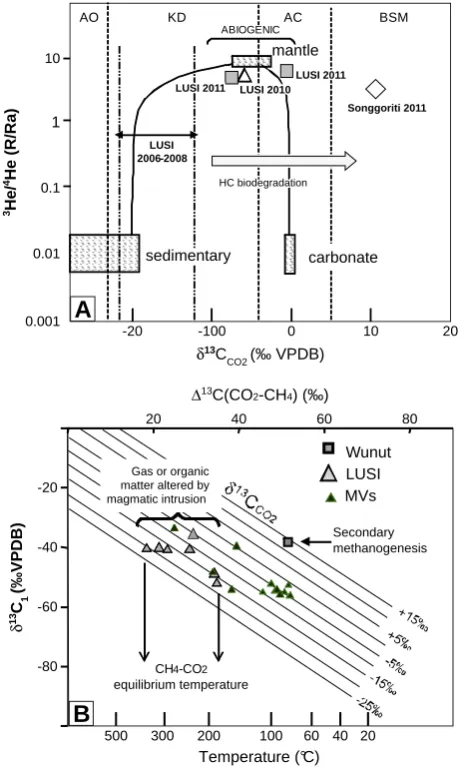
from −13‰ to −23‰; although three samples showed a values
ranging from−7.4 to−0.5‰, associated with a high helium isotopic
ratio (R/Ra: up to 6.47;Fig. 7A) hence, apparently, a magmatic gas. However,13C-enrichment could also result from reduction of organic
CO2, as typically occurs during secondary methanogenesis (Etiope
et al., 2009b; Milkov, 2011). Organic CO2in petroleum systems
typi-cally have concentrations below 10 vol.% (Jenden et al., 1993) and higher concentrations were always associated with inorganic 13
C-enriched CO2, as also occurs in some CO2-rich gasfields in Indonesia
(Cooper et al., 2006). Therefore, the apparent very high organic CO2
concentration of Lusi (up to 89 vol.%) is unusual. The strong discrep-ancy observed in the CO2content at localities of Groups 1 (crater
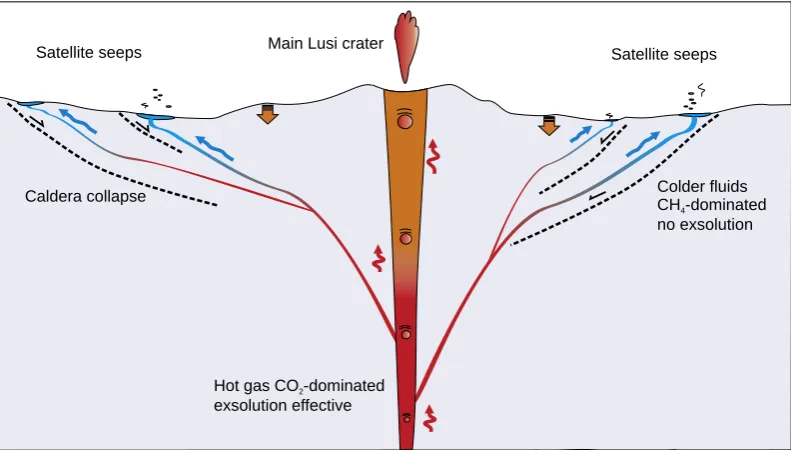
zone) and 2 (satellite seeps) can be interpreted as the result of much lower temperatures recorded at the sites away from the crater zone, where CH4is clearly dominating. Here, the rising gas diverges
Arjuno–Welirang
CH4 microbial (early stages 2006)
CO organic matter/2
1.64-5.67 % coals 62-67 %
Kujung
0.14-3.93 %
T
uban
up to 2.25 %
CH4 microbial (early stages 2006)
from the main conduit and has sufficient time to cool hence partly buffering the CO2exsolution mechanism that is dominating in the
crater zone (i.e. resulting in CO2 dominated gas). Mazzini et al.
(2007) proposed that this exsolution mechanism operates where temperatures exceed 100 °C (i.e. at 1700 m and below) along with the fast rise of fluids to the surface with a sudden pressure drop (Fig. 8).
However, the high CO2/CH4ratio, found in high temperature
cra-ter samples, can also be explained by an increased CO2generation
by thermal CH4 oxidation or alteration of organic matter (e.g.
Seewald et al., 1994). CH4 oxidation typically would give δ13CCO2
lower than−25‰(Clayton, 1995; Jenden et al., 1993) but thermal
degradation of organic matter can produce13C-enriched CO
2 with
δ13C
CO2up to−8‰(Seewald et al., 1994). Assuming equilibrium
con-ditions after CH4oxidation to CO2(as reported for thermal alteration
of organic-rich sediments bySeewald et al., 1994), and that CO2and
CH4are not mixed from different sources, the formation temperature
of Lusi CO2and CH4would be between 200 and 400 °C (Fig. 7B). This
temperature is higher than that derivable for the other mud volca-noes of this study. These data, combined with the strong mantle
helium signature, point towards the presence of sub-volcanic intrusions or migrating hydrothermal fluids affecting the source and/or reservoir rocks below Lusi.
We cannot exclude that a component of the CO2is derived from
calcite thermometamorphism (δ13C around 0‰) (e.g. Sano and
Marty, 1995). In this case, the Lusi CO2could be explained by a mixing
of these inorganic and organic (CH4or shale alteration) components.
The fact that Wunut and Lusi can be considered as two separate systems, is supported by the different He isotopic values (Wunut: R/Ra ~ 1.4 and He/Ne ~ 2, indicating crustal signature with slight mantle component vs Lusi: R/Ra up to 6.47 and He/Ne ~22 indicating mantle signature).
The other mud volcanoes of this study release a more 13
C-enriched CO2, with values from−0.3 to −18.8‰. Some of these
values are similar to those reported for geothermally-perturbed mud volcanoes of Alaska (Motyka et al., 1989) and sediment-hosted seepage near Salton Sea in California (Mazzini et al., 2011), where CO2 was interpreted as predominantly magmatic, mixed with a
minor component from thermometamorphism of limestones. In this respect, the Lusi gas is different from that of the nearby mud volca-noes; it drains a different and more pressurised system (leading to higherfluidflows) where deep source rocks and gas are thermically altered. The Davis–Schrimpf seep field in the Salton Sea (with magmatic CO2and He, and thermogenic CH4;Mazzini et al., 2011) is
probably the closest analogue to the Lusi system. The Salton Sea magmatic intrusions affect mainly the carbonate rocks therefore the resulting CO2is much heavier and undistinguished from magmatic
CO2. In the Sidoarjo area the intrusions, or the migration of hotfluids,
likely perturbed mainly shales (kerogen) and gas (CH4), leading to
larger amounts of isotopically light CO2, that likely masks eventual
magmatic CO2.
The link to the nearby volcanic complex is stressed by a) the apparent N–NE trend of the volcanic vents in this part of Java (Fig. 1), b) the overall chronology within this trend, and c) by the presence of lahars baked by hydrothermal fluids in the exposed Watukosek fault escarpment 4.6 km from Lusi. Our 2011fieldwork identified the presence of altered lahars that follow the direction of the Watukosek fault indicating that it was acting as a preferential pathway for hydrothermalfluid migration towards the north east. If the arc volcanism will migrate further towards Lusi is an open question, but in any case the whole volcanic system has evolved chronologically from Mount Kawi (the oldest), to Arjuno Welirang andfinally to Penanggungan (the youngest volcano) following the same direction as the Watukosek fault (Fig. 1).
6.3. Towards a new model of Lusi seepage system
The presented data converge towards a scenario characteristic of sediment-hosted hydrothermal–magmatic system, where igneous intrusions and hydrothermal fluids alter organic matter in deep sediments (e.g.Simoneit, 1985), as in the case of“shale subduction”
(e.g.Furi et al., 2010). This scenario may also explain the geochemical characteristics of the hot crater water and the signature of clay mineral transformation of the Kalibeng shales (Mazzini et al., 2007). Our new data clearly show the presence of a much deeper plumbing system reaching the deep limestones and the source rocks.Fig. 6
summarises the new seepage model for Lusi.
Rather than representing a traditional mud volcano, we suggest that Lusi is a surface manifestation of a deep-seated sediment-hosted hydrothermal system where the vertical migration offluids and mud is analogue to so-called hydrothermal vent complexes (Svensen et al., 2004, 2006). Hydrothermal vent complexes represent piercement structures formed as a consequence of thermally induced
fluidflow and pressure build-up and are associated with igneous in-trusions in sedimentary basins (Jamtveit et al., 2004). The association of the deep gas with shallower mobilised shale (Kalibeng Fm.) Temperature (°C)
CO2. Dotted lines indicate minimum and maximum values ofδ13C
CO2 (analysed in 2006, 2007 and 2008; R/Ra not available). Carbon dioxide isotope zonation after Etiope et al. (2011c). AO, aerobic hydrocarbon oxidation; KD, kerogen decarboxylation; AC, alteration of marine carbonates; BSM, biodegradation and secondary methanogenesis. (B)δ13CCH4versus difference in stable carbon isotope composition [δ13
C(CO2–CH4)] between carbon dioxide and methane of Lusi, Wunut and other MV gases. Relation between fractionation of stable carbon iso-tope and temperature fromBottinga (1969).
suggests that thefirst pressure driver of the seepage system is the gas itself, associated with hot water in the main feeder channel. This means that the Lusi system may be controlled by deepfluid pressure conditions, likely linked to a thermal effect from the intrusive mag-matic bodies. In this respect the adjacent Arjuno–Welirang magmatic volcano would play an important role.
Therefore, an important consequence of the newfindings is that either invoking an“earthquake-fault” or a“man-made” triggering hypothesis for the Lusi eruption, a third factor has to be considered: the role and plumbing system of the adjacent magmatic volcano and the high heatflow induced by an intrusion. This type of interac-tions between volcanoes and sedimentary basins is probably not unique for Lusi. A screening of seismic data acquired in the NE back arc basin of Java, shows numerous buried piercement structures. One of the most spectacular is the collapse structure that is visible through the Porong 1 well in the Lusi vicinity (Istadi et al., 2009). This structure likely represents an extinct mud volcano or a pierce-ment structure like Lusi that, once it terminated its activity, gradually collapsed around a vertical feeder channel and got buried.
The mechanisms ongoing at Lusi and the described hydrothermal scenario could be used as a modern analogue to understand the mechanisms of the hydrothermal vent complexes that are linked to environmental crises in the geological record. Recent studies have highlighted the correlation between Large Igneous Provinces devel-oping in the geological record and periods of global warming/ environmental crises (e.g.Wignall, 2001). It has been proposed that these climatic crises were triggered by extensive hydrothermal activity and formation of piercement structures (Svensen et al., 2004; Svensen et al., 2006).
6.4. Seismicity and the volcanic complex
There are several implications to the newly proposed link between Lusi and the Arjuno magmatic complex and in particular regarding how the frequent seismic activity may affect this setting in critical conditions.
In contrast toManga et al. (2009)that measured the strength of mud erupted at Lusi site,Tanikawa et al. (2010)measured also the
permeability and specific storage of outcrops of the Upper Kalibeng Formation (the source of the Lusi mud) coupled with various param-eters of well data logged during the drilling of the same formation.
Tanikawa et al. (2010) demonstrate that the Upper Kalibeng Formation prior to the eruption was overpressured and in critical conditions, thus prone to lose strength resulting in liquefaction even by moderate perturbations and/or stressfieldfluctuations (i.e. like those induced by the Yogyakarta earthquake). In that respect,Mori and Kano (2009)described evidence showing that the 6.3 M 27-05-2006 earthquake may have altered the localfluid conditions in the Lusi region. These authors also highlighted the possible effect of cas-cading mechanisms that can amplifyfluid pressure changes resulting in surface eruption triggered by an initial seismic activity. These scenarios seem to be applicable to the described system of Lusi–
Watukosek fault–Arjuno Welirang volcanic complex.
The new scenario implies that the analysis of the seismic effects at Lusi locality (e.g.Manga, 2007) should be revised by considering the catalytic role of the volcano. Further, it has been demonstrated that the reactivated strike-slip Watukosek fault played a crucial role in facilitating the Lusi eruption via reducing the critical fluidization pressure (Mazzini et al., 2009). Our new findings suggest that an eruption in this region was even more likely to occur considering the potential effect of an intrusion and/or the overpressuredfluids generated by it in an already critical plumbing system.
Recent works stressed the link between seismicity and volcanic and hydrothermal activity. For exampleDelle Donne et al. (2010)
tried to quantify the response in the activity of magmatic chambers and the heatflux of volcanoes following to large earthquakes. They demonstrated that even distant earthquakes have a significant effect over magmatic systems. The large database collected by Delle Donne et al. (2010) also showed that the distance between the 6.3 M 27-05-2006 earthquake (when the venting started in the Sidoarjo area) and the Arjuno complex, is well within their sensitivity threshold. Indeed it has been documented that the same earthquake triggered responses in activity at Javanese volcanoes (e.g. Merapi and Semeru) located away from the epicentre, one at even greater distance than the Arjuno complex (Harris and Ripepe, 2007; Walter et al., 2007). Therefore it is clear that the frequent seismic activity Hot gas CO -dominated2
exsolution effective
Colder fluids CH -dominated4
no exsolution Caldera collapse
Main Lusi crater
Satellite seeps Satellite seeps
occurring in the region has a strong impact on unstable systems like the one described herein.Delle Donne et al. (2010)also pointed out that the observed responses of volcanic complexes occur generally within 21 days of the triggering earthquake, but the large majority of complexes (67%) responded within 5 days. Interestingly, the venting activity in Sidoarjo occurred 2 days after the 6.3 M earthquake therefore within the same time window indicated by
Delle Donne et al. (2010).
Since 2006, Lusi responded to seismic activity in numerous instances behaving with sudden bursts and increases inflow rate and even the Watukosek fault has been reactivated with spectacular sudden collapse and shearing (Mazzini et al., 2007, 2009). To date (November 2011) the most recent response of Lusi to seismic activity occurred after the 26-04-2011 5.4 M Javanese earthquake (Cilacap coast) resulting in two separate and distinct craters one hour after the event (Fig. 2D). Additionally, 5 h after the event one of the large containment dams underwent severe contraction (Fig. 2E) resulting in breaking (S. Hadi, pers. comm.). Interestingly the dam broke on the north-easternmost part following the trend of the Watukosek fault system. All these evidences are supporting a scenario where the seismic activity periodically alters the conditions of the deep magmatic fluids that, in turns, may trigger the more powerful eruptions at Lusi site and reactivates the Watukosek fault. The lateral shearing along the Watukosek fault also contributes to facilitate this overpressure release.
6.5. A new triggering scenario
Our new findings open new implications and scenarios for understanding the Lusi plumbing system and its triggering.
• Deep sited magmatic intrusions or hot hydrothermal fluids originating from the conduit of the Arjuno volcanic complex extend towards the north-east migrating through organic-rich source rocks and reservoir sedimentary sequences. The generally high geother-mal gradient of the region supports this scenario. The whole volcanic complex may extend towards the north east following the Watukosek fault system trend (Fig. 1).
• The presence of the Watukosek fault system (that originates from the volcanic complex) represents an ideal pathway for the propagation of deep magmaticfluids towards the backarc region of the island.
• Great overpressures are generated in the new hydrothermal system. The heat from the intrusion and itsfluids produces CO2
from the organic-rich sediments and/or thermogenic gas, pushing the fluids towards the already overpressured and unstable shallower shales (i.e. Upper Kalibeng Fm.).
• A subsurface dome-shaped feature grows underneath the location of the future Lusi crater (Mazzini et al., 2009).
• 27th of May 2006: 6.3 M earthquake and reactivation of the strike-slip fault. Simultaneously, the magmatic chamber underneath the volcanic Arjuno complex is affected and in turn the migration of magma and fluids alters the critical equilibrium of the already formed and overpressured growing piercement structure beneath Lusi site.
• Fluids from the sedimentary units are drained towards the shear zone and migrate towards the surface using the fault zone as preferential pathway. Numerous vents form on the surface forming a 1.2 km alignment that follows the NE–SW fault direction.
• The mudflow from a prominent crater (later called Lusi) covers the other eruption sites.
• In several instances Lusi behaviour seemed to respond with abrupt increase inflow rates after seismic events. The collapse in the region has an ellipsoidal shape that follows the direction of the Watukosek fault.
We suggest that deepfluid pressure build-up is the main driver and co-trigger of the Lusi eruption. We cannot exclude that these pressure variations may also be independent of earthquakes as they directly respond to the volcanic evolution and behaviour of the volcanic complex, as also observed in other hydrothermal systems. Moreover we cannot exclude a man-made contribution to trigger the Lusi phenomena, however, based on ourfindings, it would appear unlikely that a shallow borehole may perturb a >4 km deep thermogenic and magmatic system.
6.6. Predictions of Lusi longevity
Our new scenario stresses that predictions of the Lusi longevity based on a mud volcano approach, especially if only mud is consid-ered to drive thefluidflow, are doomed to fail. A predictive model shouldfirstly understand the structure of Lusi plumbing system and then take into account the combined effect of seismicity that may alter the Arjuno magmatic chamber, periodically reactivates the Watukosek fault, and, in turn, affects the rheology of the sediments and the critical and overpressured plumbing system of the Lusi pier-cement. If our new model scenario is correct then the published models (Davies et al., 2011; Rudolph et al., 2011) attempting to pre-dict the evolution of Lusi are incomplete and irrelevant. Even today (November 2011),field observations showflow rates and level of ac-tivity that are both much lower when compared with the predictions of the above models. Since several months Lusi has been erupting constantflow rates of ~5000–10,000 m3/d. Additionally a
geyser-like activity with periods (up to 16 min) of no eruption and com-pleted calm has been observed (i.e. since April 2011, S. Hadi pers. comm.). So far, the periodicity of these no activity periods has not yet been investigated. Besides these daily fluctuations, peaks of much higherflow rate discharge were observed. These lasted only few days and appeared in large part coinciding with recorded seismic activity.
Future studies should aim to monitor the variation of the behaviours of the volcanic complex and the responses in Lusi activity.
7. Conclusions
• Molecular and isotopic composition of hydrocarbon alkanes, carbon dioxide and helium, combined with maturity plot and thermogenic gas formation modelling, indicate that Lusi's system is deeper than what was previously assumed andfluids are thermogenically pro-duced in source rocks more than 4 km deep (e.g. Ngimbang Fm.).
• Isotopically light CO2(b−14‰) and CH4–CO2equilibrium at
tem-peratures above 200 °C are suggestive of thermal alteration of hy-drocarbons or organic matter. The strong helium magmatic signature (R/Ra: 5.5) further supports the hypothesis of a deeper sited intrusions that bifurcates from the neighbouring Arjuno–
Welirang magmatic complex affecting source and reservoir rocks.
• This scenario would explain the local high geothermal gradient and it would be in agreement with the presence of a growing piercement structure as observed in seismic profiles from the 80s (Mazzini et al., 2009).
• In the Lusi hydrothermal system a deep heat anomaly appears to be the main driving force, generating CO2 from organic material
(marine shales), creating deep over-pressures, and altering deep hydrocarbon reservoirs. In this respect, the term“mud volcano”
for Lusi may be misleading, and Lusi cannot be a representative example of the birth of a traditional mud volcano. Indeed Lusi is likely part of a larger sediment-hosted hydrothermal system related to the adjacent volcanic complex on the south west.
• The deepfluids then migrated upward and mobilised the shallower shales. These shales were already in critical, over-pressured conditions, which is very common in the area, as shown by diffuse mud volcanism.
• Lusi's longevity may be linked to the evolution andfluid pressure build-up in the Arjuno–Welirang magmatic complex which in turn may be influenced by seismic activity and by the strike slip movement of the Watukosek fault. Any model aiming to predict the eruption longevity should implement the new results and model scenario.
The hydrothermal scenario would also open up new prospectives for geothermal energy production at this site, and thus transforming it into a resource for the community rather than a mere disaster.
Acknowledgements
The GOR Isotopes modelling was provided by Martin Schoell. BPLS is thanked for granting the access to Lusi site and in particular A. Akhmanov, S. Hadi, A. Kadar, B. Istadi, A. Nermoen, H. Prasetyo, J. Sudjunadi, H. Wibowo, for their help and fruitful discussions during
fieldworks. Salvo Inguaggiato (INGV) is thanked for his support for He analyses. This study was supported by a Centre of Excellence grant to PGP, and by a Young Outstanding Researcher grant (180678/V30) to H. Svensen, both of them from the Norwegian Research Council. The editor, R. Carlson, and two anonymous reviewers are thanked for their constructive comments.
References
Aliyev, A., Guliyev, I.S., Belov, I.S., 2002. Catalogue of Recorded Eruptions of Mud Volcanoes of Azerbaijan. Nafta Press, Baku. 87 p.
Ardhana, W., 1993. A depositional model for the Early Middle Miocene Ngrayong formation and implications for exploration in the east Java Basin. IPA 22nd Annual Convention Proceedings, v. IPA93-1.1-020, pp. 395–443.
Bernard, B.B., Brooks, J.M., Sackett, W.M., 1978. Light hydrocarbons in recent Texas continental shelf and slope sediments. J. Geophys. Res. 83, 4053–4061. Berner, U., Faber, E., 1996. Empirical carbon isotope/maturity relationships for gases
from algal kerogens and terrigenous organic matter, based on dry, open-system pyrolysis. Org. Geochem. 24 (10–11), 947–955.
Bottinga, Y., 1969. Calculated fractionation factors for carbon and hydrogen isotope exchange in system calcite–carbon dioxide–graphite–methane–hydrogen–water vapor. Geochimica et Cosmochimica Acta 33 (1), 49–64.
Carn, S.A., 2000. The Lamongan volcanicfield, East Java, Indonesia: physical volca-nology, historic activity and hazards. J. Volcanol. Geotherm. Res. 95 (1–4), 81–108.
Chung, H., Gormly, J., Squires, R., 1988. Origin of gaseous hydrocarbons in subsurface environments: theoretical considerations of carbon isotope distribution. Chem. Geol. 71 (1–3), 97–104.
Clayton, C., 1995. Controls on the carbon isotope ratio of carbon dioxide in oil and gas
fields. 44th September In: Grimalt, J.O., Dorronsoro, C. (Eds.), Organic Geochemis-try: Developments and Applications to Energy, Climate, Environment and Human History: Selected papers from 17th International Meeting on organic geochemis-try, Donosits-San Sebastian, pp. 1073–1074.
Cooper, B.A., Raven, M., Samuel, J., Hardjono, L., Satoto, W., 2006. Origin and geological controls on subsurface CO2distribution with examples from western Indonesia. Proceedings International Conference on Petroleum Systems of SE Asia and Australasia, pp. 877–892.
Davies, R., Swarbrick, R., Evans, R., Huuse, M., 2007. Birth of a mud volcano: East Java 29 May 2006 GSA Today 17, 4–9.
Davies, R.J., Mathias, S.A., Swarbrick, R.E., Tingay, M.J., 2011. Probabilistic longevity estimate for the Lusi mud volcano, East Java. J. Geol. Soc. 168 (2), 517–523. Delle Donne, D., Harris, A.J.L., Ripepe, M., Wright, R., 2010. Earthquake-induced thermal
anomalies at active volcanoes. Geology 38 (9), 771–774.
Deville, E., Guerlais, S.H., 2009. Cyclic activity of mud volcanoes: evidences from Trinidad (SE Caribbean). Mar. Pet. Geol. 26 (9), 1681–1691.
Doust, H., Noble, R.A., 2008. Petroleum systems of Indonesia. Mar. Pet. Geol. 25 (2), 103–129.
Essam Sharaf, J.A., Simo, C.A.R., Shields, M., 2005. Stratigraphic evolution of Oligocene–
Miocene carbonates and siliciclastics, East Java Basin, Indonesia. AAPG Bull. 98 (6), 799–819.
Etiope, G., Caracausi, A., Favara, R., Italiano, F., Baciu, C., 2002. Methane emission from the mud volcanoes of Sicily (Italy). Geophys. Res. Lett. 29 (8), 1215.
Etiope, G., Feyzullayev, A., Baciu, C.L., 2009a. Terrestrial methane seeps and mud volcanoes: a global perspective of gas origin. Mar. Pet. Geol. 26 (3), 333–344. Etiope, G., Feyzullayev, A., Milkov, A.V., Waseda, A., Mizobe, K., Sun, C.H., 2009b.
Evidence of subsurface anaerobic biodegradation of hydrocarbons and potential secondary methanogenesis in terrestrial mud volcanoes. Mar. Pet. Geol. 26 (9), 1692–1703.
Etiope, G., Baciu, C.L., Schoell, M., 2011a. Extreme methane deuterium, nitrogen and helium enrichment in natural gas from the Homorod seep (Romania). Chem. Geol. 280 (1–2), 89–96.
Etiope, G., Nakada, R., Tanaka, K., Yoshida, N., 2011b. Gas seepage from Tokamachi mud volcanoes, onshore Niigata Basin (Japan): origin, post-genetic alterations and CH4– CO2fluxes. Appl. Geochem. 26, 348–359.
Etiope, G., Schoell, M., Hosgormez, H., 2011c. Abiotic methaneflux from the Chimaera seep and Tekirova ophiolites (Turkey): understanding gas exhalation from low temperature serpentinization and implications for Mars. Earth Plan. Sci. Lett. 310, 96–104.
Furi, E., Hilton, D.R., Tryon, M.D., Brown, K.M., McMurtry, G.M., Bruckmann, W., Wheat, C.G., 2010. Carbon release from submarine seeps at the Costa Rica fore arc: impli-cations for the volatile cycle at the Central America convergent margin. Geochem. Geophys. Geosyst. 11 p.
Harris, A.J.L., Ripepe, M., 2007. Regional earthquake as a trigger for enhanced volcanic activity: evidence from MODIS thermal data. Geophys. Res. Lett. 34, L02304. doi:10.1029/2006GL028251.
Istadi, B.P., Pramono, G.H., Sumintadireja, P., Alam, S., 2009. Modeling study of growth and potential geohazard for Lusi mud volcano: East Java, Indonesia. Mar. Pet. Geol. 26 (9), 1724–1739.
Jamtveit, B., Svensen, H., Podladchikov, Y., Planke, S., 2004. Hydrothermal vent complexes associated with sill intrusions in sedimentary basins. Geological Society, London, Special Publications 234, 233–241.
Jenden, P.D., Hilton, D.R., Kaplan, I.R., Craig, H., 1993. Abiogenic hydrocarbons and mantle helium in oil and gasfields. In: Howell, D.G. (Ed.), The Future of Energy Gases, (US Geological Survey Professional Paper 1570). United States Government Printing Office, Washington, pp. 31–56.
Kholodov, V.N., 2002. Mud volcanoes: distribution regularities and genesis (communication 2. geological–geochemical peculiarities and formation model). Lithol. Miner. Resour. 37 (4), 293–310.
Kopf, A.J., 2002. Significance of mud volcanism. Review of Geophysics 40 (2), 1–52. Kusumastuti, A., Darmoyo, A.B., Wahyudin, S., Sosromihardjo, S.P.C., 2000. The Wunut
Field: Pleistocene volcaniclastic gas sands in East Java. IPA 27th Annual Convention Proceedings. . v. IPA99-G-012.
Kusumastuti, A., Van Rensbergen, P., Warren, J.K., 2002. Seismic sequence analysis and reservoir potential of drowned Miocene carbonate platforms in the Madura Strait, East Java. Indonesia Aapg Bulletin 86, 213–232.
Manga, M., 2007. Did an earthquake trigger the May 2006 eruption of the Lusi mud volcano? Eos 88 (18), 201.
Manga, M., Brumm, M., Rudolph, M.L., 2009. Earthquake triggering of mud volcanoes. Mar. Pet. Geol. 26 (9), 1785–1798.
Mazzini, A., Svensen, H., Akhmanov, G.G., Aloisi, G., Planke, S., Malthe-Sorenssen, A., Istadi, B., 2007. Triggering and dynamic evolution of the Lusi mud volcano, Indonesia. Earth Planet. Sci. Lett. 261 (3–4), 375–388.
Mazzini, A., Nermoen, A., Krotkiewski, M., Podladchikov, Y., Planke, S., Svensen, H., 2009. Strike-slip faulting as a trigger mechanism for overpressure release through piercement structures. Implications for the Lusi mud volcano, Indonesia. Mar. Pet. Geol. 26 (9), 1751–1765.
Mazzini, A., Svensen, H., Etiope, G., Onderdonk, N., Banks, D., 2011. Fluid origin, gas
fluxes and plumbing system in the sediment-hosted Salton Sea Geothermal System (California, USA). J. Volcanol. Geotherm. Res. 205 (3–4), 67–83. Milkov, A.V., 2011. Worldwide distribution and significance of secondary microbial
methane formed during petroleum biodegradation in conventional reservoirs. Org. Geochem. 42 (2), 184–207.
Mori, J., Kano, Y., 2009. Is the 2006 Yogyakarta earthquake related to the triggering of the Sidoarjo, Indonesia mud volcano? J. Geogr. 118 (3), 492–498.
Motyka, R.J., Poreda, R.J., Jeffrey, A.W.A., 1989. Geochemistry, isotopic composition, and origin offluids emanating from mud volcanos in the Copper River Basin, Alaska. Geochimica et Cosmochimica Acta 53 (1), 29–41.
Nakada, R., Takahashi, Y., Tsunogai, U., Zheng, G., Shimizu, H., Hattori, K.H., 2011. A geochemical study on mud volcanoes in the Junggar Basin, China. Appl. Geochem. 26 (7), 1065–1076.
Plumlee, G.S., Casadevall, T.J., Wibowo, H.T., Rosenbauer, R.J., Johnson, C.A., Breit, G.N., Lowers, H.A., Wolf, R.E., Hageman, P.L., Goldstein, H., Anthony, M.W., Berry, C.J., Fey, D.L., Meeker, G.P., Morman, S.A., 2008. Preliminary analytical results for a mud sample collected from the Lusi mud volcano, Sidoarjo, East Java, Indonesia. U.S. Geological Survey Open-File Report 2008-1019.
Rudolph, M.L., Karlstrom, L., Manga, M., 2011. A prediction of the longevity of the Lusi mud eruption. Indonesia: Earth Planet. Sci. Lett. 308 (1–2), 124–130.
Sano, Y., Marty, B., 1995. Origin of carbon in fumarolic gas from island arcs. Chem. Geol. 119 (1–4), 265–274.
Sano, Y., Wakita, H., 1988. Precise measurement of helium-isotopes in terrestrial gases. Bulletin of the Chemical Society of Japan 61 (4), 1153–1157.
Satyana, A.H., Purwaningsih, M.E.M., 2003. Geochemistry of the East Java Basin: New Observations on Oil Grouping, Genetic Gas Types and Trends of Hydrocarbon Habitats: Proceedings Indonesian Petroleum Association, 29th Annual Convention and Exhibition, October 2003.
Sawolo, N., Sutriono, E., Istadi, B.P., Darmoyo, A.B., 2009. The Lusi mud volcano trig-gering controversy: was it caused by drilling? Mar. Pet. Geol. 26 (9), 1766–1784.
Sawolo, N., Sutriono, E., Istadi, B.P., Darmoyo, A.B., 2010. Was Lusi caused by drilling? Authors reply to discussion. Mar. Pet. Geol. 27 (7), 1658–1675.
Schoell, M., 1983. Genetic-characterization of natural gases. Aapg Bulletin-American Association of Petroleum Geologists 67 (3), 2225–2238.
Shnyukov, E.F., Sobolevskiy, Y.V., Gnatenko, G.I., Naumenko, P.I., Kutniy, V.A., 1986. Mud Volcanoes of Kerch–Taman Region. Naukova Dumka, Kiev, p. 152 (in Russian). Simoneit, B.R.T., 1985. Hydrothermal petroleum—genesis, migration, and deposition
in Guaymas Basin, Gulf of California. Canadian Journal of Earth Sciences 22 (12), 1919–1929.
Svensen, H., Planke, S., Malthe-Sørenssen, A., Jamtveit, B., Myklebust, R., Eidem, T., Rey, S.S., 2004. Release of methane from a volcanic basin as a mechanism for initial Eocene global warming. Nature 429, 542–545.
Svensen, H., Jamtveit, B., Planke, S., Chevallier, L., 2006. Structure and evolution of hydrothermal vent complexes in the Karoo Basin, South Africa. J. Geol. Soc. 163, 671–682.
Tang, Y., Perry, J.K., Jenden, P.D., Schoell, M., 2000. Mathematical modeling of stable carbon isotope ratios in natural gases. Geochimica et Cosmochimica Acta 64 (15), 2673–2687.
Tanikawa, W., Sakaguchi, M., Wibowo, H.T., Shimamoto, T., Tadai, O., 2010. Fluid transport properties and estimation of overpressure at the Lusi mud volcano, East Java Basin. Eng. Geol. 116 (1–2), 73–85.
Tingay, M.R.P., Heidbach, O., Davies, R., Swarbrick, R., 2008. Triggering of the Lusi mud eruption: earthquake versus drilling initiation. Geology 36 (8), 639–642. Walter, T.R., Wang, R., Zimmer, M., Grosser, H., Lu¨hr, B., Ratdomopurbo, A., 2007.
Volcanic activity influenced by tectonic earthquakes: static and dynamic stress triggering at Mt. Merapi. Geophys. Res. Lett. 34, L05304.
Wignall, P.B., 2001. Large igneous provinces and mass extinctions. Earth Sci. Rev. 53 (1–2), 1–33.
Wiloso, D.A., Subroto, E., Hermanto, E., 2009. Confirmation of the Paleogene Source Rocks in the Northeast Java Basin, Indonesia, Based from Petroleum Geochemistry: Search and Discovery Article v. #10195.