Dimensional Stability and Mechanical Properties of
Strandboard Made from Bamboo
Ihak Sumardi a,* and Shigehiko Suzuki b
Dimensional changes in bamboo strandboard could decrease the bond durability, causing problems for structural materials. Thus, it is critical and of practical importance to study the relationship between thickness swelling (TS) and internal bond (IB) strength loss on bamboo strandboard. To determine the relationship between dimensional stability and bond durability of bamboo strandboard, various densities and board types were examined. The results show that board density and board types affected TS and water absorption (WA). The board with lower density was easier to swell than that of higher density. The board density influenced the TS/WA ratio for short-term water soaking, but not for long-term water soaking. For layer-structured board, the TS/WA ratio of randomly oriented homogenous board (RAND board) was slightly higher than that of uni-directionally oriented homogenous (UNID), three-layered oriented strandboard with cross-oriented core layer (3LYC), and three-layered oriented with random core (3LYR) boards. The maximum swelling can only be reached by high-temperature water soaking. The IB strength loss of UNID board was higher than that of RAND board.
Keywords: Thickness swelling; Internal bond; Bamboo; Strandboard; Dimensional stability
Contact information: a: School of Life Sciences and Technology, Institut Teknologi Bandung, Jalan Ganesha 10 Bandung Indonesia; b: Wood Science, Faculty of Agriculture, Shizuoka University, Japan; * Corresponding author: [email protected]
INTRODUCTION
Dimensional stability is an important property in the use of oriented strandboard (OSB). Oriented strandboard, when used as wall sheathing, is required to have good dimensional stability in both in-plane and vertical directions. In-plane swelling, which is known as linear expansion (LE), can be a very significant factor affecting the state of stress that exists in the material in both structural and non-structural utilization. LE is a phenomenon whereby there is only small change in the in-plane direction; however, it sometimes causes a serious problem for OSB in structural applications. Swelling in the vertical (thickness) direction is also a problem for wood-based panels, as it adversely affects OSB bond durability.
research that use bamboo as materials focus on various composite panels such as zephyr board (Nugroho and Ando 2000), particleboard (Zhang et al. 1997), and oriented strandboard (Lee 1996 and Sumardi et al. 2006). To date, there has been little published information on the thickness swelling of OSB made from bamboo. Thus, it is critical and of practical importance to study the relationship between TS and IB strength loss for bamboo OSB.
The objective of this study was to obtain information about manufacturing variables that affect the dimensional stability using various characterization techniques. The relationship between TS and IB strength loss is also discussed in this study.
EXPERIMENTAL
Strand Preparation and Board Fabrication
Bamboo strands were produced from freshly cut moso bamboo (Phyllostachys pubescens) using a laboratory ring-type flaker. The density of the bamboo raw material was approximately 0.60 g/cm3. The dimensions of the target strands were 40 mm in length, 0.5 mm in thickness, and 5 to 20 mm in width. All strands were initially screened on a 10-mesh sieve and then dried in an oven at 60 °C to a moisture content of less than 3% prior to adding adhesive. Randomly oriented homogenous boards (RAND) of 370 mm x 370 mm x 12 mm were fabricated at five density levels ranging from 0.49 to 0.81 g/cm3. A commercial liquid, diphenylmethane diisocyanate (MDI) with 6% resin content, was applied to strands using a pressurized spray gun in a box-type blender. No waxes or other additives were applied. Hand-formed mats were pressed at a temperature of 180 oC for 10 min; the maximum pressure applied was 2.5 MPa. No surface sanding was performed.
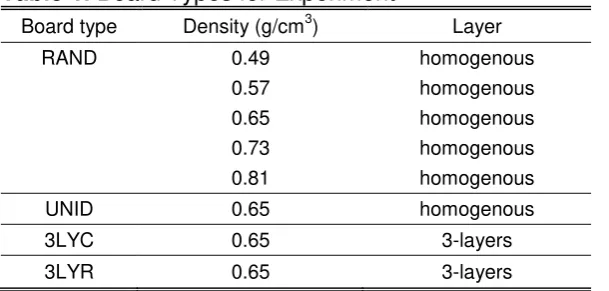
Three additional types of board at a density of 0.65 g/cm3 were fabricated at the same conditions (Table 1), with different layer structures: uni-directionally oriented homogenous boards (UNID); three-layered oriented strandboards with cross-oriented core layers (3LYC); and three-layered oriented strandboards with randomly oriented core layers (3LYR). The face/core/face ratio was 1:2:1 based on the dried weight of strands. Four panels were produced for each treatment condition.
Table 1. Board Types for Experiment
water for 2 h (T2), and then soaking was continued for 24 h (T24). The swelling and water absorption (WA) were measured for each level. Another test of TS was conducted on a wet-dry cycle. For the wet-dry cyclic test, the specimens were subjected to dimensional stability evaluation under the following wet-dry conditioning cycles. During the first cycle of this process, boards were soaked in 20 °C water for 24 h (W1) and then they were oven-dried at 50 °C for 22 h (D1). During the second cycle, the boards were soaked in 70 °C water for 2 h (W2) and then oven-dried at 50 °C for 22 h (D2). During the third cycle, the boards were soaked in 100 oC water for 2 h (W3) and oven-dried at 50 °C for 22 h (D3). After these treatments, specimens of 50 mm by 50 mm were conditioned at 25 °C and 65% ± 5% RH until they reached equilibrium. The thickness changes of the boards were calculated based on initial measurements taken after the boards were dried at 60 °C for 22 h. Eight replicates for each condition were used.
The dimensional stability in the in-plane direction was evaluated by measuring the LE. Two specimens with dimensions of 300 mm x 50 mm were tested. Changes in length were regularly measured during treatment in humid conditions of 90% RH at 40 °C for 150 h using a dial gauge comparator (ASTM 1988). The LE was calculated based on initial measurements taken after the boards were dried at 60 °C for 22 h.
Internal Bond Strength and Density Profile
The internal bond (IB) test was conducted according to the Japanese Industrial Standard (JIS 1994) for particleboard. Eight 50 mm x 50 mm specimens were prepared for the test. Before the IB test, the density profile across the board thickness for each specimen was measured with a densitometer (commercial density profiler).
RESULTS AND DISCUSSION
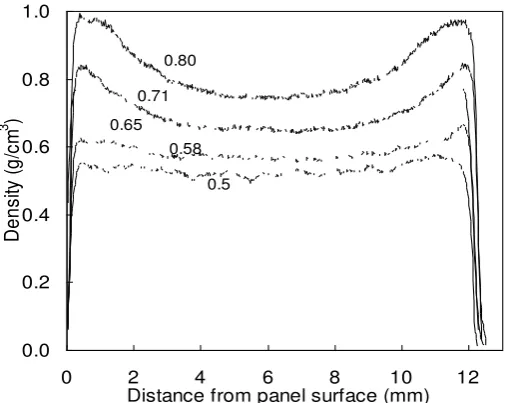
It is well known that the density profile of a board strongly affects the bending and dimensional properties (Kelly 1977). Different density gradients were observed for panels with different mean densities, as shown in Fig. 1. Boards with densities between 0.50 and 0.58 g/cm3 did not have a typical density gradient because of the lower
For higher-density panels, the shapes of their density gradients were similar to a typical density gradient for particle board with high-density layers at board surfaces. The density gradients of layer-structured panels (i.e., UNID, 3LYC, and 3LYR) showed similar peak densities and core densities of 0.73 g/cm3 and 0.60 g/cm3, respectively.
Thickness Swelling and Water Absorption
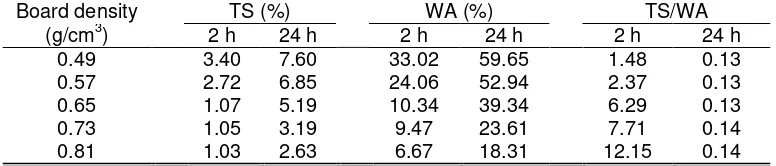
Table 2 summarizes the results of TS and water absorption (WA) at various densities after 2 and 24 h of water soaking for RAND board. TS decreased with increasing board density after 2 and 24 h water soaking, whereas the ratio of TS to WA (TS/WA) increased at 2 h of water soaking. This indicated that low-density panels swelled more easily than higher-density boards, and the low-density boards showed more WA than did high-density boards.
Table 2. Water Soaking Results for Bamboo OSB with Different Densities of RAND Board
The TS/WA ratio from low to high density increased with increasing density for 2 h of water soaking. For 24 h of water soaking, the TS/WA ratio was relatively constant at 0.13 to 0.14 %/% (Table 2). This indicated that the board density had a significant effect on the TS/WA ratio for short-term water soaking and was insignificant for long-term water soaking. Wood swells extremely fast in water even at room temperature, this apparatus made it possible, for the first time, to obtained accurate rate data on the swelling of wood in water (Mantanis 1994). It was hypothesized that the free void water absorbed into the test specimens increased the WA, but had less effect on the swelling, and the amount of swelling was proportional to the density.
It has been shown that density has a great influence on the TS properties of OSB (Winistorfer and Xu 1996). It is also known that high-density boards have high compaction ratios and can absorb more water than low-density boards at equilibrium. Furthermore, the reduced porosity in the high-density boards prevented rapid liquid water penetration throughout the board. Consequently, in high-density material, the diffusion path of water into the individual component flakes was much longer and the subsequent rate was reduced (Kelly 1977).
0
Fig. 2. Effect of layer structures on thickness swelling (TS) and TS/WA ratio of bamboo
strandboard with a density of 0.65 g/cm3. TS-2: thickness after 2 h of water soaking, TS-24: thickness after 24 h of water soaking
Thickness Swelling Aging Treatment
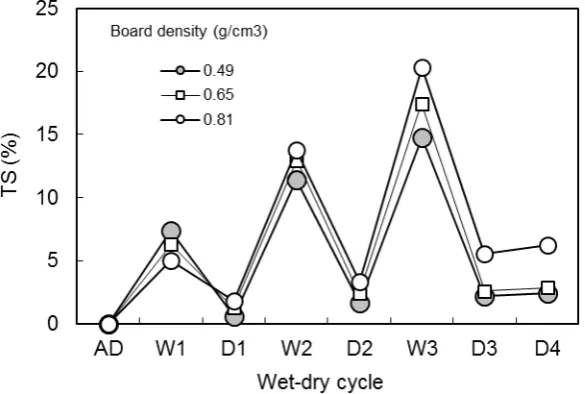
Figure 3 shows the thickness swelling obtained though wet-dry cyclic treatment. Those tests were conducted to obtain variations respond of swelling from low treatment (water soaking) up to extreme treatment (boiling water soaking). TS increased with increasing treatment cycles for all densities. For a density of 0.49 g/cm3, the TS was 8, 12, and 14% for W1 (water soaking), W2 (hot water soaking), and W3 (boiling water soaking), respectively.
Fig. 3. Effect of board density on thickness swelling (TS) tested under a cycle of wet-dry aging
treatment for random boards. First cycle: soaked in water at 20 °C for 24 h (W1) and oven-dried at 50 °C for 22 h (D1); second cycle: soaked in water at 70 C for 2 h (W2) and oven-dried at 50 °C for 22 h (D2); third cycle: soaked in boiling water for 2 h (W3) and oven-dried at 50 °C for 22 h (D3). After these treatments, the specimens were conditioned at 25 C and 65% ± 5% RH until equilibrium was reached (D4).
with a density of 0.81 g/cm3 was larger than that with a density of 0.49 g/cm3. The 24-h water soaking treatment for bamboo strandboard using MDI resin may not be long enough to result in maximum swelling for the higher-density board (Table 1). It is well known that MDI resin has higher durability than phenol resin at high humidity (Galbraith 1986). However, a TS value of 4 to 7% after aging treatment is relatively good perfor-mance for bamboo strandboard.
Hot Water Soaking Treatment
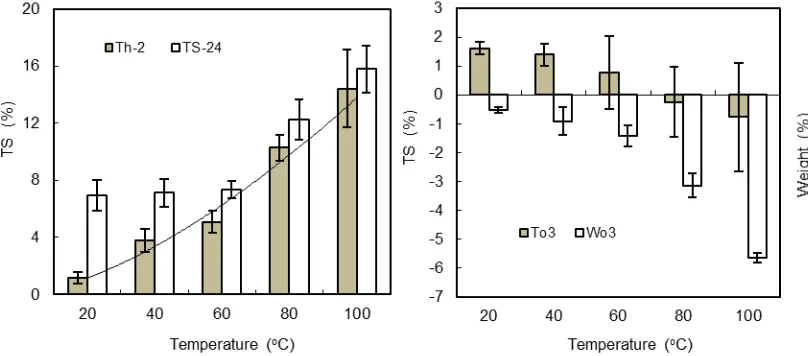
To determine the maximum swelling of bamboo strandboard, the hot water soaking treatment test was conducted with RAND boards at a density of 0.65 g/cm3. The samples were soaked in hot water at various temperatures for 2 h, followed by cold water soaking for 24 h and drying at 60 oC for 72 h. The thickness and weight were measured for each step to demonstrate the manner in which the board swelling increased.
Figure 4 shows the effect of temperature on TS for different water soaking processes. The TS increased with increasing temperature for 2 h of hot water soaking, whereas for the 24-h treatments, the TS at 20, 40, and 60 oC showed similar results of approximately 7%, and increased at 80 and 100 oC. It is obvious that the maximum swelling could not be obtained through cold water soaking. It can be only reached by soaking at high temperatures, and the increasing temperature usually increases water sorption of woods (Sahin 2008). Temperature also has a significant effect on the hygroscopic thickness swelling rate (Shia 2006). On the contrary, the thickness and weight loss of specimens after drying decreased with increasing temperatures. The TS decreased to -1% and the weight loss decreased to -5.5% for treatment at 100 oC, as shown in Fig. 4 (right).
Fig. 4. Effect of water soaking temperature on thickness swelling (TS). TS-2: thickness swelling
after 2 h of water treatment, TS-24: TS after 24 h soaking in cold water, To3: TS after drying at 60 °C for 3 days, Wo3: weight loss after drying at 60 °C for 3 days.
In-Plane Stability
continually increased after 50 h. This resulted in the same trend that has been found for TS of fiberboard subjected to humidity conditions; the different humidity conditions gave rise to specific saturation points (Shia 2006). Figure 5 also shows that the LE saturation value increased with board density, as well as the time to reach the saturation point.
Fig. 5. LE behavior of randomly oriented bamboo OSBs with different densities under condition of
40 oC and 90% RH
Thickness Swelling and Internal Bond (IB)
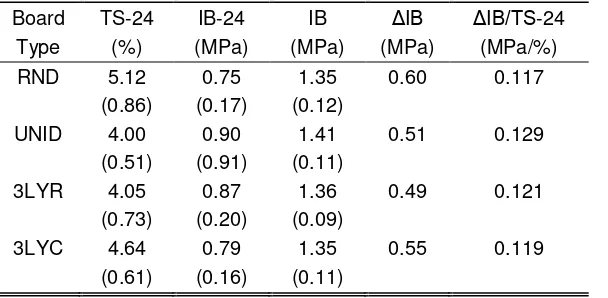
It is well known that TS values are closely related to IB strength. Table 3 summarizes the TS and IB strength at various layer structures with a constant board density of 0.65 g/cm3. The TS value was obtained through 24-h water soaking (TS-24), followed by drying at 60 oC for 24 h to obtain the IB (IB-24). The strength reduction of IB (IB) was defined as the difference between the IB-24 and the IB at the control conditions.
Table 3. Thickness Swelling (TS) and Internal Bond (IB) Strength Reduction for Various Layer Structures
Board TS-24 IB-24 IB ΔIB ΔIB/TS-24 Type (%) (MPa) (MPa) (MPa) (MPa/%) RND 5.12 0.75 1.35 0.60 0.117
(0.86) (0.17) (0.12) UNID 4.00 0.90 1.41 0.51 0.129
(0.51) (0.91) (0.11) 3LYR 4.05 0.87 1.36 0.49 0.121
(0.73) (0.20) (0.09) 3LYC 4.64 0.79 1.35 0.55 0.119
(0.61) (0.16) (0.11)
The results showed that the strength reduction of IB per unit of thickness swelling change (IB/TS-24) of UNID boards was higher than that of RAND boards (Table 3). The IB/TS-24 were 0.129 and 0.117 MPa/% for the UNID and the RAND boards, respectively. This phenomenon indicates that UNID board has the highest sensitivity, and the small change in thickness swelling can reduce the higher internal bond strength. It seems likely that parallel-oriented strands at UNID board might provide better contact and bond quality than in randomly formed strands. However, it should be noted that the
IB/TS-24 could also be affected by other parameters, such as resin type, board density, and particle geometry.
CONCLUSIONS
1. The board density and layer structure affected TS and WA. Boards with lower densities were easier to swell than those with higher densities. The board density influenced the TS/WA ratio for short-term water soaking, but not for long-term water soaking.
2. For layer-structured boards, the TS/WA ratio of RAND boards was slightly higher than those for UNID, 3LYR, and 3LYC boards.
3. The maximum swelling can only be reached using high-temperature water soaking. The IB strength loss of UNID boards was higher than that of RAND boards. However, boards with higher densities required more time to reach LE saturation values than did boards with lower densities.
4. The IB/TS-24 ratio could be used as an indicator to evaluate internal bond reduction by dimensional change.
REFERENCES CITED
Avramidis, S., and Smith, L. A. (1989). “The effect of resin content and face-to-core ration on same properties of oriented strandboard,” Holzforschung 42(2), 131-133. Bryan, E. L. (1962). “Dimensional stability of particleboard,” Forest Prod. J. 12(12),
572-576.
Canadian Standard Association. (1992). “Standard on OSB and waferboard,” CAN/CSA 0437-92. CSA, Rockdale, ON.
Galbraith, C. J. (1986). “Recent development in the full-time manufacture of all-isocyanate bonded structural composite boards,” Proceedings of the 20th
International Particleboard/Composite Materials Symposium, Washington State University, Pullman, WA. pp. 59-78.
Kelly, M. W. (1977). “Critical literature review of relationships between the processing parameters and physical properties of particleboard,” General Technical Report FPL-10. U.S. Department of Agriculture, Forest Service, Forest Products Laboratory, Madison, WI.
Lee, A. W. C., Bai, X, and Peralta, P. N. (1996). “Physical and mechanical properties of
strand board made from moso bamboo,” Forest Prod. J. 46, 84-88.
Mantanis, G. I., Young, R. A., and Rowell, R. M. (1994). “Swelling of wood, Part 1.
Nugroho, N., and Ando, N. (2000). “Development of structural composite product made
from bamboo I. Fundamental properties of bamboo zephyr board,” J. Wood Sci. 46,
68-74.
Sahin, H. T. (2008). “Wood-water interaction as affected by chemical constituents of
woods,” Asian Journal of Chemistry 20(4), 3267-3276.
Shia, S. Q., and Gardnerb, D. J. (2006). “Hygroscopic thickness swelling rate of compression molded wood fiberboard and wood fiber/polymer composites,” Composites Part A: 37(9), 1276-1285.
Suchsland, O., and Xu, H. (1991). “Model analysis of flakeboard variables,” Forest Prod. J. 41(11-12), 55-60.
Sumardi, I., Suzuki, S., and Ono, K. (2006). “Some important properties of strandboard
manufactured from bamboo,” Forest Prod. J. 56, 59-63.
Winistorfer, P. M., and Xu, X. (1996). “Layer water absorption of medium density fiberboard and oriented strandboard,” Forest Prod. J. 46(6), 69-72.
Wu, Q. (1999). “In-plane dimensional stability of oriented strand panel: Effect of
processing variables,” Wood Fiber Sci. 31(1), 26-40.
Zhang, M., Kawai, K., Yusuf, S., Imamura. Y., and Sasaki. H. (1997). “Manufacture of wood composite using lignocellulosic materials and their properties III. Properties of bamboo particleboards and dimensional stability improvement using a
steam-injection press (in Japanese),” Mokuzai Gakkaishi 43, 318-326.
Zylkowski, S. C. (1986). “Dimensional stability of structural-use panels,” American Plywood Assoc. Res. Report No. R & D 86L-43. Tacoma, WA, p. 16.
Zylkowski, S. C. (1989). “Dimensional performance of wood based siding,” American Plywood Assoc. Res. Report No. 149, Tacoma, WA, p. 50.
Article submitted: October 11, 2013; Peer review completed: December 10, 2013;