Nitrogen Transfer of Two Cultivar Faba Bean (
Vicia faba
L.) to Oat (
Avena sativa
L.)
H. Purnamawati1), K. Schmidtke 2)
ABSTRACT
Nitrogen fixed by the legume could be used by other plants, such as through rhizodeposition and direct transfer between roots. The possibility of N transfer in intercropping legum-cereal have long been observed, especially legum with short and dense root. This experiment had been carried out to determine whether there was N transfer from faba bean (Vicia faba L.) growing in association with oat (Avena sativa L.) and whether there was difference between two cultivars of faba bean in the amount of N transfer. Methods used were complete-mixed-root (CMR) between faba bean and oat, and mixed half the root of faba bean with oat (SR). As a tracer isotope 15N was used in form of K15NO3. The experiment was carried out from May 2000 through January 2001 in Institute of Agronomy and Plant Breeding, University of Goettingen Germany. The data of CMR method had great variance. Using SR method a positive value of 15N enrichment was found in oat indicated that transfer N from faba bean cv. Minica and Scirocco occurred. There was no difference found in the amount of N transferred between the two tested cultivars.
Key words: N transfer, 15N, Faba bean, Oat
1)
Departemen of Agronomy, Faculty of Agriculture, Bogor Agricultural University. Jl Meranti Kampus IPB Darmaga, Bogor, Indonesia. Ph./Fax:0062-0251-629353
2) Institut of Plant Production and Plant Breeding, University of Goettingen. Von Siebold Str 8, 37075 Goettingen, Germany
INTRODUCTION
Because of the ability of legumes to fix N2 from
atmosphere through their symbiosis with Rhizobium
bacteria, legume crops are often included in intercropping systems. Giller and Wilson (1991) described mechanisms by which legume nitrogen can be made available to other plants, included rhizodeposition, root and nodule senescence, and direct transfer of N between roots. Nitrogen transfer from legume to cereal might have the potential for further manipulation to increase cereal yields (Vandermeer, 1989).
Addition yield from mixtures of non legumes and faba beans compared to mean yield of sole crops are often to be found (Jensen, 1986; Bulson et al., 1997; Li
et al., 1999). Li et al. (1999) suggested that the beneficial effect of faba bean/maize mixtures was the results of transfer of substances from faba bean to maize via roots. In the field studies neither Danso et al. (1987), who used the 15N dilution method, nor Cochran and Schlentner (1995), who using N difference method, found an evidence of N transfer
from faba bean to cereals. The roots of faba bean are relatively large and sparse so that sloughing of legume roots is not provided. On the other hand, N transfer to non-legume could be proved for numerous grain legumes such as pea (Jensen, 1996) and soybean (Van Kessel et al., 1985; Martin et al., 1991; Hamel et al.,
1991).
The proportion of N, which transferred from legume to non-legume plants, depends on the ability of N2 fixation by the legume (Ta and Faris, 1987) and the
growing condition of the legume (Giller and Wilson, 1991). Since species or cultivar of legume plants, which have different growth habit, may have a different capacity to fix N, it is likely that the proportion of N transfer could be also different between species and cultivars.
proportion of N transferred from faba bean to companion plant oat (Avena sativa L) and to examine whether there are differences between cultivars of faba bean in the amount of N transfer.
MATERIAL AND METHODS
Plants, Nutrients and Growth Conditions
The experiment has been carried out at the beginning of summer, in the glasshouse of the Institute of Agronomy and Plant Breeding, University of Goettingen, from May 2000 through January 2001. At that time temperature in the glasshouse was at 15.9 - 29.0 oC and relative humidity of 34.8 - 62.7 %. Two cultivars of faba bean (cv. Minica and Scirocco) were used as donor plants and one cultivar of oat (cv. Lutz) was used as receiver plant. Faba bean cv. Minica had big seed and cv. Scirocco had smaller seed. A nutrient solution (Vincent, 1970) containing basic nutrient, but without N, was given every two days together with
The contribution of faba bean-N to the N nutrition of companion plant was studied using two technique
Plants were grown in PVC-pot holding 12 litre N-free vermiculite. One day after the root emergence in moist filter paper, seedlings of faba bean and oat were transplanted to the experiment units. Before planting, seedlings of faba bean were inoculated with Rhizobium. Twelve seedlings of faba bean cv. Minica were planted in a circle and one seedling of oat was planted in the labelled- fertilized-oat growing alone (C2) were also included.
Three weeks after transplanting, all pots, except treatment C1 and pots of faba bean in treatment s, were fertilised with 10 mg N, 5 atom % 15N as K15NO3. Pots was grown with the root divided between two pots. The experiment unit was a 2-litre pot which contained only moist-N-free vermiculite (‘Donor’ pot) and a 5-litre pot as ‘Receiver’ pot which contained a mixture of soiland vermiculite (1:1 v/v).
Seeds were germinated in N-free vermiculite, which have been washed with deionized water before replanted and grown in N-free-vermiculite for further 12 days to allow the plants to produce the lateral roots before being transplanted into the experimental units. Half part of faba bean root was placed in ‘Donor’ pot and the other part in ‘Receiver’ pot. One seedling of oat (one week old) was planted in ‘Receiver’ pot, 6 cm apart from faba bean. As control, one seedling of oat was planted alone in a 5-litre pot. Ten days later, half of pots ‘Donor’ received 20 mg N, 5 atom % 15N (as KNO3). The amount of 5 atom % 15N was added every
3 days to the ‘Donor’ pot for continuous labelling. The other half of pots ‘Donor’ and oat growing alone as were control plants were fertilised with non 15 N-enrichced KNO3 with the same amount of N.
Harvest and Analytical Methods
Calculation of N Transfer amount of nitrogen transferred from legume to oat. The of value of δ15N units uptake was calculated using equation : Ndft root) was calculated under assumption that N from donor plant deposited in the rhizosphere and taken up by the receiver plant had the same 15N enrichment during the labelling period as the donor root at the time of harvest.
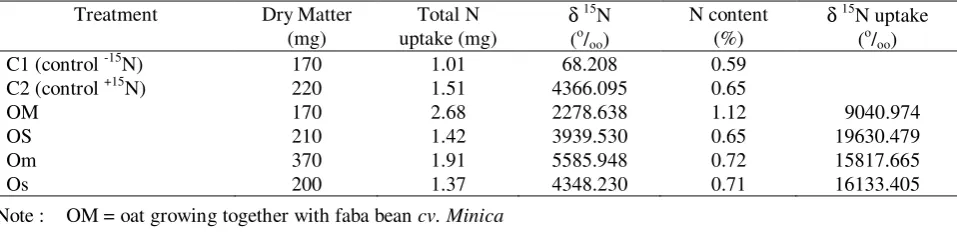
The amount of N transferred (mg plant -1) is calculated as : greatly variance within replications, therefore only the mean values were showed in Table 1.
N uptake of oat growing together with cv. Minica was much lower than δ 15N value of labelled N fertilizer. The lower value of δ 15N uptake could be caused by uptake N from mineralization (Giller and Wilson, 1991). During the first weeks of this experiment, faba beans were transplanted twice because the microclimate inside the glasshouse was not favorable. This situation could lead to mineralization of decayed-seed.
Table 1. Means value of shoot dry matter, N uptake, N content and δ15N uptake of oats in experiment 1.
Note : OM = oat growing together with faba bean cv. Minica
OS = oat growing together with faba bean cv. Scirocco
Om = oat growing surrounded by faba bean cv. Minica
Os = oat growing surrounded by faba bean cv. Scirocco
In experiment 2 faba bean was 16 days older than oat. Although the oat grew poorly, oat in the ‘Receiver’ pot did not get any additional N fertilizer. The source for N for oat, solely, came from soil and N, which
to N fertilizer, it would add a considerable amount of N and 15N to the whole plant basis.
There were no different in plant dry weight and total N uptake of oat growing with 15N-fertilised faba beans or unlabelled-fertilized faba beans, although the root of oat growing together with unlabelled-fertilized
Minica contained lower N compared to oats root
growing together with 15N-fertilized Minica. Oat growing with 15N-fertilized Scirocco showed higher
15
N enrichment compared to oat growing with unlabelled-fertilized Scirocco, whereas in oat growing with 15N-fertilized Minica only the root had higher 15N enrichment (Table 2).
Table 2. Plants dry matter, total N uptake and weighted % 15N excess of oat growing together with faba bean fertilized with or without 15N.
Dry matter (mg plant-1) Total N uptake (mg plant-1) Weighted % 15N excess
Shoot Root plant Shoot Root plant Shoot Root Plant
Oat(+Minica-15N) 1875 695 2552 37.757 6.415 44.173 0.038 0.001 0.0009 Oat(+Minica +15N) 1870 1028 2898 40.405 10.369 50.774 0.064 0.025 0.0017
HSD(0,05) ns ns ns ns 0.047 ns Ns 0.018 ns
Oat (+Scirocco -15N) 2152 810 2962 45.768 7.068 52.835 0.023 0.00002 0.0001 Oat (+Scirocco
+15
N)
2177 1215 3392 47.086 10.027 57.112 0.037 0.0096 0.0008
HSD(0,05) ns ns ns ns ns ns Ns 0.028 0.029
Note: ns = no significant
Oat(+Minica-15N) = Oat growing together with cv. Minica fertilized by KNO3
Oat(+Minica +15N) = Oat growing together with cv. Minica fertilized by K15NO3
Oat(+Scirocco -15N) = Oat growing together with cv. Scirocco fertilized by KNO3
Oat(+Scirocco +15N) = Oat growing together with cv. Scirocco fertilized by K15NO3
% 15N excess was based on the difference between 15N enrichment of oat growing together with faba beans and oat control
Growing together with faba bean did not influence oat growth, but reduced total N uptake of oat and shoot-N was much more affected than root-shoot-N (Table 3). Between the two cultivars of faba bean, Minica had larger shoot dry weight and tended to accumulate more shoot-N (P = 0,090) than Scirocco. There was a tendency that oat growing together with Minica had a lower N uptake compared to the oat growing with
Scirocco.
Since oat did not directly fertilized with 15N, the positive value of 15N enrichment found in shoot and root of oat was an indication that N had been
transferred from faba beans to oat. Oat growing together with Minica had significantly more 15N enrichment than oat growing together with Scirocco
(Table 3). The higher 15N excess in oat growing with Minica appeared, more likely, because of oat growing together with Minica took up less N compared to the oat growing with Scirocco, rather than because of
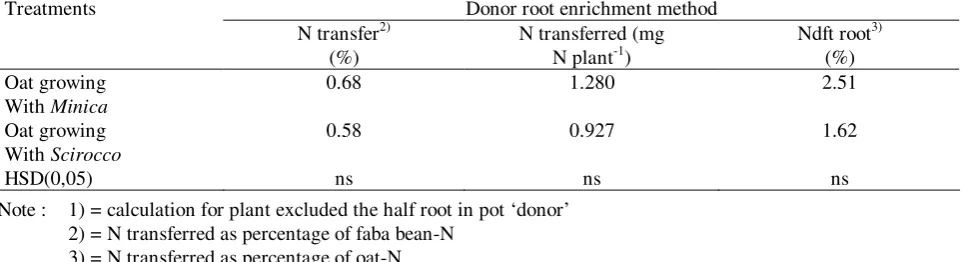
Minica transferred more N than Scirocco. Table 4 showed that the proportion of N in oat that came from
Minica was not significantly higher than the proportion of N came from Scirocco.
Table 3. Plants dry matter, N uptake and weighted 15N excess of oat and faba bean.
Dry matter (mg plant-1) Total N uptake (mg plant-1) Weighted %15N excess
Shoot Root plant Shoot Root Plant Shoot Root Plant
oat control 2425 1080 3505 60,349 a 10.377 70.816 a
oat (+ Minica) 1870 1028 2898 40,405 b 10.369 50.774 b 0.064 0.025 0.002 a oat (+ Scirocco) 2177 1215 3392 47,086 ab 10.027 57.112 ab 0.037 0.010 0.001 b
HSD(0,05) ns ns ns 0.014 ns 0.038 Ns ns 0,020
Minica (+ oat) 6815 a 3790 10 605 151.042 36.355 187.397 36.418 3.002 0.215 Scirocco (+ oat) 5562 b 3747 9 308 126.535 40.114 166.649 18.437 2.037 0.125
Note: ns = no significant.
Numbers with different letters indicates significant difference.
% 15N excess was based on the difference between 15N enrichment of oat growing together with faba bean and oat control.
Table 4. Estimated N-transfer1) from faba bean cv Minica and Scirocco to oat.
Treatments Donor root enrichment method
N transfer2) (%)
N transferred (mg N plant-1)
Ndft root3) (%) Oat growing
With Minica
0.68 1.280 2.51
Oat growing With Scirocco
0.58 0.927 1.62
HSD(0,05) ns ns ns
Note : 1) = calculation for plant excluded the half root in pot ‘donor’ 2) = N transferred as percentage of faba bean-N
3) = N transferred as percentage of oat-N ns = no significant.
Despite the low N nutrition condition created in ‘Receiver’ pot to enhance faba bean-N-fixation, there seemed no immediate benefit of N to oat. At the time of harvest, Minica contained in average 1.98% N and
Scirocco 1.99% N. This N uptake of faba beans was roughly three times of total N in oat but only less than 0.68% of faba bean’s N was transferred to oat. Giller et al. (1991) and Jensen (1996) found that the amounts of N transferred from bean to companion plant in intercropping might improve under a severe limitation on the growth of the beans such as an insect attack or shading.
We found no correlation between the amount of N, which transferred to oat, neither to the amount of N taken up by faba beans, nor the amount of N left in the media of ‘Receiver’ pot after harvest.
Jensen (1996) explained that the donor root enrichment method may give the most reliable estimation of N transfer in continuous split root labelling because the 15N enrichment of donor root is probably similar than the 15N enrichment of N deposited. But, we must also consider that at 90 days after sowing, faba bean was at the end of pod filling stage. The 15N enrichment of faba beans roots might be different with the 15N enrichment of N deposited and taken up by oat since decomposition and senescence of nodules and root had been occurred.
We concluded that transfer of N from faba bean to associated plant does occur, although the amount of N transferred was very small (less than 0.68% of faba bean’s N). The result of experiment also showed that there was no difference in the amount of N transfer between the two tested cultivars, Minica and Scirocco.
ACKNOWLEDGEMENTS
We would like to thank R. Langell for helping in N analyses, Gaby and Mrs Hofmann for helping during preparation. The work was funded by Prof. Werner Schulze-Stiftung im Stifterverband für die Deutsche Wissenschaft.
REFERENCES
Bulson, H. A. J., Snaydon, R.W., C. E. Stowes. 1996. Effects of plant density on intercropped wheat and field beans in an organic farming system. Agricultural Botany Department, University of Reading, Reading RG6 2AS, UK, 11p.
and nitrogen fertilizer response. Agron. J. 87, 420-424 .
Danso, S. K. A., F. Zapata, G. Hardarson. 1987. Nitrogen fixation in faba beans as affected by plant population density in sole or intercropped system with barley. Soil Biol. Biochem. 19, 411-415.
FAO. 2000. Production Year Book FAO Rome http://www.FAO.org/statistical databases/agricul-ture/primary crops. (September, 2000)
Giller, K. E., K. J. Wilson. 1991. Nitrogen fixation in tropical cropping systems. CAB International. Wallingford. Oxon. UK. 313p.
Giller, K. E., J. Ormesher, F. M. Awah. 1991. Nitrogen transfer from Phaseolus bean to intercropped maize measured using 15 N-enrichment and 15N-isotope dilution methods. Soil Biol. Biochem. 23, 339-346.
Jensen, E. S. 1996. Barley uptake of N deposited in the rhizosphere of associated field pea. Soil Biol. Biochem. 28 : 159 - 168.
Ledgard, S. F., J. R. Freney, J. R. Simpson. 1985. Assessing nitrogen transfer from legumes to
associated grasses. Soil Biol. Biochem. 17 : 575 -577.
Li, L., S. Yang, X. Li, F. Zhang, P. Christie. 1999. Interspesific complementary and competitive interactions between intercropped maize and faba bean. Field Crop Res.
40 : 105 – 115.
Martin, R. C., H. D. Valdeng, D. L. Smith. 1991. Nitrogen from nodulating soybean (Glycine max
L. Merr) to corn (Zea mays L.). New Phytol. 117 : 233 - 241.
Ta, T. C., M. A. Faris. 1987. Species variation in the fixation and transfer of nitrogen from legumes to associated grass. Plant and Soil 98 : 265 - 274.
Vandermeer, J. 1989. The Ecology of Intercropping. Cambridge University Press, Cambridge.
van Kessel, C., P. W. Singleton, H. J. Hoben. 1985. Enhanced N-transfer from a soybean to maize by vesicular arbuscular mycorrhizal (VAM) fungi. Plant Physiol. 79 : 562 - 563.