IEEJ Trans2015;10(s1): S28–S33
Published online in Wiley Online Library (wileyonlinelibrary.com). DOI:10.1002/tee.22161
Paper
Modeling Method of Fast Transient for Unsymmetrical Stray Capacitance to
Ground
Diah Permata
a,
Student MemberNaoto Nagaoka,
MemberTransient characteristic of power system apparatus in a high-frequency region should be modeled with stray capacitors. Pi-type circuit is commonly used to represent the stray capacitors between terminals and those to the ground. A modeling method for the pi-type circuit with unsymmetrical stray capacitances to ground is proposed in this paper. To obtain the unsymmetrical stray capacitances to ground, a couple of differential-mode measurements are interchangeably applied. The parameters of the pi-type circuit can be determined by the measurements with a common-mode measurement. A nonlinear least-squares method is used to estimate the capacitances. The method is applied to compose an equivalent circuit of a miniature circuit breaker (MCB), which has unsymmetrical stray capacitances to ground. The application is not only for the MCB but also for a scaled model of a high-voltage circuit breaker. A gas-filled arrester is used as a voltage sensor for the test because the voltage across the stray capacitor cannot be directly measured due to the input capacitance of a voltage probe. A transient response of the MCB with the gas-filled arresters is numerically simulated to show the usefulness of the equivalent circuit.©2015 Institute of Electrical Engineers of Japan. Published by John Wiley & Sons, Inc.
Keywords:stray capacitance, unsymmetrical impedance, nonlinear fitting, miniature circuit breaker, gas-filled arrester (GA), flashover
Received 8 December 2014; Revised 12 April 2015
1. Introduction
For an accurate analysis of lightning surge, power system apparatuses should be represented with their stray capacitors to ground [1]. Many researches have been obtained the stray capacitances of the apparatuses by numerical simulations, such as finite element method [2–4], or by measurements [5–7], because the theoretical calculation of the stray capacitance is difficult. Furthermore, the measurement becomes harder with the decrease of the size of the apparatus due to the decrease of the capacitance. Pi-type circuit is commonly used to represent a stray capacitor between terminals and that from each terminal to ground [1,3,6]. The authors had proposed a method to measure a small-capacitance circuit and presented an equivalent pi-type circuit model to express the stray capacitors between two electrodes implanted into a piece of wood [8]. The stray capacitances to ground of the terminals were assumed to be equal, i.e. symmetrical. In general, power apparatuses have unsymmetrical stray capacitances to ground. A method to compose an equivalent pi-type circuit model for unsymmetrical stray capacitance to ground is proposed in this paper.
A miniature circuit breaker (MCB) is taken as an example of the unsymmetrical stray capacitance to ground. The stray capacitances from the incoming and outgoing terminals are different, because the configuration of the electrodes in the MCB is asymmetrical. In addition to the capacitances, the MCB has stray capacitances between contacts. In this paper, a measurement method for the unsymmetrical circuit is proposed by improving the method for symmetrical stray capacitance proposed in Ref. [8]. The modification is achieved in the differential-mode measurements.
The previous method used the slope of the wave-tail of the transient current to estimate the circuit parameters. Although
aCorrespondence to: Diah Permata. E-mail: [email protected]
Department of Electrical and Electronic Engineering, Doshisha University, 1-3 Miyakodani, Tatara, Kyotanabe 610-0321, Japan
the method provided satisfactory accuracy in the low-frequency region, the high-frequency characteristic could not be obtained. The high-frequency characteristic was obtained as the ratio between the open-circuited applied voltageVocat the terminal and the slope of the injected current waveform at its wave front. In this paper, curve-fitting by the nonlinear least-squares method is employed to estimate the impedance of the equivalent circuit. This method automatically estimates the unsymmetrical circuit param-eters both in the high- and low-frequency regions.
The measurement of the small stray capacitance is difficult due to restrictions of the measuring instrument. In addition, the stray capacitance to ground has to be measured in a state of installation. The capacitance measurement is generally difficult by an impedance measuring instrument because of the small signal source and low immunity to noise. On the other hand, the transient measuring method, which gives the impedance as a ratio between the voltage and current frequency responses transformed from a time domain, can be easily applied to the power system apparatus. However, the measurement of the small stray capacitance is difficult due to the low impedance of the voltage probe, which is indispensable to the transient voltage measurement. In this paper, the capacitance is estimated only from the transient current, which is a technique developed in Ref. [8].
(a) (b)
(c)
Incoming terminal
Outgoing terminal
3D2V Cable of 100 m
10 k
I
O F F PG
I PG
3D2V Cable of 100 m
10 k
O F F
PG
10 k
O N
3D2V Cable of 100 m
I
Fig. 1. Measurement setup. (a) Incoming-differential mode. (b) Outgoing-differential mode. (c) Common mode
Cct Cct
Cgi Cgo
Cgo
Cgi
Incoming terminal
Outgoing terminal
Fig. 2. Equivalent circuit of impedance between contacts in MCB
2. Modeling of MCB
2.1. Transient measurement This study uses a
two-pole low-voltage MCB, whose rated voltageUeis 220 V and rated short-circuit currentIcn is 2.5 kA. The measurements are carried out in the differential and common mode, as shown in Fig. 1. In this paper, the ground is modeled by an aluminum plate.
The differential modes are for measurements of the impedances between terminals. For an unsymmetrical circuit, two impedances have to be measured to obtain the stray capacitances for the incoming and outgoing terminals. The arrangement of the core and sheath of the current injecting cable is swapped. For the measurements, the terminals at the incoming and outgoing sides are short-circuited to exclude the impedance between phases, and the contacts are opened (switched ‘OFF’).
The common-mode test is used for the measurement of the impedance to ground. In the test, all terminals are short-circuited (switched ‘ON’) [8].
The sending-end resistor of 10 k is attached to the core of the current injecting cable of 3D2V. Its cable length is 100 m. A voltage is applied using a pulse generator (PG, Noiseken INS-4040). The transient currents are measured using a digital oscilloscope (Tektronix DPO 4104, 1 GHz) with a current probe (Tektronix CT-1).
2.2. Circuit composition The MCB can be expressed
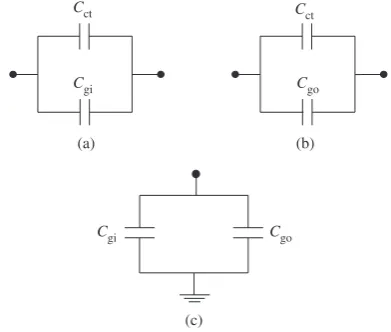
by the model circuit illustrated in Fig. 2. The capacitor Cct expresses the capacitance between contacts. The capacitors Cgi andCgo represent the stray capacitors to ground at the incoming and outgoing terminals, respectively.
(a) (b)
(c) Cct
Cgi
Cct
Cgo
Cgo Cgi
Fig. 3. Capacitance circuits in MCB, differential and common mode. (a) Incoming-differential mode. (b) Outgoing-differential
mode. (c) Common mode
The authors had shown that the sheath surge impedance affects the transient measurement in the differential mode [8]. In this mode, the sheath of the current injecting cable is connected to one of the terminals. The stray capacitor grounding from the terminal connected to the sheath is short-circuited by the low sheath surge impedance. In the incoming differential mode measurement, the outgoing stray capacitor to groundCgo can be neglected because the outgoing terminal is connected to the sheath. On the other hand, the incoming stray capacitor to groundCgiis short-circuited in the outgoing differential mode measurement. The differential modes are expressed by two equivalent circuits, as shown in Fig. 3(a). The circuit consists of a capacitor between contactCctand a capacitor to groundCgiorCgo.
The common-mode characteristic is expressed by the parallel-connected stray capacitors between the MCB and the ground (Cgi and Cgo), as shown in Fig. 3(b), since all terminals are short-circuited. The sheath surge impedance of the current injection cable has no effect on the measurement because the high resistance is connected between the cable core and the circuit.
The stray capacitances to be measured in these modes, Cin,
Yes Define the analytical function of
transient voltage waveform V(t)
Curve fitting waveform V(t) from time to frequency
domain V(s)
Analytical transformation of I(s) from frequency to time domain I(t)
Input data:
- Open-circuited voltage (Voc) - Current (I)
Circuit parameters of equivalent circuit
STOP
Fig. 4. Numerical procedure of nonlinear fitting
automatically obtained from the nonlinear fitting method explained in the next section. The parameters of the pi-type circuit model are obtained by solving (1) simultaneously.
Cin=Cct+Cgi (1a)
Cout =Cct+Cgo (1b)
Ccomm =Cgi+Cgo (1c)
3. Curve-Fitting Method
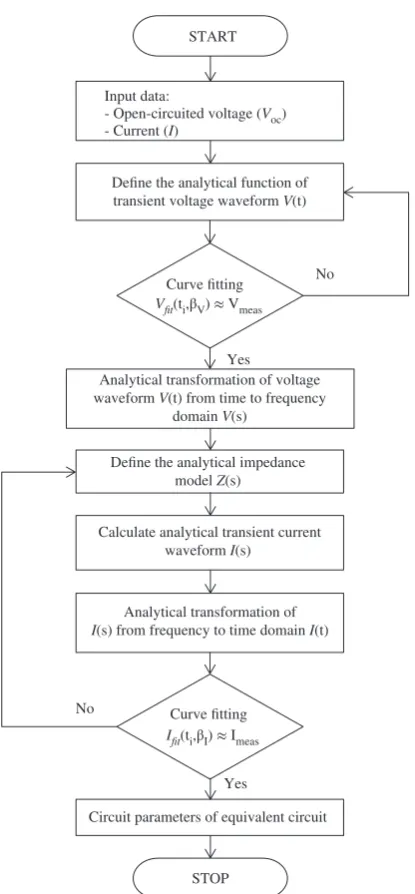
A curve-fitting method based on a nonlinear least-squares method is used to estimate the circuit parameters of the equivalent circuit. A numerical modeling procedure is shown in Fig. 4. Two input data are required to define the parameters of each circuit, i.e. an open-circuited voltage Voc, and a current flowing through the circuitI. The circuit parameters are obtained by an analysis of the transient waveforms as shown below.
The first step is an analysis of the applied voltage waveform, which is given as sampled data Vmeas(ti). The voltage can be
measured by a conventional voltage measurement with a voltage probe because the source impedance, i.e., the coaxial surge impedance of the current injecting cable, is far lower than that
of the voltage probe. The voltage is assumed to be a step-like voltage whose voltage rise is expressed by a double exponential function shown in (2).
Vfit(t)=Vm
1−Ae−t/τ1−(1−A)e−t/τ2 (2)
The parameters in (2) are obtained by minimizing the object functionS given in (3).
S = residual sum of squares S is minimized by finding the elements of the vectorβV.The fitting should be carried out with reasonable initial values of the parameters. In this paper, the initial values for Vm and τ1 is taken from the maximum voltage and half of the rising time of the open-circuited voltage, respectively. The initial values ofAandτ2are assumed to beA= 0.7 andτ2= 10τ1. The fitness of the curve has to be confirmed from a plot of the measured and estimated voltages, whether the residual reaches a local minimum or not. However, the proposed initial values give a good approximation.
In the second step, the current waveforms are approximated to obtain the circuit parameters. The procedure for the nonlinear fitting of the measured data with a model is similar to that of the first step. The current function Ifit(ti,βI) depends on the applied voltage shown in (2) and the impedance of the circuit. The circuit investigating in this paper is assumed to be an RC
series circuit, and the current is expressed by (4) and (5) using Laplace operators.
I(s)= Vfit(s)
Z(s) (4)
Z(s)=R+ 1
sC (5)
Since the current function given in (4) is in the frequency domain, the current must be transformed into the time domain prior to the estimation of the unknown parameter βI. The current function Ifit(t,βI) in the time domain is shown in (6). Because the parameters for the voltage βV= [A, Vm, τ1, τ2] have been obtained, the unknown parameters in βIbecome R and C. The fitting to the measured currentImeasgives the circuit parametersR andC.
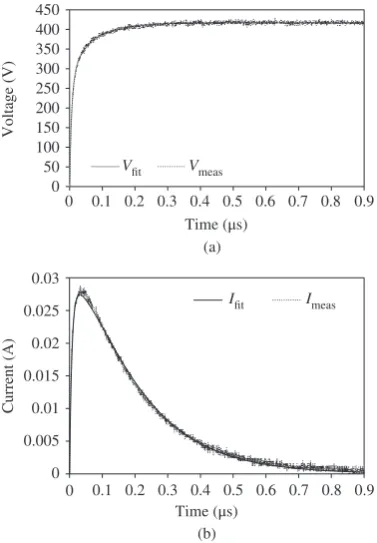
The nonlinear fitting is carried out using the Maple software version 17. AN example of the fitted results with the measured data is shown in Fig. 5.
4. Application Example
The nonlinear fitting results in the measurements of the capaci-tances in three modesCin,Cout, andCcommin (1). The capacitances between contacts, Cct, and the stray capacitance to ground in incoming/outgoing terminals, Cgi/Cgo, are obtained as a solution of the simultaneous equation (1).
Figure 6 shows that the stray capacitors in MCB can be divided into two according to the symmetry between its phases.
• The capacitanceCctbetween the contacts measured by the
(a)
(b) 0
50 100 150 200 250 300 350 400 450
0 0.1 0.2 0.3 0.4 0.5 0.6 0.7 0.8 0.9
Voltage (V)
Time (s)
0 0.005 0.01 0.015 0.02 0.025 0.03
0 0.1 0.2 0.3 0.4 0.5 0.6 0.7 0.8 0.9
Current (A)
Time (s)
Ifit Imeas Vfit Vmeas
Fig. 5. Comparison between fitted model and measured data, voltage and current waveforms. (a) Voltage waveform. (b) Current
waveform
Cct-a Cct-b
Cph-i
Cph-o
Cgo-a Cgo-b Cgi-b
Cgi-a
Fig. 6. Equivalent circuit of stray capacitors in MCB
• Each stray capacitance from the incoming or outgoing terminal to ground is separated into two phases, Cgi−a andCgi−b, orCgo−a andCgo−b.
• The capacitors between phasesCph−iandCph−oare short-circuited, as shown in Fig. 1.
The calculated result of the circuit parameters using the non-linear fitting method is listed in Table I. The total capacitance between the contacts Cct is 3.4 pF, and it is the smallest. The stray capacitances to ground at both terminals, Cgi and Cgo, are different. The MCB has the unsymmetrical stray capacitance. The stray capacitance at the outgoing terminal is twice of that at the incoming terminal.
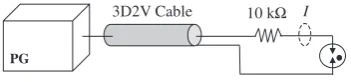
One of the methods to evaluate the reliability of the equivalent circuit of the MCB is a measurement of the voltage across the terminal of the MCB. However, the voltage across the stray capacitor cannot be measured since the stray capacitance is smaller than the capacitance of the voltage probe. The voltage is indirectly measured using a GA. The GA is connected to the MCB, and a pulse voltage is applied by a pulse generator (PG, Noiseken INS-4040) via a current injection cable 3D2V and a resistor, as shown in Fig. 7. It represents a common-mode protection. The mode can be represented by the circuit short-circuited between phases of the
Table I. Circuit parameters in MCB
Capacitance (pF)
Cin 8.7
Cout 14.2
Ccomm 16.2
Cct 3.4
Cgi 5.4
Cgo 10.8
Cct−a=Cct−b=Cct/2 1.7
Cgi−a=Cgi−b=Cgi/2 2.7
Cgo−a=Cgo−b=Cgo/2 5.4
PG
10 k 3D2V Cable I
Fig. 7. Measurement setup
Cga = 2.1 pF Rga = 5 k
TACS switch
Fig. 8. Equivalent circuit of GA for studying the flashover phe-nomena
MCB because the surge voltages on both lines are assumed to be equal [10].
Even if the MCB is opened, some voltage is induced on the terminal connected with the GA via the stray capacitor between contacts. From the time to flashover of the GA, the voltage across the GA can be estimated using a voltage–time (V–t)curve of the GA. TheV–tcurve of the GA is shown in Fig. A2 in Appendix. The characteristic of the flashover can be expressed by the equivalent circuit shown in Fig. 8. The switch is closed according to the V–t curve to express the flashover, and the RC series circuit expresses the internal impedance of the GA before the flashover. The circuit can be simulated by EMTP. Transient Analysis Control System (TACS), which is one of the models for expressing control systems, is used to represent the flashover. The TACS controls the closing time of the switch according to theV–t
curve. The capacitance Cga is determined by the configuration of the GA, which consists of two metallic electrodes insulated by dielectric gases. The resistor Rga correlates to the losses of the dielectric material before the flashover of the GA. The resistance and capacitance are determined by the proposed nonlinear fitting method as shown in Appendix. In the simulation of this paper, the resistanceRga can be neglected because the time constant of the RC series circuit is much smaller than that of the transient response of the test circuit illustrated in Fig. 7.
0
Fig. 9. Measured and simulated results to observe time to flashover
Fig. 10. Equivalent circuit of MCB and GA
Table I, and the total capacitance of the GA is 4.2 pF, which is connected in parallel with the stray capacitanceCgo (Fig. 10). Although the effect of the GA cannot be neglected, it can be said that the accuracy of the MCB model is satisfactory. The times at the flashovers, which determine the voltage across the GA, are shown in Fig. 9 by circles. The gray and black circles are for the measured and simulated time, respectively. The measured wave-form shows a strong oscillation after the flashover. However, there is no oscillation in the calculated results, because the flashover is modeled by a switch and the discharge characteristic of the GA and the induction due to the flashover current are neglected in the simulation. The flashover times are 0.13 and 0.11µs for the measured and simulated results, respectively. These times can be converted to the voltage using theV–tcurve of the GA. The times correspond to the voltages of 423 and 445 V for measured and sim-ulated results, respectively. The differences between the voltages are 5%.
The proposed equivalent circuit of the MCB and GA enables the prediction of the applied voltage at the flashover. The MCB as well as the GA is represented by the stray capacitors, as shown in Fig. 10. The ratio between input and output voltage is shown in (7). The applied voltage is higher by 5.4 times compared to the flashover voltage. where 2Cgais the equivalent capacitance of the parallel-connected GAs.
5. Conclusion
A method for estimating unsymmetrical stray capacitances to ground for a fast transient has been proposed in this paper. The proposed method is effective for obtaining the small capacitance of equipment to which impedance measuring instrument is difficult to apply. Because no voltage measurement is required in the proposed method, small stray capacitance can be measured without
the influence of the capacitance of the voltage probe. An MCB was taken as an example for the investigation. It is a practical element of a low-voltage distribution system and can be assumed as a scaled model of a circuit breaker of middle- and high-voltage power systems. A pi-equivalent circuit was used to model the stray capacitors. Three measurements are required for the modeling because there are three independent capacitances in the unsymmetrical pi-equivalent circuit. Measurements in a common mode and two differential modes were carried out to obtain the stray capacitances. The curve-fitting method based on nonlinear least squares was also proposed to estimate the circuit parameters. Although the method requires reasonable initial values to obtain a good approximation result, the information can be obtained from the slope of the wave tail by the method previously proposed by the authors.
The terminal voltages of the MCB were confirmed by flashover voltages of a GA without a voltage probe that has an unignorable capacitance. The GA can be used as a sensor of the voltage across a small capacitance circuit, because the time to flashover of the gap can be converted into the voltage using theV–t curve of the GA.
The proposed method is applicable not only to the MCB but also to any circuit expressed by the capacitive pi-type circuit if its stray impedance is far greater than the sheath surge impedance of the current injection cable. For example, a high-voltage circuit breaker has the same circuit composition as the MCB. This means that the MCB can be used as a scaled model of the circuit breaker. The scaled model makes the experimental investigation of power system easy and its results are useful for confirmation of the numerical analysis.
The equivalent circuits of the MCB and GA proposed in this paper are useful to evaluate overvoltage in communication systems, such as the telephone system, as well as in low-voltage distribution systems.
Appendix: Characteristic of Gas-Filled Arrester
A gas-filled arrester (GA, EPCOS EC90X) is used in this study. Its transient characteristic is measured using a circuit shown in Fig. A1. The transient current waveform is used to define the impedance of the GA before a flashover using the proposed nonlinear fitting method. TheRC series circuit in Fig. 8 is the internal impedance of the GA.
PG
10 k
3D2V Cable I
Fig. A1. Measurement setup
The time and voltage at the flashover are also observed to obtain the V–t curve. To obtain the flashover time, the applied voltage is increased until a flashover is observed in the current waveform. Since the impedance of the GA is higher than that of a voltage probe, any voltage measurement will result in error of measured results due to the probe capacitance [8]. An EMTP
Table A1. Flashover time and voltage
No. Time (µs) Voltage (V)
1 0.55 276
2 0.36 311
3 0.21 361
0 500 1000 1500 2000 2500
0 0.2 0.4 0.6 0.8 1 1.2 1.4 1.6 1.8 2
Voltage (V)
Time (µs)
Fig. A2. Voltage versus time curve of GA
simulation is used to estimate the flashover voltage instead of the voltage measurement. In the simulation, the GA is represented by its internal impedance. The calculated voltage across the RC series circuit at the measured flashover time is assumed to be the flashover voltage, since the voltage represents the gap voltage. Table A1 shows a set of time to flashover and their corresponding voltages. TheV–tcharacteristic can be approximated by (A1) and it is illustrated in Fig. A2.
f(t)=0.82t−0.39+84 (A1)
References
(1) IEEE Modeling and Analysis of System Transients WG. Modeling guidelines for fast front transients. IEEE Transactions on Power Delivery1996;11(1):493–506.
(2) Valsalal P, Usa S, Udayakumar K. Modeling of metal oxide arrester for very fast transients.IET Science, Measurement and Technology 2011;5(4):140–146.
(3) Yu Qin, Holmes TW. A study on stray capacitance modeling of inductor by using the finite element method.IEEE Transactions on Electromagnetic Compatibility2001;43(1):88 –93.
(4) Csendes ZJ, Hamann JR. Surge arrester voltage distribution analysis by the finite element method.IEEE Transactions on Power Apparatus and Systems1981;100(4):1806–1813.
(5) Zhongyuan Z, Fangcheng L, Guishu L. A high-frequency circuit model of a potential transformer for the very fast transient simulation
in GIS. IEEE Transactions on Power Delivery, Vol.2008; 23(4): 1995 –1999.
(6) Grandi G, Kazimierczuk MK, Massarini A, Reggiani U. Stray capac-itances of single-layer solenoid air-core inductors.IEEE Transactions on Industrial Applications1999;35(5):1162–1168.
(7) Naidu SR, Neto AFC. The stray-capacitance equivalent circuit for resistive voltage dividers.IEEE Transactions on Instrumentation and Measurement1985;34(3):393–398.
(8) Permata D, Nagaoka N. A measurement method of a small-capacitance circuit for lightning surge analysis.IEEJ Transactions on Electrical and Electronic Engineering2014;9(S1):S37–S43. (9) IEEE WG. IEEE guide for the application of gas tube and air gap
arrester low voltage surge protective devices.IEEE Standard 1993; C62.42-1992:1–24.
(10) Paul D. Low voltage power system surge overvoltage protec-tion. IEEE Transactions on Industrial Applications 2001; 37(1): 223 –229.
Diah Permata (Student member) received the B.E. degree in Electrical Engineering from Sriwijaya Uni-versity, Sumatera Selatan, Indonesia, and the M.E. degree from Bandung Institute of Tech-nology, Bandung, Indonesia, in 1993 and 1999, respectively. She joined the Electrical Engineer-ing Department, Lampung University, Lampung, Indonesia, as a Lecturer in 1999. Presently, she is pursuing the Ph.D. degree at the Graduate school of Science and Engineering, Doshisha University, Kyoto, Japan. She is financially supported by The Directorate General of Higher Education, Min-istry of Education of Republic of Indonesia. Her research interests include electromagnetic transients in power systems and lightning protection.