CHILD FEEDING PATTERN DURING TRANSITIONAL PERIOD
(6-8 MONTHS) IN JONGGAT SUB DISTRICT, CENTRAL LOMBOK,
WEST NUSA TENGGARA
(
Pola asuh makan anak pada masa transisi
[
6-8 bulan
]
di Kecamatan Jonggat,
Lombok Tengah, Nusa Tenggara Barat
)
Karina Rahmadia Ekawidyani
1*, Lindawati Wibowo
2, Lina Rospita
2, Luh Ade Wiradnyani
2,
Manjilala
3, Sitha Dwita Putriani
2, Ragil Marini
41Departemen Gizi Masyarakat, Fakultas Ekologi Manusia (FEMA), Institut Pertanian Bogor, Bogor 16680 2Southeast Asian Ministers of Education Organization-Regional Centre for Food and Nutrition
(SEAMEO-RECFON), Jakarta 10430
3Jurusan Gizi Politeknik Kesehatan Kemenkes Makassar, Makassar, 90222
4Program Studi Ilmu Gizi, Fakultas Ilmu-ilmu Kesehatan, Universitas Prof. Dr. Hamka, Jakarta, 12130
ABSTRACT
The objective of this study was to assess child feeding knowledge and practice in transitional period (6-8 months), mother’s information exposure and the functioning of the health system in delivering complementary feeding programs. A cross sectional study was done to 175 children aged 6-8 months at 12 villages in Jonggat Sub-district, Lombok. Structured interview to the mothers, 24 hour recalls, and in-depth interview to the cadres of Integrated Health Posts were used throughout the study. Most mothers had poor knowledge and practice on child feeding (68.0% and 75.4%, respectively). Almost all children had received complementary food (98.9%), but only less than a half children were introduced to complementary food at the appropriate age i.e. 6 months (45.7%). Only few children had good dietary diversity i.e. ≥ 4 food type in the previous day (6.9%). More than half of the mothers (52%) were exposed to information related to child feeding practice. The sources of information mostly were from health officers, cadres, mother and child health book and printed media (e.g. newspaper and magazine). The local health staff and cadres had basic knowledge on child feeding programs but the practice was not adequate. Mother’s knowledge and practice on child feeding within the transitional period in Jonggat sub-district was poor. The health system was not functioning well in delivering complementary feeding programs.
Keywords: cadres, child feeding pattern, complementary feeding programs
ABSTRAK
Penelitian ini bertujuan untuk mengkaji pengetahuan dan praktek pengasuhan makan pada anak selama masa transisi (6-8 bulan), sumber informasi ibu, dan keberhasilan sistem kesehatan dalam program MP-ASI. Cross sectional study dilakukan dengan subjek 175 anak usia 6-8 bulan di 12 desa di Kecamatan Jonggat, Lombok. Pengumpulan data dilakukan dengan wawancara terstruktur kepada ibu, foodrecall, dan wawancara mendalam kepada kader Pos Pelayanan Terpadu (Posyandu). Sebagian besar ibu memiliki pengetahuan (68,0%) dan praktek (75,4%) pengasuhan makan anak yang rendah. Hampir seluruh anak sudah menerima MP-ASI (98,9%), tetapi kurang dari separuh anak menerima MP-ASI pada umur yang sesuai yaitu enam bulan (45,7%). Hanya sedikit anak (6,9%) yang memiliki skor keanekaragaman pangan baik, yaitu makan >4 jenis pangan pada hari kemarin. Sebesar 52% ibu sudah terpapar dengan informasi mengenai praktek pengasuhan makan anak. Sumber informasi paling banyak berasal dari petugas kesehatan, kader, buku Kesehatan Ibu dan Anak (KIA), dan media cetak. Petugas kesehatan setempat dan kader memiliki pengetahuan dasar mengenai program MP-ASI tetapi prakteknya masih kurang baik. Pengetahuan ibu dan praktek pengasuhan makan anak pada masa transisi di Kecamatan Jonggat masih kurang. Sistem kesehatan tidak berfungsi dengan baik dalam melaksanakan program MP-ASI.
Kata kunci: kader, pola asuh makan anak, program MP-ASI
102 J. Gizi Pangan,Volume 10, Nomor 2, Juli 2015 INTRODUCTION
The first two years of life is a critical pe -riod for growth and development of children. In this period, children need adequate nutritional
in-take to provide their fast growth. Insufficient nu -tritional intake may cause growth faltering, such as stunting, underweight and wasting, which will be irreversible after two years old (Shrimpton et al. 2001).
The age of 6-8 months is transitional feeding period from only receiving breastmilk to receiving complementary food (Committee on Nutrition of American Academy of Pediatrics 1980). Until
six months, breastmilk is still sufficient for child
nutrition needs, but after that age, they have to get
complementary food to fulfill the needs (WHO
2001). This is an important period where children learn to eat food step by step from soft food until they can eat solid food like the family food. There may be many problems emerged in this period,
such as inadequate micronutrient intake, difficulty
in eating, etc. These problems may contribute to child’s growth and development faltering (WHO 1998).
Adequate nutritional intake can be influenced
by many factors; one of them is eating various kind of food. Since children under two years are still depending on their caregivers to feed them, it is important that their caregivers have proper knowledge and practice on child feeding.
Knowledge and practice on child feeding
can be influenced by several factors; one of them is
complementary food promotion programs delivered through health services. There was evidence that programmatic intervention contributed to large improvements in maternal knowledge and practices
concerning infant feeding (Caulfield et al. 1999). West Nusa Tenggara Province has nine districts; one of them is Central Lombok. The prevalence of underweight, stunting, and wasting
among children under five years in Central Lom -bok were 18.0%, 45.1% and 9.0% respectively (Kemenkes 2007). Several sub districts in Cen-tral Lombok still have high prevalence of under-weight and stunting, one of them is Jonggat sub district, with 19.24% underweight and 34.72%
stunting (Central Lombok District Health Office
2010).
Prevalence of underweight and stunting
among children under five years in Jonggat sub
district, Central Lombok district is high and
consistently high in past five years. Since food
scarcity is not a problem in the area, there may be
other factors that influence the nutritional status of
these children. One of them may be child feeding practice.
Appropriate introduction of complementary food may prevent child from growth faltering. Thus, the age of 6-8 months is an important period when there is transition from breastmilk only to complementary food. Therefore, it is important to assess child feeding knowledge and practice in this age group and other factors related to child feeding such as mother’s information exposure and the functioning of the health system in delivering complementary feeding programs.
METHOD
Design, place, and time
This survey was a cross sectional study and was conducted in Jonggat sub district, Central Lombok district, West Nusa Tenggara province. This survey was conducted on April 30 to May 7, 2011.
Jonggat sub-district has 13 villages, but the survey was conducted only in 12 villages. Puyung village was excluded because data of children aged 6-8 months was not accessible and not available due to limited time for randomization.
Sample size and sampling procedure
Population in this survey was children aged 6-8 months who lived in 12 villages of Jonggat sub-district, Central Lombok district, West Nusa Tenggara province. The sample size was calculated by estimating a population proportion using an absolute precision (Lwanga & Lemeshow 1991). The estimated proportion (p) used in this study were the proportion of mothers who practice exclusive breast feeding and proper child feeding (11%). The largest difference of the estimated proportion that could be accepted (d) used in this study was 5%. Minimal calculated subject for children aged 6-8 months was 170, including 10% non-response rate.
Simple random sampling was performed to select subjects in Jonggat sub district. There were 311 children 6-8 months of age. These data was collected from the integrated health posts (Posyandu) and village health posts (Poskesdes) in each village in Jonggat sub district. Random table from Nutrisurvey 2004 was used for subject randomization.
The inclusion criterion for the subject was children 6-8 months old (in complete month). The exclusion criteria were twins, severely ill and caregiver is not their mothers.
Data collection procedure
Interview was conducted to 175 mothers of 6-8 months old children that had been randomly selected in 12 villages in Jonggat sub-district. The interview was conducted using pre-tested and structured questionnaire.
Questionnaire for mother was consisted of questions on demographic data of the household, mother’s knowledge and concepts in child feeding practice, child feeding practice (including food taboo and food avoidance), food availability, food habit and food preference. A single 24 hour recall was also part of the interview to gather information on energy intake of the children.
Anthropometric measurement was per-formed by measuring the body weight and length of children aged 6-8 months (Gibson 2005). Body weight of children aged 6-8 months were measured by using SECA electric weight scale. The body weight was recorded to the nearest 0.1 kg. The measurement was done twice for every children and the end result was average of two measurements.
The recumbent length was done by using SECA length board. The reading was taken to the nearest 0.1 cm. The measurement was done once for every subject.
Hemoglobin assessment was done by using HemoCue Hb 201+. Peripheral blood was
obtained from the end of the finger (choosing one of 3 fingers i.e. index, middle or ring finger). The
assessment was read twice for every subject with less than 5 seconds between 2 readings.
In depth interview was conducted in 12 villages. Number of local health staff that was in-terviewed was 28. They consisted of one health
district office staff, three nutritionists, four mid -wives, and 20 cadres. Three nutritionists repre-sented for each primary health care in Jonggat sub district. Four midwives were selected based on randomization in 12 villages in Jonggat sub district. The 20 cadres represented for each sub-village in 12 sub-villages in Jonggat sub district. The topics covered during this in-depth interview were about child feeding program in health district
of-fice, primary health care, village health post and
integrated health post in Jonggat sub district and knowledge and concepts of child feeding.
Data analysis
The anthropometric measurements of
chil-dren under five years old were converted to three
indices: weight-for age (WAZ), height-for-age (HAZ) and weight-for-height (WHZ). These in-dices were then converted into standard deviation (SD) scores (Z-score). Z-score of weight for age,
height for age and weight for height were calcu-lated using WHO Anthro 2005.
Descriptive statistic was used to determine frequency, central tendency, standard deviation and range value. Inferential statistic was used to determine the association between variables. Independent t-test was used to assess association between food intake and nutritional status; also mother practice on child feeding and food intake. Chi-square test was used to determine association between mother knowledge, mother workload, and mother education level with mother practice on child feeding and mother education level and information exposure with mother knowledge on child feeding.
Estimation of energy intake from food were calculated and analyzed using Nutrisurvey 2004 and energy from breast milk using WHO guidelines. Energy for the children then compared to the nutrient requirement of children using WHO 1998 references. Average energy from breast milk and nutrient requirement were based on WHO 1998, which are 413 and 615 kcal respectively. Total energy intake was derived from energy intake from food plus average energy from breast milk.
For hemoglobin assessment, cut off point from WHO (2005) was used. Children aged 6-8 months who have hemoglobin level below 11 g/ dl was regarded as anemic children.
Child feeding practice and knowledge of mothers were analyzed using scoring system. There were 17 items assessed for knowledge and the highest score that could be achieved was 19. Mothers were divided into two groups, those with score equal or more than 12 (60% of the highest score) and less than 12. There were 12 items to assess practice and the highest score that could be achieved was 22. Mothers were divided into two groups, those with score equal or more than 14 (60% of the highest score) and less than 14.
Child feeding knowledge were assessed by asking questions on appropriate age to stop breastfeeding, appropriate age for introducing
complementary food, benefit of complementary
104 J. Gizi Pangan,Volume 10, Nomor 2, Juli 2015 Ethical consideration
This study was conducted after approval from the Ethical Committee of Medical Faculty of University of Indonesia No. 13/PT02.FK/ ETIK/2012. Permission from local government (Province and district level) as well as local health authority was also solicited before the data collection.
The involvement of the subjects and par-ticipants of the in-depth interview in this survey was voluntary and with informed consent. They could withdraw from this study anytime they want without any sanction.
RESULTS AND DISCUSSION
Subject characteristics
There were 175 children aged 6-8 months enrolled in this study, with boys and girls propor-tions were almost equal (49.1% and 50.9% res-pectively). Average mother’s age was 26.3±6.0 years old. Almost all their mothers were Sasak (98.3%) but there were a few Sundanese and Balinese (1.1% and 0.6% respectively). Most fathers were also Sasak (97.7%) and few were Balinese, Sundanese and Bima (1.1%, 0.6% and 0.6% respectively). All mothers and most fathers (99.4%) were moslem. Almost all mothers had husband (98.9%). Nearly half of mothers (47.4%)
had low education as they only finish elementary
school or below. The literacy rate of mothers was 87.4%. A few mothers can read but cannot write (5.7%) and the rest cannot read and write (6.9%).
Nutritional status
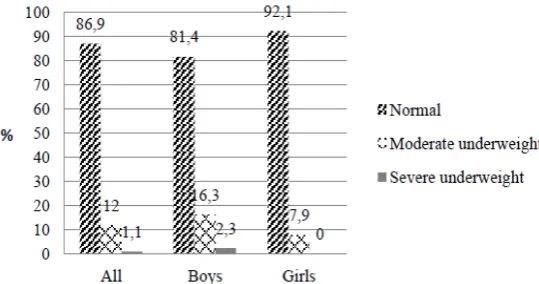
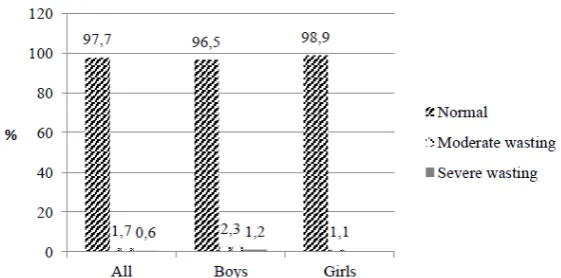
Most children had normal nutritional sta-tus. Mean WAZ, HAZ, and WHZ were in normal range (-0.8±1.1, -1.0±1.1 and -0.1±1.1 respec-tively). Girls had slightly better nutritional status than boys (Figures 1, 2 and 3). Mean hemoglobin value was 9.6±1.1 g/dL. Most children were ane-mic (88.6%).
Nutritional status of children aged 6-8 months in Jonggat was good, except for under-weight prevalence (Figure 1) which was still a medium public health problem according to
WHO classification. According to PSG 2010,
Jonggat sub district had medium prevalence of underweight and high prevalence of stunting
among children under five years (19.24% and
34.72% respectively). In Riskesdas (Kemenkes 2007), Indonesia had medium prevalence of un-derweight (18.4%), high prevalence of stunting (36.8%) and high prevalence of wasting (13.6%)
among children under five years. The prevalence
of underweight, stunting and wasting among children aged 6-8 months in this study was below those data. According to Shrimpton et al. (2001),
Figure 1. Proportion of underweight children aged 6-8 months
child growth faltering starts at 3 months of age although the z-score still normal.
Anemia prevalence of children aged 6-8 months in this study was high (88.6%). This re-sult was higher compared to SKRT 2011 which was 64.8% for children aged 6-11 months (Ba-litbangkes 2011). Since adequacy of food intake was not assessed, this might be associated with illness. The prevalence of illness among the sub-jects within last two weeks was high as about three quarter of them had illness history within last two weeks.
Food intake
Mean energy intake from food and breast-milk was 625.5 + 153.9 kcal. Healthy, breastfed infants aged 6-8 months need approximately 615 kcal/day (Dewey & Brown 2003). Therefore, ac-tual energy intake of children in this study was adequate.
In developing countries, average breast-milk energy intake is 413 kcal/day at 6-8 months (Brown et al 1998). Energy needs from comple-mentary foods are estimated by subtracting ave-rage breast milk energy intake from total energy requirements at each age. The energy needs from complementary foods for infants with “average” breast milk intake in developing countries are ap-proximately 200 kcal per day at 6-8 months of age. In this study, average energy intake from complementary food was 220.8 + 153.6 kcal. Major source of energy was from rice (porridge or mashed) and commercial baby porridge. The actual energy intake from complementary foods in this study was adequate.
Child illness
There were 72.6% children who had illness within the last two weeks before the interview. Among these children, 62.2% had respiratory symptoms, 15% had gastrointestinal symptoms,
16.5% had fever only, 0.8% had respiratory and gastrointestinal symptoms and 5.5% had other symptoms. About half of them were brought to
health officers, less than 10% was brought to non-health officers (including traditional healers
and traditional birth attendance) and 35% was not brought to seek any healthcare.
Child feeding pattern may contribute to the high incidence of respiratory and gastroin-testinal symptoms among these children. Duijts
et al. (2010) found that prolonged and exclusive
breastfeeding was significantly associated with a
reduction of respiratory and gastrointestinal in-fection among infants. Complementary feeding
at earlier age was significantly associated with
increased risk for respiratory infection (Kalanda
et al. 2006).
Mother’s knowledge and practice on child feeding
Most mothers had poor knowledge and practice on child feeding (68.0% and 75.4%, respectively) as they had score less than 12 and 14 respectively. Most mothers knew that breastmilk should be given until two years or more (81.7%). Most of them also knew appropriate meal frequency for age 6-8 months (90.3%) and 9-24
months (77.7%), but only one fifth of them knew
that appropriate food consistency for age 6-8 months is soft food (20.6%). Most of them knew that child needs snacks (86.3%) and almost all
knew that breastfeeding during illness had benefit
for child (98.2%). All mothers didn’t know about “Triguna Makanan”.
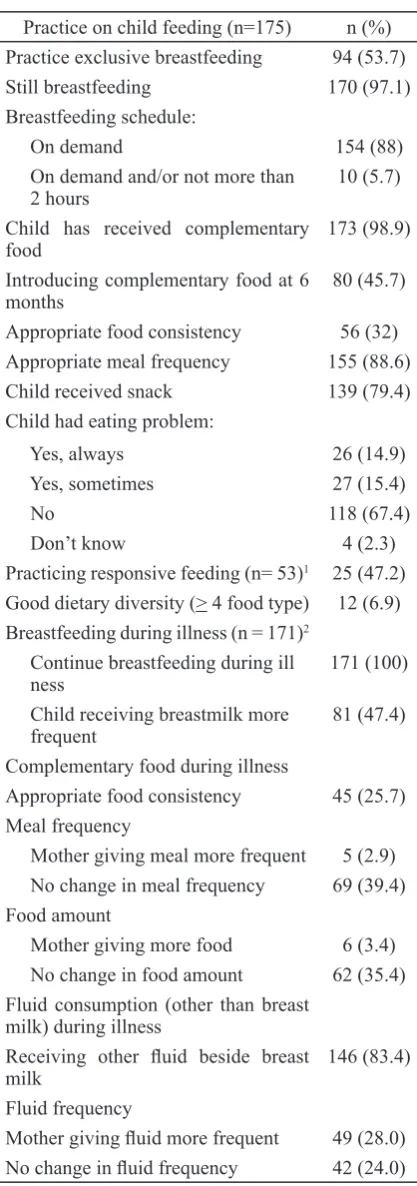
Mother’s practice on child feeding is presented in Table 1. Almost all mothers were still breastfeeding (97.1%). They breastfed on demand (88%). Almost all children had received complementary food (98.9%), but only less than a half children were introduced to complementary food at the appropriate age i.e. 6 months (45.7%).
106 J. Gizi Pangan,Volume 10, Nomor 2, Juli 2015
This is due to some of them were introduced earlier than 6 months, given pre lacteal food and a few were introduced later than 6 months. Only few children had good dietary diversity i.e. >4 food type in the previous day (6.9%). Only few mothers who gave food more often and more amount to their children during illness (2.9% and 3.4%, respectively).
Workload of mother
Approximately, one third of mothers were working (31.4%), while the others were only housewife (68.6%). Most of them worked as farmers (27%). The rest worked as teacher,
tra-der, weaver, and palm fiber craft woman.
Food for children was prepared mostly by mothers as well as feeding (96.4% and 95.8% respectively). If mother works, had to do house-work or had to leave the house for some neces-sity, more than one third (36.9%) had alternative caregivers to prepare food and/or feed the child. The alternative caregivers were grandmother/ grandfather (20.8%), father (6.5%), relatives (5.4%) and neighbors (1.8%).
Socio-cultural beliefs of mother
About one fifth of mothers (21.7%) had
food taboo for children >6 months. Mostly they believed that crackers may cause stomachache, loose stool or cough. Other taboos were egg, ba-nana and vegetables that were believed to cause stomachache. One of them also mentioned chick-en and jackfruit may cause fever.
Approximately, half of mothers (50.9%) avoid giving some food to their children due to health reason. Those foods were crackers, ice,
snack, fried food, hot food, fish, egg and food
containing monosodium glutamate (MSG). They thought crackers, snack, fried food and food
con-taining MSG can cause cough, egg and fish can
cause allergy, and hot food is not appropriate for children since it can cause stomachache.
As socio-cultural beliefs may influence
child feeding practice, mothers may have resis-tance in following proper feeding practices (Kan-nan et al., 1999). In this community we found several food taboos and some were good source of animal protein and micronutrients for children.
Information exposure
More than half of the mothers (52%) have been exposed to information related to child feeding practice. Most of them have been ex-posed to complementary feeding information
Practice on child feeding (n=175) n (%) Practice exclusive breastfeeding 94 (53.7)
Still breastfeeding 170 (97.1)
Breastfeeding schedule:
On demand 154 (88)
On demand and/or not more than 2 hours
10 (5.7)
Child has received complementary food
173 (98.9)
Introducing complementary food at 6 months
80 (45.7)
Appropriate food consistency 56 (32) Appropriate meal frequency 155 (88.6)
Child received snack 139 (79.4)
Child had eating problem:
Yes, always 26 (14.9)
Yes, sometimes 27 (15.4)
No 118 (67.4)
Don’t know 4 (2.3)
Practicing responsive feeding (n= 53)1 25 (47.2)
Good dietary diversity (> 4 food type) 12 (6.9) Breastfeeding during illness (n = 171)2
Continue breastfeeding during ill ness
171 (100)
Child receiving breastmilk more frequent
81 (47.4)
Complementary food during illness
Appropriate food consistency 45 (25.7) Meal frequency
Mother giving meal more frequent 5 (2.9) No change in meal frequency 69 (39.4) Food amount
Mother giving more food 6 (3.4) No change in food amount 62 (35.4) Fluid consumption (other than breast
milk) during illness
Receiving other fluid beside breast
milk
146 (83.4)
Fluid frequency
Mother giving fluid more frequent 49 (28.0)
No change in fluid frequency 42 (24.0)
Table 1. Child feeding practice of mothers
1 Subjects taken from those who had eating problem
2 Missing subjects due to child had stopped breastfeed
(86.8%). Nearly half of them have been exposed to information on complementary food
prepara-tion (49.5%). Only one fifth have been exposed
to information on healthy food during illness (20.9%). The sources of information mostly
were from health officer, cadre, mother and child
health (Kesehatan Ibu dan Anak/KIA) book and printed media (e.g. newspaper and magazine). Very few have received other information about complementary food products from electronic media and relatives.
Food availability
Staple food was the most unavailable food within the house in last year, as it was experi-enced by more than one third of mothers (38.9%), followed by animal protein (31.4%). The unavai-lability commonly happened during dry season or before harvest season. The household had several strategies to cope these problems, mostly was borrowing so they were in debt followed by re-ducing food intake.
Most mothers bought food from small shop near their house. Some foods also were bought from the market which was not too far. It could be reached by motorcycle or just walking. Some mothers also obtained food from self-production, mostly were staple food. The median expendi-ture for child food in a day was Rp 787.50 (0.0, 13205.0).
Saha et al. (2008) stated that household with better food security status will have better infant feeding practice. In this study we didn’t as-sess the association between food availability at home with practice on child feeding but we found that some mothers have ever experienced no food at home during last year. Most of them have ex-perienced no staple food at home. This is a seri-ous problem since staple food is main source of energy.
This food unavailability also may contri-bute to poor dietary diversity. Most children con-sumed less than four food types in the previous day. They were lacking in animal protein and fruits. Even we found some mothers only gave rice and salt to their children.
Factors associated with child feeding
There was no significant association
bet-ween food intake and nutritional status. This might be because we used 24 hour recall to as-sess food intake that represent the present intake, while indicators for nutritional status used in this study represent past and present intake (WAZ, HAZ, and WHZ).
Mother practice on child feeding was asso-ciated with food intake (p<0.05), higher practice score tend to have higher energy intake. Since this study only uses 24 hour recall to collect data on dietary intake, nutrient adequacy couldn’t be assessed.
Mother with higher education level will have better child feeding practice (Hendricks et al. 2006). In this study we didn’t found any as-sociation between mother’s education level and practice on child feeding, but we found there
was significant association between mother’s
education level and knowledge on child feeding (p<0.05).
Mother’s knowledge and practice on child
feeding can be influenced by mother’s education
level, information exposure and socio-cultural beliefs (Sellen 2001; Kannan et al. 1999). In this
study, no significant associations were found
bet-ween mother knowledge, mother workload, and mother education level with mother practice on child feeding. It was found that both knowledge and practice of mothers were poor as it was only one third of them who had score equal or more than 12 for knowledge and one quarter of them who had score equal or more than 14 for practice.
There was significant association between
mother education level and information exposure with mother knowledge on child feeding. Expo-sure to information on child feeding is important to improve mother’s knowledge and practice. This may be done through community based programmatic intervention and health services
(Caulfield et al., 1999). We found that mothers got information on complementary feeding
most-ly from health officers and cadres. This informa
-tion exposure had significant associa-tion with
knowledge on child feeding.
The child feeding program delivery in this area was not good enough. There was knowledge gap among program implementers, especially cadres because not all of them were trained. Pro-gram existence also depended on availability of fund. This made the program cannot be sche-duled regularly. On the other hand, only few mo-thers knew about child feeding program in the area resulted in low participation.
CONCLUSIONS
Stunting and wasting were low among children aged 6-8 months old in Jonggat sub district, but underweight among these children was a medium public health problem in the area. Mother’s knowledge and practice on child feed-ing within the transitional period in Jonggat sub district was poor.
There was no significant association
bet-ween food intake and nutritional status of
chil-dren aged 6-8 months old. Significant association
was found between mother practice on child
feed-ing and food intake. There were also significant
associations between mother education level and exposure to information with mother knowledge on child feeding.
It is recommended to improve mother’s knowledge and practice on food consistency based on age and preparation of complementary food through community based complementary feeding education in Posyandu. The campaign should use media like video to attract mothers,
also leaflet since the literacy rate in the area was
good.
REFERENCES
[Balitbangkes] Badan Penelitian dan Pengem-bangan Kesehatan, Kementerian Kesehat-an Republik Indonesia. 2011. Survei Ke-sehatan Rumah Tangga (SKRT). Jakarta: Badan Litbangkes.
Brown K, Dewey K, Allen L. 1998. Complemen-tary feeding of young children in
develop-ing countries: a review of current scientific
knowledge. Washington DC: World Health Organization.
Caulfield LE, Huffman SL, Piwoz EG. 1999. In -terventions to improve intake of comple-mentary foods by infants 6 to 12 months of age in developing countries: impact on growth and on the prevalence of malnutri-tion and potential contribumalnutri-tion to child sur-vival. Food Nutr Bull 20(2):183-200.
[Central Lombok District Health Office]. Cen
-tral Lombok District Health Office. 2010.
Pemantauan Status Gizi (PSG). Lombok Tengah: Central Lombok District Health
Office.
[Committee on Nutrition of American Academy of Pediatrics] 1980. On the feeding of sup-plemental foods to infants. Pediatrics 65 (6):1178-1181.
Dewey K. 2001. Guiding principles for comple-mentary feeding of the breastfed child. Washington DC: World Health Organiza-tion.
Dewey K. 2005. Guiding principles for feeding non-breastfed children 6-24 months of age. Washington DC: World Health Orga-nization.
Dewey KG, Brown KH. 2003. Update on tech-nical issues concerning complementary feeding of young children in developing countries and implications for intervention programs. Food Nutr Bull 24(1): 5-28. Duijts L, Jaddoe VWV, Hofman A, Moll HA.
2010. Prolonged and exclusive breastfeed-ing reduces the risk of infectious diseases in infancy. Pediatrics 126(1): e18-e25. Gibson RS. 2005. Principles of Nutritional
As-sessment. Second Edition. New York: Ox-ford University Press.
Hendricks K, Briefel R, Novak T, Ziegler P. 2006. Maternal and child characteristics associated with infant and toddler feeding practices. J Am Diet Assoc 106: S135-S148.
Kalanda BF, Verhoeff FH, Brabin BJ. 2006. Breast and complementary feeding prac-tices in relation to morbidity and growth in Malawian infants. Eur J Clin Nutr 60: 401-407.
Kannan S, Carruth BR, Skinner J. 1999.
Cultur-al influences on infant feeding beliefs of
mothers. J Am Diet Assoc 99(1):88-90. [Kemenkes RI] Kementerian Kesehatan
Re-publik Indonesia. 2007. Riset Kesehatan Dasar. Jakarta: Kemenkes RI.
Lwanga SK, Lemeshow S. 1991. Sample size determination in health studies, A practical manual. Geneva: World Health Organiza-tion.
Saha KK, Frongillo EA, Alam DS, Arifeen SE, Persson LA, Rasmussen KM. 2008. Household food security is associated with infant feeding practices in rural Bangla-desh. J. Nutr. 138(7):13831390.
Sellen DW. 2001. Weaning, complementary feeding, and maternal decision making in a rural East African pastoral population. J Hum Lact 17(3):233-244.
Shrimpton R, Victora CG, de Onis M, Lima RC, Blossner M, Clugstn G. 2001. Worldwide timing of growth faltering: implications for nutritional interventions. Pediatrics 107(5):1-7.