JURNAL HUBUNGAN INTERNASIONAL
VOL. 6, NO. 2, OKTOBER 2017-MARET 2018 https://doi.org/10.18196/hi.62116
Building Maritime Domain Awareness
as an Essential Element of the Global
Maritime Fulcrum: Challenges and
Prospects for Indonesia’s Maritime
Security
I Gusti Bagus Dharma Agastia; Anak Agung Banyu Perwita
School of International Relations President University
Cikarang, West Java, Indonesia [email protected]
Submitted: 11 January 2018; Accepted: 16 March 2018
Abstrak
Poros Maritim Dunia menjadi landasan penting politik luar negeri dan dalam negeri Indonesia pada masa kepemimpinan Presiden Joko Widodo. Indonesia dibayangkan sebagai kekuatan maritim regional yang mampu menjaga keamanan di wilayah maritimnya sendiri dan wilayah Indo-Pasifik. Ini menunjukkan ambisi Indonesia yang menginginkan peningkatan ekonomi dari sektor maritim. Poros Maritim Dunia bentukan Presiden Joko Widodo telah berjalan selama tiga tahun. Meskipun dapat dilihat pembangunan secara fisik yang luar biasa, akan tetapi pembangunan kesadaran maritim atau MDA masih kurang diperhatikan. Sebagai dasar dari kebijakan maritim, menjadi penting bagi Indonesia untuk memastikan kapasitas pembangunan MDA yang memadai guna memberikan arah pemangku kepentingan dalam mengalokasikan dan memprioritaskan sumber daya. Tulisan ini membangun sebuah kerangka MDA untuk mengevaluasi pembangunan MDA Indonesia di tiga level: strategis, operasional, dan teknis. Kerangka ini mengidentifikasi tiga permasalahan, antara lain kurangnya kapasitas untuk mengadakan operasional MDA yang berkelanjutan, kurangnya koordinasi antar agensi, serta permasalahan pemahaman mengenai kemaritiman. Pada bagian akhir, tulisan ini memberikan beberapa rekomendasi yang bertujuan meningkatkan kapasitas Indonesia untuk membangun MDA. Kata kunci:Kewaspadaan Lingkungan Maritim, Poros Maritim Dunia, kebijakan maritim Indonesia, keamanan maritim, pembangunan angkatan laut.
Abstract
The Global Maritime Fulcrum has been an essential cornerstone of Indonesian foreign and domestic policy for the Joko Widodo administration. It envisions Indonesia as a regional maritime power capable of providing maritime security within its territorial waters and the Indo-Pacific region. It also captures Indonesia’s ambition to boost its maritime economy. The Joko Widodo administration has been building the Global Maritime Fulcrum for three years. Though physical development has indeed been remarkable, there has been a lack of a focus on developing maritime domain awareness or MDA. As an essential foundation of maritime policy, it is important that a state invests in ensuring adequate MDA-building capacities to guide its maritime policy. Without proper MDA, it would be difficult for maritime stakeholders to allocate and prioritise maritime resources to the key areas of concern of the Global Maritime Fulcrum. This paper constructs a framework of MDA, which is used to examine the issues with Indonesia’s MDA-building process at three levels: strategic, operational, and technical. It identifies three issues, namely a lack of capacity to conduct sustained MDA operations, a lack of inter-agency coordination, and the problem of maritime ‘sense-making.’ Several policy recommendations aimed at increasing Indonesia’s capacity to build MDA are proposed at the end.
INTRODUCTION
Since 2014, President Joko Widodo proposed Indonesia as being a centre of maritime and economic activity in the Indo-Pacific due to its lucrative geostrategic position in global maritime trade. At the 9th East Asia Summit, Joko Widodo iterated the five
pillars of the Global Maritime Fulcrum (GMF), which includes maritime culture, economy, infrastructure, diplomacy, and defence. In the 2017 Indonesian Ocean Policy document, the initial five pillars have been reiterated and expanded to include (1) marine and human resources development, (2) maritime security, law enforcement, and safety at sea, (3) ocean governance and institutions, (4) maritime economy development, (5) sea space management and marine protection, (6) maritime culture, and (7) maritime diplomacy. An additional six principles on which the Ocean Policy will be carried out on, which includes
(1) Wawasan Nusantara (Archipelagic Outlook), (2)
sustainable development, (3) blue economy, (4) integrated and transparent management, (5) participation, and (6) equality and equitability (Indonesian Ocean Policy (Presidential Decree of the Republic of Indonesia no. 16/2017), 2017).
The overall goals of the GMF are strategic and economic in nature (Agastia and Perwita, 2015).
Jokowi’s GMF envisions the Indonesian Navy (TNI
-AL) as being a regional green-water navy capable of handling security threats within and beyond Indonesian territorial waters. Upholding maritime security is an essential prerequisite for the fulfilment of the latter pillars, which are largely economic. The economic goals work at both the domestic and international level. These ambitions are reflected in
Joko Widodo’s ambitions in creating a ‘sea highway’
(tol laut), which comprises of large vessels capable of transporting large amounts of cargo and people. The end goal at the domestic level is to accelerate and ensure equal economic development across the archipelago by increasing inter-island connectivity.At the regional level, accelerating development of domestic maritime infrastructure is expected to better link Indonesian ports and harbours with international maritime trade routes and sea lanes of communication (SLOCs), particularly those spanning the Indo-Pacific.
Seeing these ambitions, there is an urgency for Indonesia to improve its maritime domain awareness (MDA) capabilities. For the purposes of this paper, the concept of MDA generally refers to having a comprehensive understanding of the maritime environment, which encompasses the physical/material and immaterial aspects such as (but not limited to) maritime traffic, geography, legal jurisdictions, and extent of maritime territory. From that understanding, maritime stakeholders allow the formulation of tactical/technical, operational, and strategic decisions as a means to further the national interest. Without proper MDA, it would be difficult for stakeholders to prioritise and allocate maritime resources to the key areas of concern of the GMF. As an illustration, constructing a sustainable maritime economy through fisheries would be difficult if those fisheries are not monitored adequately. The stakeholders would need to be able to monitor for potential violations – e.g. illegal fishing, use of prohibited fishing methods, etc. – and ensure adequate enforcement. These activities require extensive MDA capabilities which Indonesia continues to lack.
Marsetio has emphasised the importance of
developing Indonesia’s MDA capabilities due to
Indonesia’s geopolitical position (Marsetio, 2014, pp.
55-57). Indonesia is situated between the Indian and Pacific Ocean which hosts some of the world’s most important maritime trade routes. Some areas of
interest in Indonesia’s vicinity include the Malacca
Strait, a crowded and narrow maritime sea lane of communication that is prone to piracy and armed robbery; the contested South China Sea, which over the years has seen simmering tensions between China and claimant states; and the Sulu Sea, which has recently seen an increase in piracy incidents (Connelly, 2015; E. A. Laksmana, 2011).
Better MDA capabilities would allow Indonesia to formulate better maritime policy. Official documents tend to emphasise the end objectives of the GMF instead of the means for achieving the GMF. In the 2015 Defence White Paper, there are expectations to build a maritime surveillance system
elaboration on the specific details of implementation remain unclear (Defence Ministry of the Republic of Indonesia, 2015). The 2017 Indonesian Ocean Policy document also fails to elaborate the implementation of a possible maritime surveillance network that is necessary for building MDA capabilities. There is little mention of how the government intends on funding such a network, yet it emphasises the importance of being aware of the maritime domain. Furthermore, the document tells little of how Indonesia is expected to direct the thirteen agencies share varying degrees of authority in maritime security governance (Salim, 2015). While there seems to be consensus that Indonesia needs to increase its MDA capabilities as a requisite for fulfilling its maritime ambitions, a comprehensive framework or roadmap that combines analyses at the strategic, operational, and technical levels of MDA remains to be seen.
Thus, this paper argues that Indonesia’s naval
development requires a comprehensive understanding of MDA to achieve its fullest potential. While physical development is indeed necessary for Indonesia to become a regional maritime power, MDA – which is a fundamental strategic concept in maritime development – also need to be developed. The importance of developing MDA lies in its guiding and directive power over physical maritime assets. Without building proper MDA, maritime development risks progressing based on political whims rather than proper understanding of the maritime domain. In this paper, we propose a framework of building MDA. It seeks to illustrate the actors and objects in the MDA-building process at the technical, operational, and strategic level. Using the framework, it is then possible to (1) identify the limitations in the MDA-building process in Indonesia, and (2) provide recommendations to address these limitations in the MDA-building process.
CONCEPTUAL FRAMEWORKS
UNDERSTANDING MDA AS A CONCEPT
As with the term ‘maritime security’, maritime
domain awareness continues to spark debate over its exact definition (Bueger, 2015b). The differences in defining MDA usually stem from the context of its usage. Generally, there are three levels at which MDA
is understood. In the technical domain, MDA originates from the practice of identifying and targeting the naval opposition. ‘Awareness’ is often
limited to a vessel’s immediate surroundings or
‘maritime situational awareness’ (Watts, 2006).
Moving up to the operational level, MDA includes
‘sufficient capacity for sufficient surveillance and
awareness across particular sea areas.’ At the higher strategic level, MDA can be generally understood as the capacity for policy-makers to understand the maritime environment and its traditional and non-traditional security dynamics which may affect the state either directly or indirectly. As stated in the National Security Presidential Directive 41 (NSPD-41),
MDA is ‘…the effective understanding of anything
associated with the global Maritime Domain that could impact the security, safety, economy, or environment of the United States.’ (National Security
Presidential Directive NSPD-41/Homeland Security
auxiliaries – to achieve maximum utility of the sea in both domestic and foreign policy.
Possessing sufficient MDA entails three important benefits. Firstly, policymakers will be able to allocate appropriate maritime resources to key areas of maritime security. If intelligence at the operational and technical levels suggests a spike in pirate activities in a vital area, swift policy changes ought to be made as a response. The implementation of such decision may take form in the mobilisation of more naval or coast guard vessels, increased surveillance, or requesting assistance to an existing multilateral network. Second, sufficient MDA also means that policymakers know the limits of their naval capabilities, thus allowing them to not implement policies that are beyond their reach. It also allows policymakers to prioritise. If intelligence at the lower levels suggest a shortage in naval vessels and surveillance capabilities at the border areas, policymakers would then should not embark on policies that could leave maritime security compromised and instead consider options of fleet modernisation. Third, the policymakers will be able to understand trends and patterns in the maritime domain and adjust their policies to anticipate future trends to the best of their capacity.
A FRAMEWORK FOR MDA
In this section, we propose a comprehensive framework that shows how MDA can enable the
formulation and implementation of a state’s maritime
policy. Some terms used in the framework ought to be
elaborated. The ‘maritime domain’ is understood as a
three-dimensional maritime space, including the ‘areas
and things of, on, under, relating to, adjacent to, or bordering on a sea, ocean, or other navigable
waterway’ along with its both material and immaterial
features. Material features include, but are not limited to, features of maritime topography (particularly undersea and sea-level features), the presence of maritime vessels or infrastructure (offshore platforms, ports, harbours, etc.), and movement of maritime vessels within the maritime domain. This has been
illustrated aptly in Boraz’s interpretation of MDA as,
…finding the ships and submarines of friends and foes, understanding the entire supply chain of cargoes, identifying people aboard vessels, understanding the infrastructures within or astride the maritime domain, and identifying anomalies and potential threats in all these areas (Boraz, 2009, p. 141).
Yet, Boraz’s definition remains incomplete as it
does not fully regard the political aspect of the maritime domain. The states need to increasingly take heed of existing political and/or legal instruments which could be used to legitimise their utilisation of the maritime domain. Such instruments include the UN Convention on the Law of the Sea, COLREGS, the ISPS Code, or the 1995 UN Fish Stocks Agreement. As such, this framework adds an immaterial layer to the maritime domain which includes the political-legal aspects that permeates the maritime domain which influences the way a state may decide to adjust their maritime strategy. These may include (but not limited to) acknowledgement and implementation (or lack thereof) of the international law of the sea within a particular
maritime domain, a state’s maritime boundaries and
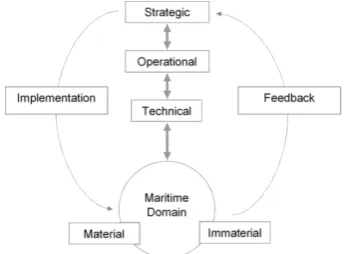
probable contestations, and the imposition of restricted zones in a specific maritime domain. By incorporating both material and immaterial factors of the maritime domain, a clearer and more
comprehensive ‘maritime image’ can be constructed,
resulting in better MDA (see Figure 1).
Figure 1: The Maritime Domain Awareness Building Loop
arise, the agency in question may act to counter the identified threat. The MDA process at this level is
simply being aware of one’s maritime surroundings
and acting based on that awareness. This level is mostly limited to the individual agency, such as the naval patrol vessel out at sea or coastal surveillance stations.
Moving up to the operational level or the middle rung of the ladder, the process of MDA-building becomes significantly more complex. The functions carried out at this level, in some ways, are similar to the technical level with an added layer of coordination and processing. Agencies at the operational level (henceforth, operational agencies) are concerned not only with the identification of
threats, but also prioritisation (‘Does this threat matter?’) and information gathering. To do this,
operational agencies have to consult the priorities set at the strategic level, until then deciding whether to act upon that threat through the available means. At this level, operational agencies need to be capable of understanding the extent of which the material and immaterial elements of the maritime domain may influence a particular decision.
One important task in MDA-building process at the operational level is the processing and compiling of information. As ships (both naval and civilian) at sea travel, operational agencies monitor their routes and receive reports and updates as they travel along their respective routes. At this level, the
broad term ‘information’ becomes significant. ‘Information’ can be differentiated into three broad
types: incidents, movements, and sensitive data such as naval intelligence or criminal investigations (Bueger, 2015a). Incidents at sea encompasses many instances, such as actual or attempted piracy, ship collisions, and transnational crimes. Information on movements allow the state to monitor its waterways and measure the volume of traffic. Sensitive data may be used to further pinpoint potential maritime threats. Combined together, this allows the operational agencies to construct a rudimentary
‘maritime image’ that incorporates trends and
patterns drawn from information on movements and incidents of maritime vessels within the specified maritime domain. One example includes results from
MDA information-sharing centres such as the ReCAAP ISP Annual Report, which reports on piracy incidents in Southeast Asia.
However, this ‘maritime image’ is not enough.
Amidst the cacophony of incident reports, movements, and sensitive information, operational agencies also need to fulfil a coordination and aggregation role. The collection of information on the maritime domain can hardly be conducted by a single agency; instead, many agencies – both military and civilian, government and non-government, national and international – are involved. The operational agencies are the ones who will coordinate these agencies so information-gathering activities at the technical level are directed towards a predefined agenda set at the strategic level. Sifting through these often complex networks and piecing together
meaningful information into a coherent ‘maritime
image’ is perhaps the most important task conducted
at the operational level.
The ‘maritime image’ constructed at the
operational level can further be refined and utilised at the strategic level. Policymaking requires the knowledge of the maritime domain gathered at the operational level, added with strategic analyses. Three core aspects of strategic MDA require understanding
and knowledge of (1) the state’s own maritime
capabilities, (2) the strategic utility of the maritime domain, and (3) the trends and patterns occurring in the maritime domain. Based on this knowledge, the strategic level then outlines the priorities for the
state’s maritime strategy. For example, if the trends
show an increase in activities related to piracy that
have a direct impact on a state’s maritime trade, at the
ANALYSIS
Once maritime strategy has been formulated, it is then implemented into the maritime domain. The state then continues its usual MDA-building loop, by which it also evaluates the changes in the maritime domain caused by the implementation of the maritime strategy. This feedback is collected either at the operational or technical level and then assessed at the strategic level. Thus, the state continues to adjust its maritime strategy according to its knowledge of the maritime domain.
Limitations to Build MDA in Indonesia
Three problems have been highlighted, namely (1) the lack of capacity to gather and process information, (2) lack of inter-agency cooperation and
coordination, and (3) lack of ‘sense-making’ resources.
Lack of Capacity to Gather and Process Information
At the operational and technical levels, creating
the ‘maritime image’ requires equipment such as naval
vessels, imaging technology, and information-sharing technology. There are thirteen agencies that are involved in safeguarding Indonesian waters and enforcing maritime security. However, these agencies often have to compete with one another for funding and resources. Some major agencies include the Navy, Marine Police (Polair), and Customs (Meliala, Ariando, Kusumo, Hartati, & Fatoni, 2016). The recently-established Maritime Security Agency (Bakamla) is also promising, however, it still suffers from a lack of equipment and manpower, for which it still needs to be dependent on the Navy (CNN Indonesia, 31 August 2016).
The Navy remains the most important actor in the MDA-building process, especially at the operational and technical level. Although the Navy is the most resourceful agency out of the thirteen maritime agencies, it still suffers from a lack of equipment. One of the primary tools in building MDA is naval vessels, as they can serve multiple roles. In building MDA, naval vessels serve the dual-role of defence and intelligence gathering. Currently, the Navy is struggling with both these roles. According to Minimum Essential Force (MEF) projections, the
Navy requires at least 154 vessels to maintain maritime security by 2024, with an optimal scenario of 274 vessels (Koh, 2015). To achieve MEF goals, Indonesia has been actively acquiring new naval vessels to replace its ageing fleet (Bakrie, 2009). In 2011, Indonesia signed a deal to purchase three Type-209 Chang Bogo diesel submarines from South Korean shipbuilding company, DSME (Afrida, 10 November 2016). In 2014, PT PAL and Damen Scheide Naval Shipbuilding (DSNS) agreed to jointly produce two Sigma guided-missile corvettes. The first vessel, the KRI Radden Eddy Martadinata, has completed sea trials in 2016 and has been handed over to the Navy in January 2017, while the second is expected to be handed over by the end of 2017 (ANTARA, 7 April 2017). The BAKAMLA has also placed an order for a 110m offshore patrol vessel (OPV), which is expected to bolster its capabilities as a Coast Guard (Rahmat, December 2016).
Commission recommended the naval base to independently carry out repairs as the radar was a vital piece of equipment (Parliament of Indonesia, 2011b). In another Working Visit in 2011 to Central Sulawesi, the Commission I found that the radar installed at the Palu naval base could only operate for two-thirds of a day and is heavily dependent on power supply from the state-owned power company. The Commission I also found that the base was undermanned, further limiting the capabilities of a naval base responsible for monitoring Archipelagic Sea Lanes II and III. (Alur Laut Kepulauan Indonesia; ALKI) (Parliament of Indonesia, 2011a).1 In a 2010
visit to Tanjung Pinang naval base, located near the Malacca Strait, Commission I found that the base only possessed one radar which operated 24 hours non-stop and was supplied by electricity from a generator. These conditions caused the radar to not operate at maximum efficiency. Commission I thus recommended to acquire more radar units and connect the existing radar to the national energy grid (Parliament of Indonesia, 2010).
The Navy also continues to struggle with logistical issues. Working Visit Reports by Commission I of the Parliament indicate the Navy has been struggling with limited fuel and energy supplies to sustain naval operations and a lack of manpower and vessels for various duties, including operating surveillance equipment and sea patrols. Soldier welfare was also found to be substandard, with reports of delayed remuneration and unsatisfactory living conditions within the base. In a 2009 Working Visit to Riau, Commission I found that the Tanjung Pinang Main Naval Base often faced fuel shortages,
which negatively affects the Navy’s operational
readiness (Parliament of Indonesia, 2009). The subsequent Specific Visit Report in 2010 provides the following details regarding the state of the Marines’ living standards on Nipah Island, one of the
outermost islands in Indonesia’s territory near
Singapore:
The barracks have been repaired, but the repairs are unsatisfactory. The walls are constructed from plywood or asbestos, and thus, the barracks could not be used as protective cover should an attack occur. The inside of the barracks was also very hot due to the low ceiling and lack of air
conditioning. There are no sources of clean drinking water. The soldiers drink distilled seawater, but according to lab results, the water does not meet healthy drinking water standards. Regular shipments of drinking water are dropped off from neighbouring areas using the Navy’s vessels or traditional vessels. […] Communications equipment are lacking and are heavily affected by bad weather. […] The SS1 rifles are in poor condition. Soldiers also do not possess means of transportation. The three motor boats are damaged and cannot be used. […] Daily meal allowances are considered inadequate, with each soldier only provided Rp 25,000 daily (around US$ 2). […] There are also no healthcare facilities. If a soldier falls ill, they have to wait for transportation to Batam either via Navy transport or fishing boat (Parliament of Indonesia, 2010, pp. 9-11).
Equipment and logistical issues mean that at the technical level, the MDA-building process occurs slowly and inadequately. Without quick and proper situational awareness, the Navy becomes severely limited in their capability to address potential maritime security threats. At the higher levels, this
delays the formation of a coherent ‘maritime image’
which has further impacts on policy. It then becomes even more difficult to envision an integrated maritime surveillance system using drones and satellites.
Lack of Inter-Agency Cooperation and Coordination
Building MDA ought to be a cooperative venture that involves many agencies within the government, smooth communication is essential so the many agencies can carry out their duties in a coordinated manner. A lack of coordination and cooperation may result in the production of a
distorted ‘maritime image’, which has ramifications in
the making of maritime policy. At the higher strategic level, the conflicting interests occurring at the operational-technical levels may potentially
undermine efforts to build a coherent ‘maritime image’.
Laut; BAKAMLA). Among these agencies, the Bakamla was formed to improve information-sharing between maritime stakeholders, along with the added authority to deploy maritime resources in line with its threefold mission of realizing national and international maritime security, safeguarding
Indonesia’s sovereignty, and strengthening Indonesia’s
maritime capabilities. Along with added authority, the Bakamla has also been equipped with additional personnel and vessels.2
Joko Widodo’s intent was to transform the
Bakamla into the equivalent of an Indonesian Coast Guard, capable of coordinating the twelve maritime security agencies. However, the agency has so far been powerless in breaking down institutional silos, which have persisted since the New Order and are exacerbated by internal competition and legal turf wars (Supriyanto and Rusdi, 2 January 2013). Friction tends to occur between the Navy, Customs, and Police due to the overlapping investigative authorities bestowed upon the agencies based on existing regulations. Each agency may claim jurisdiction over maritime law enforcement duties, which leads to less cooperation and a tendency to be involved in legal
‘turf wars. A potential clash of authority may occur
between the Bakamla, Navy, and Marine Police. Law no. 34/2000 provides the Navy with the authority to conduct maritime law enforcement operations within
Indonesia’s territorial waters and EEZ. The same
authority is also provided to Bakamla, in coordination with the Marine Police, under Presidential Regulation no. 178/2014 and Law no. 32/2014. Coincidentally, Law no. 32/2014 provides similar authority for the
Ministry of Transportation’s Sea and Coastal Unit
(Kesatuan Penjaga Laut dan Pantai; KPLP), the Ministry
of Fisheries’ Civil Service Investigations Unit, and the
Customs (Agastia, 2017). At the operational level, whose authority ought to supersede the other in the rare case these agencies meet simultaneously?
Ideally, there ought to be a single maritime security agency that can coordinate maritime security activities. At the moment, the Bakamla is being fitted to fulfil this role. A single coordinating agency would serve to eliminate institutional silos and redundancies, thus potentially reducing turf wars. The elimination of silos would greatly increase the effectiveness of
building MDA, as information gathering and sharing would be conducted under one umbrella. There would, however, be costs to bear before seeing the
Bakamla as the single coordinator of Indonesia’s
maritime security. Setting up such a mechanism would require rigorous institutional and legal overhaul. Existing legislation would need to be
reviewed and revised to accommodate the Bakamla’s
new role, which means downsizing the less essential agencies (e.g. the Civil Service Investigations Unit of the respective Ministries) and integrating them into
the Bakamla’s structure. Institutional integration
would also need to take into account the Ministry of Defence It would take tremendous effort to bring together these agencies, and even more so to bridge existing differences.3
Seeing Through the Glass Darkly
The issue at the strategic level is that
policymakers tend to ‘see through a glass darkly.’ (Till,
2013, p. 338) It is difficult to predict future trends in an increasingly complex maritime domain, especially when the dynamics are ever-changing. Though there may be adequate information gathering measures at the operational and technical level, the information needs to be refined and analysed so that it can be turned into actionable intelligence that has direct influence on national maritime policy. In other words, at the strategic level, much of MDA activities centre
on ‘sense-making’, or refining the ‘maritime image’.
This includes mapping out trends and patterns and then using these trends and patterns as a basis for analysing existing maritime policies.
At the strategic level, the Indonesian Ocean Policy document serves as an umbrella document for the formulation of the GMF, but not the implementation. It has provided a definitive interpretation of the GMF
which envisions Indonesia as ‘a sovereign, advanced,
independent, strong maritime nation that is able to provide positive contribution for peace and security of the region and the world in accordance with its
national interest.’ (Indonesian Ocean Policy (Presidential
GMF, the document itself cannot be seen as a document that can unite existing programs under different ministries. It ‘codifies and fleshes out the
skeleton of the GMF’, but does little in other areas (E.
Laksmana, 23 March 2017). Firstly, it lacks a provision for the establishment of a central agency that has the power to control and coordinate the many maritime programs under the existing ministries. Secondly, the document provides little explanation as to how domestic programs will be linked to regional maritime security programs. In the case of MDA, not only is there little mention of the need for of domestic MDA capabilities, but also how Indonesian maritime security agencies can use existing multilateral MDA centres to achieve the objectives of the GMF.
Who would be able to shoulder the duty of
‘sense-making’? Till proposes the formulation of
maritime policy be aided by an ‘informed commentariat’. The commentariat would consist of
independent elements, ideally from academia/universities or civilian think-tanks. The scope of the commentariat in Indonesia, however, remains small (Till, 2015). Furthermore, interaction between maritime security stakeholders and the informed commentariat has been limited at best.
CONCLUSION
Throughout the course of Indonesia’s project
to achieve the Global Maritime Fulcrum, it has overlooked maritime domain awareness as a crucial enabler despite having made significant progress in physical naval development. We have elaborated the myriad problems that Indonesia has in building its maritime domain awareness capabilities. These problems are apparent at all levels – strategic, operational, and technical – and in many maritime security stakeholders, which include limited operational-technical capabilities due to lack of relevant equipment, incoordination between the prominent maritime security agencies, and a limited understanding of MDA at the strategic level. To address these issues, we propose several policy recommendations.
A major hurdle in establishing a common maritime image is a lack of coordination between the
many maritime stakeholders in Indonesia. A ‘hub
-and-spoke’ architecture would be an ideal structure for
organising Indonesia’s scattered maritime security
actors (Bueger, 2015a). The Bakamla has the largest potential to become a hub for MDA in Indonesia in coordination with the Coordinating Ministry for Maritime Affairs. As a hub, the Bakamla would act as a facilitator for cross-agency capacity building. It would be where the academic expertise should be collated. Supervising the work of the Bakamla would come under the duties of the Coordinating Ministry for Maritime Affairs. The foundations of such a system would be a robust intelligence-sharing network between the actors.
The creation of indigenous information fusion centres, with functions mirroring the IFC and ReCAAP ISC, may be a possible option for increasing
Indonesia’s MDA capabilities. These agencies should
ideally be independent, staffed with competent people, and have adequate links to other such centres in the region. In the Indonesian context, these centres ought to be government-run MDA centres run under a civilian-military partnership scheme. However, due
to the sheer extent of Indonesia’s maritime domain,
coupled with the many international interests present
in Indonesia’s surrounding waters, it becomes
important for Indonesia to look towards regional neighbours for their support through bilateral and multilateral initiatives. Existing initiatives tend to
focus much on Indonesia’s western waters, through
centres, Indonesia can also gain access to their facilities and foster regional cooperation in maritime security.
Considering the proximity of the regions in Southeast Asia, maritime security should be a regional concern with ASEAN members sharing the burden proportionately according to their respective capabilities. However, there are several issues that need to be addressed beforehand. In the realm of security, a trust deficit between governments -- and even more so for maritime security stakeholders -- is apparent (Poole, 2015, pp. 156-157). This inhibits effective cooperation and ultimately, seamless intelligence sharing that is fundamental for collective maritime security. However, there have been steps to address this trust deficit through more security cooperation initiatives. The ‘Our Eyes’ initiative, proposed by Defence Minister Ryamizard Ryacudu during the 11th ASEAN Defence Ministers Meeting,
should be a stepping stone towards further Indonesian involvement in building MDA. The initiative has been said to be limited for counterterrorism, however, it could serve as a starting
framework for better maritime intelligence sharing within ASEAN (Reuters, 12 October 2017).
In the end, to achieve the ambitions of the Global Maritime Fulcrum, Indonesia would need to seriously consider not only the physical aspect of maritime development, but also developing maritime domain awareness as an essential enabler for its
In Indonesian strategic planning, there are three vital sea lanes known as National Sea Lanes I, II, and III. These are
currently acknowledged as Indonesia’s archipelagic sea lanes
in accordance with UNCLOS. For further elaboration, see Sebastian, Supriyanto, & Arsana, 2015
2 This added authority distinguishes the Bakamla from its
predecessor, the Bakorkamla (Badan Koordinasi Keamanan Laut), which previously only served an information-sharing function. Personal correspondence with Colonel Salim, Chief of Operation Strategic and Tactic, Naval Operation and Training Service, TNI-AL, 12 December 2017. 3
Personal correspondence with Colonel Salim, 12 December 2017.
REFERENCES
Afrida, N. (10 November 2016). Indonesia to purchase three more submarines. Retrieved 13 November, 2017 from
http://www.thejakartapost.com/news/2016/11/10/ind onesia-to-purchase-three-more-submarines.html. Agastia, I. G. B. D. (2017). Small Navy, Big Responsibilities:
The Struggles of Building Indonesia's Naval Power.
AEGIS Journal of International Relations, 1(2), pp. 164-180.
Agastia, I. G. B. D., & Perwita, A. A. B. (2015). Jokowi’s
Maritime Axis: Change and Continuity of Indonesia’s
Role in Indo-Pacific. Journal of ASEAN Studies, 3(1), pp.
32-41.
ANTARA. (7 April 2017). Menhan resmikan KRI Raden Eddy Martadinata-331 [Defence Minister commissions KRI Raden Eddy Martdinata-331]. Retrieved 10
September, 2017 from
https://www.antaranews.com/berita/622852/menhan -resmikan-kri-raden-eddy-martadinata-331.
Bakrie, C. R. (2009). Defending Indonesia Jakarta: Gramedia
Pustaka Utama.
Boraz, S. C. (2009). Maritime Domain Awareness: Myths and
Realities. Naval War College Review, 62(3), pp.
137-146.
Bueger, C. (2015a). From Dusk to Dawn? Maritime Domain
Awareness in Southeast Asia. Contemporary Southeast
Asia, 37(2), pp. 157-182.
Bueger, C. (2015b). What is maritime security? Marine Policy,
53, pp. 159-164.
CNN Indonesia. (31 August 2016). Tak Punya Banyak Kapal, Bakamla Diminta Wiranto Koordinasi AL [Wiranto asks Bakamla to coordinate with Navy due to lack of vessels]. Retrieved 5 March, 2017 from
http://www.cnnindonesia.com/nasional/20160830185 406-20-154947/tak-punya-banyak-kapal-bakamla-diminta-wiranto-koordinasi-al/.
Connelly, A. L. (2015). Sovereignty and the Sea: President Joko Widodo's Foreign Policy Challenges.
Contemporary Southeast Asia, 37(1), pp. 1-28. Defence Ministry of the Republic of Indonesia. (2015).
Defence White Paper 2015 Jakarta: Defence Ministry of the Republic of Indonesia.
Febrica, S. (2017). Maritime Security and Indonesia:
Cooperation, Interests, and Strategies London: Routledge.
. Indonesian Ocean Policy (Presidential Decree of the Republic of Indonesia no. 16/2017). (2017). Jakarta: Coordinating Ministry for Maritime Affairs, Republic of Indonesia. Koh, S. L. C. (2015). What Next for the Indonesian Navy?:
Essential Force by 2024. Contemporary Southeast Asia,
37(3), pp. 432-462.
Laksmana, E. (23 March 2017). Indonesian Sea Policy: Accelerating Jokowi's Global Maritime Fulcrum? Retrieved 12 December, 2017 from
https://amti.csis.org/indonesian-sea-policy-accelerating/.
Laksmana, E. A. (2011). The enduring strategic trinity:
explaining Indonesia's geopolitical architecture. Journal
of the Indian Ocean Region, 7(1), pp. 95-116.
Marsetio. (2014). Sea Power Indonesia Jakarta: Indonesia
Defence University Press.
Meliala, A., Ariando, M. K., Kusumo, J., Hartati, D., & Fatoni,
A. H. (2016). Kompendium Keamanan Laut Buku II:
Profil Pelaku Keamanan Maritim Praktik-Praktik Terbaik Negara [Maritime Security Compendium Book II: Profile of Maritime Security Actors and State Best Practices]
Jakarta: International Organization for Migration. . National Security Presidential Directive NSPD-41/Homeland
Security Presidential Directive HSPD-13. (December 2004). Washington D.C.: The White House.
Parliament of Indonesia. (2009). Laporan Kunjungan Kerja
Komisi I DPR RI dalam Reses Masa Persidangan I Tahun Sidang 2009-2010 ke Provinsi Kepulauan Riau tanggal 8-11 Desember 2009 [Report of the Working Visit of Commission I of the Parliament to the Riau Province, 8-11 December 2009]. Jakarta: Parliament of Indonesia.
Parliament of Indonesia. (2010). Laporan Kunjungan Spesifik
Komisi I DPR RI ke Pangkalan Utama TNI Angkatan Laut IV/Tanjungpinang, Provinsi Kepulauan Riau tanggal 10-11 Desember 2010 [Report of Specific Visit of
Commission I of the Parliament to Tanjungpinang Main Naval Base, 10-11 December 2010]. Jakarta: Parliament of Indonesia.
Parliament of Indonesia. (2011a). Laporan Kunjungan Kerja
Komisi I DPR RI dalam Reses Masa Persidangan I Tahun Sidang 2011-2012 ke Provinsi Sulawesi Tengah tanggal 8-10 November 2011 [Report of the Working Visit of Commission I of the Parliament to the Central Sulawesi Province]. Jakarta: Parliament of Indonesia.
Parliament of Indonesia. (2011b). Laporan Kunjungan Kerja
Komisi I DPR RI pada Reses Masa Persidangan IV Tahun Sidang 2010-2011 ke Provinsi Riau tanggal 25-27 Juli
2011 [Report of the Working Visit of Commission I of the Parliament to the Riau Province, 2010-2011]. Jakarta: Parliament of Indonesia.
Poole, A. (2015). The Foreign Policy Nexus: National Interests, Political Values and Identity. In C. B. Roberts, A. D. Habir & L. C. Sebastian (Eds.),
Indonesia's Ascent: Power, Leadership, and the Regional Order. Hampshire, UK: Palgrave Macmillan.
Rahmat, R. (December 2016). Indo Defence 2016: PT Palindo discloses further details of 110 m vessel on
order for BAKAMLA. Jane's Defence Weekly, 121(10)
Reuters. (12 October 2017). Indonesia to propose new ASEAN intelligence sharing to track militants. Retrieved 13 December, 2017 from
https://www.reuters.com/article/uk-malaysia-defense- patrol/indonesia-to-propose-new-asean-intelligence-sharing-to-track-militants-idUKKBN1CH1JJ.
Salim. (2015). A Pathway to Indonesia's Maritime Future: The
Role of Maritime Policy, Doctrine, and Strategy
Yogyakarta: Leutikaprio.
Sebastian, L. C., Supriyanto, R. A., & Arsana, I. M. A. (2015). Beyond the Archipelagic Outlook: The Law of the Sea, Maritime Security and the Great Powers. In C. B. Roberts, A. D. Habir & L. C. Sebastian (Eds.),
Indonesia's Ascent: Power, Leadership, and the Regional Order. London: Palgrave Macmillan.
Supriyanto, R. A. (2017). Naval counter-piracy in Indonesia.
In C. Liss & T. Biggs (Eds.), Piracy in Southeast Asia:
trends, hot spots, and responses. London: Routledge. Supriyanto, R. A., & Rusdi, S. (2 January 2013). Maritime
Security Agencies in Indonesia: More Not Merrier.
RSIS Commentaries. Retrieved.
Till, G. (2013). Seapower: A Guide for the Twenty-First Century
London: Routledge.
Till, G. (2015). Indonesia as a growing maritime power:
possible implications for Australia. Soundings(4)
Watts, R. B. (2006). Implementing maritime domain awareness