Ethnobiological Study of
Larung Sembonyo
Ceremony in Watulimo District,
Trenggalek as a Basic of Ecotourism Planning
Zulfaidha Zulia
1, Jati Batoro
2, Bagyo Yanuwiadi
21
Master Program of Environmental Sciences, University of Brawijaya, Malang, Indonesia 2
Department of Biology, Faculty of Mathematics and Natural Sciences, University of Brawijaya, Malang, Indonesia
Abstract
This research aims to describe the ritual plant species and types of offerings that are used in Larung Sembonyo
ceremonies and to know the community's role in the conservation of ritual plants. Plant diversity and utilization survey were conducted by semi-structured and structured interviews to the informant. The selection of informants was using snowball sampling technique. Data was analyzed descriptively with ICS and FUVs index. The results of the study found 38 species of Larung Sembonyo ritual which is divided into 23 families. Types of offerings are used in Larung Sembonyo ceremony as much as 31 types, each of which has its own meaning. The 10 highest Value Index of Cultural Significance (ICS) of LarungSembonyo ceremonial plant is Oryza sativa L., Oryza glutinosa, Cocos nucifera L., Musa paradisiaca L.,
Pandanus amaryllifolus Roxb., Piper battle L., Aliumcepa L., Alium sativum L. and Manihot esculenta Crantz. The five highest Family Values Use (FUVs) were occupied by Family Arecaceae, Euphorbiaceae, musaceae, Solanaceae and Poaceae. The higher FUVs the more uses and utilization of these plants in a ritual ceremony Larung Sembonyo. Karanggongso community has indirect conservation efforts on plants that are used for rituals. The conservation efforts were carried out by planting crops in the garden, home yard, even in the woods. The concept of management mostly still uses traditional knowledge. The LarungSembonyo has special value to integrates in ecotourism development planning. Larung Sembonyo has special uniqueness which are able to attract visitor.
Keywords: Conservation, FUVs, ICS, Larung Sembonyo.
INTRODUCTION*
The tourism sector has been predicted to be the largest industry in the world at 21st century. Tourism sector will increase world revenues and require much labor. Tourism industry is one of main sector in Indonesia, because Indonesia has a lot of natural beauty and culture that has the potential to be introduced to the world. Recently, Indonesia's tourism sector is more concentrated in tourism based of ecotourism. Ecotourism will be an interesting concept becaused that do not only tourism activity but also environmental conservation at the same time to tribute the local culture [1]. Assets that become favored tourist attractions today is the local wisdom. Local knowledge is the main attraction for tourists are getting fed up with the kind of tour there. Tourism based on local wisdom is very dependent on a particular comunities. Local knowledge can be packed into the unique cultures such as knowledge society, belief systems, cultural rituals and ceremonies.
*Correspondence address:
Zulfaidha Zulia
Email : [email protected]
Address : Graduate School University of Brawijaya, Mayjen Haryono 169, Malang 65145
Tourism will not be formed without culture. If an area wants to promote tourism, it should promote the culture in the destination [2].
Forms of local wisdom a society which is dealing in tourism development can be seen in Sekaten ceremony in Yogyakarta. Sekaten celebration is a tradition to commemorate the birth of Prophet Muhammad. There are three activities related to Sekaten tradition are: The exit of Gamelan Kanjeng Kyai Gunturmadu and Kanjeng Nagawilaga, Garebeg Maulud and Sekaten crowd [3]. The government makes Sekaten Yogyakarta as a tourist attraction because of the ceremony managed to give a special attraction for tourists. In fact, most tourist arrivals in Maulud coincided with Sekaten. Thus Sekaten tradition is strongly support the development of tourism in Yogyakarta.
One tradition that has the potential to support the development of tourism in Trenggalek is a traditional ceremony Larung Sembonyo. Larung Sembonyo ceremony is
hereditary community of Karanggongso,
Tasikmadu Village, Watulimo District, Trenggalek
Regency. Larung Sembonyo ceremony use as
gratitude to God. In addition, Larung Sembonyo
ceremony is a means of honoring ancestors who
[50] J. Ind. Tour. Dev. Std., Vol.5, No.1, January 2017 ceremony has strong related with ethnobotany.
Ethnobotany is the science that examines the perception and public knowledge about how to use plant species [4]. In addition to providing benefits, plants require human action as one form of conservation. Cultures that exist within a region will indirectly bring people to always maintain and preserve the existing sections it. This research is important to know the types of plants used for ceremonies, and to analyze the community knowledge about the value and meaning of plant species.
RESEARCH METHOD
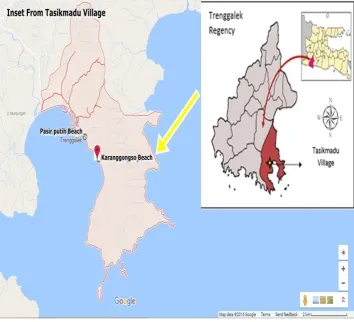
This research was conducted in the Karanggongso beach, Tasikmadu Village, District of Watulimo, Trenggalek Regency. Karanggongso is one Tasikmadu hamlet in the village, so that jurisdiction contained in Tasikmadu Village. Geographically, the village located on coodinates 8o17’43"S - 8o24'25"S to 111o44’8”E - 111o45’08”E. Tasikmadu Village has area about 2.846 ha. The Tasikmadu Village located in coastal Prigi has three main tourism sites: Prigi Beach, White Sand Beach and Karanggongso Beach (Fig. 1).
Plant Species Diversity Survey
Survey conducted by the diversity of plant species recorded at the same time documenting plants recognizable. When they find plants that are not known, the first step taken is to ask local people about the local name of the plant [5]. Further, when the unknown type, the plant was documented as a herbarium. Result from documentation was identified using the book Flora of Java.
Plant Utilization Survey
Stages of plant utilization survey were conducted by semi-structured and structured interviews to key informants. Criteria informants are people who are experienced and know details about the Larung Sembonyo ritual. Limitation of informants in this study is already married, because at that age a person can receive social conditions. To reduce the Subjective factors, interviews conducted at least twice. Related to that, qualitative research is particularly vulnerable of the subjectivity [6].
Analysis of Plant Utilization
Analysis of plants utilization is done by using Significant Cultural Index (ICS) and Family Use Values (FUVs). ICS is the result of Ethnobotany analysis that shows the values of the interests of each species based on its role in society. The Data is taken from interviews with informants. The Cultural Significance Index was calculated using following formula [7]:
ICS = Σ (qx I xe) ni, i = 1
Description:
ICS = Utilization calculation of plant species, from one use to further use (n)
Q = Quality value; quality value calculated by giving a score or value to a plant species: 5 = staple food; 4 = food secondary/additional + primary material; 3 = other food stuffs + secondary + medicinal plant material; 2 = ritual, mythology, recreation and so forth; 1 = recognition
i = Intencity value: intencity illustrates the use of the plant species that are useful, 5 = very high intencity 4 = moderately high intencity; 3 = intencity moderate use; 2 = intencity low usage; 1 = intencity use is very rare
e = Exclusivity value; 1 = most preferred, and is the top choice; 2 = there are other plants as a most preferred choice; 3 = secondary sources or low utility value.
FUVs are used to determine the usefulness of each species based on the parts of the plant is
History of Larung Sembonyo ceremony
Larung Sembonyo ceremony derived from the existence of a history of Hindu Mataram Kingdom. Hindu Mataram kingdom had a great desire to expand the territory to the land of China. However, widening the area with war is feeling enough. Finally, the Hindu Mataram kingdom tries to expand the kingdom that is still in the jungle area. The royal Officials have planned to open forest and use it for settlement. The people from day to day were more and more and required wide space to accommodate the people.
Hindu Mataram kingdom sent a knight named Raden Tumenggung Yudonegoro who has trusted
to solve the problems in the kingdom. Mataram Hindu kingwas tasked Raden Tumenggung Yudenogero to open the southern region for a settlement. In this mission, King of the Mataram Kingdom sent 5 knights, i.e. Raden Tumenggung Yudonegoro, Raden Yahuda, Raden Yahudi, Raden Joyohadilogo and Raden Prawiro Kusumo. Raden Tumenggung Yudonegoro has successfully opened Pacitan and continued to open up the
area Sumbreng District of Munjungan.
Tumenggung Yudonegoro journey continues towards the East, but their journey was hampered because Tumenggung Yodonegoro entourage could not see this area. This is expressed into proverb "Meniko wono engkang gegirisi sapto molo sapto mati", that mean this area has been controlled by something that can get sick and die. In the end Tumenggung Yudonegoro conducted meditation in Goa Lowo to inquire of God. At the time meditation Tumenggung Yudonegoro had instructed was married to the daughter of the Queen South Coast named Putri Gambar Inten. Tumenggung Yudonegoro then approves the request and undertakes all the requirements of Putri Gambar Inten.
Until now, the requirements from Putri
Gambar Inten to Raden Tumenggung
Yudonegoro become a culture for the people of Karanggongso. The rituals or ceremonies were conducted each year by the people of Karanggongso. Larung Sembonyo ceremony is a coastal people activity as a form of gratitude to God for sustenance given. In addition, the aim of this event is to commemorate ancestors who have opened region of Prigi coastal. People of Karanggongso are mostly fishermen, so Larung Sembonyo activities initiated by the fisher
community. Larung Sembonyo in Karanggongso
ceremony led by indigenous leaders and village elders. The position of traditional leaders are Recognized hereditary ancestor from people of Karanggongso.
Larung Sembonyo ceremony in Karanggongso
Larung Sembonyo ceremony held on Monday or Saturday Kliwon in Selo month of Javanese calendar. Larung Sembonyo activity is largely
utilizing products from the region of
[52] J. Ind. Tour. Dev. Std., Vol.5, No.1, January 2017 materials such rituals to get it are not advisable
to buy in the market. Because people worrying the purity of the materials. According to the people, the materials used for the ritual should be a total purity. The people who are directly taking a part in the ceremony are required to take a shower.
Figure 2. Larung Sembonyo procession. a. The ritual offerings Carnival, b. Jodhang, c. The offerings are floated out to sea, d. Traditional Leader of Karanggongso
The event of Larung Sembonyo ceremony are
hajat pray, Campursari, float procession,
wayangan, and ruwatan (Fig. 2). Hajat pray was held on the evening before the float procession. The aim from hajat pray is to ask the Lord to
show protection Larung sembonyo ceremony can
run smoothly. In addition, the community expects all request granted by God. After that, the event continued with campursari art. In the event, traditional leaders and elders prepare the equipment ritual offerings for the ceremony next day. The ritual offerings required there are two kinds of offerings are floated to sea and offerings for ceremonial meal. Differences two offerings are on the Manten. Manten is a pair of dolls made from rice flour and shaped like a pair of bride. The entire ritual offerings that will be floated out to sea placed on jodhang.
Larung Sembonyo procession held at 9:00 pm. The event began with carnival ritual offerings brought from one of the community home to the
place event Larung Sembonyo ceremony.
Procession customary ritual offerings consist of a
indigenous leaders, jodhang, Kembar Mayang,
ambengan, and jaranan. The procession float out to sea was required before 12.00pm. If exceeded a predetermined time, the people believed there will be something undesirable. The indigenous leader Karanggongso will reciting incantations or petition before daunting offerings. Spells that contains named for tumenggung totaling 16 people along with his request.
Ritual Offerings
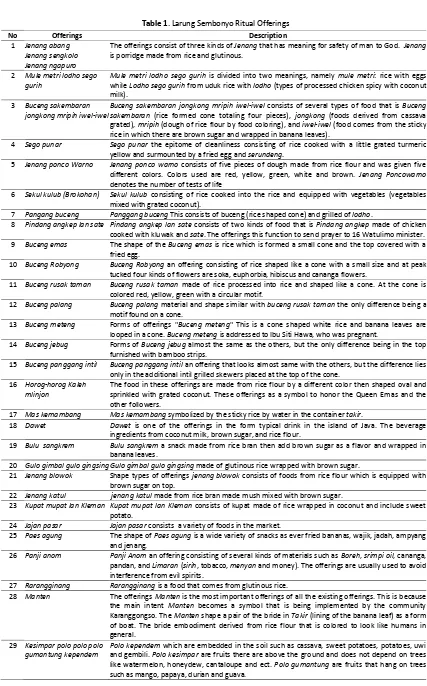
Overall 31 types of offerings are to be present in Larung Sembonyo ceremony, because each offering have a particular meaning and a purpose (Table 1, Fig. 3). The ritual offerings were symbolized Larung Sembonyo is Manten (Fig. 4). Other ritual offerings are complementary for Manten.
Manten is the offering has the pair of bride men and women are placed on Takir. Takir made of banana leaves is the embodiment of a boat. The pair of Manten made from rice flour dyed to look like a human. The embodiment of manten is rather like the original so that around the bride doll comes with Ripih. Ripih is a form that resembles various types of flowers. Also Ripih derived from rice flour dough. Manten which will be floated placed on jodhang and arrangement flanked by two bananas and Followed by cok bakal serta Panji anom. The offerings that will be floated out to sea on a later transferred to a boat made of banana stems and woven coconut (coconut leaves).
The offerings total is 30 pieces besides Manten is a complementary offering. However, its presence is very important in the ritual Larung Sembonyo. The offerings were classified Jenang-Jenangan means salvation. The people expect given the safety and go away from the evil.
Buceng shape is like a cone to the top. Buceng
made from rice meaningful things related to God. The people expects the ease and help from God. In addition Buceng is symbol as a means of human apology to his God. Sego punar is yellow rice that comes with a fried egg and serundeng.
Sego punar is symbol form the cleanliness of everything that is not good. Paes agung is the supreme form of offerings that consists of an assortment of snacks. For example: fried bananas, wajik, jadah, and jenang. Paes agung
serve as a means to ask the God to lengthen its age and dilapangkan sustenance. The use of
Table 1. Larung Sembonyo Ritual Offerings No Offerings Description
1 Jenang abang Jenang sengkolo Jenang ngapuro
The offerings consist of three kinds of Jenang that has meaning for safety of man to God. Jenang
is porridge made from rice and glutinous.
2 Mule metri lodho sego gurih
Mule metri lodho sego gurih is divided into two meanings, namely mule metri: rice with eggs while Lodho sego gurih from uduk rice with lodho (types of processed chicken spicy with coconut milk).
3 Buceng sakembaran jongkong mripih iwel-iwel
Buceng sakembaran jongkong mripih iwel-iwel consists of several types of food that is Buceng sakembaran (rice formed cone totaling four pieces), jongkong (foods derived from cassava grated), mripih (dough of rice flour by food coloring), and iwel-iwel (food comes from the sticky rice in which there are brown sugar and wrapped in banana leaves).
4 Sego punar Sego punar the epitome of cleanliness consisting of rice cooked with a little grated turmeric yellow and surmounted by a fried egg and serundeng.
5 Jenang ponco Warno Jenang ponco warno consists of five pieces of dough made from rice flour and was given five different colors. Colors used are red, yellow, green, white and brown. Jenang Poncowarno
denotes the number of tests of life
6 Sekul kulub (Brokohan) Sekul kulub consisting of rice cooked into the rice and equipped with vegetables (vegetables mixed with grated coconut).
7 Pangang buceng Panggang buceng This consists of buceng (rice shaped cone) and grilled of lodho.
8 Pindang angkep lan sate Pindang angkep lan sate consists of two kinds of food that is Pindang angkep made of chicken cooked with kluwak and sate. The offerings this function to send prayer to 16 Watulimo minister. 9 Buceng emas The shape of the Buceng emas is rice which is formed a small cone and the top covered with a
fried egg.
10 Buceng Robyong Buceng Robyong an offering consisting of rice shaped like a cone with a small size and at peak tucked four kinds of flowers are soka, euphorbia, hibiscus and cananga flowers.
11 Buceng rusak taman Buceng rusak taman made of rice processed into rice and shaped like a cone. At the cone is colored red, yellow, green with a circular motif.
12 Buceng palang Buceng palang material and shape similar with buceng rusak taman the only difference being a motif found on a cone.
13 Buceng meteng Forms of offerings "Buceng meteng" This is a cone shaped white rice and banana leaves are looped in a cone. Buceng meteng is addressed to Ibu Siti Hawa, who was pregnant.
14 Buceng jebug Forms of Buceng jebug almost the same as the others, but the only difference being in the top furnished with bamboo strips.
15 Buceng panggang intil Buceng panggang intil an offering that looks almost same with the others, but the difference lies only in the additional intil grilled skewers placed at the top of the cone.
16 Horog-horog Kaleh mlinjon
The food in these offerings are made from rice flour by a different color then shaped oval and sprinkled with grated coconut. These offerings as a symbol to honor the Queen Emas and the other followers.
17 Mas kemambang Mas kemambang symbolized by the sticky rice by water in the container takir.
18 Dawet Dawet is one of the offerings in the form typical drink in the island of Java. The beverage ingredients from coconut milk, brown sugar, and rice flour.
19 Bulu sangkrem Bulu sangkrem a snack made from rice bran then add brown sugar as a flavor and wrapped in banana leaves.
20 Gulo gimbal gulo gingsing Gulo gimbal gulo gingsing made of glutinous rice wrapped with brown sugar.
21 Jenang blowok Shape types of offerings jenang blowok consists of foods from rice flour which is equipped with brown sugar on top.
22 Jenang katul jenang katul made from rice bran made mush mixed with brown sugar.
23 Kupat mupat lan Kleman Kupat mupat lan Kleman consists of kupat made of rice wrapped in coconut and include sweet potato.
24 Jajan pasar Jajan pasar consists a variety of foods in the market.
25 Paes agung The shape of Paes agung is a wide variety of snacks as ever fried bananas, wajik, jadah, ampyang and jenang.
26 Panji anom Panji Anom an offering consisting of several kinds of materials such as Boreh, srimpi oil, cananga, pandan, and Limaran (sirih, tobacco, menyan and money). The offerings are usually used to avoid interference from evil spirits.
27 Rarangginang Rarangginang is a food that comes from glutinous rice.
28 Manten The offerings Manten is the most important offerings of all the existing offerings. This is because the main intent Manten becomes a symbol that is being implemented by the community Karanggongso. The Manten shape a pair of the bride in Takir (lining of the banana leaf) as a form of boat. The bride embodiment derived from rice flour that is colored to look like humans in general.
29 Kesimpar polo polo polo gumantung kependem
[54] J. Ind. Tour. Dev. Std., Vol.5, No.1, January 2017
No Offerings Description
30 Cok bakal Cok bakal offerings consist of all equipment or materials in the kitchen. The contents of Cok Bakal such as rice, coconut, banana, kembang telon (jasmine, flower, cananga and rose), onion, garlic, chili, brown sugar, tobacco, chew of betel, gantal (betel rolled and lace-up) , badheg
(water fermented from tape), eggs, pecans, kluweg, cigarettes, lighters, and money.
31 Kembar mayang Kembar Mayang is ubo rampen which comprises a pair made from janur (banana leaves), andong, banyan leaves, lancur or croton, debog (banana stem), Mayang (flower of pinang) and coconut amounted to 4 pieces. Kembar Mayang a symbol of hope and prayers to the family the course of a marriage ceremony.
Figure 3. The Ritual Offerings of Larung Sembonyo
Figure 4. The ritual offerings of Manten
Value Index of Cultural Significant (ICS) Related
to Larung Sembonyo ceremony
The use offerings of Larung Sembonyo
ceremony is not separated from the use of plants. Many types of plants are used as a symbol of ritual. There are 38 species of plants used in
LarungSembonyo ceremony. The plant is divided into 23 families. ICS analysis showed the value of a species in a particular culture. Thus, the higher the value of ICS that is owned by a particular species of plants is very closely shows its function in life [8]. ICS value is classified into five categories (Fig. 5): very high (>100), high (49-71), medium (26-48), low (3-25) and very low (0-2).
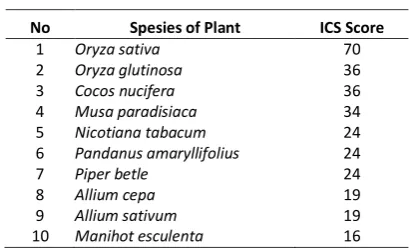
The Plants have been observed function will generate ICS value. Based on the calculation of the ICS value, there are top ten species of Larung Sembonyo (Table 2). Rice (Oryza sativa) is a ritual plant that has the highest value of ICS. The ICS
value rice is 70 (Table 2). The function of rice in
Larung Sembonyo ceremony is a major of food ingredient. The existence of rice cannot be replaced by other crops. This is because the rice has special meaning in the rituals in addition to functioning as a staple food. Rice for the Java people is considered as an incarnation from Dewi Sri, she is fertility and good fortune [9].
Figure 5. Category Value Index of Cultural Significant (ICS) of Ritual Plants Larung Sembonyo
The use of rice in the ritual offerings such as to Buceng (tumpeng), sego gurih, sego punar, basic materials of manten, basic ingredients of
jenang-Jenangan, complementary cok bakal,
brokohan, basic ingredients of traditionl snacks,
iwel-iwel, basic materials of horog-horog, basic materials of ripih and the basic material for
kupat. The demand for rice in Larung Sembonyo
is mostly become farmers. The agricultural sector is one of the main livelihoods for Watulimo District than as fisherman [10]. The Conservative measures are visible in Watulimo farmers are still applying Java calculation (Pratanamangsa) in planting. Pratanamangsa is a calendar simple, easy to implemented and used the natural phenomenon as a regulator of the growing cycle.
Table 2. Top ten ICS score
Family Use Values (FUVs)
Based on the FUVs calculation, Arecacea was the highest family with FUVs value (Table 3). The important Species that role in contributing to the highest value is the coconut (Cocos nucifera) and pinang (Areca catechu). Part of plant from Arecaceae family is widely used in the Larung Sembonyo ceremony include stems, leaves, flowers, fruits and seeds. Palm stems are used as firewood to process foods offerings. Coconut fruit used as food ingredients offerings. Coconut leaves (janur) and flowers (manggar) used for decoration kembar mayang in Larung Sembonyo
ritual. Manggar have meaning in a life that needs to consider the behavior [11].
The second family with the highest score of FUVs is the family Euphorbiaceae. The species that represent family Euphorbiaceae are croton (Codiaeum varigatum), Cassava (Manihot esculenta), Euphorbia milli and hazelnut (Aleurites moluccana). The organ plant which Karanggongso region, because cassava is very easy to be planted. Cassava survived for long drought and less water condition even without fertilizer. In addition, the cassava plant can be used as an alternative crop plants gap [12].
The third family with the highest FUVs
calculation is Musaceae. The species of this family grow wild around the yard or moor. In addition, many species Musaceae is growing wild in the woods. The species that represent this family are banana (Musa paradisiaca). Species of banana are often used in rituals are pisang raja
(Musa paradisisaca L. (aab Group) cv King), pisang kepok (Musa paradisiaca L.cv Kepok) and pisang kawak (Musa paradisiaca L. cv Kawak). Part of the plant used in Larung Sembonyo ritual is stems, leaves and fruit. Banana stems are used for the frame of the boat, and as a pedestal to
put puppets and Kembar Mayang. Banana leaves
to wrap offerings and as a place mat. While bananas as complementary offerings and processed into food such as fried bananas.
Table 3. Five Highest of FUVs Score No Plant Taxonomy FUVs Score
1 Arecaceae 4.7
surrounding community residences. The
Community to needs of the plants can take in the woods, yard, farm or field. The community use ritual of plants is classified as moderate. Rituals performed Karanggongso comunity is also not too much. But the community has indirect conservation action against the plants that are used for rituals or ceremonies by planting the crops in the fields, yards or even in the woods. Home gardens play an important role to support cultural aspect of the local community, especially through the availability of numerous plants in home gardens with its cultural function [13].
Larung Sembonyo as Tourism Attraction
Larung Sembonyo ceremony is potential as a tourist attraction in Trenggalek because in addition to bring the tourists in this area, it also keeps the existence of the culture. It becomes an effort to preserve local culture and local wisdom Tasikmadu particular. Because of cultural heritage and history is travel attractions culture as a tourist attraction of foreign and most effective media to provide concrete examples of the values and culture of the great work of the ancestors [14]. If the existence of a tradition maintained Larung Sembonyo will indirectly also
No Spesies of Plant ICS Score
6 Pandanus amaryllifolius 24
7 Piper betle 24
8 Allium cepa 19
9 Allium sativum 19
[56] J. Ind. Tour. Dev. Std., Vol.5, No.1, January 2017 conserve plants used in rituals. The local
community will try to keep these plants still exist around in the environment. Plants conservation can be done by planting ritual plants in around the yard, fields or forests. Shape preservation of local culture not only for environmental conservation manjaga but plays an important role for learning and education development everlasting, improved quality of life and show the best value owned by the public [15]. In addition, the traditional ceremony of float Sembonyo as one of the tourist sights can be used as a factor which supports the development of nautical tourism in the District Watulimo [16].
CONCLUSION
Larung Sembonyo is an activity of coastal community as a form of gratitude to God for sustenance given. In addition, this aims is to commemorate ancestors who have opened Prigi Gulf region. The event from Larung Sembonyo ceremony is sholat hajat, campursari, float procession, puppet and ruwatan. Plants used in paradisiaca L., Pandanus amaryllifolus Roxb.,
PiperbattleL., Alium cepa L., Alium sativum L. community has indirectly conservation efforts on plants that are used for rituals. The conservation efforts carried out by planting crops in the fields, yard, even in the woods. The concept of management is most still use pariwisata berbasis kearifan lokal (Studi di Kabupaten Manggarai Barat). Journal of Indonesian Tourism and Development Studies. 1(1), 28-37.
[3] Taryati. 2009. Nilai-nilai yang terkandung dalam perayaan Sekaten di Yogyakarta. Jantra 4(7), 506-522.
[4] Martin, G. J. 1995. Ethnobotany: a methods
manual. Chapman and Hall. London.
[5] Batoro, J. 2014. Pengelolaan lingkungan
dengan pendekatan Etnobiologi-Etnobo-tani. University of Brawijaya Press. Malang.
[6] Walujo, E. B. 2004. Pedoman pengum-pulan
data keanekaragaman flora. Bogor Research Center. Bogor.
[7] Turner, N. J. 1988. The importance of a rose: evaluating the cultural significance of plants in Thompson and Lillooet Interior Salish. Rouyal British Columbia Museum. British.
[8] Turner, N. J., M.B. Ignace. and R. Ignace. 2000. Traditional ecological knowledge and wisdom of aboriginal peoples in British Columbia. Ecological Aplications 10(5), 1275-1287.
[9] Purnomo. 2012. Tumbuhan kultural dalam
prespektif Adat Jawa: kajian aspek filosofi, konservasi, dan pemanfaatan tumbuhan dalam kultur dan tradisi Jawa. University of Brawijaya Press. Malang.
[10] Statistic Center of Trenggalek Regency. 2016. Statistik daerah Kecamatan Watulimo
2016. Available at: http://treng
galekkab.bps.go.id.
[11] Endraswara, S. 2006. Mistik Kejawen
Singkretisme, Simbolisme dan Sufisme. Narasi Publisher. Yogyakarta.
[12] Putri, W. K. 2016. Ethnobotanical survey of home garden in Pandansari and Sumberejo to support ecotourism program in Bromo Tengger Semeru National Park, Indonesia.
International Journal of Research in
Agricultural Sciences 2(1), 6-12.
[13] Hakim, L. 2014. Etnobotani dan manajemen
kebun-pekarangan rumah. Selaras
Publisher. Malang.
[14] Ridwan, M., A. Fatchan., and I. K. Astina. 2016. Potensi Objek Wisata Toraja Utara Berbasis Kearifan Lokal Sebagai Sumber
Materi Geografi Pariwisata. Jurnal
Pendidikan. 1(1) 1-10.
[15] Soeroso, A., and Y. S. Susilo. 2008. Strategi Konservasi Kebudayaan Lokal Yogyakarta. Jurnal Manajemen Teori dan Terapan I. 1(2), 144-161.
[16] Fadilah, S., and R. Suprihardjo. 2016. Pengembangan Kawasan Wisata Bahari
Kecamatan Watulimo, Kabupaten