Proceedings
INTERNATIONAL
CONFERENCE
ON CULTURE
AND LOCAL
WISDOM (ICCLW)
“ Globalization, National Culture, and Local Wisdom:
The Sustainability and Preservation of Culture
and Local Wisdom in Facing ASEAN Economic Community”
November 29-30, 2016
Grand Kanaya Hotel Medan, Indonesia
Reviewers
Keynote Speakers:Prof. T. Silvana Sinar, M.A., Ph.D.
Prof. Dr. Syahron Lubis, M.A.
Prof. Zainal Kling, Ph.D.
Prof. Rolando G. Talampas
Prof. Dr. Bambang Purwanto, M.A.
Prof. Zainal Kling, Ph.D. Prof. Rolando G. Talampas
Pham Van Thuy, Ph.D.
(UUM - Malaysia) (University of Philippines - PhilippinesEditors
Dr. Umar Mono, Dipl.Trans., M.Hum.
Rahmadsyah Rangkuti, M.A., Ph.D.
Muhammad Yusuf, S.Pd., M.A.
Aprilza Aswani, S.Pd., M.A.
Prof. Dr. Bambang Purwanto, M.A. Dr. Ridwan Hanafiah, M.A.Maridha Fitri, S.Pd.
(UGM - Indonesia) (USU - Indonesia)Pham Van Thuy, Ph.D. Prof. Pitch Pongsawat, Ph.D (Vietnam National University - Vietnam) (Chulalongkorn University - Thailand)
Organized by:
Faculty of Cultural Sciences, University of Sumatera Utara
PROCEEDINGS
International Conference on Culture and Local Wisdom (ICCLW)
―Globalization, National Culture, and Local Wisdom: T
he Sustainability and
Preservation of Culture and Local Wisdom in Facing ASEAN Economic Community‖
Grand Kanaya Hotel, Medan-IndonesiaTuesday-Wednesday, 29th – 30th November 2016
Reviewers
Prof. T. Sylvana Sinar, M.A., Ph.D.
Prof. Dr. Syahron Lubis, M.A.
Prof. Dr. Bambang Purwanto, M.A.
Prof. Zainal Kling, Ph.D.
Prof. Rolando
G. Talampas(USU-Indonesia)
(USU-Indonesia)
(UGM-Indonesia)
(UUM-Malaysia)
(University of Philippines-Philippines)
Pham Van Thuy, Ph.D. (Vietnam National University-Vietnam)
Editors
Dr. Umar Mono, Dipl.Trans., M.Hum.
Rahmadsyah Rangkuti, M.A., Ph.D.
Muhammad Yusuf, S.Pd., M.A.
Aprilza Aswani, S.Pd., M.A.
Maridha Fitri, S.Pd.
Organized by:
Faculty of Cultural Sciences
University of Sumatera Utara
Jl. Universitas Nomor 19 Kampus USU Medan 20155
USU Press
Art Design, Publishing & Printing
Building F, Center for Information Systems (PSI) Campus USU Jl. University No. 9
Medan 20155, Indonesia
Telp. 061-8213737; Fax 061-8213737
usupress.usu.ac.id
© USU Press 2016
These proceeding articles can be used, modified, and extended not for commercial purposes (non-profit) with a requirement not to change the author‘s attribute. Rewriting is not allowed without permission from the writers
ISBN 979 458 920 9
Perpustakaan Nasional Katalog Dalam Terbitan (KDT)
Proceedings International Conference on Culture and Local Wisdom (ICCLW) / Editor: Umar Mono; [et.al.] – Medan: USU Press, 2016.
ix, 317 p.: ilus.; 29 cm
ISBN: 979-458-920-9
1. National Culture I. Title
Dicetak di Medan, Indonesia
FOREWORD FROM THE CONFERENCE CHAIR
Praise be to Allah swt, the lord of the world, for the opportunity to host International Conference on Culture and Local Wisdom with the theme ―Globalization, National Culture, and Local Wisdom: The Sustainability and Preservation of the Culture and Local Wisdom in Facing ASEAN Economic Community‖ held on 29-30 November 2016 at Grand Kanaya Hotel Medan, Indonesia. This conference is organized by Faculty of Cultural Sciences, University of Sumatera Utara as a medium for promoting opportunity for the experts, researchers, scientists, lecturers, post-graduate students, to contribute their researches, ideas, concepts, and thoughts through their papers presented.
Firstly, let me extend my profound thanks to Rector of University of Sumatera Utara and also Dean of Faculty of Cultural Sciences for their support to make this conference exist. The conference and proceedings are tribute to a large group of people. Then, we express our gratitude to keynote speakers: Prof. Zainal Kling, Ph.D. (UUM- Malaysia), Pham Van Thuy, Ph.D. (Vietnam National University-Vietnam), Prof. Dr. Bambang Purwanto, M.A. (UGM-Indonesia), Prof. Rolando Talampas (University of Philippines-Philippines), Dr. Ridwan Hanafiah, M.A. (USU-Indonesia), and Prof. Pitch Pongsawat, Ph.D. (Chulalongkorn University-Thailand). There are 55 papers accepted to be published from various themes, namely (1) Language, Literature and Society, (2) Identity and Cultural Changes, (3) Religion and Political Culture, (4) Oral Tradition, (5) Globalization, Modernization, and Local Wisdom.
For all the reviewers, editors, and committee members, we do appreciate all your hard work to conduct this event. For all our distinguished presenters, guests and participants, thank you for your attendance and participation, without you all, this conference would be meaningless. We hope that all of you can get benefit from this conference, widen our connection and friendship, and we wish for your success in the future.
Best Regards,
Dr. Ridwan Hanafiah, M.A. Chair of ICCLW
FOREWORD FROM THE DEAN OF FACULTY OF
CULTURAL SCIENCES UNIVERSITY OF SUMATERA
UTARA
The International conference organized by Faculty of Cultural Sciences, University of Sumatera Utara under the theme ―Globalization, National Culture, and Local Wisdom: The Sustainibility and Preservation of Culture and Local Wisdom in Facing ASEAN Economic Community‖ is a strategic medium to discuss the existence of local wisdom. Recently, local wisdom grabs our deep attention in the perspective of anthropology, history, and culture. Multidiciplinary researches and conferences about it have been conducted in social sciences and humanities. And even, city government and state company have made agreement with university in facilitating to conduct researches related to local wisdom. And it becomes an intereseting theme and field among the researchers.
But, notwithstanding local wisdom becomes field of interest in research conducted by researchers in university, it hasn‘t become inspiration or reference in making a policy. Decision making is still executed by local elites without involving society members. Local wisdom regarded as containing moral values, togetherness, cooperation, and social structure based on local tradition which is still kept through generations is still far from the consideration of decision or policy making. Even though, it can empower social participation in policy making. If the participation of society incerases, local democracy will also be stronger.
The strengthening of local democracy is linked with a higher accommodation of the aspirations of the people, especially those related to human development. Human development is very strategic in sustaining the nation's competitiveness. A nation that is able to compete with other nations is a nation that concerns on human development especially if it has to face the globalization. If a nation wants to survive in the competitive world, it must strengthen human development. Currently, there is no nation is separated from the mainstream of globalization, including Southeast Asia. Globalization has not only covered Southeast Asia, but Southeast Asia is also currently running Asean Economic Community. In the Asean Economic Community (AEC), the capital and labor from one country could easily enter the other countries. If the labor‘s competitiveness of a country is weak, the skilled labor from other countries may displace local workforce. Enactment of the AEC in 2015 will bring structural changes in the region. Weak and unskilled nations in managing various aspects of life will not compete with other nations and it depicts the weakness of national identity.
Local wisdom can strengthen national identity. At the moment, none of the people can stay away from globalization. Strengthening local wisdom has a strategic role in the cultural management in order to become a strong nation. Nation‘s toughness is a major prerequisite approach towards AEC. By this toughness and strengthening local wisdom, undoubtedly, this nation will be able to compete in the AEC.
Konperensi internasional ini membentangkan makalah tentang local wisdom dan budaya dari berbagai perspektif di Indonesia, Vietnam dan Malaysia dan Filipina. Semoga seminar ini dapat menghasilkan pemikiran baru tentang kajian local wisdom dan perubahan budaya di Asia Tenggara. Last but not least, kepada Rektor Universitas Sumatera Utara yang memfasilitasi konperensi internasional ini diucapkan terima kasih.
This conference presents papers about local wisdom and culture from various perspectives in Indonesia, Vietnam, Malaysia, and Philippines. We hope that this conference can bring new perspectives about local wisdom studies and cultural change in Southeast Asia. Last but not the least, to the rector of University of Sumatera Utara who has facilitated this event, we thank you very much.
Regards,
Dean of Faculty of Cultural Sciences, University of North Sumatera
Dr. Budi Agustono
PREFACE
Praise be to God the Almighty who has given His Blessing and made the International Conference on Culture and Local Wisdom possible to be carried out. The conference with its theme ―Globalization, National Culture, and Local Wisdom: The sustainability and Preservation of Culture and Local Wisdom in Facing ASEAN Economic Community‖ organized by the Faculty of Cultural Sciences, University of Sumatera Utara is an opportunity for the experts, researchers, scientists, lecturers, post-graduate students, to contribute their researches, ideas, concepts, and thoughts through their papers presented. There are 55 full papers in the proceedings covering various themes, namely (1) Language, Literature and Society, (2) Identity and Cultural Changes, (3) Religion and Political Culture, (4) Oral Tradition, (5) Globalization, Modernization, and Local Wisdom. It is expected that the papers will broaden our horizon and enrich our knowledge.
We sincerely express our appreciation and thanks to the Faculty of Cultural Sciences, University of Sumatera Utara,and the committee members that have done their best in arranging and publishing the proceedings with ISBN.
We would also like to express our appreciation and thanks to our keynote speakers: Prof. Zainal Kling, Ph.D. (UUM- Malaysia), Pham Van Thuy, Ph.D. (Vietnam National University-Vietnam), Prof. Dr. Bambang Purwanto, M.A. (UGM-Indonesia), Prof. Rolando Talampas (University of Philippines-Philippines), Dr. Ridwan Hanafiah, M.A. (USU-Indonesia), and Prof. Pitch Pongsawat, Ph.D. (Chulalongkorn University-Thailand), the reviewers, speakers, and participants of this conference for your kind and active participation. We realize that this conference will not exist without your participation. We dream that this conferencewill be carried out yearly as aregular agenda of the Faculty of Cultural Sciences, University of Sumatera Utara. May this dream come true. Have a successful conference! May God Almighty bless us.
Editors
TABLE OF CONTENTS
FOREWORD FROM THE CONFERENCE CHAIR ... iii
FOREWORD FROM THE DEAN OF FACULTY OF CULTURAL SCIENCES
UNIVERSITY OF SUMATERA UTARA ... iv PREFACE ... v
TABLE OF CONTENTS ... vi
MUSLIM FILIPINO CULTURAL HERITAGE AND NATIONAL EFFORTS FOR ASEAN SOCIO-CULTURAL COMMUNITY BUILDING
Rolando G. Talampas ... 1
GLOBALIZATION, ECONOMIC DEVELOPMENT, AND ACCULTURATION IN VIETNAM SINCE THE 1986 ĐỔI MỚI
Dr. Pham Van Thuy ... 5
LANGUAGE CHOICE IN LOCAL POLITICAL PARTY COMMUNICATION: STRENGTHENING LOCAL IDENTITY THROUGH THE USE OF ACEHNESE LANGUAGE
Ridwan Hanafiah ... 12
CULTURAL IDENTITY AND CULTURAL CHANGE
Zainal Kling ... 17
A STUDY OF MANDAILING FOLKLORE AND ITS TRANSLATION
Syahron Lubis ... 27
LOCAL WISDOM of MERISIK in MELAYU LANGKAT SOCIETY : ORAL TRADITION STUDY
Rozanna Mulyani ... 33
AN ANALYSIS OF TRANSLATION TECHNIQUES IN THE ENGLISH VERSION OF
SEJARAH MEKAH
Dr. Muhizar Muchtar, M.S., Dr. Farida Repelita Waty Kembaren, M.Hum. ... 47
ACEHNESE UNIVERSITY STUDENTS‘ MULTIPLE INTELLIGENCE AND GLOBALIZATION
(A Case Study at Ar-Raniry State Islamic University Banda Aceh)
Mawaddah and Saiful Akmal ... 50
THE REVITALIZATION OF ADDRESSING WORDS IN DIALECT AGAM AND DIALECT PARIAMAN OF MINANGKABAU LANGUAGE IN MEDAN
Deliana ... 54
THE INFLUENCE OF TRANSLATION PROCEDURES AND IDEOLOGY ON TRANSLATION QUALITY OF MOTIVATIONAL BOOK
Roswani Siregar ... 58
THE ANALYSIS OF NARRATIVE ELEMENT IN THE FILM ―CURSE OF THE GOLDEN
FLOWER‖ BY ZANG YIMOU
Dra. Diah Rahayu Pratama, M.Pd ... 65
CODE SWITCHING AND CODE MIXING IN A DAYLY CONVERSATION OF JAPANESE PEOPLE WHO STAYS IN MEDAN AND JAKARTA
Diah Syafitri Handayani ...69
INTERCULTURAL COMMUNICATION CONFLICTS IN INDONESIA‘S SOCIAL ECONOMIC CONTEXT ALONG 2016
Dormaasi Sitanggang ...73
DOES FOREIGN LANGUAGE STUDY IN EARLY AGE GIVE GOOD EFFECT TO CHILDREN? EVIDENCE FROM CHILDREN 2 UNTIL 5 YEARS OLD
Fitri Ani and Jien Yes Taudia Panjaitan ...78
SOCIAL FUNCTION OF DIDONG DOAH AT KARO SOCIETY
Frida Deliana Harahap ...81
COMMUNICATION STYLE IN HIGH AND LOW CONTEXT COMMUNICATION CULTURES: A CASE STUDY OF GERMANY, SOUTH KOREA AND INDIA
Mardiyatul Adawiyah, Rahmadsyah Rangkuti ...86
MORAL VALUES OF MINANG PROVERB AS MINANG CULTURE INHERITANCE (LOCAL WISDOM APPROACH)
Aprili Yanti ...90
A STUDY OF RANDAI ART IN FOLK PERFORMANCE ART TO FRAME CULTURAL IDENTITY OF MINANGKABAU SOCIETY
Arifni Netrirosa ...94
EXPLORING THE RELATIONSHIP BETWEEN AGE AND MOTIVATION ON SECOND LANGUAGE ACQUISITION
Afrida Fitriyani Sipahutar ...99
PLURALISM IN MEDAN
Nurhabsyah ... 103
MUSIC AND MABOK IN ART PERFORMANCE OF JARAN KEPANG IN JAVANESE SOCIETY IN NORTH SUMATRA
Heristina Dewi ... 108
AFFIXATION IN ANGKOLA LANGUAGE
Boni Fasius Parningotan Siregar, dita alen ... 115
HOW TO UNDERSTAND MEANINGS ON COMIC
Donal Fernado Lubis, Rahmadsyah Rangkuti ... 120
AN ANALYSIS OF SYMBOLS USED IN MIKIE FUNLAND BERASTAGI
Boy Canser Tarigan, S.S., Poltak Marisi Hasibuan, S.S. ... 129
FIGURE OF SPEECH IN PUTU WIJAYA‘S GURU
Hidayati, Pardi dan Rabiatul Adawiyah Siregar ... 136
THE INFLUENCE OF SOCIAL DISTANCE ON BATAK TOBA LINGUISTIC POLITENESS
Kartina Rahmadhani Rambe, S.Pd., M.Hum ... 142
PROCESSES IN SMALLMAN AND BISCOE‘S TOO HOT TO HUG: A SYSTEMIC FUNCTIONAL ANALYSIS
Nurlela ... 149
LEARNING HARMONY THROUGH ISLAMIC TRADITIONAL ARTS IN ACEH AS AN EFFORT FOR CROSS CULTURAL UNDERSTANDING
Iswadi ... 154
TANJUNGBALAI IN 18-20 CENTURY ARCHAEOLOGICAL, HISTORICAL AND CULTURAL POTENCY
Lila Pelita Hati, and Nina Karina Purba ... 160
GENDER DIFFERENCES ON COMMUNICATION IN PAJAK PETISAH TRADITIONAL MARKET MEDAN
Restu Maulia and Jamiatul Hasanah ... 166
ILLOCUTIONARY ACTS OF DONALD TRUMP‘S CAMPAIGN SPEECH
Siti Nurhayati, S.S, SaidatulHanim, S.Pd ... 172
THE POSSIBILITIES OF MISCOMMUNICATION BETWEEN KARO AND MINANGKABAU CULTURE; VERBAL AND NON-VERBAL
Yun Friska Irene Ginting... 177
SPEECH FUNCTION IN SUSILO BAMBANG YUDHOYONO‘S SPEECH
Nazliza Ramadhani, Syarah Aisha ... 183
CULTURAL VALUES OF PARIKAN: JAVA ORAL BY TRADITION
Mayasari, S.Pd., M.Si, Ilham Sahdi Lubis, S.Pd., M.Si. ... 189
LOCAL WISDOM OF MALAY TRADITIONAL HOUSE NORTH SUMATERA
Drs. Ramlan Damanik, M.Hum, Drs. Warisman Sinaga, M.Hum, Drs. Yosrizal , MSP ... 193
TEXT AND CONTEXT IN LANGUAGE AS IDENTITY OF HUMAN BEING, NATION AND COUNTRY
Hamka ... 199
CULTURE AND LANGUAGE USE IN INTERNATIONAL SCHOOL IN MEDAN
Pratama Putra, Laila Hasyim Sihombing... 209
AN ANALYSIS OF SEMIOTICS IN INDOMIE REAL MEAT ADVERTISEMENT
Sri Utari, S.S., Enda Christiana Nora Ginting, S.Pd. ... 214
ENGLISH IN INDONESIA: ITS IMPORTANCE IN THE CURRENT ERA
Triana Lestari & Risa Umami ... 219
THE ROLE AND POSITION OF BATAK WOMAN IN FOLKLORE
Martha Pardede ... 225
INTEGRATING CURRENT ENGLISH WRITING COURSE OUTLINE WITH THE TOPICS FOCUSSING MORE ON THE WRITING PROCESS, THE RHETORICAL PROBLEM, AND THE READING-THINKING-WRITING CONNECTION
Liza Amalia Putri, SS, MA ... 235
UTTERANCE POLITENESS: A CASE STUDY OF 5TH GRADE STUDENTS IN HAMPARAN PERAK
Rizky Fadhilah, Yenny Obsi Satra, Lisna Afriana Siburian ... 239
AN ANALYSIS OF SLANG LANGUAGE IN JOHN CENA‘S SONGS YOU CAN‘T SEE ME ALBUM
Johan Ramada Damanik ... 245
INVENTORING CATALOGUING AND DIGITAL TRANSFORMATION OF OLD MANUSCRIPS OF ETHNIC NIAS NORT SUMATARA THE EFFORT TO REVITALIZE THE LOCAL CULTURE
Irawaty A.Kahar, Nurhayati Harahap ... 249
EDUCATOR‘S LANGUAGE POLITENESS AS A ROLE MODEL AND LEARNING MEDIA IMPLEMENTATION IN DEVELOPING STUDENTS‘ LEARNING
ACHIEVEMENT
Pirman Ginting ... 255
THE EFFECT OF LANGUAGE LEARNING ENVIRONMENT IN CHILDREN‘S FOREIGN LANGUAGE LEARNING
Elitaria Bestri Agustina Siregar, Soraya Grabiella Dinamika, Maridha Fitri ... 261
CHARACTER EDUCATION AND UNIVERSAL VALUES IN TOBA BATAK‘S UMPAMA
Ely Hayati Nasution, Redita Lubis ... 265
DIGLOSSIA SITUATION OF INDONESIAN AND LOCAL LANGUAGE: A CASE STUDY OF PAKPAK DAIRI LANGUAGE (BPD)
Dr.Ida Basaria, M.Hum., Drs.Amhar Kudadiri, M.Hu, Drs.Pribadi Bangun, M.Hum. ... 271
ORAL TRADITION THE WEDDING CEREMONY IN SOUTH TAPANULI TRADITION Depreciation of Understanding Lexicon
Yusni Khairul Amri dan Dian Marisha Putri ... 276
EXPLORING THE RELATIONSHIP BETWEEN AGE AND MOTIVATION ON SECOND LANGUAGE ACQUISITION
Afrida Fitriyani Sipahutar ... 281
MUSIC AND RELIGIOUS BELIEF IN TOBA-BATAK SOCIETY OF NORTH SUMATRA : THE SIMBOLIC MEANING OF THE CONCEPT AND PRACTICE OF MUSICAL
PERFORMANCE
Irwansyah Harahap ... 285
SYSTEM OF MINANGKABAU SOCIETY: REVIEW OF LOCAL WISDOM
Salliyanti ... 297
A STUDY ON MARRIAGE CUSTOM AND LANGUAGE CHANGE OF MELAYU TAMIANG IN AN ATTEMPT TO CONVERSE AND TO DOCUMENT IT
Rohani Ganie and Rozanna Mulyani ... 300
A THEME-RHEME ANALYSIS IN THE TARGET LANGUAGE TEXT OF THE BILINGUAL BIOLOGY TEXTBOOK
Sahat Taruli Siahaan ... 304
SPEECH FUNCTION IN ENGLISH CLASSROOM DISCOURSE
Aprilza Aswani, Muhammad Yusuf ... 314
LANGUAGE CHOICE IN LOCAL POLITICAL PARTY
COMMUNICATION: STRENGTHENING LOCAL IDENTITY
THROUGH THE USE OF ACEHNESE LANGUAGE
Ridwan Hanafiah
Faculty of Cultural Sciences, University of Sumatera Utara [email protected]
Abstract
This paper attempts to describe language choice in local political party communication to strengthen local identity. Aceh is a special area that accommodates the existence of local political party (LPP). In LPP communication, elites of local party choose Acehnese language than Bahasa Indonesia because of habit and fluency. It is also used in verbal and non-verbal communication. The elites of local political party in Aceh argue that ―Peureteu ureueng Aceh yang teum peugah Bahasa Aceh” or the party of Acehnese people is a party that communicates by using Acehnese language. The conditions in which Acehnese language is chosen as the medium of communication are such as in internal meeting, party campaign, unofficial meeting with the same members, interaction with people, and so on. The use of Acehnese language in any conditions included local party members communication makes Acehnese language becomes strong language because it has speakers from any level of ages (kids, women, men, parents, youths, and so on) and also it is one of the effort to strengthen their local identities.
Keywords: Acehnese, language use, local party, communication, local identity,
Introduction
Local language and Bahasa Indonesia (BI) are employed as the medium of communication in Indonesia. Indonesia has regulated the status of local language which can be found in article 32 on Education, paragraph (2) stating that the state shall respect and preserve local languages as national culture treasures. It means that the existence of local language in Indonesia is protected and respected. In relation to this statement, Mahsun (2005) asserts that local language is functioned as (i) the symbol of local pride (ii) the symbol of local identity; and (iii) communication tools in the family and social society.
There are 9 types of local language spoken in Aceh (Hanafiah, 2016, p.51). This statement is also supported by Siregar (2014) holding that Acehnese is one of the indigenous and ethnic languages that is spoken by about 1.4% population of Indonesian inhabitants. The dominant local language in Aceh is Acehnese spoken by Acehnese citizens in the coastal area of Aceh. The second prominent language is
Gayo language spoken in Gayo district. Then, successively, it is followed by Alas, Aneuk Jamee,
Singkil, Kluet, Tamiang, Sigulai and Lekon.
Language is regularly used in the exercise of political power and there are more subtle uses of language in politics. The use of a regional or a social dialect by a political leader is often a claim to a specialized ethnic identity (Spolsky, 2008, p.58). Aceh is a special area that accommodates the existence of local political party (LPP). The elites of local political party in Aceh argue that ―Peureteu ureueng Aceh yang teum peugah Bahasa Aceh” or the party of Acehnese people is a party that communicates by using Acehnese language. This statement is applied in LPP communication (verbal and non-verbal). They use it to express culture, including organizational system, religious, economy, education, technology, arts, and Acehnese language itself. For example, in official meeting of members of DPRK/A (Dewan perwakilan Rakyat Kabupaten/Aceh), they use it and in the leaflet or brochure of campaign, they use the combination of Bahasa Indonesia and Acehnese such as: ―Pintu Geureubang Meunuju Atjeh Meudelat‖ ―The gate to Free Aceh‖. This paper attempts to describe language choice in local political
party (LPP) communication to strengthen local identity.
Aceh at Glance
Generally, Acehnese people can be divided into some ethnic group namely: Aceh (Rayeuk), Gayo, Aneuk Jamee, Singkil, Alas, Tamiang, Kluet, Devayan, Sigulai, Pakpak, Haloban, Lekon, dan Nias. Pak-Pak and Nias are the sub-ethnic that have inhabited for long time in Aceh. There are many people living in Aceh. According to the data published by statistical centre bureau or Badan Pusat Statistik (BPS) in 2010, it shows that Acehnese people becomes majority in Aceh government. The distribution of Acehnese inhabitants are Acehnese (50,32%), Javanese (15,87%), Gayo (11,46%), Alas (3,89%), Singkil (2,55%), Simeulue (2,47%), Bataknese (2,26%), Minangkabau (1,09%), dan lain-lain (10,09%). From the apect of language, every sub-ethnic has their own language based on its ethnic name. there are 9 types of local language spoken in Aceh (Hanafiah, 2016, p.51) and those languages have their own differences. The dominant local language in Aceh is Acehnese spoken by Acehnese citizens in the coastal area of Aceh. The second prominent language is Gayo language spoken in Gayo district. Then, successively, it is followed by Alas, Aneuk Jamee, Singkil, Kluet, Tamiang, Sigulai and Lekon.
Furthermore, there is a big power of Islam in Aceh so that Aceh is well-known as ―Seuramo Mekkah‖ (Serambi Mekah). If we flashback, in the 11th
century, there were two eldest islamic kingdom in Nusantara namely Samudera Pasai and Perlak. From this area, the widespread of islam was started to all area of Nusantara. During 1514-1530, kingdom of Aceh covers some areas such as Pasee, Perlak Aru, Pidie, dan Lamno. Nowadays, Aceh is one of the provinces that has special status from the government of Republic Indonesia. BPS in 2010 reports that the composition of the followers of religion in Aceh i.e. moslem (97,6%), christian (1,7%), Budha (0,55%), dan Hindu (0,08%). This also makes Aceh province has a special thing compared to other provinces in Indonesia. In this province, Islamic
syariah is applied to the most citizens whose religion is Islam. This regulation is a big deal in Aceh and supported by law no. 18/2001. The application of Islamic Syariah that becomes the characteristic of Aceh was renovated by law no. 11/2006 about Acehnese government. That‘s why all aspects in life should be based on it. The reflection of what Acehnese believe in that has been maintained through generation to generation. It is said that ―Adat bak Po Teumeureuhom; hukom bak Syiah Kuala; Qanon bak Putro Phang; Reusam bak Laksamana‖ (custom is from the king, law is from ulama, rule is from Pahang princess, Reusam is from the admiral) (Hanafiah, 2016).
Local Political Party in Aceh
Lijphart dan Friederich in Supardan (2008) hold that the concept of political party relates to a group of people which is stably and well-organized in order to take and maintain the power towards the government for the leader of his party. In brief, he also supports their statement by stating that the purpose of political party is to get political power and take the political position constitutionally to do compulsory applied by them. It means that the existence of political party can‘t be separated from power and position in a government situation.
In Aceh, the formulation of local political party is based on the Memorandum of Understanding (MoU) between Indonesian government and GAM signed in Helsinnki, Finland on 15th August 2005. Local political party has participated in two legislative elections in Indonesia. First, In legislative election in 2009, there are six local parties taking part namely namely (1) Partai Aceh Aman Sejahtera (PAAS) (2) Partai Daulat Atjeh (PDA) (3) Partai Suara Independen Rakyat Aceh (SIRA) (4) Partai Rakyat Aceh (PRA) (5) Partai Aceh (PA) and (6) Partai Bersatu Atjeh (PBA). Then, in 2014, there are 3 political parties participating in it namely: (1) Partai Aceh (2) Partai Nasional Aceh (PNA) and (3) Partai Damai Aceh.
Language Choice in Local Political Party Communication: Its Reality
Language used by elites in the communication of local party is a linguistic reality. Trudgill (1984) assert that sociolinguistics, as a branch of linguistics, observes language as a social and cultural phenomenon. In addition, Oberwart in Milroy (1980) clarifies that language choice in bilingual society is based on social relationship analysis. This study shows that social relationship is a thing which can explain language choice and language distraction phenomenon. In Aceh context, language choice exists due to the choice of using language in which people possess their own reason to use a certain language (Hanafiah, 2016 p. 26). The reasons are habit, pride, satisfaction, and closeness in selecting language.
As cited in Hanafiah (2016, p,67), based on research conducted in 2009 in Bireuen and Langsa city, there are some facts revealed during legislative election in 2009 namely (1) based on the position,
the chair (muallem) of the political party and his managers, they dominantly choose Acehnese Language than Bahasa Indonesia because of habit and fluency in communication. Then, (2) based on the background of cultural of parent (mother), it is revealed that the interviewees whose mother is Acehnese dominantly use Acehnese language due to habit and still about fluency in uttering during communication. It means that Acehnese language is used as the medium of communication in local political party in Aceh.
In local political party communication, the conditions in which Acehnese language is chosen as the medium of communication are such as internal meeting, party campaign, unofficial meeting with the same members, interaction with people, political interaction with the same local party, discussing strategy and program of local party, development of local party, president and vice president candidates and so on. The following is the example of interview transcription.
▪ Hai teungku,..ulontuan peureule meutupue bacut, bagaimana peunutoeh peureuteu teuntang hai masalah kareutu anggota peureuteu? Pu mandum geutayoe wajeub na kareutu anggota peureteu… dan pakiban tapeugeut urusan masalah nyan?
Hello tengku, I need to deliver a little bit, how about the conclusion of our meeting about party member card? Should we have it and how to make it?
▪ Peureule lon pesampoe bak teungku, Geutanyou tengeuh tapreuh peunutoeh Bak Keutua rayeuk pusat di Banda Aceh, mengenai uleu sagoe peureuteu, bak mandum wilayah keucamatan,…dan uleu wilayah teungeuh geu keurija beusabouh pikeu ngeun mandum KPA lang na bak sagoeu.
I need to say to you all that we are waiting for the conclusion from the chair of the party in Banda Aceh. The problem about the managers in districts and all regions should be considered together that KPA should be exist in the village level.
▪ Peureuteu nyou peureuteu droe teuh mandum… kareuna lageunyan peunutouh pih na bak Geutanyoe mandum… Lam hai nyoe geutanyoe peureula ta saba.
This party belongs to us so that the decision depends on us. However, in this case, we should be patient.
▪ Insya Allah… entruek wateu kana penutouh, kamoe peu sampoe bak teungku dan mandum masyarakat…
Insya Allah….If then, there is a conclusion, we will deliver it you here to be announced to all society.
▪ Kajeut menyeu meunan… teurimeng gaseu that teungku… mudah-han pereuteu geutanyoe
maju di masa mendatang…
Thus, thank you very much for your coming, we hope that our party can be more shining in the future.
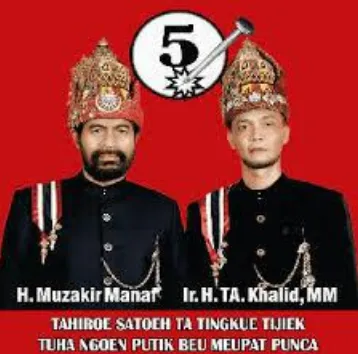
From the transcription above, it is obviously found that Acehnese language is dominantly used and chosen during local political party communication. Those statements are the example of verbal communication. Then, in non-verbal communication, such as the use of Acehnese language in political poster, the candidate from Aceh local party also chooses to use Acehnese language. Here is presented the example of poster issued by the candidate from local party.
Figure 1. Poster of governor candidate of Aceh province from Partai Aceh
Strengthening Local Identity through the Use of Acehnese Language
Acehnese language is also one of indigenous languages in Indonesia. In local political party communication, Acehnese language is used to be a symbol or character of people of Aceh. Kling (2014, p.72) states that local and indigenous cultural ideas, arts, heritage and ecological elements are selected to symbolize a new socio-political ideology. Referring to that statement, Acehnese language is chosen and used as the symbol of Aceh local party. Another expert, Halliday (1973) states that language has three functions of language namely instrumental, regulatory, and interactional function of language. Those three functions can be found in the context of local party communication in Aceh. Acehnese language used in the communication of LPP has a ‗special interest‘. The elites they declare that ―Peureteu ureueng Aceh yang teum peugah Bahasa Aceh” or the party of Acehnese people is a party that communicates by using Acehnese language. Regarding to this fact, Chomsky (2004, p.541) asserts that the term ‗special interest‘ is used in a very interesting related way to refer to the population. The special interest here is regarded as ‗Acehnese people‘.
Since Acehnese language is used in the western coastal area of Aceh from Langsa to Sabang, other regions in Aceh also use their language to strengthen their local identities. For example, local political party in Gayo will use Bahasa Gayo, or Aneuuk Jamee in Meulaboh. The elites of local political party feel satisfied if they use Acehnese language in communication. They use it to show their identity as Aceh local political party members. This reality is also supported by Mahsun (2005) asserting that local language is functioned as (i) the symbol of local pride (ii) the symbol of local identity; and (iii) communication tools in the family and social society. The use of Acehnese language as medium of communication can‘t be separated from historical fact. During DOM (Darurat Operasi Militer/Military Operation Emergency), Acehnese inhabitants were prohibited to use Acehnese language. They had to use Bahasa Indonesia. If they couldn‘t use it, they would be tortured. After DOM is over, Acehnese inhabitants got their freedom to use local language as their identity. So, in any conditions included local party members communication, they try to speak by using local language. Even they say, ―Geutanyo ureng Aceh bek male peugah haba bahasa Aceh/Don‘t say if you are Acehnese if you can‘t speak Acehnese Language‖. This brings the fact that Acehnese language becomes strong language because it has speakers from any level of ages (kids, women, men, parents, youths, and so on).
Conclusion
There is a fact that the chair (muallem) of the political party and his managers, they dominantly choose Acehnese Language than Bahasa Indonesia because of habit and fluency in their communication. In local political party communication, the conditions in which Acehnese language is chosen as the medium of communication are such as in internal meeting, party campaign, unofficial meeting with the same members, interaction with people, and so on. The use of Acehnese language in any conditions included local party members communication makes Acehnese language becomes strong language because it has speakers from any level of ages (kids, women, men, parents, youths, and so on) and also to strengthen their local identities as Acehnese people.
References
Badan Pusat Statistik dan Badan Perencanaan Pembangunan Daerah Provinsi Nanggroe Aceh Darussalam, 2006. Aceh dalam Angka: Aceh in Figures 2006. Banda Aceh: Badan Pusat Statistik dan Badan Perencanaan Pembangunan Daerah Provinsi Nanggroe Aceh Darussalam.
Chosmky, N. (2004). Language and Politics.Oakland: AK Press
Halliday, M.A.K. (1973). Explorations in the Functions of Language. London: Edward Arnold Hanafiah, R. (2016). Bahasa dan Politik: Realitas pada Parlok Aceh. Medan: Bartong Jaya
Kling, Z. (2014). Local Wisdom, Political Culture, and National Identity: The Paradox of Retribalization. In Deliany (et.al). Proceedings: International Conference: Empowering Local Wisdom in Support of Nation Identities; Medan: Graduate School of Linguistics Faculty of Cultural Sciences and Balai Bahasa Sumatera Utara. Page 68-79
Mahsun. (2005). Metode Penelitian Bahasa: Tahapan strategi, metode, dan tekniknya. Jakarta:
RajaGrafindo Persada.
Milroy, L. (1980). Language and Social Networks. Oxford: Blacwell.
Siregar, B. U. (2014). Indigenous Language Maintenance and Revival: The Indonesian Context. In Deliany (et.al). Proceedings: International Conference: Empowering Local Wisdom in Support of
Nation Identities; Medan: Graduate School of Linguistics Faculty of Cultural Sciences and Balai Bahasa Sumatera Utara. Page 16-26
Supardan, D. (2008). Pengantar Ilmu Politik: Sebuah Kajian Pendekatan Struktural. Jakarta: Bumi Aksara.
Spolsky, B. (2008). Sociolinguistics. Oxford: Oxford University Press.
Trudgill, P. (1984). Sosiolinguistik: Satu Pengenalan (Terjemahan Nik Safiah Karim dari Sociolinguistic: An Introduction). Kuala Lumpur: Dewan Bahasa Dan Pustaka Malaysia.
CULTURAL IDENTITY AND CULTURAL CHANGE
Zainal Kling
1. Cultural resurgence and resilience
Several personal participation in seminars and symposia within the circle of academies and cultural activism in the vast region of the Malay World, during the last several years reveal a widespread interest and strong desire towards contemporary resurgence and new flowering of local cultural forms and traditional wisdoms. In the Pattani region of southern Thailand, for instance, The Pattani Malays are trying to re-establish their historical rightful place in their traditional homeland in the midst of major immigrant cultures. In peninsular Malaysia, the peninsular Malays are struggling to assert their culture as the defining post-colonial national culture within the context of a cultural diversity in their nation-state. The Malay regions of Northern Sumatera, Riau, and Pontianak as well as the Sunda cultural region of west Java and Bugis-Makassar region of Sulawesi and Batak region north Sumatera and the region of Nangroe Aceh, the Indonesian Malays and the other minority sub groups seem to desire a re-emergence of their cultures as a cohesive entities within the context of provincial autonomy and national unity. In the vast regions of Malayo-Polynesia from the Maori of New Zealand to the Merina people of Madagascar, already saw the emergence socio-political movements to reclaim their rightful indigenous statuses and forcefully present their dormant cultural forms within the variety of contexts of their existence. The Malays of South Africa and of Sri Lanka are trying to rediscover their cultural affinities as a way forward, and the rest of the minute Malayo-Polynesian communities are searching for the lost proto-Austronesian cultural linkages. The defining desire seems to be the need to re-establish distinctive group cultural identities in a world of conflicting ethnic dreams and global homogenizing demands.
The process of re-emergence indicates, on the one hand the strength of local cultural resilience in the midst of national historical priorities and on the other, the pressures of global trending and homogenisation. At an earlier meeting on ‗local wisdom‘ here in USU, the same phenomenon has been defined as a ‗contradiction of global village‘ or ‗a paradox of re-tribalization‘. At this juncture perhaps we may characterise the corresponding phenomenon as the imperative of identity persistence. Historical and national experience did not seem to have demolish the persistence of local wisdom and its fundamental identity. They remain perhaps submerged and dormant for a long while, during the national reconstruction of post colonial nation states. The national priority have taken precedence above all things, to re-establish national unity and identity vis-a-vis international status. Nonetheless, heritages of colonial multi-cultural construct present demanding realities and challenging conditions for government of post colonial states. Ethnic and local cultural identities needlessly submerged by the national priorities of cohesion and development.
Nowadays, contemporary challenges of globalisation are juxtaposed with the opportunity of regional autonomy to propel the re-emergence of ethnic identity to be a strong emotional prominence. Local cultural bearers found it imperative that they seize the emerging opportunity to consolidate their ethnic consciousness. The situations seems to witness the emergent consolidation of local identities and wisdom in the light of current national pressures and global challenges, motivated largely by powerful ethnic demands for self-identity and local autonomy.
It seems there is a kind of moral dilemma in the juxtaposition of local cultural and identity consolidation against the imminent forces of contextual changes of socio-economic paradigm at local and national levels brought about by a globalised world. The whole situation also seems to create a kind of ambivalence in contemporary cultural life. The need to emphasise local identity inevitably relegates national priorities and global demands to lesser positions with its attendant generation of isolation of local communities from the main developmental stream of global socio-cultural trending. In terms of modern needs, being left-out of the modernizing trend is nothing less than being drawn into the vortex of underdevelopment, something which every modern community seek to steer clear of as much as possible. The avoidance of global influences due to misplaced local priorities could result in uncalled for cultural underdevelopment.
2. Culture and group identity
The current approach to development studies and programme implementation has placed culture in a very prominent position. It is not only the cause but also the motivation for comprehensive societal development. Culture is therefore undergoing redefinition. Generally speaking, the Tylorian notion of culture defined as the ‗complex whole‘ is being replaced by the sum total of learned behaviour of members of a particular society and its communal products, has deemphasized the significance of material and nonmaterial heritages. This contemporary look at culture in behavioural terms stems from its application in development studies and planning. Much current interests have been displayed by economic sociology as well management gurus in their application towards subjective development motivation. The lack of success among classical development economics to alleviate the problems of world poverty has driven current studies to integrate culture as a fundamental dimension in modern development approaches and implementation. Thus Business Dictionary for instance, defines culture as,
―Broadly, social heritage of a group (organized community or society). It is a pattern of responses discovered, developed, or invented during the group's history of handling problems which arise from interactions among its members, and between them and their environment. These responses are considered the correct way to perceive, feel, think, and act, and are passed on to the new members through immersion and teaching.‖ http://www.businessdictionary.com/definition/culture.html
The century old Tylorian definition which emphasises the sum total of characteristic societal material and nonmaterial achievements acquired in communal life has given way to management science with its focus on the sum total of behaviour acquired as solutions to problems of interactions with social and environmental entities. As Tylor defined it in The Primitive Society: ―Culture or civilization, taken in its wide ethnographic sense, is that complex whole which includes knowledge, belief, art, morals, law, custom, and any other capabilities and habits acquired by man as a member of society‖ (1873:1)
The core of this cultural behaviour consists of beliefs, values, and customs that regulate society as a whole. Beliefs and values are guides to behaviour, while customs are acceptable ways of behaving. A belief is basically an enduring trust on the truth of a person's particular knowledge and assessment of an issue. In general, culture composes of all the man-made environment within which man live to fulfil their life.
Culture, being human behaviour and creation, is always characterised by its universality, variability, learnedness, collectiveness, transmitted and changeableness among human societies. With the variety of human physical existence and social formations, it is always amazingly complex with incredible diverse patterns as well as construction. Scholars have classified cultural contents to include basically the tangibles and the intangibles; the tangibles being the sum total of material objects created by human in communal life, while the intangibles are the accumulation of all ideas, institutions, beliefs, language, laws and values as well as other related knowledge.
In real terms, the array of items included in the definition of culture consist of all the tangibles such as food, clothing, tools, artistic products, housing, technologies of all sorts, and all the products of communal living. To a certain extent they present observable style and pattern not only for the members of society to identify with but also for others to characterise the society. Thus the textile ‗batik‘ is a commonly observed material culture of the Mal-Indonesian World especially the Javanese that not only members of the community feel comfortable identifying with it but others also characterise the culture area of Malayo-Indonesian archipelago as a batik world. There is a process of individual as well collective identification with the characteristic feature to provide an observable cultural identity based on a form of textile material culture. Similar identification can be observed with patterns of other material and non material culture such as language, adat laws, technologies, housing, literary products, linguistic construct, values and norms and everything else that human produce in communal living. The emphasis on communal or collective achievement is because human being seems to characteristically live in communities rather than as lonely individuals. In fact to be alone a is a severe punishment for human as in the case of ―solitary confinement‖.
Language as an example, compared with other languages, the Malay language has fundamental structures and construction related to the vast majority of languages within the so-called Austronesian language family, which is the extensive coverage of languages within the geographical area from
Madagascar eastward through the Malayo-Indonesian archipelago and further into Micronesia, Melanesia and Polinesia up to Hawaii in the north and towards the Easter Island and New Zealand in the southern Pacific.
The large variety of Austronesian languages tend to be characterised generally by the, ―use of reduplication (repetition of all or part of a word, as in wiki-wiki or agar-agar). Like many East and Southeast Asian languages, most Austronesian languages have highly restrictive phonotactics, with generally small numbers of phonemes and predominantly consonant– vowel syllables.... The internal structure of the Austronesian languages is complex. The family consists of many similar and closely related languages with large numbers of dialect continua, making it difficult to recognize boundaries between branches. However, it is clear that the greatest genealogical diversity is found among the Formosan languages of Taiwan, and the least diversity among the islands of the Pacific, supporting a dispersal of the family from Taiwan or China. The first comprehensive classification to reflect this was Dyen (1965).‖ (Wiki: Austronesia languages)
The basic structure therefore provides a kind of identity for the languages that are identified as ‗agglutinative language‘, featured not only by reduplication but also the derivatives which are the agglued prefixes, infixes and postfixes. ―An agglutinative language is a type of synthetic language with morphology that primarily uses agglutination: words may contain different morphemes to determine their meaning, but each of these morphemes (including stems and affixes) remains in every aspect unchanged after their union, thus resulting in generally easier deducible word meanings if compared to fusional languages.. The term was introduced by Wilhelm von Humboldt to classify languages from a morphological point of view. It is derived from the Latin verb agglutinare, which means "to glue together". (Stoking, 1995:84)
For a map of Austronesia languages the link below is available.
https://en.wikipedia.org/wiki/Austronesian_languages#/media/File:Austroneske_jazyky.jpg
Given the vastness of the culture area of Austronesia and the Malayo-Indonesian archipelago, compounded by its socio-cultural diversity and complexity, there seem to be a fundamental means by which human culture and society are integrated to become a cohesive but complex whole. A general central principle permeates the entirety of the socio-cultural structure to provide a common identity and inner core which is reflected in the outward view of the cultural set up. This is the set of values, belief and customs which are manifested in the general behaviour of the members of society, as well as articulated in their behavioural norms and practices.
A construct of a situation of human societal existence with observable behaviours are is in reality a manifestation of a pattern conscious and unconscious normative ideas which regulate them. The entity called values, belief and customs are therefore psychosocial in nature, located in the mind and manifested in real behaviour with regulating function to the behaviour to the extent that they coherently control behaviour performance and thus pervades the society as a whole and its social institutions. A certain pattern of common behaviour may be observed among members of a society as outcomes of intangible regulation by their values, beliefs and customs.
For instance, he Malay society and its various communities frequently display generally common behaviour regulated by the cultural value understood as ‗budi‘. At least two aspects of the value are frequently verbalised and voiced out as a kind of deep appreciation to an individual whenever a certain form of behaviour being displayed conforms to the expected budi pattern: budi bahasa and
budi pekerti. He is always complemented with the remark of baik budi or berbudi bahasa. This highly positive appraisal of his behaviour and deserving praise indicate the voiced out or verbalisation of the fundamental societal values commonly found among Malay communities across the Archipelago. The budi values then provides internal cohesion and integration and commonality among various communities who regard themselves as Malays as self-identity. Members of other non-Malay communities also identify and accept the value as a common Malay behavioural identity manifestation. It thus becomes the outward marker for other non-Malay communities to identify the Malays as ‗berbudi‘ that is ‗community with ethics‘.
Classification by scholars such as Clyde Kluckhohn, Geert Hofstede or Shalom H. Schwartz on value orientation may indicate the general value inclination of a society and nation based on the general cultural identity of the society. Persistent value orientation in general displays the pattern of appropriate behaviour and response to situations that become the visible socio-cultural identity. As suggested by
Schwartz, ―Values are used to characterize cultural groups, societies, and individuals, to trace change over time, and to explain the motivational bases of attitudes and behaviour.‖ (Schwartz, 2011:3)
It is assumed that there are factors and conditions which greatly influence the developmental processes of values, beliefs and customs. Spatial and historical conditions influent the internal structures as well as external appearances of a community. Migrations over time deeply impacted societal development and inevitably demand variations in organisational, institutional and behavioural capacity in order to mitigate dysfunctional existence within a particular physical environment. Simultaneously, intangible cultural contents such as values and belief, emerged to justify the pattern of existence and thus creating particularities in social and cultural forms. Overtime these variations come to be inherited as the variegated cultural life of the society, yet integrated as a cohesive holistic patter by a common set of value conception. The intangible values therefore function as the integrative factor in the life of communities, presenting a kind of common foundation upon which all members are interrelated in a general network of societal formation. Values pervade the entire society, its organization, institutions and communities. They provide the common basis of identification for the various components to identify with and integrate themselves within the general society as a whole.
Studies on values verify that they vary in accordance with at least six main features or basic motivation: values as beliefs, desired goals, transcend specific situations and actions, as standard or criteria, ordered by importance, and relative values guide actions (Schwartz, 2011). The variety of basic conceptions illustrate the complex nature of values and their relative significance in various society and situations. Nevertheless, these varieties of basic conceptions can also be regarded as dimensions of values, each being an emphatic aspect in any situation of an individual human life. While the initial array of conceptions emphasize fundamental nature of values as beliefs and desired goals, the later criteria are more functional and indicative of the hierarchical significance of values.
With these criteria as bases of definition, ten value conceptions are compiled by Schartz. They include self-direction, simulation, hedonism, achievement, power, security, conformity, tradition, benevolence and universalism (Schwartz, ibid.). ―Spirituality might constitute another near-universal value...(however) spirituality did not demonstrate a consistent meaning across cultures... despite its potential important in many societies‖. (Schwartz, ibid.:7). The entire delineation by Schwartz may not coincide with the value conceptions of other societies. Nevertheless several of them be identified as the value concepts various societies. Malay for instance would value conformity, security, tradition, benevolence with less acceptance for self-direction or achievement. And again Schwartz suggested that,
―Values are grounded in one or more of three universal requirements of human existence with which they help to cope. These requirements are needs of individuals as biological organisms, requisites of coordinated social interaction, and survival and welfare needs of groups. Individuals cannot cope successfully with these requirements of human existence on their own. Rather, people must articulate appropriate goals to cope with them, communicate with others about them, and gain cooperation in their pursuit. Values are the socially desirable concepts used to represent these goals mentally and the vocabulary used to express them in social interaction.‖ (Schwartz, ibid.:4)
The fact that values are common acceptance as worthwhiles among members of society, indicates that there is an identity common to all members. Values thus not only regulate but also integrate members by the common value identification.
3. Culture and Identity
Chris Weedon described the cultural connection of identity in the modern world as follows:
―Identity and culture are key issues in the ‗post-colonial‘, ‗post-modern‘ West. This is a world in which the legacies of colonialism, including migration and the creation of diasporas, along with processes of globalization have put taken-for-granted ideas of identity and belonging into question. (C. Weedon, 2004)
Weedon, following many modern sociologist, have been greatly influenced by the Marxian approach of post modern analysis. Among the foremost is the French Marxist philosopher, Louis Althusser who theorizes that the process of identification enable individuals to become ‗knowing subjects‘ by which an individual is conceived of as a sovereign, rational and unified consciousness, in control of language and meaning. It is the ‗I‘ that thinks and speaks and is the apparent author of meaning. This is the theory of the subject that is usually assumed in commonsense discourses. (Althusser 1971). The idea of the subject and its attendant subjectivity is explicated as follows:
―Subjectivity (consisting of an individual‘s conscious and unconscious sense of self, emotions and desires) is also constituted in language, and rational consciousness is only one dimension of subjectivity. It is in the process of using language – whether as thought or speech – that we take up positions as speaking and thinking subjects and the identities that go with them.‖ (Weedon, ibid)
Following Foucault analysis of real situations, social interpretation become fixated with the devastating impact of European contact with the rest of the world in early 16th century. This early modern period in Western history have brought cultures of many different people to come into contact and mixed with ever increasing degrees. In various manifestation largely colonialism, the slave trade, white settlement outside Europe, war, migration to the West and now globalization, the West has developed relations of power with others, with the desire, ―to dominate or assimilate others under the various banners of civilization, Christianization, modernization, progress and development. These processes have involved a profound ‗othering‘ of colonized peoples as different and less advanced than people of European descent.‖ (C. Weedon, 2004:19).
The othering of people have eventually created the process of identification into various categories, especially racial groups with the dominance of the West in the power relation with others. Accordingly, as suggested by Weedon,
―Identity is perhaps best understood as a limited and temporary fixing for the individual of a particular mode of subjectivity as apparently what one is. One of the key ideological roles of identity is to curtail the plural possibilities of subjectivity inherent in the wider discursive field and to give individuals a singular sense of who they are and where they belong.‖ (Weedon, ibid:19)
The study of identity has taken a new significance in recent years. In 1996, Stuart Hall observed that, ―There has been a veritable discursive explosion in recent years around the concept of 'identity', at the same moment as it has been subjected to a searching critique.‖ (Hall, 1996:1)
He further delineated a three stage movements of what he perceived as decentring:
―The critique of the self-sustaining subject at the centre of post-Cartesian western metaphysics has been comprehensively advanced in philosophy. The question of subjectivity and its unconscious processes of formation has been developed within the discourse of a psychoanalytically influenced feminism and cultural criticism. The endlessly performative self has been advanced in celebratory variants of postmodernism. Within the anti-essentialist critique of ethnic, racial and national conceptions of cultural identity and the 'politics of location' some adventurous theoretical conceptions have been sketched in their most grounded forms.(Hall, ibid.)
The question that there is a process of decentring of identity from its fixed conception during the renaissance and the psychoanlysis phases to the fragmentation of the contemporary post modern social theorizing, means that,
―This is fragmenting the cultural landscapes of class, gender, sexuality, ethnicity, race, and nationality which gave us locations as social individuals. These transformations are also shifting now: personal identities, undermining our sense of ourselves as integrated subjects. This loss of a stable 'sense of self' is sometimes called the dislocation or de-centring of the subject. This set of double displacements - decentring individuals both from their place in the social and cultural world, and horn themselves, constitutes a 'crisis of identity' for the individual.‖ (Hall, ibid.)
Hall‘s observation coincide very intimately with the development of identity analysis by the discipline of communication with their emphasis on intercultural and interpersonal communications and interactions. One major line of approach is by Jane Collier and M. Thomas who suggested that culture, ―serves to give an identity to a group, ensures survival and enhances the feeling of belonging. Identity is the definition of ones-self‘‖.
By cultural identity Collier means that there is, ―self identification, a sense of belonging to a group that reaffirms itself. It is the extent to which one is a representative of a given culture behaviourally, communicatively, psychologically and sociologically. It consists of values, meaning, customs and beliefs used to relate to the world.‖
Furthermore she elaborated that identity is, ―a person‘s frame of reference by which he perceives himself . Identities are constructed by an integral connection of language, social structures, gender orientation and cultural pattern. There is a complex relationship between culture and identity.‖ (Collier, 1998).
The recent development of identity studies among communication scholars was based on the classical sociological theory of symbolic interactionism advanced by G.H. Mead and C. H. Cooley, and
was later elaborated by Herbert Blumer (1969). The new identity theory further elaborated by the communication scholars such as Jane Collier and William B. Gudykunst and other. Initially Blumer and others had suggested the three basic premises of interactions:
• "Humans act toward things on the basis of the meanings they ascribe to those things."
• "The meaning of such things is derived from, or arises out of, the social interaction that one has with others and the society."
• "These meanings are handled in, and modified through, an interpretative process used by the person in dealing with the things he/she encounters."
With the characteristic emphasis on meaning, symbolism, interactions and interpretations of symbols and meaning, the issue of cultural identity therefore has generally shifted towards social identity within the theory of intercultural and interpersonal communications in which scholars generally conceptualise it as :
• Identity as created through communication.
• Identities are created in spurts of the moments.
• Identities are multiple and developed in different ways in different cultures.
• Identities are influenced by society and they are dynamic.
Identity therefore are created in moments of interactions as strategies negotiated in interactions among individuals of various personalities and members of groups of differing cultural orientations and identity formation. Hecht et al. (1993) explore a list of eight overall assumptions of the Communication theory of identity:
i. Identities have individual, enacted, relational, and communal properties; ii. Identities are both enduring and changing;
iii. Identities are affective, cognitive, behavioural, and spiritual;
iv. Identities have both content and relationship levels of interpretation; v. Identities involve both subjective and ascribed meanings;
vi. Identities are codes that are expressed in conversations and define membership in communities;
vii. Identities have semantic properties that are expressed in core symbols, meanings, and labels;
viii. Identities prescribe modes of appropriate and effective communication.
The current focus on the changeability of identity within a multiple set up and interactions provided several themes with at least four major emphasis to explicate the notion of cultural identity:
i. Cultural identity theory (Collier) ii. Identity management theory (Cupach) iii. Identity negotiation theory (Ting-Tomey) iv. Communication theory of identity (Hecht)
i. Collier and Thomas have characterized cultural identity by referring towards the way group members communicate their identity. Quoting them extensively as follows will elaborate the descriptive features of their classification:
Avowal and Ascription - It is how one presents oneself to another. Ascription is how others perceive an individual. It is how one refers to others.
Modes of Expression - The use of core symbols (expressions of a group‘s cultural beliefs and theories about the world around them), names, labels and norms (expected standard of behaviour) that a cultural community share and follow in order to show that they belong to a particular group, demonstrates shared identity.
Individual, Relational and Communal Identity - Individual refers to how an individual interprets his cultural identity based on his experiences. Relational refers to how individuals interact with one and another (what is the appropriate behavior) and communal identity is the use of communication in the creation, affirmation and negotiation of shared identity.
Enduring and Changing Aspects of Identity - The cultural identity changes due to several factors which are social, political, economic and contextual.
Affective, Cognitive and Behavioral Aspects of Identity - emotions fully attached to cultural identity in particular situations.
Content and Relationship Levels - The participants of the conversation interpret the choice and meanings of the words based on their experiences. The interactions also show the relational level based on how a person delivers the message. This level of a message implies a cultural interpretation of who is in control, their levels of closeness, what they feel about each other, level of trust, etc.
Salience or Prominence - This is the degree to which an identity is demonstrated in a situation and refers to how much a person‘s cultural identity stands out and attracts attention... The intensity differs depending on context, situation topic and relationship. Prominence shows a strong investment/involvement in an identity.
ii. Identity Management Theory or IMT, was introduced in the early 1990‘s. It perceives that individuals as having their identities differently at different given points across time and space. William R. Cupach and Tadasu Todd Imahori, developed IMT with Erving Goffman‘s ‗Interaction Ritual: Essays on Face-to-Face Behavior‘, published in 1967 as the main source of inspiration and elaboration.
Goffman had talked of self-image of an individual during interaction with another individual. This self-image seemed to be temporary and the social impact has a very strong bearing on this image that the individual frequently project it in the future. An individual changes and perceives himself accordingly within the social context of his personal presentation. Cupach and Imahori suggest that the communicative ability requires the individual to ‗successfully negotiate the mutually acceptable identities in interaction.‘ The idea of negotiation becomes strategies for individuals to present conceivably right identity in the context of various interactions. Identity then become negotiated and very often face with acceptance or conflict which have to be resolve in the course negotiations.
iii.The term identity in the Identity Negotiation Theory (INT) usually refers to an individual‘s multifaceted identities of cultural, ethnic, religious, social class, gender, sexual orientation, professional, family/relational role, and personal image(s) based on self-reflection and other categorization social construction processes. Social identity theory, regards social (or socio-cultural) identities can include ethnic membership identity, social class identity, to family role issues, and personal identities can also include any unique attributes that we associate with our individuated self in comparison to those of others. Thus, each individual has composite identity in group membership, relational role, and individual self-reflexive implications. Individuals thus mostly acquired their composite identity through socio-cultural conditioning process, individual lived experiences, and the repeated intergroup and interpersonal interaction experiences. The term negotiation in the INT refers to the exchange of verbal and nonverbal messages between the two or more communicators in maintaining, threatening, or uplifting the various socio-cultural group based or unique personal-based identity images of the other in situ. (S.Ting-Tomey, 2015:418)
iv. The Communication Theory of Identity proposes that there are four frames of identity: personal, enacted, relational, and communal which Hecht et al. (2015) view these frames as locations of identity. "Identity is 'stored' within individuals, relationships, and groups and is communicated within and between partners and group members" (p. 164). Those four frames or levels of identities don't exist in isolation from each other, but interact and interpenetrate one another. The authors insist that frames are means of interpreting "reality" and can be considered as sensitizing constructs.
Identity as a personal frame provides an understanding of how individuals define themselves. There are three additional assumptions that are characteristic for this frame:
1. Identities are hierarchically ordered meanings attributed to the self as an object in a social situation;
2. Identities are meanings ascribed to the self by others in the social world; 3. Identities are a source of expectations and motivations.
Identity as an enactment frame focuses on the messages that express identity and on the meanings that are created through (and by) identity enactment. This frame has two additional assumptions:
1. Identities are emergent;
2. Identities are enacted in social behaviors, social roles, and symbols.