JURNAL
BIOTEKNOLOGI & BIOSAINS INDONESIA
Homepage Jurnal: http://ejurnal.bppt.go.id/index.php/JBBI
EFFECT OF NITROGEN SUPPLY IN CULTURE MEDIA AND LIGHT
INTENSITY ON PHOTOSYNTHESIS OF
Chlamydomonas reinhardtii
Pengaruh Suplai Nitrogen pada Media Kultur dan Intensitas Cahaya Terhadap
Proses Fotosintesis
Chlamydomonas reinhardtii
Bedah Rupaedah1, Yuichiro Takahashi2
1
Laboratory for Biotechnology, BPPT, Building 630 PUSPIPTEK Area, Tangerang Selatan, Banten 15314
2
Photosynthesis Research Center, Graduate School of Natural Science and Technology, Okayama University, 3-1-1 Tsushima-naka, Kita-ku, Okayama 700-8530, Japan
*Email: [email protected]
Abstract
Organisms use nitrogen to produce, among others, amino acids, proteins, and nucleic acids. In this study, the effects of various concentrations of ammonium in culture media on the photosynthetic performance of Chlamydomonas reinhardtii were done under two light conditions: low and high intensity. The microbes were grown at low (75% NH4Cl dosage), normal (100%
NH4Cl dosage, which was 2 M NH4Cl), and high (125% NH4Cl dosage) nitrogen content.
Cells density and chlorophyll content were quantitatively determined. Immunoblotting technique was used to separate proteins based on molecular mass. In both low and high light intensity, cells grown in 75% NH4Cl dosage culture medium showed lower cell density
and chlorophyll concentration than those grown in 100% and 125% NH4Cl dosage media.
The later two media produced almost the same amount of cell density and chlorophyll concentration. In conclusion, 75% NH4Cl dosage was insufficient for C. reinhardtii cells to
grow well. The results also showed that accumulation of photosystem I (PsaA and PsaD/F) and light harvesting complex II (LHCII) were higher in low light than in high light intensity.
Keywords:Chlamydomonas reinhardtii, chlorophyll, light intensity, nitrogen, photosynthesis
Abstrak
Organisme menggunakan nitrogen diantaranya untuk memproduksi asam amino, protein, dan asam nukleat. Dalam percobaan ini pengaruh berbagai konsentrasi amonium dalam media pada fotosintesis Chlamydomonas reinhardtii dilakukan di bawah dua kondisi cahaya: intensitas rendah dan tinggi. C. reinhardtii ditumbuhkan dalam medium dengan dosis nitrogen (N) rendah (75% dosis NH4Cl), normal (100% dosis NH4Cl, yakni NH4Cl 2 M), dan tinggi (125%
dosis NH4Cl). Parameter yang diukur adalah kepadatan sel dan konsentrasi klorofil. Analisis
protein dilakukan dengan imunobloting untuk memisahkan protein berdasarkan massa molekul. Pada intensitas cahaya rendah dan tinggi, sel-sel pada medium dengan 75% NH4Cl
menunjukkan kepadatan sel dan konsentrasi klorofil lebih rendah dibandingkan dengan 100% NH4Cl dan 125% NH4Cl, di mana kedua media ini menghasilkan kepadatan sel maupun
konsentrasi klorofil yang hampir sama. Dengan demikian dapat disimpulkan bahwa 75% NH4Cl
tidak cukup bagi C. reinhardtii untuk tumbuh dengan baik. Selain itu, akumulasi fotosistem I (PsaA dan PsaD/F) dan kompleks pemanenan cahaya II (LHCII) lebih tinggi pada sistem fotosintesis dengan intensitas cahaya rendah dibandingkan cahaya tinggi.
Kata kunci: Chlamydomonas reinhardtii, fotosintesis, intensitas cahaya, klorofil, nitrogen
2002; Ikaran et al. 2015; Juergens et al. 2015; Lardon et al. 2009). Altering the ratio of carbon to nitrogen changes the control of nitrogen assimilation, photosynthetic capacity, starch and sugar accumulation, and also activities of metabolic enzymes (Ball et al. 1990; Li et al. 2011). At the same time, algae slow down their growth and turn their metabolic state towards the cellular structure protection by synthesizing more lipids (Wang et al. 2009).
Extreme modifications in the availability of macronutrients triggered large alterations in gene expression as well as in biochemistry in the photosynthetic alga. Metabolism in
Chlamydomonas readily gives response to total medium nitrogen availability with temporal rises in short-chain free fatty acids and turnover of internal proteins, long before nitrogen resources are depleted (Lee et al. 2012). In different circumstances, nitrogen-starved D. tertiolecta was shown to produce only 1% of dry cell weight (DCW) in neutral lipids, whereas starch was quickly accumulated up to 46% DCW. The rise in starch content occurred in parallel with a coordinated overexpression of genes switching carbon towards starch synthesis, a response not seen in the oleaginous microalgae
Nannochloropsis oceanica, Chlamydomonas reinhardtii or Chlorella vulgaris (Tan et al. 2016).
Flexibility in the metabolism of microalgae has been known that a comprehensive description of the interaction between the various metabolic pathways is a complicated undertaking. But, there are restrictions that administer central carbon metabolism in C. reinhardtii that are demonstrated by the compartmentalization and regulation of the pathways and their relation to important cellular processes like cell motility and division, carbon uptake and
cultivated in tris acetate phosphate (TAP) medium (Harris 1989) at 25°C under constant illumination of cool-white fluorescent bulbs at an irradiance of 400 counted by using a Hemacytometer.
These experiments were done at two harvested at different points of growth phase (24, 33, 48, 72, and 96 h), transferred into microtubes, spun down and the pellets were stored at -80°C for further analysis. A half millilitre of cell culture was taken and quantified to plot growth curves based on cell density (cellsmL-1) and chlorophyll content (µgmL-1). Chlorophyll concentration was measured by spectrophotometer using the following equation:
Chlorophyll concentration = Chlorophyll (a + b)
Protein analyses
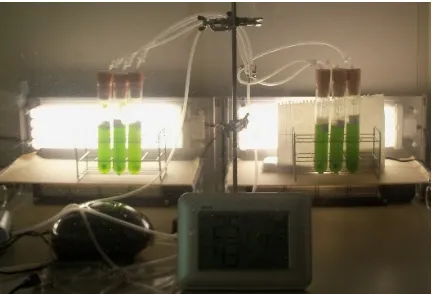
Figure 1. C. reinhardtii cultures grown in two light conditions: low and high light intensity
using a LAS-4000 mini luminescent image analyzer (Fujifilm, Tokyo) (Ozawa et al. 2010).
RESULTS AND DISCUSSION
In this study the effects of various concentrations of ammonium chloride in the culture media of C. reinhardtii on the performance of photosynthesis were measured. These microbes were grown at low (75% of NH4Cl normal dosage), normal
(100% of NH4Cl normal dosage) and high
(125% of NH4Cl normal dosage)
concentrations. Measurements were made on the cell density and chlorophyll content. In addition, analysis using immunoblotting technique to separate photosystem proteins based on their molecular mass was carried out.
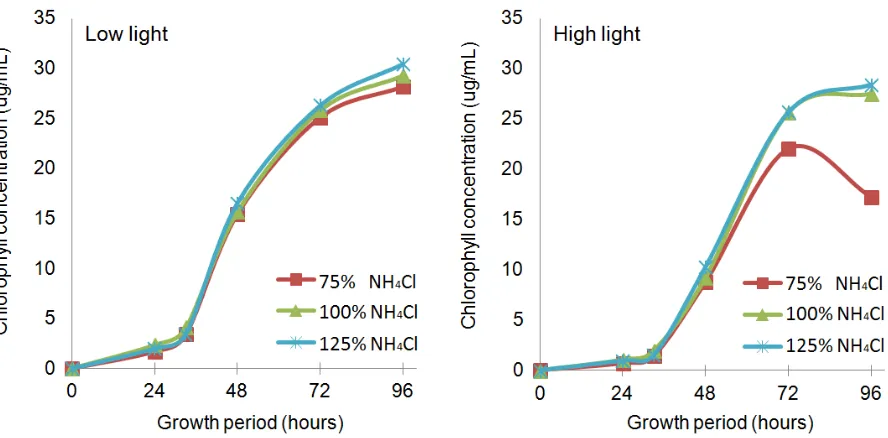
Cell density for all cases showed positive correlation with time (Figure 2). For the cultures grown in the media containing 100% and 125% NH4Cl dosage, the cells density increased steadily until 72 h, then became roughly stable, or slightly declined, until 96 h. An exception was noted for low light growth with 125% NH4Cl, where the cell
density kept increasing until 96 h. At 96 h, all the growth curves for high light condition had
higher peaks than their counterparts for low light, indicating high light promoted higher biomass formation. In addition, steeper slopes were observed for high light than that for low light during 48-72 h growth period, showing faster growth in high light setting.
There was a similarity between the two light treatments, however, in terms of the effect of the nitrogen source. Higher NH4Cl
concentration cell density tended to promote higher cell density throughout growth period, with the exception of 75% NH4Cl dosage
supplementation. This least nitrogen concentration caused a lag phase during the first 24 h of cell growth, with more severe effect seen in high light condition. This suggests that during early culture period, just after inoculation was done until about 24 h, the use of low light intensity might support better growth and avoid higher cell mortality.
could not be better in harvesting light, so the culture became less green. In both low and
After N deficiency, the starch and triacylglycerols (TAGs) accumulation is
Figure 2. Growth profile in relation to cell density
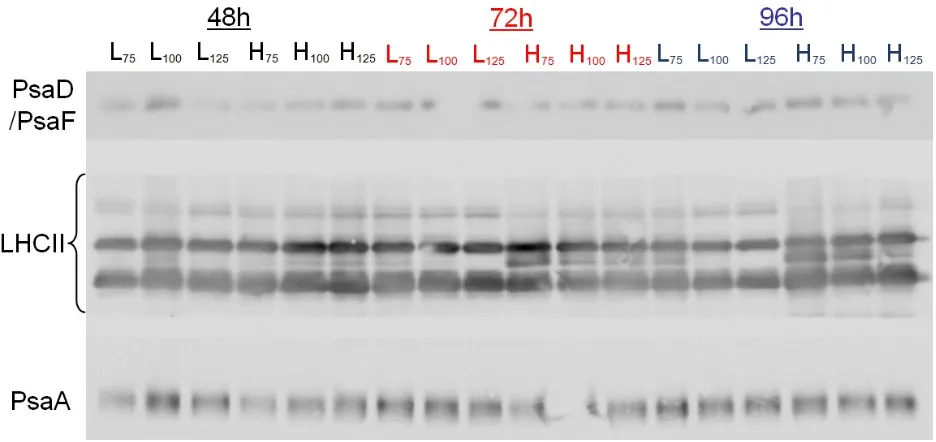
Figure 4. Protein separation based on cell biomass by using immunoblotting technique
Figure 5. Protein separation based on chlorophyll content by using immunoblotting technique
significantly changed following considerable reprogramming of metabolism at cellular level.
By using immunoblotting technique based on the cell density, low light intensity resulted in accumulation of Photosystem I (PsaA, PsaD/F) and LHCII protein complexes (Figure. 4) which were of higher quantity than in high light intensity. On the other hand, based on the chlorophyll content, the results showed that in both of low light and high light intensity, accumulation of PSI (PsaA, PsaD/F) and LHCII protein complexes were almost similar or slightly different (Figure 5).
A relatively large part of reduced N in both of plant or Chlamydomonas is associated with enzymes that are required for energy metabolism (photosynthesis, respiration). According to de Groot et al.
(2003), under N stress photosynthesis was reduced by a decreased light absorption and by the decreased utilization of assimilates. Under N stress foliar starch levels increased and the oxygen sensitivity of CO2 fixation
decreased. The relationship between starch accumulation and oxygen sensitivity (increased starch accumulation correlated with the decreased oxygen sensitivity) was always the same across the nutrient treatments. These results are consistent with N deprivation producing an increasing limitation of photosynthesis.
CONCLUSION
Under N limitation (75% NH4Cl)
Sailey SO (2011) Effect of nutrients on growth and lipid accumulation in the green algae Dunaiella tertiolecta. Bioresour Technol 102:1649-1655 De Groot CC, Boogaard RVD, Marcelis LFM,
Harbinson J, Lambers H (2003) Contrasting effects of N and P deprivation on the regulation of photosynthesis in tomato plants in relation to feedback limitation. J Exp Bot 54:1957-1967
Forde BG (2002) Local and long-range signaling pathway's regulating plant responses to nitrate. Annu Rev Plant Biol 53:203-224
Gargouri M, Bates PD, Park JJ, Kirchhoff H, Gang DR (2017) Functional photosystem I maintains proper energy balance during nitrogen depletion in
Chlamydomonas reinhardtii, promoting triacylglycerol accumulation. Biotechnol Biofuels 10:89
Harris EH (1989) The Chlamydomonas Sourcebook: a Comprehensive Guide to Biology and Laboratory Use. Academic Press, San Diego
Johnson X, Alric J (2013) Central carbon metabolism and electron transport in
Chlamydomonas reinhardtii: metabolic constraints for carbon partitioning between oil and starch. Eukaryot Cell 12:776-793
Juergens MT, Deshpande RR, Lucker BF, Park JJ, Wang H, Gargouri M, Kramer DM (2015) The regulation of photosynthetic structure and function during nitrogen deprivation in
Lee DY, Park JJ, Barupal DK, Fiehn O (2012) System response of metabolic networks in Chlamydomonas
reinhardtii to total available
ammonium. Mol Cell Proteomics 11:973-988
Li Y, Han D, Sommerfeld M, Hu Q (2011) Photosynthetic carbon partitioning and lipid production in the oleaginous microalga Pseudochlorococcum sp. (Chlorophyceae) under nitrogen-limited conditions. Bioresour Technol 102:123-129
Ozawa S, Onishi T, Takahashi Y (2010) Identification and characterization of an assembly intermediate subcomplex of photosystem I in the green alga
Chlamydomonas reinhardtii. J Biol Chem 285:20072–20079
Tan KWM, Lin H, Shen H, Lee YK (2016) Nitrogen-induced metabolic changes and molecular determinants of carbon allocation in Dunaliella tertiolecta. Scientific Reports, 6
Park JJ, Wang H, Gargouri M, Deshpande RR, Skepper JN, Holguin FO, Gang DR (2015) The response of
Chlamydomonas reinhardtii to nitrogen deprivation: a systems biology analysis. Plant J 81:611-624
Wang ZT, Ulrich N, Joo S, Waffenschmidt S, Goodenough U (2009) Algal lipid bodies: stress induction, purification and biochemical characterization in wild type and starchless