2
International Seminar on Quality and Affordable Education (ISQAE 2013)
Maritime Academy The Forgotten Education?*
Khairil Ansari,* I. Wy. Dirgeyasa
State University of Medan
*Corresponding author : [email protected], [email protected]
Abstract
Lately, the Ministry of Education and Culture of Indonesia, endevours to improve the ratio between vocational education and common education proportionally. In the past, the ratio, between vocational education and non vocational education is about 40:60 and there will become about 60:40 in the near future. However, in higher education level, among other vocational education types, the Maritime Academy or popularly known as Maritime Education and Training (hereafter MET) seemingly gets less attention from the government and the society. Consequently, this vocational education becomes the ‘third class’ vocational education in the eyes of the stakeholders. As a matter of fact, this vocational education and training shares significantly the national revenue each year. Then, the demand of the seafarers (officers) recently improves signficantly either national or international wide. This paper tries to dicuss the current phenomena and condition of the Maritime Education and Training in Indonesia, particulary the privateMaritime Education and Training.
Keywords: Maritime Academy
INTRODUCTION
The word ‘vocation’, ‘technic’ or even ‘career’ are used interchangeably referring to vocational education in common. The contextual definition for ‘vocation’ is various and slightly different. However, they have similiarities in common. In general, the term voacational education or education based on occupation or employment also known as vocational education and training or VET. Also, VET is called Career and Technical Education (CTE). This education prepares the learners for jobs that are based on manual or practical activities, traditionally non-academic and totally related to a specific trade, occupation or vocation. In addition, it also is sometime referred to as technical education (TE), as the learner directly develops expertise in a particular group of techniques or technology1
Moreoever, VET is then, defined as an education that prepares people for specific trades, crafts and careers at various levels from a trade, a craft, a technician or a professional position in engineering, accountancy, nursing, medicine, architecture, parmacy, law, etc. Or vocational education might be classified as teaching procedural knowledge. Acftually, the vocational education originally focuses on specific trades for example, an automobile mechanic or welder, is associated with activities of lower level social classes. Therefore, the vocational education is commonly related to the age-old apprenticeship system of learning.However, it now diversified in industries such as retail, tourism, information technology, cosmetics etc.
In Indonesian context, vocational education is defined as a higher education which is focused and directed to the mastery of a certain applied skill or competence or expertise. In terms of grade or level of education, it is then classified or categorized into Diploma I, II, III and IV. The Diploma IV is equalized to graduate level. In addition, vocational education is defined as a higher education which prepares the students to provide a certain maximum or optimal work and applied skills and is equivalent to graduate (S1) or Diploma IV. In short, it is oriented to practical purposes.
In line with the Indonesian Law No 20 2003 concerning to education system, the vocational education or school is concerned to the shake of national interest. That is why, the government, Education and Culture Department plans and designs what is called HELTS (Higher Education Long Term Strategy). It formulates three core strategies for the higher education such as nation’s competitiveness, autonmy, and organizational health.
In its implementation, the vocational education implementsmulti-entry-exist system and mutli-purposes or orientations (culturized, empowerment, character building, and life skills).The vocational education also applies the ‘terminal’ system. Terminal means that the graduates are not designed to continue their education to higher level or academic education in common. They strictly are designed for practical knowledge competencies or skills. Then, the vocational education can be carried out in terms of academy, polytechnic, institute, and university as well. The detail of MET is shown by table 1 below.
1
No Education Level Status Total
It is a fact that Indonesia is the three biggest seafarers suppliers together with India and Philippine. Indonesia becomes the third largest after India and Philippine producing and employing the seafarers. This means that Indonesia is really potential state either as seafarers supplier or user as well. At presesnt, Indonesia has about 250.000 seafarers who are internationally certified but it is still far behind with the Phillippne producing almost 400.000 seaferars.While the world now needs almost 90.000 seafarers for the next four years and around 4000 year by the of this year.
While for national demand, the Head of BPSEDM, the Ministry of transportaion, Mamahit predicts that during the year 2011-2015, the need of seafarers reaches 43.806 people consiting of 18.774 officers and 25.032 ratings. Then, he notes further that the supply from the state maritime education and training only 1.500 people and private ones only about 2.000 people per year. This shows that Indonesia itself is lack of the seafarers during that period.2With 250.000 seafarers either in national and international workplaces, they can contribute approximately 16 trillions a year for national revenues. It is much more than Indonesian workers (low level worker) working abroad only reaches 3,4 trillions a year3Then, it is important to note that the salary of Indonesian seafarers who work in international fleets accros the globe such as in European countries, US, and Australia reach about 1.800 USD-2.000 USD or Rp.18 millions-Rp.20 millions with 20 USD for insurance premium4According to Research and Development Board of the Ministry of transportaion, Siahaan MsTr, to support this condition and to meet the need of the high demands of national seafarers, the Indonesia government issues pertaining to the Empowerment of National Shipping Industry. By this instruction, the number of Indonesian fleet is improving signficantly from 6.041 fleets in 2005 to be 9.170 fleets by the end of 2009 or it increases 51% by that period.
However, the developement and growing of METis not really significant and surprising. The total number of MET either state own and private is about 24 METs. The 24 METs then are classified as board of education and training, academy, polytechnic, and institute. This shows that Maritime Education and Training in Indonesia is not popular yet either by the government or societies. MET is relatively still considered to be less prospective in connection to the job market and work force. In addition, many societies still have negative or minor perspective and stereotype toward the MET. The minor persepctive and stereoptype for example ‘the seafarer is regarded to have‘lecherous’ or to like having more than one ‘propellers’ etc.
The less number of Maritime Education and Training in Indonesia compared to the great number of its people and the slogan “ Indonesia is a maritime country”, become something ironic and rediculous. To view and to know the the real conditon of Maritime Education and Training, the Strenght, Weakness, Opportunities and Threats analysis (SWOT) can be used.
The Strenghts
Due to the less favorite and the unforgotted academy among others, by Indonesian context, the private maritime education and training still have few strenghts. These strenghts can be a kind of triggers and sprits to improve Maritime Education and Training to be qualified and popular vocational education and training in Indonesia. The following possible strenghts of the MET as follows:
First, the private Maritime Education and Training in Indonesia is commonly set up individualy or in group of people under the foundation. In general, the owners of the Maritime Education and training still have strong spirits to carry out the education and training. They try to invest more money to develop academy in order to meet standard and requirements under the STCW’ 95 curriculum and IMO convention.
Second, the private Maritime Educationn and Training students in the last five years increased by number
2
International Seminar on Quality and Affordable Education (ISQAE 2013)
Educationn and Training also increase as well. The people now think more practically and pragmatically. They think that education must be in line with job market. And education can really create graduates with relevant job market. They assume that the graduates of Maritime Educationn and Training seemingly can bridge the gap between the education and job market .
Third, Maritme Education and Training can be internationally labelled because it adopts, modifies and implements international curriculum named STCW’95 (International Training Certifiation and Watchkeeping for Seafarers’95) issued by IMO (International Maritime Organization) based in London. By the international curriculum, the graduate have international standards of competences.
Fourth, the diploma of the graduate is written in two languages-the language in which the Maritme Education and Training is set up and the English language. This leads to that the coverage area of working of the graduate is world-wide scope. By this diploma, consequently, the graduates have to compete with the graduates of Maritime Educationn and Training from other countries.
And finally, referring to the STCW’95 curriculum for Maritime Academy all over the world, In Indonesia, the Maritime Academy curriculum is developed by national curriculum board of Maritme Academy under the Sea Transportation Directorate General of Transportation Ministry. Then, it is enriched and improved by the local institution by considering the local genious of Maritime Academy where it is situated and located.
The Weaknesses
Eventhough, the Maritme Education and Training has strenghts, however in Indonesian context, the privates Maritme Education and Training have many weaknesses and constraints such as lack of professional lecturers, availability of learning materials, low entry behaviors, big-size class, lack of facilites and euipment, etc.
Lack of professional lecturers meaning that some lecturers do not have qualified competences like sailing experiences or field experiences at sea. For examples, mostly the English lecturers are from university whose majors are English or general English. Then also, some lecturers teaching in nautical and engine departments come from universities6(Dirgayasa, et al, 2007) in his surevy states that the teachers’ work performance is not really satisfying and optimal yet in the eye of the students. It is about (45, 23%) of the respondents argues that they need training to improve their competence and proficiencies including English language.
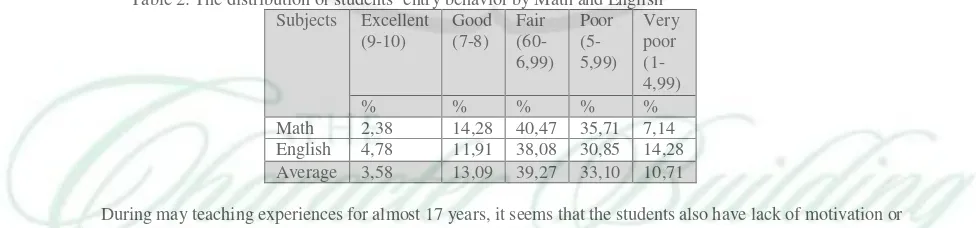
In term of the availability of learning materials, actually this current existing materials condition of maritime academy seemingly is not only a matter of Indonesia private maritime academies but it is also an international occurrence and phenomena. It is a fact that providing a standard learning materials have been difficult to achieve for a number of reasons7. claims that the real condition of existing materials of maritime academies are: (a) non-academies and universities. Research shows that most of the students have low grades and low achievement of both subjects. Table 1 shows existing cognitive domain-math and English entry behavior as follow
Table 2: The distribution of students’ entry behavior by Math and English Subjects Excellent
During may teaching experiences for almost 17 years, it seems that the students also have lack of motivation or lack of interests to study in. I personally state that ‘theystill go to school but they don not learn at school yet’.
Due to lack of government attention, a big-size class in conducated by the privates Maritme Education and
students for each class.8It seems that to operate Maritme Education and Training costs a lot money. To meet the minimum standards of curriculum as amanded by STCW’95, the Maritme Education and Training either state or private has to meet the minimum faciliteis and equipments in order to carry out the teaching and learning process. Survey shows that the three Maritme Education and Training in Indonesia survied shows that the facilities and equipments generally are still lack of standards and qualifications. This aslo is lack of the adequacy and relevence. Due to lack of facilities and equipment, the many of them can not carry out National Examination independently. They must join the other Maritme Education and Training having minimum standards of facilities and equipments and are approved by the legal institution.
The Opportunities
If the number of maritime education and training is compared with the demand of seafarers it seems that there is a serious gap between the suppliers or producers of the seafarers and the market demand of the seafarers. This phenomenon is really ironic because Indonesia is ‘maritime country’ in which the 2/3 of the state is sea. In addition, Indonesia is also located between the international sea that is Java Sea and South China Sea. This also shows that Maritime Training and Education either board of education and training, academy, polytechnic, and institute is viewed as less favorite or least favorite among other vocation education such as medical, business and economic, tourism, Inforamtion Communication and Technolgy (ICT), etc. The ICT vocational education nowadays seems to be the most rapid growing vocational education.
This means that Indonesia is really potential state either as seafarers’ supplier and user as well. At present, Indonesia needs 78.000 seafarers. While for national demand, the Head of BPSEDM, the Ministry of transportaion, Bobby R Mamahit predicts that during the year 2011-2015, the need of seafarers reaches 43.806 people consiting of 18.774 officers and 25.032 ratings. Then, he notes further that the supply from the state maritime education and training only 1.500 people and private ones only about 2.000 people per year. This shows that Indonesia itself is lack of the seafarers during that period.9This factually indicates that need of seafarers is really prosepective nationally in particular and internationally in general. Conseqeuntly the set up of new MET is still prosepective and widely open.
Then, if is seen from world demands of the seafarers, the world now needs almost 90.000 seafarers for the next four years and around 4000 year by the of this year. So it can be concluded that the need of world seafarers either ratings and officers is widely open and Maritime Training and Education,Indonesia Maritime Training and Education can supply the seafarers, however we Indonesia, have to compete with other Maritime Training and Education of other countries. For Indonesia, nowadays Philipines, India, and Vietnam becomes serious competitiors to provide and produce the graduates or seafarers.
For Indonesian seafarers, to be saferares is not merelly a matter of job seeking, or due to lack of seafarers or to be seafarers are not interesting. Again it seems that for Indonesian seafarers, working at maritime industry or shipping industry is a kind of making money. High salaray and income apparently become the critical reason for them. For Indonesian context, the slogan “study by rupiah and work by dollar’ become the ‘heart’ or key expression to be seafarers 10(Dirgayasa, 2007).
To set up and promote the quality of Maritime Training and Education, in Indonesia particulary is still widely open. The less developed Maritime Training and Education, particularly private ones can create networking and cooperation with other Maritime Training and Education either nationally and internationally. Networking seems to be ‘holy’ word to promote the quality of education and graduates as well. Minirth in his book ‘You Can’ argues "Networking is a process of getting together to get ahead.It is the building of mutually beneficial relationship". The Frank’s statement can be clearly inferred that the key word of networking is “aprocess of togetherness” This also means that networking refers to “together we can” and “movingforward.” If we analyze further, the networking is actually a matter of building a beneficial and mutual relationship in order to reach the goals settled cooperatively. Networking must be underlined and based on mutual benefical and a two way communication between the members collaborated and related.
The Threats and Challanges
Even thoguh there are some strenghts and big opportinity of Maritime Education and Training in Indonesia, some serious threats and challanges can not be avodided and must be faced. These threats and challanges to manage the maritime education and training must be considered seriously. The threats and challanges potentially constraint the Indonesia Maritime Education and Training, and the graduate as well. Among the folloing threats and challanges faced by Indoesian Maritime Education and Training as folows:
8
AMI Medan. 2007. Self Evaluation Report.
9
http://www.pikiran-rakyat.com/node/181775 10
2
International Seminar on Quality and Affordable Education (ISQAE 2013)
First, the seafares of other countries such as Philphines and India generally have better English than Indonesian seafarers11(Risyuandi, 2009) Indo pos. These lead Indonesian seafarers to be less comptetitively compete with other seafarers from other countries. By this condition, the Maritime Education and Trainging should improve the students’ English proficiencies. It is a fact that English subject in STCW’95 curriculum is categorized professional subject and not complementary or optional subject. Beside, the lacks of English, the Indonesia seafarers also have lack of attitudes; tend to be disobident, like quarellsome, etc.12Second, it is a fact that job market for seafarers is really widely open; however, the comptetition among the seafarers is still competitive one. For Indonesian seafarers, The tight competition become a big problem, The lacks of Indonesian seafarers are not due to their technical skills but the communication skill they have-English13(Shiping Gazetta, 2008). Mastering English, particulary becomes serious problem to solve by the institution of Maritime Eduation and Training.
Third, Rapid development of facilities and equipments and or media used by the Maritime Education and Training in world, is another problem for Indonesia Maritime Education and Training. Most private one can not follow and afford the modern and shopisticated facilities and equipment or media used during the teaching and learning process. In short, by facilities and equipment, the Maritime Education and Training in Indonesia need improving if their graduates can provide standard of competences and can compete with graduates from other Maritime and Education of other countries.
Fourth, more countries seemingly concerns to the development and improvement of the Maritime Eduation and Training. The rapid growing countries such Philipines and India seriously concers to Maritime Eduation and Training. In addition, the next growing countries which become interseted in developing and improving the Maritime Eduation and Training are Vietnam and Laos. For Indonesia Maritime Eduation and Training, those countries become serious threats and challanges in order to produce the seafarers in terms of quality and quantity. By quantity, Indonesia is the third big country producing the seafarers either ratings or officers after Philipines and India but by quality, it is a matter of big question.
Finally, it seems that the Indonesian government has less attention of MET.This can be seen from budget provided to empower the MET. The government’s will also is not serious and strong enough to do so. In addition, the government issues a very few regulation dealing with the empowerment of the MET.
CONCLULSION
To sum up, the Maritime Education and Training in Indonesia can be viewed from two perspectives inner look and outerlook. By outlook perspective, Maritime Education and Training in Indonesia seemingly still left behind compared to others from other countries. To improve their quality of the graduates, networking between and among other Maritime Education and Training either nationally or internationally is a matter of a must. Then, the networking can also be done with the relevant institutions such as shipping company, costum offices, expedition of shipping company, etc.
By inner look, the reality of Maritime Education and Training is still dominantly carried out by private ones. In addition, the spread of MET is not proporpitionaly by province and or regional coverage. Compared to other types of vocational education, the number of Maritime Education and Training is really left behind from others such as Medical, ICT, Technical, Tourism, etc. Finally, the government attention to this vocational is not really optimal yet. The Maritime Education and Training seems to be forgotten. It is forgotten by the government and the people. By this fact, it tends to be the third class education and training among others.
REFERENCES
AMI Medan. 2007. Self Evaluation Report.
Directorate General of Sea Transportation of Department of Transportation2002.The Framework Quality Standard System for Maritime Education and Training in Indonesia. Jakarta.
Balabar, Corazon.1995.Collaborating with Subject Specialists. Getting Started Materials Writer on Materials Writing, Hidalgo, C. Araceli et al. Singapore: SMEAO Publishing.
Directorate General of Sea Transportation of Department of Transportation: The Framework Quality Standard System for Maritime Education and Training in Indonesia. Jakarta. 2002.
Dirgayasa, Wayan, et al. 2007. Pengembangan Bahan Ajar Bahasa Inggris Jurusan Nautika Akademi Indonesia Medan.Unpublished.
International Maritime Organization. IMO Standard Marine Communication Phrases.London: Albert Embankment. 1995.
Shiping Gazetta, 2008.
Trenkner, Peter and Cole, Clivic. Profiling the Maritime English Instructor-Are We All At Sea? http://www.iamu-edu.org/journal/5/trenkner-cole.php/7/26/2009/
Forum Wartawan Perhubungan, di Jakarta, Kamis (22/3/12). http://www.pikiran-rakyat.com/node/181775