57 Agroland: The Agriculture Science Journal, 2016 June 3(1) : 57– 70 ISSN : 2407 - 7585
E-ISSN : 2407 - 7593
COCOA PROCESSING INDUSTRY FEASIBILITY ANALYSIS
(CASE STUDY IN HOUSE OF CHOCOLATE DEPARTMENT OF
INDUSTRY CENTRAL SULAWESI PROVINCE) IN PALU
Evyana Marwati Bangkele1), Made Antara2), Lien Damayanti2)
1)
Department of Industry and Trade. Central Sulawesi Province. E-mail: [email protected]
2)
Lecturer and Researcher at Department of Agribusiness Faculty of Agriculture. University of Tadulako. Palu.
ABSTRACT
This study aims to determine the appropriateness of the establishment of cocoa processing industry (Rumah Coklat Office of Industry and Trade of Central Sulawesi Province) in Palu
based on market aspects, technical aspects, aspects of the organization and management as well as financial aspects. The research was conducted in the city of Palu, namely Rumah
Coklat Industry and Trade Office of Central Sulawesi province were carried out from July to September 2016. The method used was survey used data sourced from Rumah Coklat Department of Industry and Trade of Central Sulawesi province and institutions associated with the study and the results of research conducted by the Center for R & D relating to the cacao processing. Data collected was processed and analyzed the aspects of the market, technical, organizational and management aspects and financial aspects. The results showed that the business of processing cocoa into chocolate and chocolate converture liqour from the aspect of the market is feasible to set up because it has a fairly large market opportunities, both domestic market and overseas markets. Based on a technical aspect, the business of processing cocoa into chocolate liqour and chocolate converture feasible to implement in Palu because of the availability of raw materials, labor, buildings and facilities equipment, the need for production machinery and equipment, the capacity of production capacity and the production process is relatively easy to be fulfilled and realized. Based on the aspect of organization and management, processing of chocolate is feasible. Because the needs of the labor management section and production section is obtained in accordance with the wishes of the company, as well as the maintenance of legality companies easily obtained. Financial aspects of the analysis results obtained by period of return on investment or payback period is 7 years. NPV is Rp. 182,141,428. IRR is about 14 and PI is 1.08%. BEP amounted to 58.28% of total sales or Rp. 323,561,529. as well as the results of the sensitivity analysis shows that this cocoa processing business into chocolate liquor and converture very sensitive to the price of raw materials cocoa and the amount of the sale. Based on the calculation and analysis can be concluded that the cocoa processing industry namely Rumah Coklat Office of Industry and Trade of the Province of Central Sulawesi in Palu meet the eligibility criteria and eligible to be run the business.
Key Words : Cacao, industry, market. INTRODUCTION
Cocoa (Theobroma Cacao L.) is one of the commodities which has a role that is quite real and reliable in realizing agricultural development programs,
58 600 thousand tons per year. Of that amount,
74 percent cocoa to be exported because it is not absorbed in the country. Most cocoa in Indonesia (around 96 percent) is produced by farmers (ASKINDO, 2011). In 2012 the Indonesian cocoa production increased, thus it becoming the 2nd largest cocoa producerin the world, with production reaching 922 720 tones, below Côte d'Ivoire/Ivory Coast Africa with a production of 1.38 million tons.
Central Sulawesi Cocoa Production in 2015 reached 208 485 256 kg with districts (Kota Palu, North Morowali, Morowali, Buol, Tolitoli, and Tojo Una-una) of approximately 20%.
Compared with Malaysia cocoa beans products amounted to only 60,000 tones per year, but is able to produce the cocoa processing of 300,000 tons per year. Additional supply of raw materials comes from Indonesia (including Central Sulawesi), and thus the added value of cocoa enjoyed by other States. For a future development is targeted in 2016 in which the central Sulawesi cocoa exports has been in the form of fermented cocoa, partly to supply cocoa processing industry in the country and partly to recycle industry engaged in processed chocolate, which is located in several District Municipality in Central Sulawesi, ranging from product cotton candy, chocolate candy, and chocolate bars that require raw materials chocolate (Chocolate Liquor
and Couverture) to process into various chocolate, so it is very potential to establish a cocoa processing industry in Palu.
Based on the description it is an issue of concern in this study Is the establishment of cocoa processing industry in Palu is feasible, viewed from the aspect establishment of cocoa processing industry (House of Chocolate, Department of distribution centers throughout the cocoa beans from cocoa-producing region, and also as a center for the development of the cocoa industry in Central Sulawesi. This research was conducted for three months ie from July to September 2015.
59 and Financial Aspects. To know the
feasibility of each aspect of the feasibility of the cocoa processing industry Chocolate House Office of Industry and Trade of Central Sulawesi province with the following criteria:
Market and Marketing Aspects. For the feasibility of market and marketing aspects in the analysis are:
a. Potential Market
b. The market opportunity (the magnitude of the difference between bid and ask) to know the size of the market opportunity in business establishment cocoa processing plant is in use forecasting methods linear regression formula
where:
Y = Variable needs of cocoa
X = Variable time, a and b parameter regression coefficient,
c. Market Share d. Marketing Strategy
Financial Aspects . For the feasibility of the financial aspects, which were analyzed were:
a. The need for investment costs, b. the Working Capital Needs
c. Source-a source of funds to be obtained, d. The Investment Assessment Criteria.
The methods used to analyze the financial feasibility, are as follows:
1) Method of Pay-Back period (PP) 2) Net Present Value (NPV)
3) Probability Index (PI)
4) Internal Rate Of Return (IRR)
5) analysis Break Even Point (BEP) 6) Sensitivity Analysis
RESULTS AND DISCUSSION
Markets and Marketing Aspects Analysis
Market Potential. Potential consumer
chocolate factory owned by the industry are the small and medium enterprises which are also engaged in cocoa processing and using chocolate as the main raw material in the manufacture of their products.
Market Opportunities. Market
opportunities describe how great the opportunity or possibility of the market to deliver the products to the consumers. Market opportunities seen through the approach of a request (demand) and supply.
Forecasting made with quantitative approach using linear regression (RL). Inanalysis linear regression variable is the time in the form of Y = f (X), then Y is the variable that is predictable and X is the time variable.
Table 1. Data of the Numbers of Chocolate Industry Performers in County/City of 2011-2015
No Regency / City Number of SME (Unit)
1 Palu 30
2 Sigi 10
3 Donggala 5
4 Parimo 5
5 Poso 5
6 Tojo Una-una 6
Total 61
Source: Department of Industry, Central Sulawesi Province.
Table 2. Data of IKM Cocoa Needs or Requests Years 2011-2015
Year Demand
2011 1.066
2012 1.084
2013 2.147
2014 3.271
2015 3.292
Source: Department of Industry, Central Sulawesi Province.
60 a. Demand projections
b. Projection Deals
Projection deals is the large supply of existing products in the market which are supplied by other manufacturers. Based on the data obtained from Department of Industry Central Sulawesi Province and of the perpetrators of SMEs chocolate that kind of chocolate is in use or currently use to create different types of chocolate products such as chocolate bars, chocolate Pralin, brownies, chocolate drinks Tri One and others are cocoa couverture, and liquor that use fat and cocoa beans native from
Central Sulawesi. But it can’t deny that
the IKM chocolate also still use Compound Chocolate as an additive and flavor enhancer variations on various chocolate products such as chocolate brand collata, tulips, Van houten, Mercolade, Galetto and Flamboyan. The data about how many Compound chocolate products are in use by the SME chocolate business used are as follows:
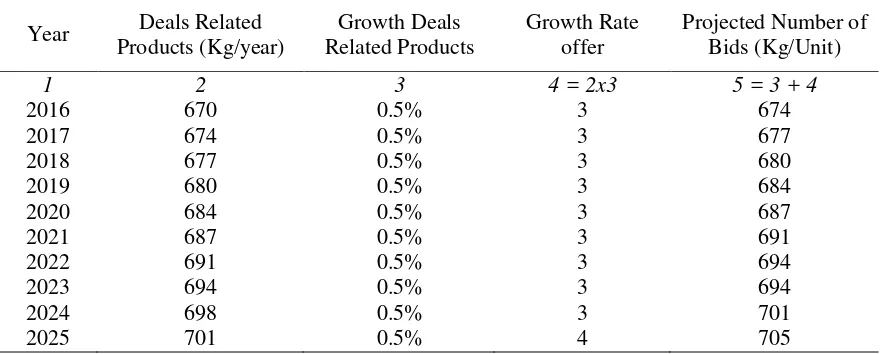
Based on the table above the total number of deals in the SME chocolate brown in Central Sulawesi as much as 667 Kg. Offer is expected to increase by 5% per year on the assumption that the businesses in the sector has good prospects, so every year there will be new market participants or entrepreneurs engaged in
cocoa processing. So the bidding for the beginning of the year 2017-2025 of chocolate compound product in the future can be seen in the following table:
2016 = ( Number of deals in 2015 ) + (Total chocolate factory in Central Sulawesi that produce fine chocolate couverture, liquor and compound.
Marketing and Strategy Program. The
61 Table 3. Forecasting Chocolate Products Inquiry Using Linear Regression Method, Year
2016-2025
Year Level Requirement Y X X² Y² XY
2011 1.066 0 0 1.135.823 0
2012 1.084 1 1 1.174.189 1083,6
2013 2.147 2 4 4.610.683 4294,5
2014 3.271 3 9 10.697.806 9812,25
2015 3.292 4 16 10.835.618 13167
∑ 10.859 10 30 28.454.118 28.357
Description:
1) Value and
Based on The Calculations Obtained Equation Y = 1,065 + 664 X, Table 4. Data Deals Related Products 2016
Chocolate Brand Number of Products in Offer (Kg)
Chocolate Collata 250
Tulip 87
Van Houten 120
Mercolade 150
Galetto 30
Total 667
Source: Department of Industry Central Sulawesi Province. Table: 5 Projected Number of Offer
Year Deals Related Products (Kg/year)
Growth Deals Related Products
Growth Rate offer
Projected Number of Bids (Kg/Unit)
1 2 3 4 = 2x3 5 = 3 + 4
2016 670 0.5% 3 674
2017 674 0.5% 3 677
2018 677 0.5% 3 680
2019 680 0.5% 3 684
2020 684 0.5% 3 687
2021 687 0.5% 3 691
2022 691 0.5% 3 694
2023 694 0.5% 3 694
2024 698 0.5% 3 701
2025 701 0.5% 4 705
Source: Data Processing.
∑ ∑ ∑ ∑ ∑
∑
Y X
2).Value b and value a :
62 a. Product
In accordance with the original purpose of the establishment of a chocolate factory, the type of products to be produced are three types of chocolate liquor, milk couverture chocolate and dark chocolate couverture. In order for production of the products that can compete in the market and can be in the interest of consumers, so some of the things need to be done in marketing the Chocolate products which is:
1) The Products of chocolate couverture and liquor are packed using aluminum foil packaging.
2) Net weight each package varies from 1 kg to 3 kg
3) Attractive package and brand the product "Chocolate Sulteng"
4) Quality of products should be guaranteed is the best because it uses cocoa beans from Central Sulawesi, which has been in full fermented and processed using modern engine technology, each of chocolate products that used the raw materials of chocolate couverture and liquor, will make the chocolate products become more shiny, has a better taste and aroma.
b. Prices
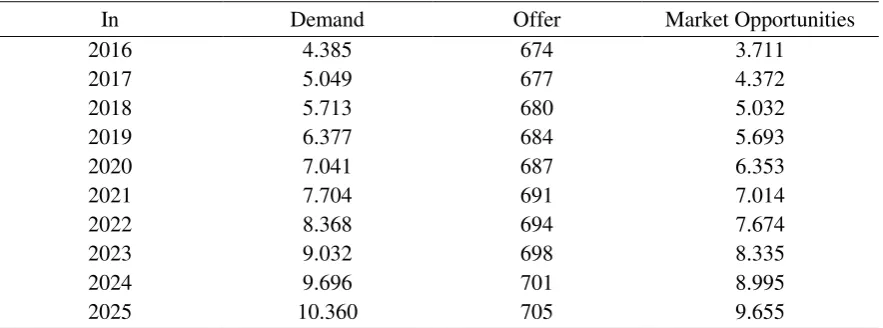
In order to achieve maximum profit, it would require careful pricing strategies. In order to maximize sales, Table 6. Market Opportunities Calculation
In Demand Offer Market Opportunities
2016 4.385 674 3.711
2017 5.049 677 4.372
2018 5.713 680 5.032
2019 6.377 684 5.693
2020 7.041 687 6.353
2021 7.704 691 7.014
2022 8.368 694 7.674
2023 9.032 698 8.335
2024 9.696 701 8.995
2025 10.360 705 9.655
Source: The Results of Data Processing.
Table 7. Calculation of Market Share and Sales Plan
Source: Results Data Processing.
Chocolate chocolate chocolate chocolate chocolate chocolate Liquor Couverture Couverture Liquor Couverture Couverture
( Dark ) ( Milk ) ( Dark ) ( Milk )
2016 3711 5% 10% 70% 189 371 2598 3155
2017 4372 5% 10% 70% 219 437 3060 3716
2018 5032 5% 10% 70% 252 503 3523 4277
2019 5693 5% 10% 70% 285 569 3985 4839
2020 6353 5% 10% 70% 318 635 4447 5400
2021 7014 5% 10% 70% 351 701 4910 5962
2022 7674 5% 10% 70% 384 767 5372 6523
2023 8335 5% 10% 70% 417 833 5834 7084
2024 8995 5% 10% 70% 450 900 6297 7646
2025 9655 5% 10% 70% 483 966 6759 8207
Total Sales Plan Market
Opportunity
Market Share (%)
63 dominate the competition, and the
opportunity to enter the broader market (market share), the couverture chocolate products (Dark and Milk) chocolate couverture and chocolate liquor, the result of a production from certain temperature that exceeds the limit. Required a substantial investment to distribute these products as other products distributed.
d. Promotion
In order to introduce this product to the general public, especially the SMEs chocolate Central Sulawesi, the initial program is taken as a form of
Cost Investment Needs. Broadly speaking,
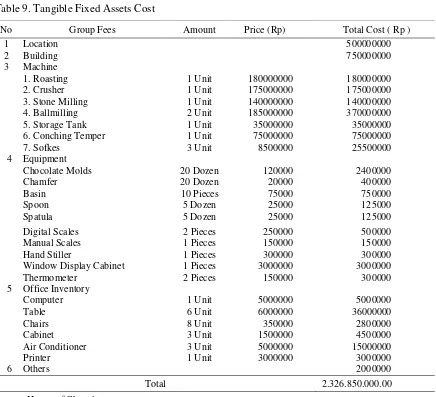
the cost of the investment needs include pre-investment costs, the cost of fixed assets and operating costs. The cost data obtained from the investment needs of field surveys, store, market research, and interviews with interested parties. The required amount of investment costs in and auxiliary materials for 1 year 2) Factory overhead expense
An all expenses related to the activity of operating processes that occur in the plant. In this feasibility study, factory overhead costs include the cost of electricity and gas.
3) General and administrative expenses General and administrative expenses include the fees and charges for internet and office stationery. The amount of general and administrative expenses that the company will be issued each year is in the amount of Rp. 9,000,000.
4) Maintenance Costs
Maintenance costs include machinery and equipment, buildings and also the office equipment. The amount of maintenance costs that should be incurred every year is Rp. 15.600.000, every year it is assumed there is no increase.
5) Equipment Purchase Costs
64 Table 8. Pre-Investment Cost
No Group Fees (Rp)
1 Development Studies Cost 15,000,000
2 Handling License-permit Cost 5,000,000
3 Survey Cost 10,000,000
4 Experiment Production Costs 20,000,000
5 Initial Campaign Costs 10,000,000
Total Costs 60,000,000
Table 9. Tangible Fixed Assets Cost
No Group Fees Amount Price (Rp) Total Cost ( Rp )
1 Location 500000000
2 Building 750000000
3 Machine
1. Roasting 1 Unit 180000000 180000000
2. Crusher 1 Unit 175000000 175000000
3. Stone Milling 1 Unit 140000000 140000000
4. Ballmilling 2 Unit 185000000 370000000
5. Storage Tank 1 Unit 35000000 35000000
6. Conching Temper 1 Unit 75000000 75000000
7. Sofkes 3 Unit 8500000 25500000
4 Equipment
Chocolate Molds 20 Dozen 120000 2400000
Chamfer 20 Dozen 20000 400000
Basin 10 Pieces 75000 750000
Spoon 5 Dozen 25000 125000
Spatula 5 Dozen 25000 125000
Digital Scales 2 Pieces 250000 500000
Manual Scales 1 Pieces 150000 150000
Hand Stiller 1 Pieces 300000 300000
Window Display Cabinet 1 Pieces 3000000 3000000
Thermometer 2 Pieces 150000 300000
5 Office Inventory
Computer 1 Unit 5000000 5000000
Table 6 Unit 6000000 36000000
Chairs 8 Unit 350000 2800000
Cabinet 3 Unit 1500000 4500000
Air Conditioner 3 Unit 5000000 15000000
Printer 1 Unit 3000000 3000000
6 Others 2000000
Total 2.326.850.000.00
Source: House of Chocolate.
Table 10. Cost of Raw Materials and Helper for 1
No Details Needs Unit Unit Price (Rp) Amount (Rp)
1 fermented cocoa beans 1643 Kg 40000 65.725.057
2 sugar 150 Kg 12000 6.123.452
3 chocolate fat 572 Kg 120000 68.582.668
4 milk powder 829 Kg 75000 62.153.043
5 Lecithin 10 Liter 75000 750.000
7 Salt 5 packs 50000 1.500.000
Total 205.609.220
65
Working Capital Needs. Costs or funds
needed to finance various operational activities within the company. Once the process plant construction is completed, expected within the normal operating period (one year) cash increase can be achieved. The detailed list of working capital requirements in the establishment of a cocoa processing plant are as follows :
Obtained Sources of Funding. Source
of funds that will be used in the construction of this plant comes from APBD (Regional Budget) Department of Industry and Trade of Central Sulawesi province, as well as from the state budget of the Republic of Indonesia through the Ministry of Industry Director General of Agro, ie with a total investment amount of Rp. 2.387.449.928, where 58% is taken from the budget of the Department of Trade and Industry Central Sulawesi and 42% is obtained from the Director General of the Ministry of Agro Industry of the Republic of Indonesia.
Estimatedincome. The amount of revenue
each year is determined by the amount of sales targets and the company's ability to produce. Total revenue and total production each year is always fluctuating, it is adjusted to the target amount of sales made by the company and the products selling price of that are marketed, where the
selling price of all three of chocolate products is Rp. 160,000. More specifically, of the income earned each year can be seen in the following table :
Depreciation and Amortization. When
an asset-fixed (building, machinery, equipment, and other supplies) are used in a company's activities, the longer it will decrease productivity capabilities. therefore the price (value) of the assets would be even smaller. In this case the company to calculate the cost of depreciation and amortization using the Straight Line Method (SLM) or straight- line method. The amount of depreciation costs derived from the calculation amounted Rp. 6.2.877.500 and amortization costs amounted Rp. 9.000.000.
Financial Statements.
a. Income Projection
In the income / loss, in the first year net profit after tax was Rp.13.945.725 with selling price Rp.160.000 / kg for all types of chocolate products.
b. Cash Flow
Cash flow is the amount of money in and out within an enterprise, ranging from investments made until the end of the investment. In the calculation of cash flows, cash obtained early (initial cash flow) in the first year is equal to Rp.2.353.250.000 the amount Table 11. Marketing Costs for 1 Year
No Cost Type Requirement Per Month (RM) Requirement Per Year (USD)
1 Packaging Costs 763 698 9,164,378
2 Promotion Costs 3,000,000
Total Costs 12,164,378
Table 12. Labor Cost
No. Position Total 1 Month Salary
Cost
Total Cost Salary 1 Year
1 Manager 1 2,000,000 24,000,000
2 Administrative & General 1 1,250,000 15,000,000
3 Marketing 2 1,250,000 30,000,000
4 Production 4 1500 .000 72,000,000
66 of credit payments of the investments.
c. Balance Projection equal position (balanced check). From the calculations, the total assets and liabilities in the first year amounted Rp. 2.353.250.000.
Corporate Finance Feasibility Assessment (Financial).
a. Net Present Value (NPV)
Investment feasibility assessment using the Net Present Value (NPV) is obtained by finding the difference between the current value of investment
b. Profitability Index (PI)
Probability Index technique salso called the analysis techniques of project proposal will be declared as unfit. Total Present Value (PV) : Rp 2.569.591.356 Early Investment : Rp 2.387.449.928 establishment of Chocolates factories in Palu declared as eligible to run.
c. Internal Rate of Return (IRR)
Internal Rate of Return (IRR) is a tool to measure the internal rate of return of the results of the company. If the IRR is greater than the value of lending companies, the business establishment will be declared as Decent, but on the contrary, if the value of IRR is less than the amount of credit interest, the
67 cash flow expected after this time will
be a net gain for the company. e. Break Even Point Analysis (BEP)
Break Even Point (BEP) Analysis is a break-even point where a project is in a position not to suffer losses and also not provide benefits. So to make a profit, product sells should be able to surpass the break-even point. Break Even Point Analysis (BEP) is used to estimate how much the minimum numbers that should be in production by the company and then sell their products in order not to suffer loss or experiencing Break Even Point. From
the calculations result can be seen that the break-even point (BEP Q) of the companies in the first year can be achieved if the company sold as many as 3,470 kg of chocolate products and BEP is Rp. 323 561 529. The calculation that more details can be found in appendix.
f. A sensitivity analysis
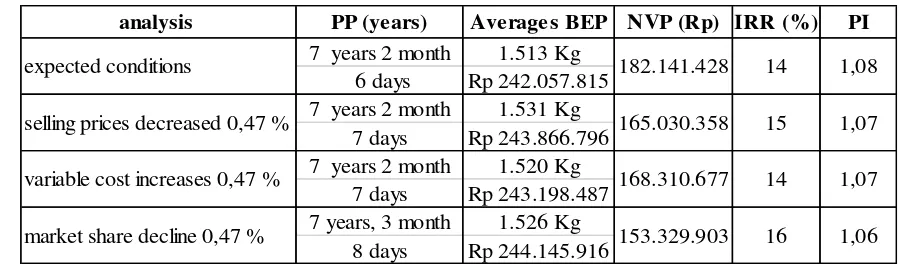
This analysis seeks to provide an overview of the influence of various parameters against the feasibility of the business. The parameters are include: changes in selling prices, variable costs changes and market share changes.
Table 13. Working Capital Requirement
No Group Fees Total Amount (Rp)
A Production Fees
1 Raw And Auxiliary Materials Purchase Costs 204.859.220
2 Factory Overhead Cost 30.000.000
Sub Total 234.859.220
B Business costs
1 marketing costs 9.939.913
2 Labor 141.000.000
3 general and administrative expenses 9.000.000
4 buildings and office equipment maintenance 15.600.000
Sub Total 175.539.913
Working Capital Requirements (1year) A+B 410.399.133 Working Capital Requirements Per Period (Months) 34.199.928
Table 14. Estimated Revenue
Source: Data Processing
Chocolate Chocolate Chocolate
Couverture Couverture
(Dark) (Milk)
2016 29689467 59378933 415652532 504720932
2017 34973839 69947678 489633748 594555265
2018 40258077 80516154 563613077 684387308
2019 45542179 91084359 637590510 774217048
2020 50826149 101652291 711566039 864044479
2021 56109975 112219950 785539652 953869577
2022 61393667 122787334 859511341 1043692342
2023 66677221 133354442 933481096 1133512759
2024 71960636 143921173 1007448908 1223330717
2025 77243912 154487824 1081414766 1313146502
year Total (Rp)
Liquor
68 CONCLUSIONS AND
RECOMMENDATIONS
Conclusions
1. Analysis of Business stated that chocolate processing plant was declared feasible, as in the know that the level below the average market price.
2. Technological and Technical Aspects Based on the analysis of the and facilities, production machinery and equipment needs, the capacity of the production capacity and the production process is relatively easy fulfilled and realized.
3. Management and Organization Aspects Judging from the organization and management aspect, as well as based on the results of the analysis it can be concluded that the business of chocolate processing plant is feasible. The needs against labor is in accordance with the wishes good company management section and production section is easy to obtain, as well as the maintenance of legality companies
easily obtained. 4. Financial aspects
Judging from the financial aspects, efforts chocolate processing plant is feasible. It can be seen from some of the parameters of the feasibility assessment for investment, including:
a. NPV>0, amounted Rp. 182.141.428 which means that the business of cocoa processing plants is feasible,
where the NPV value indicates a benefit or a net income, received
during the economic life of the project on the level of discount (discount factor) that applies (10%).
b. IRR obtained from financial analysis is 14% where the IRR is greater than discount factor which is 10% applicable. The IRR value indicates the level of internal projects at 14% and for IRR> 10%, then this business is feasible and profitable.
c. Profitability Index (PI) obtained value is 1.08 which states that businesses of cocoa processing plant is feasible. Profitability value equal to the index of 1.08 means that every RP 1 costs incurred over the life of the project resulted in a net benefit of 1.08 units. d. Payback Period (PP) has a payback
investment costs period it is for 7 years, 4 months, 11 days
e. Breakeven point (BEP) in the first
year as many as 2,022 kg or Rp. 323.561.529. Thus, the effort is feasible because it would be profitable Table 15. Sensitivity Analysis
The Parameters Increase Determines Based on the Consumer Price Index (CPI) in Palu, Prevailing by 0.47%.
analysis PP (years) Averages BEP NVP (Rp) IRR (%) PI
7 years 2 month 1.513 Kg 7 years, 3 month 1.526 Kg
69 for the owners of the investors or
owners of capital. f. the sensitivity analysis
From the results of the sensitivity analysis shows that all parameters compared to the base case, It produce a positive value. Thus, the effort is feasible.
Recommendations
The management of the Chocolate House should use the standard of feasibility which had and stated positive results, the eligibility can be used in carrying out the operational activity and gains more significant profit for the company.
In order for a cocoa processing business can be run well, the cooperation between relevant agencies such as the Department of Trade and Industry and the Department of Plantations ere needed. It aims to maintain the quality of the raw material for the chocolate production.
The House of Chocolate company should always pay attention and control so that volume of sales did not decline, this can be done by doing collaboration with chocolate SME associations and others groups as well as doing promotions so that the chocolate products is well known by the people in Central Sulawesi and also from outside the city.
REFERENCES
Dinas Perindustrian dan Perdangangan Provinsi Sulawesi Tengah, 2015. Data IKM Cokelat.
Dinas Perkebunan Provinsi Sulawesi Tengah, 2013. Laporan Perkembangan Produksi Tanaman Kakao di Provinsi Sulawesi Tengah. Palu. Sulawesi Tengah.
Dinas Perkebunan Provinsi Sulawesi Tengah, 2015. Laporan Perkembangan Produksi Tanaman Kakao di Provinsi Sulawesi Tengah. Palu. Sulawesi Tengah.
Jasman,p, 2004. Perkakaoan Indonesia. Makalah Simposium Kakao 2004, Tanggal 4-5 Oktober 2004 di Yogyakarta. Penyelenggara : Pusat Penelitian Kopi dan Kakao Indonesia. Jember.
Kasmir dan Jaktar, 2006. Studi Kelayakan Bisnis. Penerbit : Kencana Prenada Media Group. Jakarta. Martono dan hardjito, 2005. Manajemen Keuangan. Penerbit : Ekonosia. Yogyakarta.
Mulato,S., Widyomoto, Misnawi, dan Suharyanti, 2005. Pengolahan Produk Primer dan Sekunder Kakao”. Pusat Penelitian Kopi dan Kakao Indonesia. Jember.
Said, E.G. dan Intan, 2004. Manajemen Agribisnis, Cetakan Kedua. Penerbit : Ghalia Indonesia. Jakarta. Semaoen, I., 2000. Pengantar Menuju Agribisnis, Cetakan Ketiga. Penerbit : Gadjah Mada University Press.
Yogyakarta.
Sikumbang. Z, Antonius P dan Madang S.M, 2004. Prospek Pengembangan Industri dan Ekspor Hasil Olahan Kakao Indonesia. Makalah yang disampaikan pada Simposium Kakao 2004, tanggal 4-5 Oktober 2004 di Yogyakarta. Penyelenggara : Pusat Penelitian Kopi dan Kakao Indonesia. Jember. Soekartawi, 2005. Agribisnis, Teori dan Aplikasinya. Penerbit : PT. Raja Grafindo Persada. Jakarta.
Sudibyo, A.,Hartisari, H. Dan Arbaimah, 1999. Model Perecanaan Pengembangan Industri Kakao di Indonesia. Warta IHP. Volume 16 (1-2): 10-19
Sumardjo,J.S., dan Darmono, 2004. Teori dan Praktek Kemitraan Agribisnis, Cetakan Pertama”. Penerbit : Swadaya. Jakarta.
70 Sustrisno, 2003. Manajemen Keuangan, Teori, Konsep dan Aplikasi, Edisi PertamaCetakan Ketiga. Penerbit
: Ekonisia. Yogyakarta.
Tadjo, M., 2004. Dampak Agribisnis Kakao Terhadap Perekonomian dan Pendapatan Asli Daerah Sulawesi Selatan. Makalah yang disampaikan pada Simposium Kakao 2004, tanggal 4-5 oktober 2004 di Yogyakarta. Penyelenggara : Pusat Penelitian Kopi dan Kakao Indonesia. Jember.
Tjakrawedaya, Subiyakto, 1999. Pengantar Menuju Agribisnis, Cetakam Kelima. Penerbit : Universitas Gadjah Mada. Yogyakarta.
Umar, H. 2003. Studi Kelayakan Bisnis, Edisi Kedua. Penerbit : Gramedia Pustakan Utama. Jakarta.
Widyatomo, S dan Mulato, 2004. Rekayasa Proses dan Alat Mesin Pengolahan Produk Hilir Kakao untuk Skala Kecil Menengah. Makalah yang disampaikan pada Simposium Kakao 2004, tanggal 4-5 Oktober 2004 di Yogyakarta. Penyelenggara : Pusat Penelitian Kopi dan Kakao Indonesia. Jember. Winadri, Benny, 2006. Menciptakan Jiwa Kewirausahaan. Penerbit : Graha Ilmu UIEU. Jakarta