“You Don’t Have To Be Innovative In the Creative Industries”
A Study of Entrepreneurial Orientation and Social Capital in Creative
Industries
Dewi KusumaWardani, LenyNoviani, Muhammad Sabandi and Feri Setyowibowo Prodi Pendidikan Ekonomi FKIP UNS
Corresponding e-mail:[email protected]
Abstract: Competitiveness and performance of businesses in the creative industry have the disadvantage of resource management and development and entrepreneurial policies. Creative industries covering the fashion industry, design, and craft are industries that expected to be able to competewith the establishment of the Asian Economic Community (AEC) by 2015. To improve the capability to compete in the regionally and globally, internal capabilities such as Entrepreneurial Orientation (EO) and social capitals (SC) of companies in the creative industry need to improve. Entrepreneurial Orientation has been the focus of many researchers and contributed significantly to the development of entrepreneurship literature over the decades. This fact supported by empirically significantfindings contributedby various researchersin the literature. However, up to the date there are many debates and require more research, specifically in the robustness of the dimensions within creative industries. The current research using Mixed Methods analyses tested the EO and SC model to 60 entrepreneurs in the creative industries within specific areasof fashion, design and crafting in Central Java regions. Findings suggested that in the creative industries, EO varied to those companies in manufacturing and technology industries. The current research contributed to the literatureby (1) modelling the EO in the creative industry, (2) confirming previous research findings on Entrepreneurship Orientation, (3) suggesting the source of competitive advantage in this industry, (4) social capital not adopted scientifically.However, these findings should require more extensive research and tested across regions. Hence, the directions for future research are implied in the research limitations section.
Keywords: Entrepreneurship Education, Entrepreneurial Orientation, creative industries, developing country, innovativeness, risk taking, proactiveness
1. INTRODUCTION
The Creative industries in recent years have received considerable attention from the Indonesian government. This sector has created 11.8 million jobs and able to contribute 6.9% of the Indonesian Gross Domestic Product (GDP) in 2012by Biro Pusat Statistik (2013) but to make the country be able to compete in the AEC and global competition the capacity of companies in this sector, it needs to improve further.Latest data from the World Economic Forum shows this sector rankedon the 70thin export during the year 2013 with total values Rp. 119 billion of which 60% comes from the creative fashion products and 12.2% comes from crafts products.Similar trends reported in developed countries for the significance contributions of creative industries (Flew, 2005 ).Along with the enforcement of ASEAN Economic Community (AEC) forum by
2015,this sector is predicted will be facingfiercer
competition in the upcoming
years.Entrepreneurial Education Programmes supporting the business education in preparing the current students with relevant expertise and capabilities to be successful in their future businesses (Matlay, 2008). Although creative industries in Indonesia have been around for many years, nonetheless only recently that entrepreneurship studies interested in this type of industry to find the supporting avenue for development of businesses entrepreneurial competence (Chaston & Sadler-Smith, 2012).
2014). These requires serious attention to support the creation of qualified entrepreneurs to build a small business that strong and enhancing company performance which mostly affected by the Entrepreneurship orientation, external
environment and business strategy
tough(Chaston & Sadler-Smith, 2012).Then it is the job for current educators to provide relevant teaching environments and appropriate business knowledge in business (Alberti, Sciascia, & Poli, 2004). Within these reasons, it becomes apparent for business educators to test the suitability of entrepreneurship models in various business environmentsto see its applicability in current business settings (Brown & Hanlon, 2014).
Given the potential significance of creative sector, there are growing significance to boost economic performance and business growth, the current research focus solely on the single aspects of organisational capacity within organizational theory or strategic management literature(Baum, Locke, & Smith, 2001). Framework for the research is to provide suitable strategies to improve the competitiveness of the creative industries started by developing the internal capabilities. An established theory in organisational behavior and structure in entrepreneurship are the development of Entrepreneurial Orientation (Lumpkin & Dess, 1996)and Social Capital (Adler & Kwon, 2002). These two constructs had beenwidely cited and researched in the field. By commencing with established theories, the research can be focused on another aspect of the theories.
Increasing the Entrepreneurship Orientation is increasing the company capabilities to develop entrepreneurial behavior because it can expand the choice to explore the potential of production owned economic enterprises actors (Gries & Naudé, 2010). The entrepreneurial capability is also a strategy that can identify and exploit business opportunities
(Kumalaningrum, 2012). Furthermore,
entrepreneurial capabilities are methods, practices, and decision-making style to act in entrepreneurially behaviors(Carsrud, Brannback, Nordberg, & Renko, 2009). In addition to the entrepreneurial capabilities, the competitiveness of the creative economy can be improved through the development of the social capital.
Prusak and Cohen (2001) and Lin, Cook, and Burt (2001) suggests that social capital is a social relationship and can be used as social glue to keep the unity of the group members in achieving the goals. Increased social capital can enhance social relations and cooperation between economic operators concerned so as to increase competitiveness when entering the international market (Acquaah, 2007; Aidis, Estrin, & Mickiwiez, 2008; Maurer & Ebers, 2006).
In Entrepreneurship studies, the one of established model of highly competitive companies is the Entrepreneurial Orientation theory (Covin & Slevin, 1989; Lumpkin & Dess, 1996). However, many researchers still debating about the dimensions and robustness of this construct in different industrial settings (Chaston & Sadler-Smith, 2012), specifically creative sectors that are in still in early growing stages. These facts show there is a significantgap to be able to provide the type of industrial cluster that havinga different set composition of EO that affect the company's performance (Covin & Lumpkin, 2011). The purpose of the current study is to find policy strategies and training models that can extend the capabilities of entrepreneurship and social capital of the entrepreneurs in creative sectors specifically in fashion, design and craft industries.
1.1. EO in Creative Industries
The creative industry is characterised by large labour inputs and notable for distinct management style from other kinds of industries (Chaston & Sadler-Smith, 2012). Several researchers have studied the EO of several industries of creative industries. (Lukiastuti, 2012) in her attempt to measure the contributions of EO toward thebusiness performance of Batik producers in Jawa Tengah, found that
In a preliminary study of the creative sectors business activities in Central Java,Wardani and Noviani (2012)how that entrepreneurial skills of the owners in the creative sector are still in simple fashion. Hence,relevant withWardani, Wahyuningsih,
Nugroho, and Sabandi (2014), these
Pambudi, Wardani, and Sabandi (2014) also showed that business actors in other economic sectors in Central Java do not have the management skills and good social capital management. In anattempt to increase the capability,Wardani and Mulyanto (2012) found that increased knowledge of the design of business actors metal craft creative economy
sector can boost performance and
competitiveness. On the other hands, it also showed that the developments of training can improve and empowering businesses owners’
capability in creative economy sector specifically of fashion industries. Wardani and Noviani (2012)to develop that knowledge of design on business owners in creative economy handicraft sector can improve the performance and competitiveness.
Entrepreneurial Orientation
entrepreneurial behaviour is defined as a behavior of ahigh-performance company that characterized by: dare to take on high-riskactivities, be proactive against the competition and always make innovations in running production and business processes (Covin & Slevin, 1989). The measurement results of EO provides an overview oftraits policy strategy taken by firm in directing the company's ability to create an advantage over othercompetitors(Rauch & Frese, 2009), and of course, this will eventually create success and
boosting performance better than the
competitors. This construct intended to measure the tendency of the companies in conducting its business that describedfalls within two poles: entrepreneurial and conservative (Miller, 2011). Companies with high EO considered having anentrepreneurial character that always aimed for growth and possess the characteristics of high risk-taking, always creating innovations and bold moves to anticipate rather than reactive (Rauch & Frese, 2009). On the other hands, for more conservative firms the opposite is true, that it tends to avoid the risk of thebusiness, rarely innovate and do not anticipate changes in competitions. Based on acompany that has such a strongEO, many empirical studies supported the existence of a significant positive relationship between EO and company performance (Rauch, Wiklund, Lumpkin, & Frese, 2009), and there
have been many previous studies that supported the correlation relationship between EO and performance of the company.
In a literature study on the role of entrepreneurship orientation in the creative industries provides gapsneed to be explored further in thecapacity development of knowledge, specifically in the creative industries
(Chaston & Sadler-Smith, 2012).
Entrepreneurship in the company's orientation is influenced by a difference rivalry and competition in the industry (Covin & Slevin, 1989) so that each industry has different EO character as well. In some previous studies, EO relationship with the company's performance depends on the type of industry and the level of the business environment (Wiklund, 1999). The contingency provides agap to study the important sets of EO within different industrial clusters to know which composition affect the company's performance (Covin & Lumpkin, 2011). However, implementation and application orientation of Entrepreneurship in the creative industries is still considered very scarce (Chaston & Sadler-Smith, 2012).
Previous studies reported that in some cases within specific contexts give different results
between EO and performance of the
company(Wales, Gupta, & Mousa, 2013). In a study on high-tech enterprise(Stam & Elfring, 2008), more EO leads to innovation but not on proactiveness.The different composition shows that a firm will create higher performance characterized by high Entrepreneurial Orientation, specifically in a hostile environment(Chaston & Sadler-Smith, 2012). However, theresearcher found acontradiction in testing the Entrepreneurial Orientation in Batik industry in Central Java that theonly risk taking and proactiveness contributed significantly
toward company performance,and that
contributed to the inconsistencies in the creative sectors settings.
Entrepreneurial orientation as reflected in the attitude of innovation, proactive and risk-taking, competitive aggressive and autonomy is believed to be able to boost the company's performance (Lumpkin, Cogliser, & Schneider, 2009). is corroborated with (Covin, 1991; Wiklund, 1999), which states that the higher entrepreneurial orientation can enhance the company's ability to market its products towards and enhancing business performance (Rauch & Frese, 2009). The EntrepreneurialOrientation of the entrepreneurs can lead to increase in operating performance was also delivered (Covin, 1991).
1.2. Social Capital
The current research adopted the theory of social capital based on the definition of social capital described by (Nahapiet & Ghoshal, 1998) which is the total number of potential and current resources available and accessible because of the network of relationships that owned by an individual or a social group. In the literature on entrepreneurship, even though social capital has researched previously but in its application prior research has many forms of operations and the measurement scales that makes the concept of social capital is hard to make a comparation of one to another research (Stam, Arzlanian, & Elfring, 2014).
Following the definitions from (Burt, 1997) and (Fornoni, Arribas, & Vila, 2011) social capital at the aggregate level is generally defined as those in the "features of social organization, such as trust, norms and networks, that can improve efficiency society by facilitating coordinated actions." In short, (Mariel Fornoni, Ivan Arribas, & Jose E. Vila, 2012b) suggested that social capital refers to social relations among persons generating productive results. Social networks could be a valuable resource since they can supports and facilitates economic activity and allowing entrepreneurs to access resources that impossible to obtain without relationships (Nahapiet & Ghoshal, 1998).
1.3. Entrepreneurial Orientation and Performance
In literature, researchers divided
performance into three categories of
measurements: financial, non-financial and subjective measurement (Runyan, Droge, & Swinney, 2008). However, it should also be understood that the outcome of entrepreneurship study is usually used as an exogenous (independent variable), has a lot of variations that comparing between research is difficult, made it impossible to be confirmed or confronted (Murphy, Trailer, & Hill, 1996) because of differences in industrial types, size of the company and other issues. Nevertheless in many of entrepreneurship research fields applying the analytical tools altogether to see the performance at the firm level or individual levelby the management theory that an entrepreneur as the owner is certainly expecting totarget the same performance with corporate goals and majority owner (Covin & Wales, 2012). From the contingency theory means that the performance of the company performance is a derivation by the company top management(Bygrave & Hofer, 1991).
These shed some similarities and differences objectives in the creative industries in the models of performance measurement. Therefore,it is important in thecurrentstudy to test the research so that the questionnaire can apply to another similar objective in the future. The main purpose of the current research is to get information about the determinants that affected the company's performance in the creative industries in Central Java especially the contribution of social capital and entrepreneurial orientation.
H1: there is a significant contribution of all
dimensions in Entrepreneurial Orientation of creative industries toward firm performance.
1.4. Social Capital and Entrepreneurial Performance
2008). The entrepreneurial orientation may have astronger association with performance when the high social capital appears. As social capital enhance the resource that can only accessible through the network and structural ties between the actors (Fornoni et al., 2011).
Previous research has suggested that the access to finance, markets and information critically contributed toward the entrepreneurial performance (Mariel Fornoni, Iván Arribas, & José E Vila, 2012a). These resources can be
provided by social capital of the
founders/entrepreneurs. Hence the social capital research had also found similar relationships of the contributions of social capital toward firm performance by extending the network of the founders (Stam & Elfring, 2008). On their research,they show that performance and network centrality have interactive relationship, but depends on the entrepreneurial orientation of the firms.
However, learning from existing literature, social capital has several approaches. Contrary to the widely used model of social capital that measuring the capability and capacity of the organization in making networks (Adler & Kwon, 2002; Stam & Elfring, 2008), SMEs in creative industries are highly depends on the founder/entrepreneurs. Although this view is not new, it will be contradictive with existing measurement that measuring organisation level. Therefore the current research using the (Fornoni et al., 2011)individual level model of social capital that already found to correlate with entrepreneurial performance.
H2: Social capital significantly influences
entrepreneurial performance through
entrepreneurial orientation.
2. RESEARCH METHOD
This study is a part of broader research in mapping the condition of Entrepreneurship Orientation and the use of Social Capital in the creative sector in Central Java. In-depth interviews are used to ascertain the orientation of the model of entrepreneurs Entrepreneurship. In this research data collection models with in-depth interviews with 60 entrepreneurs in thecreative industry could represent the
population representativeness. In this preliminary study, the population generated based on membership of the employers within the creative industry whose are the members of the Chamber of Commerce of Central Java. For convenience purpose for collection, data gathered using purposive sampling method.
All of the Items are consulted to the language experts specifically to assess whether the instruments in this study are valid or not because most of the scales in this study refer to the foreign literature. All the scales were then translated into Bahasa and then back translated
into English for any inconsistency
checks(Brislin, Lonner, & Thorndike, 1973). Expert in entrepreneurship study consulted to assess the questioner readability of assessing the Likert scale instruments ranging from one, which means the item so not describes the concepts being measured and the other extreme that the number seven means very illustrate the concepts being measured. The results show that not all items qualify or be able to measure the concept. This study uses only those items have reached criteria described the concepts previously.
2.1. Measurements of Entrepreneurial Orientations
In this research, the entrepreneurial orientation considered as the focal point for the research. In this research, the items for entrepreneurial orientation obtained from previous research available in the literature. These items based on (Covin & Slevin, 1989).
Innovative refers to the attitude of thecompany to engage in creative activities in the process experimenting with new ideas that allow generating new production methods resulting in new products or services, both for the existing market and into new markets (Covin & Slevin, 1989). Innovative capability and activity related to the creations of new products and serving thenew business.
entrepreneurship in anticipation of new threats and opportunities.Being proactive in business, this item measured with theidentification of new opportunities and threats, actively being the first to move in the industry.
Risk Taking or risk-taking is an act of an entrepreneur who has the willingness to exploit available resources to be able to run a job even without the certainty of the results to obtained(Dess, Lumpkin, & Covin, 1997). The effort to be the able to take arisk in need some supporting factors as an indicator that the business person has had a dimension of Risk Taking in Entrepreneurship orientation. This factor measured by manager tendency to take risky business, bold and risky action to reach the goals and take bold decisions.
2.2. Measurement of Social Capital
The structure is about all forms of relationships and resources that can be accessed by someone because he or she is in a position in a particular organization's network structure. In analysing social capital because this structure there are two important parts, the depth of the network in the industry (intra-industry network centrality) and the breadth of tissue outside the industry (extra-industry bridging ties) (Fornoni et al., 2011). Depth of networks in industry defined as a level where an organization has of connectedness directly with many other companies through the network ties (Stam & Elfring, 2008), the high of depth company's network is notated by the fewer number of nodes required to access other person or firm in the network, while the breadth of networks outside the industry is defined as the number of connectedness owned by a firm within or outside the industry. This dimension is measured by the number of connections and other characteristics of the network configuration such as depth, hierarchical relationships exist or the level of connectivity in the network (Fornoni et al., 2011).
Relational is a contrary to the structural relationship, defined as the degree of closeness of the relationship in accordance with the development of the relationship between a person and another person (Nahapiet & Ghoshal, 1998), that this dimension focuses on the kind of
relationship someone has, such as mutual respect and friendship that ultimately affect the relationship of cooperation between the two personal that exist in the network. This dimension is important to anticipate. For example, on the same network, two persons with different personal attachment will behave differently and eventually will affect the behavior and business decisions. This dimension measured by displaying the number of thetwo-way relationship between the principal actor in the network and the number of connectedness that nurtured by these actors (Fornoni et al., 2012b), or also can measure by the length of the connectedness.
On the other hand, the relative dimension measures the value of resources that can be provided by the actors in the network that signify the quality of each of connectedness that may include power, sharing of experience, wealth and others (Fornoni et al., 2011). In other words, this dimension measures the likelihood of this resource accessible by someone from the network.
2.3. Performance measurement
Can be measured in metric usually a financial calculation, the percentage or employment growth (Lumpkin & Dess, 2001). In measuring the calculation that isquantitative, it may be difficult for companies that do not have properly accounting and bookkeeping. Therefore, in measuring the performance, the current research used adaptations of the model measurements were carried out by(Chaston & Sadler-Smith, 2012)that provided a choice in respondent answers.
3. RESEARCH DESIGN AND DATA
COLLETCIONS
industries, respectively there are 20% from fashion industries, included were the batik fashions outlet, wholesaler and other fashion outlets. 28% is from design industries, included the batik producers, shoemaker and clothes printing factories. The other 55% craft industries, such as handy craft factories, metal crafting and guitar maker ventures.
Table 1. Respondents and industries
Industries Regions N
Design Bantul 1
Craft Boyolali 17
Fashion Klaten 5
Craft Klaten 2
Craft Sleman 3
Design Sragen 9
Craft Sragen 10
Fashion Sukoharjo 1
Design Surakarta 1
Fashion Surakarta 6
Craft Surakarta 1
Design Yogyakarta 4
Total 60
Source: data
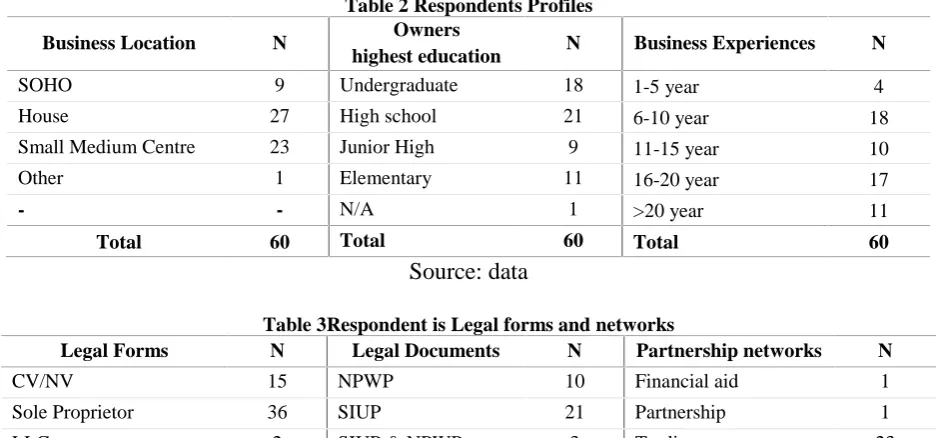
Business locations of 43% the respondents located in the residential and 38% in
industrial areas, such as small and medium of the craft sector metal (copper, brass, aluminum and iron), furniture, and batik. There are also for 19%
respondents’ business locations in the shop as
SMEs in the fashion sector, children's toys crafts and many others similar businesses pointing the firmslocations were the workshops that are operating as producing factories and dwelling addresses, most of the case in the sector of batik and fashion.
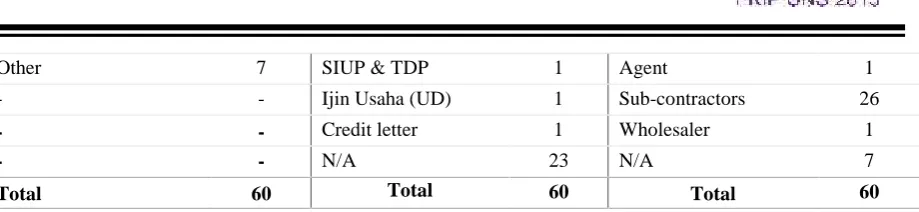
The highest education attended by themajority of the SME owners in this study graduated from high school, then college, elementary, junior high and only one non-educated. Regarding the business experience, there are only four respondents who have newly started the business while the other have average is long enough and some even up to 50 years. The legal forms of the business entities of respondents are mostly private companies which mean that the entrepreneurs are the major decisions maker. SME is a private firm located in most of the sectors of metal handicrafts, batik and children's toy. Furthermore, there are 15 SMEs in forms of CV/NV, 2 SMEs are Limited Liability Companies, and other forms of business entities there are 7 SMEs. Other forms of business entities in this study are the Trade Enterprises (UD), and others are aprivate company
.
Table 2 Respondents Profiles
Business Location N Owners
highest education N Business Experiences N
SOHO 9 Undergraduate 18 1-5 year 4
House 27 High school 21 6-10 year 18
Small Medium Centre 23 Junior High 9 11-15 year 10
Other 1 Elementary 11 16-20 year 17
- - N/A 1 >20 year 11
Total 60 Total 60 Total 60
Source: data
Table 3Respondent is Legal forms and networks
Legal Forms N Legal Documents N Partnership networks N
CV/NV 15 NPWP 10 Financial aid 1
Sole Proprietor 36 SIUP 21 Partnership 1
Other 7 SIUP & TDP 1 Agent 1
- - Ijin Usaha (UD) 1 Sub-contractors 26
- - Credit letter 1 Wholesaler 1
- - N/A 23 N/A 7
Total 60 Total 60 Total 60
Source: data
The partnership that conducted by respondents in this study were mostly (43%) in forms of sub-contracts. Sub-contracting is usually a partnership between SMEs with similar business already large to produce the product. SMEs that have sub-contract partnerships engaged in the field of iron handy crafts, batik, fashion and design. SME partnerships that pretty much also is a type of trading partners (38%) that the business activities or the production process of SMEs are intended to supply goods to larger businesses. In this study, SMEs and trade partnerships are mostly SMEs which produce furniture, clothes or T-shirts and batik products. Furthermore, the rest of respondents that are havingonly one partnership in forms of capital assistance, guidance, franchise and agency trading at the same time.
3.1. Validity test
Firstly, the instruments tested in two ways, content and construct validity(Cronbach & Meehl, 1955). The analysis used to assess the validity of the content items that exist in this research instrument is to check the adequacyrepresenting the concept being measured. The other analysis in the study, the construct validity is to examine whether the content of instruments used in this study valid by consulting with experts in entrepreneurship. For its consistency inmethodology,by doing the Focused Group Discussion (FGD)(Bolton & Lane, 2012).
Furthermore, to determine the reliability, the study calculates the value of Composite Reliability and Cronbach's Alpha of constructs used. The test results produced Cronbach's Alpha values> 0,600 and composite reliability> 0,700 thus measurement results in this study are consistent or reliable, although measurements were taken twice or more of the same symptoms(Gefen, Straub, & Boudreau, 2005).
4. DATA ANALYSIS
Once the instrument passes thetest the validity of the content, the instrument used to pilot toward 15 respondents. The result is that in terms of language, the instrument has to be understood by the respondents with the best comprehensions and the items used have been able to describe the concept to be measured. Then testing using all of the respondents, and apply the confirmatory factor analysis (CFA)
resulting factor loading above the value of 0.5 (λ
= 0.5) on all items of questions. Means all items thesescales are valid and able to measure the variables or concepts are used in this study.
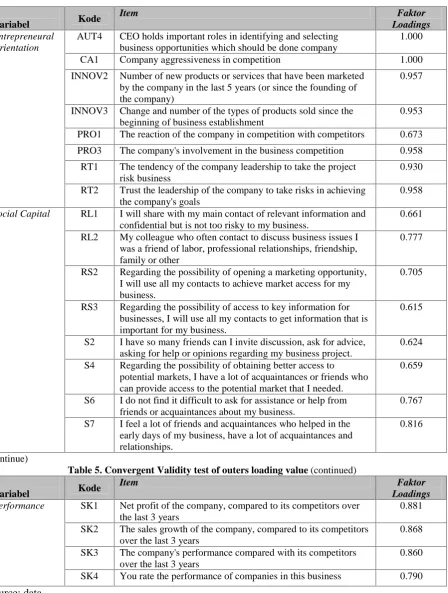
After all tested, the instruments are then used to conduct a survey. Test how well the results of instruments capable of measuring and defining a construct tested through convergent validity (convergent validity) and discriminant validity (discriminant). Convergent validity of the test results produced by the loading factor values above 0.5 and significant for all the question items. Besides this through statistical observation value Average variance extracted (AVE) obtained figures above 0.50 in all the variables. Referring to(Fornell & Larcker, 1981) that the instrument is said to be valid if all the items loading factor is significant if>0.50 and variance extracted average value>0.50. If these are reachedthen all of the items used in the study have had no doubt about the validity of the statistical.
Table 4Structural Test Results
Variable Cronbac
h Alpha
Composit e Reliability
R-Squar
e
Autonomy 1.000 1.000 0.087
Competitive
Innovativeness 0.904 0.954 0.111
Performance 0.872 0.913 0.191
Proactive 0.604 0.809 0.155
Risk Taking 0.881 0.943 0.091
Social Capital 0.861 0.887 Source: data
PLS analyses applied to test the Structural model. PLS were chosen because the capability to provide less stringent demand in the
measurement scale, sample size and
distributional assumptions (Chin & Frye, 1998).
5.1. Model Testing Results
The PLS results on path coefficient, significance and variance explained (R2) in this
model provided in the table 5. All hypothesised are significant in the level 0.01 or above. This model provides a good the relationship of social capital contribution toward entrepreneurial orientation and entrepreneurial performance and path analysis provided in the figure1.
The test results showed that the variation of the variable Autonomy is able to be explained by the Social Capital variable at 8.7%, the variation in the Aggressive Competitive variable can be explained by the Social Capital variable of 12.7%; Innovativeness variation can be explained by the Social Capital variable of 11.1%, the Proactive variation can be explained by the variable Social Capital 15.5%; Taking risk can be explained by the Social Capital variable at 9.1%. Meanwhile 19.1% of the variation that occurs in the Performance Variables can be predicated by the variables Autonomy, Competitive Aggressive, Innovativeness, Proactive, and Risk Taking together.
5. DISCUSSION
The research was motivated by the need to better understand the contributions of Social capital and Entrepreneurial Orientation toward entrepreneurial performance. The findings suggested that Social Capital through Entrepreneurial Orientation determined important role for entrepreneurial performance. Although contribute significantly, however the
relationship having different contribution toward each of the dimensions in EO. These differences might also related to the different business environment that usually contributes to different sets of innovativeness, proactiveness and risk-taking variations in entrepreneurial orientation (Kreiser et al., 2002) rather than aggregated model as suggested by (Covin, 1991).
Results of the study indicated that social capital significantly influences towards all dimensions of EO. However, among these dimensions, only risk taking not significant. The low levels of risk taking contributions toward entrepreneurial performance. This is in line with result of Chadwick, Barnett, and Dwyer (2008)that risk-takingwas not able to load into one dimensions and had to combined together toward other variables.
This is finding also in line with Kreiser and Davis (2010 p. 39)whom indicate that increases in firm performance related to EO are contingent upon theenvironmental context in which the firm is operating as suggested byLumpkin and Dess (2001).While this finding contradictive from EO streams, but nonetheless thisalso confirm the business environment
influencescreating different sets of
entrepreneurial orientation (Chaston & Sadler-Smith, 2012). The business environment can vary in the range from benign to hostile (Covin & Slevin, 1989). A hostile business environment is characterized by fierce industrial competition, harsh business climate and the scarcity in business opportunity (Zahra & Neubaum, 1998). On the other hand, benign environment provide relatively calmer business competition, safe business climate and predictable consumer expectation (Covin & Slevin, 1989).
conservative strategy provides convenience and growth, however with high pace of industrial and global competitions, sooner or later these industries should also prepare for entrepreneurial strategies.
Studying from the previous research of EO in international context, there might be bias in the perceived about the measurements, specifically in international contexts that has different sets of local culture, may contribute to preferences bias (Kreiser, Marino, Dickson, & Weaver, 2010). Some items in proactiveness and risk taking measures are contradictive with local values. Although these measures had tested previously for the consistencies across cultures (Kreiser et al., 2002), however with different samples setting may result differently.
The current empirical results however, inconsistent with empirical findings from Lukiastuti (2012) in the similar contexts. This difference may because of variations in the samples that consist of various types of creative forms of ventures, while in that research only toward batik owners. This is also confirming the Covin and Lumpkin (2011) that entrepreneurial orientation highly depended on the industrial types of competitiveness.
Other source of differences may also because of the social capital negative contributions toward risk taking. Social capital helps entrepreneur to obtain resources that only available through his/her relationships (Fornoni et al., 2012b). It includes the formal and informal links that can be manageable to the discretion of the entrepreneur to get the profit from this links.While Social Capital and Entrepreneurial Orientation in this research proved to be significant; however it only provided medium predictions toward performance. In this case, the perceived business environment also contributes toward these relationships (Stam et al., 2014).
The current research was also motivated to test the consistency of multidimensional social capital as suggested by Fornoni et al. (2011)that arguedto be different with other previous studies. Testing the consistency, research found that all of these variables in social capital were able to load completely. This can be considered that the social capital indeed a multidimensional model.Furthermore, different to those
dimensions provided by Adler and Kwon (2002) and Nahapiet and Ghoshal (1998) that measure organisational level, the Fornoni et al. (2011)model measures the intensity, the quality and the resource of the relationship within the
individual realms.In this case,
founder/entrepreneur as the main actor in SME has to make the business decision making individually (Covin, 1991). Hence the measurement of SC in individual level analysis suitable for the current research and proved to be significantly influenced Entrepreneurial Orientation in creative industries in Indonesia setting.
However, this construct also provided mixed results. The social capital contributed significant but negatively toward proactiveness and risk taking.The differences of these contributions toward EO brought new insight into the business understanding.
Social capital provide resources that can only be accessible with the network of the entrepreneur as the actors (Adler & Kwon, 2002). High social capital can provide source of information, technology and opportunitiesthat available instantly (Stam & Elfring, 2008). Based on this fact, rather spending the resource on anticipations for business changes, a firm with high social capital CEO can focus on maximizing resources for existing opportunities (Fornoni et al., 2012b), hence will not take risks
unnecessary. Furthermore, because of
information about opportunities most of the time can be provided by networks, it can hamper the willingness for entrepreneurs to embrace strategic positions. With no intentions to compete with other firms, high social capital can make firm less proactive.
Table 5. Convergent Validity test of outers loading value
Variabel Kode
Item Faktor
Loadings Entrepreneural
Orientation
AUT4 CEO holds important roles in identifying and selecting business opportunities which should be done company
1.000
CA1 Company aggressiveness in competition 1.000 INNOV2 Number of new products or services that have been marketed
by the company in the last 5 years (or since the founding of the company)
0.957
INNOV3 Change and number of the types of products sold since the beginning of business establishment
0.953
PRO1 The reaction of the company in competition with competitors 0.673 PRO3 The company's involvement in the business competition 0.958
RT1 The tendency of the company leadership to take the project risk business
0.930
RT2 Trust the leadership of the company to take risks in achieving the company's goals
0.958
Social Capital RL1 I will share with my main contact of relevant information and confidential but is not too risky to my business.
0.661
RL2 My colleague who often contact to discuss business issues I was a friend of labor, professional relationships, friendship, family or other
0.777
RS2 Regarding the possibility of opening a marketing opportunity, I will use all my contacts to achieve market access for my business.
0.705
RS3 Regarding the possibility of access to key information for businesses, I will use all my contacts to get information that is important for my business.
0.615
S2 I have so many friends can I invite discussion, ask for advice, asking for help or opinions regarding my business project.
0.624
S4 Regarding the possibility of obtaining better access to
potential markets, I have a lot of acquaintances or friends who can provide access to the potential market that I needed.
0.659
S6 I do not find it difficult to ask for assistance or help from friends or acquaintances about my business.
0.767
S7 I feel a lot of friends and acquaintances who helped in the early days of my business, have a lot of acquaintances and relationships.
0.816
(continue)
Table 5. Convergent Validity test of outers loading value (continued)
Variabel Kode
Item Faktor
Loadings Performance SK1 Net profit of the company, compared to its competitors over
the last 3 years
0.881
SK2 The sales growth of the company, compared to its competitors over the last 3 years
0.868
SK3 The company's performance compared with its competitors over the last 3 years
0.860
SK4 You rate the performance of companies in this business 0.790
6. CONCLUSION AND IMPLICATION
Most of the supports contributed by the Government in development of SMEs are in the form of funding and financial supports (Tambunan, 2006). Nevertheless, it has been reported that those supports unsuccessful (Bhasin & Venkataramany, 2010). We suggest that trainings and development to increase entrepreneurship, for example in opportunity seeking and networking developments. Contrary to current view that funding opportunities considered to be the most important requirement for entrepreneurs. However, with global competition, sooner or later this industry will be more saturated and entrepreneurial strategy will become logical.
Social capital for entrepreneurs provides influential resource to entrepreneurial strategy. Therefore, we also suggest a policy to create business links or network for the entrepreneurs to access information, opportunities and technologies. In the growing business, firms will require more opportunities information and technology anticipation also important to develop. Networks and structure can contribute as a security net for business development. Although, it is important for business but many entrepreneurs still not aware about social capital contributions for the availability of needed resources.
It can be seen that the majority of entrepreneurs in the creative industries in Central Java still not maximizing social capital and associations and relationships to gain for business performances. Social Capital can be acting as a facilitator to get access to finance, information and resources (Fornoni et al., 2012b). These are not the most important is to measure the effect of EO on the dimensions of social capital that has the resources, followed by relational and dimensional one. We concluded that access to this financing does not depend on the number of entrepreneurs of the network connection, such as its capacity to mobilize resources or contacts power (especially economic) and their motivation might have.
7. RESEARCH LIMITATION
This research also acknowledges the limitation for the current study. Firstly, data
collections on heterogenic sample that having different business environment types would be difficult to generalized (Stam & Elfring, 2008). We suggest for future research to test the results to bigger sample size and wider creative clusters.
Secondly, this entrepreneurial orientation is a set of strategic position taken by company as a response toward dynamic change for business environment (Covin & Lumpkin, 2011). Without inclusions of environmental variable in the measurement can hamper the wider view of the concept. We suggest for researchers to employ the environmental scan in future research.
Thirdly, we used samples based on convenience sample procedures, which might not give enough representation of the creative sectors. Future research with random sampling methods can provide better understanding for the concept.
8. ACKNOWLEDGMENT
This research is a part of a bigger research project from Penelitian Unggulan Perguruan Tinggi Negeri (PUPTN) Dikti.
9. REFERENCES
Acquaah, M. (2007). Managerial Social Capital, Strategic Orientation and Organizational Performance in an Emerging Economy. Strategic management journal, 28, 1235-1255.
Adler, P. S., & Kwon, S.-W. (2002). Social capital: Prospects for a new concept. Academy of management
review, 27(1), 17-40.
Aidis, R., Estrin, S., & Mickiwiez, T. (2008). Institutions and Entrepreneurship Development in Russia: a Comparative Perspective. Journal of Business Venturing, 23(6), 656-672.
Alberti, F., Sciascia, S., & Poli, A. (2004).
Entrepreneurship Education: Notes on an Ongoing Debate. Paper presented at the 14th Annual IntEnt
Conference, Napoli, Italia.
Baum, R., Locke, E. A., & Smith, K. G. (2001). A Multidimensional Model of Venture Growth. The
Academy of Management Journal, 44, 292-303. doi:
10.2307/3069456
Bhasin, B. B., & Venkataramany, S. (2010). Globalization of Entrepreneurship Policy Considerations for SME Development in Indonesia. International Business &
Economic Research Journal 9(4).
Bolton, D. L., & Lane, M. D. (2012). Individual Entrepreneurial Orientation: Development of a Measurement Instrument. Education + training, 54, 219-233.
Brislin, R., Lonner, W. J., & Thorndike, R. (1973). Cross
Brown, T. C., & Hanlon, D. (2014). Behavioral Criteria for Grounding Entrepreneurship Education and Training Programs: A Validation Study. Journal of Small
Business Management. doi: doi: 10.1111/jsbm.12141
Burt, R. S. (1997). A note on social capital and network content. Social networks, 19(4), 355-373.
Bygrave, W. D., & Hofer, C. W. (1991). Theorizing about Entrepreneurship. Entrepreneurship: Theory & Practice, 16, 13-22.
Carsrud, A., Brannback, M., Nordberg, L., & Renko, M. (2009). Cognitive Maps and Perceptions Of Entrepreneurial Growth: A Quasi-Experimental Study In The Differences Between Technology Entrepreneurs, Corporate Managers, And Students. Journal of enterprising culture, 17, 1-24.
Chadwick, K., Barnett, T., & Dwyer, S. (2008). An Empirical Analysis of the Entrepreneurial Orientation Scale. The Journal of Applied Management and
Entrepreneurship, 13.
Chaston, I., & Sadler-Smith, E. (2012). Entrepreneurial Cognition, Entrepreneurial Orientation and Firm Capability in the Creative Industries. British Journal of
Management, 23, 415-432.
Chin, W. W., & Frye, T. A. (1998). PLS-Graph version 3.0: Soft Modelling Inc. .
Covin, J. G. (1991). Entrepreneurial Versus Conservative Firms: A Comparison of Strategies and Performance.
Journal of Management Studies, 28, 439-462. doi:
10.1111/j.1467-6486.1991.tb00763.x
Covin, J. G., & Lumpkin, G. T. (2011). Entrepreneurial Orientation Theory and Research: Reflections on a Needed Construct. Entrepreneurship: Theory & Practice, 35, 855-872. doi: 10.1111/j.1540-6520.2011.00482.x
Covin, J. G., & Slevin, D. P. (1989). Strategic Management of Small Firms in Hostile and Benign Environments.
Strategic Management Journal, 10, 75-87.
Covin, J. G., & Wales, W. J. (2012). The Measurement of Entrepreneurial Orientation. Entrepreneurship: Theory
& Practice, 36, 677-702. doi:
10.1111/j.1540-6520.2010.00432.x
Cronbach, L. J., & Meehl, P. E. (1955). Construct validity in psychological tests. Psychological bulletin, 52(4), 281. Dess, G. G., Lumpkin, G. T., & Covin, J. (1997).
Entrepreneurial Strategy making and Firm Performance: Tests of Contingency and Configurational Models.
Strategic Management Journal, 18(9), 667-695.
Flew, T. (2005 ). Creative Commons and the Creative Industries. Media and Arts Law Review, 10(4).
Fornell, C., & Larcker, D. F. (1981). Evaluating structural equation models with unobservable variables and measurement error. Journal of marketing research, 39-50.
Fornoni, M., Arribas, I., & Vila, J. E. (2011). Measurement of an Individual Entrepreneur's Social Capital: a Multidimensional Model. International Entrepreneurial
Management Journal, 7, 495-507.
Fornoni, M., Arribas, I., & Vila, J. E. (2012a). An entrepreneur's social capital and performance: The role of access to information in the Argentinean case.
Journal of Organizational Change Management, 25(5),
682-698.
Fornoni, M., Arribas, I., & Vila, J. E. (2012b). An Entrepreneurs Social Capital and Performance Journal
of Organizational Change Management, 25(5), 682-698.
Gefen, D., Straub, D., & Boudreau, M. C. (2005). A practical guide to factorial validity using PLS-Graph: tutorial and annotated example. Communication of AIS,
16, 91-109.
Gries, T., & Naudé, W. (2010). Entrepreneurship and structural economic transformation. Small Business
Economics, 34(1), 13-29.
Kreiser, P. M., & Davis, J. (2010). Entrepreneurial orientation and firm performance: the unique impact of innovativeness, proactiveness, and risk-taking. Journal
of small business and entrepreneurship, 23, 39.
Kreiser, P. M., Marino, L. D., Dickson, P., & Weaver, M. K. (2010). Cultural Influences on Entrepreneurial Orientation: The Impact of National Culture on Risk Taking and Proactiveness in SMEs. Entrepreneurship:
Theory & Practice, 34, 959-983. doi:
10.1111/j.1540-6520.2010.00396.x
Kreiser, P. M., Marino, L. D., & Weaver, K. M. (2002). Assessing the Psychometric Properties of the Entrepreneurial Orientation Scale: A Multi-Country Analysis. Entrepreneurship: Theory & Practice, 26, 71. Kumalaningrum, M. P. (2012). Lingkungan Bisnis,
Orientasi Kewirausahaan, Orientasi Pasar dan Kinerja Usaha Mikro, Kecil dan Menengah. Jurnal Riset
Manajemen dan Bisnis, 7(1, Juni), 45-59.
Lin, N., Cook, K. S., & Burt, R. S. (2001). Social capital:
Theory and research: Transaction Publishers.
Lukiastuti, F. (2012). Pengaruh Orientasi WIrausaha dan Kapabilitas Jejaring Usaha Terhadap Peningkatan Kinerja UKM dengan Komitmen Perilaku sebagai Variabel Intervening. Jurnal Organisasi dan Manajemen 8(2), 155-175.
Lumpkin, G. T., Cogliser, C. C., & Schneider, D. R. (2009). Understanding and Measuring Autonomy: An Entrepreneurial Orientation Perspective.
Entrepreneurship: Theory & Practice, 33, 47-69. doi:
10.1111/j.1540-6520.2008.00280.x
Lumpkin, G. T., & Dess, G. (1996). Clarifying the Entrepreneurial Orientation Construct and Linking It to Performance. The Academy of Management Review, 21, 135-172.
Lumpkin, G. T., & Dess, G. G. (2001). Linking two dimensions of entrepreneurial orientation to firm performance: The moderating role of environment and industry life cycle. Journal of Business Venturing, 16, 429-451.
Matlay, H. (2008). The impact of entrepreneurship education on entrepreneurial outcomes. Journal of Small
Business and Enterprise Development, 15(2), 382-396.
Maurer, I., & Ebers, M. (2006). Dynamics of social capital and their performance implications: evidence from biotechnology start-ups. Administrative Science Quarterly, 51(2), 262-292.
Miller, D. (2011). Miller (1983) Revisited: A Reflection on EO Research and Some Suggestions for the Future.
Entrepreneurship: Theory & Practice, 35, 873-894.
Murphy, G. B., Trailer, J. W., & Hill, R. C. (1996). Measuring performance in entrepreneurship research.
Journal of Business Research, 36, 15-23.
Nahapiet, J., & Ghoshal, S. (1998). Social capital, intellectual capital, and the organizational advantage.
Academy of management review, 23(2), 242-266.
Ngadiman, N., Pambudi, D., Wardani, D. K., & Sabandi, M. (2014). Determinants of Accounting Information Technology Adoption in Syaria Micro Financial Institutions. Asian Social Science, 10(14), 93-105. Nur, N., Surachman, Salim, U., & Djumahir. (2014).
Entrepreneurship Orientation, Market Orientation, Business Strategy, Management Capabilities On Business Performance; Study At Small And Medium Enterprise Printing In Kendari. International Journal of
Business and Management Invention 3(12), 08-17.
Prusak, L., & Cohen, D. (2001). How to invest in social capital. Harvard business review, 79(6), 86-97.
Rauch, A., & Frese, M. (2009). Entrepreneurial Orientation A. Bausch & B. Schwenker (Eds.), Handbook Utility
Management doi:DOI: 10.1007/978-3-540-79349-6_6
Rauch, A., Wiklund, J., Lumpkin, G. T., & Frese, M. (2009). Entrepreneurial Orientation and Business Performance: An Assessment of Past Research and Suggestions for the Future. Entrepreneurship Theory
and Practice, 33(3), 761-787. doi:
10.1111/j.1540-6520.2009.00308.x
Runyan, R., Droge, C., & Swinney, J. (2008). Entrepreneurial orientation versus small business orientation: what are their relationships to firm performance? Journal of Small Business Management,
46(4), 567-588.
Stam, W., Arzlanian, S., & Elfring, T. (2014). Social Capital of entrepreneurs and small firm performance: a meta analysis of contextual and methodological moderators.
Journal of Business Venturing, 29, 152-173.
Stam, W., & Elfring, T. (2008). Entrepreneurial Orientation and New Venture Performance: The Moderating Role of
Intra and Extra Industry Social Capital. Academy of
Management Journal, 51, 97-111. doi: 10.5465/amj.2008.30744031
Statistik, B. P. (2013). PERTUMBUHAN EKONOMI INDONESIA TRIWULAN II-2012. Diakses tanggal,
28.
Tambunan, T. (2006) SME Development in Indonesia.
Center For Industry and SME Studies Working Paper Series No.2 Jakarta: Faculty of Economic Trisakti
University.
Wales, W. J., Gupta, V. K., & Mousa, F.-T. (2013). Empirical research on entrepreneurial orientation: An assessment and suggestions for future research.
International Small Business Journal, 31(4), 357-383.
doi: 10.1177/0266242611418261
Wardani, D. K., & Mulyanto. (2012). IbM Usaha Kecil
Menengah Batik di Sragen. LPPM Universitas Sebelas
Maret Surakarta.
Wardani, D. K., & Noviani, L. (2012). Kewirausahaan dari Sudut Pandang Psikologi Kepribadian. Jurnal Semar,
1(1), 11-21.
Wardani, D. K., Wahyuningsih, N., Nugroho, J. A., & Sabandi, M. (2014). Peningkatan Kinerja UKM Bambu Klaten Melalui Pengembangan Desain dan Manajemen Keuangan. Semar, 2(2).
Wiklund, J. (1999). The sustainability of the entrepreneurial orientation--performance relationship.
Entrepreneurship: Theory & Practice, 24, 39-50.
Wiklund, J., & Shepherd, D. (2005). Entrepreneurial orientation and small business performance: a configurational approach. Journal of Business Venturing, 20(1), 71-91.
Zahra, S. A., & Neubaum, D. O. (1998). Environmental adversity and the entrepreneurial activities of new ventures. Journal of Developmental Entrepreneurship,