DOI: 10.22146/jpsi.29671 https://jurnal.ugm.ac.id/jpsi
RTs across Dual Stimuli, Gender, GPA and Trialtype
Hartanto1
Fakultas Psikologi Universitas Widya Dharma
Abstract. This psychophysics experiment of Eriksen Flanker Task experiment is built in four independent variables (stimuli, gender, GPA, and trial type) with one dependent variable (RTs). CAF was also examined between stimuli arrow and letter. The data was analyzed using four-way ANOVA. The result revealed that 1) Arrow stimuli needed few RTs than letter stimuli (F value = 17.964, and p-value = 2.34e-05). 2) In gender, there was a significantly different effect of RTs between female and male groups (F value = 91.203, p-value = 2e-16 (p < 0.001). 3) In trial type, incongruent trial required more RTs than congruent trial (F value = 144.569, p-value = <2e-16 (p < 0.001). 4) Arrow stimuli was more accurate than letter with t-value = 6.4099, df = 2220.5, p-value = 1.773e-10. The result found the differences between the stimuli were caused by horizontal and vertical attention, so were in trial-type with parallel and focus phase. Across gender,the male group has proven to be faster in both stimuli than the female counterpart. This RTs pattern suggest that in conflict flanker task research, people tend to show the same architecture processing. Therefore the finding is quite universal in several research.
Keywords: CAF, flanker effect, flanker task
Object 1recognition, object repetition and focus attention have an essential role in learning pattern of a human being through evolution. Some stimulus would be ignored and fades away, but some of them are straight forward and have a typical response (selective visual attention). The stimulus may also have a different pattern of response between gender and various type of stimuli, especially in reaction time (RTs). One of the visual attention tests that has a purpose for determining the reaction time with the level of compatibility distraction stimulus is Flanker Task (Stins, Polderman, Boomsma, & Geus, 2007). Coined initially from Barbara Eriksen and Charles W Eriksen cognitive work experiment in 1974. Flanker Task primary
1 Korespondensi mengenai artikel ini dapat melalui: [email protected]
work is to explain the ability of attention focus from distraction stimulus with task-relevant and task-irtask-relevant flankers, whereas the distraction stimulus is a set of stimulus which has a quite different directional from the target (Wells & Hamm, 2009). Therefore response that inappropriate would be suppressed, ideally. Thus, flanker effect refers to the difference in mean of RTs of response congruent trial stimulus and incongruent trial stimulus (distraction) (Mordkoff, 1996; Wright, 2015).
Chen et al., 2015). Many flanker task researched have been conducted through the years with various kinds of approaches. As with the emotion recognition, Zhou and Liu (2013) developed task-relevant and irrelevant flankers to modulate the emotion response. Bugg (2014) has a different approach with flanker task method, that is to examine contingency-driven ISPC (Item-Specific Proportion Congruence) and control-driven ISPC. ISPC refers to the minimalized effect interference for the incongruent item to congruent item. This phenomenon was also studied under two different stimuli (letter and arrow). Rouder and King (2003) suggested that negative and positive flanker task might yield a different result. Therefore, in a current research, I will use flank symbol ("<", ">") and letter ("N", "H") to deploy the flanker experiment in two conditions. The "H" and "N" letters have the same height and almost similar to each other, which make them perfect for studying selective attention in conflict task. In addition, Jain, Bansal, Kumar, and Singh (2015) conclude that several variables settle the differences in RTs. The result suggests that various RTs were fazed by personality type, genders, ages, and intellectuality. Conse-quently, to address this question, an experiment is needed to initiate the measurement of RTs across genders, GPA, trial type and with the different model stimuli.
Widely known, even volunteer's responses have particular navel in the central nervous system. ACC (Anterior Cingulate Cortex) has been studied through years and revealed to become the central to an automatic response. When a participant faces a conflict task, ACC would be activated for some periods. According to Baars and Gage (2013) ACC
plays vital role to generate an incongruent response in flanker task. In neurological basis, ACC responsible for autonomic function pattern. Gratton (Stins, et al., 2007), studied and named this pattern as the Gratton effect. Gratton effect describes the lower interference effect following incongruent trial compare to the congruent trial (Blais, Stefanidi, & Brewer, 2014). Lower interference effect (congruency effect) emerged because the ACC becomes activated after the incongruent trial presents then in the result, the response becomes more cautious and controlled, compared to the following congruent trial. Therefore, Gratton effect also can be defined as the size of differences RTs between both trials which are larger subsequent to the congruent than the incongruent (sequential dependent effect) (Hazeltine & Mordkoff, 2014). In other perspectives: flanker effect is typically smaller in different-series stimuli (inconsistent), than to stimuli that are not inconsistent. To illustrate, pattern error correlation that emerged from error administrating item questionnaire in psychometric properties would be similar. Sequential dependent effect arose due to expectancies-series stimuli in flanker task, which is increasing alertness of the participant to accomplish the task respecti-vely. Ghinescu, Schachtman, Ramsey, Gratton, and Fabiani (2016), found that SDE has been associated with the prepared reflex control cognitive in daily life such as driving and studying and was modulated by conflict adaptation.
Accuracy Functional) was used to measure the accuracy pattern trial from both stimuli. The current study is segmented into four main points; 1) this experiment is deployed in two block phases, each event/block trial will carry two different stimuli. Flanker symbol compares to letter stimuli to discover the RTs among participants. To assume, culturally, a symbol (flank) would be recalled at first before a letter, so there is a shred of evidence to support that the symbol perceived universal and reminded more natural than the letter (Shiraev & Levy, 2010) and how the way brain works differently (Carreiras, Quinones, Hernandez-Cabrera & Dunabeitia, 2015). 2) Previous research has shown that genders are differentially affected by distractors (Judge & Taylor, 2008). The different RTs responses between men and women will be analyzed and assumed that women have more upsurge time, less accuracy and to be more distracted (error) than men. It can be seen that men might develop technique that different from their rival (Adam et al., 1999). Moreover, gender RTs will be sorted by GPA level. GPA levels were divided into two groups that are above 3.3 (>3.3) and below 3.3 (<3.3). The participant who has higher level GPA score in less RTs than its rival. Proper visual attention, robust concentrate and habituation to pore played a significant role. 3) In the third question, the trial type will analyze to distinguish which RTs is faster between the congruent and incongruent trial in two different stimuli. 4) Finally, CAF effect has become vast majority topic in -mostly- every Flanker task research, thereby additionally, to this end I decided to analyze RTs CAF for both trial stimuli. The CAF only limited to measure between trialtype (congruent – incongruent) across the stimuli. As with the growing up IT and open source
programming used in interdisciplinary science, it has given us more benefit in Psychology particularly Cognitive Neuroscience for supporting method and data analyzed in research (Anderson, 2014).
Method
Participants of this research were 53 healthy Javanese Widya Dharma Univer-sity undergraduate students ranging from the fifth to seventh semester. All of the participants fill the informed consent contract about this research beforehand. All participants were right-handed and had a good visualization. The age of the participants ranging from 21 – 25 years old.
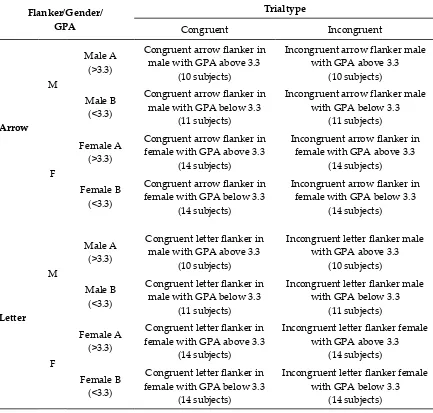
support the valid result. Experiment contained six blocks with 24 trials total, so there will be 360 total trials for each block. I simply put a 2x2x2x2 ANOVA method and t-test analysis to perform the analysis. The details are 2x2 (stimuli: flanker stimuli vs letter stimuli), 2x2 (participant group: female vs male), 2x2 (GPA group: >3.3 vs <3.3) and 2x2 (trial-type: congruent vs incongruent) (table 1) and t-test analysis to determine the accuracy of the stimuli. Due to the lack of information about how many flanker trials standard can be done, I
decided to have a very brief discussion about the endurance of the participants to execute the flanker task.
Result
From the aggregate of 53 flanker data set, there were four individual dataset which are considered inadequate and therefore were excluded from being analyzed due to the significant error rates (60 – 100% error in both stimuli). With formation: 16 groups divided into 10 males
Table 1
IV, DV and Subject per Block Formation
Flanker/Gender/ male with GPA above 3.3
(10 subjects) male with GPA below 3.3
(11 subjects) female with GPA above 3.3
(14 subjects)
Incongruent arrow flanker in female with GPA above 3.3
(14 subjects)
Female B (<3.3)
Congruent arrow flanker in female with GPA below 3.3
(14 subjects)
Incongruent arrow flanker in female with GPA below 3.3
(14 subjects) male with GPA above 3.3
(10 subjects) male with GPA below 3.3
(11 subjects) female with GPA above 3.3
(14 subjects) female with GPA below 3.3
(14 subjects)
Incongruent letter flanker female with GPA below 3.3
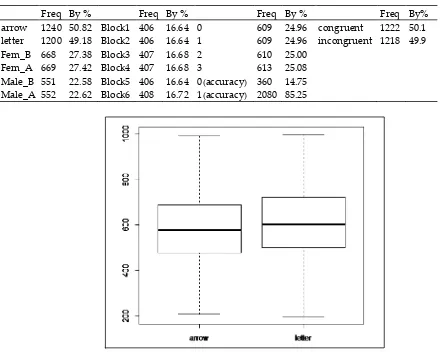
with GPA >3.3, 11 males with GPA <3.3, 14 females in both GPA levels. In total, 2441 stimuli were conducted in this research (1241 in arrow stimuli and 1200 in letter stimuli) and 14.75 % error rates (see table 2). Power test analysis suggests that with the effect size of 0.25, k=16, p=0.05 and power = 0.08 the sufficient sample in each group is 19. In the effect size of 0.40, the sufficient sample is 8, and from the data, the cohen D coefficient is 0.158 with the sufficient sample around 50. However, Cohen benchmark is not a stiff value in social sciences (i.e., Psychology) (Kabacoff, 2011; Durlack, 2005). There should be a baseline formula effect size for the similar-previous research. In addition, both
stimuli presented in six blocks with each block contains four trials. Therefore, each subject should have 24 trial. In traditional ANOVA analysis, each subject is responsible for each summated rating data.
Boxplots (stimuli, participant group, and trial type) were produced to support the result. In Boxplot group gender, the only male group has few outlier data point. Outlier represent the data that lies outside the +1.5 IQR. Nonetheless all the boxplot has completed upper and lower whisker which is a normal data and adequate representative sample for this research (Hartanto, 2016).
Table 2
Percent and Frequency
Freq By % Freq By % Freq By % Freq By%
arrow 1240 50.82 Block1 406 16.64 0 609 24.96 congruent 1222 50.1
letter 1200 49.18 Block2 406 16.64 1 609 24.96 incongruent 1218 49.9
Fem_B 668 27.38 Block3 407 16.68 2 610 25.00
Fem_A 669 27.42 Block4 407 16.68 3 613 25.08
Male_B 551 22.58 Block5 406 16.64 0(accuracy) 360 14.75
Male_A 552 22.62 Block6 408 16.72 1(accuracy) 2080 85.25
Figure 2. Boxplot group gender Figure 3. Boxplot congruent vs incongruent
1) The four-way ANOVA uncovers more profound information effect about the flanker's data. There was a main overall effect of the stimuli with F value = 17.964, and p-value = 2.34e-05 (p < 0.001), diff = 25.751, lower point = 13.837 and upper = 37.665 which indicate the perfor-mance in the arrow stimuli has required fewer RTs than the letter stimuli. For further reason, I interviewed some partici-pants about the two kinds of stimuli, and for them, symbol refers to the letter (symbol to the letter) are easy to maintain than the letter to letter reaction. Because letter to letter was little difficult to bear in mind for some periods, therefore many data point fall over in the few last bin. 2) Later on, there was evidence of effect between the groups of female and male participants, in which ANOVA result has F value = 91.203, p-value = 2e-16 (p < 0.001). It indicates that there was a significantly different effect RTs between overall female and male groups, in which male group possess few RTs than female group. Sorted by GPA, Tukey analyzed that male A group has the highest effect by means it has fewer reaction times among all group with diff score = -32.53177, p = 0.00189 (p < 0.001). Group of male A attends to execute a command or decision
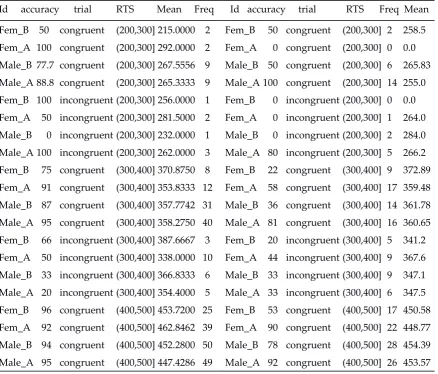
As with the theory explained earlier, the congruent task would be processed with ease than the incongruent task. In the previous result, the congruent task also had more accuracy than the incongruent task, and this phenomenon would be the same across the countries, cultures, and races (Atmaca, et al., 2011). 4) In the case of the detailed result, I have separated RTs to equally seven intervals bin then input the accuracy percentage index and mean RTs in each bin and- in both stimuli. These steps must be taken to distinguish the CAF value (Bonnet & Dresp, 1993; Wylie, et al., 2009). However, due to the massive trial multiply with the participant data, there is
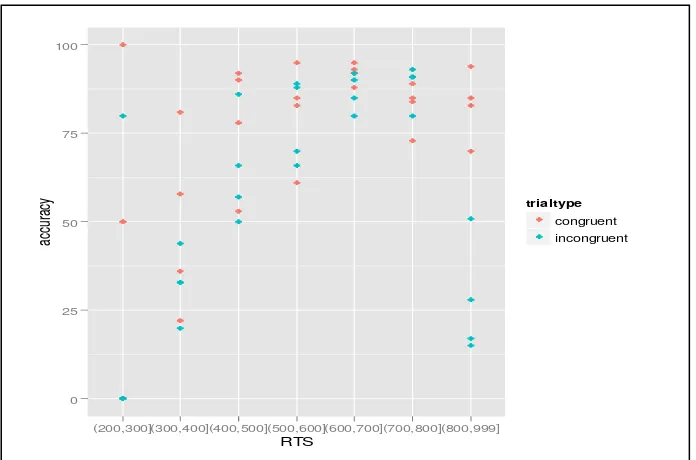
no way to plot more subtle CAF graph. Because of that, to accompany plausible explanation, both of the stimuli in this research were presented in two part of tables (Table 3). CAF value for arrow stimuli has drawn a pattern that the frequencies in early RTs were less than the late RTs. As well as with the accuracy (see table) in both stimuli. From the table 3, there was evidence in the early bins particularly congruent trial which has more accuracy than its rival and has more frequencies. But as the RTs elevated, the accuracy and rates in both trials and participants are likely do so (below 3.3 and above 3.3).
Table 3
Accuracy in Arrow and Letter Stimuli
Id accuracy trial RTS Mean Freq Id accuracy trial RTS Freq Mean
Fem_B 50 congruent (200,300] 215.0000 2 Fem_B 50 congruent (200,300] 2 258.5
Fem_A 100 congruent (200,300] 292.0000 2 Fem_A 0 congruent (200,300] 0 0.0
Male_B 77.7 congruent (200,300] 267.5556 9 Male_B 50 congruent (200,300] 6 265.83
Male_A 88.8 congruent (200,300] 265.3333 9 Male_A 100 congruent (200,300] 14 255.0
Fem_B 100 incongruent (200,300] 256.0000 1 Fem_B 0 incongruent (200,300] 0 0.0
Fem_A 50 incongruent (200,300] 281.5000 2 Fem_A 0 incongruent (200,300] 1 264.0
Male_B 0 incongruent (200,300] 232.0000 1 Male_B 0 incongruent (200,300] 2 284.0
Male_A 100 incongruent (200,300] 262.0000 3 Male_A 80 incongruent (200,300] 5 266.2
Fem_B 75 congruent (300,400] 370.8750 8 Fem_B 22 congruent (300,400] 9 372.89
Fem_A 91 congruent (300,400] 353.8333 12 Fem_A 58 congruent (300,400] 17 359.48
Male_B 87 congruent (300,400] 357.7742 31 Male_B 36 congruent (300,400] 14 361.78
Male_A 95 congruent (300,400] 358.2750 40 Male_A 81 congruent (300,400] 16 360.65
Fem_B 66 incongruent (300,400] 387.6667 3 Fem_B 20 incongruent (300,400] 5 341.2
Fem_A 50 incongruent (300,400] 338.0000 10 Fem_A 44 incongruent (300,400] 9 367.6
Male_B 33 incongruent (300,400] 366.8333 6 Male_B 33 incongruent (300,400] 9 347.1
Male_A 20 incongruent (300,400] 354.4000 5 Male_A 33 incongruent (300,400] 6 347.5
Fem_B 96 congruent (400,500] 453.7200 25 Fem_B 53 congruent (400,500] 17 450.58
Fem_A 92 congruent (400,500] 462.8462 39 Fem_A 90 congruent (400,500] 22 448.77
Male_B 94 congruent (400,500] 452.2800 50 Male_B 78 congruent (400,500] 28 454.39
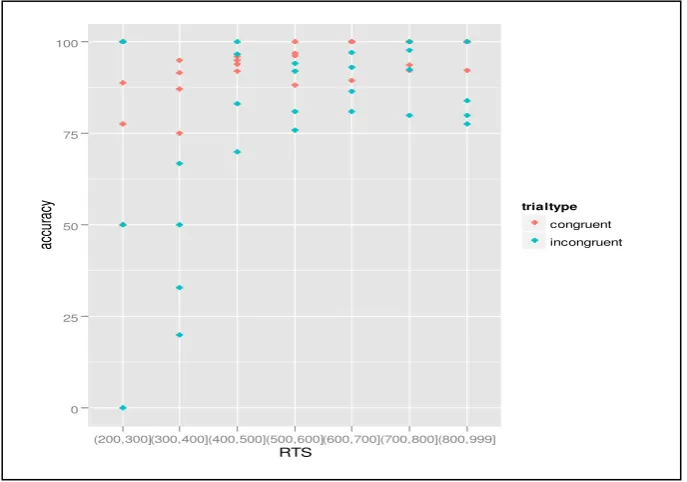
Figure. 4 Arrow CAF trialtypes
The graph (Figure 4) and table give precise information for RTs and the accuracy in each bin for arrow stimuli from the first bin to the last bin. The congruent trial in both groups of female A (>3.3) and female B (<3.3) have slightly different accuracy and frequencies; female A has more attempt to finish the stimuli task. In the male group, the condition is the same, a matter of fact, the male B group did not score any of the tasks in early bin of inconsistent trial (but there is an attempt with 0 accuracies). However, the discrepancies become tighter in both groups in a row with the RTs increased. Mostly, in male B and female B groups, RTs are less accuracy compare to its rivals, by means, these groups have more error rates. In letter stimuli the finding was different, in early bin group of female B score, the 50% accuracy with two frequencies overtake the rivals with zero rates. Whereas, male A group leads the scoring task with 100% accuracy in the congruent task and decline slowly to 80% in the incongruent task. Table 3 also illustrates the same dynamic RTs to the
arrow stimuli, in the case where congruent trial has more accuracy and frequencies than the incongruent task. However the only difference was that letter stimuli has less accuracy in 100% task, both in the congruent or incongruent task, the male B and A group scored the same accuracy but have different frequencies.
Figure 5 describes RTs vs. accuracy in letter stimuli. Accuracy was low in the early bin but gradually arose then fall over to the last bin. This phenomenon is different compared to arrow stimuli, in which there was no evidence of drop point in the last bins. The interaction between stimuli and group participant was not significant with p-value = 0.14072, which means there is no effect different from all group participant RTs with different stimuli or in another word after being analyzed, the discrepancies between score groups are tiny/weak to attain approval condition against the null hypothesis. Interaction between stimuli and trial-type significant at level 0.00101; p < 0.001. Arrow stimuli score the fastest latency response compare to the letter in both 0
25 50 75 100
(200,300](300,400](400,500](500,600](600,700](700,800](800,999]
RTS
accu
ra
cy trialtype
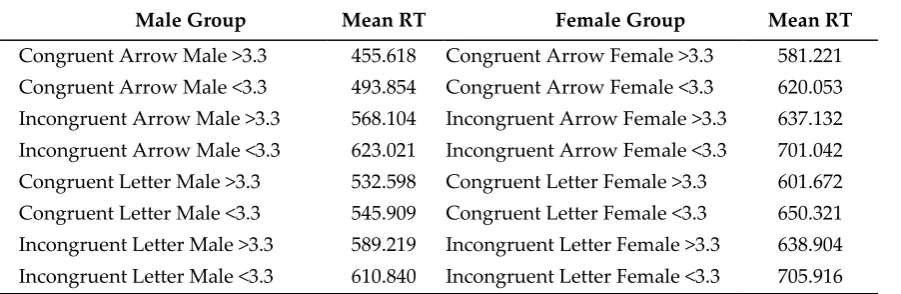
trial-type, with arrow congruent trial is the fastest diff=98.31753, lwr=76.24549, upr=120.38957 p=0.00;p<0.001. There was a significant effect interaction between group participant with trial-type (trial-type across arrow and letter stimuli) with F value = 3.297, p = 0.01968; p < 0.05. Group of male A with congruent trial have the least RTs compare to other groups,
while the group of female B with incongruent trial have the most RTs. Nevertheless, there is an exception in incongruent letter trial with incongruent arrow trial which has reported not significant or there is no different effect in incongruent trial-type RTs between stimuli letter and arrow.
Figure. 5 Letter CAF trialtype
Table 4
Four Way Anova
Df Sum Sq Mean Sq F value Pr(>F)
stim 1 404407 404407 17.964 2.34e-05 ***
participant 3 6159451 2053150 91.203 < 2e-16 ***
trialtype 1 3254526 3254526 144.569 < 2e-16 ***
stim:participant 3 123150 41050 1.823 0.14072
stim:trialtype 1 243777 243777 10.829 0.00101 **
participant:trialtype 3 222673 74224 3.297 0.01968 *
stim:participant:trialtype 3 56675 18892 0.839 0.47227
Residuals 2424 545690 22512
Signif. codes: *** . ** . * . 5 . .
0 25 50 75 100
(200,300](300,400](400,500](500,600](600,700](700,800](800,999]
RTS
accu
ra
cy trialtype
Table 5
Total Mean RTs in 16 groups
Male Group Mean RT Female Group Mean RT
Congruent Arrow Male >3.3 455.618 Congruent Arrow Female >3.3 581.221
Congruent Arrow Male <3.3 493.854 Congruent Arrow Female <3.3 620.053
Incongruent Arrow Male >3.3 568.104 Incongruent Arrow Female >3.3 637.132
Incongruent Arrow Male <3.3 623.021 Incongruent Arrow Female <3.3 701.042
Congruent Letter Male >3.3 532.598 Congruent Letter Female >3.3 601.672
Congruent Letter Male <3.3 545.909 Congruent Letter Female <3.3 650.321
Incongruent Letter Male >3.3 589.219 Incongruent Letter Female >3.3 638.904
Incongruent Letter Male <3.3 610.840 Incongruent Letter Female <3.3 705.916
Overall, accuracy of t-test analysis found that arrow stimuli have more accuracy than letter with t = 6.4099, df = 2220.5, p-value = 1.773e-10, mean Arrow = 0.9096774, mean letter= 0.8216667.
Discussion
In this research, totals of 49 participants performed the experiment Flanker Task. 1) In both stimuli, yielded a different result. The arrow trial takes fewer RTs and accuracy than the letter ones- in both trial types. In arrow stimulus, the participants used horizontal focus attention to distinguish the target, meanwhile, in letter stimulus, this technique encounters serious difficulties. Because arrows point some direction in left or right used, this method is quite helpful. However, in letter stimulus, letter identification needs vertical focus attention, and just because letter stimulus cannot be read from left to right or vice versa (consonant) thereby it is not pointing to anywhere. Also, letter "H" and "N" have almost similar form and height in mental accounting participants, which elevated double checking behavior vertically.
In complexity stimuli research, using various stimuli are the common technique.
this research, some interviews I have made to some participants in male group uncover that: they may learn pattern in a way trials were presented. However, this takes place just for few rounds during the task comes to an end. The male A group, seems more to be "socially" and "technically" in deciding on the task trial present. Socially, it refer to an ability to decide because they feel understand and credible, whereas technically, it is explained as an ability to determine by calibrating the present stimuli and the prediction probability (i.e., if flanker "<" present twice then ">" will be present next).
The male group seems to have robust and focused their attention more than the focus attention) (BBC, 2014). Meanwhile, its trait may not or may not fully present in female counterpart (Jant, 2014). Group of female B give an opinion about task flanker that according to them it has a fast shift and complicated stimuli, contrast to the female A. In addition, they insist that these flanker task trials required more focus attention. Thereby these trials in female B were considered to be a difficult task which need high perceptual loading (de Fockert, 2013). I did not mention which stimuli that more difficult, because the interaction was not significant. Group of female A considered this flanker task as "the challenge one," according to this finding; therefore I concluded there was a disparity in how they perceive perception and build motivation among the female groups. External motivation is more visible in group of female B, meanwhile
female A group is likely to be internally motivated (Ryan, 2009).
3) From ANOVA analysis, the incong-ruent trial-type has highest RTs compare to all trials. This flanker congruence effect (FCE) finding is similar in several research (Stins et al., 2007; Hubner & Lehle, 2007). The interaction between participants and trial type were also significant, means that according to all participants, incongruent stimuli is considered to be the most challenging part of the stimuli. Participant appears to gather more attention when facing the incongruent trial, and double the re-check behavior which after a few round, this behavior become "slightly automatic." The automatic phenomenon described by Bugg (2014), involves fast flexibility of cognitive control modulated by attention to the incongruence trial event. Although, after following the incongruent trial the interference effect reduced and readily prepared for the flankers in subsequent trial, however the consequences in fewer RTs with congruent trial fazed by the repetition trial among two choices (Mayr, Awh, & Laurey, 2003).
develops some strategy to encounter the stimuli. If participant focuses on the basis to identify the flanker (parallel phase), their accuracy will be near-perfect, but fall below chance in the incongruent trial. The participants in this research seem to use the parallel phase strategy to perform the flanker task. The other approach called focus phase, emphasize on the basis to identify the target stimuli (Hubner, Steinhauser, & Lehle, 2010). Furthermore, Hubner et al., (2010) inferred that strate-gies were affected by selective attention in early and late attention towards both stimuli, by means that in early attention, participants just selected and processing one object at a time. In contrast to late attention, which identified several stimuli at a time then picked and processed the target stimuli.
Conclusion
Flanker task provides abundant informa-tion about how human cogniinforma-tion works. Many progress should be made about neurocognitive research, mainly by adding numeric flanker or equipped with the eye movement tracking system. Flanker task reveals that the different mechanism occurs across stimuli model and gender. In fact, intelligence also settles the difference. However, in mixed stimuli, some of the letters trial fall in the last bins CAFs also unveil the mechanism how participant's respond the task and the result slightly different in both trials.
Suggestion
Many progress should be made about flanker task research, mainly by adding numeric flanker, Javanese letters or equipped with the eye movement tracking system. Also, individu that living in area with high level selective attention such as
railway and market area might be display different result compare to them that have not.
References
Adam, J. J., Paas, F. G., Buekers, M. J., Wuyts, I. J., Spijkers, W. A., Wallmeyer, P. (1999). Gender diferences in choice reaction time: Eevidence for differential strategies. Ergonomics, 42(2), 327- 335.
Atmaca, S. Sebanz, N. & Knoblich, G. (2011). The joint flanker effect: Sharing tasks with real and imagined co-actors. Exp Brain Res, 211, 371–385. doi: 10.1007/s00221-011-2709-9
Anderson, B. (2014). Computational neuro-science and cognivite modelling. SAGE Publications Inc.
Bernard J. B. & Chung S. T. L. (2011). The dependence of crowding on flanker complexity and target-flanker complexity. Journal of Vision, 11(8), 1– 16.
Baars, B. J., & Gage, N. M. (2013). Fundamentals of cognitive neuroscience: A beginner’s guide. Elsevier Inc.
Bugg, J. M. (2014). The relative attrac-tiveness of distractors and targets affects the coming and going of item-specific control: Evidence from flanker tasks. Atten Percept Psychophys, 77, 373–389. doi: 10.3758/s13414-014-0752-x.
BBC Horizon. (2014). Is your brain male or female. http://www.bbc.co.uk/ programmes/ b04knbny.
Blais, C. Stefanidi, A. & Brewer, G. A. (2014). The Gratton effect remains after controlling for contingencies and stimulus repetitions. Frotier in Psychology, 05, 1-11. doi: 10.3389/ fpsyg.2014.01207
Carreiras, M., Quinones, I., Hernandez-Cabrera, J. A. & Dunabeitia, J. A. (2015). Orthographic coding: Brain activation for letters, symbols, and digits. Cerebral Cortex, 25(12), 4748– 4760.
Chanceaux, M. Mathot, S. & Grainger, J. (2014). Effects of number, complexity, and familiarity of flankers on crowded letter identification. Journal of Vision, 14(7). doi: 10.1167/14.6.7
Chen, C., Yang, J., Lai, J., Li, H., Yuan, J. & Abbasi, N. H. (2015). Correlating gray matter volume with individual difference in the flanker interference effect. PLoS ONE, 10(8), doi: 10.1371/ journal.pone.0136877
Dalmaijer, E. S., Mathôt, S., & der Stigchel, S. (2014). PyGaze: An open-source, cross-platform toolbox for minimal-effort programming of eyetracking experiments. Behavior Research Methods, 46(4), 913–921.
Durlack, J. A. (2005). How to select, calculate, and interpret effect sizes. Journal Of Pediatric Psychology, 34(9), 917–928.
de Fockert, J, W. (2013). Beyond perceptual load and dilution: A review of the role of working memory in selective attention. Frontier in Psychology, 04, 1-12.
Ghinescu, R., Schatchman, T. R., Ramsey, A. K., Gratton, G., Fabiani, M. (2016). Conflict adaptation and cue competition during learning in an eriksen flanker task. PLoS ONE, 11(12), 1-19. doi: 10.1371/journal.pone.0167119
Hazeltine, E. & Mordkoff, J. T. (2014). Resolved but not forgotten: Stroop conflict dredges up the past. Frontier of
Psychology, 5(1327). doi: 10.3389/
fpsyg.2014.01327
Hartanto. (2016). Pengenalan analisis statistik dengan software R. Yogyakarta: Magnum Publishing
Hubner, R. Steinhauser, M. & Lehle, C. (2010). A dual-stage two-phase model of selective attention. Psychological Review, 117(3), 759-784. doi: 10.1037/ a0019471
Hubner, R. & Lehle, C. (2007). Strategies of flanker coprocessing in single and dual tasks. Journal of Experimental
Psychology/Human Perception and
Performance, 33(1), 103-123 124–127. doi: 10.4103/2229-516X.157168 Jant, G. L. (2014, Februari). Brain differences
between genders. Retrieved from:
https://www.psychologytoday.com/bl og/hope-relationships/201402/brain-differences-between-genders, 30 Sep-tember 2017
Judge, J. Taylor, P, J. (2008). Gender differences on the semantic flanker task using transposed-letter target words. The Quarterly Journal of Experi-mental Psychology, 65(10), 2008-2017. doi: 10.1080/17470218.2012.676654 Kabacoff, R. I. (2011). R in action. Shelteer
Island: Manning Publications Co. Kraus, F. & Lindemann, O. (2014).
Marsja, E. (2017, Februari). Python and R as tools of data analysis and building
psychological experiments. Retrieved
from: https://www.marsja.se/, 19 Juni 2017
Mayr, U., Awh, E., & Laurey, P. (2003). Conflict adaptation effects in the absence of executive control. Nat, Neurosci. 6, 450–452. doi: 10.1038/ nn1051
Mordkoff, J. T. (1996). Selective attention and internal constraints: There is more to the flanker effect than biased contingencies. In A. F. Kramer, M. G. H. Coles, & G. D. Logan (Eds.), Converging operations in the study of visual selective attention (pp. 483-502). Washington, DC, US: American Psychological Association. doi: 10.1037/10187-018
McLean, S. P., Garza, J. P., Wiebe, S. A., Dodd, M. D., Smith, K. B., Hibbing, J. R., & Espy, K. A. (2013). Applying the flanker task to political psychology: A research note. Political Psychology, 20(20). doi: 10.1111/pops.12056
Postle, B. R. (2015). Essentials of cognitive neuroscience. John Wiley & Sons, Ltd. Rouder, J. N & King, J. W. (2003). Flanker
and negative flanker effects in letter identification. Perception & Psychophysics, 65(2), 287-297.
Stins, J, F., Polderman, J. C. T., Boomsma, D. I. & Geus, E. J. C. (2007). Conditional accuracy in response interference tasks: Evidence from the Eriksen flanker task and the spatial
conflict task. Advances in Cognitive Psychology, 3(3), 409-417. doi: 10.2478/ v10053-008-0005-4.
Shiraev, E. B & Levy, D. A. (2010). Cross-cultural psychology–critical thinking and contemporary applications. Pearson Education, Inc.
Ryan, R. (2009). Self determination theory and wellbeing. Journal of WeD Research Review, 1, 1–2.
Wells, I. C. & Hamm, J. P. (2009). The effect of inverting stimuli in a flanker task. Canadian Journal of Experimental Psychology, 63(1), 33–39. doi: 10.1037/ a0013440.
Wright, J. D. (2015). International encyclopedia of the social and behavioral sciences – second edition. Elsevier Ltd. Wylie, S. A., van den Wildenberg, W. P.
M., Ridderinkhof, K. R., Bashore, T. R., Powell, V. D., Manning, C. A., & Wooten, G. F. (2009). The effect of speed-accuracy strategy on response interference control in Parkinson s diseases. Neuropsychologia, 47(0), 1844– 1853. doi: 10.1016/j.neuropsychologia. 2009.02.025.
Zhou, P. & Liu, X. (2013). Attentional modulation of emotional conflict processing with flanker tasks. PLoS ONE, 8(3), 1-8. doi: 10.1371/ journal.pone.0060548