Page | 89
CONFERENCE PROCEEDING
2017 International Multidisciplinary Conferences on
Productivity and Sustainability
Jakarta, 5-7 December 2017
The Influence of Marketing Mix on the Parent Loyalty through School Image
Hotlan Siagian1,*, Serli Wijaya2, Patricia Karnia11Petra Christian University, Magister Management Department, Surabaya, 2630, Indonesia 2Petra Christian University, Hospitality Department, Surabaya, 2630, Indonesia
*Corresponding author email: [email protected]
This work aims at examining the influence of the marketing mix on the parent loyalty through school image. The sampling size includes 200 respondents representing the parent of the student of 15 private schools in the city of Surabaya, East Java, Indonesia. Data collection used a questionnaire designed with 7-point Likert type scale. Data were analyzed using SmartPLS software. The results showed that the marketing mix influences the loyalty of parents. Marketing mix also impacts the school image, and school image affects the parent loyalty. School image contributes a mediating impact on the marketing mix and parent loyalty relationship.
Keywords: marketing mix, school image, and parent loyalty
1. Introduction
Today, many private schools are serving the people in any level of education including playground school, kindergarten school, and the next level, the primary school. Statistical report by the local government of East Java, Indonesia, indicates that the school capacity growth reaches 10% annually at the playground level, 7% for the kindergarten and primary school. Meanwhile, the demand for this level of education, which represented by the growth of the population of the age of two to six years old, is only 2% per year. This oversupply situation has pushed the foundation and their school management to review and redesign their strategy in facing the competition. The management of the school understands very well that there are many choices available for the parent of the kids without any switching. Based on this situation, the school management has to pay attention to getting the loyalty. They also understand that decision maker on the selection of the school is the parent of the kid1. Hence, the effort should be addressed primarily to the parent of the children.
Page | 90 2. Theoretical background
2.1. Marketing Mix
Marketing is defined as a process how an organization provides value and make relationships with consumers to obtain a return from consumers3. There is a big difference between traditional marketing and educational marketing5. The first one is the reality that business organizations provide goods meanwhile schools as institutions offer services. Second, the acquisition of buyers on education services is intangible. It, therefore, must be evaluated by referring to the impression they give to the potential clients. The third difference is that educational services mainly depends on the reputation of the individual. Fourth, it is not fair to differentiate the quality of the services in the education industry. Fifth, that buyers cannot return educational products when they have used it. Last is the impossibility of repeating the use of educational services, unlike the use of other goods or services. The importance of these additional factor encourages the marketer to consider the concept of the expanded marketing mix for services which consists of product, price, place, promotion, people, process, and physical evidence3,4.
2.2. School Image
Brand image is the perception of the customer in respect of the brand in consumer mindset6. Brand associations are anything related to brands in consumer memory7. The brand association is getting stronger when the frequency of experience with a particular brand is increasing8. Brand associations allow companies to distinguish the brands within the market. The different brand will create a competitive advantage. The image is built from one's ideas, impression, and ideas about an object9. The image of schools is not absolute but relatively depends on the image presented by other agencies10. The institutional image is the result of a set of processes by which the community take into consideration the various attributes of the organization11. School image can be shaped by a variety of dimension and is the achievement of some processes that include the past experiences, various information, and education promotion activities2. The school offer promises to the parents of the student through a variety of attributes.
2.3. Parent Loyalty
Marketing activities by organizations is to attain specific results, such as increased profits, market share, and loyal consumers12. The loyalty is a deep voluntary of the user to repeat the purchase or subscribe to a favored product and service13. Loyalty is a result of four phase of the development before the consumer decides to repurchase. The four stages of loyalty are cognitive loyalty, affective loyalty, conative loyalty, and action loyalty. Loyal parents will support their children to continue to the next level in the same until they completed their study. Hence, parent loyalty influences the decision making2,12. The level of loyalty comprises three layers, i.e., low loyalty, moderate loyalty, and high loyalty, which characterized by a promise and support from parents to their graduated student resulting from an unforgettably enjoyable experience and enormous educational service delivery14.
2.4. Marketing Mix and Parent Loyalty Relationship
Better quality of the marketing mix will improve the loyalty of the parent15. The marketing mix also aims at producing goods and services that have been carefully researched and designed to attract consumers in the market to provide a high value to consumers16 and consequently, marketing mix affects consumer loyalty17. Elements of the marketing mix should not be run individually but as a whole so that the marketing mix has an impact on consumer loyalty and therefore marketing mix influences the loyalty of parents12. The discussion above leads to the first hypotheses H1: Marketing mix affects parent loyalty.
2.5. Marketing Mix and School Image Relationship
Page | 91
2.6. Marketing Mix and Loyalty Relationship
The brand image has an impact on loyalty and promise. Brand image has a positive impact on customer loyalty and the perceptions of the quality and it affects the level to which consumers perceive marketing mix and the satisfaction on offer in the long run to generate sustainable returns21. In the sector of the university, it has proved that University image affects student loyalty22. The result of this research has significant implications for management, which suggest that by maintaining the image, the university will gain loyalty from undergraduates to advance their postgraduate studies at the same university. Hence, the university image affected student loyalty23. School image could serve as a useful means to predict the loyalty of parents2. This discussion leads to third hypothesis H3: School image affects parent loyalty
3. Methodology
3.1. Sample and Data Collection
On this study, the unit of observation was the parent of the student who has sent their kids to private school at the level of the playground, kindergarten, a primary and elementary school in the city of Surabaya, East Java, Indonesia. The questionnaire was constructed based on previous related literature as the primary source. The measurement item was developed using a semantic differential in 7 points of scale (1: strongly disagree, 7: strongly agree). Questionnaires were then distributed to 200 respondents. The individual sample was selected by chance at the public place where the parent brings along their kids such as at a restaurant, mall, and the school. The collection of administered questionnaire continues until 200 respondent obtained. The dataset is then analyzed using smart PSL software to assess the measurement model and to test the hypotheses through the analysis of the inner model.
3.2. Operational Definition of Variables
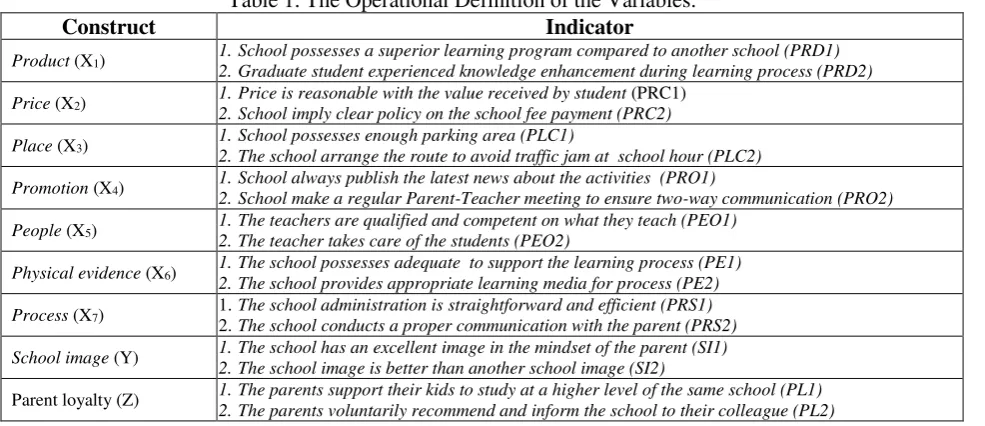
Based on the theoretical background discussed, the three research variables are defined in term of its indicators enabling the measurement of each latent variable. The operational definition of all the constructs and the corresponding theory is summarized in Table 1.
Table 1. The Operational Definition of the Variables.
Construct Indicator
Product (X1) 1.School possesses a superior learning program compared to another school (PRD1)
2.Graduate student experienced knowledge enhancement during learning process (PRD2)
Price (X2) 1.Price is reasonable with the value received by student (PRC1)
2.School imply clear policy on the school fee payment (PRC2)
Place (X3) 1.School possesses enough parking area (PLC1)
2.The school arrange the route to avoid traffic jam at school hour (PLC2)
Promotion (X4) 1.School always publish the latest news about the activities (PRO1)
2.School make a regular Parent-Teacher meeting to ensure two-way communication (PRO2)
People (X5) 1.The teachers are qualified and competent on what they teach (PEO1)
2.The teacher takes care of the students (PEO2)
Physical evidence (X6) 1.The school possesses adequate to support the learning process (PE1)
2.The school provides appropriate learning media for process (PE2)
Process (X7) 1.The school administration is straightforward and efficient (PRS1)
2.The school conducts a proper communication with the parent (PRS2)
School image (Y) 1.The school has an excellent image in the mindset of the parent (SI1)
2.The school image is better than another school image (SI2)
Parent loyalty (Z) 1.The parents support their kids to study at a higher level of the same school (PL1)
2.The parents voluntarily recommend and inform the school to their colleague (PL2)
4. Result and Discussion
Page | 92 corresponding T-value exceed 1.96 for a significant level of 5% (range 4.161 to 13.736). The path coefficient and T-value was used to examine if the marketing mix affects parent loyalty. The path coefficient of 0.382 and the T-value of 5.132 implies a significant association between marketing mix and parent loyalty (H1). Table 2 also indicated that the indicators which are the most representative of the marketing mix are the people like the teacher, the physical evidence such as the building, location, and also the process. The school management needs to enhance those indicators in building the parent loyalty. This finding supports the previous research, which proposed that educational services be different from goods produced by manufacturers. This empirical analysis result proves that marketing mix affects the parent loyalty (H1).
Table 3. Inner model assessment
Hypothesis Relationship Coefficient T-value Remark
H1 Marketing mix -> Parent loyalty 0.382 5.132 supported
H2 Marketing mix -> School Image 0.722 13.736 supported
H3 School Image -> parent loyalty 0.326 4.161 supported
As illustrated in Table 3, the path coefficient of 0.772 and the T-value of 13.376 proved empirically that marketing mix affects school image (H2). This relationship is relatively stronger than that of the marketing mix and parent loyalty. The finding also means that marketing mix gives an impact not only on the parent loyalty but school image as well
The last finding support hypotheses (H3), that school image influence the parent loyalty. As shown in Table 3, path coefficient of 0.326 and corresponding T-value of 4.161 support the hypotheses. School image gives an impact in building the parent loyalty. It implies that the school image gives a mediating role in the relationship between marketing mix and parent loyalty. This result also implies that marketing mix has an indirect effect in affecting the parent loyalty. Hence, marketing mix activities for the private school is highly critical in building the parent loyalty. The most exciting finding was that school image does mediate the relationship of the marketing mix and the parent loyalty. The mediating effect of the school image is relatively high compared with the direct effect of the marketing mix on parent loyalty.
4. Conclusion
Page | 93
consequently, essential to building the parent loyalty. The people, process, and the physical evidence are the most affecting factor in the building the school image and the parent loyalty. In enhancing the parent loyalty, schools are advised to pay attention to the improvement of the physical evidence, people competency, and simplification of the process.
References
1. F. Noble, Aust. J. Early Child., 32, 51–57 (2007). 2. C. Li and C. Hung, J. Educ. Adm., vol. 47, 477 (2009).
3. P. Kotler and G. Armstrong, New Jersey: Prentice Hall (2013).
4. V. A. Zeithaml, M. J. Bitner, and D. D. Gremler, Services marketing: Integrating customer focus
across the firm(2009).
5. C. C. Glava and A. E. Glava, Procedia - Soc. Behav. Sci., 180,170 (2015). 6. K. L. Keller, J. Mark., vol. 57, 1 (1993).
7. J. L. Aaker, J. Mark. Res., 34, 347 (1997).
8. E. A. Ergin, H. Ozdemir, and B. Ozsacmaci, J.Int. Buss.& Ec. Ress. 5, 65 (2006). 9. P. Kotler and K. F. A. Fox, Prentice-Hall (1995).
10. J. Ivy, Int. J. Educ. Manag., 15, 276 (2001).
11. N. Nguyen and G. LeBlanc, Int. J. Educ. Manag., 15,303 (2001).
12. S. A. Malik, A. Mushtaq, L. H. Jaswal, and S. A. Malik, Int. J. Manag. Educ., 9, 180 (2015). 13. R. Oliver, J. Mark., 63,33 (1999).
14. A. B. De Guzman, B. V. De Castro, K. a B. Aquino, M. a R. Buenaventura, a. C. C. Duque, and M. L. D. R. Enriquez, Educ. Res. Policy Pract., 7,109 (2008).
15. S. Thalib, Kencana (2015).
16. O. O. Ogunnaike, T. T. Borishade, S. Adeniyi, and O. O. Omolade, Mediterr. J. Soc. Sci., 5, 616
(2014)
17. R. Sukamto and D. B. Lumintan, J.Mark., 3, 316 (2015).
18. L. Samia, Y. Naima, and M. Saliha, Br. J. Mark. Stud., 2, 55 (2014). 19. D. C. Dabija and A. Chis, SSRN Work. Pap. Ser., (2016).
20. A. Y. Ebeid, Am. J. Bus. Manag., 3, 237 (2014).
21. I.-E. Ogba and Z. Tan, J. Technol. Manag. China, 4,132 (2009). 22. M. Mohamad and Z. Awang, J. Int. Manag. Stud., 4, 30 (2009).
23. H. Alves and M. Raposo, J.Int.Total Qual. Manag & Bus. Excel, 18, 571 (2007). 24. W. W. Chin, Physicology Press(1998).