CASE REPORT
Mortality Rate of Patients with Tuberculosis-
Destroyed Lung Who Underwent Pulmonary
Resection: Evidence Based Case Report
Kartika Anastasia Kosasih1, Zulkifli Amin2
, Astrid Priscilla Amanda3
1Faculty of Medicine Universitas Indonesia, Jakarta, Indonesia
2Division of Respirology and Critical Illness, Department of Internal Medicine Universitas Indonesia, Jakarta, Indonesia 3Assistant Researcher, Division of Respirology and Critical Illness, Department of Internal Medicine Universitas Indonesia,
Jakarta, Indonesia
ABSTRACT
Introduction: Tuberculosis (TB) is a leading cause of death worldwide alongside with HIV. Globally, there were an estimated 9.6 million new TB cases and 1.5 million deaths from TB in 2014. Tuberculosis-destroyed lung is a complication of severe pulmonary tuberculosis that can causes various respiratory symptoms and pulmonary dysfunction. Destroyed lung can seriously compromises long-term survival, so it is imperative to do the surgery.
Objective:to determine the chance of survival in patients with tuberculosis-destroyed lung who underwent pulmonary resection.
Method:Literature searching on PubMed, Cochrane Library, ProQuest, EBSCOHost, Science Direct and ClinicalKey was conducted on March 15th, 2016. Three articles were included to be appraised for its validity and relevance using several aspect based on Center of Evidence-Based Medicine, University of Oxford for prognostic study.
Result:Study by Byun CS.et al showed operative mortality of 6.8%, SE 2.9%, 95% CI (3.9% to 9.7%). The post- operative mortality rate in 5 years is 11.1%, SE 3.7%, 95% CI (7.4% to 14.8%) and 23.8%, SE 5%, 95% CI (18.8% to 28.8%) in 10 years. Rifaat A. et al revealed post-operative mortality rate of 7.1%, SE 6.8%, 95% CI (0% to 20.3%). Bai L. et al presented post-operative mortality rate of 5.8%, SE 1.8%, 95% CI (4% to 7.6%).
Conclusion:Pulmonary resection for tuberculosis-destroyed lung patients can be achieved with low overall mortality rate (operative and post-operative).
Keywords: destroyed lung, mortality, resection, surgery, tuberculosis
ABSTRAK
Latar Belakang:Tuberkulosis (TB) merupakan salah satu penyebab utama kematian di dunia. Pada tahun 2014, diperkirakan terdapat 9.6 juta kasus TB baru dan terdapat 1.5 juta kematian yang disebabkan oleh TB dari seluruh dunia. Tuberculosis destroyed lung merupakan komplikasi dari TB paru berat dan dapat menyebabkan berbagai gangguan dan disfungsi pernapasan. Destroyed lung dapat mempengaruhi angka harapan hidup sehingga perlu dilakukan pembedahan. Pembedahan dapat membantu mencapai terapi yang efektif dengan membuang jaringan TB aktif.
Tujuan: Untuk menentukan peluang kelangsungan hidup pada pasien dengan tuberculosis-destroyed lung yang menjalani operasi.
Metode: Pencarian literatur dilakukan pada tanggal 15 Maret 2016 pada PubMed, Cochrane Library, ProQuest, EBSCOHost, Science Direct and ClinicalKey. Tiga artikel diikut sertakan untuk ditelaah klinis untuk menilai validitas dan relevansinya menggunakan Center of Evidence-Based Medicine, University of Oxford for prognostic study.
Hasil: Studi oleh Byun CS dkk menunjukkan angka mortalitas operatif sebesar 6.8%, SE 2.9%, 95% CI (3.9% to 9.7%). Mortalitas dalam 5 tahun sebesar 11.1%, SE 3.7%, 95% CI (7.4% to 14.8%) dan 23.8%, SE 5%, 95% CI (18.8% to 28.8%) dalam 10 tahun. Rifaat A. dkk menunjukkan mortalitas post-operasi sebesar 7.1%, SE 6.8%, 95% CI (0% to 20.3%). Bai L. dkk memperlihatkan mortalitas post-operasi sebesar 5.8%, SE 1.8%, 95% CI (4% to 7.6%).
Simpulan: Tindakan pembedahan pada pasien dengan Tuberculosis destroyed lung dapat dilakukan dengan angka mortalitas yang rendah (operatif dan post-operatif).
Korespondensi: Dr. dr. Zulkifli Amin SpPD-KP
Email: [email protected]
Indonesian Journal of
Kata Kunci: bedah,destroyed lung, mortalitas, reseksi, tuberkulosis.
80
CHEST
Critical and Emergency Medicine
Mortality Rate of Patients with Tuberculosis-Destroyed Lung Who Underwent Pulmonary Resection: Evidence Based Case Report
can be treated with combined anti-tuberculous drugs, however some small cases still need surgical intervention.1,2 Although surgical intervention is considered a high risk procedure, it is still indicated when anti-tuberculous drugs fail to control TB and its complications.2,3 Tuberculosis-destroyed lung, chronic TB empyema, persistent cavity, destroyed lung, pneumothorax, bronchiectasis, tracheal or bronchial stenosis, and massive hemoptysis remain as valid indications for surgery in both drug-sensitive and drug-resistant TB.2-5
Tuberculosis-destroyed lung is a complication of severe pulmonary tuberculosis that can cause various
respiratory symptoms and pulmonary dysfunction.6,7,8
Most cases of destroyed lung have a history of undergoing retreatment for TB, with delayed healing
or resistance to anti-tuberculous drugs.6 Areas of
destroyed lung and thick walled cavitatory lesions have less exposure to host defenses and are poorly penetrated by anti-tuberculous drugs. These cavities act not only as huge reservoir for TB infection, but also
as the site for drug resistance development.5
Surgical resection is usually done because the bacterial count within the cavity is high and antibiotic treatments fail to reach the site of infection.4 Excision of these lesion will reduce the overall organism load in the lung while concurrently eliminating sites of high
concentrations of drug-resistant bacilli.5 Therefore,
the major point in surgery is to resect the active TB destroyed lung who underwent pulmonary resection.
CASE ILLUSTRATION
Patient, male 69 years old with worsening symptoms of dyspnea 4 days prior to hospital admission. There were productive cough with greenish tint. Dyspnea was felt continuously, not precipitated by exercise, weather, or certain position. No nausea and vomiting. Patient has a history of asthma since childhood and has been treated with salbutamol. Three months before admitted to hospital, patient was admitted to RSCM due to dyspnea. Patient was diagnosed with lung infection.
Patient had history of pulmonary tuberculosis (TB) 14 years ago and completed his 6 months therapy in local community health center (Puskesmas). Eleven years ago, he developed TB again but only received
treatment for 2 months from Puskesmas because of
poor compliance. Two years before hospital admission, the patient was diagnosed with TB and had been on tuberculosis treatment but hasn’t been declared cured by the doctor.
On the physical examination of the lungs, there were dyspnea, reduced vesicular sound on the left lung, and wet rhonchi from both lungs. The blood examination showed anemia, leukocytosis, thrombocytosis, and high erythrocyte sedimentation rate; the leukocyte differential count showed low lymphocyte and high monocyte. The patient also suffered from decreased serum protein, albumin, and albumin-globulin ratio. According to thorax x-ray, there was impression of pleural effusion and atelectasis in the left lung. From thorax CT Scan examination, the patient was confirmed with destroyed lung in the left lung.
Patient was diagnosed with Health Care- Associated Pneumonia (HCAP) with differential diagnosis of tuberculosis with secondary infection; destroyed lung on the left lung; and malnutrition. The and omeprazole 1 x 40 mg. The patient was planned to undergo front lobectomy for the destroyed lung.
Kartika Anastasia Kosasih, Zulkifli Amin, Astrid Priscilla Amanda
CLINICAL QUESTION
Based on the illustration above, the clinical question is formulated as follow: “What is the mortality rate of patients with tuberculosis-destroyed lung who
underwent pulmonary resection?”
METHOD
Literature searching on PubMed, Cochrane Library, ProQuest, EBSCOHost, Science Direct and ClinicalKey was conducted on March 15th, 2016 using key words ‘lobectomy’, ‘pneumonectomy’, ‘resection’,
‘surgery’, ‘tuberculosis’, and ‘destroyed lung’. The specific search terms and Boolean operators are
1. Byun CS, Chung KY, Narm KS, Lee JG, Hong
D, Lee CY. Early and long-term outcomes of pneumonectomy for treating sequelae of pulmonary tuberculosis. Korean J Thorac
Cardiovasc Surg. 2012;45:110-15.10
2. Rifaat A, Ghally MA, Sobhy E, Badr A, Metwally
A. Pulmonary resection can improve treatment outcome in re-treatment pulmonary tuberculosis and its complications. Egypt J Chest Dis
Tuberc.2014;63:385-388.11
3. Bai L, Hong Z, Gong C, Yan D, Liang Z. Surgical
treatment efficacy in 172 cases of tuberculosis- destroyed lungs. Eur J Cardiothorac Surg.
2012;41:335-40.12
recapitulated in Table 1. Hand searching was also
done on The International Journal of Tuberculosis and Lung Disease.
Studies obtained from literature searching were screened based on titles and abstracts. Articles were scanned for double and full text availability. If an article appeared relevant, it was examined in full text. Search strategy, results, andthe inclusion and exclusion criteria are shown in the flowchart (Figure 1). From the search criteria, six articles met the inclusion and exclusion criteria. Through further selection process, only three studies have relevant statistical analysis. Those three studies, which included three cohort studies, were eligible for this report:
Table 1. Search Strategy
RESULT
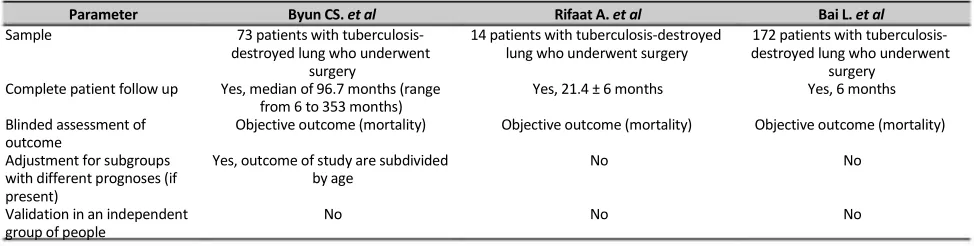
After literature selection, all included trials were appraised for its validity and relevance using several aspect based on Center of Evidence-Based Medicine, University of Oxford for prognostic study (Table 2 and
Table 3). The summaries of the appraised articles and
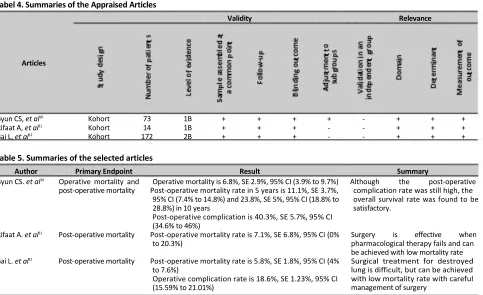
included studies are depicted in Table 4 and Table 5.
Validity
All studies included patients with tuberculosis- destroyed lung who underwent any types of pulmonary
resection, including: pleuropneumonectomy,
pneumonectomy or lobectomy. Blinding for outcome assessors is not needed because the outcome is objective (mortality).
Database Search Strategy Finding Selected
Pubmed (((surgery[Title/Abstract] OR resection[Title/Abstract] OR pneumonectomy[Title/Abstract] OR 49 4 lobectomy[Title/Abstract])) AND tuberculosis[Title/Abstract]) AND destroyed lung[Title/Abstract]
Cochrane (surgery OR resection OR pneumonectomy OR lobectomy) AND tuberculosis AND destroyed lung 0 0 ScienceDirect (resection OR pneumonectomy OR lobectomy) AND tuberculosis AND destroyed lung 282 3 EBSCOhost AB ( surgery OR resection OR lobectomy OR pneumonectomy ) AND AB tuberculosis AND AB destroyed lung 30 4 ProQuest ab(surgery OR resection OR pneumonectomy OR lobectomy) AND ab(tuberculosis) AND ab (destroyed lung) 8 1
ClinicalKey surgery AND tuberculosis AND destroyed lung 68 3
Table 2. Validity Assessment of the Included Studies
Parameter Byun CS. et al Rifaat A. et al Bai L. et al
Sample 73 patients with tuberculosis- 14 patients with tuberculosis-destroyed 172 patients with tuberculosis- destroyed lung who underwent lung who underwent surgery destroyed lung who underwent
surgery surgery
Complete patient follow up Yes, median of 96.7 months (range Yes, 21.4 ± 6 months Yes, 6 months from 6 to 353 months)
Blinded assessment of Objective outcome (mortality) Objective outcome (mortality) Objective outcome (mortality) outcome
Adjustment for subgroups Yes, outcome of study are subdivided No No
with different prognoses (if by age present)
Validation in an independent No No No
Mortality Rate of Patients with Tuberculosis-Destroyed Lung Who Underwent Pulmonary Resection: Evidence Based Case Report
Importance
Table 3. Importance Assessment of the Included Studies
Author Outcomes of the study
Byun CS. et al The operative mortality is 6.8% After patients follow-up and using the Kaplan-Meier survival curve, the 5 year and 10 year survival rate were 88.9% and 76.2% respectively
Post-operative complication is 40.3%.
Rifaat A. et al After 21.4 ± 6 months follow-up, one patient died post-operative
due to respiratory failure (mortality rate is 7.1%)
Bai L. et al After 6 months follow-up, the overall post-operative mortality rate is 5.8% (10/172). Five patients died 30 days post-surgery due to pleural hemorrhage and hemorrhagic shock. Another five died within six months due to acute respiratory failure, BPF, and massive hemoptysis.
Operative complication rate is 18.6%. The most common complication being empyema.
Precision of the prognostic estimates Operative mortality is 6.8%, SE 2.9%, 95% CI (3.9% to 9.7%) Post-operative mortality rate in 5 years is 11.1%, SE 3.7%, 95% CI (7.4% to 14.8%) and 23.8%, SE 5%, 95% CI (18.8% to 28.8%)
Operative complication rate is 18.6%, SE 1.23%, 95% CI (15.59% to 21.01%)
Tabel 4. Summaries of the Appraised Articles
Validity Relevance
Articles
Byun CS, et al10 Kohort 73 1B + + + + - + + +
Rifaat A, et al11 Kohort 14 1B + + + - - + + +
Bai L, et al12 Kohort 172 2B + + + - - + + +
Table 5. Summaries of the selected articles
Author Primary Endpoint Result Summary
Byun CS. et al10 Operative mortality and Operative mortality is 6.8%, SE 2.9%, 95% CI (3.9% to 9.7%) Although the post-operative
post-operative mortality Post-operative mortality rate in 5 years is 11.1%, SE 3.7%, 95% CI (7.4% to 14.8%) and 23.8%, SE 5%, 95% CI (18.8% to 28.8%) in 10 years
Post-operative complication is 40.3%, SE 5.7%, 95% CI (34.6% to 46%)
Rifaat A. et al11 Post-operative mortality Post-operative mortality rate is 7.1%, SE 6.8%, 95% CI (0%
to 20.3%)
Bai L. et al12 Post-operative mortality Post-operative mortality rate is 5.8%, SE 1.8%, 95% CI (4%
to 7.6%)
Operative complication rate is 18.6%, SE 1.23%, 95% CI (15.59% to 21.01%)
complication rate was still high, the overall survival rate was found to be satisfactory.
Surgery is effective when pharmacological therapy fails and can be achieved with low mortality rate Surgical treatment for destroyed lung is difficult, but can be achieved with low mortality rate with careful management of surgery
Applicability
The participants of all the studies are similar to the illustrated patient, hence the evidences from the included studies are important in making conclusion of regarding the management of the patient.
DISCUSSION
Tuberculosis-destroyed lung (TDL) is a complication of severe pulmonary tuberculosis that can causes various
respiratory symptoms and pulmonary dysfunction.6,8
TDL results from years of chronic progressive TB and
Kartika Anastasia Kosasih, Zulkifli Amin, Astrid Priscilla Amanda
Areas of destroyed lung and thick walled cavitatory lesions can contain up to 107 to 109 actively replicatingMycobacterium tuberculosis, even in patients with culture-negative sputum. These tuberculous lesions have less exposure to host defenses and are poorly penetrated by anti-tuberculous drugs. These cavities act not only as huge reservoir for TB infection, but also as the site for drug resistance development.5 The overall prognosis of TDL is poor. According to a study of non-operated patients, overall mortality was 27.8% and median survival was estimated at only 39 simultaneously removing sites of high concentrations of drug resistant bacilli.5 Therefore, the surgical
From three studies that we analyzed in this EBCR, we found three cohort studies that were appropriate Study by Byun et al followed the patients for the longest, with the median of 96.7 months (range from 6 to 353 months). It is the only study that analyzed the long- term survival rates in post-operative patients. The 5 year and 10 year survival rates were 88.9% and 76.2% respectively. We can determine the overall mortality in
10 years was 23.8%.10 Compared to median survival
rate of non-operated patients, the post-operative mortality rate of both study is satisfactory.9-11
Although all studies display low mortality rates, post-operative complications were still high. In studies by Bai et al and Byun et al, post-operative complication rates were 18.6% and 40.3% consecutively. The most
common post-operative complication was empyema, 16.7% (Byun et al) and 34.4% (Bai et al).10,12 Surgery for destroyed lung is indeed complex, and complications may arise, such as: respiratory failure, bronchopleural fistula, empyema, infection and
bleeding.10,12,15-17 Complication rate varies between
areas of low and high prevalence of tuberculosis. In countries with a high prevalence of tuberculosis, the incidence of complications such as empyema and bronchopleural fistula is reported to be fewer than 10%.18-19 By contrast, in low prevalence country, the
incidence of such complications can occur up to 25%.19
However, surgery remains an important part of has a strong impact on the further course of the healing process and thus on the prognosis.16,20 Managing the modifiable preoperative risk factors (BMI, smoking, AS score) can reduce the risk of developing post- didn't, as it was unethical to not operate someone who was indicated for surgery.
CONCLUSION
Pulmonary resection for TDL patients can be achieved with low overall mortality rate (operative and post-operative). Surgery needs to be done if indicated and can increase the survival rate of TDL patients. Although surgery for TDL is difficult and complications may occur, preventive measures can be done to prevent undesirable outcome.
RECOMMENDATION
Mortality Rate of Patients with Tuberculosis-Destroyed Lung Who Underwent Pulmonary Resection: Evidence Based Case Report
REFFERENCES
1. WHO. Global tuberculosis report 2015. WHO: France; 2015. Available from: http://apps.who.int/iris/ bitstream/10665/191102/1/9789241565059_eng.pdf?ua=1 2. Ekpe EE, Obot V (2014) Indications and outcome of surgery in
pleuropulmonary tuberculosis. Trop Med Surg. 2014;2:174. 3. Massard G, Salmento N, Falcoz p. Surgery for the Sequelae of
Postprimary Tuberculosis. Thorac Surg Clin. 2012;22:287-300 4. B.J. Pomerantz, J.C. Cleveland, H.K. Olson, M. Pomerantz,
Pulmonary resection for multi-drug resistant tuberculosis, J. Thorac. Cardiovasc. Surg. 121 (2001) 448-453.
5. Calligaro GL, Moodley L, Symons G, Dheda K. The medical and surgical treatment of drug-resistant tuberculosis. J Thorac Dis. 2014;6(3):186-195.
6. Jung CY, Jeon YJ, Rho BH. Radiologic Findings and Lung Function in Patients With Tuberculous Destroyed Lung. Chest. 2011;140 7. Lee JH, Chang JH. Lung function in patients with chronic airflow obstruction due to tuberculous destroyed lung. Respiratory Medicine. 2003;97:1237-1242.
8. Bai L, Hong Z, Gong C, Yan D, Liang Z. Surgical treatment efficacy in 172 cases of tuberculosis-destroyed lungs. Eur J Cardiothorac Surg. 2012;41(2):335-340.
9. Ryu VJ, Lee HJ, Chun EM, et al. Clinical outcomes and prognostic factors in patients with tuberculous destroyed lung. Int J Tuberc Lung Dis 2011;15: 246-50.
10. Byun CS, Chung KY, Narm KS, Lee JG, Hong D, Lee CY. Earlu and long-term outcomes of pneumonectomy for treating sequelae of pulmonary tuberculosis. Korean J Thorac Cardiovasc Surg. 2012;45:110-15
11. Rifaat A, Ghally MA, Sobhy E, Badr A, Metwally A. Pulmonary resection can improve treatment outcome in re-treatment pulmonary tuberculosis and its complications. Egypt J Chest Dis Tuberc.2014;63:385-388
12. Bai L, Hong Z, Gong C, Yan D, Liang Z. Surgical treatment efficacy in 172 cases of tuberculosis-destroyed lungs. Eur J Cardiothorac Surg. 2012;41:335-40
13. Lee J H, Chang J H. Lung function in patients with chronic airflow obstruction due to tuberculous destroyed lung. Respir Med 2003; 97: 1237-1242.
14. Heffner J E, Strange C, Sahn S A. The impact of respiratory failure on the diagnosis of tuberculosis. Arch Intern Med 1988; 148: 1103-1108.
15. Freixinet J. Surgical indications for treatment of pulmonary tuberculosis. World J. Surg. 1997;21:475-9.
16. Kang M, Kim HK, Choi YS, Kim K, Shim YM, Koh W, et al. Surgical treatment for multidrug-resistant and extensive drug resistant tuberculosis. Ann Thorac Surg. 2010;89:1597-602
17. Oclmen A, Gunlouglu MZ, Demir A, Akin H, Kara HV, Dicer SI. Role and outcome of surgery for pulmonary tuberculosis. Asian Cardiovasc Thorac Ann. 2006;14(5):363-6
18. Kim YT, Kim HK, Sung SW, et al. Long-term outcomes and risk factor analysis after pneumonectomy for active and sequela forms of pulmonary tuberculosis. Eur J Cardiothorac Surg 2003;23:833-9.
19. Massard G, Dabbagh A, Kessler R, et al. Pneumo- nectomy for chronic infection is a high risk proce- dure. Ann Thorac Surg 1996;62:1033-7.
20. Ekpe EE, Obot V. Indications and outcome of surgery in pleuro- pulmonary tuberculosis. Trop Med Surg. 2014;2:174. 21. Agostini P, Cleslik H, Rathinam S, Bishay E, Kalkat MS, Rajesh