Increasing student evaluation capacity through a collaborative
community-based program evaluation teaching model
Shauna K. Carlisle1 & Jean M. Kruzich2
Abstract: The evaluation literature reflects a long-standing interest in ways to provide practical hands-on training experience in evaluation courses. Concomitantly, some funders have shown rising expectations for increased accountability on the part of Community-Based organizations (CBOs), even though agencies often lack the associated funding and expertise required. This paper describes a training evaluation model, developed and refined over the past ten years, that partners student needs for real-world evaluation experience with CBOs needs for technical expertise and assistance in conducting evaluation activities that support program improvement. The process of developing and implementing the model is presented, and content analysis of ten years of student feedback is summarized.
Keywords: capacity building, community partnership, nonprofit community agencies, content analysis, course evaluation
I. Introduction.
In recent years the topic of nonprofit accountability has received increased interest and attention. In a statewide survey of North Carolina nonprofits, 61% of the 271 agencies surveyed indicated that evaluation activities had become more extensive, comprehensive, or rigorous in the past years (Murphy & Mitchell, 2007). At the same time research on nonprofits’ evaluation capacity suggests significant constraints to their ability to address these mandates (Carman & Fredericks 2009). A study of evaluation practices in Canadian nonprofits found 37% identified a lack of internal capacity, such as staff and time, with 31% a indicating a lack of skills and knowledge in conducting evaluations as major challenges (Hall, Phillips, Meillat, & Pickering, 2003). With increased expectations on the part of some major funders, professional degree programs have seen an expansion in the market for skilled evaluators. Efforts to incorporate real-world experiences in program evaluation curriculum have been a focus across professional training programs including public health (Fierro & Christie, 2011; Davis, 2006) social work (Jacobson & Goheen, 2006; Anderson, 2003; Margolis, Stevens, Laraia, Ammerman, Harlan, Dodds, & Pollard, 2000; Lundahl, 2008) and education (Gredler & Johnson, 2001; Kelly & Kaczynski, 2008).
The most common methods used for providing practical hands-on training experiences include simulations, role-playing, course projects, and practicums (Trevisan, 2002; Trevisan, 2004, Lee, LeBaron Wallace, & Alkin, 2007; Gredler & Johnson, 2001). However, few articles both describe a practical training approach and assess student responses to it. Further, no model was identified in the literature that had been implemented in both graduate and undergraduate
1
Assistant Professor, School of Interdisciplinary Arts and Sciences, University of Washington Bothell,
2
level courses. Therefore, this article has two goals. First it aims to describe a pedagogical model called Collaborative Community-based Program Evaluation (CCPE) that responds to the need for nonprofits to engage in evaluation activities while at the same time providing the real world experience and training students need. Second, this study also provides preliminary findings from an analysis of students’ responses to CCPE as a model for teaching graduate and undergraduate students’ program evaluation.
CCPE is based on university level course instructors and students partnering with community-based agencies on evaluation projects that support students’ learning critical evaluation skills essential for meeting the demand for nonprofit evaluators. The goals are to create a mutually beneficial collaboration that increases both agency’s evaluation capacity and students’ individual evaluative capacity, and to increase student motivation, interest, and evaluation skills through working with a “real world” community partner. Content analysis of student responses to course evaluations from 12 graduate and 7 undergraduate courses was conducted to assess CCPE’s utility in preparing students for real world experiences in the field of evaluation and its effectiveness at increasing student interest in program evaluation research.
II. Background and Significance.
Hatry, Wholey, and Newcomer (2010) identify two primary reasons for evaluation activities: 1) to achieve greater accountability in the use of funds and 2) to improve the effectiveness of programs. While evaluation scholars and agency administrators view improving agency program effectiveness as the more important of the two (Carman, 2010; Ebrahim, 2005; Wholey et al., 2010) the literature suggests that most agencies have a primary focus on mandated external
reporting to funders (Benjamin, 2012)―activities that often do not lead to program
improvements. In a survey of 178 nonprofits, Carman (2007) found that 8 of every 10 community-based organizations reported reviewing programs and assessing whether they were meeting program goals and objectives (accountability), but far fewer organizations were engaged in evaluation and performance measurement activities with 41% using a performance measurement system and 65% conducting a formal program evaluation of any of their programs. A second study reaffirmed this focus with executives identifying the most frequent use of evaluation being for accountability purposes, including reporting to funders (87%) and reporting to the board (84%) (Murphy & Mitchell, 2007). These discrepant priorities lead to nonprofit administrators preferring formative evaluations that help them know how to better operate their programs, while funders want summative evaluations that identify, “What did we cause?”, the answer to which does not improve agency services (Snibble, 2006).
As a result, the agency’s need for technical assistance and program evaluation resources provides a real world opportunity for emerging practitioners to engage in CCPE. Through the course students develop technical and analytic evaluation competencies as well as interpersonal skills needed for conducting evaluation studies (communication, negotiation, conflict, collaboration, and cross-cultural sensitivity), topics seldom addressed in evaluation curriculums and even more rarely provided opportunities to apply. Further, this model provides entry-level evaluation training that includes the professional interpersonal skills needed to interact with clients and stakeholders, skills that have been identified as key competencies desired by employers but lacking in existing evaluation training (Dewey, Montrosse, Schroter, Sullins, & Mattox, 2008; Simons & Cleary, 2006; Taut & Alkin, 2003). The next section describes the CCPE approach, created and refined over the past ten years, followed by preliminary analysis of students’ and agencies’ responses to the collaboration experience.
III. The Collaborative Community-Based Program Evaluation Model.
A. Steps to Developing a Collaborative Community-Based Program Evaluation.
Collaborations represent a mutually beneficial and well-defined relationship entered into by two or more organizations to achieve common goals. Essential characteristics of collaboration
include: 1) joint action for mutual benefit; 2) interdependence and reciprocity; 3) mutual authority;and 4) shared responsibility, risks, resources,and rewards (Mattessich, Murray-Close, & Monsey, 2001).To maximize the likelihood of a successful collaboration the instructor needs to invest a significant amount of time prior to the course, developing a relationship with an agency partner identifying both parties’respective interests,concerns and available resources, as well as negotiating roles and responsibilities with the goal of developing a set of groupprojects that are appropriate in size and scope for the time available. Based on past experiences teaching
the course, the instructor developed a list of criteria that identifies the resources and commitments an agency needs to provide in order to provide a good fit with the goals of the class (See Appendix 1).
While the criteria list is used to guide agency choice for both undergraduate and graduate courses, there are differences in emphases. At the graduate level, there is more of a priority to work with agencies that have existing data that can be analyzed in the multiple SPPS computer labs, since a primary goal is to develop the professional competencies of MSW students in the program administration and policy concentration. For the undergraduate class, the primary objective is to develop general research methods and data collections skills within the context of program evaluation that undergraduates apply to profit and nonprofit agencies. For both courses, the objective is to engage students in hands on “real world” experiences that simulate the experiences they will encounter within an occupational setting. Typically only one agency is a collaborator in both the undergraduate and the graduate class. The graduate class is capped at 25 students, whereas the undergraduate class is typically capped between 32 and 45 students. On two occasions two agencies have been used for the undergraduate class, to ensure enough evaluation questions for students to address.
be a valuable source. One or two quarters before the class the instructor contacts a potential agency to determine if the agency has program evaluation needs they are unable to address with their current evaluation capacity and that might be appropriate for the given class. The instructor communicates to the agency the purpose of the course, the number and educational level of the students involved, course learning objectives, and provides a brief description of the CCPE process. The instructor emphasizes that a utilization-focused evaluation approach (Patton, 2008) is used whereby the instructor and students provide support and consultation in addressing the agency’s program evaluation need. Furthermore, the instructor explains that CCPE provides an opportunity for students to gain real world skills at the same time that the agency receives a quality program evaluation that will have utility for the agency. If, following this initial phone conversation, agency staff express interest in further exploring collaboration and the instructor believes there is a good likelihood that the agency would be a good match, an initial meeting is scheduled at the agency. Conducting the meeting at the agency allows the instructor to get a better sense of the agency size, programs, how its location may influence student access, check availability of meeting space for interviewing and an opportunity to be introduced to other agency staff.
A set of questions, derived from the criteria for agency selection, are used to structure the initial meeting (See Table 1). These questions identify the instructor’s interests in the collaboration but also provide a vehicle for finding out what commitments and resources the agency is expecting from the class. The purpose of the first planning meeting is to identify the program evaluation interests, questions, and how the agency plans on using the program evaluation research. An important question the instructor asks the agency representative is “What final products are needed for this collaboration to be considered a success by the agency?” The agency’s ability to respond to the question helps guide the process. While program staff are often familiar with gathering information on program inputs and outputs and tracking data for billing purposes, they often have little experience with process evaluation and thinking about how research could be designed to improve the quality of their program. In some cases program staff may not have a college background or familiarity with research methods. This means the instructor needs to play an active role in helping shape a general staff request such as, “We want to find out if youth attending our arts and community service based program are more involved in their community following the program,” and tease out what specific types of data would be most useful, their rationale for wanting information, and helping identify the range of options for data collection and measurements choices. Taking along copies of student group reports from past classes is helpful in giving examples of different types of data collection methods and presentation of findings in addition to demonstrating the quality of student work.
Table 1. Questions for Preliminary Community Agency Meeting.
1. What questions are important to you as an agency?
2. How many clients do you serve on an annual basis?
3. What data is currently available for analysis?
4. How will you use the findings?
5. What methods for collecting data from clients would be permissible?
6. Will the director and program staff assist in the coordination of data collections
between class and clients?
7. Does your program have a logic model? If not would you be willing to work with
8. Does this partnership have the approval of the agency leadership?
9. Does the agency agree to pay incentives if needed to help recruit client
participants?
10.Will the director and contact person agree to attend the second and last class session?
11.Is the agency an organization that serves marginalized communities and do they
lack the capacity to evaluate the questions they have identified?
Following the initial meeting the instructor creates a summary that is distributed to all meeting participants of research questions and possible projects the group discussed and any guidelines they agreed to on how they will work together. Participants are asked to review the summary and make any revisions so they can ensure the document represents shared commitments and understandings that will guide the partnership. Often times a second meeting is needed to further refine and specify the questions that will form the basis for the student projects. By the end of this iterative process, through meetings and email exchanges, the agency and instructor have clearly outlined in writing the specific projects that will be available for class members to choose from and the processes that will guide the work. The project list is distributed to students at the first class session. The CCPE group project is the major assignment and provides a focus for sequence of topics and activities for the ten-week quarter (see Appendix 2, which also includes recommended content for a semester length class). Early on in the course, the instructor shares with the students the process involved in engaging the agency and clarifying their information and program evaluation needs as well as the agreements that will guide the collaboration.
Prior to beginning the class projects, the instructors follow the same human subjects procedures used in research projects to attain IRB approval. The section of the Federal Register that pertains to the Department of Health and Social Services Protection of Human Subjects defines research as, “a systematic investigation, including research development, testing and evaluation, designed to develop or contribute to generalizable knowledge” (Human Subjects Protection, 2009). Because the program evaluation activities we engage in with a community partner are for the agency’s internal purposes, are not designed to add to generalizable knowledge, and will not be published, they are not considered research under Part 46.101 of this regulation (Human Subjects Protection, part 46.101, 2009). In spite of the fact that our evaluation activities are exempt and so do not require IRB Board Review, course instructors follow the protocols that govern research that is reviewed by IRBs including participant consent forms and protection of confidentiality.
B. First Day of Class.
Once projects have been identified, the instructor in both the undergraduate and graduate course meets with students on the first day of class and shares with them: information on the program the students will be evaluating, 1) background on the agency, 2) summary statistics from the agency, 3) population served by the agency, 4) programs offered by the agency, and 5) contact information for the agency. Often this information is shared in a packet format, and students are given a short period of class time to review the material and course syllabus. The instructor describes the activities carried out the prior quarter to begin building the agency/class collaboration, how the instructor identified the agency partner, steps involved in developing a relationship with the program director and processes that culminated in the list of group project topics distributed during the first class session. Students also sign a confidentiality agreement that prohibits sharing any client or staff information gathered during the evaluation without authorization. The agreement states that a violation of confidentiality will result in a failing grade for the course.
While there are many similarities in the implementation of the CPPE model across educational levels, there are some notable differences. Students enter the graduate level course having completed a statistics and introductory research methods course. Following a brief overview of the history, services provided and populations served by the agency program partner, each of the possible group projects are discussed in detail. Once students have a clear understanding of the focus of each project they self-select themselves into one of four or five groups based on their interest in the topic and/or the data collection method. Project options always include a range of research methods so that students can pursue their interest in quantitative or qualitative methods. After class members have chosen from among the project topics, they meet in their project groups to share contact information, available times for meeting outside of class, formalize ground rules for how the work group will operate, and identify a group member who agrees to act as the group’s liaison with the project staff identified as the agency contact for that group roles. They also develop a list of questions to ask agency staff who will attend the first half of the upcoming second class session.
easily. During the second half of the class (after students have identified their project and question), they meet in their groups to develop a group contract and resume. The group contract and resume is designed to insure that all members understand their roles and responsibilities and to identify the unique skills each member brings to the group. Students are asked to respond to four questions as a group: 1) What are the individual strengths or skills in our group? 2) What type of communication methods will we use? 3) What are the group expectations around participating in group meetings, timelines, and deadlines? 4) What role will each member fulfill (facilitator, project manager, editor, etc.). This information is then written in the form of a contract, signed by each member of the group, forwarded to the instructor and posted on the group Blackboard discussion board. This is especially important given the enormity of the project for undergraduate students and the need to clearly outline group participation expectations. Students are then asked to develop interview questions for a session with the agency partner. The instructor delivers an online group assessment four times throughout the quarter that allows students to provide feedback on their group member’s participation. The feedback on this survey is used by the instructor to insure that each member is participating fully and to guard against social loafing.
C. Agency Interview and Class Sessions.
An introduction to the agency partner occurs during the second-class session in both undergraduate and graduate classes. Agency program staff attend the class to 1) meet the students with whom they will be interacting, 2) describe in person their agency, services, constituents, etc. 3) describe how they intend to use the evaluation report findings and 4) describe why student’s projects are important to the functioning of the agency. Students then have an opportunity to pose questions to program staff that were not addressed in the agency information packet provided during the first class session. This class session is critical for engaging students in the process. By the end of the session students identify feeling a stronger sense of responsibility and commitment to the final products.
For both undergraduate and graduate courses, class time includes a combination of lectures, group discussion, computer labs, and project group work. Working in small groups, all class members conduct evaluation activities with the same agency program. A utilization-focused evaluation perspective with its emphasis on addressing specific, practical needs of the users of the evaluation, and joint control over the research and ongoing participant involvement undergirds both courses (King, Cousins, & Whitmore, 2007; Patton, 2008). For the graduate course, project groups may focus on specific aspects of the evaluation process, such as developing and piloting a measure or analyzing existing pre/post data. The focus is on development of specific knowledge and skills regarding important evaluation relevant topics including conducting a content analysis, completing an evaluation program audit of evaluation practices at their practicum agency, statistical analysis of quantitative data and responding to challenging ethical scenarios
In contrast, the undergraduate course has all students engage in all stages of the program
evaluation process, including identifying relevant theories, conceptualization and
concept and then engage in a group activity to reinforce the concept. This process is repeated until all the research steps are covered and a final report is provided to the agency.
D. Agency Presentations.
In both undergraduate and graduate courses students completed a final written report, and to develop a 15- to 20-minute formal PowerPoint presentation of their major findings and recommendations that is to be presented on the last day of class. Members of multiple agency stakeholders groups often attend including agency executives, board members, program staff, volunteers, and program participants. Stakeholders have an opportunity to ask questions of the students and make comments on the findings. The group Power Point presentation includes identifying the project group’s evaluation questions, variables of interest, data analysis approach, significant findings, limitations of the analysis, and suggestions for utilizing the project findings. Students receive verbal feedback from the agency and verbal and written feedback from the instructor on the presentation and written report. Each student group provides the agency a copy of the PowerPoint, a written evaluation report, covering all aspects of the evaluation process as well as an executive summary and data analysis details so that agencies can replicate student research findings. To date undergraduate and graduate classes have produced over 25 projects through partnerships with 12 community agencies. These projects include instrument development, needs assessments, assessing service delivery, comparing service delivery models, customer satisfaction surveys, and outcome evaluations. Table 2 includes a list of typical projects.
IV. Evaluating the Success of Collaborative Community-Based Program Evaluation.
A. Methods.
A university wide Instructional Assessment Form that includes open-ended questions was distributed to students on the final class day. To identify what aspects of the course were most important to students, responses to the question “What aspects of this class contributed the most to your learning?” were transcribed and content analyzed from 12 graduate level and 7 undergraduate level courses held between 2000 and 2011 (533 students). To assess inter-coder reliability, the degree to which coding of text by two coders were similar, the co-authors independently examined 15% of all responses, drafted a set of emergent categories, then met to compare proposed codes and agree on an initial master list of codes. After the initial draft codebook was developed, an iterative process of coding, reliability assessment, codebook modification, and recoding was used. After three coding rounds, inter-coder reliability was conducted to validate the coding scheme. Using SPSS, Cohen’s kappa (Cohen, 1960) was calculated resulting in a kappa of.85, an excellent level of inter-coder reliability (Lombard, Snyder-Duch, & Bracken, 2002). Each author then coded half of all student responses.
V. Results.
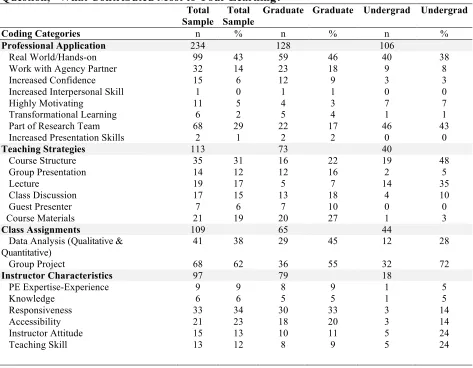
row category by the total graduate sample and undergraduate sample. Of the four overarching categories, professional application represented 234 of the 553 (42.3%) of the coded segments. This is a good indicator of the importance of the CCPE model.
Table 2. Illustrative Evaluation Projects.
• Assessment of an educational model designed for students with family members
receiving treatment for life threatening illnesses.
• Assessment of the utility of an early childhood education brochure.
• Evaluate the impact of agency programming on youth's feelings of empowerment and
identity, use of time, values and risk behaviors.
• Six month follow up telephone interview with summer camp attendees.
• Analysis of pre and posttest results of camp program serving marginalized youth.
• Pilot evaluation of mentors' experience participating in a positive youth development program.
• Development and pilot testing of caregiver satisfaction measure for a community-based
youth counseling program.
• Assessment of prescription medication and medical care use by homeless youth.
A. Professional Application
Real world hands-on experience was a category of professional application mentioned frequently by graduate (46%) and undergraduate (38%) students:
“I loved the applied (experiential) learning. Plus it makes me feel more connected to the UW when I can conduct meaningful research. We’re a research institution are we not?” (Undergraduate)
“The actual applied hands-on learning was amazing, it facilitated the most challenging, but educational experience I've had by far”. (Graduate)
“Learning how ’real’ processes play out in the ‘real’ world”. (Graduate)
Table 3. Percentage and Frequency of Text Segments from Student Responses to the Question, “What Contributed Most to Your Learning?”
Total
Professional Application 234 128 106
Real World/Hands-on 99 43 59 46 40 38
Instructor Characteristics 97 79 18
PE Expertise-Experience 9 9 8 9 1 5 undergraduates students’ perspectives of what contributed most to their learning. A course structure that closely integrated lecture and application for each step in the evaluation process was more often important to undergraduates (48%) as compared to 22% of graduate students:
“I love the setup of the class, instead of lecturing the whole quarter we actually
got to conduct our own study”. (Undergraduate)
“Going step-by step with support. Able to ask questions (Undergraduate)
“The instructor did a fabulous job breaking points down and applying it to our project”. (Graduate)
C. Class Assignments.
While important to both groups, undergraduates (72%) more often noted the importance of carrying out of the program evaluation as compared to graduate students (55%). It may be that the CPPE model supported developing higher level cognitive skills than is usually found in undergraduate courses (Anderson & Krathwohl, 2001), a possibility suggested by a student’s remark, “The group project forced us to apply what we learned and not just regurgitate info during a test.” Graduate students (45%) were more likely than undergraduates (28%) to remark on the value of the data analysis assignments.
To ensure all graduate students had experience with different types of analysis, a qualitative coding exercise, in addition to computer lab exercises that required using SPSS with an existing sample of the agency’s data were assigned early in the quarter to give students practice in analyzing data prior to gathering their project data. Illustrative student comments in response to the question of what aspects contributed most to your learning included, “The hands-on practice of SPSS” and “Being in the computer lab and using SPSS where we were able to get one-to-one help” as well as “coding qualitative responses”.
D. Instructor Characteristics.
With only 10 weeks to complete their evaluation projects students felt under considerable pressure for fast turnaround and often requested consultation with the instructor or feedback from an agency liaison on a weekly basis. For graduate students, the instructor characteristics mentioned most frequently as contributing to their learning were responsiveness to student needs (33%), with comments such as, “following up with students to ensure understanding” and instructor accessibility (23%) including meeting outside of class. A student commented, “Instructor spent many hours with us outside of class helping us to figure things out;” and another wrote, “Knowing that the professor was there to answer questions.” Undergraduate students most often remarked on the instructors’ attitudes (24%) in terms of her “enthusiasm” or “energy” and teaching skills (28%) particularly her excellence in communicating and attention to different ways of learning.
D. Agency Responses.
A Clinical Director of a multi-service center remarked at the conclusion of the course that the benefits of the collaboration extended beyond the evaluation report: “I’ve come to appreciate how this program speaks to something far greater than just the individual tasks undertaken by the students. It’s an alliance between a community’s service providers and the educational system that prepares them. Connecting all this focused academic energy with real — and somewhat overwhelming — issues within the community offers multiple benefits. The students get a chance to see some things that are likely not covered in their textbooks, and we get access to an incredible amount of intellectual power, energy, and research tools that we could never afford on our own.” In addition to the instrumental use conveyed in the prior statement, involvement in an evaluation may lead to process use, changes in the thoughts and behaviors of individuals, which then impacts organizational change (Preskill, Zuckerman, & Matthews, 2003). An agency partner, commenting on the partnership captures both: “It has left us with practical resources that are already positively impacting the families we serve. From opening up a dialogue with families through the survey to finding ways to get better information from our data, we’re right at the genesis of something that feels more structurally sound than what we had before.”
After a decade of offering the course, former students, who are now program directors and board members of nonprofit agencies frequently ask if their agency can become a site for partnering with the class. Former students recognize the significant contribution CCPE classes can make in preparing students for program evaluation and for helping their agencies achieve their program development and accountability needs.
VI. Conclusion.
The purpose of this article was twofold; to describe the CCPE pedagogical model in sufficient detail that instructors interested in conducting a collaborative community based program evaluation course could confidently implement the model and second, to examine data gathered over the past decade from student perception of CCPE’s impact on their learning. We conducted a content analysis of course evaluations from twelve graduate level and seven undergraduate level courses, held between 2000 and 2011, focusing on the question “What aspects of this class contributed most to your learning?” Results of this analysis indicate that both undergraduate and graduate students overwhelmingly identified that the aspect of CCPE that contributed most to their learning was the real world experiences, followed by working on a research team. These findings show that students believed this pedagogical model was useful in preparing them as evaluators. Further, the findings reveal that working with a community partner was both engaging and fueled their motivation for completing the class work.
working with an agency partner. Despite the limited textual support for motivation, CCPE, as a pedagogical model, contributed to students viewing themselves as being well prepared by real world experiences.
We would be remiss if we did not note the increased demands on the instructor implementing this approach to teaching collaborative community based program evaluation. Adopting the CCPE model significantly increases the demands on the instructor when compared with more traditional courses that do not involve ongoing community agency collaborations. For example, providing students with real world evaluation experiences requires preliminary work identifying and working with a community partner, meeting with students regularly, juggling the teaching of theory with practice, reviewing many drafts of a final product and ensuring the program evaluation needs of the agency are addressed require time above and beyond that of a traditional course. Additionally, faculty using this model must anticipate dedicated supervision and planning time over and above what is required for other courses. This is critical when multiple course projects must be completed within an academic term. One approach to help minimize some of the additional time demands on the instructor is to work with the same program for two years so that the upfront time on engagement, relationship building with staff, and becoming familiar with the program’s data collection systems are activities that do not need to be repeated during the second year of working together. Agencies usually request to work with the instructor for another year since their evaluation efforts can benefit from additional support and it provides an opportunity for additional kinds of analyses such as completing pre and post measures the second year using a measure developed during the first year of the collaboration. Additionally, given the emphasis on university/community partnerships the first author has received support for a TA to assist in the data collections and data analysis process in the classroom. Universities may find providing funds for a teaching assistant a good investment to provide support for community based learning.
This study is not without its limitations. Given the preliminary nature of these findings, gathering additional quantitative information on students’ perception of the utility of this approach as well as their feedback on how to strengthen the course would be helpful. Secondly, a comparison of the outcomes of this model to the outcomes of a standard research course would provide a more comprehensive understanding of the impact of this approach on student learning. Thirdly, asking our community partners to provide structured feedback on their experience of the collaboration and ways they intend to use the results would help with further developing the curriculum. Lastly, following up with community partners a year after the end of the class to see if they did use the results as they had intended and if there were other ways in which our collaboration had influenced the program’s attention, focus and involvement in evaluation activities will add to our understanding of factors that influence the use of evaluation results, and development of program’s evaluation capacity.
Appendices
Appendix 1. List of Criteria Used for Selection of Agency Partners.
1. Agency serves a minimum of 30-40 clients annually so there are sufficient
numbers to calculate statistical significance.
2. Preferable if agency has an existing data set that has not been analyzed that can be
used in class computer labs so that students receive experience in quantitative analysis using SPSS with the programs' data.
3. Agency is interested in evaluation questions that include qualitative and quantitative
data collections strategies or a combination of both. Multiple data collections methods are used so that students can gain experience with different approaches.
4. Program has a logic model or program leadership is willing to develop a draft logic
model prior to the quarter when the course is taught.
5. Agency executive is interested and supportive of evaluation partnership and informs
board of the collaboration.
6. Agency staff is willing to serve as liaisons to student project groups and respond by
email, phone, or in-person meetings with student groups during the quarter.
7. Program director and staff commit to attend the second-class session, to share
information about the program and answer students' questions and attend the last class session to hear student's PowerPoint presentations of their group project findings.
8. Program staff agrees to help coordinate and set up schedule for data collection
requiring interviews, focus groups, etc. with clients or staff.
9. Agency agrees to pay for an incentive (providing food at focus group, fast food gift card;
childcare, transportation), if that is needed to recruit client participants.
10.Agency is a community based grassroots organization that lacks capacity to address
evaluation questions they have identified.
Appendix 2. Course Activities and Topics for Ten Week3 Undergraduate and Graduate Courses4.
Undergraduate Graduate
Week 1 Overview of program/List of projects Sign confidentiality form.
Students choose group project.
Meet in groups to develop group resume & contract. Develop questions for program staff.
Week 2 Staff attend class, answer student questions. Lecture on levels of measurement.
Finish draft 1 of literature, submit for feedback. Develop qualitative questions.
Week 4 Send draft of survey questions to program staff for vetting. Forward draft research design and sampling method. Prepare for midterm exam.
Send draft of survey/focus group questions to program staff for vetting.
Qualitative Methods & Content Analysis. Computer session 1 & lab assignment.
Week 5 Based on agency and instructor feedback survey and qualitative questions are revised. Develop consent form.
Forward survey to agency for dissemination.
Based on agency and instructor feedback survey and qualitative questions are revised.
Submit draft research methods section to instructor for feedback.
Lecture on data analysis. Computer session 2 & lab assignment.
Implement focus groups/individual interviews or disseminate self-administered surveys.
Lecture on evaluation designs.
Computer session 2 & lab assignment including reliability analysis.
Week 7 Data analysis & interpretation. Develop tables and graphs. Develop results section.
Data analysis & interpretation. Input data, transcribe interviews.
Week 8 Continue data analysis and results. Develop conclusion and suggestions. Submit part 3 of report for instructor feedback.
Develop tables and graphs. Draft report and PowerPoint (PPT).
Week 9 Begin PowerPoint presentation development. Instructor feedback used to revise PPT presentation. Use instructor feedback to revise part 3. Submit full report for instructor feedback.
Dress rehearsal of PPT presentation.
Instructor & class feedback used to revise PPT presentation.
Week 10 PPT presentation to agency stakeholders. Final presentation feedback from instructor. Final group project reports given to staff.
PPT presentation to agency stakeholders.
References
Anderson, L. W., & Krathwohl, D. R. (Eds.). (2001). A taxonomy for learning, teaching and assessing: A revision of Bloom's Taxonomy of educational objectives. New York : Longman.
Anderson, S. G. (2003). Engaging students in community-based research. A model for teaching social work research. Journal of Community Practice, 10(2), 71-87.
Benjamin, L. M. (2012). Nonprofit organizations and outcome measurement: From tracking program activities to focusing on frontline work. American Journal of Evaluation, 33(3),
431-447. doi: 10.1177/1098214012440496
Carman, J. G. (2007). Evaluation practice among community-based organizations: Research into the reality. American Journal of Evaluation, 28(1), 60-75. doi: 10.1177/1098214006296245
Carman, J. G. (2010). The accountability movement: What’s wrong with this theory of change? Nonprofit and Voluntary Sector Quarterly, 39(2), 256-274.
Carman, J. G., & Fredericks, K. A. (2008). Nonprofits and evaluation: Empirical evidence from the field. New Directions for Evaluation, 119, 51-71.
Carman, J. G., & Fredericks, K. A. (2009). Evaluation capacity and nonprofit organizations: Is the glass half-empty or half-full? American Journal of Evaluation, 31(1), 84 -104. doi:
10.1177/1098214009352361
Christensen, R., & Ebrahim, A. (2006). How does accountability affect mission: The case of nonprofit serving immigrants and refugees. Nonprofit Management & Leadership, 17, 195-209.
Cohen J. (1960). A coefficient of agreement for nominal scales. Educational and Psychological Measurement, 20, 37-46.
Dewey, J. D., Montrosse, B. E., Schroter, D. C., Sullins, C. D., & Mattox, J. R., II. (2008). Evaluator competencies: What’s taught versus what’s sought. American Journal of Evaluation, 29(3), 268-287. doi: 10.1177/1098214008321152
Dewey, J. D., Montrosse, B. E., Schroter, D. C., Sullins, C. D., & Mattox, J. R., II. (2008). Evaluator competencies: What’s taught versus what’s sought. American Journal of Evaluation, 29(3), 268-287. doi: 10.1177/1098214008321152
Offering the course in a 15 or 16 week semester would allow students to more effectively integrate and consolidate their learning than is possible in a 10 week quarter. When offered on a semester basis, implementing the CCPE model would benefit from additional attention in the following areas: 1) alternative ways to approach literature reviews to strengthen different aspects of group projects, 2) review and critique of potential measures for groups projects, 3) practice and receive feedback on reporting written findings and interpretations, 4) discuss initial findings with agency program director prior to class presentation, 5) examine alternative methods to use graphs and figures
to report results and 6) use class time for group project teams to share progress with other teams and provide consultation and peer review to each other throughout the course.
4
Ebrahim, A. (2005). Accountability myopia: Losing sight of organizational learning. Nonprofit and Voluntary Sector Quarterly, 34(1), 56-87.
Fierro, L. A., & Christie, C. A. (2011). Understanding evaluation training in schools and programs of public health. American Journal of Evaluation, 32(3), 448-468. doi:
10.1177/1098214010393721
Gredler, M. E., & Johnson, R. L. (2001). Lessons learned from the directed evaluation
experience. American Journal of Evaluation, 22(1), 97-104. doi: 10.1177/109821400102200110
Hall, M. H., Phillips, S. D., Meillat, C., & Pickering, D. (2003). Assessing performance:
Evaluation practices & perspectives in Canada’s voluntary sector. Evaluation Research Project (VSERP) Centre for Voluntary Sector Research and Development: Carleton University, Ottawa, Ontario.
Hatry, H.P. Wholey, J.S. & Newcomer, K.E. (2010). Evaluation challenges, issues, and trends. In Wholey, J. S., Hatry, H. P., & Newcomer, K. E. (Eds.). 3rd ed. Handbook of practical program evaluation (pp. 668-679). San Francisco, CA: Jossey-Bass.
Human Subjects Protection, 46 C.F.R., part 46.101, 2009 Available at
http://www.hhs.gov/ohrp/humansubjects/guidance/45cfr46.html#46.101 Accessed October 7, 2012.
Jacobson, M., & Goheen, A. (2006). Engaging students in research: A participatory BSW program evaluation. The Journal of Baccalaureate Social Work, 86-104.
Kelly, M. A., & Kaczynski, D. (2008). Teaching evaluation from an experiential framework: Connecting theory and organizational development with grant making. American Journal of Evaluation, 29(4), 547-554. doi: 10.1177/1098214008324181
King, J. A., Cousins, J. B., & Whitmore, E. (2007). Making sense of participatory evaluation: Framing participatory evaluation. New Directions for Evaluation, (114), 83-105. doi:
10.1002/ev.226
Knowlton, L. W., & Phillips, C. C. (2009). The logic model guidebook: Better strategies for great results. Thousand Oaks, CA: Sage publications Inc.
Lee, J., LeBaron Wallace, T., & Alkin, M. (2007). Using problem-based learning to train evaluators. American Journal of Evaluation, 28(4), 536-545. doi: 10.1177/1098214007305613
Lombard, M., Snyder-Duch, J., & Bracken, C. C. (2002). Content analysis in mass
communication: Assessment and reporting of inter-coder reliability. Human Communication Research, 28, 587-604.
Margolis, L. H., Stevens, R., Laraia, B., Ammerman, A., Harlan, C., Dodds, J., Pollard, M. (2000). Educating students for community-based partnerships. Journal of Community Practice, 7(4), 21 - 34.
Mattessich, P. W., Murray-Close, M., & Monsey, B. R. (2001). Collaboration: What makes it work (2nd ed.). St. Paul, MN: Amherst H. Wilder Foundation.
McLaughlin, J. A., & Jordan, G. B. (1999). Logic models: A tool for telling your programs performance story. Evaluation and Program Planning, 22(1), 65-72. doi:
http://dx.doi.org/10.1016/S0149-7189(98)00042-1
Murphy, D. M., & Mitchell, R. (2007). Building evaluation capacity in North Carolina's nonprofit sector: A survey report. Raleigh, NC: Institute for Nonprofits.
Patton, M.Q. (2008). What is utilization-focused evaluation? Utilization-focused evaluation. 4th edition (pp. 35-57). Newbury Park, CA: Sage.
Preskill, H., Zuckerman, B., & Matthews, B. (2003). An exploratory study of process use: Findings and implications for future research. American Journal of Evaluation, 24(4), 423-442. doi: 10.1177/109821400302400402
Simons, L., & Cleary, B. (2006). The influence of service learning on student’s personal and social development. College Teaching, 54(4), 307-319.
Snibbe, A. C. (2006). Drowning in data. Stanford Social Innovation Review, (4), 3, 39-45.
Taut, S. M., & Alkin, M. C. (2003). Program staff perceptions of barriers to evaluation implementation. American Journal of Evaluation, 24(2), 213-226. doi:
10.1177/109821400302400205
Trevisan, M. S. (2002). Enhancing practical evaluation training through long-term evaluation projects. American Journal of Evaluation, 23(1), 81-92. doi: 10.1177/109821400202300110
Trevisan, M. S. (2004). Practical training in evaluation: A review of the literature. American Journal of Evaluation, 25(2), 255-272. doi: 10.1177/109821400402500212
Wholey, J. S., Hatry, H. P., & Newcomer, K. E. (Eds.). (2010). Handbook of practical program evaluation. 3rd ed. San Francisco, CA: Jossey-Bass.