Impact of deltamethrin on cockroaches (
Periplaneta americana
)
and its
residue on environment
Endang Puji Astuti, Pandji Wibawa Dhewantara
National Institute of Health Research and Development, Ministry of Health of Indonesia
Corresponding author: Pandji Wibawa Dhewantara Email: [email protected]
Received: October 18, 2014; Revised: October 25, 2014; Accepted: November 5, 2014.
Abstrak
Latar belakang: Penggunaan insektisida secara intensif tidak hanya memberikan dampak pada spesies target, namun juga pada spesies non-target dan lingkungan. Pada penelitian ini dilakukan penilaian pengaruh residu deltametrin terhadap kecoa (Periplaneta americana), ikan lele (Clarias batrachus), dan nila (Oreochromis niloticus). Selain itu laju infi ltrasi residu pada tipe tanah dengan komposisi tanah yang berbeda juga diukur.
Metode: Percobaan dilakukan terhadap kecoa yang dikembangbiakan di laboratorium di Institut Pertanian Bogor. Perlakuan dengan tiga ulangan dan lima taraf konsentrasi deltamethrin: 0.8%, 0.4%, 0.2%, 0.1% and 0.05% (v/v) dilakukan untuk mengukur pengaruh residu terhadap kecoa selama 24 dan 48 jam. Penentuan LC50 dilakukan dengan analisis Probit. Konsentrasi letal yang didapatkan kemudian diujikan kepada ikan lele dan nila dengan metode semprot. Untuk perbandingan, uji efek organofosfat dengan konsentrasi 1 ppm dan 10 ppm dilakukan melalui metode soaking kepada dua jenis ikan tersebut. Laju infi ltrasi residu pada tiga tipe komposisi tanah diukur menggunakan lysimeter.
Hasil: Hasil penelitian menunjukkan bahwa LC50 residu deltamethrin terhadap kecoa tercapai pada konsentrasi 0,2% pada 24-jam perlakuan. Lima puluh persen ikan nila mati pada perlakuan deltamethrin 0,2% selama 24 jam. Laju infi ltrasi residu lebih tinggi pada jenis tanah berpasir (5 ml/menit) dibandingkan jenis tanah yang didominasi tanah liat.
Kesimpulan: Selain memiliki efek mematikan pada kecoa, Deltamethrin 0,2% mencemari tanah dan air, serta membunuh ikan nila (O. niloticus). (Health Science Indones 2014;2:94-9)
Kata kunci: deltamethrin, efek residu, P. americana, O. niloticus, tanah
Abstract
Background: Intensive use of chemical insecticides not only affect the target species, but also non-target species and environment. In this study, we examined residual effect of deltamethrin on cockroaches (Periplaneta americana), catfi shes (Clarias batrachus) and nile-tilapia (Oreochromis niloticus). In addition, we aimed to measure the infi ltration rate of deltamethrin insecticides in different types of soil.
Methods: An experimental study was conducted on laboratory-reared P. americana in Institut Pertanian Bogor (Agricultural Institute, Bogor). Using fi ve different deltamethrin concentrations 0.8%, 0.4%, 0.2%, 0.1% and 0.05% (v/v) in three replications, we assessed deltamethrin residual effect against cockroaches in 24 and 48-hrs. Lethal concentration (LC50) for cockroaches was determined using Probit analysis. The lethal concentration was then tested on C. batrachus and O. niloticus in spraying and soaking method using organophosphate 1 ppm and 10 ppm. Infi ltration rate of insecticide on three soil type was measured with lysimeter.
Results: The toxic effect (LC50) of deltamethrin residue against cockroach reached at concentration of 0.2% in 24-hrs. Fifty per cent of nile-tilapia were killed by deltamethrin 0.2% within 24-hrs. Infi ltration capacity of the insecticide were higher on sandy soil (5 ml/mins) than dominantly-composed by clay soil.
Conclusions: Deltamethrin 0.2% had a knockdown effect on P. americana, may infi ltrate soil and waterbodies, and had a residual toxic effect on nile-tilapia (Oreochromis niloticus). (Health Science Indones 2014;2:94-9)
Insects are the most varied and the most dominant creature on earth. Some insects are benefi cial for humans by acting as pests at farmlands and plantations, but some are disadvantageous because of its role as disease vectors. One example of pest is cockroach (Periplaneta americana). Cockroaches are domestic pests and their presence may affect the community health. In addition to being aesthetically disrupting, cockroaches bite and act as a mechanical vector for various epidemics.1,2
One method to control the population of insect pests is to use chemical compounds, i.e. insecticides. Insecticides are widely used due to its practical and economical traits, and the results in reducing the population of such pests are quickly evident. To introduce new active ingredients for insecticides, an effi cacy tests and ecological risk assessment of their toxicity level must be ensured.3
One of the insecticides compounds, pyrethroid, is generally safe for mammals and birds, but highly toxic for fi sh and other aquatic organisms. Their low solubility in water and their lipophilic properties are harmful for gills and reduce the effectiveness of enzymes, so they pose a threat for fi shes.4 One of pyrethroids, deltamethrin, has become increasingly popular in the last few years due to its high photo-stability, low toxicity on mammals and their relatively high durability on natural medium.5 It is important to monitor the residual effects of deltamethrin on the environment. Soil samples can be used to determine the contents of insecticides that infi ltrate into the earth, the time they need to fully infi ltrate the earth and waterbodies, and their toxicity level on non-target creatures, particularly aquatic organisms.6 However, studies on residual effect of deltamethrin against P. americana and its side-effects on different types of soil and fi shes are still limited.
Thus, we conducted this research with objectives: (1) to measure the LC50 of deltamethrin insecticide (effi cacy) on Periplaneta americana with the residual effect method; (2) to measure the infi ltration rate of deltamethrin insecticides in different types of soil (organic, sandy and clay soil); and (3) to assess the residual effects of deltamethrin insecticide on catfi shes (Clarias batrachus) and nile-tilapia (Oreochromis niloticus).
METHODS
We conducted an experimental study at the Laboratory of Insect Physiology and Toxicology, Crop Pest and
Disease, Faculty of Agriculture, Institut Pertanian Bogor, Indonesia. We conducted two main steps of toxicity tests: fi rst we test the Deltamethrin toxicity on cockroaches to determine the LC50. Second, we did the toxicity test on non-target species and toxin infi ltration test on environment (soil).
Deltamethrin toxicity test on cockroaches (
Peripla-neta americana)
The toxicity test with the residual effect method was assigned on laboratory-reared adult cockroaches (Periplaneta americana). Samples were obtained from laboratory of Faculty of Veterinary Medicine, Institut Pertanian Bogor. Three replications of fi ve deltamethrin concentrations 0.8%, 0.4%, 0.2%, 0.1% and 0.05% (v/v) and control were prepared. Round fi lter papers were cut according to the size of the petridishes sand used as top covers. Each concentration of insecticide was dripped on different petridish using pipettes with a spiral pattern. The
fi lter papers were then placed in a closed container together with fi ve cockroaches each (in total 90 cockroaches). We counted the number of knock-downed P.americana in 24 and 48-hrs.The results from the toxicity tests were analyzed using probit analysis with POLO PC.7 The concentrations used were converted by the programme to log dose and the number of dead fi shes to mortality Probit values. A plot of these two parameters was made to estimate the 50 percent death rate (LC50) of deltamethrin.The data was analyzed statistically by one-way ANOVA using SPSS 17.0.
Deltamethrin toxicity on non-target species
Toxicity tests were conducted on non-target species: catfi sh (C. batrachus) and nile-tilapia (O. niloticus). Toxin was introduced with two separate methods, i.e spraying and soaking. The observations determine the effect of insecticides on the fi shes that were exposed with the toxic dose of pesticides for 24 and 48 hours. In the spraying method, 10 catfi shes and four nile tilapias were exposed to maximum lethal concentration of deltamethrin. In the soaking method, fi ve catfi shes and six nile-tilapias were exposed to organophosphat (Curacron 500EC) at 1 ppm and 10 ppm. Number of killed fi shes were counted and reported .5,7,8
Deltamethrin infi ltration test on soil
composition until it reached the weight of 200 grams. Type 1 comprised of 70% sand, 15% organic material, 15% clay; Type 2 consists of 15% sand, 70% organic material, 15% clay; and Type 3 consists of 15% sand, 15% organic material, 70% clay. Soil were then spread evenly and placed into controlled-valve lysimeters until the soil fi ll up to 3-cm below the mouth of the lysimeter. Two-hundred mililiters of 0.2% deltamethrin were then poured into each of the lysimeter. The remaining volume of pesticide (a result of water administration) was then observed for the speed of the fl ow of the insecticide inside the soil (the fl ow of insecticide (cm) per 30 minutes), and the number of drops produced per 30 minute. The
fl ow speed and the fl ow rate were measured using the following Crosby’s formula:8,9
Flow speed = [(water height (cm)] / [(time (minute)] Flow rate = [(fl ow water volume (ml)] / [time (minute)]
RESULTS
The effect of deltamethrin application on Periplaneta
americana
In 24-hrs, the highest death rate occurred at the highest concentration (73.3% v/v). The LC50 occured at deltamethrin concentration of 0.2% (v/v) (p < 0.05). There was no differences on 24-hrs and 48-hrs mortality rate (Table 1).
Effects of deltamethrin residue on fi sh
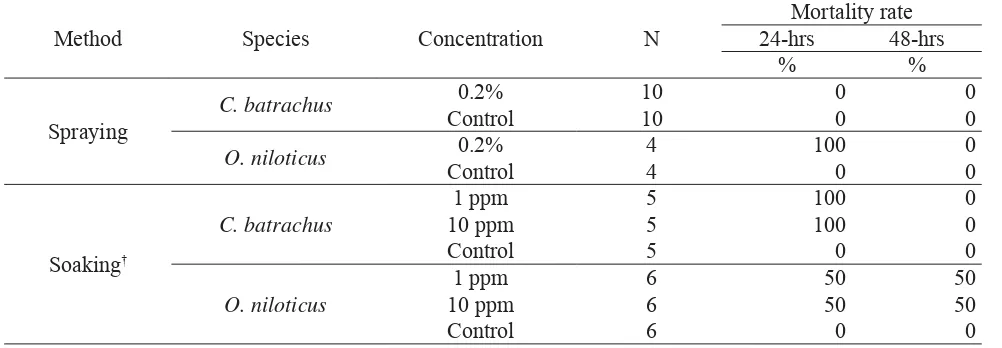
All of nile-tilapia fi shes killed by deltamethrin 0.2% in 24-hrs when applied in spraying method. In the soaking method (using organophospate), all catfi shes were killed in both 1 ppm and 10 ppm solution within 24-hours. Meanwhile, only 50 per cent of the nile-tilapias were killed in the 1 ppm and 10 ppm solution in 24-hours (Table 2).
Deltamethrin fi ltration on three soil characteristics
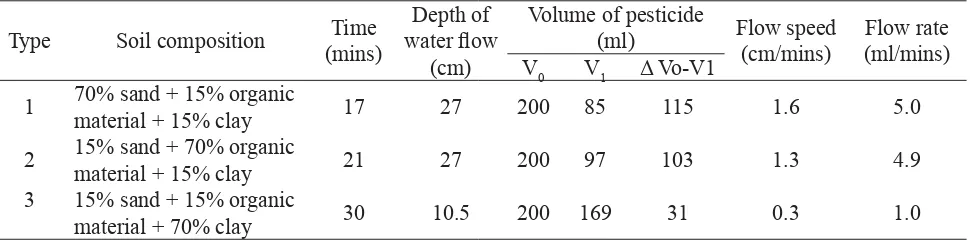
Pesticide fl ow rate were varied amongst different types of soil. Deltamethrin residue fl own faster across the type 1 soil composition. Water successfully infi ltrated the soil, that indicated by numerous drops of water came out of the lysimeter. Fifty-eight (115/200) per cent deltamethrin residue remains in type-1 soil. In contrast, it was only 16 (31/200) % deltamethrin residue successfully washed out from the soil type 3. Flow speed and fl ow rate on soil type 3 was the lowest (Table 3).
Table 1. Residual effect (mortality) of fi ve concentration of Deltamethrin against P. americana
Concentration
(% v/v) n
Mortality rate (%)
24-hrs 48-hrs
0.80 5 73.3 73.3
0.40 5 66.7 66.7
0.20 5 53.3 53.3
0.10 5 33.3 33.3
0.05 5 0 0
Control 5 0 0
Table 2. Residual effect of Deltamethrin against C. batrachus and O. niloticus based on two different methods
Method Species Concentration N
Mortality rate
24-hrs 48-hrs
% %
Spraying
C. batrachus 0.2% 10 0 0
Control 10 0 0
O. niloticus 0.2% 4 100 0
Control 4 0 0
Soaking†
C. batrachus
1 ppm 5 100 0
10 ppm 5 100 0
Control 5 0 0
O. niloticus
1 ppm 6 50 50
10 ppm 6 50 50
Control 6 0 0
Table 3. Infi ltration rate of deltamethrin residue in different soil compositions
Type Soil composition Time
(mins)
Depth of water fl ow
(cm)
Volume of pesticide
(ml) Flow speed
Overall, our study emphasizes that the use of insec-ticides should be consider carefully for their effect for non-target organisms and environment. In our study, we found that deltamethrin 0.2% had a knockdown effect on more than fi fty per cent of target species (P. americana) population within 24-hours. Deltamethrin 0.2% also affect non target species. In soaking method, organophospate residue (1 ppm) caused 100% deaths of the catfi shes and 50% nile-tilapias within 24-hours. Furthermore, on environmental aspect, the rate of soil and waterbodies pollution by insecticide were varied in different soil compositions.
In our observation, cockroaches experienced seizures (before dying) after contacted with insecticide. Effect of deltamethrin against cockroaches has been examined in another studies where deltamethrin 2.5% (v/v) was shown to be lethal for bigger type of cockroaches: German cockroach (Blattella germanica).10 It shows that every cockroach species may differ on their sensitivity to deltamethrin exposure. Physiological properties and resistance level might affect the cockroaches vulnerability to chemical exposure. Insecticide may accumulated and affected the group of insects and causes disrupted development, changed eating behavior, growth and fi nally death.11 Yet, our study cannot conclude if P.americana more sensitive to deltamethrin than B. germanica.
We showed that nile-tilapias are more susceptible to deltamethrin-contaminated water than catfi shes (C. batrachus). Another study showed that deltamethrin is highly toxic to the speciesat LC50 of 15.47 mg/l.12 Deltamethrin is a type-II pyrethroid compound that is more potentially toxic to fi sh and least toxic to mammals contaminating aquatic ecosystems
as potential toxic pollutants, causes severe morphological alterations in the gill and liver of
fi ngerlings of nile-tilapias.13 Catfi sh is known to survive in polluted water, including media contains gutters and trenches. Small fi shes, like catfi shes, are more vulnerable to pesticide and thus easily died.7 Our study shows that compare to deltamethrin, organophospate have a deadliest impact on catfi shes.
We show that dissolved insecticide residue in water can affect the life of aquatic organisms. Insecticide can accumulate in organs and affects enzymes activity. In addition, it may cause genetic, morphological and physiological changes, and even death. The differences in size and age of the fi sh may affect their vulnerability. A study revealed that deltamethrin slowed down lipase enzyme in Poecilia reticulata and negatively affecting the nutrition in its body and physiology.13 Another effect of deltamethrin on fi shes have also been explained in several laboratory studies.14,15 Deltamethrin causes morphologic disruptions to the gills, liver, and haemobiotic organs.16,17
This study also provides evidence that sandy soil was more likely to absorb and release a high amount of insecticide residue faster than on dominantly-composed clay soil. This proves that infi ltration rate of insecticide residue on sandy soil area is greater than other types of soil. Thus, the waterbodies will be rapidly contaminated. It is also indicate that clay soil has higher holding capacity than sandy soil. As a result, higher proportion of clay on soil would be able to hold pesticide residue longer.
in the soil and water. Bioconcentration occurs when the dissolved chemicals in the water are absorbed by gills and epithelium tissue of organisms. Next, bioaccumulation of the chemical ingredients happens when aquatic organisms consumes. In the last phase, biomagnifi cation, the chemical compounds of the insecticide compounds accumulated in many organisms and concentrated in two or more trophic level food web, including plant and human.18 Even deltamethrin has strong adsorption on particles and low solubility in water, it still potentially affect ecosystem. Deltamethrin may reduces insect population and indirectly cause the proliferation of algal blooms, which in turn consequently decreasing dissolved oxygen in water.19
Chemical insecticides, like deltamethrin, are a popular alternative to control the population of pests in both the agriculture and the health sector. Deltamethrin is commonly used as disease vector controls.10 In daily life, deltamethrin is used as pesticide with concentration of 0.6%; higher than our observed lethal concontration. Intensive and long-term use of insecticides may have impacts on the vectors resistance. Few studies revealed that rapid insecticide use had increased target insects resistance.20 The increasing resistance trend among target species is something that deserves serious attention.
In conclusion, at concentration of 0.2%, Delta-methrin not only had a knockdown effect on P. americana, but had also infi ltrated soil and killed nile-tilapias. Monitoring on continous use of insecticide is important to minimize its impacts on non-target species and the surrounding enviroment. The precautionary principle of applying a low-dose insecticide (based on standard regulation) and re-evaluation on pesticide residual regulation (especially on consumable organisms) must be strengthen and highly promoted.
Acknowledgments
The authors wish to thank all technicians who help and supported samples preparation.
REFERENCES
1. Borror DJ, Triplehorn CA, et al. An introduction to the study of insect, 6th edition. Partosoedjono S, Indonesian editor. Yogyakarta: Gajah Mada University Press; 1996. Indonesian.
2. Tatfeng YM, Usuanlele MU, Orukpe A, et L. Mecha-nical transmission of pathogenic organisms: the role of cockroaches. J Vect Borne Dis. 2005;42:129-34.
3. Environmental Protection Agency [Internet]. New York: Ecological risk assessment: technical overview; c2000 [updated 2012 Sept 5; cited 2014 Sept 18] Available from: http://www.epa.gov/oppefed1/ecorisk_ders/ 4. Kumar A, Sharma B, Pandey RS. Assessment of stress
in effect to pyrethroid insecticides, l-cyhalothrin and cypermethrin, in a freshwater fi sh, Chana punctatus
(Bloch). Cell.Mol.Biol. 2012;58:153-9.
5. Johnson M, Luukinen B, Buhl K, et al. Deltamethrin Technical Fact Sheet. National Pesticide Information Center: Oregon State University Extension Services; 2010. Available from: http://npic.orst.edu/factsheets/ Deltatech.pdf.
6. Navarro S, Vela N, Navarro G. Review. An overview on the environmental behaviour of pesticide residue in soils. Span J Agric Res. 2007;53:357-75.
7. Robertson JL, Savin NE, Preisler HK, Russel RM. Bioassays with Arthropoda: Second edition. Boca Raton, FL: CRC Press; 2007. 224pp.
8. Soemirat J. Environmental Toxicology. Yogyakarta: Gadjah Mada University Press; 2005. Indonesian. 9. Ministry of Agriculture of Indonesia. Guidelines on
pesticide with complex active ingredients testing. Jakarta: Directorate General of Bina Sarana Pertanian. Jakarta; The Ministry: 2003. Indonesian.
10. Kemabonta KA, Ohadiwe A, Adetoro FA. Toxicological and residual effect of Deltamethrin and Chlorpyrifos against the German cockroach, Blattella germanica
(Linnaeus) (Insecta: Blattodea: Blattellidae). J Entomol Nematol. 2014;6:90-7.
11. Pesticide Action Network [Internet]. San Francisco: c2000-2010 [cited 2012 July 11]. Avalable from: http:www.pesticideinfo.org
12. Boateng JO, Nunoo FKE, Dankwa HR, et al. Acute toxic effects of deltamethrin on Tilapia, Oreochromis niloticus (Linnaeus, 1758). WAJAE. 2006;9:1-5. 13. Yildirim MZ, Benli ACK, Selvi M, et al. Acute
toxicity, behavioral changes, and histopathological effects of deltamethrin on tissues (Gills, Liver, Brain, Spleen, Kidney, Muscle, Skin) of Nile tilapia (Oreochromis niloticus L.) fi ngerlings. Environ. Toxicol. 2006; 21:614-20. DOI:10.1002/tox.20225. 14. Güneş E, Yerli SV. Effects of deltamethrin on lipase
activity in Guppies (Poecilia reticulata). Turk. J. Fish. Aquat Sci. 2011;11:473-476. DOI: 1010.4194/1303-2712-v11_3_19.
15. Amin KA, Hashem KS. Deltamethrin-induced oxidative stress and biochemical changes in tissue and blood of catfi sh (Clarias gariepinus): antioxidant defense and role of alpha-tocopherol. BMC Veterinary Research. 2012; 8:45.
16. Viran R, Erkoç FÜ, Polat H, et al. Investigation of acute toxicity of deltamethrin on guppies (Poecilia reticulata). Ecotoxicol Environ Saf. 2002;55:82-5. doi:10.1016/S0147-6513(02)00096-9.
monosex Nile tilapia, Oreochromis niloticus L. Basic Clin Pharmacol. Toxicol. 2008; 102:293-299. DOI:1 0.1111/j.1742-7843.2007.00157.
18. Katagi T. Bioconcentration, Bioaccumulation, and Metabolism of Pesticides in Aquatic Organisms. In: Whitacre DM (eds.). Reviews of Environmental Contamination and Toxicology. New York: Springer Science & Business Media, LLC. 2010; 204. DOI 10.1007/978-1-4419-1440-8_1
19. Bhanu S, Archana S, Ajay K, et al. Impact of deltamethrin on environment, use as an insecticide and its bacterial degradation – a preliminary study. International Journal of Environmental Sciences. 2011;1:977-85.
20. Ahmad I, Astari S, Rahardjo B, et al. Resistance of