SWUP
Research on University Student’s self-efficacy scale in science
education: A systematic review
Nadi Suprapto*, a, b and Te-Sheng Changb
aState University of Surabaya, Jl. Ketintang Surabaya, 60231, Indonesia
bNational Dong Hwa University, No.1 Sec.2 Da Hsueh Rd., Shoufeng-Hualien, 97401,Taiwan
Abstract
Numerous studies have revealed student self-efficacy in science education. The main purpose of this study was to review university students’ efficacy in science. The review intended not only to summarize, but also to explore the instrument, sample selectivity, validity, and reliability as reported in empirical studies. For this purpose, four papers from science education view were deduced from the experiencing data by using selection study method. Each of the paper focuses on physics, chemistry, and biology. How the researchers conducted an analysis of data, and they're finding have described in this paper. In addition, the overview of the development process of the science self-efficacy scale and the implication for the future research also described in this study. The result of the study showed that, first, the most item parameter can be estimated with relative stability for samples of 200 participants and so this might consider the minimum number desired for survey study. Second, the self-efficacy scale in university science student should cover seven dimensions: conceptual understanding, higher-order thinking skills, practical work, everyday application, science communication, self-learning strategy, and self-assessment. Third, there were several criteria for conducting data analysis in self-efficacy scale by considering the result of Exploratory factor analysis (EFA), loading factor must be weighted greater than .4, the eigenvalue larger than 1 confirming at least four-factor loadings over .6 and the four-factor should explain at least 56% of the variance.
Keywords self-efficacy, science, university student
1.
Introduction
Albert Bandura defined perceived self-efficacy as “beliefs in one’s capabilities to organize and execute courses of action required to produce given attainments” (Bandura, 1997). It means an individual’s belief in their capability to conduct the tasks and actions for achieving certain goals or performance. Self-efficacy is an important variable for students to monitor because it focuses attention on their beliefs about the effectiveness of their learning methods (Zimmerman et al., 2006). The goal of self-efficacy monitoring is to make students more accurate in their predicting their learning. Self-efficacy was not fixed and should not be measured in a general sense. Self-efficacy is more like a domain-specific or task-dependent construct (Pajares & Schunk, 2001). It means self-efficacy needs more a specific domain or dimension.
Many studies concerned about the self-efficacy in science education. The main focus has ranged from an elementary science student to university level. However, not at all studies focused on university’s student self-efficacy scale. Self-efficacy ratings not only were
informative to students, but also produced self-regulatory reactions, such as increasing studying to score better in the classroom (Zimmerman et al., 2006). Some of the studies have explored the significant influence of students’ conceptions of learning science on their science learning self-efficacy (Chiou & Liang, 2012; Tsai et al., 2011). There was a linear relationship between students’ self-efficacy and their performing in tasks (Pintrich & Schunk, 2002). Consequently, students who had strong self-efficacy beliefs in determining a given project and done it successfully were likely to employ in the task, while fewer self-efficacious students were distinct to avoid it.
In this study, some of the previous research of university’s student self-efficacy in science education will be analyzed and reviewed. By using a selection method, then this study becomes more focused. Therefore, the aim of this study was reviewed how the preceding researchers developed the self-efficacy scale and how they examined their information. In bare, this study was directed to analyze a questionnaire of previous inquiries. Therefore, this study was fixed in the earlier empirical studies only.
2.
Materials and methods
2.1
Procedure of systematic review
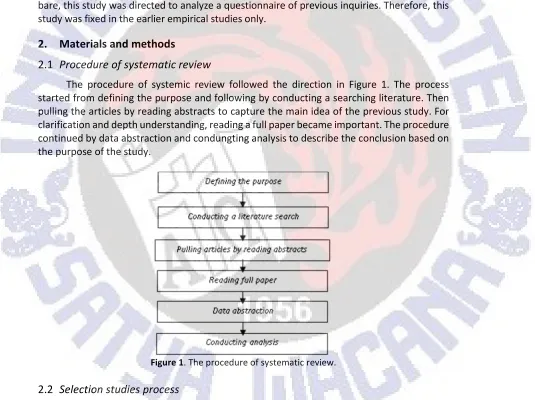
The procedure of systemic review followed the direction in Figure 1. The process started from defining the purpose and following by conducting a searching literature. Then pulling the articles by reading abstracts to capture the main idea of the previous study. For clarification and depth understanding, reading a full paper became important. The procedure continued by data abstraction and condungting analysis to describe the conclusion based on the purpose of the study.
Figure 1. The procedure of systematic review.
2.2
Selection studies process
SWUP Research in Science Education--Res Sci Educ, and International Journal of Innovation in Science and Mathematics Education (IJISME). Res Sci Educ was published by Springer and IJSE was published by Routledge (Taylor and Francis Group). IJISME was published by University of Sidney, Australia. In addition, two of these journals listed in Social Science Citation Index by Thomson Reuters. In the following step, about eight articles within the last 10 years remained worthy of being read more closely. From the obtained collection, those articles were selected that present empirical studies, including self-efficacy scale, validity, and reliability in the sense identified above. Some authors stated clearly the set of their fields; some did not provide any information at all. Finally, the papers were chosen as listed in Table 1.
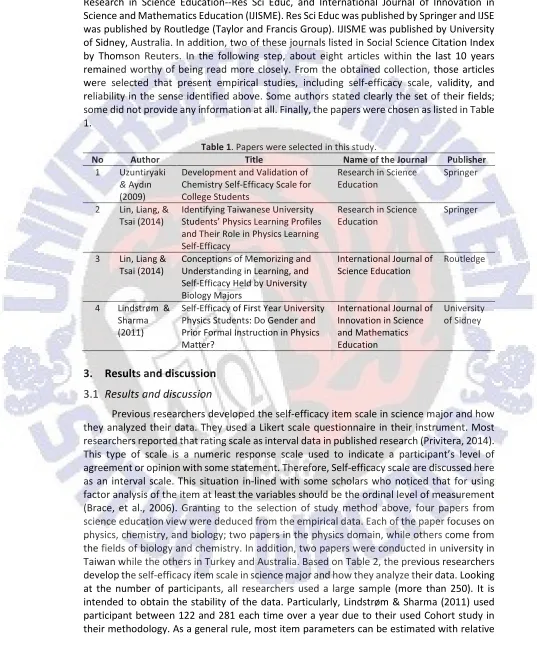
Table 1. Papers were selected in this study.
No Author Title Name of the Journal Publisher
1 Uzuntiryaki & Aydın (2009)
Development and Validation of Chemistry Self-Efficacy Scale for College Students
Research in Science Education
Springer
2 Lin, Liang, & Tsai (2014)
Identifying Taiwanese University Students’ Physics Learning Profiles and Their Role in Physics Learning Self-Efficacy
Research in Science Education
Springer
3 Lin, Liang & Tsai (2014)
Conceptions of Memorizing and Understanding in Learning, and Self-Efficacy Held by University Biology Majors
International Journal of Science Education
Routledge
4 Lindstrøm & Sharma (2011)
Self-Efficacy of First Year University Physics Students: Do Gender and Prior Formal Instruction in Physics Matter?
International Journal of Innovation in Science and Mathematics Education
University of Sidney
3.
Results and discussion
3.1
Results and discussion
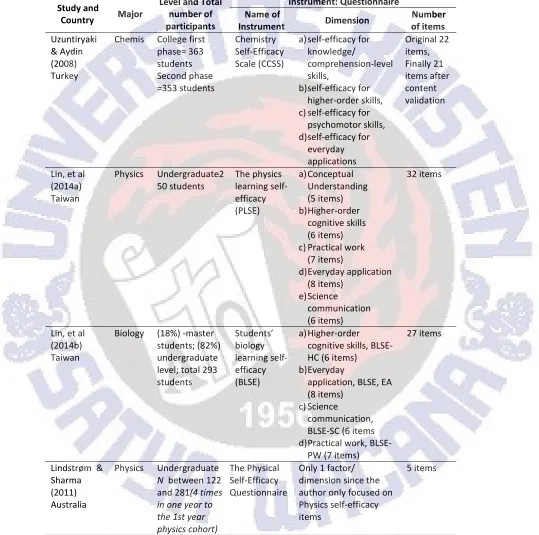
stability for samples of 200 participants, and so this might consider the minimum number desired (Crocker & Algina, 1986).
Table 2. Overview about articles analyzed in this review.
Study and
Country Major
Level and Total number of participants
Instrument: Questionnaire Name of
Instrument Dimension
Number
Chemis College first phase= 363
a)self-efficacy for knowledge/
comprehension-level skills,
b)self-efficacy for higher-order skills, c)self-efficacy for
psychomotor skills, d)self-efficacy for
everyday c)Practical work
(7 items)
d)Everyday application (8 items)
Biology (18%) -master students; (82%) undergraduate level; total 293 students
application, BLSE, EA (8 items)
c)Science
communication, BLSE-SC (6 items d)Practical work,
BLSE-PW (7 items) dimension since the author only focused on Physics self-efficacy items
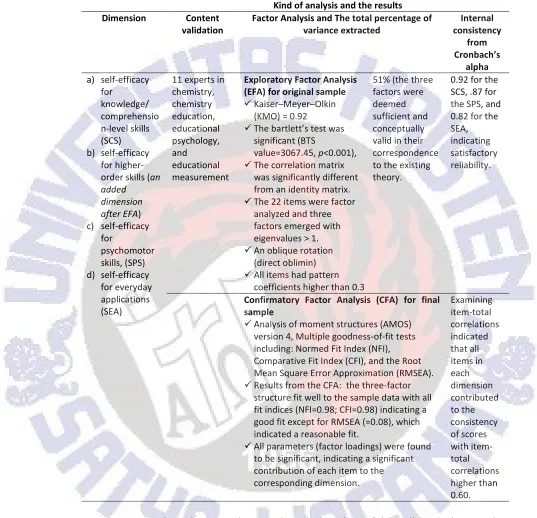
SWUP Table 3. Summary of data analysis (Uzuntiryaki & Aydin, 2008).
Kind of analysis and the results
Dimension Content
validation
Factor Analysis and The total percentage of variance extracted order skills (an added
Exploratory Factor Analysis (EFA) for original sample
"Kaiser–Meyer–Olkin
(KMO) = 0.92
"The bartlett’s test was significant (BTS
value=3067.45, p<0.001),
"The correlation matrix was significantly different from an identity matrix. "The 22 items were factor
analyzed and three factors emerged with eigenvalues > 1. "An oblique rotation
(direct oblimin) "All items had pattern
coefficients higher than 0.3
51% (the three factors were deemed sufficient and conceptually valid in their correspondence to the existing theory.
Confirmatory Factor Analysis (CFA) for final sample
"Analysis of moment structures (AMOS) version 4, Multiple goodness-of-fit tests including: Normed Fit Index (NFI), Comparative Fit Index (CFI), and the Root Mean Square Error Approximation (RMSEA).
"Results from the CFA: the three-factor structure fit well to the sample data with all fit indices (NFI=0.98; CFI=0.98) indicating a good fit except for RMSEA (=0.08), which indicated a reasonable fit.
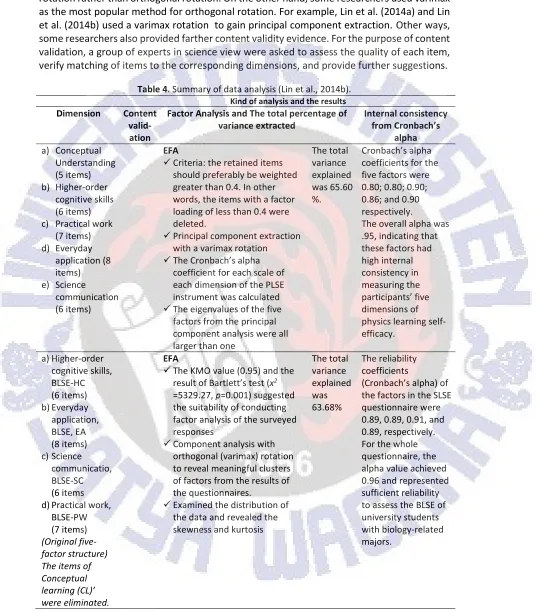
rotation rather than orthogonal rotation. On the other hand, some researchers used varimax as the most popular method for orthogonal rotation. For example, Lin et al. (2014a) and Lin et al. (2014b) used a varimax rotation to gain principal component extraction. Other ways, some researchers also provided farther content validity evidence. For the purpose of content validation, a group of experts in science view were asked to assess the quality of each item, verify matching of items to the corresponding dimensions, and provide further suggestions.
Table 4. Summary of data analysis (Lin et al., 2014b). Kind of analysis and the results
Dimension Content
valid-ation
Factor Analysis and The total percentage of variance extracted c) Practical work
(7 items)
" Criteria: the retained items should preferably be weighted greater than 0.4. In other words, the items with a factor loading of less than 0.4 were deleted.
" Principal component extraction with a varimax rotation " The Cronbach’s alpha
coefficient for each scale of each dimension of the PLSE instrument was calculated " The eigenvalues of the five factors from the principal component analysis were all larger than one coefficients for the five factors were 0.80; 0.80; 0.90; 0.86; and 0.90 respectively.
The overall alpha was .95, indicating that these factors had high internal d)Practical work,
BLSE-PW result of Bartlett’s test (x2 =5329.27, p=0.001) suggested the suitability of conducting factor analysis of the surveyed responses
"Component analysis with orthogonal (varimax) rotation to reveal meaningful clusters of factors from the results of the questionnaires.
"Examined the distribution of the data and revealed the skewness and kurtosis
The total
SWUP Table 5. Summary of data analysis (Lindstrøm & Sharma, 2011).
Kind of analysis and the results Dimension Content
validation
Factor Analysis and The total percentage of variance extracted
Internal consistency from Cronbach’s alpha Only one
factor: Physics Self-Efficacy with 5 items
Three experienced physics education experts, one of whom is also an expert in self-efficacy and related constructs. They were asked to comment on the validity of the items.
Initial trial
" EFA using the Statistical Package for the Social Sciences (SPSS) version 15.0. " Scree plot, clearly indicated
one factor only.
" Equally there was only one element, factor rotation did not use
" The five items had factor loadings in the range .694 to 0.821
Confirmatory trial
" CFA using Amos 7.0 provided evidence for the construct’s validity (values in
parentheses indicate
requirements for validity); χ2 = 2.127, p = 0.831 (p>.05). " Main fit showed a very good
model fit: RMSEA =.000 (<.05) with a 90% confidence interval of [0.000, 0.042]; RMR = 0.009 (<.05); GFI = 0.998 (>.95); NFI=0.994 (>0.95); and CFI = 1.000 (>0.95).
Final checks on the questionnaire were for invariance and stability
" A questionnaire is said to be invariant if the factor structure for data from different samples from the population is consistent.
The factor explained 56% of the variance
Cronbach’s α=0.796.
3.2 Implications for the next research
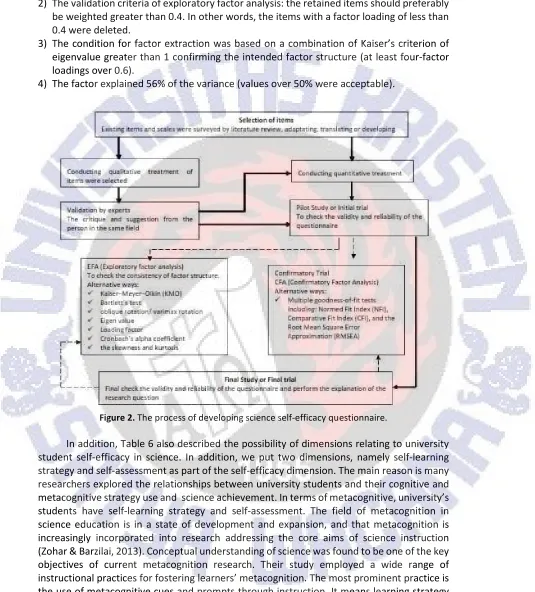
For the future research, Figure 2 summarizes the development process of the science self-efficacy questionnaire. The diagram also compatible for developing general self-efficacy and an alternative way how to analyze the data. More ever, there are several criteria for conducting data analysis (summarized from four papers were discussed):
1) Exploratory factor analysis was employed to attain the factor structures of the two
2) The validation criteria of exploratory factor analysis: the retained items should preferably be weighted greater than 0.4. In other words, the items with a factor loading of less than 0.4 were deleted.
3) The condition for factor extraction was based on a combination of Kaiser’s criterion of
eigenvalue greater than 1 confirming the intended factor structure (at least four-factor loadings over 0.6).
4) The factor explained 56% of the variance (values over 50% were acceptable).
Figure 2. The process of developing science self-efficacy questionnaire.
SWUP
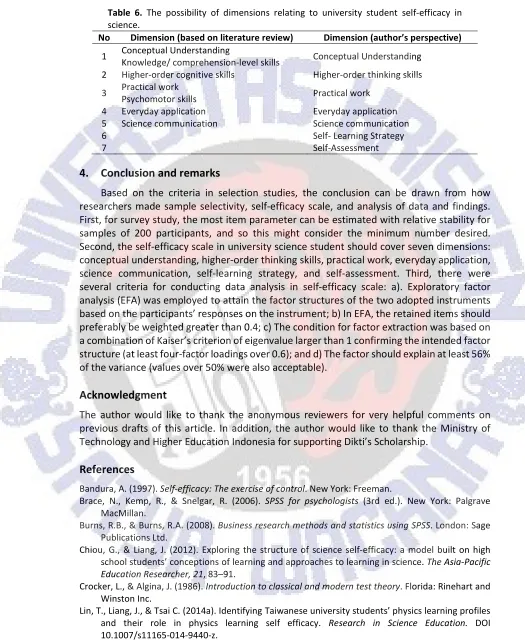
Table 6. The possibility of dimensions relating to university student self-efficacy in
science.
No Dimension (based on literature review) Dimension (author’s perspective)
1 Conceptual Understanding Conceptual Understanding
Knowledge/ comprehension-level skills
2 Higher-order cognitive skills Higher-order thinking skills
3 Practical work Practical work
Psychomotor skills
4 Everyday application Everyday application
5 Science communication Science communication
6 Self- Learning Strategy
7 Self-Assessment
4.
Conclusion and remarks
Based on the criteria in selection studies, the conclusion can be drawn from how researchers made sample selectivity, self-efficacy scale, and analysis of data and findings. First, for survey study, the most item parameter can be estimated with relative stability for samples of 200 participants, and so this might consider the minimum number desired. Second, the self-efficacy scale in university science student should cover seven dimensions: conceptual understanding, higher-order thinking skills, practical work, everyday application, science communication, self-learning strategy, and self-assessment. Third, there were several criteria for conducting data analysis in self-efficacy scale: a). Exploratory factor analysis (EFA) was employed to attain the factor structures of the two adopted instruments based on the participants’ responses on the instrument; b) In EFA, the retained items should preferably be weighted greater than 0.4; c) The condition for factor extraction was based on a combination of Kaiser’s criterion of eigenvalue larger than 1 confirming the intended factor structure (at least four-factor loadings over 0.6); and d) The factor should explain at least 56% of the variance (values over 50% were also acceptable).
Acknowledgment
The author would like to thank the anonymous reviewers for very helpful comments on previous drafts of this article. In addition, the author would like to thank the Ministry of Technology and Higher Education Indonesia for supporting Dikti’s Scholarship.
References
Bandura, A. (1997). Self-efficacy: The exercise of control. New York: Freeman.
Brace, N., Kemp, R., & Snelgar, R. (2006). SPSS for psychologists (3rd ed.). New York: Palgrave MacMillan.
Burns, R.B., & Burns, R.A. (2008). Business research methods and statistics using SPSS. London: Sage Publications Ltd.
Chiou, G., & Liang, J. (2012). Exploring the structure of science self-efficacy: a model built on high school students’ conceptions of learning and approaches to learning in science. The Asia-Pacific Education Researcher, 21, 83–91.
Crocker, L., & Algina, J. (1986). Introduction to classical and modern test theory. Florida: Rinehart and Winston Inc.
Lin, T., Liang, J., & Tsai C. (2014b). Conception of memorizing and understanding in learning, and
self-efficacy held by university biology majors. International Journal of Science Education, 1–23. DOI:
10.1080/09500693.2014.992057
Lindstrøma, C., & Sharma, M.D. (2011). Self-efficacy of first year University Physics Students: Do
gender and prior formal instruction in Physics matter? International Journal of Innovation in
Science and Mathematics Education, 19 (2), 1–19.
Pajares, F., & Schunk, D. H. (2001). Self-beliefs and school success: self-efficacy, self-concept, and
school achievement. In R. Riding & S. Rayner (Eds.). Perception (page 239–266). London: Alex.
Pintrich, P. R., & Schunk, D. H. (2002). Motivation in education: theory, research, and applications.
Merrill: Columbus.
Privitera, G. J. (2014). Research methods for the behavioral sciences. London: SAGE Publications, Inc.
Tsai, C., Ho, H., Liang, J., & Lin, H. (2011). Scientific epistemic beliefs, conceptions of learning science
and self-efficacy of learning science among high school students. Learning and Instruction, 21,
757–769.
Uzuntiryaki, U., & Aydın, Y. Ç. (2009). Development and validation of chemistry self-efficacy scale for
college students. Research in Science Education, 39 (5), 539–551.
Zimmerman, B. J., Bonner, S., & Kovach, R. (2006). Developing self-regulated learner: Beyond
achievement to self-efficacy. Washington, DC: American Psychological Association.
Zohar, A., & Barzilai, S. (2013). A review of research on metacognition in science education: current