109
F
actors Impacting Employee’s Satisfaction and Commitment
in Banking Industry in Surabaya
Ivan Junius
International Business Management Program, Petra Christian University Jl. Siwalankerto 121-131, Surabaya
E-mail: [email protected]
ABSTRACT
This research is done to know whether or not motivational factors – consists of rewards, working conditions, managerial abilities, employee participation, company policies, recognition and feedback, as well as job interest and importance – simultaneously and individually have impact on the satisfaction level and commitment level of banking industry employees in Surabaya. Multiple regressions were used as the analysis technique to reveal the relationship between them.
The results show that Motivational Factors simultaneously have impact on both employee’s
satisfaction and commitment level, while job interest and importance was found to be the only factor that individually have impact on the satisfaction and the commitment level of banking industry employees in Surabaya.
Keywords: Motivational Factors, Employee’s Satisfaction, Employee’s Commitment, Banking Industry
ABSTRAK
Penelitian ini dilakukan untuk mengetahui apakah faktor -faktor motivasi – terdiri a tas imbalan, kondisi kerja, kemampuan manajerial, partisipasi karyawan, peraturan perusahaan, pengakuan dan umpan balik, serta ketertarikan dan kepentingan pekerjaan –secara simultan dan individu memiliki pengaruh terhadap tingkat kesetiaan serta tingkat komitmen dari karyawan industri perbankan di Surabaya. Regresi linear berganda digunakan sebagai teknik analisa dalam menemukan hubungan di faktor-faktor motivasi dan kesetiaan karyawan, serta komitmen karyawan. Hasil penelitian menunjukan bahwa secara simultan, faktor-faktor motivasi memiliki pengaruh terhadap tingkat kesetiaan dan juga tingkat komitmen karyawan industri perbankan di Surabaya. Sedangkan, ketertarikan dan kepentingan kerja adalah satu-satunya faktor yang terbukti memiliki pengaruh secara individu terhadap keduanya.
Kata Kunci: Faktor Motivasi, Kepuasan Karyawan, Komitmen Karyawan, Industri Perbankan
INTRODUCTION
It is true that computers and machines may eliminate
company’s needs of having thousands workers for the
production process. Even so, it is undeniable that a machine still took human capital to design, build and operate it. This simple illustration is one of the examples that shows how
human capital’s role is still very important for an
organization or a company. In this globalization era, no
matter how well a company’s system in adopting artificial
intelligence, it is almost impossible for them to accomplish anything that is purely contains no human capital’s interference. In fact, based on Denton, Goldman, Graham, Reilly, and Twardak (2004), employees are one of the most valuable assets a company may have, and every day, they
become more and more important as the competitive advantage for business.
110 Bannking industry, which is only a subsector under the Financial, Real Estate and Corporate Service sector, holds a very important role in the economy of Indonesia due
to its 2.4% contribution to the whole nation’s GDP (Badan
Pusat Statistik, n.d.). In addition, based on Bank Indonesia (2013), banking industry contributed as big as 77% shares
out of the whole country’s financial system in 2012
(Alimin, 2014).
According to Fikri (2014), “the role of Indonesian
banking system highly controlled by small number of bank
known as "Big Ten" in term of asset”. In June 2014, those
10 banks, which are Bank Mandiri, BRI, BCA, BNI, Bank CIMB Niaga, Bank Permata, Panin Bank, Bank Danamon, BII and BTN, acquired 60.2% of the total banking asset of the whole nation. In terms of net profit, based on the data from Bank Indonesia (2013), in December 2013, 70.8% out of the total banking profit was actually generated by these
“Big Ten” banks, while the rest which is only 29.2% was
generated by 110 commercial banks and 1,635 rural banks as shown. Looking at those facts, it can be said that these
“Big Ten” banks has a very significant role to determine the
performance of the whole banking industry in Indonesia (Fikri, 2014). Therefore, they can also be good representative to analyze the problem in banking industry.
Given the fact that banking industry holds a very important role in the economy of Indonesia, unfortunately the turnover rate within the industry is still high. Based on the survey about banking industry in Indonesia by PricewaterhouseCoopers (PwC) Indonesia, almost 20% of the respondents reported that the turnover rate in their banks is more than 15%. The majority of the respondents, which is 53% percent, reported that the turnover rate in their banks range from 5-15% (Wibisana, 2014). This turnover rate is extremely big compared to the ideal turnover rate in banking industry which is supposed to be 5% (Helen, 2014) and the number of the whole financial sector, which is only 8% in average. As a comparison to another industries in Indonesia, the turnover rate is 8% for communications, 10% for industrial-construction and materials, 6.7% for consumer goods, 7.8% for natural materials and resources and 7% for mining industry (PortalHR, 2012).
In addition, often some executives who moves from one bank to another bank, will bring the teams with them altogether. As a matter of fact, bankers who resign and move to another bank had acquired and carried with them
some amount of information about previous bank’s
consumer, which leads to an increase in the possibility of consumer data to be leaked and misused (The Jakarta Post, 2014). This, however, make the high level of employee turnover rate in banking industry a very sensitive issue that is different compared to high turnover rate in another sectors (Wibisana, 2014). Another reason of why this issue needs to be solved as soon as possible is the on-going talent war within banking industry in Indonesia. With a big number of local banking institutions and foreign banks expansions, qualified staff in Indonesia becoming even scarcer. The demand for talent with certain expertise and experience, such as funding, micro-banking, lending and operations staff, has been increasing significantly as the turnover rate in
those areas are the highest. The survey of PwC Indonesia about banking industry also found that 40% of respondents reported that the issue regarding difficulty to source qualified human resource was the biggest challenge in their talent management, followed by 30% of difficulty in retaining valuable employees and 30% of difficulty in developing a robust leadership pipeline. Therefore, while competition for external talent is getting tighter, it is very important that banks in Indonesia focus on the existing talent retention, which is by lower their turnover rate, to build talent from within (PwC Indonesia, 2014).
LITERATURE REVIEW
This part explains about the underlying theories used in this research, in order to assure that readers and researcher will have the same concepts and definition regarding the topic being researched. Basically, there are three big concepts, which are the concept of motivational
factors, the concept of employee’s satisfaction and the concept of employee’s commitment.
Concept of Motivational Factors
Based on Kelechi and Temitayo (2013), motivation is
defined as “a psychological feature that arouses an organism
to act towards a desired goal and elicits, controls, and sustains certain goal-directed behaviors”. Kendra Cherry
(2014) also defined motivation as “the process that initiates, guides, and maintains goal-oriented behaviors”. Based on the definitions above, motivational factor can actually be defined as the factors that initiate and maintain an individual to act towards a desired goal, which is in this case is the expected individual performance desired by the organizations or companies.
This research will use the theory of motivational factors developed by Krüger and Rootman in their study. Krüger and Rootman had developed the concept from
several preceding theories, such as Sheldon’s Motivational Conditions in 2006, Daft’s Company Inducements in 2008.
The theories classified Motivational Factors into seven, which are rewards, working conditions, managerial abilities, employee participation, company policies, recognition and feedback, as well as job interest and job importance.
Rewards refer to company’s programs to motivate
individual and/or group of employees for their performance. Rewards are often monetary in nature or have a cost to the
company, and normally separated from employee’s salary.
There are several types of rewards, variable pay or pay-for-performance, bonuses, profit sharing and stock options. Variable pay or pay-for-performance refers to where a
portion of employee’s pay is tied to certain performances of
the company. This kind of rewards will challenge employee to achieve better results in order to gain more in that portion of pay. Bonuses, is a generally short-terms motivators over outstanding work or accomplishments of individual or group. Profit sharing is a reward given to employee over
company’s achieved profit goal. It is meant to encourage
111 right company gives to employee to buy a specified number of shares at a fixed price for a specified period of time. It serves as a long-term motivator as it requires employee to stay with the company for certain period of time to get those options (Inc., 2005).
Working conditions refers to the environment and all the circumstances in the workplace that affects employee to get the job done (USLegal, 2010). According to Kate Stringer (2006), it is manager or owner’s responsibility to ensure a safe and conducive working conditions for the employees that includes several things. First, equipment such as desks, chairs, computers, telephones should be ergonomic, safe and proper. Second, lighting, as the atmosphere creator should be proper in order to avoid eye fatigue, inaccurate work, headaches and vision problems. The next is temperature that should be accommodated as necessary. The comfort and safe zone to prevent extremes of temperature is between 72 and 75 degrees Fahrenheit. Office decor and layout, such as colors, furniture, will affect the psychology of employee to feel and perform better.
Managerial abilities refer to programs provided by the company to facilitate employees a multiple skill-sets acquisition in order to enable them to handle tasks outside their traditional job description. Job rotation, team formation and training courses are some examples that company can
do to enrich employee’s managerial abilities (AWPA, 2012). Employee Participation refers to the strategy of the company to empower employees to express their thought and utilize some control over their day-to-day work, roles and the workplace conditions. According to AWPA (2012), employee participation is crucial for company’s innovation and change, and therefore it can be approached through these two ways, strategic participation and task participation. Strategic participation refers to where company allows employees to directly involve in
developing company’s strategic direction by sharing their
views and suggestions. Task participation, where employees can involve by providing inputs on matters regarding their workplace and jobs-performing circumstances, such as new equipment, health and safety concerns, to help solve the problems that company may be encountering (AWPA, 2012).
Company policies refer to the organization’s rules of
conduct that specifies the duties and responsibilities of employees and employers. Those policies include things such as forbidden behaviors, salary, employee rights, equal opportunity, attendance, dress code, privacy and others aspects. It is established in order to encourage fairness,
protect employee’s rights, as well as ensuring uniformity and consistency within the organization (WiseGeek, 2015; Scott, 2011).
Recognition and feedback refer to how organizations
boost their employees’ self-esteem by appreciating, as well as reinforcing their contributions in making the organization successful (Heathfield, 2002). The difference between recognition and feedback with rewards is the absence of money given to the employee, even though the form of recognition and feedback still carry monetary value. Recognition and feedback can be given to employee
through many forms. It can be as simple as giving comments, critiques or praises, a lunch treat, privileges, or even regular event and symbolic recognitions, such as employee of the month, plaques and gift certificates (Inc., 2005; Geraghty, 2013).
Job interest and importance refer to employees’
perception towards their assigned job. According to Daft (2008), human resource managers should be able to ensure that employees likes and will see the job that they are assigned to as challenging, meaningful and have a sense of importance for the organization (in Krüger & Rootman, 2010, p. 61).
Concept of Employee’s Satisfaction
Carol Woods (2013) defined employee’s satisfaction as the condition where “employees are contented with their
work and position. To be contented, they likely enjoy much of their work, they feel management is fair and cares about
them, and they are comfortable in their work environment”. This definition basically states that employee’s satisfaction
is about the positive feeling employees develop towards their work, management and the environment of the organization.
In a more detailed way, Peloso (2004) also defined
employee’s satisfaction as “the level of satisfaction
employees have with various facets of the job, including compensation, opportunities for advancement, overall satisfaction with the job itself, and overall satisfaction with the organization as a place to work, including the policies
directed towards employee” (p.172). According to him, employee’s satisfaction can be measured through five indicators, which are: employee can see organization’s respect for individuals in decision made in the organization, employees feel being fairly compensated for their positions compared to the marketplace, employees feel they have sufficient opportunity to realize career goals in the organizations, employees feel satisfied with their current job in overall, employees feel satisfied with the organization as a place to work in overall.
Concept of Employee’s Commitment
According to Vinove (2007), employee commitment
is defined as “a psychological state that binds an individual
to the organization. It refers to the likelihood that an individual will stick to the organization, feel psychologically attached to it, whether the job is satisfying or not”. According to Peloso (2014), there are four indicators that
can measure employee’s commitment to the organization,
constructed by Peloso (2004), which are: employees rarely think about leaving and go to a different company, employees are proud to be identified with the organization, employees would recommend the organization to others as a good place to work, employee would recommend the organization to others as a good place to do business.
Relationship between Concepts
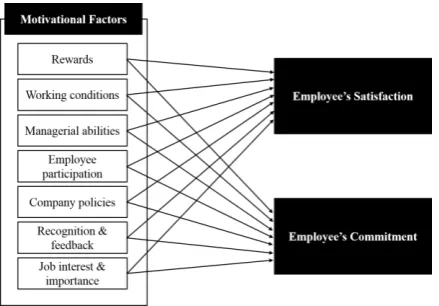
First of all, motivational factors are believed to have
impact on employee’s satisfaction in a way that allowed
112
participation will reflect company’s respect to individual for
their views and thoughts in decisions made in the organization. Good rewards systems within the company, in addition to fair company compensation policies will make employee feel that they are being fairly compensated. Not only that, provided programs to enrich managerial abilities and allowed employee participation by the company, supported by fair company policies, will make employee feel there is opportunity for them to realize their career goals
in the organization. In addition, employee’s interest and
importance towards their job, as well as recognition and feedback provided by the company regarding their
contributions, will stimulate employee’s overall satisfaction
towards their current job. Last but not least, managerial
abilities programs, employee’s interest and importance
towards their jobs, provided adequate working conditions and good rewards system by the company will stimulate
employee’s overall satisfaction towards the organization as
a place to work.
Secondly, motivational factors are also believed to have impact on employee’s commitment. Allowing employees to participate in running the business and giving them chances to enrich their managerial abilities will make employees feel that they are valuable for the organization, which may make them proud to be identified with the organization. Moreover, factors like good rewards system, provided program to enrich managerial abilities, adequate working conditions and fairly conducted company policies will make employee think less about leaving the organization, especially if sense of belonging where employee is being recognized and allowed to participate, is also developed within the organization. Not only that, those factors also will stimulate employee willingness to recommend the organization as a place to work, which may help the company to attract even more talents. Last but not least, employee who has positive perception towards the interest and importance of their jobs and is allowed to participate in the business, will be more willing to recommend people to do business with the organization, especially if rewards, recognition and feedback are provided by the company for what the employee has done.
Figure 1. Relationships between concepts
There are four hypotheses developed for the importance of this research:
H1 : Motivational factors (rewards, working conditions, managerial abilities, employee participation, company policies, recognition and feedback, job interest and job importance) simultaneously have impact on the satisfaction level of banking industry employees in Surabaya.
H2 : Motivational factors (rewards, working conditions, managerial abilities, employee participation, company policies, recognition and feedback, job interest and job importance) simultaneously have impact on the commitment level of banking industry employees in Surabaya.
H3 : Motivational factors (rewards, working conditions, managerial abilities, employee participation, company policies, recognition and feedback, job interest and job importance) individually have impact on the satisfaction level of banking industry employees in Surabaya.
H4 : Motivational factors (rewards, working conditions, managerial abilities, employee participation, company policies, recognition and feedback, job interest and job importance) individually have impact on the commitment level of banking industry employees in Surabaya.
RESEARCH METHOD
The current study being conducted is categorized as explanatory study. This is because this research aims to
study the impact of motivational factors to employee’s
satisfaction and employee’s commitment by conducting analysis based on theories and formulated hypotheses as defined by Cooper and Schindler (2014). The results of the hypothesis testing later are expected to explain the relationship between them, so readers may understand how motivational factors that consist of rewards, working conditions, managerial abilities, employee participation, company policies, recognition and feedback, as well as job interest and job importance, influence the satisfaction and commitment of banking industry employees in Surabaya. There are several variables used in this research aim to study the impact of motivational factors to employees in
banking industry’s satisfaction and commitment in
Surabaya. Those variables can be classified into independent and dependent variables.
113 Dependent variables, still according to Cooper and
Schindler (2014), are “the variable measured, predicted, or
otherwise monitored by the researcher; expected to be
affected by a manipulation of the independent variable”. In
the context of this research, there are two dependent variables, which are employee’s satisfaction and
employee’s commitment, which researcher expects them to
be affected by motivational factors.
Table 1. Independent Variables and Indicators Independent
2.Bonuses motivates employee to accomplish outstanding work 3.Profit sharing encourages employee
to stick with the company
4.Stock option motivates employee to stick with the company
1.Job rotation enables employee to handle tasks over the traditional job description
2.Team formation enables employee to handle tasks over the traditional job description
3.Training courses enables employee to handle tasks over the traditional job description
Employee participation
1.Employee participation through view sharing and suggestions is
crucial in developing company’s
strategic direction
2.Employee’s inputs on matters, such as equipment purchase, health and safety concerns, etc. are crucial to improve workplace and
job-1.Critiques and praises given are reinforcing
2.Treat and privileges given are encouraging
3.Gift and honorable status given make employee feel appreciated
Job interest and job importance
1.Likeliness towards the job
2.Challenging perception towards the job
3.Meaningful perception towards the job
4.Sense of importance towards the job
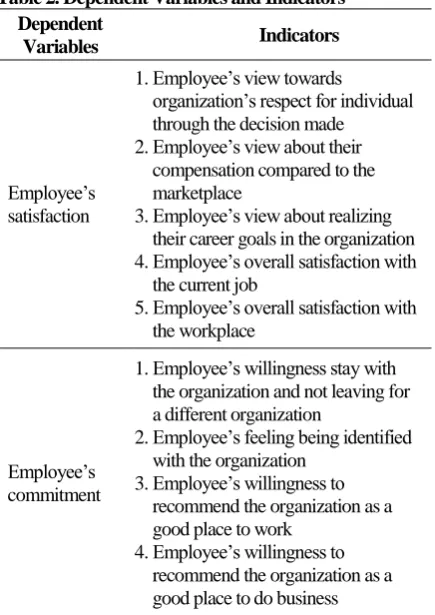
Table 2. Dependent Variables and Indicators Dependent 2.Employee’s view about their
compensation compared to the marketplace
3.Employee’s view about realizing their career goals in the organization 4.Employee’s overall satisfaction with
the current job
5.Employee’s overall satisfaction with the workplace
Employee’s
commitment
1.Employee’s willingness stay with the organization and not leaving for a different organization
2.Employee’s feeling being identified with the organization
3.Employee’s willingness to recommend the organization as a good place to work
4.Employee’s willingness to recommend the organization as a good place to do business
Each indicator of the both independent and dependent variables will be represented in one statement developed by the researcher. Respondents will give score to each given statement using 5-point Likert scale based on their attitude towards the statement. In the end, the score of each
dependent variables will be the average of its indicators’
score.
In conducting this research, researcher follows simple
random sampling method with employees of Indonesia’s
114 be a good representative to analyze the problem regarding
employee’s satisfaction and commitment in banking
industry. The data being collected in this research falls into two categories. The screening questions in the questionnaire of this research, which will be in the form of multiple choices, are categorized as nominal data. Meanwhile, the
data regarding respondent’s answers towards the variables,
both independent and dependent, used in this research are categorized as interval data.
The source of information for this research came from two types of sources, primary and secondary. The primary data would be the data gathered from the self-administered questionnaires developed by the researcher. The secondary data for this research would be the data taken from existing and available source, such as reports, books, journal, articles and websites. The use of secondary data in this research is mostly related to the observation and justification of the problems, theories and concepts, as well as the analysis and overview of the banking industry.
There are several analytical methods need to be done in this research. First of all, all the data should be checked for its validity and reliability before being analyzed further. After that, multiple regression analysis needs to be done in order to reveal the impact of motivational factors,
simultaneously and individually, to employee’s satisfaction
and commitment, as the purpose of the study. However, before the multiple regression analysis is conducted, all the data should be first examined with classic assumption test to see its normality, autocorrelation, multicollinearity and homoscedasticity.
As for the data justification, validity test is done to measure whether the indicators used in the questionnaire are measuring the right thing. To conduct a validity test, researcher performed a bivariate correlation test, where correlation between the variables and indicator are examined. For reliability test, researcher uses one shot
which correlation is measured through Cronbach’s Alpha
values. If the results are not valid and deletion of any indicators is necessary to be done in order to gain reliable results, those particular indicators will no longer be included in the further analysis.
There are four tests need to be done in classic assumption tests. Normality test aims to examine whether a regression model is good or not, indicated by normal distribution of the residuals. Normality test is necessary to be done because the t and F tests, as parts of the multiple regression analysis, assumed that the residual values follow the normal distribution. Researcher conduct the normality test by performing statistical analysis, in which researcher examines the kurtosis and the skewness ratio.
Multicollinearity is defined as the condition where more than two independent variables are highly correlated. It is necessary to test multicollinearity between the independent variables because when multicollinearity exists, the coefficients estimation of the regression is no longer reliable. According to Ghozali (2011), the existence of multicollinearity can be indicated by the value of VIF (Variance Inflation Factor) or tolerance value
(VIF=1/Tolerance), which can be obtained by using SPSS program.
Homoscedasticity test is necessary to be done before conducting the multiple regression analysis, since according to Ghozali (2011), a good regression model should have a homoscedasticity spread, where the variance of errors stay constant throughout different observations. There are several statistical tests that can be used to conduct a homoscedasticity test. In this research, researcher chooses to use Park test, where the heteroscedasticity among the residuals is defined by comparing the P-value of the independent variables with the significance level.
Autocorrelation test is conducted to know whether or not correlation exists between the residual at t period and the residual from the previous period, t-1 period (Ghozali, 2011). If there is correlation between the residuals, it is said that autocorrelation exists. In the case that autocorrelation exists, the regression coefficient that will be generated from the analysis would be inefficient and unstable, in which, the error level will be very high (Bramasto, 2011). Therefore, autocorrelation test will test the degree of the independence of those residuals, which can be performed by using Run test as one of the alternatives (Devita, 2014).
For the multiple linear regression analysis, F test is a test conducted to examine the simultaneous significant impact that all the independent variables in a regression model have on the dependent variable. There are two ways for the researcher to examine whether or not the regression model has passed the test. The first option is to look at the P-value (significance F) and compare it with the
significance level (α) used in the research (this research used
5% significance level). The second option researcher can do is to look at the F value (F test statistic) and compare it with the F table (F critical value). T-test is a test conducted to examine the individual significant impact that each of the independent variable in a regression model have on the dependent variable. There are two ways for the researcher to examine whether or not the regression model has passed the test. The first option is to look at the P-value (significance t)
and compare it with the significance level (α) used in the
115
RESULTS AND DISCUSSION
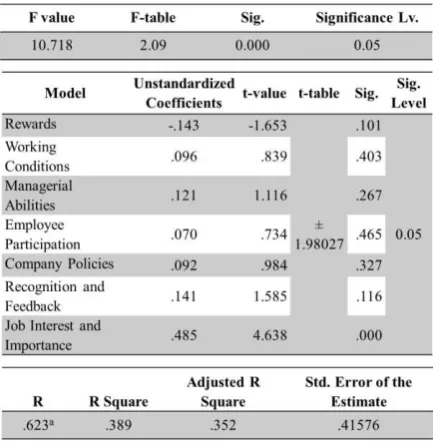
Table 3. Result Summary for Employee’s Satisfaction
Table 4. Result Summary for Employee’s Commitment
Researcher had performed validity and reliability tests for each variables. Using bivariate correlations, all items were found to have significant correlation to their construct matrix and therefore they can be said as valid. Reliability test was measured through the Cronbach’s Alpha value, in
which the acceptable Cronbach’s Alpha value of particular
variable to be considered as reliable is any point greater than 0.6. The results shos that all indicators are reliable with
Cronbach’s Alpha value of 0.854 for Rewards, 0.832 for
Working Conditions, 0.623 for Managerial Abilities, 0.711 for Employee Participation, 0.850 for Company Policies, 0.750 for Recognition and Feedback, 0.724 for Job Interest and Importance, 0.845 for Employee’s Satisfaction and
0.749 for Employee’s Commitment.
In addition to that, the data has passed all the classic assumption tests, which consisted of normality, autocorrelation, multicollinearity and homoscedasticity tests. Thus, the data is proper to be tested using the multiple linear regression analysis. The summary of the result to test
the hypothesis can be seen in Table 3 for Employee’s Satisfaction and Table 4 for Employee’s Commitment.
As mentioned before, researcher had developed four hypotheses, which the first and second hypothesis talked about the simultaneous impact of motivational factors. Hypothesis number one stated that motivational factors simultaneously have impact on the satisfaction level of employees of banking industry in Surabaya, while hypothesis number two stated that motivational factors simultaneously have impact on the commitment level of employees of banking industry in Surabaya. From the F test, it was found that motivational factors simultaneously have impact on the satisfaction level of employees of banking industry in Surabaya, as well as their level of commitment. This is because the significance F obtained
from the test for both employee’s satisfaction and
commitment were 0.000, which number is far below 0.05 as the significance level. In addition, the F values obtained
from the test, which is 10.718 for employee’s satisfaction and 5.414 for employee’s commitment were far greater than
2.09 as the F critical value. Therefore, refer to the results from the F test, it can be said that hypothesis number one and hypothesis number two developed by the researcher are confirmed, meaning that motivational factors – consist of rewards, working conditions, managerial abilities, employee participation, company policies, recognition and feedback, job interest and importance – are proven to simultaneously have impact on the satisfaction and commitment level of
banking industry’s employees in Surabaya.
As for the other two hypotheses, which are hypothesis number three and four, were tested using the t-test. The result from the t-test revealed that job interest and importance (X7) is the only factor that individually has impact on both employee’s satisfaction and commitment.
This is because out of all the seven factors in motivational factors, job interest and importance was found to be the only factor that has significance t below 0.05 as the significance
level for this research, which is 0.000 for employee’s satisfaction and 0.047 for employee’s commitment.
Additionally, the t-values obtained from the test for job interest and importance were also found to fall outside the range of -1.98027 to +1.98027 as the t critical values for this research. The t-value of job interest and importance is 4.638
for employee’s satisfaction and 2.011 for employee’s commitment. Meanwhile, the other six factors’ t-values were found to fall within the range of t critical values (see table 3 and table 4 for the detail of the other factor’s significance t and t-value). Therefore, refer to the results from the t-test, it can be said that for hypothesis number three, only job interest and importance that is confirmed to individually have impact on the satisfaction level of banking
industry’s employees in Surabaya, while the other six
116 recognition and feedback – are not confirmed to have impact on it. Same thing also goes to the hypothesis number four, where it is only job interest and importance that is confirmed to individually have impact on the commitment
level of banking industry’s employees in Surabaya, while
the other six factors– consist of rewards, working conditions, managerial abilities, employee participation, company policies, recognition and feedback – are not confirmed to have impact on it.
Researcher believes that what makes the job interest and importance as the only factor that individually has impact to
employee’s satisfaction and commitment is the nature of the
job of banking industry employees. This is because according to Michael R. Tampi (2010), an executive in banking industry, working in a bank requires the employee to always deal with great risk, responsibilities and ethic code. Thus, it is reasonable that job interest and importance is found to have significant impact on the satisfaction and commitment level of banking industry employee. Job interest and importance is very important for banking industry employees in order for them to feel satisfied and be committed, since employees who fail to see the risks, responsibilities and ethic codes of their job as something likeable, meaningful, challenging and important will result in a decrease in their satisfaction and their commitment level due to the stress they experience.
As a matter of fact, still according to Tampi, the current stress level of banking industry employee can be considered as high (Kompas, 2010; Tempo, 2014). Therefore, even if the other motivational factors offered by the banks are promising, but the banks fail to encourage its employee in such way that is able to make them like their job and see their job as meaningful, challenging and important, most likely it is not going to make the employees feel satisfied and be committed as the main thing they are looking is missing. However, even though job interest and importance is the biggest consideration for banking industry employees to be satisfied and committed, that does not mean that the other motivational factors contribute nothing, since simultaneously, they are proven to have impact on
employee’s satisfaction and commitment. Thus, in order for
banking industry employees to be more likely satisfied and committed, it is also important to offer them a complete package, in which the other factors, together with job interest and importance are favorable. This argumentation is supported by the result of this research, where motivational factors – rewards, working conditions, managerial abilities, employee participation, company policies, recognition and feedback, job interest and importance – simultaneously have impact on the satisfaction and commitment level of
banking industry’s employees in Surabaya.
CONCLUSION
Researcher had previously developed hypotheses and conducted several tests to reveal the answer about the simultaneous impact and the individual impact that motivational factors – consist of rewards, working conditions, managerial abilities, employee participation, company policies, recognition and feedback, as well as job
interest and importance – have on the satisfaction and commitment level of banking industry employees in Surabaya,. The first finding from the research is the simultaneous impact that motivational factors have on the satisfaction level of banking industry employees in Surabaya. The second finding is the simultaneous impact that motivational factors have on the commitment level of banking industry employees in Surabaya. The third finding from the research found job interest and importance to be the only factor that individually has impact on the satisfaction level of banking industry employees in Surabaya. The fourth finding also found job interest and importance to be the only factor of all the motivational factors that individually has impact on the commitment level of banking industry employees in Surabaya.
Based on the result of the research, there are several suggestions that can be made for banking industry. First of all, they need to gain as many input as possible from their employees to know how they feel and see about their current job through survey, interview, open discussion etc. Then, banks need to process the inputs gained from the prior step to decide what changes are necessary to be made, so that employee would like their job more and see their job as more meaningful, challenging and have a sense of importance than before. As the banks had gained inputs and decided what changes to be made, they now have to ensure that those changes will go smooth in the transition which can be done by providing assistance to help for employees who encounter work-related problems, especially problems generated from the changes made by the company. Aside from assisting, the banks also need to encourage their employee to like their job and always remember that the job that they have been doing are meaningful, challenging and important. This can be done by increasing the awareness of this message through easy-to-read posters, flyers, e-mail, desktop background in the computer, and other media that employees often look at it.
The next thing to do, although several changes have been applied, banks should not stop putting effort to study even more about how to improve the job interest and importance of their employee. In certain period of time, can be annually or adjusted to the needs, banks should rejuvenate themselves by having another favorable changes
in order to boost employee’s job interest and importance
even more. Another important thing that banks also need to do in this phase is to freshen their employees with something fun and interesting but still can create social interaction. A talk show with banking expertise discussing about how he has successfully managed to deal with the risks, responsibilities and ethic codes of his job is a good
example to freshen employee’s mind and fill it with positive
thoughts. As for the other motivational factors, bank industry must ensure that while they focus on making improvement in the job interest and importance, they keep the other motivational factors wail-maintained too. It would be better if bank industry for once in a while review the current performance of their other motivational factors.
117 that every bank has during the data collection. The second limitation is the limitation of coverage area. The respondents for this research were only gathered from Surabaya, while actually, the problem of high turnover rate and on-going talent war in banking industry have been occurring in all over Indonesia. Thus, the findings of this research may only fully represent banking industry in Surabaya city, and as for the other cities in Indonesia, they might not have the same results. The other limitation is the limitation of independent variables involved in this research. Based on the results, motivational factors are only able to explain 35.2% of the variation in the satisfaction level, and 19.8% of the variation in the commitment level. The rest, which is 64.8% of the variation in the satisfaction level and 80.2% of the variation in the commitment level are explained by another factors that was not included and covered in this research.
For the limitations that this research has, there will be room for improvement for the further research. First of all, researcher suggests further research to clarify the procedure and requirement to get permission from each bank before spreading the questionnaire, in order to be more prepared in proposing the number, location and distribution for the desired respondents from that particular bank. Researcher also suggests further research to widen the coverage area, if possible, to all over Indonesia, so that the results can be more representing the population. Last but not least, it is wise for further research to study more about theories of
factors impacting employee’s satisfaction and commitment,
and include more relevant independent variables, such as co-worker’s relationship as analyzed in the related study by Yusuf, Prabowo and Eliyana (2012), that was not included in this research in order to increase the ability of the research
findings in explaining the variation of employee’s satisfaction and employee’s commitment. Thus, it will be
able to provide a more accurate benefit for banking industry, especially for human resource managers, regarding the factors or variables that should be focused on.
REFERENCES
Alimin, P. (2014). Analisa Kinerja Bank Umum di Indonesia Berdasarkan Cluster Kepemilikan. Finesta, 2, 26-31.
AWPA. (2012, April). Better use of skills, better outcomes: A research report on skills utilisation in Australia. Retrieved from Australia Workforce and
Productivity Agency (AWPA):
http://www.awpa.gov.au/publications/documents/S kills-utilisation-research-report-15-May-2012.pdf Badan Pusat Statistik. (n.d.). Produk Domestik Bruto
Menurut Lapangan Usaha. Retrieved March 3, 2015, from Badan Pusat Statistik: http://bps.go.id/pdb.php?kat=2&id_subyek=11¬ ab=0
Bennett, B. (2003). Job Rotation Benefits. Retrieved June
16, 2015, from CiteHR:
http://www.citehr.com/8230-job-rotation-benefits.html
Bersin, J. (2013, August 16). Employee Retention Now a Big Issue: Why the Tide has Turned. Bersin by Deloitte.
Bramasto, A. (2011). Analisa Perputaran Tetap dan Perputaran Piutang Kaitannya Terhadap Return On Assets Pada PT. Pos Indonesia (Persero) Bandung. Majalah Ilmiah UNIKOM, 9(2), 215-230.
Cherry, K. (2014, July 8). What is Motivation? Retrieved
from About Education:
http://psychology.about.com/od/mindex/g/motivatio n-definition.htm
Cooper, D. R., & Schindler, S. P. (2014). Business Research methods (12th ed.). New York: McGraw-Hill/Irwin.
Denton, R., Goldman, L., Graham, M., Reilly, C., & Twardak, M. A. (2004). Human Resources Your Most Valuable Assets. International Legal Technology Association.
Devita, E. (2014, March 19). Bab III. Retrieved from Academia.edu.
Fikri, M. (2014, September 5). The Role of "Big Ten" In Indonesian Banking System. Retrieved February 28,
2015, from LinkedIn:
https://www.linkedin.com/pulse/20140905100224- 47207812-the-role-of-big-ten-in-indonesian-banking-system
Geraghty, S. (2013, March 28). Types and Sources of Feedback in the Workplace. Retrieved from Talkdesk: http://blog.talkdesk.com/types-and-sources-of-feedback-in-the-workplace
Ghozali, I. (2011). Aplikasi Analisis Multivariate dengan Prgram SPSS 21. Semarang: BP Universitas Diponegoro.
HayGroup. (2013, July 11). Pengabdian dan pemberdayaan karyawan. Retrieved February 26,
2015, from HayGroup:
http://atrium.haygroup.com/id/your-challenges/engage-enable-employees.aspx
HayGroup. (2013, June 4). Preparing for Take Off. Retrieved February 27, 2015, from HayGroup: https://atrium.haygroup.com/downloads/marketingp s/ww/Preparing%20for%20take%20off%20-%20executive%20summary.pdf
Heathfield, S. M. (2002, April 1). The Power of Positive Employee Recognition. Retrieved from Human Resources:
http://humanresources.about.com/od/rewardrecognit ion/a/recognition_ten.htm
Helen, D. (2014, November 13). Cari Pegawai Tak Seperti Gigit Cabe. Retrieved March 4, 2015, from
Finansial Bisnis:
http://finansial.bisnis.com/read/20141113/90/27278 1/cari-pegawai-tak-seperti-gigit-cabe
Inc. (2005, November 1). Employee Reward and Recognition Systems. Retrieved March 16, 2015,
from Inc.:
118 Keeling, K. A., McGoldrick, P. J., & Sadhu, H. (2013,
March). Staff Word-of-Mouth (SWOM) and retail employee recruitment. (M. M. S. Brown, Ed.) Journal of Retailing, 89(1), 88-104. Retrieved from ScienceDirect:
http://www.sciencedirect.com/science/article/pii/S0 022435912000905
Kelechi, N. G., & Temitayo, Q. (2013, October). Motivation and Organizational Behaviour.
Retrieved from Academia.edu:
https://www.academia.edu/4910456/MOTIVATIO N_AND_ORGANIZATIONAL_BEHAVIOUR Kompas. (2010, October). Kerja di Bank, Untung Besar,
Stres Level Tinggi. Retrieved from Kompas.com: http://female.kompas.com/read/2010/10/16/163023 84/Kerja.di.Bank..Untung.Besar..Stres.Level.Tinggi Krüger, J., & Rootman, C. (2010). How Do Small Busines Managers Influence Employee Satisfaction and Commitment? Acta Commercii, 59-72.
MBA Brief. (2013, May 22). Employee Commitment.
Retrieved from MBA Brief:
http://www.mbabrief.com/what_is_employee_com mitment.asp
Peloso, A. F. (2004). The Antecedents of the Employee Loyalty-Customer Loyalty Relationship. Queensland University of Technology, Philosopy, Brisbane.
PortalHR. (2012, January 30). Bagaimana Tren CNB dan Recruiting Intelligence 2012? Retrieved February
27, 2015, from PortalHR:
http://www.portalhr.com/berita/bagaimana-tren-cnb-dan-recruiting-intelligence-2012/
PwC Indonesia. (2014, June 5). Indonesian Banking Survey 2014. Retrieved from PwC Indonesia: http://www.pwc.com/id/en/publications/assets/indo nesian-banking-survey-2014.pdf
Rouse, M. (2007, May 29). What is employee assistance program (EAP)? Retrieved from TechTarget: http://searchcio.techtarget.com/definition/employee-assistance-program
Scott, S. (2011, June 15). Examples of Company Policies & Procedures. Retrieved from Chron: http://smallbusiness.chron.com/examples-company-policies-procedures-10995.html
Sekaran, U., & Bougie, R. (2010). Research Methods for Business: A Skill Building Approach (5th ed.). Chichester: Wiley.
SPSS Inc. (2010). Introduction to Statistical Analysis with PASW Statistics. Chichago: SPSS Inc.
Tempo. (2014, June 3). Tingkat Stres Karyawan Bank Tinggi. Retrieved from Tempo.co: http://www.tempo.co/read/news/2014/06/03/08758 2224/Tingkat-Stres-Karyawan-Bank-Tinggi The Jakarta Post. (2014, May 16). Domestic banks
concerned about shortage of talent. Retrieved February 27, 2015, from The Jakarta Post: http://www.thejakartapost.com/news/2014/05/16/do mestic-banks-concerned-about-shortage-talent.html
Theodora, J. G. (2013). The Influence of Marketing Mix on Customer Loyalty Towards Magnum Ice Cream. Surabaya: Petra Christian University.
USLegal. (2010, October 27). Working Condition Law & Legal Definition. Retrieved March 4, 2015, from USLegal: http://definitions.uslegal.com/w/working-condition/
Vinove. (2007, November 2007). Employee Commitment - Importance & Types . Retrieved from CiteHR:
http://www.citehr.com/58418-employee-commitment-importance-types.html
Wardhani, W. K. (2015, February 1). The Influence of Employee Motivation to Organizational Commitment with Job Satisfaction as Intervening Variable. Journal of Administrative Business (JAB),
2(1), 1-10. Retrieved from
administrasibisnis.studentjournal.ub.ac.id
Wibisana, M. J. (2014, July 27). Indonesian Banking Sector: Challenges in 2014. Retrieved February 27, 2015, from PricewaterhouseCoopers: http://www.pwc.com/id/en/media/indonesian-banking-sector-challenges-in-2014.jhtml
WiseGeek. (2015, January 26). What Is A Company Policy?
Retrieved from WiseGeek:
http://www.wisegeek.com/what-is-a-company-policy.htm
Woods, C. (2013, April 9). What Is Employee Satisfaction? - Examples, Factors & Quiz. Retrieved from Study.com: http://study.com/academy/lesson/what- is-employee-satisfaction-examples-factors-quiz.html
Yusuf, R. M., Prabowo, K., & Eliyana, A. (2012, June). The
Influence of Employee’s Job Satisfaction Factors on