INTERNATIONAL ASSOCIATION FOR URBANCLIMATE
Urban Climate News
Quarterly Newsletter of the IAUC
ISSUENO.52JUNE2014 •
Inside the Summer issue...
2
9
14
19
24
28
If you haven’t visited recently, check out
http://
www.urban-climate.org/resources/. And if you have
ideas for resources that you don’t see, please let me
know. I hope the move will be transparent to users,
but there may be a transition period in which some
resources are not available. We will keep members
informed via the web or email as necessary.
Welcome to the 52nd edition of the
Urban Climm
mate News
.
This is the time of year when the Board of the
IAUC gives thanks to those members who have
completed their terms and welcomes those
mem--bers newly elected by the memmem--bership. Thanks are
due to
Alberto Martilli
(CIEMAT, Spain),
Aude Lemoo
onsu
(CNRS / Météo France, France) and
Silvana di
Sabatino
(University of Salento [Lecce], Italy) for
their service to the Board. Joining the Board are
Fei
Chen
(NCAR, USA),
Edward Ng
(The Chinese
Uni--versity of Hong Kong, Hong Kong), and
Nigel Tapoo
per
(Monash University, Australia). Our new board
members represent a range of geographical
loca--tions and bring varied scientific interests and
exten--sive experience to the Board. A total of 380 eligible
ballots were cast, a number very similar to the past
few elections. Thanks to our secretary
David Sailor
for conducting the election.
We are nearing one year in the countdown to
ICUCo9 in Toulouse, France
that will be jointly held
with the AMS 12th Symposium on the Urban
Envi--ronment
20o24 July 2015
. A first call for abstracts
is now being issued and I encourage everyone to
re--serve those dates now. Closer at hand is the World
Weather Open Science Conference in Montréal
Canada. A number of our members are
participat--ing in urban-themed topics (and, I’m sure others)
that include “New technologies and observation
instrumentation innovations: from urban to global
scales.” and “Urban scale environmental prediction
systems”. The aim of the conference is to bring
to--gether both the weather science and user
communi--ties to review the state of the art and plot the course
of future science for the next decade.
On the operational front, IAUC has digitally
out-grown its current webhost site. This necessitates a
(virtual) move to provide more room for our
grow--ing resources, which include the archive of
Urban
Climate News
,
ICUC Proceedings
, the
Urban Climate
Bibliography
,
The Urban Flux Network
,
Classic Texts
,
Teaching Resources
and more.
From the IAUC President
− James Voogt,
IAUC President
[email protected]
News: Brazil’s heat stress • Cool enough roofs? • Growing green cities • China’s air
Feature: Combined efects of urban expansion & climate change in Sydney
Projects: Reframing governance for urban climate resilence in Asian cities
Special Reports: Urban forestry & GI, Lausanne • Urban environment, Toronto
Bibliography: Recent publications
Conferences: Upcoming gatherings
IAUC Board: First call for abstracts: ICUC9 in Toulouse, France in July 2015
In the News
2
The World Cup’s Climate Wild Card
[Editor’s note: this article has been modified slightly to remm flect the fact that the World Cup is now behind us...]
June 2014 — When I read that the soccer balls used for World Cup games have been specially designed for the climate in Brazil, that got me wondering – which climate? Brazil has many different climates. And [were] the players ready for a wide range of climates too?
Technically it’s winter in the Southern Hemisphere, but that doesn’t stop the heat or humidity in a place like Manaus, Brazil, at the heart of the Amazon rainforest. Dur--ing the match between England and Italy it was a swelter--ing 90 degrees Fahrenheit. With over 80 percent humidity, the difference between air and water was slight.
But during the match between France and Honduras, 2,000 miles away in Porto Alegre, Brazil, the temperature on the field only got up to 73 degrees. Humidity was much lower too – still high compared to many places, but much less humid than Manaus. In the evening, temperatures were chilly enough for a sweater.
Brazil is huge, spanning about 40 degrees of latitude, and includes ten different climates. Brazilians peppered 12 soccer stadiums for the World Cup throughout many of these climates, providing the opportunity for players to move from hot and moist stadiums like the one in Manaus to cooler and drier stadiums like the one in Porto Alegre or even a hot and dry stadium like the one in Natal.
If you [watched] World Cup games and predicted which teams will win matches, might I suggest that you [should have taken] into account the climate where matches are played. You can do this with a map of regional climates like the one shown here. The map is no soothsaying octo--pus, but it can provide a good first guess at what types of weather soccer players will encounter around the country. Plus, you [would] be the envy of all other soccer fans if you watch each game with a colorful map in hand.
The Köppen Climate Classification System divides land into different climate types based on average temperature and precipitation. This is regional climate variation. The climate varies over geography depending on factors such as distance from the equator, altitude, and proximity to a coast. All the patchiness of regional climates worldwide, averaged together, is global climate.
I doubt that showcasing regional climates was the rea--son for the 12 locations, but, for the weather and climate fans among us, it is an exciting twist. A team that’s win--ning at temperate stadiums might be struck down when faced with a midday match in extreme heat. My hypothesis is that dehydration and heat exhaustion [would] be more common in matches in the blue areas on the map, which are hottest and most humid, and the orange areas, which are hot and dry. The World Cup stadiums in green areas in the south likely have less heat-related ailments, how--ever there’s another variable that could compromise the athletes: smog. Several of the cities in the south are more known for air pollution than hot weather.
In preparation for a match in the hot and humid Manaus, the English and Italian teams were training for the climate. According to the LA Times, the Italian players were running on treadmills in a sauna and the British were training in thick extra layers of clothing to get used to the heat.
There [is] an extra opponent on the field – climate. If you watch matches, also watch for climate. It’s invisible, but [makes] an impact. The different climates within Brazil are a wildcard in World Cup games. Any octopus could predict that. − By Lisa Gardiner, Scientific American
http://blogs.scientificamerican.com/guest-blog/2014/06/16/ the-world-cups-climate-wildcard/
Adapted from: Alvares et al. (2013) Köppen’s climate classification map for Brazil, Meteorologische Zeitschrift,
22(6):711-728. Source: Scientific American
In the News
just driving up average temperatures across the globe, but extreme high temperatures, as well. “It really is the extremes where we experience stresses in the climate system most acutely,” said Noah Diffenbaugh, an asso--ciate professor of environmental earth system science at Stanford University and author of multiple studies on changes in extreme heat. “And we know not only that global warming is occurring — that the global mean near surface air temperature has been increasing — but also that in many parts of the globe, the occurrences of heat extremes has been becoming more frequent.”
The research Diffenbaugh and his team have under--taken found that in many parts of the globe, the occur--rence of extremely hot seasons has been increasing, meaning more of the region is experiencing these ex--tremes. Using climate models to look forward and ask, as global warming continues, what the likelihood will be that different parts of the globe will move into a novel heat regime — where every year is hotter than what used to be the hottest year — Diffenbaugh said the cur--rent World Cup site is part of the region experiencing the most dramatic changes.
“We find that actually in the Tropics is where there is the clearest and most immediate emergence of this per--manent extreme heat — and for large areas of the Trop--ics, there is greater than 50 percent likelihood that will occur in the next couple of decades if global warming continues along its current trajectory,” Diffenbaugh said. “Tropical South America, Tropical Africa, Tropical South--east Asia − we see 50 percent likelihood of moving to this extreme heat regime prior to 2040” if global emissions continue on a path similar to the current trajectory.
As a result, exercising won’t be the only activity to get more dangerous; working outdoors will become more
Extreme Heat Threatens Lives Of World Cup Players
June 2014 — The 2014 World Cup in Brazil was notable for more than hard-fought matches and stoppage time goals; it was also the first time official water breaks were called due to excessive heat and humidity. And as cli--mate change drives up not only average temperatures but extreme heat and humidity, experts say outdoor events like the World Cup could pose a danger to the health of athletes.
In a draw between the United States and Portugal, for instance, the referee stopped play in the 39th minute so players could get water. The game was played in the Arena da Amazonia in Manaus, the subject of much criti--cism for its location in the middle of the Amazon rainfor--est — built solely for four World Cup matches. “At times it felt like [I was] having hallucinations due to the heat,” Italian player Claudio Marchisio said after his team de--feated England in Manaus.
Dr. Thomas Trojian, Director of Injury Prevention and Sports Outreach Programs at the New England Muscu--loskeletal Institute, says temperature alone isn’t a rep--resentative way to measure threats to athletes. Accord--ing to Trojian, events like the World Cup must monitor the heat stress on athletes by using the Wet Bulb Globe Temperature (WBGT), which measures radiant heat, hu--midity, wind speed, cloud cover and more. Earlier this month, Rogerio Neiva Pinheiro, a judge in Brasilia’s labor court, ordered FIFA, soccer’s governing body, to allow players water breaks if the composite temperature ac--cording to the WBGT exceeds 32 degrees Celsius. Fail to comply and face a fine of 200,000 reais ($90,000), Pin--heiro said.
England’s Daniel Sturridge douses himself during the group D World Cup soccer match between England and Italy at the Arena da Amazonia in Manaus. Source: ThinkProgress.org
“As you exercise you generate heat and if there’s heat outside, you can’t dissipate that heat and get rid of the heat in your body,” Trojian explained, “which then ele--vates your body temperature and once it reaches above 104 [degrees F], the proteins in your body start to break down, they get damaged, and people can die.”
The danger posed by high heat and humidity is exac--erbated by current climate trends. “It’s hard to rationally deny that there are global changes and the fluctuations in temperature, especially with the increase in high tem--peratures, are going to effect people and that includes athletics,” Trojian said.
As greenhouse gas emissions continue to rise, it’s not
“It really is the extremes where we
experience stresses in the climate
In the News
4
challenging, as well. “In terms of impacts of climate change, it’s easier to adjust when in the calendar a par--ticular event is held than it is to adjust when in the calen--dar a person is able to work outside,” Diffenbaugh said. “Certainly I’m not a medical expert, but the players in the World Cup seem to be working hard when they’re play--ing and there are millions of people that labor outside in the heat to earn a living that don’t have the same kind of choice about when in the year they work.”
While Diffenbaugh isn’t examining the impacts of extreme heat on labor, he said the questions are being asked at the academic level. According to a recent anal--ysis of the economic toll climate change could take on the United States, extreme heat poses a major threat to public health and labor. With the number of days over 95 degrees Fahrenheit projected to double or triple by 2050, the report projects that the American Southeast could see its labor productivity cut by three percent.
Looking out over the next century, if global carbon emissions continue unchecked, we’re headed for some--where around 4° C (or 7.2° F) of global warming, Diffen--baugh said. “And when we’re looking at that level of global warming, then most land areas of the globe ex--perience extreme seasonal heat mostly every year,” he said. According to the latest analysis from the United Na--tions’ Intergovernmental Panel on Climate Change, that level of warming would lead to “severe and widespread impacts on unique and threatened systems, substantial species extinction, large risks to global and regional food security, and the combination of high temperature and humidity compromising normal human activities.”
For Dr. Trojian, the risks that come from exertion in high heat and humidity aren’t just something to be monitored several decades down the road, but need to
“I think that changes in the global
environment are going to put more
and more athletes at risk.”
in the lead-up to the World Cup. “Whether the cause of death is labelled a work accident, heart attack (brought on by the life threatening effects of heat stress) or dis--eases from squalid living conditions, the root cause is the same — working conditions,” the report found.
Qatar has promised to install solar-powered cooling systems in the stadiums it will construct for the World Cup. The systems have not been proven to work on such a large scale, however, and the “innovative technology” is still being developed, according to Doha News. The coun--try recently cut the number of stadiums it plans to build by a third, due to rising costs and delays, Bloomberg re--ported. In January, FIFA Secretary-General Jerome Valcke told France Inter Radio, in what was apparently an unau--thorized comment, that he believes the 2022 World Cup will be moved to winter. “The idea of moving the Middle East’s first World Cup to the cooler winter months arose out of concern for the health and safety of both players and fans alike, as well as out of environmental concerns associated with the Qatar organizing committee’s ambi--tious stadium cooling plans,” Al Jazeera reported. Source:
http://thinkprogress.org/climate/2014/06/26/3453392/ world-cup-heat-illness/
be taken into consideration now. “I think that changes in the global environment are going to put more and more athletes at risk, especially…when FIFA, the international federation, decides to put the World Cup in Qatar,” Tro--jian said. Qatar, site of the 2022 World Cup, “is a very bad choice heat illness-wise,” Trojian said. “You’re putting athletes at risk; it’s very dangerous for them.”
A glance at the summer forecast for Qatar shows high temperatures ranging between 108 and 113 degrees Farenheit. These brutal conditions, coupled with ram--pant human rights abuses, led an international labor group to project that more than 4,000 workers could die
A view of newly-planted grass inside the Arena da Ama--zonas Stadium in the heart of Brazil’s Amazon rainforest.
Source: The Nation
In the News
5
Cool Roofs Might Be Enough to Save Cities from Climate Overheating
February 2014 — Crickets chirp and bees buzz from sedum flower to flower atop the post office in midtown Manhattan during a visit to the 9th Avenue facility on a perfect New York City fall day. On a sprawling roof that covers most of a city block a kind of park has been laid, sucking up carbon dioxide and other air pollution, filter--ing rainfall, makfilter--ing it less acidic.
Such verdant roofs may form part of an effective strat--egy for both cooling buildings and helping combat cli--mate change, according to new research published in
Proceedings of the National Academy of Sciences (PNAS) on February 11. Other solutions cited in the study include white roofs that reflect more sunlight back to space or hybrid roofs that combine aspects of white and green, or planted, roofs.
A large enough number of such roofs could “com--pletely offset warming due to urban expansion and even offset a percentage of future greenhouse warming over large regional scales,” says sustainability scientist Matei Georgescu at Arizona State University, who lead the re--search. That conclusion contradicts previous findings by researchers from Stanford University, who found that
reflective roofs actually might increase global warming. Roofs have quickly become a sticky subject, touted by some, such as former U.S. Secretary of Energy Steven Chu, as one solution to global warming. That’s because cities are hot places. As buildings replace forest or grass--lands, the local temperature rises—the so-called urban heat island effect. The amount of urban land in the U.S. is predicted to increase by as much as 261,000 square kilo--meters by 2100, a more than doubling from the current 250,000 square kilometers, according to models devel--oped by the U.S. Environmental Protection Agency.
That translates to an area nearly the size of Colorado, containing at least one house for every hectare of land. By the end of this century, according to the new research, some “megapolitan” regions of the U.S. could see local average temperatures rise by as much as 3 degrees Cel--sius, in addition to whatever global warming may do.
For example, New York City has some 100 square ki--lometers of rooftop, most of it tar or other black roofing materials, absorbing heat and helping to make build--ings—and the city as a whole—hotter in summer. Some city roofs have measured temperatures as high as 70 de--grees C, thanks to their being black, with concomitantly high cooling costs, not to mention local temperatures raised by a degree or more Celsius.
As part of a project known as Cool Roofs, volunteers in New York City have been painting black roofs white and
New research suggests that planting gardens atop roofs or painting them white could ofset both the local urban heat island efect and global warming − although one roof type does not cover all situations
have so far covered more than 500,000 square meters of roof, though that’s less than one percent of the pos--sible area. The U.S. Department of Energy suggests such reflective rooftops can keep a given roof 30 degrees C cooler than surrounding traditional rooftops. Even bet--ter, according to new research from Lawrence Berkeley National Laboratory, white roofs are the cheapest roof--ing option based on a study of 22 commercial roofroof--ing projects. The lab’s research confirms the Arizona findings that white roofs reduce global warming, proving three times more effective at countering climate change than even green roofs, thanks to all that reflected sunlight.
But the new research published in PNASsuggests that such white roofs would have different impacts in differ--ent places. So, in New York City any energy savings on air-conditioning in the summer are counterbalanced by increased heating usage in winter (although this can be addressed with optimal roof design or roofs with adjust--able reflectivity). And white roofs can reduce precipita--tion as well, by reducing the amount of warm, humid air rising and, thus, the number of clouds and eventual rainfall. “Adaptation to urban-induced climate change depends on specific geographic factors,” Georgescu adds, noting that white, reflective cool roofs work well in California, but could reduce rainfall from Florida up the U.S. east coast, for example. “What works over one geo--graphical area may not be optimal for another,” he says.
Green roofs may be a better fit for New York City, for example, because they provide better insulation during winter, along with cooling benefits in the summer.
In the News
ter evaporation from the plants lowers overall tempera--tures—and releases more humidity into the air. And, they offer ancillary benefits like green space for weary urban minds.
Here’s how a green roof works: a layer of felt retains water for hardy plants like sedum or certain grasses, covered by about an inch of “soil”—really a man-made substrate composed of porous shales and clays. The key is to have a strong roof, strong enough to hold its weight in water. But although expensive, the $5-million planted roof offers benefits beyond combating climate change, compared with white roofs. In New York City the rain falls at a pH of around 4.2—very acidic—but af--ter filaf--tered through a green roof it is 6.2 or higher (the higher the pH, the less acidic). The evaporative cooling provided by the roof also reduces local temperatures by around 2 degrees C.
The PNAS findings do not jibe with some other re--search, however. In 2011 Stanford University research--ers found that white roofs would provide some local cooling but at the expense of more global warming, largely because such cooling means less hot air rising and therefore fewer clouds forming. That lack of clouds would cause more warming downwind. The reflected sunlight also hits more of the soot and other pollutants commonly found in the atmosphere above cities, which also increases warming, according to the computer model simulation. The Stanford scientists suggested roofs covered in photovoltaic panels would do a better job, by producing electricity that then obviates the need for more fossil fuel–burning power plants.
Many scientists disagree with the Stanford analysis, including yet another team of Lawrence Berkeley re--searchers who found that white roofs on every building globally could offset the effect of some 44 billion metric
tons of greenhouse gas emissions, or more than a year’s worth of global climate changing pollution. And at least one Stanford climate modeler suggests that local cool--ing has never been shown to create global warmcool--ing. “I do not deny that such a case is possible,” climate mod--eler Ken Caldeira of Stanford wrote in 2011, when the original research suggesting white roofs could worsen climate change was published. “I am highly skeptical that it would be a common occurrence,” added Caldeira, who had a white roof installed over part of his own home for cooling purposes.
Regardless, the space for reflective or even green roofs is limited. Urban areas cover less than 1 percent of the globe (although that number is likely to increase in com--ing decades), and less than half of that area is roof- or road-top, amenable to whitening. It also fails to capture the complexity of an urban environment, such as how replacing trees with buildings affects the water table and wind speeds. “Urbanization affects not just surface albedo,” says urban environment researcher Karen Seto of the Yale School of Forestry and Environmental Stud--ies, who was not involved in any of the research. The
new PNAS study “is an innovative first step, but limited in terms of what impacts they’re looking at,” she adds.
In the meantime, black roofs remain a human health risk. In the deadly Chicago heat wave of 1995 those liv--ing on the top floor of a buildliv--ing with a black roof were most likely to die, according to subsequent analysis. “Black roofs should be outlawed,” geochemist Wade McGillis of the Lamont–Doherty Earth Observatory at Columbia University told me during my visit to the post office green roof. “If you’re going to put up a roof, don’t put up black.”
Source: http://www.scientiicamerican.com/article/cool-roofs-might-be-enough-to-save-cities-from-climate-overheating/
Growing Green Cities
June 2014 — The future of the world’s climate will be decided in our cities. Urban areas already account for up to 70% of global CO2 emissions, and that share is likelyto increase in the coming decades, as more people – bil--lions more – move to cities, and as urbanization drives global economic growth. From the standpoint of both climate change and growth, the rise of cities represents a challenge and an opportunity.
The nexus between urban expansion and climate pro--tection is infrastructure. Upgrading urban infrastructure can drive economic growth and reduce carbon emis--sions at the same time. But how will the world’s cities pay for new and greener infrastructure?
The good news is that mayors – in developed and de--veloping countries alike – are no longer waiting for
na--tional governments to strike a global climate agreement. Not only Copenhagen, London, and Munich, but also Jo--hannesburg, Rio de Janeiro, and Shanghai are drawing up their own environmental programs. Such plans are variously ambitious – ranging from wish lists to enforce--able targets – but the trend toward sustainenforce--able urban living is clear.
If cities are to reduce their carbon footprint, they will need massive investments in their infrastructure. Three-quarters of rich countries’ CO2 emissions come from just
man--In the News
agement of waste and water – along with much else.
Infrastructure investments are also necessary to cope with con--tinued urbanization: by 2050, there could be as many people living in urban areas as are alive today. And new infrastructure will be needed to maintain cit--ies’ role as the drivers of eco--nomic growth: the world’s 600 major cities already generate more than half of global GDP, and urban areas will contribute disproportionately to future wealth creation.
In all, around $2 trillion a year will be needed for the next 20 years to keep the world’s cities liveable and to reduce their car--bon emissions. Where will this money come from?
Only a few cities are rich enough to upgrade their infra--structure on their own. Most
cities – especially in developed countries – cannot rely on more transfers from national governments. Public spending on infrastructure has plummeted in Europe and the United States since the 1960s; and, with public budgets under strain, it is unlikely to recover. Faced with a growing infrastructure-investment gap, cities will need more private investment.
Banks have traditionally financed a large share of in--frastructure outlays. But, six years after the start of the financial crisis, banks in many countries are still trying to repair their balance sheets, while new capital and liquid--ity requirements will make it more expensive for banks to finance long-term lending in the future.
Meanwhile, pension funds, insurance companies, and other institutional investors are increasingly investing in infrastructure. Unlike banks, they have long-dated liabilities, for which the long-term, predictable returns from infrastructure investments can be a good match. In an environment of extremely low interest rates and frothy equity markets, infrastructure also looks like an attractive and reasonably safe alternative to stocks and bonds, yielding returns that can ultimately finance the pensions of the West’s aging societies.
So far, however, institutional investors have invested relatively little in infrastructure, partly owing to short--comings in the overall investment environment. For ex--ample, some governments have retroactively changed their policies for renewables, which has made investors
more cautious. Moreover, new capital requirements can make it very expensive for insurers to invest in infrastructure.
Furthermore, many institu--tional investors do not yet have sufficient expertise to venture into infrastructure. And, be--cause infrastructure is not yet a clearly defined asset class, in--vestors often find it difficult to plan, assess, and manage their holdings in this area.
These obstacles apply to all infrastructure investments. But urban infrastructure is at a partic--ular disadvantage. For starters, many city officials have limited experience dealing with private investors, which can make it dif--ficult to get fruitful partnerships off the ground. More important, urban infrastructure projects tend to be small, dispersed, and diverse. For most private inves--tors, the effort required to find, evaluate, and manage such projects is far greater than the return that they can expect, which is why institutional investors often prefer large, more easily assessed projects such as wind parks, pipelines, or motorways.
If more private money is to flow into urban infrastruc--ture, the institutional setup must change. Very large cit--ies can establish their own institutions to match infra--structure projects and investors, as Chicago has already done through its Infrastructure Trust. For the rest, gov--ernments should create national institutions to support sustainable urban infrastructure investments.
Such “Green Cities Platforms” could start by provid--ing consultancy services, matchprovid--ing investors to proj--ects, and serving as forums for knowledge sharing. They would then be well positioned to act as aggregators – packaging, standardizing, and marketing sustainable urban infrastructure projects. At a later point, they could move on to raise money in the capital market and fund sustainable infrastructure alongside other investors.
If the barriers to private investment in urban infra--structure could be overcome, the world would benefit from lower CO2 emissions, faster economic growth, and
sounder retirement savings. This is a dialogue worth having.
Source: http://www.project-syndicate.org/commen-- tary/michael-heise-proposes-a-mechanism-for-boost--ing-private-investment-in-urban-infrastructure
TWoTrILLIoNDoLLArSAyEArWILLBENEEDEDfor ThENExT20yEArSToKEEPThEWorLD’SCITIES LIvEABLEANDTorEDuCEThEIrCArBoNEMISSIoNS.
WhErEWILLThISMoNEyCoMEfroM?
In the News
8
Beijing expects healthy air by 200
June 2014 — The Chinese capital’s fine-particulate pol--lutant intensity is expected to drop to the internationally recognized safe level in 16 years, environmental authori--ties said.
Pan Tao, head of the Beijing Municipal Research Insti--tute of Environmental Protection, said the concentration of PM2.5 − particulate matter with a diameter of 2.5
mi--crometers − is likely to be reduced regularly to no more than 35 micrograms per cubic meter by 2030.
“Improving air quality in the city is not going to be an easy task,” Pan said on Tuesday during the 2014 Beijing International Academic Symposium on Urban Environ--ment.
“It takes time and effort to turn the ship around.” The World Health Organization has said the concentra--tion of PM2.5 should be no greater than 35 micrograms per
cubic meter.
Air quality with a higher intensity is considered un--healthy, especially for the old and young, and those with heart and lung problems.
The Beijing Environmental Protection Bureau said that the intensity of PM2.5 in 2013 was 89.5 micrograms per
cu--bic meter − still two and a half times above the standard. The bureau’s recently released plan said the intensity
of PM2.5 is to be reduced to 60 micrograms per cubic
me--ter. The 2017 target is still harmful to people’s health, but achieving the goal is challenging, Pan said.
The rapid expansion of Beijing, the population explo--sion and improper urban planning have hindered envi--ronmental improvements, he said. “The current pollution emission is far beyond the environmental capacity in the city, and any adverse climate condition would easily result in smoggy days. The key to current air quality improve--ment lies in emission reduction.”
To ensure that Beijing residents can enjoy cleaner air by 2017, governments in the area have been imposing harsh fines against polluting enterprises to reduce the region’s notorious smog.
Many companies, especially those with coal-fired boil--ers and cement plants, have been fined for excessive smoke exhaust, lacking or having faulty emission-moni--toring facilities and leaving coal dumps uncovered in the past few months, the Beijing Environmental Protection Bureau said.
The amount of sulfur dioxide in Beijing’s air has been reduced 77 percent since 1998, while nitrogen dioxide has been cut by 30 percent and PM10 by 42 percent, the
research institute said.
Source: http://www.chinadaily.com.cn/china/2014-07/02/ content_17635872.htm
Feature
9
The influence of city sprawl under climate change conditions over Sydney was examined using a Regional
Climate Model coupled to an Urban Canopy Model. Two periods of 20 years were simulated at very high
spatial resolution for present and future climate conditions incorporating both greenhouse gases and urmm
ban expansion effects. The results indicate that urbanization impact on minimum temperature is compamm
rable to the magnitude of the climate change at local scales over the next 50 years, especially during winter
and spring. Maximum temperature changes, however, seem to be driven solely by climate change with no
impact from urban expansion. Other climate variables also responded to changes in land use, such as surmm
face evaporation and to a lesser extent, wind.
By Daniel Argüeso
([email protected]) and
J.P. Evans
ARC Centre of Excellence for Climate System Science
University of New South Wales, Sydney, Australia
Combined efects of urban expansion and climate change on
temperature in Sydney
1. Introduction
Anthropogenic climate change and urbanization
pose considerable challenges. Urban population
growth will take the percentage of people living in
cities to over 65% of total world population by
mid-century (UN, 2012). Climate change will increase
near-surface global temperature by 0.4 to 2.6°C
by that time compared to the recent past climate
(IPCC, 2013), with important repercussions for
pop--ulation.
In this scenario, understanding how climate
change will manifest in the unique environment of
cities is crucial to adequately assess risks for urban
population and design strategies tailored to reduce
their vulnerability.
Despite our knowledge of the urban climate
sig--nificantly improving since the early study by
How--ard (1833), the question of how urbanization and
climate change will interplay in the future remains
open to a large extent. Valuable insight into the role
of urban areas in shaping future climate was
provid--ed by previous studies, but they usprovid--ed Global Climate
Models (GCMs) and hence were prone to limitations
due to the GCMs’ coarse spatial resolution. Regional
Climate Models (RCMs) have arisen as a useful tool
to dynamically downscale large-scale information
from GCMs (Rummukainen, 2010) at resolutions
gradually closer to urban climate scales (Argüeso
et
al
. 2012). In addition, urban canopy models (UCMs)
have been coupled with RCMs enabling the study
of urban climate from a new perspective.
Some of the few studies (Georgescu
et al
. 2012;
Kusaka
et al
. 2012) that have investigated the effect
of urbanization under climate change scenarios
used the Weather Research and Forecasting (WRF)
modeling system (Skamarock
et al
. 2009) coupled
to a UCM to downscale large-scale information for
the urban environment. These studies focused on
megapolitan expansion effects but were limited to
the warm season only, when population often
en--dures adverse heat-stress conditions.
In this study, the same modeling system was
se--lected but the approach adopted was different in
that the climate implications of Sydney (Australia)
sprawl were examined over periods that are
clima--tologically meaningful (20 years) and for all seasons.
The climate of the Sydney area was simulated using
unparalleled spatial resolution (2 km) under present
(1990-2009) and future (2040-2059) climate
condi--tions according to SRES A2 scenario and assuming
moderate changes of land use to estimate the
mag--nitude of the urban expansion compared to the
cli--mate change signal.
2. Methodology
Feature
10
along the eastern coast characterized by a clearly
distinct climate from the rest of Southeast
Austra--lia, partly due to the presence of the Great Dividing
Range and the influence of the ocean. Such a
geo--graphical configuration warrants the use of RCMs
to better capture the climate of the region, which is
poorly represented in coarse-resolution GCMs.
The Advanced Research WRF (ARW) coupled
to a Single-Layer Urban Canopy Model (Kusaka
et
al
. 2001) was selected to downscale CSIRO-MK3.5
GCM for a high-emission scenario over the Sydney
region. As mentioned before, two periods were
simulated at 2-km spatial resolution over the
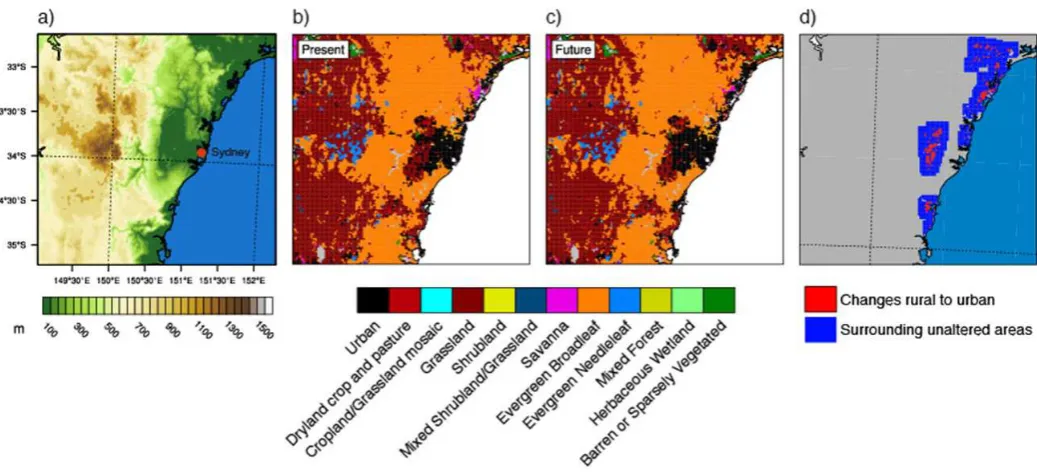
do--main (shown in Figure 1a). Further details on the
model configurations may be found in Argüeso
et
al
. (2014) and Evans and McCabe (2010), as well as
references of model evaluations in the region.
Present and future land cover maps (Figure 1b-c)
derived from data generated by the state of New
South Wales (NSW), replaced the default land use
from the model in each of the simulations. Future
urban land expansion (Figure 1d) was determined
according to NSW Department of Planning, which
allocates areas for future urban development and
consolidation in order to accommodate the
ex--pected increase in population.
The comparison of changes in temperature
pro--jected by the model between areas of urban
ex--pansion and the surrounding unaltered grid cells
serves as an indicator of the potential footprint of
urbanization in a changing climate.
. Results and discussion
Seasonal changes in near-surface temperature
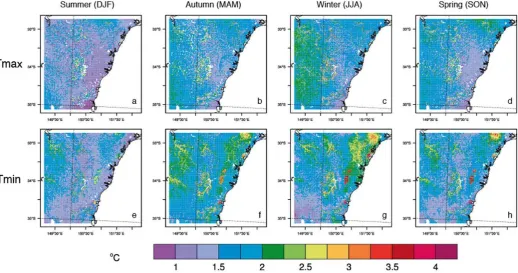
reveal that daily maximum temperature (Tmax) is
projected to change similarly over the domain and
across all seasons (Figure 2a-d). Larger increases are
expected in the inner west of the model domain,
especially during winter (up to 2.5°C). On the other
hand, summer will see a rise in Tmax between 1.0
and 1.5°C over most of the region according to the
prescribed climate change signal. The presence of
new urban areas (see Figure 1d) cannot be detected
in any of the plots showing seasonal changes and
thus the changes seem to be driven exclusively by
the large scale.
Daily minimum temperature (Tmin) will be
sub--jected to overall larger seasonal changes than Tmax.
However, the most remarkable feature of Tmin
sea--sonal changes is the evident footprint of newly
ur--banized areas (Figure 2e-h). Unlike Tmax, minimum
temperature changes are strongly affected by both
large-scale climate change and local urbanization.
The areas exposed to future land-use changes are
clearly identifiable in the spatial pattern of Tmin
seasonal changes. Such a contrast between areas of
Feature
11
figure 2. Seasonal changes in daily maximum temperature (a-d) and daily minimum temperature (e-h) obtained from the diference between future and present climate simulations.
urban expansion and the surroundings stands out
during winter and spring, when Tmin could increase
up to 4°C in new urban areas compared to changes
rarely exceeding 2°C in the neighboring grid cells
(Figure 2g-h). Despite seasonal differences, the land
use change footprint is noticeable throughout the
year.
The differences in response of temperature
ex--tremes to urbanization and climate change is in
agreement with previous studies that characterized
the urban heat island (UHI) for present climate and
found greater UHI intensity during the night
(Arn--field 2003; Grimmond and Oke 1999). Changes in
the temperature diurnal cycle were also analyzed
(see original paper) over areas of city growth and
adjacent grid cells showed that the largest impact
of urbanization is projected around sunrise. Indeed,
climate change broadly displaces the diurnal cycle
toward higher temperature values, whereas the
combined effect of climate change and
urbaniza--tion modifies the shape of the diurnal cycle,
reduc--ing the diurnal temperature range.
An excerpt of extreme indices from the Expert
Team on Climate Change Detection and Indices
(ETCCDI) was selected and we investigated changes
in adverse conditions that might have particular
re--percussions for urban populations. Especially warm
nights (TN90p) will substantially increase (from
10% to 90% of total nights) in areas of city growth,
comparatively more than in the surroundings (60%
of nights in the future). Similarly, no cool nights
(TN10p) as we know them today will occur in areas
of urban development, whereas neighboring
coun--terparts will still see them happening in the future,
although also with a strong reduction. Hot days
(TX90p) will also become more frequent and cool
days more rare, but the city does not seem to play a
role in these changes.
The projected changes are compatible with the
energetic basics of the UHI (Oke 1982), which
attri--butes relative warmth of urban areas to increased
heat capacity, delay of heat loss due to reduced Sky
View Factor and air trapping, and evaporative
cool--ing inhibition by impervious surfaces. Most of these
features are observed in the diurnal cycle of the
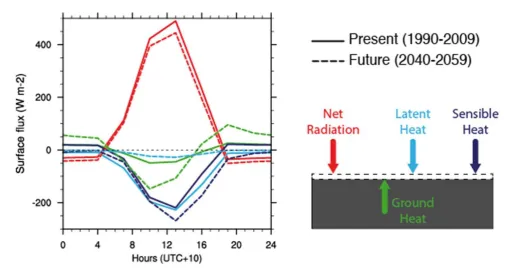
sur--face energy budget (Figure 3).
es--Feature
12
perature. Minimum temperature was systematically
projected to increase due to urban development,
adding to warming caused by GHGs. Changes were
noticeable in all seasons, but they were particularly
marked in winter and spring. Combined effects of
urbanization and climate change during these
sea--sons could double the increase in minimum
tem--perature due to global warming alone by 2050,
which indicates that the magnitude of the
urban--ization impact on minimum temperature is locally
comparable to the climate change signal. On the
contrary, maximum temperature seem to be
inde--pendent of the land-use change from rural to urban
and changes are explained by climate change.
As a result of the aforementioned changes, the
frequency of warm and tropical nights will increase
substantially in the future, whereas changes in
par--ticularly high daytime temperature are more
relat--ed to topography and distance to the ocean, rather
than land-use changes.
Population vulnerability to higher temperatures
is strongly related to nighttime conditions
(Lough--nan
et al
. 2013) and therefore, in view of results
pre--pecially after midday. During the warmest hours of
the day, net radiation in new urban areas is reduced
and the ground heat uptake increased. Around
sun--set, the signs of net radiation and sensible heat
re--verse. In areas of urban expansion, nighttime
radia--tion from the surface slightly increases and sensible
heat from the atmosphere to the ground decreases.
The new partition has no perceptible impact on
Tmax but does affect minimum temperature, which
reaches much higher values when climate change
and urbanization act together.
Other variables such as wind and surface
evapo--transpiration were explicitly examined too.
Urban--ization has an effect on both of them, but wind is
only slightly affected under light wind regimes and
not when high wind speeds occur. Surface
evapo--transpiration is strongly diminished leading to
val--ues close to 0 mm/month in new urban areas.
4. Summary
Urban expansion of Sydney has a clear footprint
in future climate projections on a range of variables,
such as surface evapotranspiration, wind and
Feature
1
sented here, further investigation on the direct links
between future urban-induced climate changes and
human comfort is necessary. This work is now
be--ing extended to assess changes in heat stress due to
potential changes of both temperature and relative
humidity and determine to what extent these
com--pensating factors dominate changes in human heat
stress. Another factor to consider in the future is the
effect of anthropogenic heat, which represents an
additional and potentially important source of heat
in cities that could intensify the warming effect of
urbanization in a changing climate.
Acknowledgement
This article is a summary of an earlier
publica--tion in
Climate Dynamics
. Please refer to the original
publication for the
complete work (Argüeso
et al
.
2014).
References
Argüeso, D., J. M. Hidalgo-Muñoz, S. R.
Gámiz-Fortis, and Y. Castro-Díez, 2012: High-resolution
projections of mean and extreme precipitation
over Spain using the WRF model (2070–2099
ver--sus 1970–1999).
J. Geophys. Res
, 117, doi:10.1029/
2011JD017399.
Argüeso, D., J. P. Evans, L. Fita, and K. J. Bormann,
2014: Temperature response to future urbanization
and climate change.
Climate Dyn
, 42, 2183–2199,
doi:10.1007/s00382-013-1789-6.
Arnfield, A. J., 2003: Two decades of urban climate
research: a review of turbulence, exchanges of
en--ergy and water, and the urban heat island.
Internamm
tional Journal of Climatology
, 23, 1–26, doi:10.1002/
joc.859.
Evans, J. P., and M. McCabe, 2010: Regional
cli--mate simulation over Australia’s Murray-Darling
basin: A multitemporal assessment.
J. Geophys. Res
,
115(D14114), doi:10.1029/2010JD013816.
Georgescu, M., M. Moustaoui, and A. Mahalov,
2012: Summer-time climate impacts of projected
megapolitan expansion in Arizona.
Nature Climate
3, 37–41, doi:10.1038/nclimate1656.
Grimmond, C., and T. R. Oke, 1999: Heat storage
in urban areas: Local-scale observations and
evalu--ation of a simple model.
Journal of Applied Meteorolmm
ogy
, 38, 922–940.
Howard, L., 1833:
The climate of London deduced
from meteorological observations made in the memm
tropolis and at various places around it
. Harvey and
Darton, London.
IPCC, 2013:
Climate Change 2013: The Physical
Science Basis.
Working Group I Contribution to the
IPCC Fifth Assessment Report. Cambridge
Univer--sity Press, Cambridge, United Kingdom and New
York, 2216 pp.
Kusaka, H., H. Kondo, Y. Kikegawa, and F. Kimura,
2001: A simple single-layer urban canopy model for
atmospheric models: Comparison with multi-layer
and slab models.
BoundarymLayer Meteorology
, 101,
329–358.
Kusaka, H., M. Hara, and Y. Takane, 2012: Urban
Climate Projection by the WRF Model at 3-km
Hori--zontal Grid Increment: Dynamical Downscaling
and Predicting Heat Stress in the 2070’s August for
Tokyo, Osaka, and Nagoya Metropolises.
Journal
of the Meteorological Society of Japan
, 90B, 47–63,
doi:10.2151/jmsj.2012-B04.
Loughnan, ME, Tapper, NJ, Phan, T, Lynch, K,
Mc--Innes, JA 2013:
A spatial vulnerability analysis of urban
populations during extreme heat events in Australian
capital cities
. National Climate Change Adaptation
Research Facility, Gold Coast, 128 pp.
Oke, T. R., 1982: The energetic basis of the urban
heat island.
Q J Roy Meteor Soc
, 108, 1–24.
Rummukainen, M., 2010: State-of-the-art with
regional climate models. Wiley Interdisciplinary
Re--views:
Climate Change
, 1, 82–96.
Skamarock, W. C. and Coauthors, 2009:
A Descripmm
tion of the Advanced Research WRF Version 3
. NCAR/
TN-475+STR NCAR TECHNICAL NOTE, 125.
Urban Projects
14
Beyond mainstreaming: Reframing governance for urban climate resilience
Introduction
In this paper we focus on the limitations of notions of mainstreaming urban resilience. We argue that generally there is such a fundamental failure of urban governance that there is often nothing to mainstream into, and ar--gue the need for more politically nuanced approaches to urban resilience that can put in place some of the building blocks of the kind of polycentric, multi-scale governance founded on
adap--tive, flexible learning oriented institutions that resilience theo--ries advocates. In doing so the paper draws on a number of re--cent publications by colleagues and partners within the ISET net--work, and practical and research experience in Thailand, Vietnam through a fundamental trans--formation as it urbanizes, affect--ing everythaffect--ing from ecological landscapes, social structures and social relations to core values and aspirations. Some countries are going through a transition from small-scale, often largely subsistence agriculture, to heav--ily urbanized and industrialized economies within little over a generation. Much of this urban--ization is occurring in secondary cities, and it is this pace and scale of growth that is at the heart of the future challenge around ur--banization and climate change in Asia.
Urbanization is often equated with the administrative units of cities, with definitions of cities based on their lo--cation, historical boundaries, their densities of built-up space and populations. Yet the emerging cities of con--temporary Asia are quite unlike the cities of the past. The scale of the mega-cities, in geographical area and popu--lation, has never been witnessed before. Moreover, the critical dependence on complex systems of infrastructure and technology is perhaps the defining characteristic of contemporary urbanization.
Urbanization and the cities that are created are driven
by global capital flows and become physical embodi--ments of political and economic power. Cities are em--bodiments of socially constructed meaning and power. The physical layout of cities, the design and scale of build--ings and public space are all symbolic representation of and ways of giving form and meaning to political and social power relations (Swyngedouw and Heynen, 2003). Previously cities were testaments to imperial, national and royal power. Contemporary cities represent other power re--lations and values. Of course, these power structures and val--ues are often vigorously contest--ed, and it is these tensions that permeate the sphere of urban climate policy and planning.
The planning of cities and urbanization must be seen as a political process (Harvey, 2008). Whether framed in terms of re--newal or resilience, inevitably these actions are tied up with a whole range of political values and contests. As with the history of urban renewal and regenera--not neutral (Friend and Moench, 2013).
There are of course additional challenges. Urbanization is inti--mately linked to global environ--mental change, contributing to climate change through emis--sions, construction and land conversion while also creating new risks and vulnerabilities through the refashioning of ecological landscapes and the concentration of econom--ic assets and people in hazardous space. Urbanization of the future will need to balance a mix of highly contested local values and interests, with the harsh realities of eco--logical constraints and planetary boundaries. Forging an urban future that is both ecologically viable and socially just is first and foremost a challenge of governance – of balancing conflicting values and interests. This balance will set the agenda for how resilience is approached, of what, for whom and by whom.
people in Can tho still access natural water sources for domestic use and consumption −
Urban Projects
15
Forging an urban future that is both
ecologically viable and socially just
is irst and foremost a challenge of
governance – of balancing conlicting
values and interests.
Current global efforts around urban resilience only of--fer partial recognition of the political dimensions of this challenge. Global discourse on urban resilience tends to adopt a rather technocratic approach, founded on cre--ating the strategies, policies and plans, and attracting investment finance as if such processes were entirely neutral and free from potential controversy or contesta--tion. It is an agenda that is increasingly framed around physical infrastructure and finance mechanisms. It ig--nores often murky governance mechanisms that might be needed to deal with future climate uncertainty and risk, to manage public finance, and to ensure socially just, equitable outcomes.
This is also further complicated by the dis--course of resilience itself. Resilience has entered policy discourse but of--ten without the core theoretical principles of complex systems. Largely it is the connotations of
maintaining system function, of bouncing back that are most influential. However, this discourse easily supports narratives of order over justice, opening up a whole ad--ditional set of challenges for policy and practice (Friend and Moench, 2013). The term “resilience” has also be--come a buzzword in many contexts to justify or spin “business and usual” agendas.
This approach is manifest in a push towards main--streaming urban resilience. Many development ac--tors and projects have now taken on board the call to mainstream resilience as a rallying cry. There is a certain logic to putting urban resilience at the heart of policy and planning. Yet calls for mainstreaming, and associ--ated recommendations founded on policy champions and resilience planning, often fail to acknowledge the dynamics of urbanization or the core governance gaps. Much effort is directed towards the government rath--er than processes of govrath--ernance; towards policy and plans, rather than promoting processes of accountabil--ity, transparency and public participation; towards in--dividual government champions rather than networks of alliances of citizens, private and public sector. Talk of mainstreaming only further deflects attention from system failings and governance gaps (Friend, Jarvie et al. 2013). Such calls are at risk of promoting a one-sided view of resilience that is imposed from above, and that disempowers and disadvantages certain groups of ur--ban people. It also fails to draw on the rich intellectual history of resilience thinking.
The significance of complex systems and services
Part of the problem lies in the rather limited
think--ing of what constitutes the city. In the context of urban climate resilience, the city is often taken to be a specific administrative unit – but in the case of rapidly urbaniz--ing Asia, existurbaniz--ing administrative units do not correspond with the territories that are urbanizing. The urbanizing areas of many cities include the core area that has been an established urban centre, with the administrative units around it that are now becoming urbanized. As such, the city ‘system’ that resilience aims to address, is going through a rapid process of change as urbaniza--tion spreads. There is no clear geographical or territorial boundary of such changing urbanizing areas.
While cities in some form have existed for much of history in South--east Asia, there is some--thing unique about the contemporary cities that are emerging. This is both in the scale of con--temporary cities and the pace of change. For ex--ample, Thai cities such as Udon Thani expect to double in size and population within the next 10 years. From a remote town in a notoriously poor province, renowned for its export of labour, Udon is becoming a regional urban centre, attracting investment and migrants from across the Mekong.
Urbanization becomes increasingly dependent on systems – water, food, energy, waste, and transport – that are derived from beyond territorial boundaries. The dependence on physical infrastructure, technolo--gies and complex institutions is a critical feature of the way that these systems are created and maintained, and of how the services that they generate are accessed and distributed. For Graham and Marvin (2001) ‘infrastruc--tures are the key technological and physical assets of modern cities’. Increasingly linked across regional and global scales, essential resources such as capital, labour and information move on transport and communication infrastructure between and across urban areas, often in previously unimagined ways (Friend and Moench, 2013). The global scale, and the inter-linkages between urban centres is also referred to as a ‘pan-urbanism’ (Moris, 2014). But these inter-linkages are not merely between urban centres. As flows of resources and people often cross administrative and ecological boundaries, distinc--tions between rural and urban are increasingly blurred.
Urban Projects
1
Rethinking policy and practice
Perhaps more fundamentally, we need to rethink our approach to governance, policy and practice to both understand the current dynamics of urbanization and to be better positioned to address the challenges of building urban resilience, and to do it in ways that can generate socially just outcomes.
Efforts around shaping urban policy and practice are framed as technical or managerial challenges, often with implicit assumptions of what policy is, how it operates and how it can be influenced (Friend, Jarvie et al. 2013).
Underpinning many of these current efforts, especially within the framework of development programmes and projects, are assumptions of policy as following linear processes, of bureaucratic
ratio--nality – in which sound science-based information leads to an assessment of policy options, and the selection of the best op--tion. While this appears a crude summary, we see this kind of simplistic representation of pol--icy becoming manifest in many ways. Much of the effort around policy influence is in generating and communicating evidence on the rather optimistic assumption that decisions, and then actions, will follow.
Yet we also know that policy processes rarely follow these simple steps, that policies and plans may never be implement--ed, or that they are reshaped in their implementation – leading to a range of often unintended consequences. Others approach policy and planning as inherently political acts, concerned with the exercise of power and the cre--ation and manipulcre--ation of rules to unfairly affect distribution of political and economic benefits.
Drawing on both political economy perspectives and resilience thinking, others approach policy processes as murky and clumsy. Policy is inherently experimental (Verweij, Douglas et al. 2006). Policy actions can never be guaranteed to deliver the policy outcomes that are intended. Anthropological approaches to policy illus--trate the contested discourse, knowledge and power within policy processes (Shore and Wright, 1997). Such analysis suggests that the speeches and documents of policies and plans are but the theatre of policy, in many
situations acting as a smokescreen to divert attention from real interests and objectives, and that much pol--icy is purposively designed never to be implemented. Equally, implementation of policy is also contested, and actions are shaped according to competing interests of ever-shifting networks and alliances.
The failure of urban governance
Much of the climate adaptation literature highlights the inherent uncertainty and risk of climate change, and the resilience concepts of strengthening capacity to learn and reorganize. This leads to calls for climate governance that is founded on adaptive, flexible and learning-oriented institutions, able to operate at mul--tiple ecological scales and across sectors and tiers of ernance, and the fundamental failures of urban governance that characterize much of rapid--ly urbanizing Asia (Friend, Jarvie et al. 2013). It is essential to rec--ognize the political nature of the forces that are driving urbaniza--tion, and how these influence urban governance.
Urbanization is central to the established orthodoxy of eco--nomic development. Yet in most of urbanizing Asia, this is only partly planned at best. The main role of the state is geared to--wards putting in the physical in--frastructure, that then allows for investment, and then providing services. The key infrastructure comes first, and the city follows. There is no clear vision of what an urban future would look like – of how cities might be laid out, of how urban citizens could shape their urban environment. This is to be determined by individual, private sector led investments rather than a shared vision of urban values and futures.
The state plays two critical and perhaps incompatible roles. The state has played both an entrepreneurial and a managerial role, investing and also acting as a system of checks and balances (Harvey, 2006). This conflicting role is especially significant given that much of the ef--fort around mainstreaming is actually geared towards providing finance to local governments, and finance is
In the context of urban climate resilience, the city is often taken to be a speciic administrative unit – but in the case of rapii idly urbanizing Asia, existing administrative
Urban Projects
1
the basis of their political capital.
While the tools and techniques of urban planning are well established, the practice is something quite differ--ent. Urban planning hinges on the application of spatial planning. But it is here that we see the greatest chal--lenge. On the whole, there has been a complete and absolute failure of land use planning in rapidly urban--izing areas. While the plans themselves look convincing, it is often a process of painting by numbers – updating maps after the fact to take account of changes on the ground. Rather than applying land use plans as the ba--sis of realizing a strategic vision of an urban future, land use plans can serve to
identify areas for invest--ment and conversion for the benefit of the pow--erful. The knowledge of land use plans becomes critical capital (Ribeiro, 2005).
The main pressure on existing land use
plan--ning systems has been related to investment capital. Speculative investment in land has driven much of this urbanization. With free capital both within the region, and globally, investment in and redevelopment of land has attracted huge amounts of investment capital (Har--vey, 2012). This has often been driven by and attracted to low-value land where revenues from conversion and further investment are the highest. In Southeast Asia this has often been low-value agricultural, wetland land – prone to flooding or in other ways hazardous – or un--der ambiguous land title regimes.
Urbanization has thus gone against existing land use plans and over-ruled environmental legislation. Indeed, the insider knowledge of land use plans has had a mar--ket value, allowing for speculative investment ahead of state planning decisions, creating a whole new set of political and economic alliances that further blur the boundaries between the state and the market.
From across Thailand to Vietnam and south to In--donesia, this has led to a range of well-documented problems of pollution and land degradation, creating a whole new set of vulnerabilities and risks that will be further intensified by climate change. Within this whole process the rights of citizens, and non-citizen urban residents, to shape their urban future has been tightly constrained.
Creating the conditions for urban governance
If we take this situation as the starting point – of a process of urbanization that is fiercely contested, driv--en by political and investmdriv--ent interests, with a failure of both governance and the market to prevent
envi--ronmental degradation and the emergence of climate climate-related risks – then the challenge is less about mainstreaming urban climate resilience into failed gov--ernance processes and practices, than it is about creat--ing the conditions for urban governance that can take on board the principles of resilience. In many cases there are such fundamental gaps in policy and practice that there is nothing to mainstream into (Friend and Moench, 2013). Moreover, such principles that are so central to resilience-based theories of governance – of adaptive, flexible, learning learning-oriented institutions and pro--cesses, and of multi-scale, polycentric governance – do
not sit easily with the re--alities of contemporary urbanization.
Realising the principles of urban governance re--quires putting at centre stage both the rights and needs of diverse urban citizens with account--able, representative and transparent state processes, as well as the emerging eco--logical constraints of planetary boundaries and climate change. It means choosing sides – putting the interest of a collective populace ahead of powerful interests able to manipulate planning and broader governance pro--cesses. From our perspective, at the heart of these chal--lenges, and in view of the need to improve such core urban planning practices such as land use planning, are access rights as enshrined in the Rio Summit’s Principle 10 – access to information, public participation, and re--dress and remedy.
If we take the technological approach that sees cities as set in stone – as systems in their own right that are not contested – then the kinds of interventions we pro--mote, particularly around infrastructure, and the kinds of processes that we promote that do not create the kind of governance space – can lead to unjust interven--tions and outcomes. Given the significance of the finan--cial drivers of urbanization and the history of urbaniza--tion, such outcomes should be expected.
Much of the current effort is framed around financial investment for infrastructure needs. Clearly many ur--banizing areas in Asia have a need for investment, since much infrastructure is not present, or is already fragile and failing, and many urban governments struggle to provide the services, and create the conditions needed for citizen well-being and healthy lives.
But if we see cities as products of capital investment and infrastructure, and appreciate the political dimen--sions of such flows as well as the risks associated with leakages, we must also be concerned that investment without appropriate governance mechanisms – which