Bank Loans and Stock Prices:
An Empirical Evidence
Bakri Abdul Karim,
1*Lim Siew Lih,
2and Zulkefly Abdul Karim
3 1,2Faculty of Economics and Business, Universiti Malaysia Sarawak (UNIMAS),94300 Kota Samarahan, Sarawak, Malaysia, Tel: +6 082 584396. 3School of Economics, Faculty of Economics and Management, Universiti Kebangsaan Malaysia, 43600 Bangi, Selangor, Malaysia.
*Corresponding author: [email protected]
Abstract - This study re-examines the interaction between bank loans and stock prices in Malaysia. We use Granger non-causality test proposed by Toda and Yamamoto (1995) in both bivariate and multivariate frameworks and both monthly and quarterly data in examining the relationship between the two variables. Unlike previous studies, we find that there is strong evidence of no causality running between stock prices and bank loans in all models and samples. This finding revealed that stock prices and bank loans are independent. The predictability of stock prices cannot be enhanced considerably through utilizing information on the bank loans.
Keywords : Bank lending; Stock prices; Non-Granger causality; Efficient market
Introduction
The link between stock market development and financial intermediaries has been increasingly significant to determine economic development. For example, stock market development could influence economic activity through four mechanisms, namely investment spending (Tobin’s q theory), household liquidity effects, household wealth effects, and firm balance-sheet effects. Thus, a healthy economic growth is always accompanied with a healthy financial market as it transmits its influences to the real sectors. Nowadays, the increasingly emerging of financial intermediaries plays an important role in providing financial assistance to the expansion of corporation. However, the growing importance of
stock market and financial intermediaries’ development has raised critical questions for many: Do stock prices predict future bank lending activities? Do bank loans play an important role in transmitting its financial shock to the real sectors, and, if so, how?
Economists believe that the stock prices are a predictor for future economic development. Thus, stock market development plays an important role in predicting future economic growth (Levine and Zervos, 1998). In addition, Demirguc-Kunt and Levine (1996) found that most of the stock market indicators are highly correlated with banking sector development while most of the well-developed stock markets tend to have well-developed banking sectors. Furthermore, Demirguc-Kunt and Maksimovic (1996) show that firms in countries with better-functioning banks and equity markets grow faster than predicted by individual firm characteristics. Accordingly, the stock prices should reflect various macroeconomic variables to indicate current economic development. If stock prices are able to reflect all the macroeconomic variables, then it should be a good predictive tool for future bank lending activities as the stock market indicators are the macroeconomic variables that determine bank lending (Yartey, 2008). Moreover, the causal relationship between stock prices and bank lending activities has played an important role in providing deeper understanding on banking vulnerability and the mechanism of stock prices in the real market (Ibrahim, 2006). In addition, the inherent fragility of banking sector to the virulent of crisis has caused many bank-dependent especially stock markets to collapse.
Although, the role of banks in the economy has attracted enormous attention especially in assessing monetary transmission, however their relations to the health of financial markets have received very limited attention (Ibrahim, 2006). To the best of our knowledge, Kim and Moreno (1994) and Ibrahim (2006) are perhaps the only studies addressing the issue of relationship between bank loans and stock prices. Using a vector autoregressive consisting of five variables, Kim and Moreno (1994) find evidence for positive effects of stock price changes on bank lending in Japan while Ibrahim (2006) evaluates the issue for the case of Malaysia using quarterly data from 1978:Q1 to 1998: Q2. Employing time series techniques of cointegration, vector autoregression and impulse response function consisting of six variables, he finds evidence that bank loans react positively to the increase in stock prices but there seem to be no influence from bank loans to stock prices. Prior to the 1997 Asian financial crisis, many Malaysian firms depend on bank
RESEARCH PAPER
loans for their working capital and financing their business. However, during the catastrophe, there has been a drastic drop in Malaysian stock prices followed by reduction in bank loans (Ibrahim, 2006). Since, the empirical relation between the two variables has strengthened over the recent years; it is interesting to revisit the relationship between stock prices and bank loans for the case of Malaysia. Unlike previous studies, in this study, we utilize the post-1997 Asian crisis period data and Toda and Yamamoto (1995) Granger non-causality test. Granger non-causality is found to be superior causality test as it ignores any possible non-stationary or cointegration between series when testing for causality. In addition, we consider both bivariate and multivariate framework and both monthly and quarterly data to re-examine the interaction between the two variables. In particular, we consider both setting as they provide more information to estimate the causal relationship.
While robustness of previous findings concerning dynamic interaction between stock prices and bank loans can be examined, our analysis contributes further to the literature on Market Efficiency Hypothesis (MEH) and monetary transmission. If the predictability of stock prices can be enhanced considerably through exploiting information on the bank loans then, it means that the Malaysian stock market is not efficient and vice versa. As policy makers, it is important to first understand how the economic transformation affects the nature of the monetary transmission mechanism and in addition to evaluate the relative potency of transmission channels (Ooi, 2008). The stock market and banking development may help to facilitate in designing policies to improve the stability of the banking industry and to enhance the effectiveness of the monetary system as a whole (Omar et al. 2006).
The rest of this paper is structured as follows. Section 2 provides the development in Malaysian banking industry and stock market. Section 3 presents empirical framework and description of the data. The fourth section provides the empirical results and discussion. Finally, the fifth section concludes the study and provides some implications.
Development In Banking Industry and Stock Market
Development in Banking Industry
The highly contagious effects of a failure of a single entity in one part of the world on all other connected parties
illustrate the tremendous importance of effective risk management in today’s financial world (Ibrahim, 2010). To
confront with the crisis, the governance and risk management of Bank Negara Malaysia (BNM), the central bank, plays an important role in the capital market at regulating the banking structure, other financial intermediaries system, monetary and foreign exchange in Malaysia. Previous decades, BNM has implemented Risk Based Supervisory Framework and Risk Based Capital regime to promote governance and risk management to reduce the volatility and the negative financial effect of adverse exposure to risk (Thompson, 2001). These efforts have helped many institutions in managing their risk profile and recovering from the crisis.
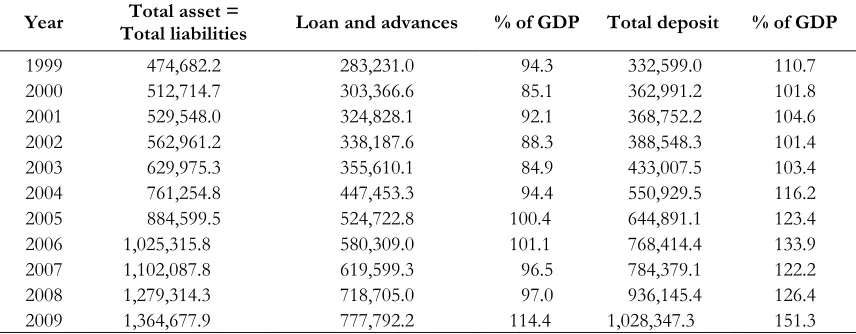
Therefore, the banking industry has been given more attentions since economic gradually recovered from the Asian financial crisis. Table 1 represents the performance of Malaysian commercial banks from 1999 to 2009 in terms of total loans and deposits.
Table 1:
Assets and liabilities of Malaysia commercial bank from 1999 to 2009
(in RM million)
Year Total asset =
Total liabilities Loan and advances % of GDP Total deposit % of GDP
1999 474,682.2 283,231.0 94.3 332,599.0 110.7
2000 512,714.7 303,366.6 85.1 362,991.2 101.8
2001 529,548.0 324,828.1 92.1 368,752.2 104.6
2002 562,961.2 338,187.6 88.3 388,548.3 101.4
2003 629,975.3 355,610.1 84.9 433,007.5 103.4
2004 761,254.8 447,453.3 94.4 550,929.5 116.2
2005 884,599.5 524,722.8 100.4 644,891.1 123.4
2006 1,025,315.8 580,309.0 101.1 768,414.4 133.9
2007 1,102,087.8 619,599.3 96.5 784,379.1 122.2
2008 1,279,314.3 718,705.0 97.0 936,145.4 126.4
2009 1,364,677.9 777,792.2 114.4 1,028,347.3 151.3
Development of Stock Market
The main stock exchange in Malaysia is Bursa Malaysia Berhad. It contains Main Board, Second Board, and Malaysian Exchange of Securities Dealing and Automated Quotation (MESDAQ). The main index of Bursa Malaysia Berhad is the Kuala Lumpur Composite Index (KLCI) which is currently known as FTSE Bursa Malaysia KLCI since July 6, 2009. The index calculation methodology for KLCI is internationally accepted and it provides an accurate index for Malaysian stock market performance as well as indicator for Malaysian economy. Nowadays, KLCI comprises of the 30 largest listed companies of the Main Board.
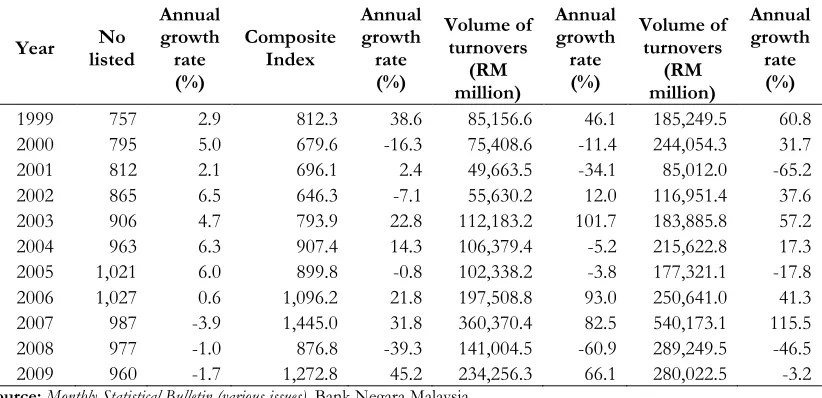
Prior to the Asian financial crisis in 1997, KLCI performed at peak level with approximately 1,240 points in 1996. However, the index declined sharply to approximately 600 points in 1997 and below than 300 points in 1998 due to the crisis. Supported by the strong export demand, private consumption and foreign investment, the Malaysian economy started to gradually recover and the index reached its highest level of 1,445 points in 2007. The performance of the Malaysian stock market and its indicators of Bursa Malaysia are presented in the Table 2.
Table 2.
Key indicator of Bursa Malaysia Kuala Lumpur from 1999 to 2009
Year No composite index showed a growth rate of 57% since 1999. However, the composite index suffered a reduction of 39% during 2008. This is mainly due to the impact of global housing bubble that affected a lot of banks suffered major loss and some of them were forced into bankruptcy around the world. This resulted in loss of investor confidence thus led to collapse of stock market.
Methodology and Data
In examining the relationship between stock prices and bank loans, this study used a Granger non-causality test proposed by Toda and Yamamoto (1995). Granger non-causality test in an unrestricted vector autoregressive (VAR) model can be conducted by testing whether some parameters are jointly zero. Toda and Yamamoto (1995) involve a Modified Wald (MWALD) test in an augmented VAR model and avoid the problems due to the sensitivity of stationarity or cointegration tests by ignoring any possible non-stationary or cointegration between series when testing for causality. In addition, it utilizes a standard VAR in the levels of the variables. Thus, we could minimize the risks associated with possibly wrongly identifying the orders of integration of the series, or the presence of cointegration and
minimizes the distortion of the tests’ sizes as a result of pre-testing (Mavrotas and Kelly 2001).
This test utilizes the MWALD for testing linear restriction on the parameters and it has an asymptotic χ2 distribution when a VAR (k + dmax) is estimated. Here dmax is the maximum degree of integration to occur in the system
and k is the optimal lag length. Toda and Yamamoto (1995) noted that, for d = 1, the lag selection procedure is always valid since k≥ 1 = d. If d = 2, the procedure is valid unless k = 1. In addition, this procedure is valid regardless whether a series is I(0), I(1) or I(2), non-cointegrated or cointegrated of an arbitrary order. Moreover, Zapata and Rambaldi (1997) provide evidence that the MWALD test has a comparable performance in size and power to the LR and WALD tests if the correct number of lags for estimating k + dmax is identified and no important variables are omitted, provided a
t
integration of the variables. The order p of the process is determined by using the Akaike Information Criterion (AIC). We used monthly and quarterly data for bank loans and stock prices over the period from 1999 to 2009. In this study, focusing on both of these two variables in bivariate context may not be satisfactory to test their relationship (Ibrahim, 2006). As noted by Kim and Moreno (1994), there may have cyclical factors that might have effect on the bank loans. Following Ibrahim (2006) and Kim and Moreno (1994) we also include Industrial Production Index (IPI), the price level, interest rate, and exchange rate while running a multivariate setting. All data are collected from the International Financial statistics (CD-ROM version) of the International Monetary Fund (IMF) and the Statistical Bulletin (various issues) published by Bank Negara. Except the interest rate, all variables are expressed in natural logarithm.
Empirical Findings
Prior to implement the non-causality test, we have to determine the degree of integration of the variables. Accordingly, the standard Augmented Dickey-Fuller (ADF) and Phillips-Perron (PP) unit root tests are conducted to determine the order of integration for stock prices and exchange rates. To conserve space the results are not reported here. This result indicates that all variables are integrated of order one, I(1) and, then, we proceed to the Granger non-causality test as proposed by Toda and Yamamoto (1995) to examine the causal linkages between stock prices and the bank loans.
Table 3 shows the results of the Granger non-causality test for both bivariate and multivariate models. Panel A shows the results of the Granger non-causality test for monthly data while Panel B for quarterly data. The results suggest that there is strong evidence of no causality running between stock prices and bank loans in all models and samples. While Kim and Moreno (1994) find evidence for positive effects of stock price changes on bank lending in Japan and Ibrahim (2006) finds evidence that bank loans react positively to the increase in stock prices, our results find that there seem to be no influence from bank loans to stock prices and vice versa.
Since our main objective is to examine the relationship between bank loans and stock prices, to conserve space, the results of other variables estimation are not reported here. One of the findings that worth to highlight is that we also discover the existence of a bidirectional causality relationship between Industrial Production Index and bank loans. An increase in industrial activities means more funds needed from banks for business expansion. Ibrahim (2006) notes that expansion in real output tends to motivate investments and loan demand. In addition, expansion in bank loans is to
Notes: SP and BL refer to stock prices and bank loans respectively. =/=> indicates does not Granger cause. The optimum lag lengths are based on the Akaike Information Criterion (AIC).
Conclusion
(1994) and Ibrahim (2006). Gargia and Liu (1999) note that the financial intermediary growth and stock market development are the complements as another factors in determining the stock market capitalization rather than as substitute. However, Levine and Zervos (1998) find that stock market liquidity and banking development both positively predict growth, capital accumulation and productivity improvement. Demirguc-Kunt and Maksimovic (1996) show that firms in countries with better-functioning banks and equity markets grow faster than predicted by individual firm characteristics.
One of the plausible reasons of this no-causality is the imposition of capital control in Malaysia in September 1998. This measure was able to insulate the domestic financial markets from volatile portfolio capital flows and speculative activities. Karim et al. (2010) argue that the imposition of capital controls tends to deactivate the finance link among equity markets. Therefore, the domestic market may be insulated from international financial disturbances. In addition, Raghavan et al. (2010) note that the capital controls were imposed to provide Bank Negara Malaysia (BNM) with the required breathing space to restructure the financial and corporate sectors.
Acknowledgements
Financial support from the Ministry of Higher Education Malaysia through Fundamental Research Grant Scheme [Grant No: FRGS/05(29)/783/2010(64)] is gratefully acknowledged.
References
Demirguc-Kunt, A., and Levine, R. (1996), “Stock market development and financial intermediaries: Stylized Facts”, The World Bank Economic Review, Vol. 10 No. 2, pp. 291-321.
Demirguc-Kunt, A., and Maksimovic, V. (1996), “Financial constraints, uses of funds, and firm growth: An international
comparison”, World Bank Mimeo.
Gargia, V. F., and Liu., L. (1999), “Macroeconomic deternimant of stock market development”, Journal of Applied Economics, Vol. 2 No. 1, pp. 29-59.
Ibrahim, H. M. (2006), “Stock prices and bank loan dynamic in developing country: The case of Malaysia”, Journal of Applied Economics, Vol. 1, pp. 71-89.
Ibrahim, M. (2010), “Sound risk management to boost bottom line and strengthen resilience”, Keynote of MII International Risks and Risk Management Conference for Insurance Sector, 2010.
Karim, B.A., Majid, M.S.A., Isa, A.H.M. and Jais, M. (2010), “Capital control and stock market integration”, in the Proceedings of 2010 Oxford Business & Economics Conference, St. Hugh’s College, Oxford University, Oxford, UK.
Levine, R., and Zervos, S. (1998), “Stock market, banks, and economic growth”, The American Economic Review,
Vol. 88 No. 3, pp. 537-558.
Kim, S.B. and Moreno, R. (1994), “Stock prices and bank lending behavior in Japan”, Economic Review, Vol. 1, pp. 31-42.
Mavrotas, G., and R. Kelly (2001), “Old wine in new bottles: Testing causality between savings and growth”, The Manchester School, Vol. 69, pp. 97-105.
Omar, M.A., Rahman, A.R.A., Yusof, R.M. Majid, M.S.A. and Rasid, M.E.S.M. (2006), “Efficiency of commercial banks in Malaysia”, Asian Academic of Management Journal of Accounting and Finance, Vol. 2 No. 2, pp. 19-42.
Ooi, S. K. (2008), “The Monetary transmission mechanism in Malaysia: Current developments and issues”, Bank for International Settlements Working Paper No 35.
Peek, J., Eric, S.R., and Geoffrey, M.B.T. (2003), “Identifying the macroeconomic effect on loan supply shocks”, Journal of Money, Credit, and Banking, Vol. 35 No. 1, pp. 931-946.
Toda, H. Y., and Yamamoto, T. (1995), “Statistical inference in Vector Autoregressions with possibly integrated processes”, Journal of Econometrics, Vol. 66, pp. 225-250.
Thompson, J. (2001), “Risk based supervision of the insurance companies: An Introduction”, World Bank Working Paper.
Yartey, C. A. (2008), “The determinants of stock market development in emerging economies: Is South Africa
different?”, IMF Working Paper, WP/08/32.
Zapata, H. and Rambaldi A. (1997), “Monte Carlo evidence on cointegration and causation”, Oxford Bulletin of Economics and Statistics, Vol. 59 No. 2, pp. 285-298.