312 ISBN (Vietnam): 978-604-73-4020-0
A SYMMETRY INFORMATION AND CREDIT RISK EFFECT
ON LOAN PRICING IN ASIA PACIFIC
Ivana Alim
Deddy Marciano
Liliana Inggrit Wijaya
Abstract
The purpose of this research is to test the relationship of the independent variables (commercial bank, mix bank, country risk, CPI, foreign lender, log amount, maturity, ticker, secure, senior, deal purpose, and sector industries) to the dependent variables (loan spread). Key issues in this study consisted of information asymmetry, moral hazard, adverse selection, and country risk. The results of this research show the variable that significantly affect the loan pricing decisions by lenders especially in Asia Pacific countries. Borrowers in Asia Pacific can learn from the lender’s behavior in the loan pricing decision. They also can have more knowledge on the determinants influence the procedure of the loan pricing. Governments of the Asia Pacific countries can use this study to gain more information about factors that influence the loan pricing. They should make a regulation according loan pricing decisions and they should monitored the process of the loans for the local banks so they wouldn’t be bankrupt because loans in Asia Pacific contains high risk.
Keywords: asymmetry information, credit risk, loan pricing.
JEL Classification: D82
INTRODUCTION
In most all country especially Indonesia, bank lending continues to be an important source of funding for companies. Bank loans remain the main source of external financing for companies in Indonesia. Seeing the large loans from banks, loan pricing that based on the risk assessment must be done correctly by the lenders. Indonesia that have high NPL (Non-performing Loans) rate raises doubts to whether lenders have indeed assessed risk properly, thus resulting in an appropriate loan pricing.
ISBN (Indonesia): 978-602-73852-0-7 313
The most substantial theories affecting variables in loan pricing decision are asymmetric information and moral hazard theories (Sinkey, 2002; Heffernan, 1996). In Indonesia, asymmetric information becomes a serious issue related to the insufficient monitoring system from creditor and the weakness of financial system regulation. This situation creates unique aspect for loan pricing research in Indonesia caused by high level of asymmetric information, which is different from the previous research conducted in USA and Europe with low level of asymmetric information.
Asymmetric information is happen when there are disparity in information between lenders and borrowers (Atmojo, 2004). The quantity and the quality of information that the borrowers had are different with the information that the lenders have. The limited information makes the lender unable to differentiate between high quality and low quality borrowers and make a mistake by charging high loan pricing for high quality borrowers, or vice versa, called as adverse selection caused by asymmetric information.
Besides adverse selection, moral hazard problem is also caused by asymmetric information. Moral hazard is occurred when the lenders and borrowers have different level of information and the borrowers are taking advantages from having more information than the lenders.
Country characteristics have an important role in shaping the loan pricing despite the availability of financial information related to borrower. This is because the risk of asymmetry information in the Asia Pacific countries is greater than the U.S. or Europe, so the lender need to assess the risks that could affect the ability of borrower to repay the loan. Comparing risk assessment and loan pricing by domestic lenders and foreign lenders are also conducted by Atmojo (2004). Atmojo (2004) explains that domestic lenders are in a good position to easily obtain information and more cost efficient than the foreign lenders.
Atmojo (2004) also categorize corporate lending based on listed and non-listed borrowers. For listed borrowers which shares traded on the stock exchange, the information will be more easily obtained. (Booth, 1992) also explained that publicly owned companies will reduce a lower asymmetric information and monitoring cost, as well caused a lower risk, since the borrower maintain their transparency which results in a lower/cheaper loan pricing.
For type of creditor, there are 2 kinds of banks which are commercial bank and investment bank. Marciano (2008) explained that commercial bank have a better ability to reduce asymmetric information compare to investment bank. Furthermore, the loan size that the lenders give to the borrower is representing the quality of the borrower to decide the spread given.
314 ISBN (Vietnam): 978-604-73-4020-0
be paid. It represents that the riskier the company, lenders will tend to give shorter term maturity so they can reevaluate it, thus lenders will give high spread to cover high risk that the company have (Barclay and Smith, 1995; Stoch and Mauer, 1996).
Another variable that needs to be considered is whether the loan is secured with the collateral or not. The definition of collateral in Winton and Rajan (1995) is as a
“specific assets pledged as security for a loan.” Bester (1985), Besanko and Thakor
(1987) stated that the borrower could have a good credit risk quality by offering a collateral.
While for seniority, if the loan is senior it means it will be paid first than the
subordinates’ loan. This suggests that senior loans will be charged lower loan spread
by lender.
LITERATURE REVIEW
In the practical world, loan pricing tend to follow prime-rate convention or cost of funds-plus-pricing formula, where borrowers will be given prime rate plus (or minus)
the base or based on a markup over lenders’ cost of funds (Sinkey, 2002). Lenders
should perform the right risk based pricing to the borrowers, because they often performed with their own assumption and consideration. Risk based pricing requires lenders to determine the interest rate that compensates the risk level of the loan (Atmojo, 2004).
Corruption Perception Index (CPI)
Lasmono and Marciano (2010) explained that the high rate of corruption perception index shows the common practice of bribe and misused funds in the bureaucrat, which
could lead to borrower’s false action such as issuing a misleading financial report,
false tax report, etc. Country with high corruption perception index indicates that the asymmetry information also greater, thus the lenders will enlarge the loan spread.
H1: The higher the corruption rate will results in a higher loan spread.
Ticker
Listed company is monitored by the investors, public claimholders, analysts, or bond rating agencies all the time through cross monitoring. The situation where the information is easier to obtain could reduce the level of asymmetry information between lenders and borrowers (Marciano, 2008). Therefore, listed borrowers will have lower loan spread compared with non-listed borrowers (Booth, 1992).
ISBN (Indonesia): 978-602-73852-0-7 315
Foreign and Domestic Lenders
There are findings from Goldberg, Dages, and Kinney (2000) who explained that foreign banks will have better performance in lending to developing countries if the foreign bank may cooperate with the domestic banks located in that country. Atmojo (2004) explained that domestic lenders are in a good position to easily obtain information and more cost efficient than the foreign lenders. Therefore, foreign lenders will have higher loan spread than the domestic lenders.
H3: Foreign lenders gives higher loan spread compare to domestic lenders.
Commercial and Investment Bank
The result of the research conducted by Tanjung and Marciano (2012) shows that investment bank has poor monitoring capabilities, so they will increase the lead share to get a better monitoring ability. Drucker and Puri (2003) also explained that the investment bank has a higher monitoring costs due to weak evaluation capability compare to commercial bank.
H4: Commercial bank gives lower loan spread compare to investment bank.
Country Risk
Country risk is an index measuring the risk of a country that is based on credit risk and political risk (Tanjung, 2012). No matter how good the company's financial performance, it will have a high risk if the country condition is unstable (Tanjung, 2012). This condition leads the lender to give higher loan spread to the country that has high country risk.
H5: The higher the country risk will results in a higher loan spread.
Maturity
There are negative relationship between maturity and loan spread. The riskier the company, lenders will tend to give shorter term maturity so they can reevaluate it, thus lenders will give higher spread to cover high risk that the company have. Lasmono (2010) also explained that it is because a short term maturity will results in a more frequent due time payment extension request by the borrower, and cause a more frequent monitoring activities by the lenders.
H6: Longer maturity makes lender gives lower loan spread.
Secured Loans
316 ISBN (Vietnam): 978-604-73-4020-0
risk loan (Harhoff and Korting, 1998). In conclusion, loan with collateral is considered riskier thus lender will assigned higher loan spread to the borrower.
H7: Secured loans makes lender gives higher loan spread.
Senior Loans
The findings of research conducted by Tanjung and Marciano (2012) are consistent with research by Godlewski and Weill (2007) which stated that the existence of seniority would lead a lower need of lead arranger to monitor the borrower, thus the loan spread will be reduced. This suggests that senior loans will be charged lower loan spread by lender.
H8: Senior loans makes lender gives lower loan spread.
RESEARCH METHODOLOGY
This study involves empirical research (quantitative and explanatory), because the main goal is to examine the relationship between measured variables. Explanatory research explains the causal relationship of the increasing or decreasing a factor that will affect the loan pricing decisions in Asia Pacific in the year 2006 – 2010.
Data collection procedure begins with collecting all transactions data from the data of all loan corporations that were recorded on Dealscan LPC (Loan Pricing Corporation). From the data, this research sort it based on these characteristics: (1) loan contracts in the period 2006 – 2010 (2) loans located in the Asia Pacific region, specifically in 17 countries, i.e. China, Japan, Australia, South Korea, Indonesia, Taiwan, Thailand, Malaysia, Hong Kong, Singapore, Philippines, Sri Lanka, Vietnam, Bangladesh, Macau, Cambodia and Laos (3) U.S. dollar denomination loans (4) loans with LIBOR base rate. After following the characteristics, the sample has total 886 loan transactions.
This research used only two levels of measurement which is nominal and ratio level measurements. The OLS regression (Ordinary Least Squares) to estimate the determinants in loan spread with white correction method (White heteroscedasticity correction) for heteroscedasticity problem is conducted to test the model.
ISBN (Indonesia): 978-602-73852-0-7 317 RESULTS AND DISCUSSION
This research will be conducted in several groups of model, which are : (1) all sample loan data (2) public loan data (3) non-public loan data (4) public loan data with financial performance.
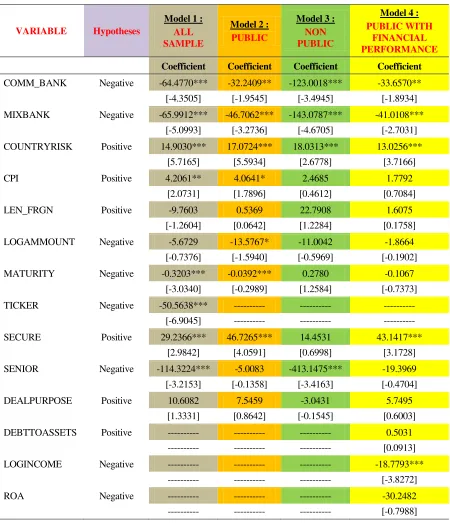
Table 1 shows the results for all four models, compare to the hypotheses explained in the theory above. The number inside parenthesis [ ] is showing the t-Statistic value.
Table 1.Comparison of Hypotheses and Research Results (All Models)
VARIABLE Hypotheses
Coefficient Coefficient Coefficient Coefficient
COMM_BANK Negative -64.4770*** -32.2409** -123.0018*** -33.6570** [-4.3505] [-1.9545] [-3.4945] [-1.8934] MIXBANK Negative -65.9912*** -46.7062*** -143.0787*** -41.0108***
[-5.0993] [-3.2736] [-4.6705] [-2.7031] COUNTRYRISK Positive 14.9030*** 17.0724*** 18.0313*** 13.0256***
[5.7165] [5.5934] [2.6778] [3.7166]
CPI Positive 4.2061** 4.0641* 2.4685 1.7792
[2.0731] [1.7896] [0.4612] [0.7084] LEN_FRGN Positive -9.7603 0.5369 22.7908 1.6075
[-1.2604] [0.0642] [1.2284] [0.1758] LOGAMMOUNT Negative -5.6729 -13.5767* -11.0042 -1.8664
[-0.7376] [-1.5940] [-0.5969] [-0.1902] MATURITY Negative -0.3203*** -0.0392*** 0.2780 -0.1067
[-3.0340] [-0.2989] [1.2584] [-0.7373] TICKER Negative -50.5638*** --- --- --- [-6.9045] --- --- --- SECURE Positive 29.2366*** 46.7265*** 14.4531 43.1417***
[2.9842] [4.0591] [0.6998] [3.1728] SENIOR Negative -114.3224*** -5.0083 -413.1475*** -19.3969 [-3.2153] [-0.1358] [-3.4163] [-0.4704] DEALPURPOSE Positive 10.6082 7.5459 -3.0431 5.7495
318 ISBN (Vietnam): 978-604-73-4020-0
Test for Model 1
The test results showed negative and significant correlation at 1% between loan spread with commercial bank. This shows that commercial bank lender have the tendency to give lower loan spread to the borrower. This happened because commercial bank has a better ability to reduce asymmetric information compare to investment bank that will lead to a cheaper loan pricing decision (Marciano, 2008). This research results is in accordance with the research results conducted by Tanjung and Marciano (2012) that conclude significant negative relationships between loan spread and commercial bank.
Mix bank variable showed negative and significant correlation at 1%.The results of this analysis is in accordance with the statement of Drucker and Puri (2003) which revealed that the investment bank has a higher monitoring costs due to weak evaluation capability compare to commercial bank. While Gupta, Singh, and Zebedee (2008) adds that universal banks are more flexible than an investment bank because the bank function are between investment banks and universal banks.
Country risk variable showed positive and significant correlation at 1%. This suggests that the riskier the country, the higher the loan spread. In their book, Jorion (2002),
Heffernan (2008), Eaton et al., (1894) stated that credit risk is a risk of borrower’s
incapability to perform their duties as stated in loan agreement, which means that the
borrower could not paid the loans because of bankruptcy, or late payment for loan’s
interest. This findings is in accordance with the findings of Lasmono and Marciano (2010) who found that higher risk of loan will cause lender to require greater monitoring capabilities.
CPI variable showed positive and significant correlation at 5%. This suggests that the higher the corruption index will lead the lender to assign higher spread because the lenders will try to protect themselves by increasing its monitoring capabilities. This finding is similar with the research done by Lasmono and Marciano (2010) which explained that when the level of corruption of a country is very high, then the asymmetry information also predicted to be greater, thus the lenders will enlarge its share.
Maturity variable showed negative and significant correlation at 1%. This shows that the longer the maturity given, lender will assign lower spread because a long term maturity indicates that the lender didn’t need to reevaluate or re-monitoring often. Shorter term maturity rate will give a chance for creditor to reevaluate or re-monitoring when the loan is due, which mean there is positive correlation between
maturity rates with debtor’s quality (Barclay and Smith, 1995; Stoch and Mauer,
1996). If the debtor’s quality is good, it means that the risk of the company could not
ISBN (Indonesia): 978-602-73852-0-7 319
Ticker variable showed negative and significant correlation at 1%. The finding is consistent with the results of Denis and Mulleneaux (2000) which revealed that if the
borrower is registered in the capital markets, it may reduce the lenders’ monitoring
cost. It is also supported by the findings of Booth (1992) which explained that listed borrowers will have lower loan spread because there are cross monitoring that conducted by the public claimholders, analyst, and bond rating agencies. Information is easier to obtain in listed company than private or non-listed company, the situation where the information is easier to obtain could reduce the level of asymmetry information between lenders and borrowers.
Secure variable showed positive and significant correlation at 1%. This suggests that if there is a guarantee / collateral in the loan, the loan spread will be higher. The findings are consistent with the results from Tanjung and Marciano (2012). Berger, Udell (1990) also associated collateral with a riskier loans, since collateral usually are found in a loan transaction that need more monitoring. The existence of collateral assumed as a signal of high risk loan (Harhoff and Korting, 1998). Smith and Warner (1979) shows that secured loans need more monitoring than unsecured loans or loan without collateral. In conclusion, loan with collateral is considered riskier thus lender will assign higher loan spread to the borrower.
Senior variable showed negative and significant correlation at 1%. This suggests that if the loan is senior, the lender will assign lower spread because the existence of seniority would lead a lower need of lenders to monitor the borrower (Godlewski and Weill, 2007). The findings are consistent with research by Tanjung and Marciano (2012) which showed a negative and significant correlation for seniority variable.
Test for Model 2
The test results showed negative and significant correlation at 5% between loan spread with commercial bank. This shows that commercial bank lender have the tendency to give lower loan spread to the borrower. This happened because commercial bank has a better ability to reduce asymmetric information compare to investment bank that will lead to a cheaper loan pricing decision (Marciano, 2008). This research results is in accordance with the research results conducted by Tanjung and Marciano (2012) that conclude significant negative relationships between loan spread and commercial bank.
320 ISBN (Vietnam): 978-604-73-4020-0
Countryrisk variable showed positive and significant correlation at 1%. This suggests that the riskier the country, the higher the loan spread. In their book, Jorion (2002),
Heffernan (2008), Eaton et al., (1894) stated that credit risk is a risk of borrower’s
incapability to perform their duties as stated in loan agreement, which means that the borrower could not paid the loans because of bankruptcy, or late payment for loan’s interest. This findings is in accordance with the findings of Lasmono and Marciano (2010) who found that higher risk of loan will cause lender to require greater monitoring capabilities.
CPI variable showed positive and significant correlation at 10%. This suggests that the higher the corruption index will lead the lender to assign higher spread because the lenders will try to protect themselves by increasing its monitoring capabilities. This finding is similar with the research done by Lasmono and Marciano (2010) which explained that when the level of corruption of a country is very high, then the asymmetry information also predicted to be greater, thus the lenders will enlarge its share.
Secure variable showed positive and significant correlation at 1%. This suggests that if there is a guarantee / collateral in the loan, the loan spread will increase. Berger, Udell (1990) also associated collateral with a riskier loans, since collateral usually are found in a loan transaction that need more monitoring. The existence of collateral assumed as a signal of high risk loan (Harhoff and Korting, 1998). Smith and Warner (1979) shows that secured loans need more monitoring than unsecured loans or loan without collateral. In conclusion, loan with collateral is considered riskier thus lender will assign higher loan spread to the borrower.
Test for Model 3
The test results showed negative and significant correlation at 1% between loan spread with commercial bank. This shows that commercial bank lender have the tendency to give lower loan spread to the borrower. This happened because commercial bank has a better ability to reduce asymmetric information compare to investment bank that will lead to a cheaper loan pricing decision (Marciano, 2008). This research results is in accordance with the research results conducted by Tanjung and Marciano (2012) that conclude significant negative relationships between loan spread and commercial bank.
ISBN (Indonesia): 978-602-73852-0-7 321
bank. While Gupta, Singh, and Zebedee (2008) adds that universal banks are more flexible than an investment bank because the bank functions are between investment banks and universal banks.
Country risk variable showed positive and significant correlation at 1%. This suggests that the riskier the country, the higher the loan spread. In their book, Jorion (2002),
Heffernan (2008), Eaton et al., (1894) stated that credit risk is a risk of borrower’s
incapability to perform their duties as stated in loan agreement, which means that the
borrower could not paid the loans because of bankruptcy, or late payment for loan’s
interest. This findings is in accordance with the findings of Lasmono and Marciano (2010) who found that higher risk of loan will cause lender to require greater monitoring capabilities.
Senior variable showed negative and significant correlation at 1%. This suggests that if the loan is senior, the lender will assign lower spread because the existence of seniority would lead a lower need of lenders to monitor the borrower (Godlewski and Weill, 2007). The findings are consistent with research by Tanjung and Marciano (2012) which showed a negative and significant correlation for seniority variable.
Test for Model 4
The test results showed negative and significant correlation at 5% between loan spread with commercial bank. This happened because commercial bank has a better ability to reduce asymmetric information compare to investment bank that will lead to a cheaper loan pricing decision (Marciano, 2008). This research results is in accordance with the research results conducted by Tanjung and Marciano (2012) that conclude significant negative relationships between loan spread and commercial bank.
Mix bank variable showed negative and significant correlation at 1%. The results of this analysis is in accordance with the statement of Drucker and Puri (2003) which revealed that the investment bank has a higher monitoring costs due to weak evaluation capability compare to commercial bank. While Gupta, Singh, and Zebedee (2008) adds that universal banks are more flexible than an investment bank because the bank function are between investment banks and universal banks.
Country risk variable showed positive and significant correlation at 1%. This suggests that the riskier the country, the higher the loan spread. In their book, Jorion (2002),
Heffernan (2008), Eaton et al., (1894) stated that credit risk is a risk of borrower’s
incapability to perform their duties as stated in loan agreement, which means that the
borrower could not paid the loans because of bankruptcy, or late payment for loan’s
322 ISBN (Vietnam): 978-604-73-4020-0
Secure variable showed positive and significant correlation at 1%. This suggests that if there is a guarantee / collateral in the loan, the loan spread will increase. Berger, Udell (1990) also associated collateral with a riskier loans, since collateral usually are found in a loan transaction that need more monitoring. The existence of collateral assumed as a signal of high risk loan (Harhoff and Korting, 1998). Smith and Warner (1979) shows that secured loans need more monitoring than unsecured loans or loan without collateral. In conclusion, loan with collateral is considered riskier thus lender will assign higher loan spread to the borrower.
Senior variable showed negative but not significant correlation. This suggests that
whether the borrower’s company is senior or not, it would not affect the amount of
spread given to the borrower. The negative correlation shows that if the loan is senior, the lender will assign lower spread because the existence of seniority would lead a lower need of lenders to monitor the borrower (Godlewski and Weill, 2007). Besides that, the results is not significant because the data is grouped in different specification, so for public with financial performance testing tend to have a more dominant data on dummy 1 (senior loans).
Deal purpose variable showed positive but not significant correlation. This suggests that the purpose of refinancing did not have much differences with other purposes. This happened because the purpose of debt refinancing could indicate the possibility that the borrowers have certain debt obligations and that they are not able to pay out of their own cash flows, so they have to use another loans to cover it. Therefore, debt refinancing purposes have higher risk than the other purposes. Because of this reason, lenders will give higher spread to debt refinancing loan purpose (Limtiono, 2013). The results are not significant because of the exaggerating response from the lenders who consider the difference of motives from borrowers for refinancing purpose. Besides that, the results is not significant because the data is grouped in different specification, so for all sample testing tend to have a more dominant data on dummy 0 (non-refinancing purpose).
Debt to assets and ROA variable showed not significant correlation. This suggests that financial variables did not affect the amount of spread given to the borrower. This happened because the lenders in public subsample with financial performance tend to not able to distinguish between low risks listed borrowers and high risk listed borrowers. Atmojo (2004) explains that the testing results for public (listed borrowers) subsample by adding the general financial variables shows that financial ratio is not a relevant factor in the risk measurement of loan.
ISBN (Indonesia): 978-602-73852-0-7 323
similar with the results of Tanjung and Marciano (2012) which explains that the better the financial performance of the company will push the lenders to lose its lead share, because good financial performance lead to a lower default risk, so lenders may reduce the monitoring cost too.
CONCLUSION AND RECOMMENDATION
The purpose of this research is to know the relationship of the independent variables (commercial bank, mix bank, country risk, CPI, foreign lender, log amount, maturity, ticker, secure, senior, deal purpose, and sector industries) to the dependent variables (loan spread).Based on the test with four models, it is concluded that some significant factors are the type of creditor, the country risk, the corruption perception index, maturity, the
borrower’s companies whether they are listed or not, seniority and whether their loan is
secured or not.
For further research, it is suggested to add some other variables that affect the loan pricing decisions. Researcher also suggests to make the period longer and observe more samples from different countries outside the Asia Pacific region.
REFERENCES
1. Atmojo, I., 2004, Penilaian Harga Pinjaman Korporasi : Studi Empiris di Indonesia,
unpublished.
2. Barclay, M., and Smith, C., 1995, The maturity structure of corporate debt, Journal of Finance, 50, 609-631.
3. Berger, A., and Udell, G., collateral, loan quality, and Bank Risk, job paper 25.
4. Berlin, M., and Mester, L.J., 1992, Debt Covenants and Renegotiation, Journal of Financial Intermediation, Vol.2, No.2, pp.95-133.
5. Besanko, D., and Thakor, A., 1987, Collateral and Rationing: Shorting equilibrium in Monopolistic and Competitive Credit Markets, International Economic Review, 671-689.
6. Booth, J., 1992, Contract Costs, Bank Loans, and the cross-monitoring hypothesis, Journal of Financial Economics, Vol.31, pp.25-41.
7. Booth, J.R. and Chua, L., 1995, Structure and Pricing of Large Bank Loans, Federal Research Bank of San Fransisco, Working Paper, pp.52-62.
8. Carey, M., Post, M., and Sharpe, S.A., 1998, Does Corporate Lending by Banks and Finance Companies Differ? Evidence on Specialization in Privatee Debt Contracting, Journal of Finance, Vol.53, June, pp.845-878.
324 ISBN (Vietnam): 978-604-73-4020-0
10. Chen, A.H., Mazumdar, S.C., Hung, M.W., 1996, Regulations, Lender Identity and Bank Loan Pricing, Pacific-Basin Finance Journal, Vol.4, pp.1-1-14.
11. Chen, A.H., Mazumdar, S.C., Yan, Y., 2000, Monitoring and Bank Loan Pricing,
Pacific-Basin Finance Journal, Vol.8, pp.1-24.
12. Darmodaran, A., 2003, Measuring Company Exposure to Country Risk : Theory and Practice, Working Paper.
13. Datta, S., Datta, M.I., and Patel, A., 1999, Bank Monitoring and the Pricing of Corporate Public Debt, Journal of Financial Economics, Vol.51, pp.435-449.
14. Dennis, S.A., Mullineaux, D.J., 2000, Syndicated Loans, Journal of Financial
Intermediation 9: 404-426.
15. Diamond, D., 1984, Financial Intermediation and Delegated Monitoring, Review of Economic Studies, Vol.51, pp.393-414.
16. Drucker, P., and Puri, M., 2003, Typing Knots: Lending to Win Equity Underwriting Business, Unpublished working paper.
17. Fama, E.F., Jensen, M.C., 1983, Separation of Ownership and Control, Journal of Law and Economics (June), 301-325.
18. Eaton, J., Gersovitz, M., and Stiglitz, J.E.,1894, The Pure Theory of Country Risk, National Bureau Economics of Research 1050.
19. Godlewski, C.J., Weill L., 2008, Syndicated Loans in Emerging Markets, working paper 28.
20. Hallak, I., 2002, Why Borrower Pay Premium to Larger Lenders: Empirical Evidence from Sovereign Syndicated Loans, Center for Financial Studies, 2002/02, Working Paper.
21. Hanafi, M.M., 2009, Risk Management, 2nd edition, UPP STIM YKPN.
22. Harhoff, D., Korting, T., 1998, Lending Relationships in Germany:Empirical Results from Survey Data, CEPR Discussion Paper No. 1917.
23. Harjoto, M., Mullineaux, D.J., and Yi, H.C., 2004, Loan Pricing at Investment Banks and Commercial Banks, Working Paper, Unpublished.
24. Heffernan, S., 1966, Modern Banking in Theory and Practice, Jhon Wiley and Sons.
Syndications : Evidence for 1995 to 1999, Economic and Policy Analysis Working Paper 10.
25. Husnan, S., 1998, Dasar-Dasar Teori Portfolio dan Analisis Sekuritas, UPP AMP YKPN,
Edisi ketiga.
26. Ivashina, V., 2009, Asymmetric Information Effects on Loan Spread, Journal of Financial Economics 92, 300-319.
27. James, C., 1987, Some Evidence of the Uniqueness of Bank Loans, Journal of Financial Economics, Vol.19, pp217-235.
ISBN (Indonesia): 978-602-73852-0-7 325
29. La Porta, R., De-Silanes, F.L., Shleifer, A., and Vishny, R.W., 1997, Legal Determinants of External Finance, Journal of Finance, Vol.52, No.3, pp.1131-1150.
30. Lasmono, D., 2010, Pengaruh Tingkat Korupsi dan Resiko Negara Terhadap Keputusan Pembentukan Sindikasi Dan Struktur Sindikasi di Asia Pada Tahun 1999-2003, UBAYA.
31. Marciano, D., 2004, Loan Pricing in United States, Europe and Asia, working paper.
32. Marciano, D., 2008, The Impact of Information Asymmetry, Moral Hazard and The Structure of Funding on Corporate U.S. Dollars Loan Pricing : The Empirical Study in Indonesia The Period 1990-1997, Gadjah Mada University.
33. Millon, M.H., and Thakor, A.V., 1985, Moral Hazard and Information Sharing: A Model of
Financial Information Gathering Agencies, Journal of Finance, (December), 1403-1422.
34. Petersen, M., and Rajan, R., 2002, Does Distance Still Matter: the Information Revolution in Small Business Lending, Journal of Finance, Vol.57, pp.2533-2570.
35. Sinkey, J.F.Jr., 2002, Commercial Bank Financial Management in the Financial-Services
Industry, Prentice Hall, Sixth edition.
36. Smith, C., and Warner, J., 1979, On Financial Contracting : An Analysis of Bond Covenants, Journal of Financial Economic 7, 117-161.
37. Stiglitz, J., and Weiss, A., 1981, Credit Rationing in Markets with Imperfect Information,
American Economic Review 71, 393-410.
38. Stochs, M., and Mauer, D., 1996, The Determinants of Corporate Debt Maturity Structure, Journal of Business, Vol.69, pp.279-312.
39. Tanjung, Y., and Marciano, D., 2012, Asymmetry Information and Diversification Effect on Loan Pricing in Asia Pacific Region 2006-2010, UBAYA.