Introduction: The Study of
Policy Making in Britain
The need for a new textbook on
policy making in Britain
This book arose out of frustration with the dearth of up-to-date texts on policy making in Britain, which made it difficult to recommend a specific text to my third year and post-graduate ‘public policy’ students. In contrast to the super-abundance of textbooks on British politics and government in general, there has been a paucity of books on policy making in Britain. Of the few that do exist, some are now woefully out of date, such as Brian Hogwood’s From Crisis to Complacency: Shaping Public Policy in Britain, and A.G. Jordan and J.J. Richardson’s British Politics and the Policy Process, both of which were published originally in 1987, but sadly, neither has been updated since. In terms of both organization and content, both were excellent texts for students of policy making in Britain, lucidly written as they were by leading academic experts in this aspect of British politics.
The necessity of a much more contemporary text is due not merely to the obvious need for more recent examples to illustrate aspects of policy making in Britain, but also because since the 1980s new trends have themselves led to the development of new issues, both conceptually and empirically. For example, as we will note in Chapter 2, the concept of agenda setting has been enriched by the notion of ‘policy streams’, while new sources of ideas for public policy have been provided by the marked expansion of think tanks, and the increasingly important phenomenon of ‘policy transfer’.
Meanwhile, as Chapters 3 and 4 will illustrate, traditional discussions about the role of the Cabinet, ministers and civil servants in policy making have been superseded by the rise of ‘core executive studies’. This draws attention to the increased role and importance of junior ministers, the growing significance of Special (Policy) Advisers, the changing role of senior civil servants (and thus their changing relationship with ministers), the role of departments themselves, and the increasing importance of supporting and coordinating institutions at the heart of the core executive, most notably the Cabinet Office and the Prime Minister’s Office. There is also now, of course, a much greater need to consider how the ‘core executive’ has responded to, and is affected by, the phenomenon of ‘Europeanization’.
The concept of the core executive also places strong emphasis on the interdependence of the individuals and institutions who comprise the core executive, and challenges older accounts which often depicted relationships in terms of ‘Prime Ministers versus Cabinet or Ministers’ or ‘ministers versussenior civil servants’. Instead, we will explain how the
various ‘actors’ in the core executive are bound together by ‘resource dependency’, and therefore need to interact in order to achieve policy goals. Instead of viewing individuals as having a specific degree of power, as if its was ‘fixed’ and predetermined, we will show how power in the core executive is relatively fluid and contingent, in the sense that its possession and the exercise of it is heavily dependent on circumstances, personalities, styles of leadership and the type of issues or policies involved.
A further development in the policy making literature since the 1980s is the approach to organized interests, which now tend to be discussed in terms of ‘policy networks’. As we will show in Chapter 5, the concept of policy networks draws attention to the way in which the role of organized interests (or pressure groups as they are sometimes known) varies from one policy subsystem (agriculture, health, transport, etc.) to another. Some policy subsystems have traditionally been characterized by a very close and closed rela-tionship between a government department and a specific organized interest, who have largely determined policies between them, on the basis of bargaining, shared objectives and a highly clientelistic relationship. These are known as ‘policy communities’, and have tended to exert a broadly conservative influence on public policy within their subsystem, often thwarting or slowing down attempts by ministers or new governments to implement significant changes. The prevalence of such policy communities in certain subsystems also contributed to the notion of a discernible ‘British policy style’, which we critically evalu-ate in Chapter 9. Meanwhile, in both Chapters 5 and 9, we will note how some policy communities have been weakened or restructured since the 1980s.
The extent to which public policy in Britain has tended to be ‘made’ within the core exec-utive but with the involvement, in certain policy subsystems, of important or powerful orga-nized interests, has served to marginalize the role of Parliament in the British policy process. As we discuss in Chapter 6, Parliament has played a relatively minor role in policy making, having long been a primarily reactive body, in which the relativeunity and strength of the governing party and its parliamentary majority, coupled with the government’s overall control of the House of Commons timetable – thereby enabling it to prioritize governmental business has usually ensured that government-initiated public policies have been formally approved by Parliament (as opposed to actually being ‘made’ or initiated by Parliament).
However, whereas some commentators are inclined to dismiss Parliament almost entirely as a meaningful actor in the policy process, we acknowledge that Parliament may play a more indirect role, one which its critics overlook or underestimate. For example, that the overwhelming majority of governmental measures are formally approved by Parliament, and thus enacted, reflects the fact that ministers generally pursue measures which they are confident will be supported by the vast majority of their own MPs. If enough of the governing party’s MPs are seriously and implacably opposed to a particular measure, then this opposition is likely to be made clear to the whips, possibly via meet-ings of various backbench committees, so that the contentious measure will either be aban-doned, or significantly modified. Meanwhile, backbench MPs may effect policy change through successfully introducing Private Members’ Bills.
of a policy, or affected by it. The reports published by these select committees can themselves sometimes prompt policy change or modification. These Select Committees are now also increasingly involved in ‘prelegislative scrutiny’, whereby ‘draft Bills’ are examined by MPs before being formally introduced into Parliament as a whole. The increasing use of prelegislative scrutiny by Select Committees means that Parliament now as the opportunity to play a rather more active and potentially influential role in the legislative stage of policy making than it has hitherto.
Select Committees also play a valuable role in examining the implementation of public policy. Until relatively recently, implementation was considered a largely unproblematic or straightforward aspect of the policy process, representing the final part of a series of ‘stages’ through which public polices proceeded. However, as we explain in Chapter 7, implementation is often the ‘stage’ at which policies unravel or falter, as problems become apparent during the practical application and administration of them. A policy which was enthusiastically formulated in the core executive, and then formally approved by Parliament, may then encounter unforeseen difficulties when it is being applied in the real world, or it may have unintended consequences. What also has an impact on the success of a policy is the manner in which it is interpreted and applied by those ultimately respon-sible for implementation, namely ‘street level bureaucrats’.
Consequently, whereas implementation was previously viewed as largely a ‘top-down’ process which followed the policy making ‘stage’, it is now widely recognized that implementation should also be seen as a ‘bottom-up’ process too, whereby street level bureaucrats – doctors, local authorities, police officers, social workers, teachers, etc. – both shape public policy through the manner in which they apply it ‘on the ground’, and themselves identify problems with the original policy, which can then be reported back, and eventually lead to policy modification. In other words it is now recognized that the implementation ‘stage’ itself contributes to policy making, rather than merely following it: an integral part of a dynamic, ongoing ‘process’, not simply the end point.
A further significant development since the 1980s, which we examine in Chapter 8, is the transition from government to governance. This refers to a number of simultaneous, often interlinked, trends whereby policymaking has become increasingly fragmented, and con-ducted at different levels – international, European, national and regional – while also involving a more diverse set of policy actors drawn from the public, private and voluntary sectors. The concept of governance emphasizes the extent to which ‘the government’ is now only one of many participants in the policy process, and which is increasingly concerned with ‘steering’ and coordinating public policy, rather than directly determining it from the centre. This, in turn, places a premium on both vertical and horizontal coordination, and greater interaction, cooperation, partnership and ‘exchange relationships’ between the plethora of actors now involved in the formulation and/or implementation of public policy.
political parties, when in government, made little substantive difference to public policy in Britain. These authors identified a variety of factors which contributed towards significant policy continuity in many policy areas in Britain, with short-term changes in public policy proving to be the exception rather than the norm. Jordan and Richardson (1982) emphasized the extent to which policy making was subject to a process of ‘bureaucratic accommodation’ whereby negotiation between the key policy actors invariably facilitated only relatively modest or incremental policy changes, while Rose (1984, 1990; see also Rose and Davies, 1994) drew attention to the extent to which policies and governmental programmes were ‘inherited’, or characterized by a form of inertia: governments generally needed at least two consecutive terms in power in order to effect significant or durable changes in public policy.
We will suggest that while the work of eminent authors such as Jordan and Richardson, and Rose, still offers valuable insights into aspects of policy making and the policy process in contemporary Britain, recent developments suggest that, in some respects, there is greater fluidity and less predictability in policy making and the policy process in Britain at the beginning of the 21st century. Some of these changes can be attributed to initiatives pursued by the Blair governments per se, but other trends can be traced back to the late 1980s and 1990s, even if their impact or implications have only become fully apparent in more recent years.
Before we commence our study properly, though, there is one particular aspect of policy making and the policy ‘process’ which we need briefly to consider, by way of providing context of background to some of the themes and issues which will variously be alluded to in the chapters which follow.
Policy making as a series of stages?
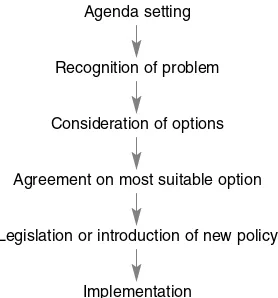
Many models of policy making have assumed or implied that there is a clear sequence of stages through which public policies proceed, and which therefore constitute the ‘policy process’. As Figure 1.1 illustrates, this ‘stagist’ version of the policy process starts with agenda setting, and then portrays policy proceeding through a logical sequence of stages: recognition of problem; consideration of options; agreement on most suitable option; legislation or introduction of new policy; and implementation.
Although there have been variations on this model, they have all reflected and rein-forced the notion that policies proceed through a sequential series of stages, and that there is a ‘policy process’ with a clear beginning, middle and end (although to be fair, revised versions of this model have sometimes added an ‘evaluation’ stage after implementation, which then feeds back to agenda setting).
One famous version of this ‘stagist’ approach was provided by David Easton’s wider notion of the political system, in which societal demands were processed inside the ‘black box’ of the political system, and then emerged as outputs in the form of allocation of resources, legislation and public programmes, as illustrated by Figure 1.2.
policy areas or subsystems. It does not disaggregate or distinguish between discrete areas of public policy, or convey the extent to which different policies will involve different policy actors and modes of interaction or influence. For example, the poor have generally had rather less input in shaping welfare policy than farmers have had in shaping postwar agricultural policy in Britain.
Consequently, the ‘stagist’ version of the policy process has been criticized for provid-ing an inaccurate account of how policies are ‘made’, because it depicts policy makprovid-ing as a linear process, with a clear beginning, middle and end. This sequential model, its critics argue, not only grossly oversimplifies the manner in which policies are apparently initi-ated, developed and implemented, but also fails, crucially, to explain howissues emerge, whysome enter the political system (but not others), howthey are ‘processed’ inside the ‘black box’ of the political system (and whois involved, and in whichrole or capacity), and why the policies (the outputs) subsequently encounter various difficulties, or enjoy varying degrees of success.
Agenda setting
Recognition of problem
Consideration of options
Agreement on most suitable option
Legislation or introduction of new policy
Implementation
Figure 1.1 The ‘stagist’ model of the policy process
Source: Adapted from Easton, 1965.
Figure 1.2 Simplified version of Easton’s model of the political system
Political System
Demands processed
+
Decisions taken
Outputs
Laws and policies
Authorities
Outputs applied to
society
Society
In short, the ‘stagist’ model can be criticized for failing to provide either a realistic or an explanatory account of policy making (for two examples of such criticism, see Jenkins-Smith and Sabatier, 1993: 3–4; John, 1998: 25–7). Sabatier especially emerged as a promi-nent critic of what he termed ‘the stages heuristic’ – or what Nakamura (1987) more prosaically called ‘the textbook approach’ – claiming that while it ‘served a useful purpose in the 1970s and early 1980s by dividing the very complex policy process into discrete stages’, subsequent research and analysis of policy making has exposed serious weak-nesses with the ‘stages heuristic’ model of the policy process.
Not least of these deficiencies, Sabatier (1999: 6–7)elaborates, are: its failure to provide causal accounts of policy development; the sequence of the stages is inaccurate or mis-leading, because the ‘first’ stage (agenda setting) is itself intimately and inextricably affected by other stages, such as the ‘final’ stage (evaluation); it reflects a rather legalistic or top-down approach to policy making, in which the focus often appears to be on legis-lation per se; it fails to distinguish between different types or aspects of public policy; it reflects an emphasis on government rather than the recent trend towards governance, involving different actors at different levels.
In similar vein, a former senior civil servant in the Department of Trade and Industry in the early 1990s, who also served in the Cabinet Office during the first Blair government, asks rhetorically: ‘What [policy] process?, emphasizing that:
The problem is that new policies, and policy decisions, can arise in, and are handled in, a multitude of different ways. But it is often possible to discern a number of separate stages, including research, consultation and gaining knowledge, exploring options, more consultation, and taking decisions through to Ministerial agreement. The individual stages do not operate sequentially, but overlap as policies become firmed up. (Stanley, 2000: 44)
Yet the ‘stagist’ model remains popular, and can still be defended, as a tool or starting point which can help us to understand some of the aspects of policy making. The fact that policy making is frequently complex or messy actually makes it even more useful to pro-vide a simplified model which identifies some of the constituent elements of ‘the policy process’, precisely so that the complex or messy reality can begin to be understood.
Indeed, the ‘stagist’ model has often been defended precisely on these grounds, namely that it is best understood as a ‘heuristic device’, rather than an accurate depiction of policy making in the real world. A ‘heuristic device’ is an analytical tool or pedagogic model – particularly in the social and political sciences – designed and deployed to aid under-standing (particularly for educational purposes) of an otherwise highly complex issue or process. In this context, characterizing the policy process as a series or sequence of stages ‘facilitates the understanding of public policy making by breaking the complexity of the process into a limited number of stages’, even though in the real world of day-to-day policy making ‘there is often no linear progression as conceived by the [stagist or sequen-tial] model’ (Howlett and Ramesh, 1995: 12).
identify how policy making in Britain enshrines various of the stages, even though overlap, are inextricably interlinked, and do not always occur in the sequential order which the ‘stages heuristic’ suggests.
For example, this book treats agenda setting and the role of ideas in a separate (and prior) chapter to those which examine the roles and relationships of the formal policy makers in the ‘core executive’ and how they formulate public policy, but we readily acknowledge that those inside the ‘black box’ of central or formal governmental institutions themselves sometimes shape the policy agenda, and promote influential ideas, rather than merely responding to them (as the sequential model clearly implies).