E-ISSN: 2347-5129 P-ISSN: 2394-0506
(ICV-Poland) Impact Value: 5.62 (GIF) Impact Factor: 0.549 IJFAS 2017; 5(3): 414-419 © 2017 IJFAS
www.fisheriesjournal.com Received: 23-03-2017 Accepted: 24-04-2017
Md. Abdus Samad
Associate Professor, Department of Fisheries, University of Rajshahi, Rajshahi, Bangladesh
Md. Mizanur Rahman
Department of Fisheries, University of Rajshahi, Rajshahi, Bangladesh
Alok Kumar Paul
Department of Fisheries, University of Rajshahi, Rajshahi, Bangladesh
Md. Abdur Rashid
Department of Fisheries, University of Rajshahi, Rajshahi, Bangladesh
Correspondence
Md. Abdus Samad
Associate Professor, Department of Fisheries, University of Rajshahi, Rajshahi, Bangladesh
Growth and production of riverine
Catla catla
(Hamilton, 1822) fry in pond habitat based on stocking
density
Md. Abdus Samad, Md. Mizanur Rahman, Alok Kumar Paul and
Md. Abdur Rashid
Abstract
The research work was conducted for 60 days in earthen ponds of Fisheries Department under the
University of Rajshahi to investigate fingerling production of riverine Catla, Catla catla (Hamilton,
1822) in pond habitat. The experiment was carried out under 3 treatments each with 3 replications. The
stocked fries (Catla catla) were collected from Padma River, Rajshahi. The stocking density was
maintained at 500/dec (T1), 450/dec (T2), and 400/dec (T3) respectively. Fishes were fed same diet in
three different treatments consisting of Fish meal (20%), rice bran (25%), wheat bran (25%) and mustard oil cake (30%) at the rate of 4-8% of body weight. The Physico-chemical characteristics of pond water were measured fortnightly. The mean values of some water quality parameters such as temperature (°C) were 31.301.29 (T1), 31.241.46 (T2), 31.361.29 (T3); dissolved oxygen (mg/l) 6.740.49 (T1),
6.970.63 (T2), 7.250.38 (T3); carbon dioxide (mg/l) 6.830.57 (T1), 6.360.68 (T2), 6.630.50 (T3) and
pH 7.070.22 (T1), 7.110.23 (T2), 7.460.08 (T3); transparency (cm) 40.190.23 (T1), 39.311.25 (T2),
40.831.34 (T3) respectively. The mean value of final fish weight (g) was 8.320.07 (T1), 9.560.10 (T2),
11.450.03 (T3). The specific growth rates (SGR) at 60 days were ranged from 4.6(T1) to 5.08(T3) in
different treatments during the experimental period. The survival rate ranged between 84 to 92%.
Treatment T2 and treatment T3 showed significantly higher survival than Treatment T1. The highest final
weight gain, survival rate and cost benefit ratio were found in T3 treatment. The production (kg/ha) of
Catla was 758.29kg (T1), 849.68kg (T2), 958.36kg (T3) respectively. The highest production was found in
T3. Among three treatments the production was very significant (p<0.05). The cost benefit ratio was for
(T1) 1:1.79, for (T2) 1:1.88 and for (T3) 1:2.19 respectively. The results of the present study indicate that
treatment T3 is better than treatment T1 and T2.
Keywords: Stocking density, fingerlings, production and Catla catla
Introduction
The spawn fishery in the different river system of Bangladesh plays a vital role in pond culture and is still considered as one of the important cash income of the fishermen. The Padma, the Brhamaputra and their tributaries and the Halda rivers are the main sources of spawn in Bangladesh (DOF, 2010) [1].
Previously seeds of catla used to be collected from the natural sources of river but because of large scale degradation of the breeding the natural supply of seeds has been drastically reduced and now about 90% of the total demand is being met from an estimated 800 hatcheries established under private and public sector in the country. Hatchery produced seeds do not grow as fast as the naturally collected seeds due to poor performance relating to inbreeding, negative selection, introgression etc. in the hatchery of Bangladesh (Shah, 2010) [2]
Development of suitable techniques of nursing and rearing of larvae is very important to ensure reliable and regular supply of fish fingerlings. Successful controlled method of fry nursing depends on a proper knowledge of nutritional and environmental requirement of the larvae in the aquatic ecosystem (Mollah, 1985) [3] Lack of proper care and understanding about
the biotic and abiotic factors in the rearing system may result in mass mortality of young fry (Jhingran and Pullin, 1985) [4].
Higher density of a species may affect the growth of another species. Similarly lower density of a species may reduce the overall production. Among the fish species that make up the backbone of the carp farming system in Bangladesh is Catla.
There should be a compatibility of species with diversified feeding habits that includes the whole range from omnivorous to macro-vegetation feeding fish species. The Indian major carp Catla have been characterized as surface plankton feeder
(Agrawal and Mitul, 1992) [5].
A number of studies have been performed on the effect of fertilizers (Nandeesha et al., 1984; Dhawan and Toor, 1989;
Varghese and Shankar and, 1981; Mitra et al., 1987) [6, 7, 8, 9]
on growth and production of carps and some on the effects of stocking density (Backiel and Le Cren 1967: Davis et al.,
1984; Haque et al., 1993) [10, 11, 12] on survival and growth of
fry and fingerlings in different environmental conditions at different geographical locations, the results of which varied from one experiment to another.
Catla is one of native fresh water fish in Bangladesh for which the development of controlled larval rearing procedures are needed for stock enhancement. Therefore, a suitable culture method for rearing of riverine Catla catla fry are very
important to ensure reliable and regular supply of fingerlings. Growth, survival and production of fingerlings in nursery ponds depend on quality fish fry and stocking density. The present experiment had been conducted to develop an optimum stocking density of Catla catla fry in nursery pond
management system. were similar in shape, depth, basin configuration including water supply facilities. The average area of the ponds was 0.8 decimal (0.0032 hector).
Pond preparation
All unwanted fishes and other predatory species were completely removed through repeated netting from the ponds and finally applying rotenone at the rate 20mg/deci/feet water depth. After soaking overnight lime was applied at the rate of 1 kg/decimal. One week after liming, the pond was manured with cow dung minimum 0.5 kg/deci and maximum 11 kg/deci with a mean valve of 5.37 4.74 kg/deci.
Collection and Stocking of fry
The hatchling of Catla catlamixed with some other species
were collected from Padma river near the Rajshahi area and nursing 3 weeks in nursery pond. The rearing ponds were stocked with the separated fries of Catla catla after three
weeks nursing for research purposes. The sizes of the stocked fires were 2.4±0.38 cm length and 0.60±0.04 g weight.
Use of supplementary feeds
Fries were fed three same type of supplemental feed for different treatment (T1, T2, and T3), such as Fish meal, rice
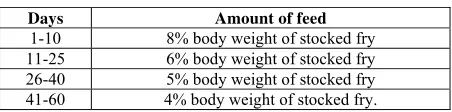
bran, wheat bran and Mustard oil cake at the rate of 4-8% body weight daily (Table-1 & 2).The proximate composition of each the feed were carried out in accordance with A.O.A.C method (1990) in table 3.
Table 1: Amount of supplementary feed
Days Amount of feed
1-10 8% body weight of stocked fry
11-25 6% body weight of stocked fry
26-40 5% body weight of stocked fry
41-60 4% body weight of stocked fry.
Table 2: Inclusion rate of supplementary feed used during the study pond.
Table 3: Composition of feed used in the experiments
Components Diets
* Nitrogen free extract (NFE) calculated as
100-% (Moisture + Crudeprotein+ Crudelipid+ CrudeFiber+ Ash)
Design of the experiment
Evaluation of fingerling production of catla in ponds, three treatments were used each with three replications. The experimental layout has been given in the Table-4 below:
Table 04: Design of the experiment
Treatment Species Feed Stocking density (piece/dec)
T1 Catlacatla 24.5% 500 (123500 fry/ha)
T2 Catlacatla 24.5% 450 (111150 fry/ha))
T3 Catlacatla 24.5% 400 ((98800 fry/ha)
Water Quality parameters
Physico-chemical paremeters like water temperature (ºC), transparency (cm), dissolved oxygen (mg/l), Carbon dioxide (mg/l), NH3-N (mg/l), pH, alkalinity (mg/l) of each
experiment pond were measured at 15 days interval and data were recorded on sampling dates. Temperature was recorded using a Celsius thermometer, transparency by secchi disc and other chemical parameters were using Hack kit box (FF2, USA). Recording of water quality data were taken between 8:00 am and 9:00 am.
Growth parameters
The length gain (cm), weight gain (gm) and Survival rate was measured into the following formula used-
Length gain (cm) = Average final length – Average
pond was counted separately for calculation of survival rate.
Yield (kg/deci): Yield was calculated by deducting
biomass at stock from biomass at harvest and it was expressed as kg/deci.
Specific growth rate (SGR, % bwd-1)
Specific growth rate (SGR, % bwd-1) was calculated as-[Ln
(final weight) – (initial weight)] / culture period (day) 100 (Brown, 1957) [13].
Statistical Analysis
The length gain (cm), weight gain (g), Final length gain (cm), Final weight gain (g) and survival rate of fry during experimental period with same feeding & fertilization in different treatments were all tested using one way analysis of variance (ANOVA). Significant results (P<0.05) were further
tested using Duncan’s New Multiple Range Test (DMRT) to identify significant differences among means. This statistical
analysis was performed with the support of the computer software SPSS (Statistical package for social sciences) program.
Results
Water quality parameters were monitored fortnightly. Water temperature, water transparency, dissolved oxygen, pH, Carbon dioxide of water varied from 31.241.46 to 31.301.29 ºC, 39.311.25 to 40.831.34 cm, 6.740.49 to 7.250.38 mg/l, 7.070.22 to7.460.08, 6.360.68 to 6.830.57 mg/l respectively. Among all the water quality parameters in three different treatments were not significant. Variation in the mean values of water quality parameters in three different treatments are shown in Table 5.
Table 5: Average water quality parameters under different treatments during the study period
Treatments / Parameters T1 T2 T3
Temperature (°C) 31.30±1.29a 31.24±1.46a 31.36±1.29a
DO (mg/l) 6.74±0.49a 6.97±0.63a 7.25±0.38a
CO2 (mg/l) 6.83±0.57a 6.36±0.68a 6.63±0.50a
pH 7.07±0.22a 7.11±0.23a 7.46±0.08a
Transparency (cm) 40.19±0.23a 39.31±1.25a 40.83±1.34a
Figures in a row bearing common letter do not differ significantly (p<0.05)
Growth performance of fry in rearing pond during 60 days of rearing
For the evaluation of growth performance of fish in different treatments in terms of final weight, mean weight gain, specific growth rate (%,bwd-1), survival rate (%) and
production (Kg/ha /60 days) were calculated and shown in table 06. In the present experiment there was no significant (P0.05) difference in initial weight of fish under different
treatments. The average final weights were 10.32±0.07, 11.56±0.10and 13.45±0.03in T1, T2 and T3 respectively.
Weight increments were statistically significant among the treatments. The highest weight gain were observed in T3(12.85±0.06a)and lowest in T1(9.72±0.03a). Similarly, The
highest growths in length were noticed in T3 (8.49±0.31cm)
and the lowest in T3 (7.93±0.45cm). The recorded mean
specific growth rate after 60 days of experiment of treatments T1, T2 and T3 were 3.57±0.06, 3.35±0.01 and 3.20±0.009
(Table 6) respectively, which were significantly (P<0.05)
different among the treatments. The significantly (P<0.05)
highest SGR (%, bwd-1) value 5.08±0.09 was recorded
treatment T3 while the lowest 4.6±0.05 was obtained in T3.
The survival rate (%) in different treatments was fairly high. The survival rate (%) during the study period were 79.75±0.25%, 85.13±0.88 and 89.63±2.38% in the T1, T2 and
T3 respectively, which were significant different (P>0.005)
among the treatments. The production of Catla catla ranged
between 958.36kg (T3) to 758.29kg (T1) kg/ha/60days in
different treatments (Table 6). Significant differences were found among three treatments when compared using ANOVA (P<0.05).
Table 06: Growth performance of Catla catla fries of three different treatments after 60 days.
Growth parameters Treatments
T1 T2 T3
Initial weight(g) 0.60±0.04a 0.60±0.04a 0.60±0.04a
Weight gain (g) 9.72±0.03c 10.96±0.06b 12.85±0.06a
Initial length(cm) 2.4±0.38a 2.4±0.38a 2.4±0.38a
Length gain (cm) 7.93±0.45b 7.84±0.36b 8.49±0.31a
SGR 4.6±0.05b 4.8±0.1b 5.08±0.09a
Final weight (g) 10.32±0.07c 11.56±0.10b 13.45±0.03a
Final length (cm) 10.34±0.03b 10.24±0.02b 10.89±0.07a
Survival rate (%) 79.75±0.25b 85.13±0.88ab 89.63±2.38a
Yield (kg/dec) 3550g/3.07kg 3796g/3.44kg 3741g/3.88kg
Yield (kg/ha) 758.29kgc 849.68kgb 958.36kg a
Figures in a row bearing common letter do not differ significantly (p<0.05)
Cost Benefit Analysis
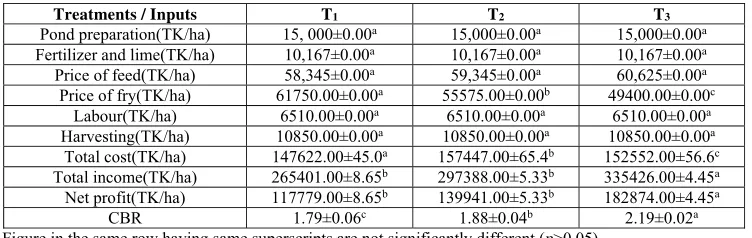
The cost of production was based on the local wholesale market price of the inputs. The cost of leasing ponds was not included in the total cost. The cost of different inputs and economic return from the sale of fishes in different treatments are summarized in the table 7. The total cost of inputs and profit hectare-1 were significantly different (P˂0.05) among
the treatments. The cost of input was lowest inT1and highest
in T2. The net profit (TK/ha) was the highest in
182874.00±4.45 (T3) and the lowest in 117779.00±8.65 (T1),
Table 7: Cost-benefit analysis of Catla catla (during 60 days) in rearing system under different treatments
Treatments / Inputs T1 T2 T3
Pond preparation(TK/ha) 15, 000±0.00a 15,000±0.00a 15,000±0.00a
Fertilizer and lime(TK/ha) 10,167±0.00a 10,167±0.00a 10,167±0.00a
Price of feed(TK/ha) 58,345±0.00a 59,345±0.00a 60,625±0.00a
Price of fry(TK/ha) 61750.00±0.00a 55575.00±0.00b 49400.00±0.00c
Labour(TK/ha) 6510.00±0.00a 6510.00±0.00a 6510.00±0.00a
Harvesting(TK/ha) 10850.00±0.00a 10850.00±0.00a 10850.00±0.00a
Total cost(TK/ha) 147622.00±45.0a 157447.00±65.4b 152552.00±56.6c
Total income(TK/ha) 265401.00±8.65b 297388.00±5.33b 335426.00±4.45a
Net profit(TK/ha) 117779.00±8.65b 139941.00±5.33b 182874.00±4.45a
CBR 1.79±0.06c 1.88±0.04b 2.19±0.02a
Figure in the same row having same superscripts are not significantly different (p>0.05)
Discussion
Water quality parameters
Growth, feed efficiency and feed consumption of fishes are normally governed by a few environmental factors (Fry, 1971) [14]. Quality of experimental water remained favorable
for fish growth throughout the experimental period. In the present study the average temperature recorded was 31.301.29 (T1), 31.241.46 (T2) and 31.361.29 (T3)
respectively. Ali et al., (1982) [15] observed temperature range
of 25-35.5°C in pond water. DoF (2008) [16] recorded suitable
temperature ranges at 26-32.44°C in pond water for Carp fish culture in Bangladesh. These finding are also more or less similar from of the present study.
pH is considered as an important factor in fish culture. It indicates the acidity or alkalinity condition of a water body. The pH value of the experimental ponds were recorded as 7.070.22 (T1), 7.110.23(T2), 7.460.08 (T3) respectively.
According to Swingle (1957) [17] pH 6.5 to 9.0 is suitable for
pond fish culture and pH more than 9.5 is unsuitable because free CO2 is not available in this situation. The optimum pH
range for carp poly culture in pond is 6.5-9.0 (Dewan et al.,
1991; and Wahab et al., 1994, DOF (2008) [18, 19, 16] recorded
suitable pH ranges 5.66-7.44 in pond water. These findings are also more or less similar for catla fry in pond habitat. Dissolved oxygen (DO, mg/l) is another important water quality parameter responsible for normal living of aquatic organisms. In the present study, the ranges of dissolved oxygen in different treatments varied from 6.750.49 (T1),
6.970.63 (T2), 7.250.38 (T3) respectively. Nirod (1997) [21]
recorded dissolved oxygen from 3.4 to 8.97 mg/l and Paul (1998) [22] found dissolved oxygen 0.8 to 7.85 mg/l, while
Kohinoor (2000) [23] measured dissolved oxygen 2 to 7.4 mg/l
in the research ponds of BAU campus, Mymensingh. So, the level of dissolved oxygen was within the acceptable range in all experimental ponds.
The recorded carbon dioxide among three treatments were 6.830.57 (T1), 6.360.68 (T2), 6.630.50 (T3) respectively.
DOF (2008) [16] recorded free C02 level of 1.04 - 29.49 mg/1.
From the above findings, it is concluded that the carbon dioxide content of the experimental ponds was within the good productive range. Transparency ranged from 39.31 to 40.83 cm which was near the findings of Kohinoor (2000) [23]
who recorded transparency values ranging from 15 to 58 cm. Wahab et al. (1994) [19] found transparency depth ranging
from 5-75 cm in polyculture pond. The observed range of water transparency was more or less similar with the findings of Wahab et al. (1995) and Paul (1998) [20, 22].
Growth performance of Catla fry
Growth in terms of length gain and mean weight gain of Catla
was significantly higher in T3 where the stocking density was
low compared to the treatments of T2 andT1.The present result
coincide with the finding of Haque et al. (1993) [12] who
carried out an experiment on the effect of stocking densities in six nursery ponds and achieved best growth at lower stocking densities in Labeo rohita and Cirrhina mrigala. DoF (2010) [1]
observed the daily average weight gain of catla 0.391 g/day with mixture of rice bran and mustard oil cake (1:1) as supplemental feed fed at the rate 5% of total fish body weight daily. These findings are more or less similar from the present study. The highest SGR value was found at T3 and lowest was
observed at T1.The lowest stocking densities provide more
space, food and less competition, which were reported by various authors like Ahmed (1982) [24], Hasan et al. (1982) [25]
and Haque et al. (1984) [26].
The survival rates of three different treatments of Catla were
79.75% (T1), 85.13% (T1), and 89.63% (T3) respectively after
rate of all fish including Thai sarpunti was higher than 80.0% in polyculture with native major carps. Kohinoor et al. (1993)
[28] reported the the survival rate of Thai sarpunti ranged from
86.0% to 94% in monoculture system. The findings of the previous studies indicate that survival rate of Catla was more or les similar to this study.
Among three treatments, the production of Catla 3.320.20
kg/dec (T1), 3.660.04 kg/dec (T2), 4.100.12 kg/dec (T3)
respectively. Among three treatments the highest production was observed in T3 followed by T2 and T1. Lakshmanan et al.
(1971) [29] presented that the fish were fed a mixture of
mustard oilcake and rice bran. Fish production were in the range of 2230 to 4209 kg/ha/yr. Fry production from Hossain
et al., (1997) [30] obtained a yield of 3.64-9.91 kg/deci with 80
days from 3 seasonal nursery ponds with supplemented feeding. Boyd (1990) [31] suggested that feeding of carp with
mixture of oilcake and rice bran 1:1 for better production. Uddin et al. (1994) [32] found a gross production of 3415
kg/ha/yr (ca. 2277 kg/ha/8 mo) from polyculture of carps with Thai sharpunti. The results in the present experiment are very close to those of Saha et al. (1988) [2] who obtained a gross
production of 1385.15 to 1995.60 kg ha-1 by 8 weeks rearing of rohu (Labeo rohita) fingerlings at 0.6 to 0.8 million ha-1
stocking densities. Rahman et al. (2003) [33] also found
local sharpunti (Puntius sarana) hatchlings at stocking
densities of 1.25 to 1.75 million ha-1. Similar to the present
study, Rahman et al. (2003) [33] obtained a production of
1869.1 kg ha-1 by rearing of Labeo calbasu fingerlings for 8
weeks at a stocking density of 0.8 million hatchlings ha-1.
Significantly higher numbers of fingerlings were produced in T3 where the stocking density was higher than those in T2 and
T1.The total production of Catla obtained from this study were
lower than those of the above studies. The reason behind this might be because of fry rearing of Catla in nursery rearing in ponds.
The cost benefit analysis indicated that the net profit and CBR was the highest in T3 followed by T2 and T1, because weight
gain, survival and production of fishes were higher in T3 than
those obtained in other treatments. Kohinoor et al. (1999) [34]
reported a net benefit of Tk. 69750-73480/ha/6 month from polyculture of Thai sarpunti, Mirror carp and Silver carp fed with low cost feed. These findings are more or less similar vary from the present study.
Conclusion
From the study, it is clear that the higher growth and survival
of Catla fingerling was found in lower stocking density (T3).
Finally it can be said that, to increase riverine carp fingerlings
(Catla) production, the riverine fingerling production based
research should be developed for inbreeding depression free indigenous catla stock and also for higher production of grow-out farmers.
Acknowledgement
The authors are thankful to Department of Fisheries, University of Rajshahi, Bangladesh for the facility and infrastructure provided to carry out this research work.
Reference
1. DoF. Jatio Matshaw Saptah. Department of Fisheries. 2010, 104-108.
2. Shah MS. Genetics of Aquaculture and Fisheries Management. 1st Edition.Fisheries and Marine resources
technology Discipline, Khulna University, Khulna. 2010, 269. Manila, The Phillippines. 1985, 37-40.
5. Agrawal N, Mitul AK. Structural organization histochemistry of the epithelia of lips and associated structure of a common Indian carp, Cirrhinu mrigala.
Can. Journal of Zoology. 1992; 70:71-78.
6. Nandeesha MC, Keshavanath P, Denesh KR. Effects of three organic manures on plankton production in fish ponds. Environ. Ecology. 1984; 2(4):311-318.
7. Dhawan A, Toor HS. Impact of organic manures or supplementary diet on plankton production and growth and fecundity of an Indian major carps, Cirrhinus
mrigala (Ham.) in fish ponds, Biological Wastes. 1989;
29:289-297.
8. Varghese TJ, Shankar KM. A review of fertilization experiments conducted at the college of Fisheries. Bangalore. Proceedings of the seminar oil some aspects of Inland Aquaculture in Karnataka. University of
Agricultural Sciences. 1981, 67-70.
9. Mitra B, Gupta A, Laka UK. Effects of some manures on the growth and production of major carps in village ponds of district Birbhum, West Bengal, Environ. Ecology. 1987; 5:381-385.
10. Backiel T, Le Cren ED. Some density relationship for fish population parameters. In: S.D. Gerkings (Editor). The Biological Basic, of Freshwater Fish Populations. Blackwell Scientific Publication’s. Oxford. 1967, 261-293.
11. Davis GH, Bhuiyan AR, Ammen M. Fish production in managed farmers ponds with different feeding and stocking regimes. Proceedings of the 7th seminar on
maximum livestock production from minimum land. Department of Animal Science, BAU, Mymensingh. 1984, 111-129. Academic press, New York. 1957, 361-400.
14. Fry FEJ. The effect of environmental factors on the physiology of fish. In: W.S. Hoar & D.J. Randall (ed.) Fish Physiology, Academic Press, New York, 1971; 6:1-98.
15. Ali S, Ataur Rahman AK, Patwart AK, Islam KHR. Studies on the diurnal variations in physicochemical factors and zooplankton in a fresh water pond. Bangladesh. Journal of Fish. 1982; 2-5(1-2):15-23. 16. DoF, Matsha Pakkah Shankalan. Department of
Fisheries, Ministry of Fisheries and Livestock, Government of the Peoples Republic of Bangladesh. 2008, 79-81.
17. Swingle HS. Standardization of chemical analysis for waters and pond muds. FAO fish Report. 1957; 4(4):397-421.
18. Dewan D, Wahab MA, Beveridge MCM, Rahman MH, Sarkar BK. Food selection, electivity and dietary overlap among planktivorous Chinese and Indian major carp fry and fingerlings grown in extensively managed, rainfed pond in Bangladesh. Aquaculture and Fisheries Management. 1991;22:277-294.
19. Wahab Jiqiao, Xia Xuewen, Zhang Quinjie. A research on rearing of common carp, bighead carp and grass carp fry by natural food. (In Chinese). J. Dalian Fish. Coll. Dalian Shuichan Xueyuan Xuebao. 1994; 7(2/3): 65-71.
20. Wahab MA, Ahmed ZF, Islam MA, Rahmatullah SM. Effect of introduction of commoncarp, Cyprinus carpio
(L) on the pond ecology andgrowth of fish in polyculture. Aquculture Research. 1995; 26:619-628.
21. Nirod DB. Effect of stocking density on the growth and production of mola (Amblypharyngodon mola). M.S.
Thesis, Department of Fisheries Management, BAU, Mymensingh. 1997, 75.
22. Paul S. Comparison between carp polyculture system with silver carp (Hypophthalmichthys molitrix) and with
small indigenous fish mola (Amblypharyngodon mola).
MS Thesis, Department of Fisheries Management, Bangladesh Agricultural University, Mymensingh. 1998, 85.
23. Kohinoor AHM, Haque MZ, Hussain MG, Gupta MV. Growth and survival of Labeorohita, Labeobata spawn in
Bangladesh, Sci. 2000; 20(1):65-72.
24. Ahmed GU. Intensive culture of Labeo rohita (Hamilton)
in floating ponds with special reference to different stocking. M.Sc. Thesis. Department of Fisheries Biology and Limnology. Bangladesh Agricultural University, Mymensingh. 1982, 38.
25. Hasan MR, Aminul Haque AKM, Islam MA, Khan EUK. Studies on the effect of stocking density on the growth Nile tilapia, Saratherodon nilotica (Linnaeus) in floating
ponds. Bangladesh Journal of Fisheries. 1982; 2(5):73-81.
26. Haque MM, Islam MA, Ahmed GU, Haq MS. Intensive culture of Java Tilapia (Oreochromis mossambicus) in
floating ponds at different stocking densities. Bangladesh Journal of Fisheries. 1984; 7(1-2):55-59.
27. DoF. (Department of Fisheries) JatioMatshawSaptah,
Department of Fisheries. 2005, 107.
28. Kohinoor AHM, Akhteruzzaman M, Shah MS. On the production of Puntius gonionotus (Bleeker) in ponds.
Bangladesh Journal of Zoology. 1993; 21(2):77-83. 29. Lakshmanan MAV, Sukumaran KK, Murty DS,
Chakraborty DP, Philipose MR. Preliminary observations on the intensive fish fanning in fresh-water ponds by the composite culture of indian and exotic species. Journal of Inland. Fish. Soc. India. 1971; 3:1-21.
30. Hussain MS. Analysis of experimental data on the spawning of carp in the Panjab. Proc.Nat. Inst. Sci. India. 1997;11(3):320-324.
31. Bhuiyan AS, Musa ASM, Islam MK. Hatchery Management in Bangladesh. Rajshahi University Journal of Zoology. 2008; 12:20-23.
32. Uddin MS, Miah MS, Alam MS. Study on production optimization through polyculture of indigenous and exotic carps. Bangladesh Journal of Training and Development. 1994; 7(2):67-72.
33. Rahman MA, Rahman MR. Studies on the growth and survival of sharpunti (Puntius sarana Ham.) spawn at
different stocking densities in single stage nursing. Progressive Agriculture. 2003; 14(1-2):109-116.
34. Kohinoor AHM, Islam MS, Begum N, Hussain MG. Production of Thai harpunti (Puntius gonionotus) in