1
Indonesia’s Movie Industry: Impediments to
Growth
by Titik Anas, Haryo Aswicahyono and Dandy Rafitrandi
This Policy Research Paper was prepared for the Indonesia Services Dialogue under the USAID-SEADI project.
Industry in Reborn
The Indonesian film industry is an industry in reborn. It was barely non-existence in the early 2000 as there were only 4 movies produced at that time (Figure 2). The past ten years shows a gradual increase in movie production. However, the growth remains suboptimal. As a way of comparison, in 2011, while local movies were only 82 titles, the total number of imported movies was about 168 titles.
Figure 1. Movies Production in Indonesia
2 The economic contribution of the industry is small, about Rp.27trillion (US$2.98bn) to GDP, absorbed 491,800 of employments and contributed about Rp.2.8trillion (US$310m) to the government’s tax revenue. Although its economic contribution is small, the movie industry has potential to grow. The demand for movies, including local movies increased as income increase. Indonesia, with its growing middle class is a potential movie market. However, the sector has not grown to its potential. Ministry of Tourism and Creative Economy (2012) shows that in the past 10 years, the sector exhibited a 2.5 percent annual growth, below average growth of the creative industries. What are any impediments to growth of this industry?
Impediments to Growth
3
Figure 2.Value Chain of A Movie Industry
Based on literature survey and field survey, we found that the impediments to growth of the industry are found in a few difference stages of production of a movie: development stage, production stage, post-production stage as well as at the distribution and exhibition stages. On the development stage, we found that the impediment is the human capital, i.e. a shortage of scriptwriters. The shortage is due to the competition with TV industry while the supply of such talents is limited. In the production stage, the impediment is non-standardized specific skills, like directors. Once again, the growing demand for such talents is not supported by its supply. In the post-production stage, Indonesia has inadequate supporting industry for producing high quality movie, such as post-production laboratory. Local movie producers often have to perform the post-production process, coloring and sound effect mixing in particular in Hongkong, Thailand and other countries.
4
Figure 3. Movie Theaters Distribution
Source. Ministry of Tourism and Creative Economy (2012)
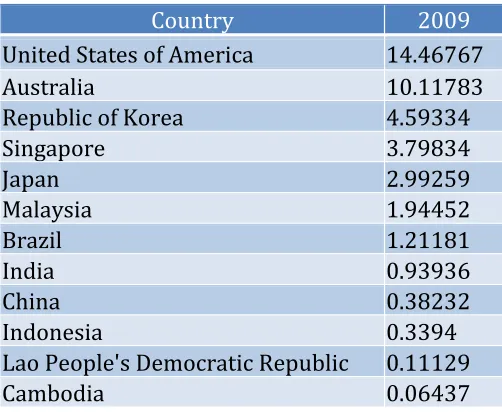
The relatively shortage of movie theater in Indonesia is evidence. Table 1 show that Indonesia has 3 screens per 1 million populations, much lower compared to the United States or Australia, which have about 144 screens and 101 screens per 1 million populations respectively.
Table 1. Screen per capita (per 100000 inhabitants)
Country 2009
United States of America 14.46767
Australia 10.11783
Lao People's Democratic Republic 0.11129
Cambodia 0.06437
Source: UNESCO
Investment in the cinema screens is relatively capital intensive. As a way of illustration, an investment of one screening room in a movie theater is about US$2 bn. Besides, particularly for Indonesia, the investment in the movie theater is also high risk due to the limited supply of local film local investors while the
5 distribution rights of Hollywood movie in particular is under the hand of one business entity which has affiliation with the major cinema chain.
Meanwhile, big foreign investors is restricted by )ndonesia’s negative list of investment (Daftar Negative Investasi) limiting the entry of foreign investment. Table 2 shows that film studio, film processing laboratory, film dub facilities, film printing and/or duplication, film-editing facility, film subtitling facilities are open for foreign direct investment. Meanwhile filmmaking, film distribution and viewing (movie theater) are closed for foreign investments.
Table 2. Negative List of Investment
No Business field Condition
1 Film Technique Service
Film Taking Studio Foreign Capital Ownership maximum
49%
Film Processing Laboratory Foreign Capital Ownership maximum 49%
Fill Dubbing Facility Foreign Capital Ownership maximum 49%
Film Printing and/or Duplication Foreign Capital Ownership maximum 49%
Film editing facility Foreign Capital Ownership maximum 49%
Film subtitling facility Foreign Capital Ownership maximum 49%
2 Film Making 100% local capital
3 Film Distribution (export, import and
distribution) 100% local capital
4 Viewing: movie theatre 100% local capital
5
Film promotional facility (advertisement, poster, stills, photo, slide, negative, banner, pamphlet, giant banner, folder, etc)
100% local capital
Source. Perpres 36/2010
6 be lowered or even eliminated. However, CSIS (2012) shows that taxes on film industry is relatively small compare to other expenses and only has effect approximately 10% of the total cost (Figure 4). Given the complexities of )ndonesia’s tax system, CS)S recommends the relevant ministries to develop tax guide for movie producers and tax compliance assistance, particularly the small ones to avoid confusion in complying with the tax regulation.
Figure 4. Taxation in Film Industry
Source: CSIS (2012)
Conclusion and Policy Recommendation
Short-7 term trainings on specific skills will also be beneficial to improve the capacity and skills of local providers. Second, to provide a more transparent and user-friendly custom procedures relevant to movie processing overseas. Given that economic scale of specific postproduction facilities are not there yet, the easiness to do post-production overseas are needed. Third, ease of entry for investment in postproduction, including foreign investment are needed. Fourth, lifting up the restriction on foreign investment in movie theaters will increase the screen per population ratio in Indonesia, which will consequently increase public access to movie screening. Fifth, lifting up the restriction on foreign investment in movie distribution, including export and import will provide room for more players and allow synergies between domestic and international players. Sixth, A more flexible arrangement which allow co-production between local movie makers and foreign movie makers will expose the industry to international best practice which might accelerate the growth of the industry. Last but not least, providing tax guide for movie producers and tax compliance assistance, particularly the small ones to avoid confusion in complying with the tax regulation.
References
CSIS (2012), Studi Fiskal Perfilman Indonesia, Laporan untuk Kementerian Pariwisata dan Ekonomi Kreatif
Ministry of Tourism and Creative Economy, 2012b, Perkembangan Industri Film Indonesia, 2012