FORMS OF RESISTANCE AGAINST THE
CAPITALIST DISCIPLINE:
FEMALE FACTORY WORKERS IN BATAM
SITI NURAIDAH BT. ABDUL RAHMAN
(B.Soc.Sci. (Hons.), NUS
A THESIS SUBMITTED
FOR THE DEGREE OF MASTER OF
SOCIAL SCIENCES
DEPARTMENT OF SOCIOLOGY
NATIONAL UNIVERSITY OF SINGAPORE
! " # $%& '
'
( &
)
* *
+
,
-."
# / +
& ( & $
# &
0
&
&
&
&
+
*
. /
+
-4 /
-. /
+
0
->
- #
H
&
G
&
G
'
Chapter 1: Introduction
Feminization of labour, gendered jobs and social change
Batam, an island of 415 sq km, is situated in the north-west of Indonesia.
Located about 21 km away from Singapore, it is approximately two-thirds the
size of its neighbour with a population of only 155,000 people (Royle, 1997).
This Singapore-Indonesian border zone became a centre of activity in the
early 1990s as both countries strengthened their bilateral ties, with Singapore
helping to direct western transnational corporation investments to Batam,
especially towards the manufacturing sector, at a time of rapid change in
Indonesia as it strove to modernize its economy, moving towards
industrialization. In exchange, Singapore retains an important role for its own
firms in the provision of management and administrative functions, as it has
Figure 1.1: Singapore and the Riau Islands (Grundy-Warr et al, 1999)
Batam‘s designation as a Free Trade Zone (FTZ) or Export Processing Zone
(EPZ) attracted TNC investments which created thousands of jobs as they set
up their factories in its industrial estates. Mack (2004) argues that in areas
legally cordoned off from the host nation, EPZs offer conditions which are
parts and export of finished products, to structures that allow companies to
avoid restrictive labour legislation. EPZs treat ‗labour‘ as a generic component
and in their bid to attract investment, host countries may even restrict the
autonomy of workers by employing strict legislation against unionization.
Part of the marketed image of an EPZ rests on its ―docile‖ and ―nimble-fingered‖ female labourers, universally considered to be more desirable employees than men. Generally recruited from rural, agricultural backgrounds, these young (and usually unmarried) women are classified as ―unskilled‖, and thus easily replaceable.
(Mack, 2004: 157)
Why did the manufacturing of labour-intensive consumer goods pass into the
hands of developing countries in Asia? Also, how did feminization of labour
especially in the manufacturing sector of EPZs occur? The main argument
accounting for the proliferation of female factory workers is that they are a
source of cheap labour. This rests upon various assumptions: firstly, society is
organized upon the patriarchal order where men are seen to be the main
breadwinners. When women did enter formal employment, an unequal pay
structure was established according to the notion that men‘s wages must
support a family while wage-earning women are partly supported by men or at
least have only themselves to support. Secondly, the jobs that the women
entered are poorly compensated compared to the jobs that men entered as
women are seen to be doing work that is of a lower order, performing tasks
such as sewing, that they would have performed while maintaining the
monetarily, similar work in the formal sector is poorly recompensed (Kaur,
1998). These arguments will be revisited and critiqued in later chapters.
The Argument in Brief
This thesis aims to deconstruct gender and sexuality with regard to female
migrant factory workers in Batam by acknowledging the discursive formation
of gender, which affects ‗doing gender‘ when dealing with the issue of women
and work. The thesis is largely centred on the theme of gendered work and
labour control. Firstly, based in a literature review, I summarize and argue that
the feminization of labour in Indonesia is facilitated by institutions at three
different levels: the state‘s ideology on labour as well as its discourse on
women, gendered recruitment practices at the factory level, as well as supply
factors that mobilize women that make them appealing towards employers as
ideal workers. In the above analysis, I take on the Foucauldian view that
‗discourse‘ produces its subjects, and also discuss how gendered subjects are
constructed relationally through discourse, where male and female workers
are produced relationally through a series of binary oppositions. To capture
this idea, I will illustrate how the Indonesian discourse on women, via the
kodrat filters affects the management discourse on recruitment practices. My
interviews with various factory managers show that the management
themselves have internalized taken-for-granted notions that there are certain
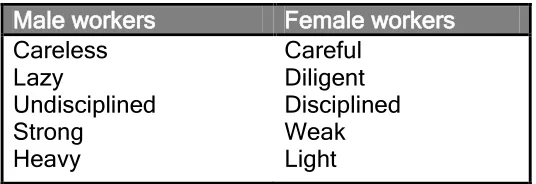
innate traits that women possess that make them ideal factory workers –
carried out by women; as compared to men who are careless, lazy, and
undisciplined. What then are the implications of such stereotypes? Secondly, I
will highlight how these women, despite being stereotyped by their employers
as docile, empower themselves by employing various techniques of
resistance against the subordinating powers of the capitalist discipline. Such
techniques range from decreasing their productivity or declining to perform
overtime hours, to mass absenteeism, and lastly being on strike. How then do
these techniques relate to the women‘s autonomy and agency?
Methodology
I shall begin with a wide literature review of key works by various authors on
themes such as -- feminization of global manufacturing (Saptari, 2000; Kaur,
2004; Caraway, 2007), industrialization in Indonesia (Royle, 1997), gender
and migration (Chant & Radcliffe, 1992; Mahler & Pessar, 2006), female
migration in Indonesia (Hugo, 1992; Elmhirst, 2002), the construction of
feminine subjects in Indonesia (Sears, 1996; Tiwon, 1996; Devasahayam et
al, 2004) and also women and factory work in Indonesia (Ong, 1987; Wolf,
1992; Tjandraningsih, 2000; Mack, 2004; Ford & Lyons, 2006; Warouw, 2008;
Ford & Parker, 2008).
As part of my fieldwork, I conducted qualitative interviews with five
managers of five different factories on Batam, and posed them questions on
policies, remuneration packages and the working conditions of their workers.
Their factories varied in terms of production, ranging from electronic products
such as semiconductors and television tuners to garments and also checking
finished products for quality control. My informants told me that a high
proportion of their workers, almost 80 per cent of their production operators,
are females. Managers also revealed that their workers may sometimes show
signs of dissatisfaction with the management, mainly due to salary issues.
These issues will be further discussed in my paper.
Interviews were also conducted with several female factory workers in
the same factory, PT Permata, a Japanese firm which manufactures hard
disks for electronic devices, PT Permata and themes centred upon their
migratory experience and dormitory life emerged.
Theoretical Apparatus
One of the first issues when considering the topic is to deconstruct gender
and gender identity with regards to work and labour control. Mahler & Pessar
(2006) offers a very succinct definition of approaching gender as a subject
under scrutiny:
perspective wherein gender identities, relations, and ideologies are fluid, not fixed.
(Mahler & Passer, 2006: 29)
Therefore, in relation to my research topic, an omnipresent fact of industrial
life is the categorization of jobs in factories as ―men‘s work‖ and ―women‘s
work‖, since men and women seldom do the same jobs. Often, the literature
suggests that such profound gender segregation is rooted in the gendered
discourse of work. This research is guided by Caraway‘s (2007) conception of
‗gendered discourses of work‘. Caraway argues that ‗the gendered worker on
the shop floor is created in part through the discourses produced by the
management about gendered workers‘.
From a Foucauldian perspective the issue is not whether the women are patient, disciplined, and diligent but that the subject of the woman worker as patient, disciplined, and diligent worker is produced through discourse.
(Caraway, 2007: 30)
Post-structural feminists have called for special attention to be paid to how
gendered subjects are created relationally through discourse: the
dichotomous relations between male and female workers. This view is
reproduced several times in most of the works that I reviewed on women and
factory work. Therefore, this research is very much guided by Caraway‘s tool
of inquiry, where she adopted a ‗syncretic conceptualization of gendered
discourses of work‘ combining Foucault‘s (1990) conception of discourse and
Connell‘s (1987) praxis-oriented perspective and poststructuralist feminist
Research Findings and Plan of the Thesis
Chapter 2 attunes the reader to the historical emergence of Indonesia‘s export
oriented industrialization strategy and how this has affected labour patterns.
Indonesia was described in the 1960s as being one of the least industrialized
countries in the world for its size (Hill, 1990) and the manufacturing sector
only totalled an estimate of 840,000 workers in 1971. During the 1980s,
however, due to trade liberalization and deregulation policies, Indonesia
moved from being a negligible exporter of manufactures to a significant
supplier. Statistics show that in 1980, manufactures generated less than 3
percent of total exports; however by 1992 they were nearly 50 percent (Hill,
1996:810). This expansion was facilitated by a series of trade reforms, during
the New Order years of 1966 to 1997/8. Indonesia moved away from a
protectionist strategy of protecting its domestic market and towards an export
oriented industrialization (EOI) strategy as the country, which is a major oil
exporter, coped with the collapse of the price of oil. This chapter highlights
Indonesia‘s rise as an export manufacturer and the concomitant effects on the
changes in labour structure i.e. – the feminization of labour and its resultant
effects, such as the patterns of migration and concerns on exploitative nature
of female factory work.
This chapter also later highlights how Batam features as part of
(FDI) as an export processing zone (or also called ‗bonded zone‘ by
commentators on the Indonesian economy) in order to leverage on its
comparative advantage in export manufacturing. Since this research is largely
centred on themes of gendered work and labour control, this chapter also
reviews the feminist literature on women‘s work in export processing zones
and highlights the waves of feminization of the manufacturing industry as
posited by Caraway (2007).
Chapters 3, 4, and 5 turn attention to an in-depth analysis of the case
in point, Batam, specifically on, BatamIndo Industrial Park. Chapter 3 outlines
the profile of factory workers in the manufacturing sector, who are mostly
young, single females, between the ages of 18-22. Based on my in-depth field
interviews with the women, they relate to me their migratory experience and
the anxieties that they face as well as how they cope with and mitigate these
anxieties. I argue that based on the everyday experiences that these women
share as a community of migrant workers, it allows them to create and share a
‗structure of feeling‘ where they create their own identity via their own feelings
and emotions. Examples of such feelings are bareng (togetherness),
kebebasan (freedom) and kangen (homesickness) and these women cope
with these anxieties by being each other‘s social support system.
Chapter 4 demonstrates the importance of bringing gender to the core
and not to fall simply into the trap of tokenism when discussing gender by
concept of the gendered discourses of work is introduced to show how this
leads to gendered outcomes, as again portrayed by Caraway, as this is
pivotal towards the understanding of women and labour in factories.
Therefore, before we can see the effects of industrialization on work and
labour control, we must firstly explore the very operation of gender and
explore how it is articulated with other axes of differentiation in complex ways.
I argue that the stereotypical, gendered image of the nimble-fingered, docile
female worker is articulated at different levels, Firstly, the ideological level of
the state‘s discourse on gender via the notion of kodrat wanita (women‘s
nature). This section will highlight the Indonesian discourse on gender as
posited by scholars such as Suryakusuma (1987), Blackwood (1995), Tiwon
(1996), Wieringa (2003) and Caraway (2007). The next level where the
construction of the ideal female factory worker is articulated is at the level of
recruitment practices by the management. Management believes that women
possess certain characteristics that make them better workers at certain tasks
than men. Therefore, in order to understand employers‘ preference to employ
women as production operators in their factories, we must consider the
gendered discourses of work. I take on the view that ‗discourse‘ (Foucault,
1990) produces its subjects, and also discuss how gendered subjects are
constructed relationally through discourse, where male and female workers
are produced relationally through a series of binary oppositions (Caraway,
2007). To capture this idea, my interviews with various factory managers
show that they have internalized as a fact that there are certain innate traits
disciplined, docile and diligent, embodying the tasks traditionally carried out
by women; as compared to men who are careless, lazy, and undisciplined.
Lastly, the process of feminization in Indonesia finally took off in the 1980s
onwards due to the increased supply of labour – the availability of qualified,
educated female labour, attributed mostly to the New Order education policies
which improved the educational levels of women. All the above factors
contributed significantly to the process of feminization in Indonesia between
the years 1971 to 1994, the percentage of women involved in manufacturing
work increased substantially from 37 per cent to 51 per cent (Caraway, 2007).
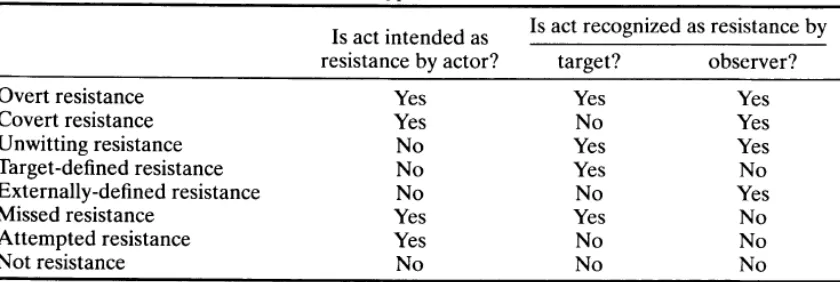
Chapter 5 centres the issue of resistance in relation or in tension with
the agency of the feminine subject. Here, I conceptualize the definition of
resistance, aided by Hollander and Einwohner‘s typology of resistance. In
order for resistance to manifest itself, there must be binary oppositions, and in
my research, the struggle between the capitalists (manager) and labour
(production operators) is not only a class issue but also has a gendered
dimension. I argue that the capitalism, is a ‗disciplinary practice‘ where
capitalists assert their repressive power in order to demand compliance from
the labouring subject (Sakolsky, 1992). In the factories, the disciplinary
practice is asserted via Taylorism, the scientific management of work, which
includes the adherence towards standard operating protocol as well as Key
Performance Indicators (KPIs) to monitor productivity. These are employed in
order to obtain the maximum surplus-value from the employment of labour. As
production operators are paid only the minimum wage of 1,080,000rp
(US$106.40). Further, when the work order increases, the factory increases
its output by imposing compulsory overtime hours on its staff, since their
production operators are single women who do not have a family to return to
and hence usually available to perform overtime. Therefore, subjected the
capitalist discipline, dissatisfaction amongst the female factory workers arise.
From my interviews with the factory managers and factory workers,
they highlight that there are four different forms of female labour resistance
that may be enacted in succession: (1) production slowdown, (2) refusal to
perform overtime hours, (3) mass absenteeism and lastly (4) labour strike.
This chapter illustrates how resistance is translated into practice which argues
for the significant agency of the female factory worker by highlighting the
inherent contradiction in the logic of the resistance posed by these women. I
shall show with evidence from other researchers as well as my own findings
from my research site that employers are keen to employ women as
production operators because they are believed to be the ideal workforce;
docile and disciplined. How then do factory managers account for these
displays of overt resistance by the women? What is not discussed in this
section is how the workers themselves conceptualise their acts of resistance,
since firstly, interviews with the managers were intended to uncover the role
of managerial practice in the construction of a gendered workplace, and
secondly, I did not have access to informants who were involved in the sites of
Chapter 6 concludes the thesis and ponders on the future directions of
research with regard to issues concerning female factory workers in Batam.
One of the interesting issues is the rise of labour organizations such as the
FSPMI (Indonesian Metal Workers‘ Union) and Lomenik SPSI (Federation of
Metal, Machine and Electronics) in representing the rights of the workers.
Directions for future research may involve to noting the development of labour
movements in Batam in their campaign against precarious work. What seems
to be happening on the ground as a concomitant effect of the feminization of
the workforce is the feminization of unions. Questions include, what does the
Chapter 2: Industrialization in Indonesia
Framing the Global Factory: Indonesia‘s trajectory towards industrialization
and the feminization of labour
Women‘s labour force participation has increased dramatically in developing
countries like Indonesia over the past several decades. While the proportion
of employed women is still lower than in more developed countries, recent
estimates indicated that labour force participation rates among women ages
20 to 54 exceed 60 percent in developing countries as a whole. According to
information from the International Labour Organization (ILO), women‘s
employment has increased faster than men‘s employment since 1980 in most
regions of the world (Appleyard, 1999). Villareal and Yu (2007) argue that
factors such as women‘s higher educational attainment and lower fertility rate,
as well as changing attitudes toward women working outside the home, raise
female employment rates by increasing the demand for female workers in the
manufacturing sector.
This increase is female labour force participation is especially
pronounced in developing countries which embrace export oriented
industrialization with a focus on the manufacturing industry, such as the four
Asian tigers, Singapore, Hong Kong, Taiwan and South Korea and other
(2004) attributes the shift of manufacturing labour-intensive consumer goods
from the developed to the developing countries to a global restructuring for
manufacturing. Increased global competition resulted in the industry in the
United States, Europe and Japan ‗reassembling‘ itself to reduce costs while
remaining competitive.1
Therefore, in order to understand globalization and women‘s
employment in developing countries like Indonesia, it is important to attune
ourselves to the historical emergence of the export oriented industrialization
strategy and how this has affected labour patterns. The political context of its
emergence is also important as this elucidates the relationship between the
state, labour and civil society.
Becoming an exporter of manufactures: the case of Indonesia
Indonesia was described in the 1960s as being one of the least industrialized
countries in the world for its size (Hill, 1990) and the manufacturing sector
only totalled an estimate of 840,000 workers in 1971. During the 1980s,
however, due to trade liberalization and deregulation policies, Indonesia
moved from being a negligible exporter of manufactures to a significant
supplier. Statistics show that in 1980, manufactures generated less than 3
percent of total exports; however by 1992 they were nearly 50 percent (Hill,
1996:810). This expansion was facilitated by a series of trade reforms as
Indonesia – a major oil exporter – coped with the collapse of the price of oil.
This present section highlights Indonesia‘s rise as an export manufacturer and
the concomitant effects on the changes in labour structure i.e. – the
feminization of labour and its resultant effects, such as the patterns of
migration and concerns on exploitative nature of female factory work.
The 1980s trade reforms have already been very well documented by
other writers but it is imperative that a brief introduction is given to provide a
background understanding, highlighting industrial change in Indonesia.
Successful economic policy in Indonesia is always traced back to the
years of 1966 to 1997/8. During New Order rule, under the presidency of
Suharto, the Indonesian economy experienced rapid and sustained growth,
which enabled Indonesia to rise up the ranks from one of the poorest
countries in the mid-1960s to one of the eight high-performing Asian
economies in the early 1990s, along with Japan and the four Asian Tigers--
Singapore, Hong Kong, Taiwan, South Korea - as well as Indonesia‘s
neighbours Malaysia and Thailand.
The rapid economic growth during the period 1965 to 1997 was driven
mostly by the expansion of three main sectors of the economy—agriculture,
manufacturing and services. However, it was the manufacturing sector
throughout this period which was growing at double digits, much faster than
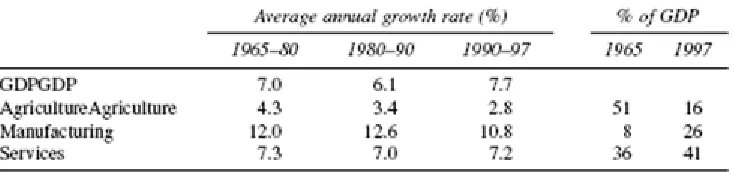
rate during this period, as highlighted in table 2.1 below averaged at about 7.0
percent.
Table 2.1: Economic Growth and Transformation in Indonesia, 1965-97
Source: Thee, 2006:343
In the late 1960s and the early 1970s, Indonesia‘s rapid industrial
growth was fuelled by the liberalization of economic policies which also
marked its return to normal economic conditions after the political turmoil and
economic chaos of the early 1960s, a remnant of the Sukarno years.
Up to the late 1970s, the growth of the Indonesian economy was based
primarily on its exports of crude oil. It was during this oil boom period that the
Indonesian economy was able to sustain protectionist import-substituting
policies. The de facto Indonesian Minister of Industry, B. J. Habibie, rejected
free market solutions and opted for industrialization via import substitution
(ISI). ISI is based on production for the local market and involves high levels
of protection for domestic producers. As was the case with other South-East
that Southeast Asian countries did not have sufficiently large domestic
markets to sustain the industries (Kaur, 2004). This raised a concern amongst
many Indonesian and foreign economic analysts about this costly and
inefficient pattern of import substituting industrialization. Indonesia‘s strategy
of import substitution industrialization (ISI) in the years from 1968 to the 1980s
yielded dismal numbers with regard to employment, with the number of
workers increasing by only 130,000 between 1971 and 1980 (Caraway,
2007), but the large boom from the oil revenues enabled the Indonesian
government to ignore its critics. However, the decline in crude oil prices in the
early 1980s, which signalled the end of the oil boom, prompted the
government to diversify its exports by promoting manufactured exports via
introducing a series of deregulation measures to boost foreign direct
investment (FDI). The result of this is shown in table 2.2, from which it can be
seen that between 1983 and 1991, both the agricultural and mining sectors
declined in importance, while the share of manufacturing in GDP grew, from
12.8 percent to 20.2 percent in 1991. Indonesia‘s shift from the agricultural
sector to the manufacturing sector is evident in the figures for 1991. A
precedent was set when manufacturing‘s contribution to GDP exceeded the
Table 2.2: The Indonesian Economy (%GDP)
shows the composition of Indonesia‘s manufactured exports in 1991.
Table 2.3: Indonesia‘s Manufactured Exports, 1991
Since 1987, the manufacturing sector generated a surge in manufactured
exports, particularly low skill labour-intensive exports, where Indonesia clearly
had a comparative advantage. Indonesia‘s manufacturing sector thrived
The policy measures adopted in 1986, especially the devaluation and
the trade liberalization measures, put Indonesia on the path to rapid
export-oriented, labour-intensive growth on a similar trajectory to that which its
neighbours like Singapore had adopted earlier. This pattern of growth,
characterized as the "East Asian model", had been adopted at least two
decades earlier by the newly industrializing economies (NIEs) like Argentina,
Brazil, Hong Kong, Taiwan, and at least a decade earlier by Indonesia's
ASEAN neighbours, such as Singapore and Malaysia.
In order to leverage on its comparative advantage in export
manufacturing, as part of its strategy to attract an inflow of large foreign direct
investment (FDI), Indonesia established export processing zones (also called
‗bonded zones‘ by commentators on the Indonesian economy). Export
processing zones (EPZs) became an important feature of the industrial
landscape of several Asian and Latin American countries. These zones
consist of limited areas of land lying in a sense outside the normal customs
jurisdictions. Imported goods may be brought into the zones duty-free for
processing provided that all output is sold abroad. In practice, not all EPZs
conform exactly to this definition, but the emphasis on exporting distinguishes
the zones from other types of industrial estates (Grundy-Warr, 1983:28).
The investing firms view the zones as a means of reducing costs by
transferring the labour intensive parts of their production processes to low
the EPZ strategy as a means of generating employment opportunities, foreign
exchange earnings and technology transfer. Substantial incentives have been
offered to attract foreign firms into the zones. In various countries these have
included different combinations of duty-free import of manufactured
intermediate goods and raw materials, company tax holidays, subsidized
provision of factory space and/or utilities, streamlined bureaucratic and
administrative procedures to avoid costly red tape, exemptions from industrial
regulations applying outside the zones, guarantees on the absence of strikes
and guaranteed repatriation of profits (Thee, 2006).
In 1973, an export processing zone was established in Jakarta under
the control of a state company P.T. (Persero) – Bonded Warehouses
Indonesia (BWI). Warr emphasized that during the time of his writing, in 1983;
it was the only EPZ existing in Indonesia and was established as a pilot
project under the Ministry of Trade with a view to assessing whether similar
zones should be established elsewhere in Indonesia.
Peripheral Hub of Indonesian Capitalism: The Batam Development Program
(1970-present)
In the early 1970s, Batam was still a largely uninhabited island of fishing
communities with an estimated population of 6000, located in the Riau
archipelago (Kelly, 2003). With an intention to developing the island of Batam
partnership with Pertamina, the state oil company, along with NisshoIwai Co.
Ltd of Japan and Pacific Bechtel of U.S.A (BIDA, 1980). Pertamina was
initially interested to develop Batam as an oil and gas exploration base with
downstream processing activities on the island. Following a draft of Batam‘s
Master Plan, industrial areas were designated in Batam in 1973 and in the
following year a customs-free bonded zone was officially created on the island
along with the establishment of the Batam Industrial Development Authority
(BIDA) in order to encourage export-oriented industries.
The creation of the bonded zone2 was intended to stimulate the
development of export-oriented industries and facilitate the importation of
materials required by the manufacturing industries located on the island. One
of the most important of the concessions granted was the duty-free import of
all raw materials and component inputs on the condition that all of it is to be
used or processed within the island or is destined for re-export (KPMG,
1993:12-13). The Indonesian government aimed to make the development of
Batam a link between the Indonesian domestic economy and the world
economy. Currently, Batam‘s main industries are electronics, manufacturing
and ship-building.
2 Bonded zones are also referred to as Export Processing Zones (EPZs) by commentators.
Grundy-Warr‘s (1989) article on ‗Export Processing Zones: The Economics of Enclave
Manufacturing‘ succintly describes the nature of EPZs and their characteristics, such as the
In order to boost foreign direct investment into Batam, a number of
attractive incentives and guarantees were put in place to attract investors.
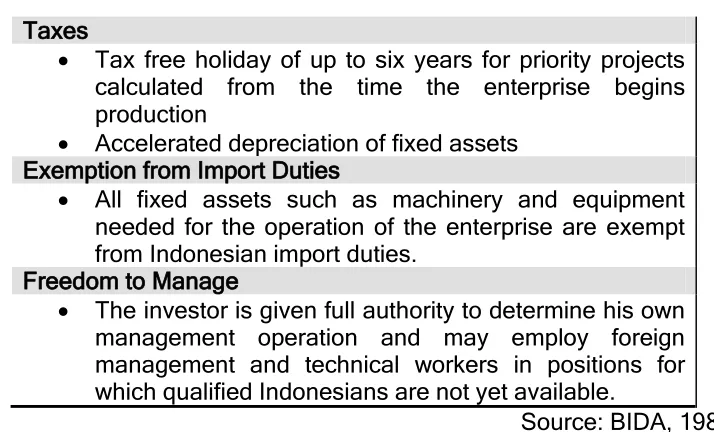
These main incentives as a bonded zone are highlighted in figure 2.1:
Figure 2.1: Main incentives for Batam‘s Bonded Zone
The investor is given full authority to determine his own management operation and may employ foreign management and technical workers in positions for which qualified Indonesians are not yet available.
Source: BIDA, 1980
As highlighted in the previous section, Indonesia‘s deregulation and
trade liberalization policy during the post-oil crisis of the 1980s led to the focus
towards a new industrialization strategy which was to manufacture for export—
export oriented industrialization (EOI). This strategy was first adopted by
Singapore in the mid-1960s during a time when Singapore was separated
from the Malaysian Federation, which therefore meant that adopting the ISI
strategy was a less feasible option as their internal market was significantly
reduced. EOI proved to be a successful strategy3 and helped Singapore gain
its status in the 1970s as a first tier newly industrialized country (NIC).
Singapore‘s successful early adoption of export oriented industrialization
(EOI) served as a model for other countries like Indonesia, similarly seeking to
grow and industrialize (Kaur, 2004). This prompted Indonesia to begin talks
on cooperation with its neighbour Singapore from the early 1980s; however
such talks only bore fruit in the late 1980s when Indonesia was willing to grant
regulatory concessions to Singapore which relaxed restrictions with respect to
foreign investment and ownership.
This cooperation could not have come at a more fortuitous time for
Singapore as the state‘s rapid growth in the manufacturing sector raised
alarm for Singapore‘s economic planners, given that it faced severe limits in
its labour and land resources. There was a fear that Singapore‘s inability to
provide for foreign investors in these respects would cause a ‗hollowing out‘ of
the economy as industry moved to other parts of Asia. During that period of
time, Singapore was faced with the problem of the rising cost of labour and
the subsequent movement of multi-national companies moving out of the
country into more cost-efficient manufacturing sites in other parts of Asia
(Ford & Lyons, 2007:242). A ‗regionalisation strategy‘ due to its proximity to
the Riau islands would be beneficial to Singapore, combining Singapore‘s port
and service industries with Batam‘s ready pool of cheap labour. Singapore
linked Batam, Indonesia and Johor, Malaysia in a growth triangle project to
assuage any concerns from Malaysia over Singapore‘s assistance to a new
competitor location for foreign investment. The SIJORI
Deputy Prime Minister Goh Chok Tong. As more states from Malaysia and
Indonesia joined the grouping, SIJORI was renamed
Indonesia-Malaysia-Singapore Growth Triangle (IMS-GT). A 1994 Memorandum of Understanding
(MOU) formalized the tripartite IMS framework. It also became apparent that
the Indonesia-Singapore link was without doubt the most active (Royle, 1997;
Grundy-Warr et al, 1999; Mack, 2004).
The participation that resulted has turned around Batam‘s investment
prospects, especially following the development of Batam Industrial Park with
the promise of attracting Singapore-based TNCs to Batam. The largest of
these industrial estates is the Indonesia-Singapore joint venture between the
Salim Group of Indonesia and the government-linked Singapore Technologies
(now known as SembCorp) and Jurong Town Corporation. This industrial
estate, BatamIndo Industrial Park is located in the Muka Kuning area, in the
heart of the island, and is still the largest and most developed industrial estate
on the island. BatamIndo Industrial Park has significant investments from
countries such as the USA and those of Western Europe (for instance the
United Kingdom, France, Germany and the Netherlands), as well as Asian
countries like Japan, Malaysia and Singapore. Sumitomo was the first tenant,
established in 1990, and other tenants later included AT&T, Philips, Thomson,
Sony and Epson. The environment of the BatamIndo Industrial Park will be
further elaborated on and discussed in Chapter 4, since this study is
specifically focused on female factory workers working within the compounds
female labour as the majority of its workforce. In early 1997, out of a total
employment of around 55,000, 85% of its workers were females aged 18-22.
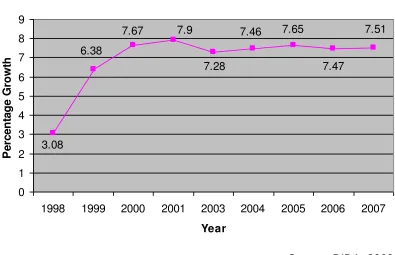
Figure 2.2: Batam‘s Economic Growth %
1998 1999 2000 2001 2003 2004 2005 2006 2007
Year
the Asian financial crisis, the economy seemed to recover (as indicated above
in figure 2.2). It grew from 3.08 per cent per year in 1998 to 6.38 per cent in
1999 and peaked in 2001 at 7.9 per cent growth. However, year on year
growth fell in 2003 at 7.28 per cent and has since levelled out between 7.46
per cent to 7.51 per cent from 2004 to 2007. However, it is said that the
manufacturing sector has not recovered to pre- 1997 levels and the growth
triangle is coming to be regarded on all sides as a failure (Sparke et al, 2004,
Ford & Lyons, 2007). Others such as Pereira (2004) provide a more balanced
successes and failures. The most positive aspect of the project via the
viewpoint of its investors was its effectiveness as a cheap and efficient
industrial production site. It also generated jobs for the Indonesian workforce,
as an estate, BatamIndo employs about 60,000 to 80,000 workers.
Human Migration to Batam
According to Ford & Lyons (2007), historically, early migration to Batam
began in 1945 when a number of young people moved there in order to
support the Indonesian army after the declaration of Independence, but the
population on the island remained small in the 1970s. Once development
began, as a consequence of attracting high levels of foreign investment,
Batam also began to attract large volumes of migrants within Indonesia
seeking work in its industrial parks and tourist resorts (Grundy-Warr et al,
1999; Ford & Lyons, 2007). Due to plans to develop the island industrially
under the Batam Master plan, by 1978, when Batam was designated as a
tax-free bonded zone for export industries, its population had increased to 31,800
(Ford & Lyons, 2007:241). Over the next ten years, domestic and foreign
investors were attracted to Batam and large numbers of construction workers
were also brought in to develop Batamindo Industrial Park and its associated
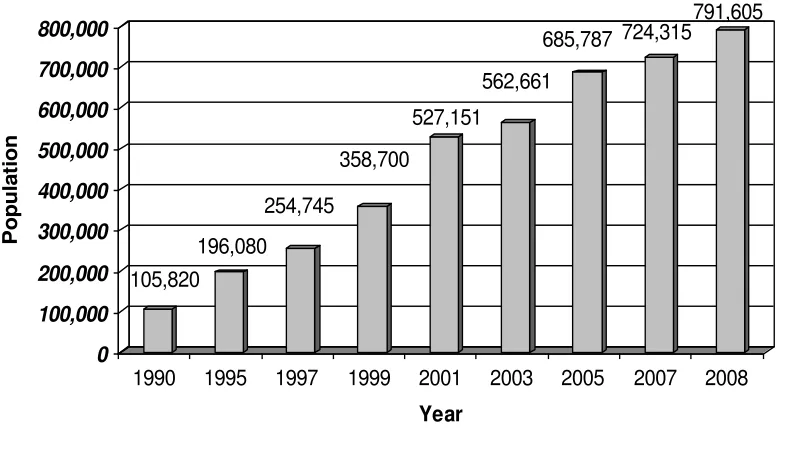
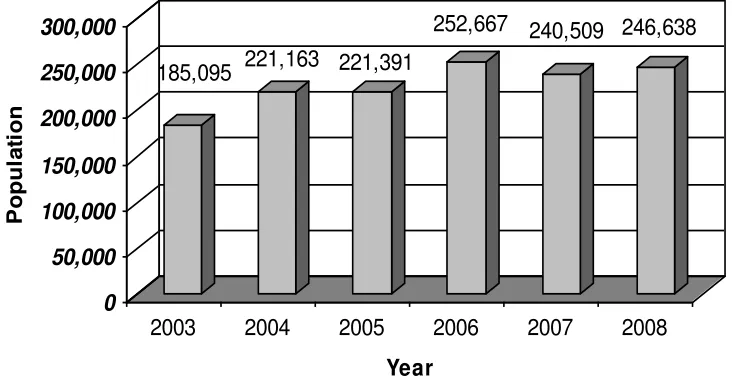
Figure 2.3: Total Population of Batam (1990-2007)
1990 1995 1997 1999 2001 2003 2005 2007 2008
Year
SOURCE: BIDA, 2009
Batam witnessed phenomenal changes in twenty years, between 1970
and 1990, partly due to the formation of the IMS-GT, with the official
population growing from 31,800 in 1978 to 105,820 by December 1990.
Batam‘s population growth continued to grow sharply in the boom years. In
1990, as shown in Fig 2.3 above, Batam registered a population of 105,820,
with almost a seven-fold increase by 2007, to 724,315. Kelly (2003) noted that
there is even reason to believe that the number is a gross underestimation,
considering the unrecorded numbers of migrants arriving daily on the island
from different parts of the Indonesian archipelago. Senior BIDA officials
estimate that figure to be in the range of 500,000 per year, with 1000-2000
Figure 2.4: Batam‘s Workforce Population
However, though Batam experienced high population growth, its
workforce only made up about 32 per cent of the total population, suggesting
that there is a high unemployment rate on the island. In 2007, the rising
unemployment rate in Batam and the Riau islands was reported in the Jakarta
Post, which cited the departure of several major foreign companies from the
area. According to data cited, unemployment on Batam in 2007 reached
180,000, a 20 per cent increase from the year before (Jakarta Post, October 6
2007). However, the high unemployment rate is not discouraging more
job-seekers, mainly new high-school graduates, who flock to the island for job
opportunities (Jakarta Post, July 1 2008). The government voiced fears that
the soaring unemployment rate could undermine security and public order, as
one million people at most. Its current population had already reached more
than 790,000 in 2008.
The workforce statistics also show that there is an imbalance towards
women, who represent 56% of the total workforce (Kelly, 2003). The greater
number of women provides some indication of the gendered division of labour
that exists in the industrial estates.
Clearly, given Batam‘s original low population, the workers were mostly
migrant workers from different parts of the Indonesian archipelago. This influx
is in line with the government‘s policy of curbing population growth and
encouraging population redistribution. Since they face massive
overpopulation in areas such as Java, they have for long encouraged
transmigration (BIDA, 1980). Most of the workforce is accounted for in
manufacturing (75 percent), construction (10 percent) and the leisure industry
(7 percent).
The IMS-GT cooperation was however marred by setbacks and was
especially affected by the economic and political uncertainty in the aftermath
of the Asian financial crisis (1997-98). Many multinational investors began
downsizing operations and investments in Batam, but Lyons and Ford point
out that the crisis had the opposite effect on internal migration. The island‘s
‗relative prosperity became a magnet for people in other parts of the
crisis (1998-2001), Batam‘s population grew by an incredible 79.5 per cent
and by the end of 2004, the population of Batam was 633,944 (Ford & Lyons,
2007:242). They argued that migrants from other parts of Indonesia were
attracted to the island by the ‗prospects of employment in an economy that
had been cushioned from the economic crisis of 1997-98, or because of their
relative calm during the violence that erupted across the archipelago from
1998‘ (Ford & Lyons, 2007: 242).
However, Batam suffered an economic slowdown especially between
the years 2000 - 2004 when non-oil exports declined by US$1.11 billion,
shrinking by 20 per cent. Foreign investment in 2005 also fell by 34 per cent
(The Straits Times, 15 September 2006).In recent years however, investor
confidence in Batam has further dwindled due to the lack of concessions and
Indonesia‘s eroding comparative advantage in labour costs over emerging
industrializing countries such as China and Vietnam. This is also further
exacerbated by the current economic recession. In order to regain investor
confidence, current President Yudhoyono launched the much delayed free
trade zone for Batam in 2009 (Jakarta Post, January 20 2009). The
government is hoping that with Batam‘s status as a free-trade zone and the
exemption of value-added tax (VAT), import duties and luxury tax, this will
spur more foreign businesses to invest on the island and tap its low
production costs. However, to date Batam has never really recovered from the
1997-98 financial crisis and this free-trade zone status may be a last ditch
economy as the global crisis hits hard on the local manufacturing industry in
Batam (Jakarta Post, 20 June 2009). The government however still remains
optimistic, citing that despite the economic crisis, new industries are still being
set up in the Riau islands and are in desperate need of 100,000 skilled
workers (The Jakarta Post, 2 July 2009). In the first four months of 2009, the
government announced that they have approved 29 foreign investment
projects worth US$23.2 million (Asia Pulse, 4 June 2009).
Effects of Industrialization: Batam as a transient migrant space
Kelly (2003) highlights Batam‘s unique administrative structure as a distinctive
characteristic about the island‘s industrialization process. Batam‘s
administrative structure has BIDA rather than the local municipal or provincial
governments in control of all developmental planning on the island. The
chairman of BIDA reports directly to the President and bypasses all levels of
intermediate authority. The resultant effect is the focus on economic
development on the island. The needs of investors are privileged, with social
concerns being accorded secondary importance. This is in order to promote
investor confidence by showing Indonesia‘s strong commitment towards the
development of Batam as an EOI.
Rapid development on Batam, under the administration of BIDA, has
changed its social and physical landscape drastically. Forests were razed to
industrial areas. While most migrants brought in on temporary contracts to
work in BatamIndo are offered accommodation in dormitories, many more live
in squatter settlements on land that has been cleared of forests but remain
undeveloped. Due to the transient nature of their work, most migrants see
themselves as sojourners with no sense of long-term commitment to the
place. Their intent would not usually extend to building a more liveable
physical and social environment which is in line with the government‘s
ambivalence towards improving the social space in Batam, especially in terms
of proper housing.
However, the administrative structure of Batam has recently changed
since the city of Batam has changed to a township status of a municipality
(Batam Center, 2009). Currently, Batam‘s Mayor is responsible for the civic
administration as well as social affairs, and works hand in hand with BIDA
whose responsibility is to promote economic development by managing the
land and infrastructure as well as stimulating investment in the Barelang
(Batam, Rempang, Galang) region. Even so, the government has reiterated
the view that Batam is just a transit city and that the high volume of
Indonesians who arrive in Batam are in transit to other countries such as
Malaysia and Singapore (Antara, 26 October 2007).
In fact, the government has no plans to accommodate the settling of
migrants in Batam as it seeks to control the city‘s burgeoning population
the next five years due to rapid migration from other provinces. The
government reiterated that Batam has very limited resources such as clean
water and land and could only accommodate up to one million people;
anything above that limit could spark social problems. Their response to
addressing the problem is to promote family planning programmes as well as
tightening the conditions for the issuance of identity cards in order to curb the
population growth.
Further evidence which suggests the government‘s ambivalence
towards social issues in Batam is shown in its slow reaction in tackling health
issues such as recognizing Batam‘s dengue troubles in 2009. 4 The
government‘s reluctance to declare an alert for the spread of the virus was
because ‗such announcements would have an impact on a number of sectors
including tourism and business‘, which again shows the privileged importance
of the economic activities on the island, over-riding the social concerns of the
resident population.5
Grundy-Warr et al. (1999) further point out that the uncontrolled inflow
of migrants from other parts of Indonesia poses an increasing threat to the
economy of Batam. Since there is little investment in low-income housing,
coupled with uncertain employment, squatter housing has proliferated. Illegal
4 During the first six months of 2009, nearly 800 people reportedly contracted dengue fever in
Batam, with 10 deaths. Population density as well as a lack of adequate sanitation and the presence of stagnant water in many areas has been blamed for the spread of dengue (Jakarta Post, 16 July 2009).
5
squatter housing colloquially known as ruli‘, short for rumah liar or ‗wild
housing‘ is scattered across the island. These squatter areas are seen as a
threat to Batam‘s investment attractiveness to multinational companies.
Concomitantly, Grundy-Warr et al. view the lack of sufficient housing
and employment for migrants as leading to other social problems such as
crime and prostitution. In fact, the sex industry has become a major activity in
Batam, with demand from visitors on short-stay trips, mostly from Singapore.
Due to this ‗Batam scene‘, HIV infections have also increased. Batam ranks
as a hot spot for infections, contributing to the fact that Riau shows one of the
highest provincial rates of HIV/AIDS infection spread through sexual contacts
(28 June 2008, Jakarta Post).
Though these issues are beyond the scope of this thesis, this account
sheds light on some of the effects of industrialization in Batam as a result of
focused development on the economy, coupled with the lack of social
development, i.e. provision of housing or proper heath policy for the migrant
community.
The Gendered Effects of Industrialization – Waves of Feminization in
Indonesia
One of the main issues that will be discussed in this thesis is the gendered
emergence of the feminization of labour in Indonesia and understand the
political and socio-economic climate of its emergence. As highlighted in the
earlier sections, in the 1980‘s Indonesia‘s economy experienced rapid change
as it strove to modernize its economy, moving away from its traditional role as
an agrarian society.
Ford & Lyons (2007) noted that the gender composition of Batam‘s
population has changed considerably after the formation of the IMS-GT. Since
the late 1990s when the factories and infrastructure were complete, large
numbers of female factory workers replaced the construction workers and
male factory workers. This was due to the stereotype that female factory
workers were best suited to work in the electronic industries, a contention that
will be discussed fully in Chapter 4. Since 1997 women have outnumbered
men on Batam, which reflects the increased pressure on women in other parts
of Indonesia to migrate for work as a result of the Asian financial crisis of
1997-98 (Ford & Lyons, 2007). Therefore, it could be argued that on Batam,
the feminization of labour began in the 1990s when investment in the
manufacturing sector began, since prior to Batam‘s development plans, the
area was largely uninhabited. However, before then, the cogs were already in
motion for the feminization of labour in other parts of Indonesia, such as in the
export processing zones in Jakarta (Grundy-Warr, 1983).
Caraway‘s (2007) review of the feminist literature on women‘s work in
feminization of labour to the strategy of manufacturing for export and labour
intensity. According to these authors (Elson & Pearson, 1981; Joekes, 1987;
Lim, 1983) ‗export and labour intensity compel factories to reduce labour
costs as much as possible in order to compete‘ (Caraway, 2007:16).
Therefore, it is their contention that the feminization of labour is facilitated by
the emergence of the EOI strategy. Caraway however refutes that statement
and argue that in Indonesia, the feminization of labour preceded years before
the EOI strategy was in place.
‗Feminization unfolded in a series of waves. Textiles, in particular spinning and weaving, pioneered the first wave of feminization during the ISI years. Plywood and garments led the second wave, which coincided with the transition phase of industrialization. Footwear and electronics, along with the sectors from the second wave, propelled the third wave. Foreign investment did not play a significant role in the first two waves of feminization—which is surprising, given the overwhelming emphasis on the role of multinational corporations in the feminization literature—but they were a key component of the third wave.‘
(Caraway, 2007: 87)
Therefore, Caraway argues that contrary to what previous authors have
written, the feminization of labour in Indonesia may not necessarily been
driven by the EOI strategy, but was facilitated initially by its ISI strategy. By
the 1980s, the facilitating pieces were all in place and all that was needed to
generate an impressive wave of feminization was a substantial increase in
demand for women workers. Expanding on the above, Caraway highlights
in tandem with its three stages of industrialization: the ISI period (1968-78),
the transition period (1979-86), and EOI (1987-1997).6
In the first wave under its ISI strategy, employers in garments and
textiles responded to the changes in women‘s fertility and education by
shifting selected jobs to women. However since employment in the labour
intensive sectors had not expanded significantly, the degree of this early
feminization was modest.
The second wave of feminization began in the transition years between
ISI and full-blown export promotion, in the years 1979 to 1986 before the
oil-crisis hit. This was facilitated by the demobilization of unions and political
parties as well as repression of labour by the New Order state. As Indonesia
was also moving away from agriculture, coupled with the economic crisis, this
created a larger pool of women workers available for mobilization into the
factories. The first major exporting industries during this period were mainly
concentrated on the processing of plywood and production of garments.
The third wave proved to be the most significant, driven by foreign
investors from East Asia who turned to South East Asian countries like
Indonesia due to rising production costs. This was mainly led by the
electronics and footwear sector, and there was significant interest in EPZs like
Batam which further increased the demand for female labour. Both at home
6 A detailed discussion of the three waves of feminization can be found in Caraway’s (2007) book,
and abroad, Asian investors preferred to hire women in electronics, especially
in their overseas operations.
Conclusion
This chapter illustrates Indonesia‘s trajectory towards industrialization via
trade reforms in the 1960s and especially with trade liberalization policies in
the 1980s when the government moved away from their import substitution
policies in support of a more export oriented industry in the post-oil crisis of
the 1980s, taking cue from the success of newly industrializing countries
(NICs) such as Hong Kong, Taiwan, Singapore and Malaysia. Bonded zones
or Export Processing Zones (EPZs) were created in Indonesia. This highlights
the creation of an EPZ in Batam as the government aimed to develop the
island as a link between the Indonesian domestic economy and the world
economy by stimulating the development of export-oriented industries.
Economic cooperation between Indonesia, Malaysia and Singapore created
the formation of industrial parks in Batam, with the most significant project
being BatamIndo Industrial Park, co-owned by Singapore and Indonesia,
whose factories largely specialize in assembly operations, which mostly
required and hired female labour. Since Batam was still a largely uninhabited
island of 6000 people, most of the workforce is made up of migrant workers
from different parts of the Indonesian archipelago. However, in recent years,
with foreign investors downscaling or closing their operations in Batam due to
Therefore, as a borderland region, Batam has experienced rapid social
and economic transformation by virtue of its proximity to wealthier economies
such as Singapore. The growth of manufacturing industries in Batam has
created a demand for labour and improved infrastructure which facilitated the
movement of people into the islands. However, recently fraught by several
economic crises, the island is experiencing a hollowing out of the economy
with companies downsizing or moving out, cutting down the number of jobs
available in Batam. To further exacerbate the situation, more internal migrants
are still flocking to Batam with the prospect of finding employment, leading to
the high unemployment rate of 180,000 in 2007.
One of the concomitant effects of Batam‘s industrialization is the feminization
of its workforce. A profile of female factory workers in Batam and the
environment and social landscape of Batamindo Industrial Park in Batam is
further discussed in Chapter 3.
Chapter 3: Female Factory Workers in Batam
Introduction
One of the most effects of industrialization, as a result of export oriented
industrialization in Indonesia is the rise of a new class of women workers.
Improved education levels has resulted in the emergence of women workers
who are economically independent and active within the workforce. Statistics
from 2007 show that 68 per cent of females are in secondary school and 17
per cent of those at tertiary age are receiving tertiary education (Unesco,
2007). Education has equipped women with the skills and knowledge to
remain economically viable as Indonesia experienced a shift from an agrarian
mode of production to industrialization, though this means for many, migrating
from their villages to industrial cities such as Jakarta and Batam. In this
chapter, I explore the lives of the female factory workers in Batam as they
relate to me their experience of working and living in Batam as well as the
relationships that they form during their sojourn on the island.
Ford & Lyons (2007) point out that the gender composition of Batam‘s
population changed considerably after the formation of the IMS-GT. Since the
late 1990s when the factories and infrastructure were complete, large
numbers of female factory workers replaced the construction workers and
male factory workers. This was due to the stereotype that female factory
workers were best suited to work in the electronic industries, a contention that
work and the discursive formation of gender and labour. Ford & Lyons
highlight that since 1997, women workers have outnumbered men on Batam
which could reflect the increased pressure on women in other parts of
Indonesia to migrate for work as a result of the Asian financial crisis of
1997-98.
According to BIDA, there are a total of 26 industrial estates which are
situated in Batam, in which most of the female workers are employed in as
production operators in the manufacturing industry. These industrial estates
are located mostly in areas such as Batu Ampar, Muka Kuning, Batam
Figure 3.1: Location of BatamIndo Industrial Estate
Source: Adapted from Royle, 1997:92.
BatamIndo Industrial Complex
BatamIndo Industrial Park, currently owned by SembCorp Singapore, was
established in 1991 and is the largest industrial estate in Batam, occupying a
sprawling 320 hectares across Muka Kuning district. It is a self-sustainable
complex which boasts dormitories for workers, food centres, wet markets,
shopping malls, recreational sports centre, clinic and places of worships that
include two mosques and a church. A short distance away, in order to
accommodate the professionals located in BatamIndo, the BatamIndo
golf course, driving range, tennis courts and swimming pool. The complex
even has its own dedicated water treatment plant and power station. In fact,
the complex is so self-sustainable that its residents would never have to leave
the industrial park.
BatamIndo hosts about 80 companies involved in several light
industries relating to the production of electronic components and computer
industries. These include manufacturers of printed circuit boards (PCBs),
computer components and parts, audio and video equipment, and car
automotive parts. Some of the internationally recognized electronic
companies present are Epson, Ciba, Sanyo, Hyundai, Matsushita, Phillips,
Siemens, Sony and McDermott, which represent a lot of foreign investment
from countries such as the US, South Korea and Japan. As a whole, the
estate employs 60,000 to 80,000 workers. BatamIndo has been very well
described by scholars like Mack (2004) and Peter (2008).
‗Behind the storefronts narrow foot paths lead to tin and wooden shanties which house the poorest workers. The massive industrial complex is protected by heavy iron bars with razor wire running along the top. To enter and leave you must pass a guarded security check point and provide identification. Inside the billion dollar complex, corporate buildings of the world‘s biggest brand names, complete with polished chrome lettering and tinted glass, loom large amidst the well-paved streets and manicured lawns. Many workers never leave the industrial park. They live in company housing, go to the company shops, visit the company clinic and pray at the company mosque. It is a caged existence.‘
Indeed BatamIndo industrial park is situated far from neighbouring cities.
Once past the security, rows and rows of industrial buildings line up along the
roads which intersect at 90 degrees, which goes to show the amount of
planning which went into the development of the estate. Most of the buildings
look similar, distinguished only by their chrome lettering, which distinctly mark
the company‘s name and logo. In fact, it was built on plans which mirror
Jurong industrial estate in Singapore where pre-built factory units of various
sizes were built, ready to be leased to investors. Driving around the complex,
it had a very strong American and Japanese presence with companies like
Philips, NuTune, and PerkinElmer, as well as Shikoku Electronics, FujiTec,
Sumitomo, Casio and Minamoto. I initially was fooled by the laid-back
atmosphere, with only a few people milling about around the compounds, but
when it came to shift change in the mornings and evenings, the area is a hive
of activity with masses of workers leaving and entering the buildings, and the
roads ruled by green TransKIB (Kompleks Industri BatamIndo) vans and ojeks
(motorcycle taxis).
Most of the workers are housed in dormitories (asrama) located at the
back of the compound.
are encouraged to leave it at all. The estate is sited so far from the other cities in Batam that it exists as a kind of fortress with gated entrances.‖
(Mack, 2004: 171)
Evidently, in my various interviews with the workers, most of the production
operators prefer not to leave the compound as most of what they need can be
obtained within the complex. Food centres are located around the estate as
well as within their dormitory, but most of the workers would prefer to visit the
wet markets to purchase their own food, and cook communally in their shared
dormitory kitchen. Daily necessities can also be bought at small stalls located
within their dormitory, or they can visit Plaza Batamindo which houses several
cafes, a food court, a supermarket and also shops for gifts, clothing, books
and such. Though it does seem to be a ‗caged existence‘ or a ‗fortress‘, the
women I interviewed do leave the complex during their free time to places like
Panbil Mall which is frequented by many factory workers, or Nagoya town, or
they visit Barelang bridge or the beach for leisure.
The factory managers, whom I interviewed, however, do not live on
site, but in housing complexes such as Duta Mas, located about a ten-minute
drive away in Batam Centre. They seldom hang around within the complex
other than going to work or visiting the mosque to perform their prayers.
Belonging to the middle-class, they prefer to visit malls such as Batam City
Square (BCS) mall or Batam Centre or Vista Hill to admire the view, where